

How to Expand the Pie in Negotiation: A Tactical Playbook
You're three rounds into a vendor contract renewal. Both sides are grinding over a 4% price increase. Nobody's budging. The deal stalls - not because the terms are impossible, but because everyone's fighting over the same single number.
You're arguing over the wrong thing.
This is the fixed-pie trap, and it's the most common error in negotiation. Bazerman's research in HBR shows that negotiators still assume the pie is fixed and miss opportunities to create value, even when they know better intellectually. The expand the pie negotiation approach isn't about making the same pie bigger - it's about building a new deal from more ingredients.
What "Expanding the Pie" Actually Means
Two fundamentally different approaches exist in negotiation. Distributive bargaining treats the deal as zero-sum: every dollar I gain, you lose. Integrative bargaining flips this by uncovering each side's actual interests and making creative tradeoffs across multiple issues.
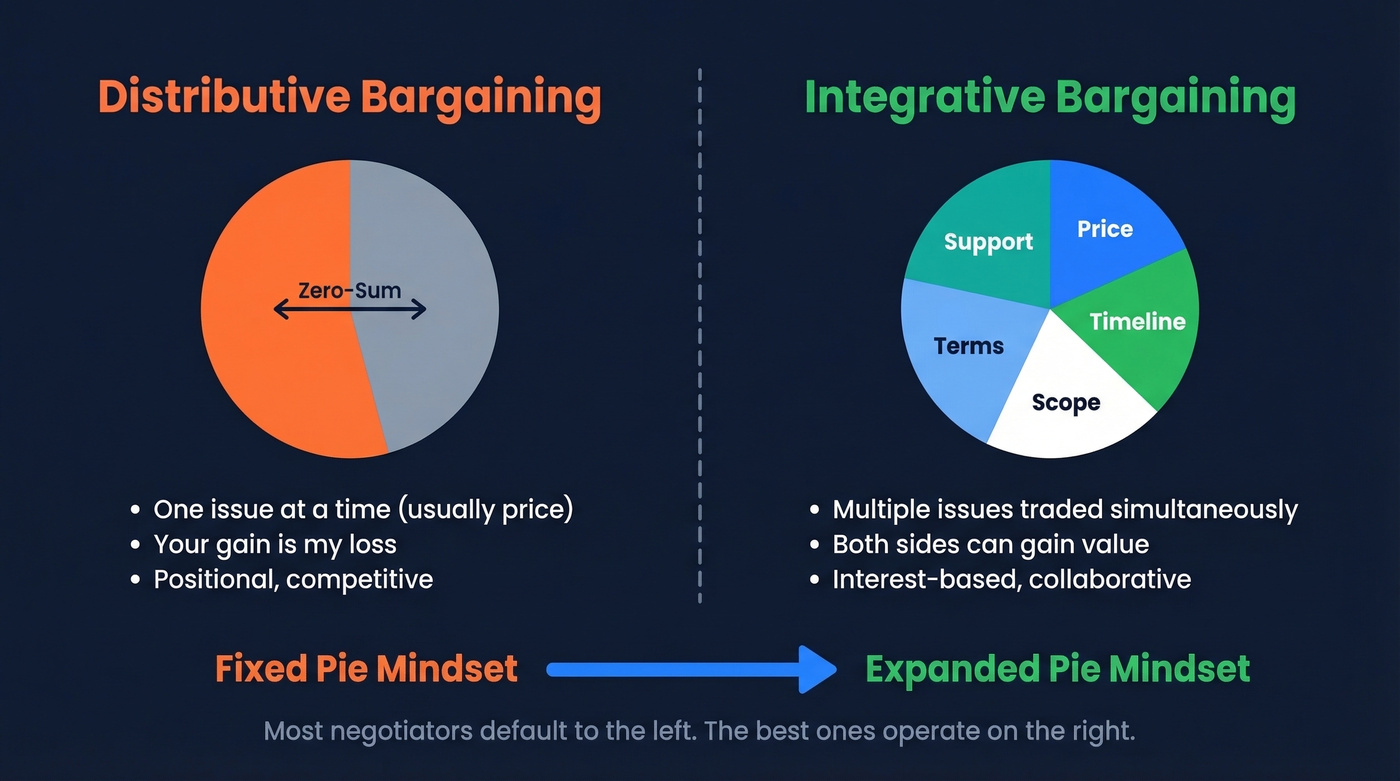
The "fixed-pie bias" is the assumption that your counterpart's interests are directly opposed to yours on every dimension. It's almost never true. Once you break that assumption, you learn what the other side actually cares about and start finding trades that cost you little but mean a lot to them.
Two foundational concepts underpin everything here. Your BATNA (best alternative to a negotiated agreement) is what you'll do if the deal falls apart. The ZOPA (zone of possible agreement) is the range where both sides can say yes. Know both before you walk in, because expanding the pie doesn't mean accepting a bad deal - it means finding a better one.
Why Most Attempts to Create Value Fail
Even people who understand the concept intellectually default to fixed-pie behavior under pressure. And in negotiation training settings, the same thing shows up: when time pressure and uncertainty hit, people revert to positional bargaining and stop looking for trades. Let's be honest - knowing the theory and executing it are wildly different things.
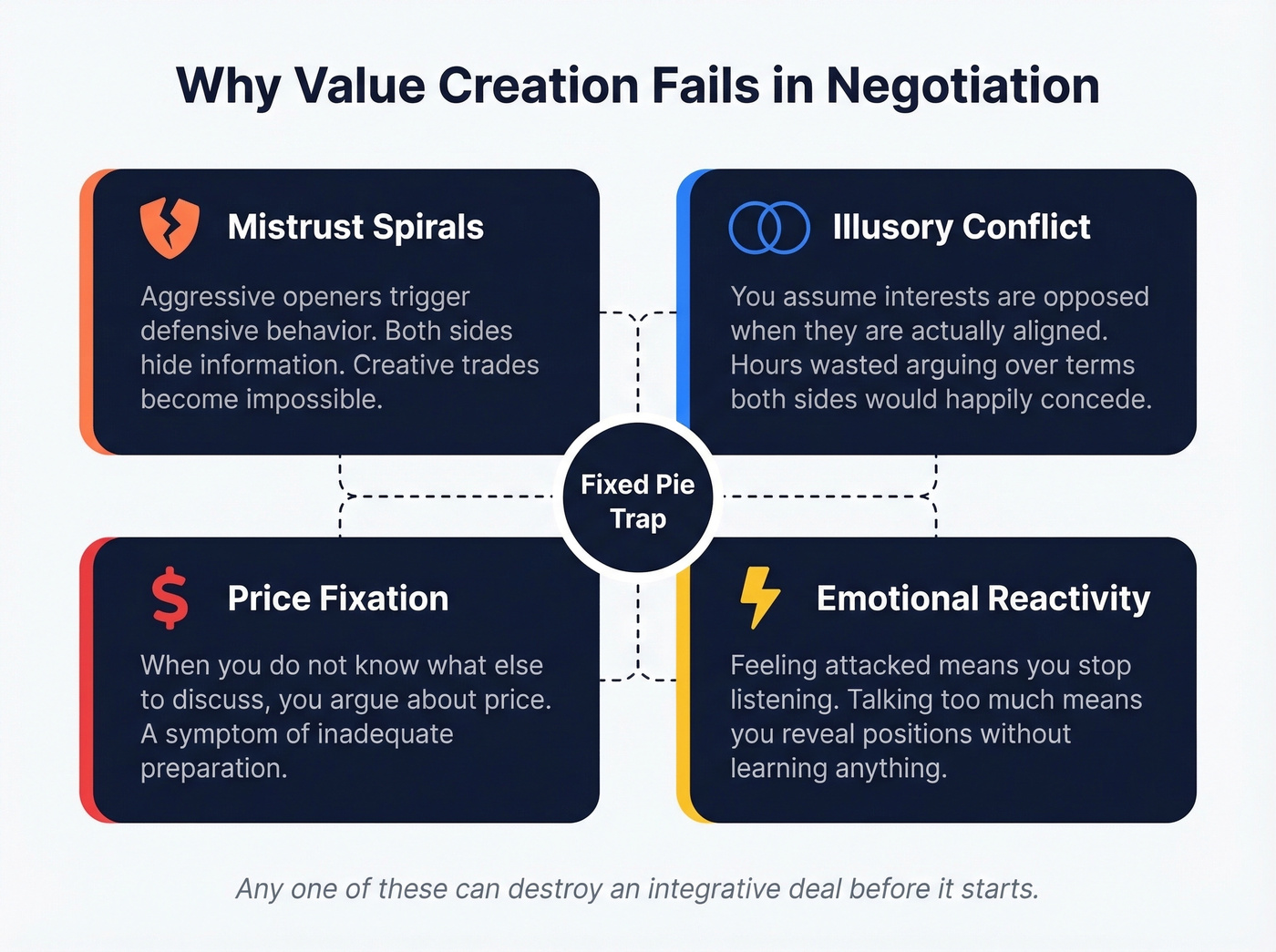
Mistrust spirals. A hostile opening move - an aggressive anchor, a take-it-or-leave-it demand - triggers defensive behavior. Both sides start withholding information, which makes creative trades impossible. Competitive expectations lead to information opacity and outright deception, killing integrative deals before they start.
Illusory conflict. Parties assume their interests are incompatible when they're actually aligned. We've watched two sides spend hours arguing over a term they'd both happily concede if they understood what the other actually wanted.
Price fixation. This is the laziest default in negotiation. When you don't know what else to discuss, you argue about price. But payment terms, volume, timeline, scope, exclusivity, and support levels can all be traded. Focusing exclusively on price is a symptom of inadequate preparation, full stop.
Emotional reactivity. Negotiators who feel attacked stop listening. Negotiators who talk too much reveal positions without learning anything in return. Both behaviors destroy integrative potential.
6 Proven Tactics for Integrative Deals
1. Logrolling (Trade What You Don't Value)
If you learn one technique from this article, make it this one.
Logrolling means trading concessions across issues based on different priorities - you give on something that matters little to you but a lot to them, and vice versa. An SHRM survey found that 80% of recruiters are willing to negotiate salary and benefits, but only 33% of applicants are comfortable doing it.
The ones who negotiate effectively don't just push for a higher number. They use if/then trades: "I'll accept the current salary offer if we can add a performance bonus and move my first review from 12 months to 6." That's logrolling. You've given the employer budget certainty now in exchange for upside and a faster path to a raise. The key is knowing which issues matter most to you and which are expendable - then figuring out the same for the other side through questions, not assumptions.
2. MESOs (Multiple Equivalent Simultaneous Offers)
The most underused tactic in negotiation. A MESOs (Multiple Equivalent Simultaneous Offers) means presenting two or three proposals simultaneously, each of equal value to you but structured differently. Your counterpart's reaction tells you what they actually care about - without you having to ask directly.
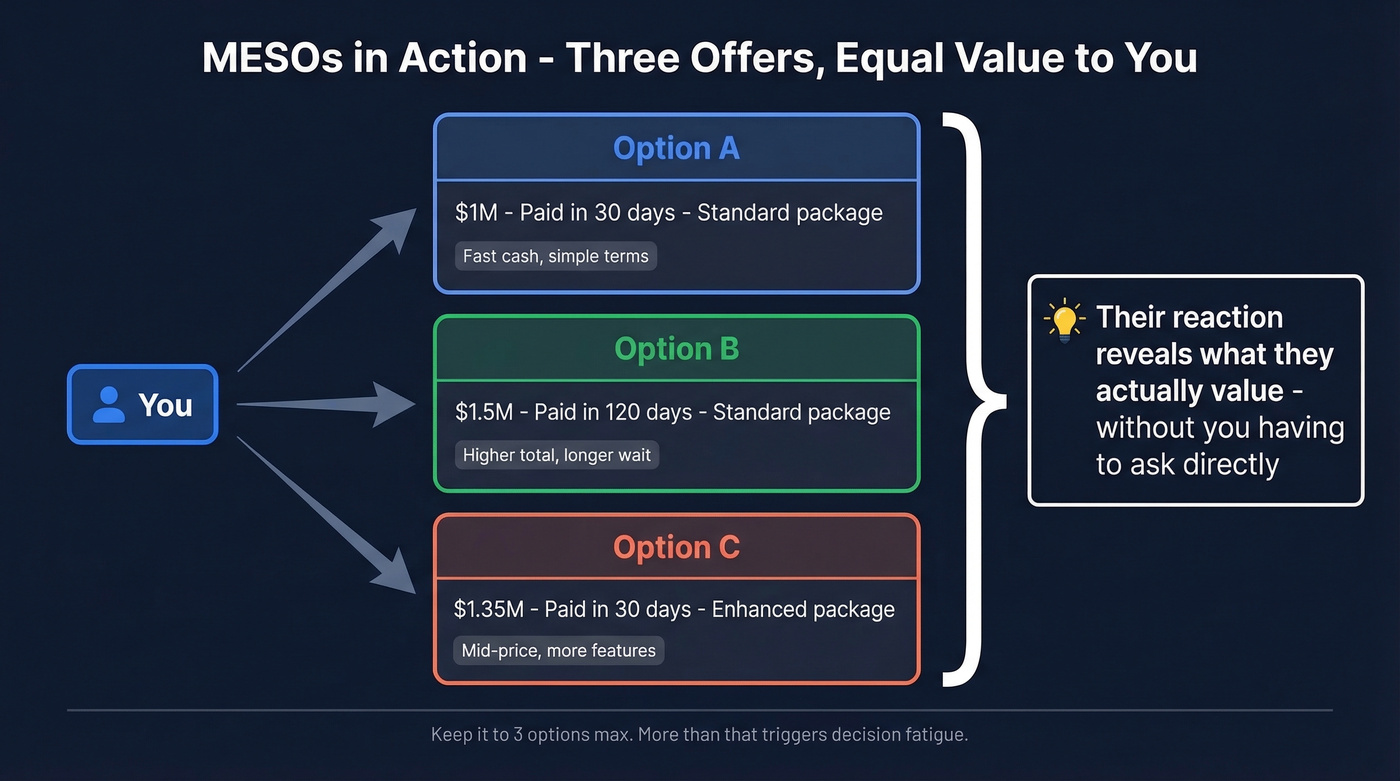
A software company tested this by offering three equivalent packages: $1M paid in 30 days, $1.5M paid in 120 days, or $1.35M for an enhanced package paid in 30 days. Profits rose. In our experience, three options is the ceiling before decision fatigue kicks in. The Iyengar & Lepper jam study.pdf) backs up the broader choice-overload effect: shoppers shown 6 jam varieties bought at a 30% rate versus just 3% when shown 24. Keep your MESOs tight.
3. Contingent Agreements
When you can't agree on what will happen, agree on what to do if it happens. Contingent agreements tie terms to measurable outcomes - performance-based pricing, milestone-based scope, review clauses triggered by specific metrics.
This works especially well when both sides have different forecasts. A vendor confident in their product's ROI should welcome performance-based pricing. A buyer uncertain about adoption should welcome milestone-based payments. The disagreement itself becomes the raw material for a deal both sides accept.
4. Post-Settlement Settlement
After you've reached a deal, do a second pass. With the pressure off and a signed agreement as your safety net, both parties explore whether a better configuration exists that improves outcomes for one or both sides. The original deal remains the fallback - it's low-risk by design.
Most negotiators skip this step entirely, leaving value on the table out of sheer relief that the deal got done.
5. Bracketing
Instead of making a single offer, propose a range. Rather than offering $500K, propose a $450K-$550K range and ask which end works better for their budget. Bracketing narrows the gap between positions and signals flexibility without immediately locking you into one number.
6. Adding Parties
When bilateral trades have stalled, bringing in a third party can unlock new value. A supplier and buyer stuck on price find that adding a logistics partner creates savings neither could achieve alone. The tradeoff is real though: more parties means more coordination costs and slower decisions. Use this when the two-party deal has genuinely hit a wall, not as a first move.

The best negotiators don't just expand the pie - they make sure they're sitting across from the right person first. Prospeo's 300M+ verified profiles with 30+ filters like buyer intent and job changes help you skip gatekeepers and reach decision-makers who can actually say yes to creative deals.
Stop negotiating with people who can't expand anything. Find the real buyers.
Worked Example: B2B Vendor Renewal
A manufacturer is renegotiating with their logistics supplier. The supplier wants a 7% rate increase. The manufacturer's budget allows 3%. On price alone, this deal is stuck.
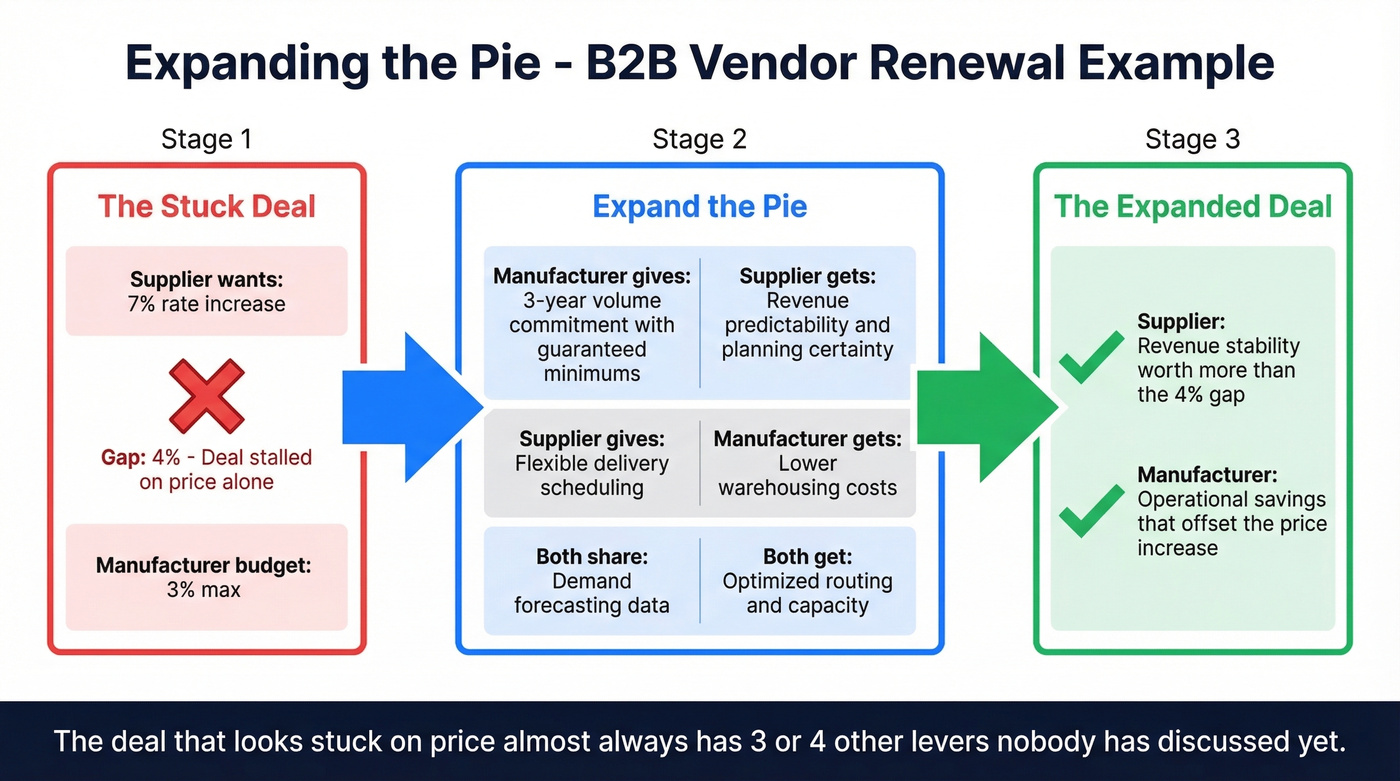
But price isn't the only issue. The manufacturer offers a three-year volume commitment - guaranteed minimums that give the supplier revenue predictability. In exchange, the supplier agrees to flexible delivery scheduling that reduces the manufacturer's warehousing costs. They also agree to share demand forecasting data, which helps the supplier optimize routing and capacity planning.
The supplier gets revenue stability worth more than the 4% gap. The manufacturer gets operational savings that offset the price increase. We've seen this exact pattern in B2B renewals - the deal that looks stuck on price almost always has three or four other levers nobody's discussed yet. That's logrolling and contingent agreements working together.
Here's the thing that doesn't get discussed enough: none of this works if you're negotiating with the wrong person. In B2B deals, preparation starts with reaching the decision-maker who has actual authority over the terms. Prospeo gives you verified emails and direct dials so you're not wasting leverage on gatekeepers who can't sign off anyway.
The Negotiator's Dilemma
The biggest lie in negotiation training is that every deal can be win-win. If you're selling a $5K tool and dealing with a procurement team that runs 50 vendor reviews a quarter, they don't care about your creative tradeoffs. They want the lowest number.
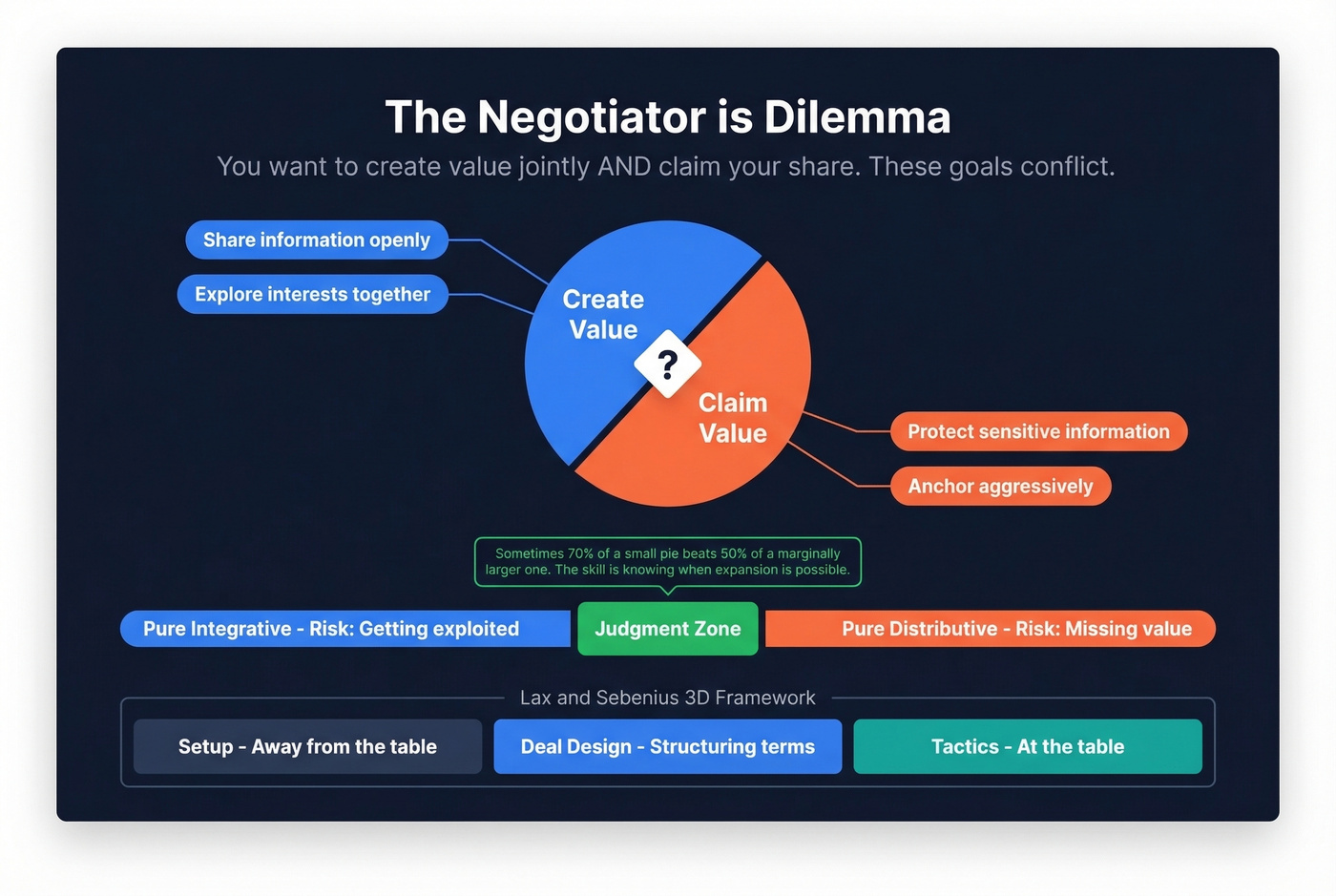
Lax and Sebenius nailed the core tension: you want to create all possible value jointly, claim a full share of it, and prevent yourself from being exploited by a value-claimer. These goals are inherently in conflict. Share too much information in pursuit of integrative gains, and a distributive counterpart will use it against you. Share too little, and you'll never find the trades that create value.
A frequent pushback from experienced negotiators on r/sales and similar communities: "Expanding the pie sounds great in a classroom, but my counterpart just wants to grind on price." That's the negotiator's dilemma in action, and there's no clean solution - only judgment.
Their "3D negotiation" framework offers the best mental model for managing this tension across three dimensions: setup (what happens away from the table), deal design (structuring the terms), and at-the-table tactics. A bad setup makes tactics irrelevant. If you're negotiating with someone who has no authority, or in a context where the other side has no incentive to collaborate, no amount of logrolling will save you.
Sometimes getting 70% of a small pie beats getting 50% of a marginally larger one. The skill isn't always expanding - it's knowing when expansion is possible and when you need to protect what you have.
How to Prepare (Quick Checklist)
- Map your BATNA - what's your best alternative if this deal dies? (Also set a clear walk-away point.)
- Estimate their BATNA - what are their options without you?
- Identify 3-4 tradeable issues beyond price: timeline, scope, payment terms, exclusivity, support
- Rank your priorities honestly - know what you'd concede first
- Prepare 2-3 open-ended questions to uncover their interests (use a tight set of discovery questions like "What would make this deal a home run for your team?")
- Draft one MESO set - three packages of equal value to you, structured differently
Skip the MESO prep if you're in a single-issue, one-time transaction with no relationship value. In those cases, know your BATNA cold and negotiate distributively. Not every deal deserves the integrative playbook.
If you're doing this in a revenue context, it also helps to align negotiation prep with your broader sales process optimization and sales execution so concessions don't break downstream delivery.
Logrolling and MESOs only work when you understand what the other side values. Prospeo's intent data tracks 15,000 topics so you walk into every negotiation knowing what your counterpart's company is actively researching and buying - the ultimate preparation for integrative deals.
Know their priorities before they tell you. That's how you expand the pie.
FAQ
Can you always expand the pie in negotiation?
No. Single-issue, one-time transactions with no relationship value are often genuinely zero-sum. Research on multi-issue negotiations found no meaningful joint-gains boost as you add issues up to about three, and joint gains can actually drop beyond that due to complexity. Most deals have hidden issues to trade, but not all - the skill is recognizing which ones do.
What if the other side won't cooperate?
Use MESOs to learn their priorities without over-disclosing yours. Their reaction to three equivalent offers reveals what they value without requiring trust. If they remain purely distributive, protect your BATNA and don't share information that can be weaponized. Not every counterpart deserves transparency.
How many issues should you put on the table?
Around three well-chosen issues is the sweet spot. Joint gains can drop when you go beyond three due to complexity and coordination cost. Pick the issues where your priorities genuinely differ from theirs - that's where logrolling creates the most value.