

Feature-Benefit Selling: What Works, What Fails, and How to Actually Do It
You send 200 cold emails. Every one leads with your AI-powered dashboard, your 99.9% uptime, your proprietary algorithm. Reply rate: zero. The problem isn't your product - it's that you're pitching specs to people who care about outcomes.
Feature-benefit selling fixes this. But it's the most over-taught and under-practiced technique in sales. Most reps think they sell benefits. They actually sell features with better grammar.
What Is Feature-Benefit Selling?
Feature-benefit selling connects what your product does (features) to what the buyer gains (benefits). Instead of listing capabilities, you translate each one into a tangible outcome the prospect cares about.
It's table stakes, not a silver bullet. Benefit-led messaging lifts conversion rates 25-40%, but only when done right.
The FAB Framework
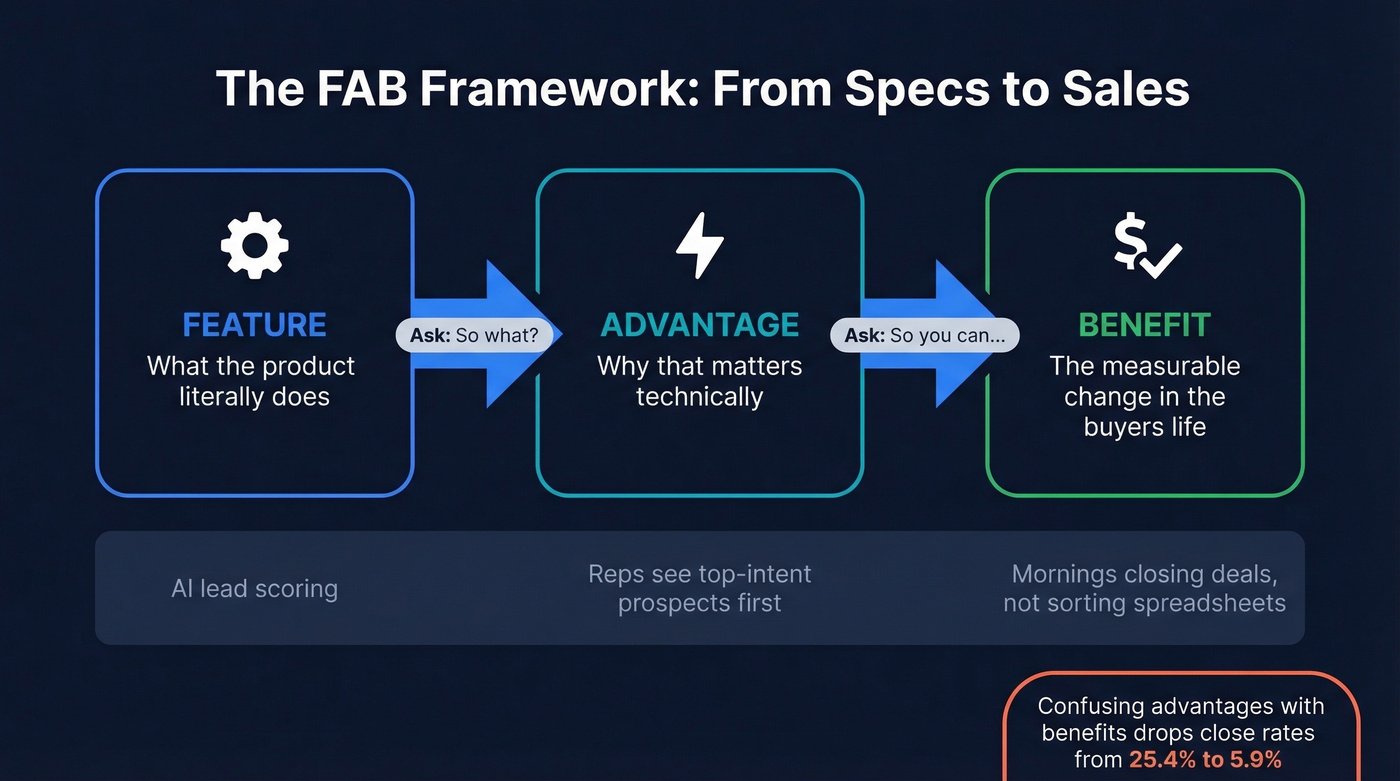
The cleanest model is FAB: Feature, Advantage, Benefit. The distinction between advantage and benefit is where most teams get sloppy - one commonly cited stat from Huthwaite's SPIN Selling research is that confusing advantages with true benefits can tank success rates from 25.4% down to 5.9%.
| Feature | Advantage | Benefit |
|---|---|---|
| SSO with Okta | IT provisions access in minutes | Pass SOC 2 audits; cut IT overhead 15% |
| AI lead scoring | Reps see top-intent prospects first | Mornings closing, not sorting spreadsheets |
| 14-day free trial | Buyers test before committing | Prove ROI to your CFO before signing |
| Same-day delivery | Orders arrive in hours | Stop losing weekend shoppers to Amazon |
The fastest trick to get from advantage to benefit: ask "so you can..." after every advantage statement. "IT provisions access in minutes" becomes "so you can pass your next SOC 2 audit without scrambling." That single phrase forces you out of product-speak and into buyer-speak.
SPIN Selling - built on 35,000 sales calls - is the discovery layer that makes FAB work. FAB is the output; SPIN is the input. A solid questioning strategy can increase your closure rate by 20%, which is why discovery and messaging aren't separate skills. They're the same skill at different stages.
How to Build a Benefit Statement
Three steps. That's it.
- Identify the feature. What does the product literally do?
- Ask "so what?" This gives you the advantage.
- Ask "so you can..." This gives you the benefit.
Take a project management tool with automated status updates. The advantage is managers stop chasing people for progress reports. The benefit? "Your Monday standup takes 10 minutes instead of 45, and your team ships a week faster per quarter."
Here's an advanced move: strip the feature entirely and lead with the benefit alone. "Your Monday standup takes 10 minutes instead of 45" - no mention of what product does it. This triggers curiosity and pulls the prospect toward asking how. We've found this works especially well in cold outbound, where you have about three seconds of attention before someone hits delete.
Goldelucks, an e-commerce brand, shifted from feature-focused copy to benefit-led descriptions and saw a 31.56% increase in orders from product pages alone. The product didn't change. The messaging did.

You just learned to translate features into buyer outcomes. Now make sure those outcomes reach real people. Prospeo's 98% email accuracy on a 7-day refresh cycle means your carefully crafted benefit statements land in inboxes - not bounce logs. At $0.01/email, testing your new FAB messaging costs less than a cup of coffee.
Great copy deserves live inboxes. Start with 75 free verified emails.
When Selling Benefits Fails
Let's be honest: feature-benefit selling fails constantly.
A demand gen marketer on r/b2bmarketing wrote: "The whole of last year went in doing feature benefit marketing and successfully burned through the budget with miniscule leads that eventually didn't convert." Their fix? Switching to use-case-oriented marketing that felt more relevant and relatable to the audience. HubSpot research found 82% of buyers feel overwhelmed by information in the sales process, and you've been on that demo call - the rep rattles off eight features in ten minutes, each with a "benefit" that's really the feature restated in softer language. "Our platform saves you time" isn't a benefit. It's a feature wearing a costume.
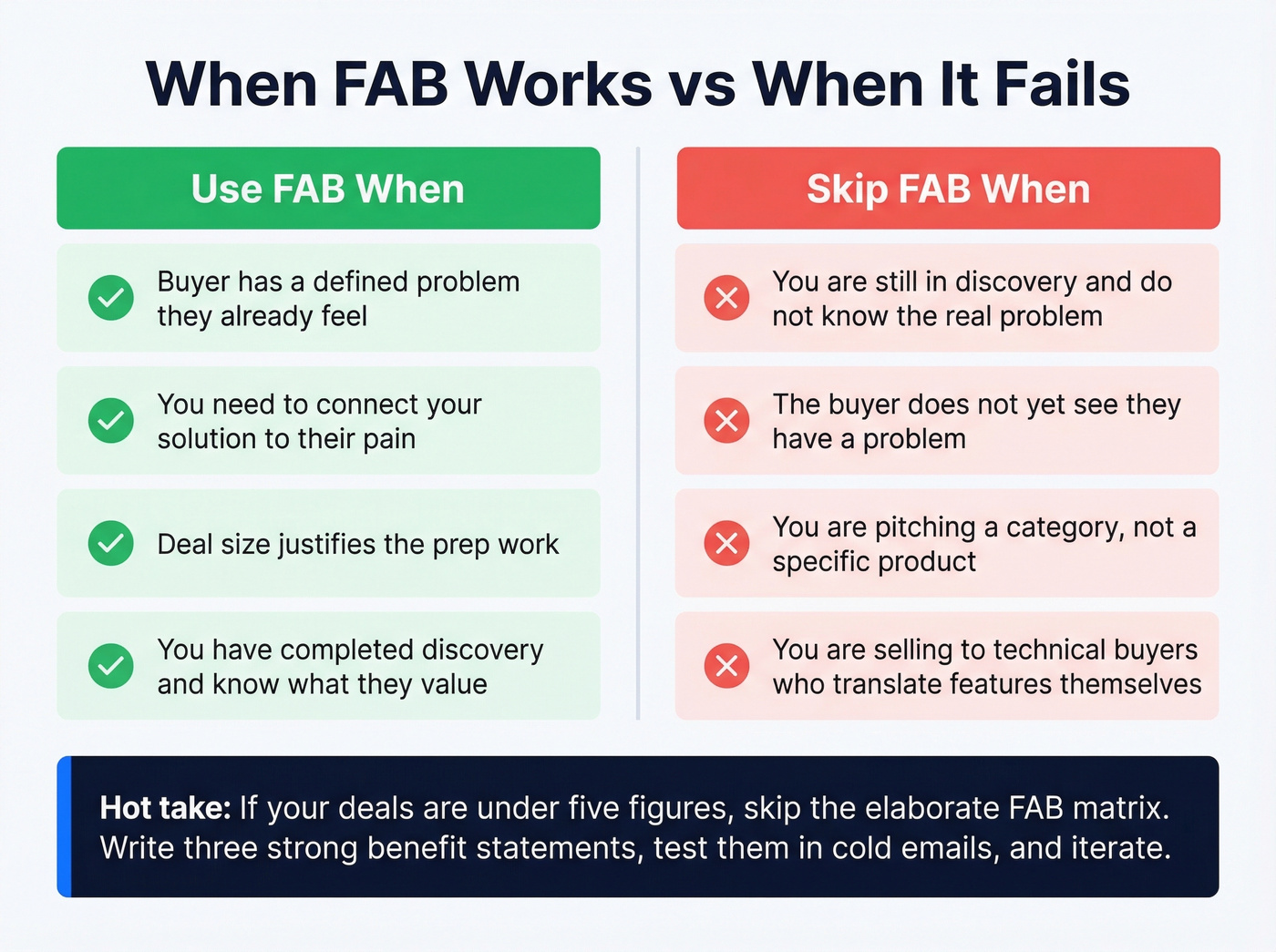
Use FAB when your buyer has a defined problem and you need to connect your solution to it.
Skip FAB when you're still in discovery, the buyer doesn't yet see the problem, or you're pitching a category rather than a product.
Here's my hot take: if your deal sizes sit below five figures, you probably don't need elaborate FAB matrices. Write three strong benefit statements, test them in cold emails, and iterate. The teams that over-engineer their messaging frameworks are usually the ones avoiding the real work - actually talking to buyers.
The After-State Evolution
Benefits explain. The after-state sells.
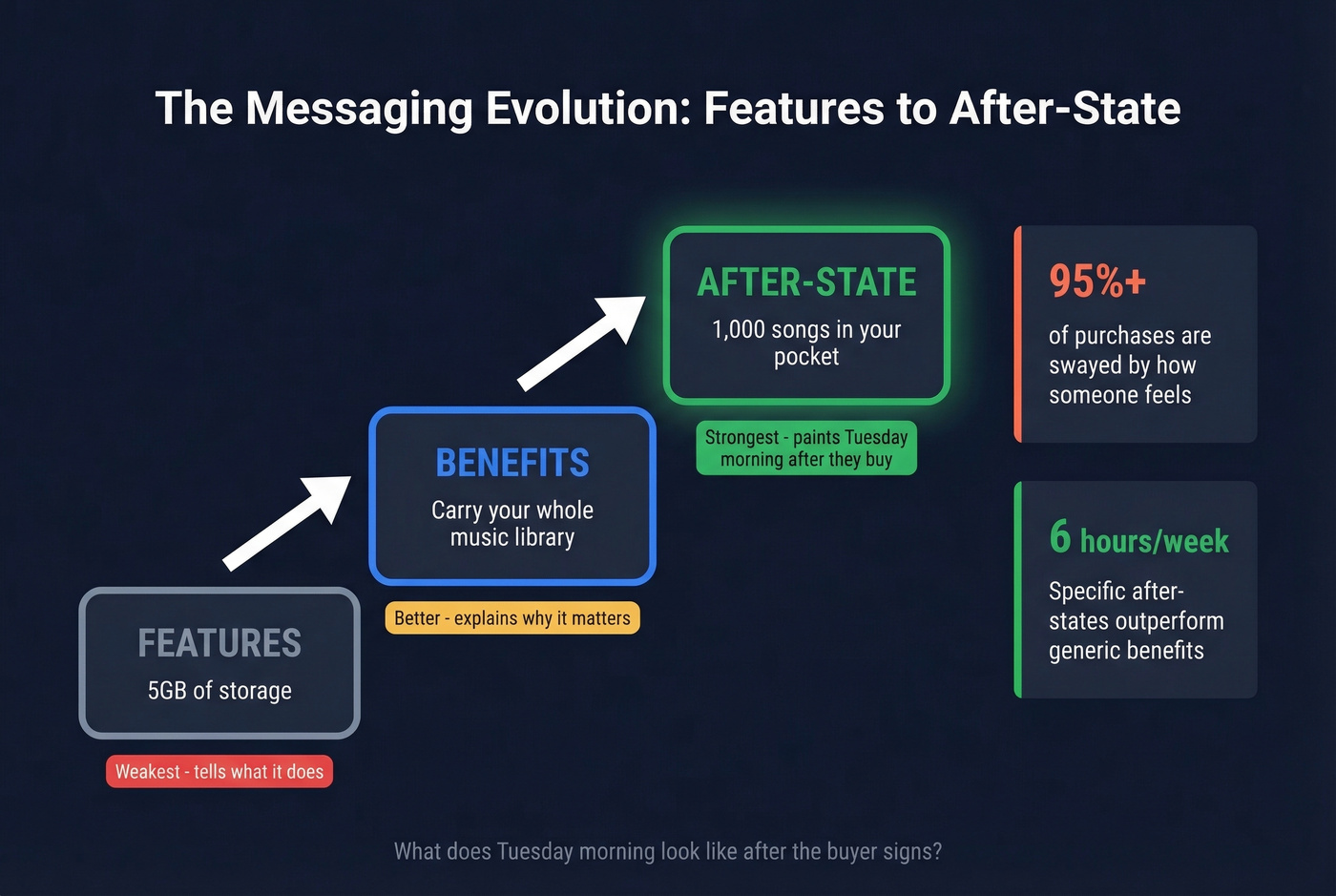
Apple didn't pitch the iPod as "5GB of storage" or even "carry your whole music library." They said "1,000 songs in your pocket" - a vivid picture of daily life, transformed. A post on r/marketing put it well: the real shift isn't benefits vs. features, it's selling the workflow, the after-state. What does Tuesday morning look like after the buyer signs?
In our experience, reps who quantify a specific after-state - "your ops team reclaims 6 hours per week" - outperform those who list generic benefits by a wide margin. The number makes it real. "Save time" is forgettable. Six hours is a person's entire Monday afternoon.
Why Benefits Persuade
Loss aversion makes framing what the buyer will miss more powerful than what they'll gain. "You're losing 6 hours a week to manual data entry" hits harder than "save 6 hours a week." Same outcome, completely different emotional weight.
Over 95% of purchases are swayed by how someone feels. Benefits tap emotion. Features don't.
Applying FAB to Outbound
Compare two cold email subject lines:
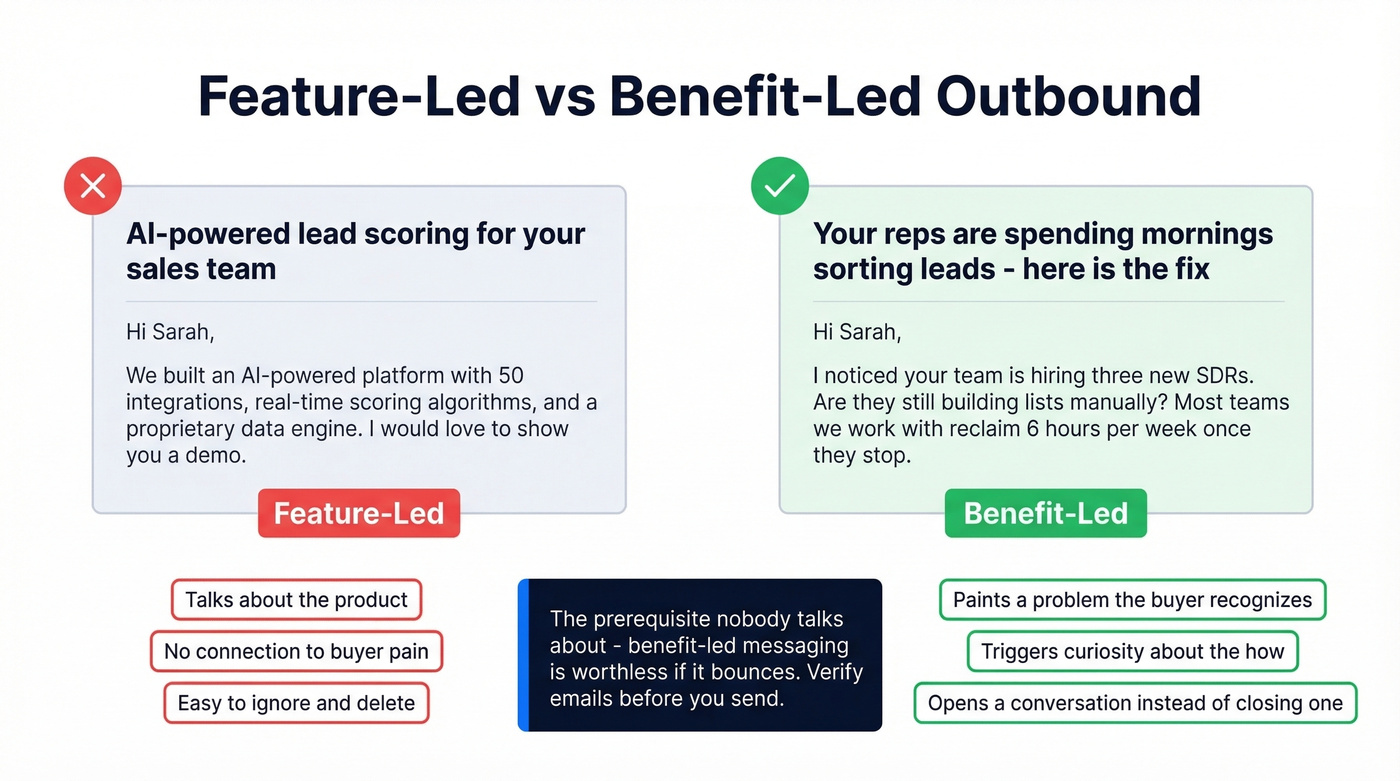
- Feature-led: "AI-powered lead scoring for your sales team"
- Benefit-led: "Your reps are spending mornings sorting leads - here's the fix"
The second one paints a problem the buyer recognizes. On a cold call, the same principle applies: "I noticed your team is hiring three new SDRs - are they still building lists manually?" opens a conversation. Leading with "We have 50 integrations" closes one.
The prerequisite nobody talks about: benefit-led messaging is worthless if it bounces. You craft the perfect after-state email, send it to 500 prospects, and 47 bounce because your data's stale. Prospeo's 98% email accuracy on a 7-day refresh cycle means your carefully written benefit statements land in inboxes, not bounce logs. The free tier gives you 75 verified emails per month - enough to test whether your new messaging actually moves the needle before you scale.
If you're seeing bounces, start with your email deliverability basics and track your email bounce rate before you scale volume.
Benefit-led outbound falls apart when you're pitching the right message to the wrong person. Prospeo's 30+ filters - buyer intent, job changes, headcount growth - let you find prospects who already feel the pain your benefits solve. Discovery before messaging, just like SPIN teaches.
Find buyers who already have the problem your benefits address.
FAQ
What's the difference between a feature and a benefit?
A feature is what the product does; a benefit is the measurable change in the buyer's life because of it. If your statement doesn't answer "so what does that mean for me?" it's still a feature. Apply the "so you can..." test to every advantage to reach a true benefit.
Does feature-benefit selling work in B2B?
Yes, but only when benefits are specific and quantified. "Save time" is generic. "Your ops team reclaims 6 hours per week on manual data entry" moves deals. Pair FAB with SPIN or similar discovery frameworks to uncover what the buyer actually values before you present benefits.
When should I lead with features instead of benefits?
Lead with features when selling to highly technical buyers who evaluate specs directly - engineers comparing APIs, IT teams reviewing security certifications, or procurement running compliance checklists. In these contexts, the buyer translates features into benefits themselves, and over-simplifying can undermine credibility.