


FinalScout vs LeadRocks: Which Actually Delivers Usable Leads?
Comparing FinalScout vs LeadRocks comes down to more than star ratings. FinalScout pulls a 4.8/5 on G2 from 226 reviews. LeadRocks sits at 4.5/5 on AppSumo from 365 reviews. Both sound solid on paper - the difference is in what happens after you export that first list.
30-Second Verdict
- Choose FinalScout if your workflow starts from professional profiles and you need one-click extraction, API/webhooks, and team credit sharing.
- Choose LeadRocks if budget is the hard constraint. At $29/mo for 1,000 credits, it's cheap - but expect cleanup work on the back end.
Pricing and Credits
FinalScout charges by plan tier with scrape concurrency and team seats as the levers. It doesn't publish credit amounts per tier - concurrency and seats are the real scaling factors. LeadRocks uses a transparent credit system where 1 credit = all contact details for one person.
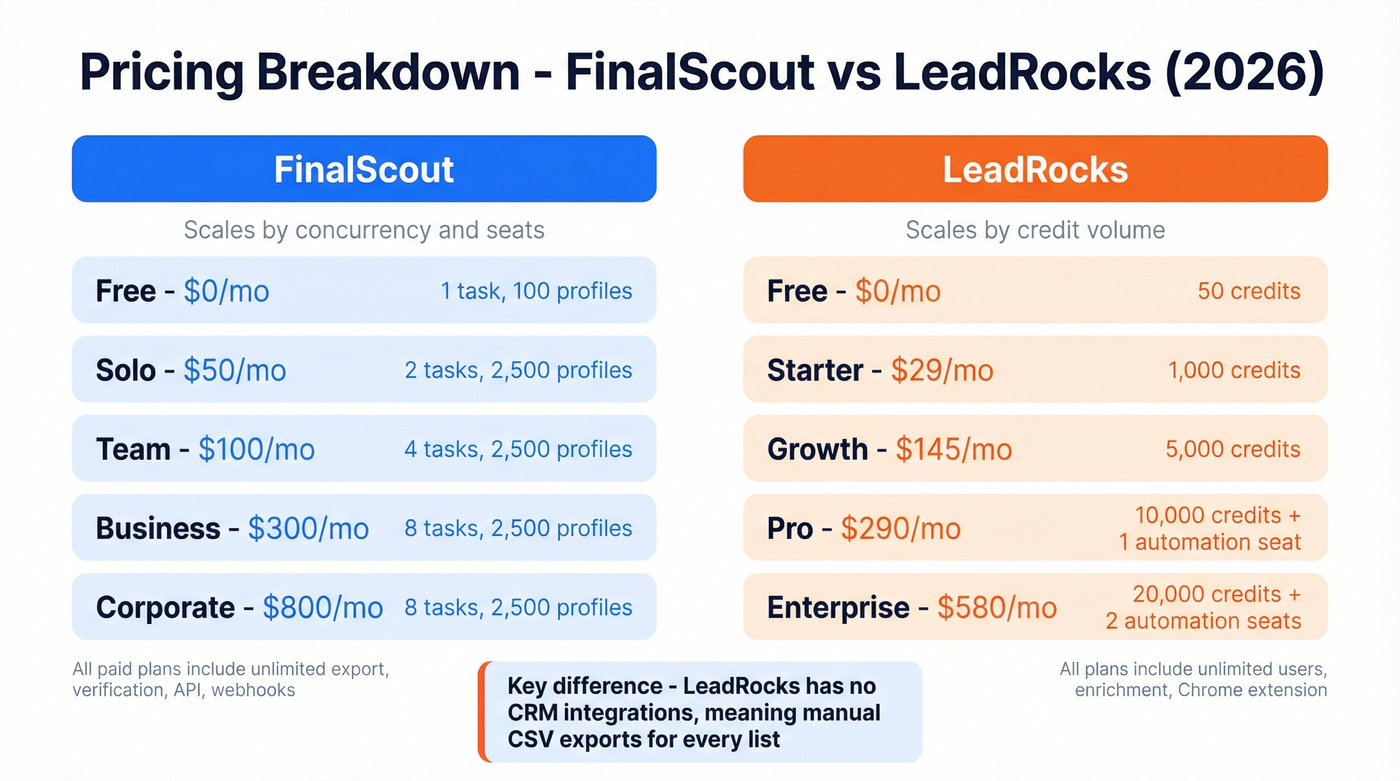
FinalScout Pricing:
| Plan | Monthly | Concurrent Tasks | Max Scrape Size |
|---|---|---|---|
| Free | $0 | 1 | 100 profiles |
| Solo | $50 | 2 | 2,500 profiles |
| Team | $100 | 4 | 2,500 profiles |
| Business | $300 | 8 | 2,500 profiles |
| Corporate | $800 | 8 | 2,500 profiles |
Annual billing saves two months. Paid plans include unlimited export, unlimited email verification, integrations, APIs & webhooks, credit rollover, and priority support.
LeadRocks Pricing:
| Plan | Monthly | Credits |
|---|---|---|
| Free | $0 | 50 |
| Starter | $29 | 1,000 |
| Growth | $145 | 5,000 |
| Pro | $290 | 10,000 + 1 automation seat |
| Enterprise | $580 | 20,000 + 2 automation seats |
Every LeadRocks plan includes unlimited users, enrichment, a Chrome extension, and emails + phone numbers - solid for agencies. The catch: no CRM integrations exist yet. That means manual CSV exports into whatever you're running. For teams pushing leads straight into HubSpot or Salesforce, that's a dealbreaker.
Feature-by-Feature Breakdown
| Feature | FinalScout | LeadRocks | Edge |
|---|---|---|---|
| Data source | Profile extraction + built-in prospecting (500M+ professionals) | Database-style search (100M+ records) | FinalScout |
| Email verification | Built-in | Built-in; can return "unknown" statuses | FinalScout |
| Bulk export | CSV, all plans | CSV, batch-based | Tie |
| API / Webhooks | All plans (including Free) | Email Verifier API only | FinalScout |
| CRM integration | Via API/webhooks | None | FinalScout |
| AI email writing | ChatGPT-powered | Not available | FinalScout |
| Team sharing | Credit sharing on paid plans | Unlimited users, all plans | LeadRocks |
| Automation seats | N/A | Pro and Enterprise plans | LeadRocks |
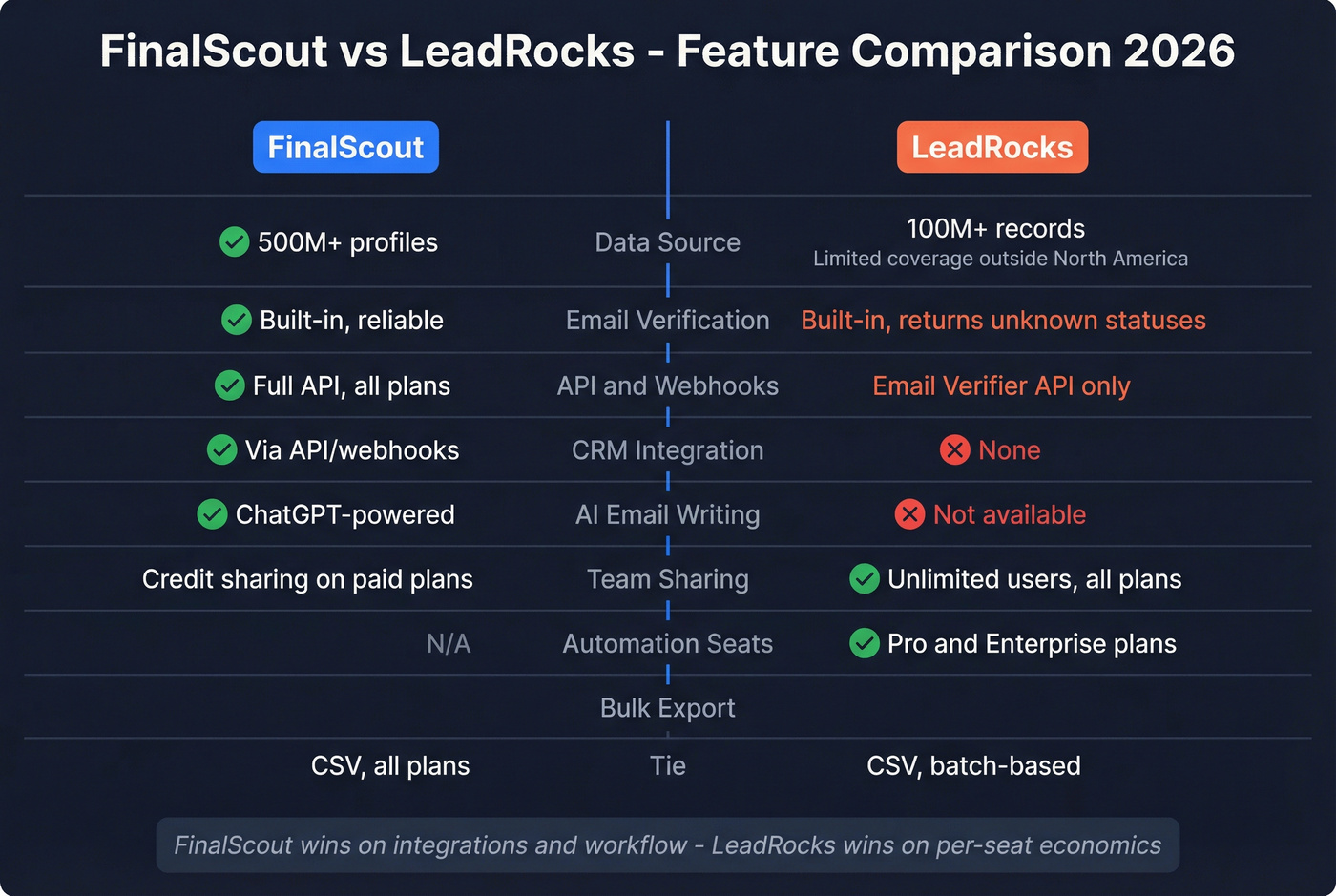
FinalScout wins on workflow integration. LeadRocks wins on database-style filtering and per-seat economics. If you're comparing broader options, see our breakdown of sales prospecting platforms.

Neither FinalScout nor LeadRocks offers native CRM integrations, real-time verification, and database search in one platform. Prospeo does - with 30+ filters, 98% email accuracy, and direct pushes to HubSpot and Salesforce. No CSV cleanup loops. No manual deduplication.
Stop choosing between cheap data and accurate data - get both.
What Users Actually Say
FinalScout Reviews
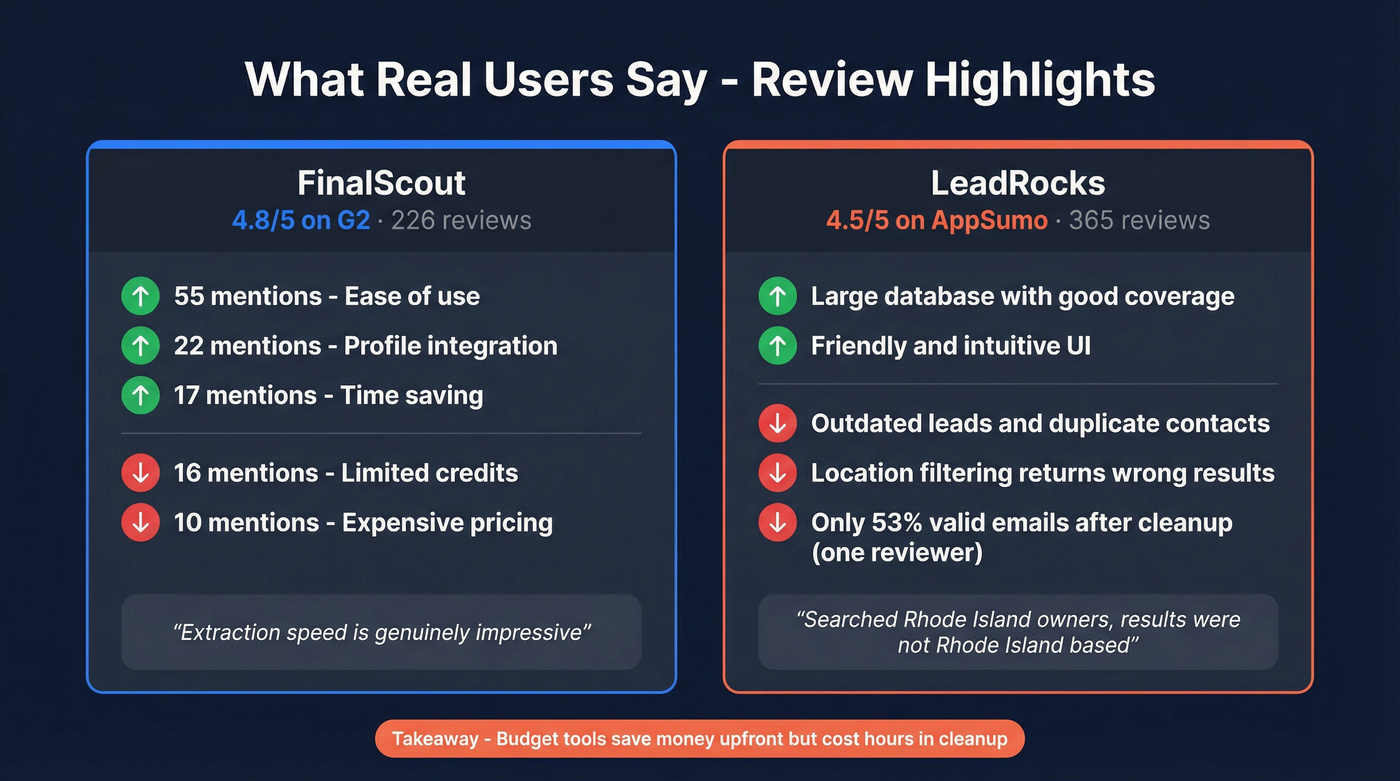
The G2 reviews tell a clear story. Ease of use dominates with 55 mentions - people love the one-click email extraction. Profile integration and time-saving get 22 and 17 mentions respectively. On the negative side, 16 reviewers flag limited credits and 10 call it expensive. In our testing, the extraction speed is genuinely impressive, though five G2 reviewers do flag incorrect or outdated emails, which is worth watching if you're running high-volume cold email marketing.
LeadRocks Reviews
AppSumo reviews paint a rougher picture. The database is large and the UI is friendly, but operational complaints stack up fast. Outdated leads, duplicate contacts, and location filtering that doesn't work as expected come up repeatedly - one reviewer searched Rhode Island business owners and said the results weren't actually Rhode Island-based.
Here's the thing: the API gap is real. The API only covers the Email Verifier tool, not lead pulling, which kills automation workflows. When you're forced into a manual export, dedupe, and verify loop, the "cheap" plan gets expensive in hours. One reviewer said that after cleaning a downloaded list, only 53% of emails were valid.
LeadRocks is listed as Sales.Rocks on G2 (4.5/5, 83 reviews), which causes confusion when cross-referencing platforms. Reddit threads asking about LeadRocks experiences exist but have minimal substantive replies - most real feedback lives on AppSumo.
Our take: LeadRocks is fine if your average deal size is under $5k and you can absorb some bounce risk. But if a single domain reputation hit costs you a week of pipeline, the $29/mo savings evaporates instantly. (If you're trying to quantify that risk, use these average bounce rate for email campaigns benchmarks.)
When to Pick Which
FinalScout makes sense if:
- Your workflow starts from professional profiles and you need one-click extraction
- You need API/webhooks and team credit sharing baked in
- You value speed and integration over raw database size
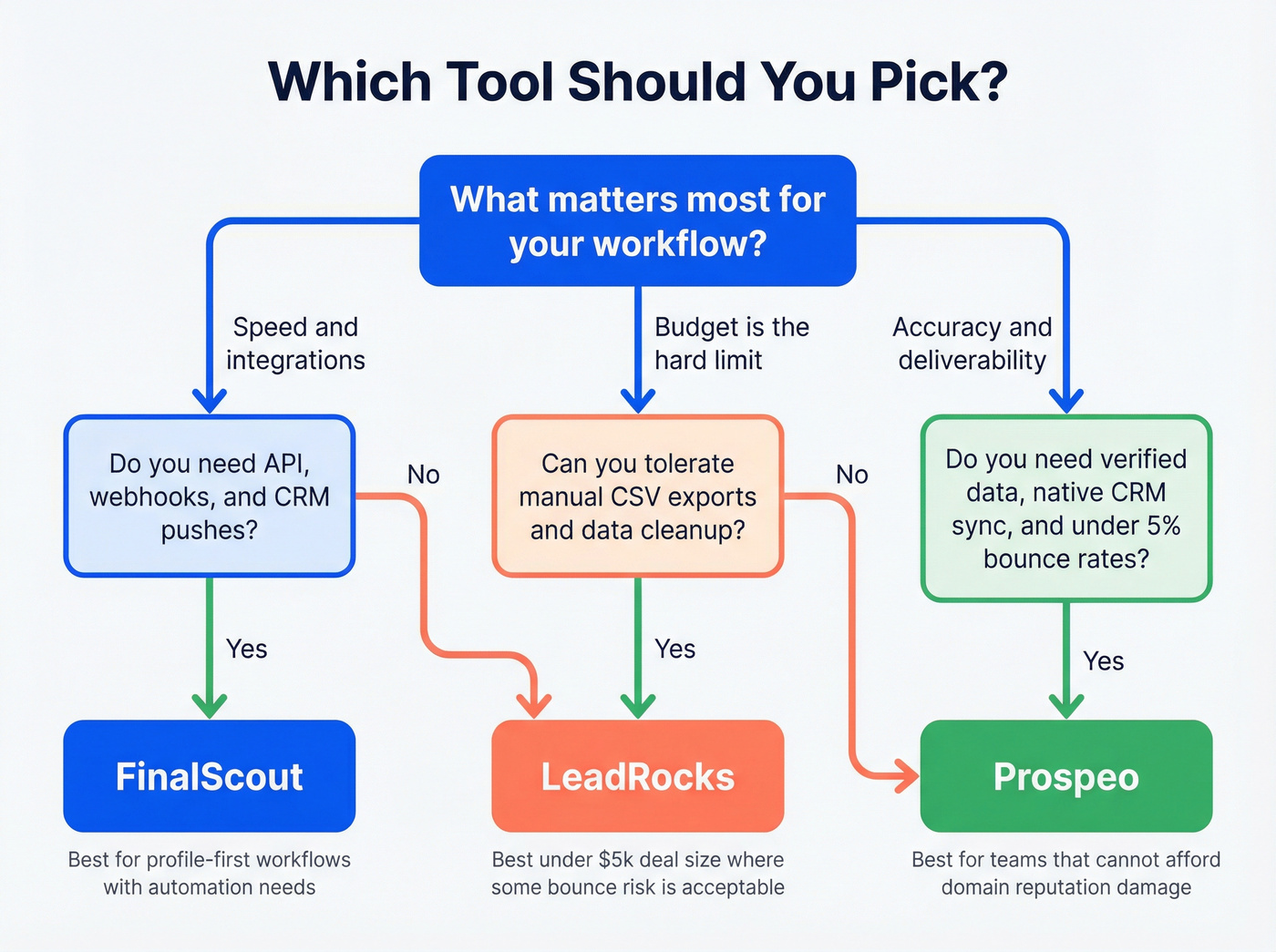
LeadRocks makes sense if:
- Budget is the hard constraint - $29/mo is tough to beat
- You need a searchable database with company, title, location, industry, and team size filters
- You can tolerate manual export batching and cleanup downstream
For teams that need both database search and real-time verification in one tool, neither option fully covers it. If you're evaluating other stacks, compare sales prospecting software options by workflow.
When Neither Tool Is Enough
Let's be honest - if the real problem is deliverability and data freshness, neither option in this FinalScout vs LeadRocks matchup solves it well enough. We've seen teams burn through weeks of pipeline because they trusted unverified exports from budget tools. Prospeo's 5-step verification, 7-day data refresh cycle, and catch-all domain handling mean fewer bounces and zero domain damage. You get 30+ search filters, native CRM enrichment for Salesforce and HubSpot, and API access - all self-serve with no contracts. Teams switching from tools like these typically see bounce rates drop from 30%+ to under 5%. The free tier starts at 75 emails/month, which is enough to test accuracy before committing a dollar.
If you're tightening up list quality, start with email verification and a clear email deliverability baseline before scaling volume. For the underlying hygiene work, a lightweight data cleaning process helps prevent duplicates and bad merges.

One LeadRocks reviewer found only 53% of emails were valid after cleanup. FinalScout users flag outdated contacts. Prospeo's 5-step verification and 7-day refresh cycle keep bounce rates under 5% - that's why teams switching from budget tools triple their pipeline.
75 free emails per month. Test the accuracy yourself before spending a dollar.
FAQ
Is LeadRocks data accurate?
Results are mixed. AppSumo reviews consistently cite outdated leads, duplicates, and location mismatches. One reviewer reported only 53% valid emails after cleanup. Always verify before launching sequences to keep bounce rates under 5%.
Does FinalScout work without Sales Navigator?
Yes, but free accounts have profile-view limits that cap bulk scraping. FinalScout recommends Sales Navigator for unlimited views and full bulk capability. Expect roughly 100 profiles/day without it.
What's the most accurate email finder in 2026?
Prospeo leads with 98% verified email accuracy, a 7-day refresh cycle, and 5-step verification including catch-all handling and spam-trap removal - significantly ahead of tools refreshing every four to six weeks. Its free tier (75 emails/month) lets you test accuracy before committing.
Is there a free alternative to both tools?
Prospeo's free plan includes 75 email credits and 100 Chrome extension credits per month with full verification - more generous than FinalScout's free tier (100 profiles, limited concurrency) and LeadRocks' 50-credit cap. For small teams running real outbound, it's the strongest no-cost starting point.