

Firmographic Data Sources: Free, Paid, and How to Choose
B2B data decays at roughly 2.1% per month. That's 22.5% per year. Run outbound off a six-month-old list and you're staring at bounced emails, wasted sequences, and a sender reputation circling the drain. The fix isn't buying more data - it's picking the right firmographic data sources, ones that deliver fresher records matched to your actual workflow.
What Is Firmographic Data?
Firmographic data describes a company the way demographics describe a person. The fields most teams care about:
- Industry - NAICS/SIC codes or plain-text classification
- Employee count - total headcount, sometimes by department
- Annual revenue - exact or banded ranges
- Location - HQ, branch offices, countries of operation
- Ownership type - public, private, subsidiary, nonprofit
- Founding year - useful for maturity-based segmentation
Don't confuse firmographic data with technographic data - what software a company uses - or intent data, which tracks what topics they're actively researching. Most commercial providers bundle all three, but the underlying pipelines and refresh cadences differ significantly, and that distinction matters when you're evaluating accuracy claims.
The Short Version
- Free sources like SEC EDGAR, OpenCorporates, and Census CBP work for TAM sizing and validation. Not for outbound lists. No emails, no phones, no normalization.
- Most B2B teams do well with Prospeo for verified emails and weekly-fresh firmographic enrichment, Apollo for budget-friendly sequencing, and Crunchbase for funding signals.
- Enterprise teams with $15K+ budgets should look at ZoomInfo or Cognism for maximum US direct-dial coverage and hierarchy mapping.
Here's the thing: if your average deal size sits below five figures, you almost certainly don't need ZoomInfo-level data. The ROI math just doesn't work. Start with a leaner stack and upgrade when deal sizes justify it.
Why Refresh Frequency Matters
15-20% of professionals change jobs every year. Work emails decay 20-30% annually. Job titles go stale at 15-25%. Even a perfect list built in January is meaningfully degraded by summer.
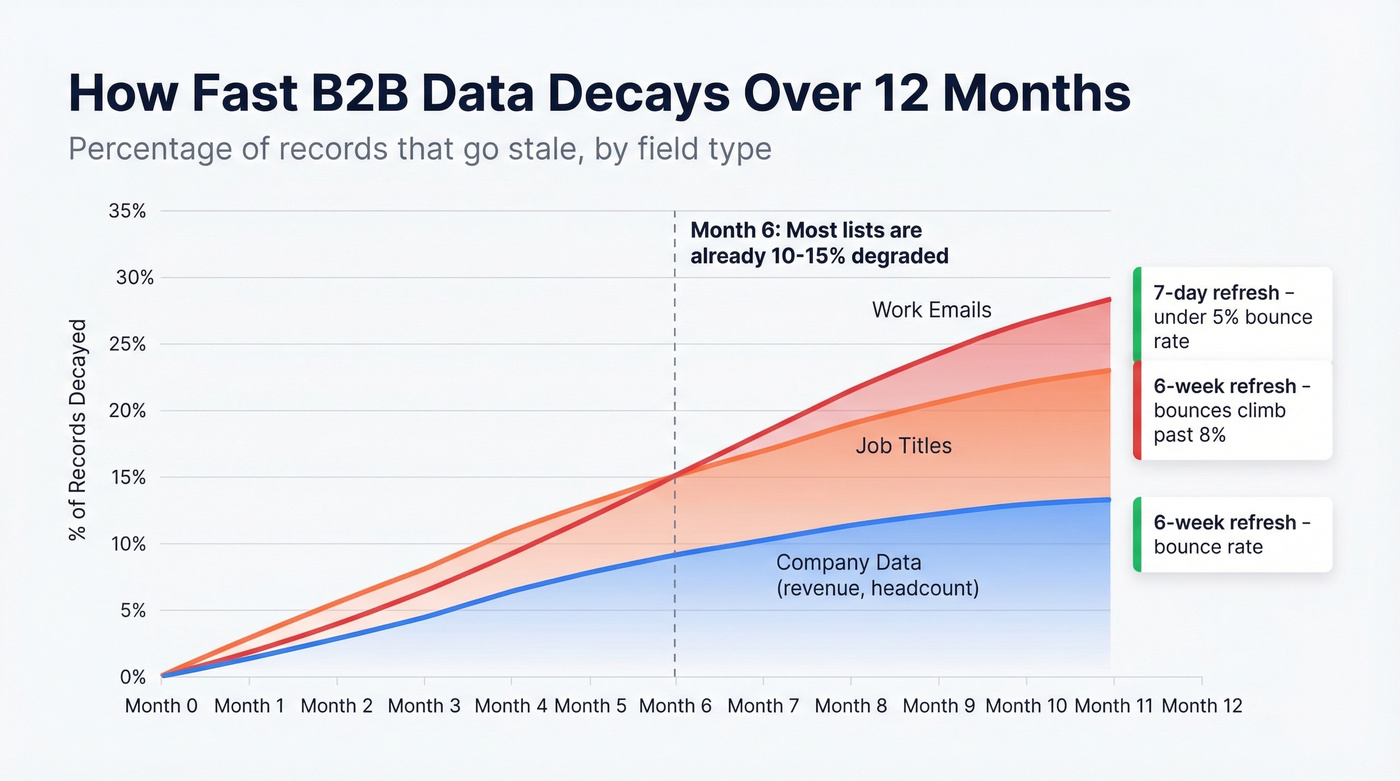
Most major providers refresh on about a 6-week cycle, which means the data is already a month-plus old before you touch it. Weekly refresh is the benchmark for what "fresh" actually means in 2026. If your provider can't tell you their refresh cadence, assume it's slow.
In our experience, teams that skip quarterly re-enrichment see bounce rates climb fast by month six. For active outbound sequences, weekly or on-demand verification is the most reliable way to keep bounces under 5%.
Where Does Firmographic Data Come From?
Understanding collection methods helps you evaluate any provider's quality claims. There are four main pipelines:
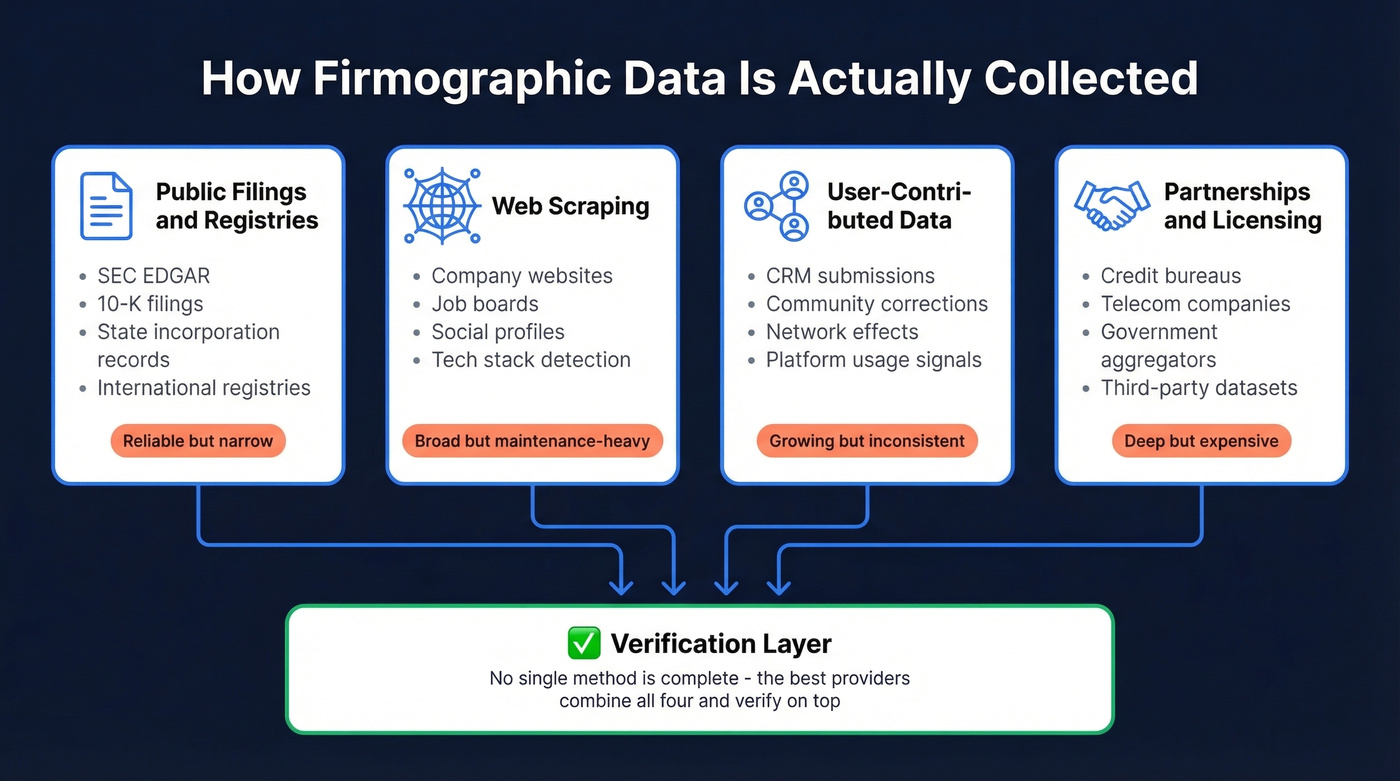
Public filings and registries - SEC EDGAR, state incorporation records, and international equivalents provide revenue, officer names, and legal entity details. Reliable but narrow.
Web scraping - Providers crawl company websites, job boards, and social profiles to extract headcount, tech stack, and location data. Scraping at scale requires proxy infrastructure and constant maintenance as site structures change, which is why most teams outsource this to commercial providers or API-first platforms like Bright Data and Apify rather than building in-house.
User-contributed data - Platforms like Apollo and ZoomInfo supplement their databases with information submitted by their own users, creating a network effect that improves coverage over time. The tradeoff is that user-submitted data can be inconsistent or outdated if verification layers aren't strong.
Partnerships and licensing - Some providers license data from credit bureaus, telecom companies, or government aggregators to fill gaps in their own pipelines.
No single method produces complete, accurate data on its own. The best providers combine multiple collection pipelines and layer verification on top.

Most firmographic data sources refresh every 6 weeks. By then, 5%+ of your list has already decayed. Prospeo's 7-day refresh cycle and 98% email accuracy mean your firmographic filters actually connect you to real people at real companies - at $0.01 per email.
Build firmographic lists that don't rot before you hit send.
Free & Public Sources
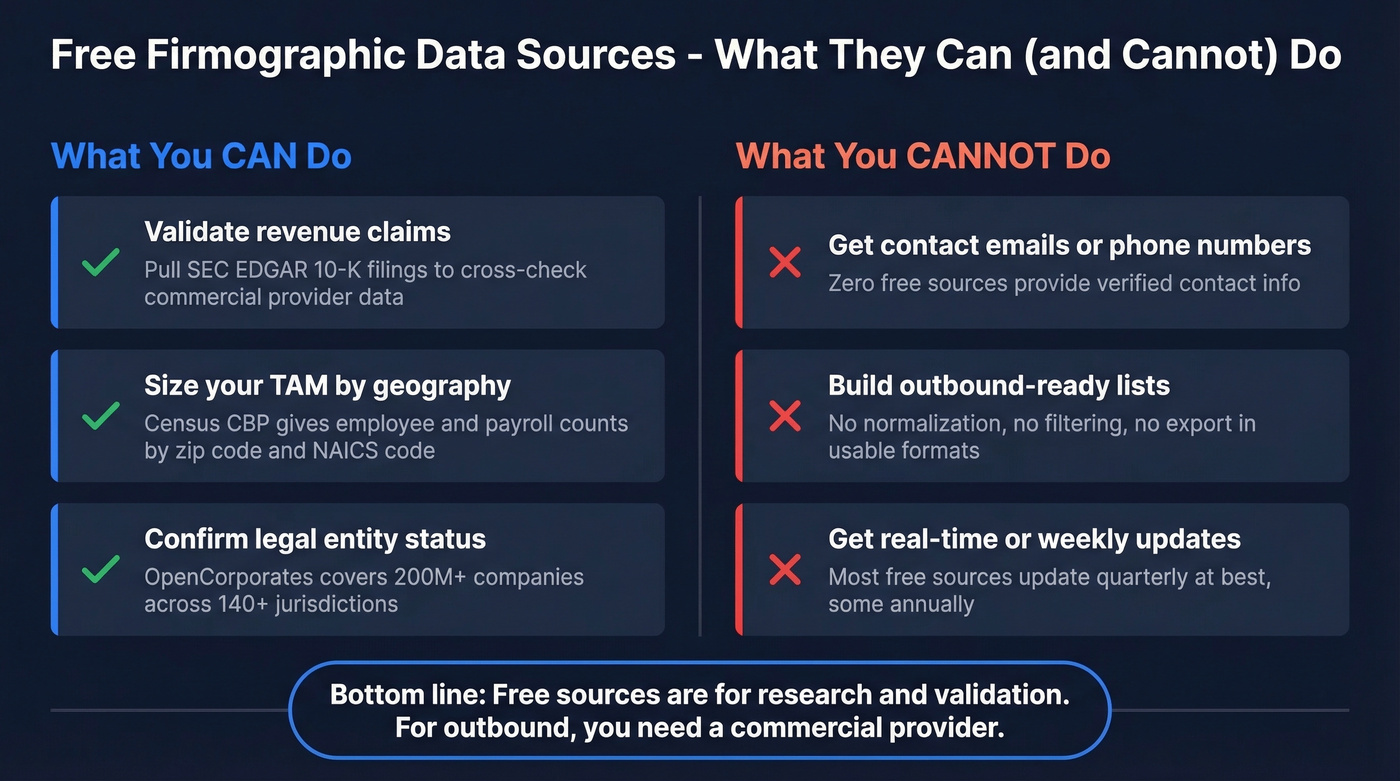
These won't replace a commercial provider, but they're genuinely useful for validation and market sizing.
| Source | What You Get | Limitations |
|---|---|---|
| SEC EDGAR | Financial filings, revenue, officers | Public companies only |
| Census CBP | Employee/payroll by geography | Aggregated, no company names |
| OpenCorporates | Corporate registrations | Basic registration data only |
| State registries | Incorporation details, agents | No revenue or headcount |
| SBA datasets | Small business aggregate stats | No individual company records |
Pull SEC EDGAR 10-K filings to validate revenue claims from commercial providers. Use Census CBP to size addressable markets by geography and industry before building outbound lists. OpenCorporates is a fast way to confirm a company's legal entity status and jurisdiction.
The limitation across all of these: no emails, no phone numbers, no normalized fields, and updates lag by months or quarters. For anything beyond TAM estimation, you need a commercial source.
Top Commercial Providers
Prospeo
Use this if you care about data accuracy above all else and want self-serve pricing without a sales call.
Prospeo covers 300M+ professional profiles, 143M+ verified emails, and 125M+ verified mobile numbers. Email accuracy runs 98%, and a 7-day refresh cycle means you're working with data that's genuinely current - not weeks-old snapshots dressed up as "real-time." The 30+ search filters cover buyer intent, technographics, job changes, headcount growth, funding, and revenue, so you can build firmographic-rich lists without stitching together multiple tools.

Pricing is credit-based at roughly $0.01 per email. There's a free tier with 75 emails/month, no contracts, and no "talk to sales" gates. One proof point worth mentioning: Meritt dropped their bounce rate from 35% to under 4% after switching, and their pipeline tripled from $100K to $300K per week. For teams that have been burned by bad data, those numbers speak for themselves.
Best paired with Instantly or Lemlist for sequencing.
ZoomInfo
The deepest US firmographic database - 110M+ companies, 410M+ contacts, 35M+ non-HQ locations. NAICS/SIC codes, corporate hierarchy mapping, technographics, and intent data all in one platform. For teams that need everything under one roof and have the budget, it's still the default enterprise choice.
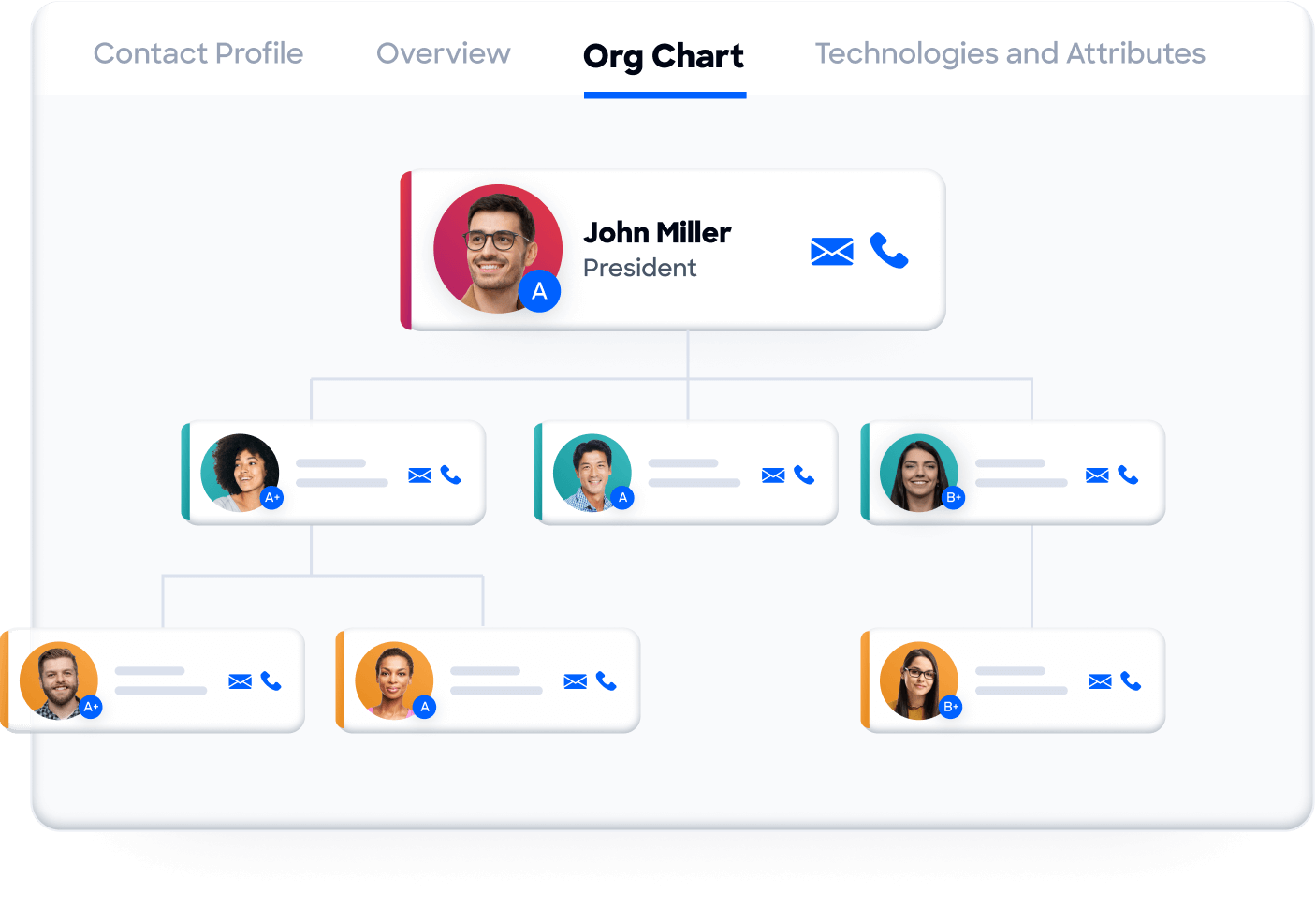
The downside is real: pricing starts at $14K-$25K/year and climbs past $30K for enterprise packages. Annual contracts with auto-renewal clauses that the consensus on r/sales consistently flags as painful to escape. Email accuracy runs 75-85% - solid but not best-in-class.
You're also paying for modules like intent, chat, and workflow that many teams never activate. That's a significant line item for any team under 50 people.
Apollo.io
The obvious starting point for budget-conscious teams. 275M+ contacts across 73M+ companies. The free plan includes 1,200 credits/year - enough to test seriously. Paid plans start at $49/user/month on annual billing, and Professional runs $99/user/month. The built-in sequencer means you get data and outreach in one tool.
The tradeoff: accuracy sits at 65-80%. We've seen teams run Apollo lists through a separate verification step, which defeats the convenience argument. Good enough for startups testing outbound. Not good enough if data quality is your bottleneck.
All Providers Compared
| Provider | Database Size | Refresh | Starting Price | Best For |
|---|---|---|---|---|
| Prospeo | 300M+ profiles | 7 days | Free; ~$0.01/email | Verified emails, freshness |
| ZoomInfo | 110M+ companies | ~6 weeks | ~$14K/yr | US enterprise, direct dials |
| Apollo.io | 275M+ contacts | Monthly | Free; $49/user/mo | Budget all-in-one |
| Cognism | 400M+ contacts | Varies | ~$1K-$3K/mo | EMEA, GDPR, mobile |
| Lusha | 100M+ profiles | Varies | $29.90/mo | SMB Chrome extension |
| D&B | 500M+ businesses | Quarterly | $49/mo (300 credits) | Corporate hierarchy |
| Clearbit/Breeze | 44M+ companies, 350M+ contacts | Real-time | Included w/ HubSpot | HubSpot-native enrichment |
| Crunchbase | 106M+ companies | Weekly | $49/mo (annual) | Funding signals |
| Coresignal | 36M+ companies | Daily | ~$1K-$5K/mo | API-first enrichment |
| People Data Labs | 70M+ companies | Monthly | ~$0.01-$0.10/record | Dev-first, entity resolution |
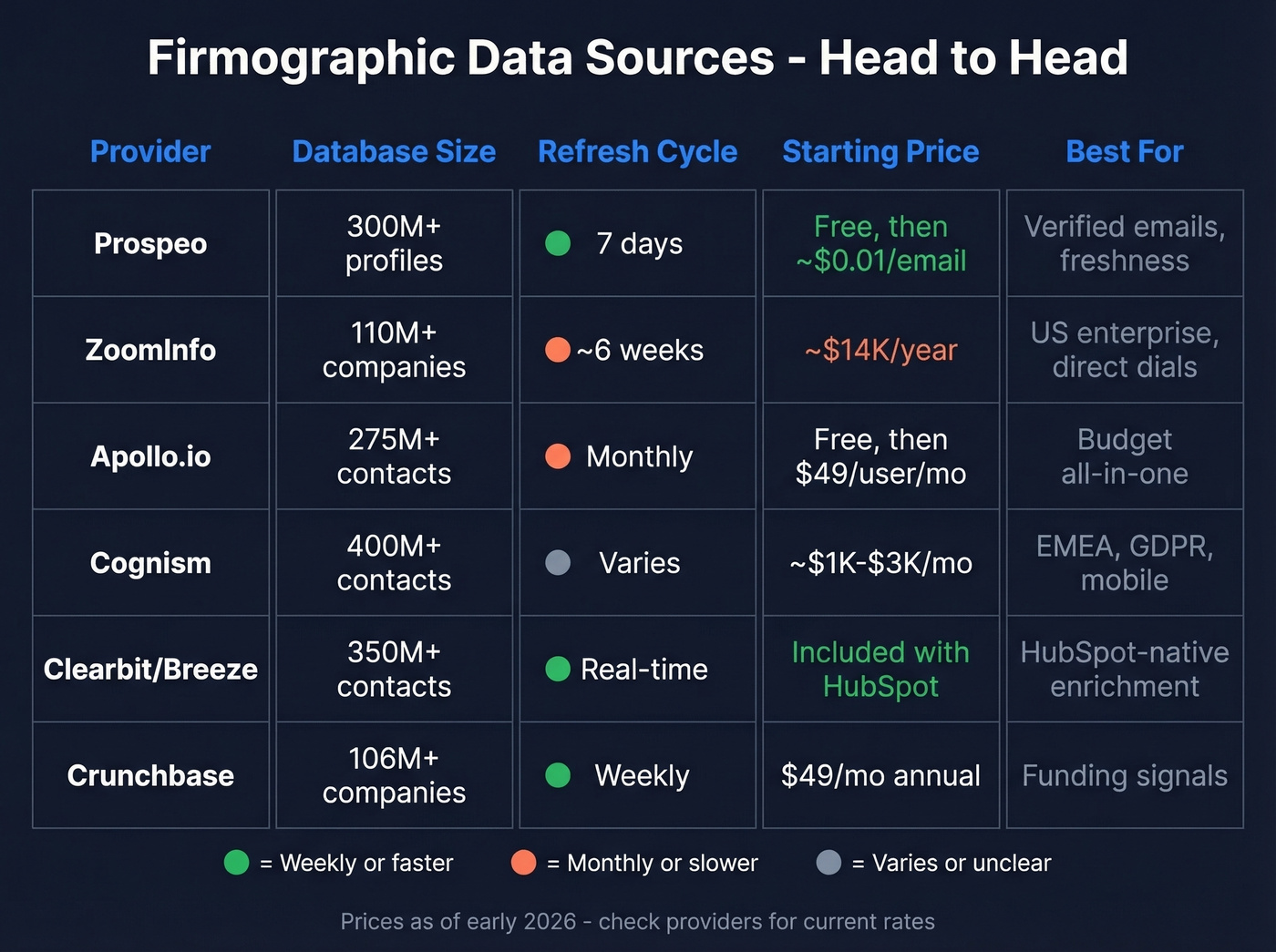
Cognism is the go-to for EMEA coverage and GDPR-first compliance, but its US database is thinner than ZoomInfo's. D&B has one of the deepest corporate hierarchy datasets at 500M+ businesses, though the credit-based pricing adds up fast. Breeze Intelligence is included with HubSpot Starter/Professional/Enterprise plans.
In a practitioner-tested roundup on r/B2BSales, Coresignal and People Data Labs were top recommended API-first alternatives for custom enrichment pipelines. MixRank - 65M+ private company profiles, hourly refresh, technographics-first - is another strong pick for developer teams that the usual listicles overlook. For global coverage beyond the US and EMEA, Xverum (700M+ companies) and Forager.ai (61M+ records across 249 countries) are worth evaluating.
You don't need to stitch together free registries, scrapers, and a $25K ZoomInfo contract. Prospeo gives you 300M+ profiles with 30+ firmographic filters - industry, headcount, revenue, funding, intent - all verified weekly. Meritt cut their bounce rate from 35% to under 4%.
One platform. Every firmographic signal. No sales call required.
How to Choose by Workflow
Your choice depends on one question: are you enriching, triggering, or building from scratch?
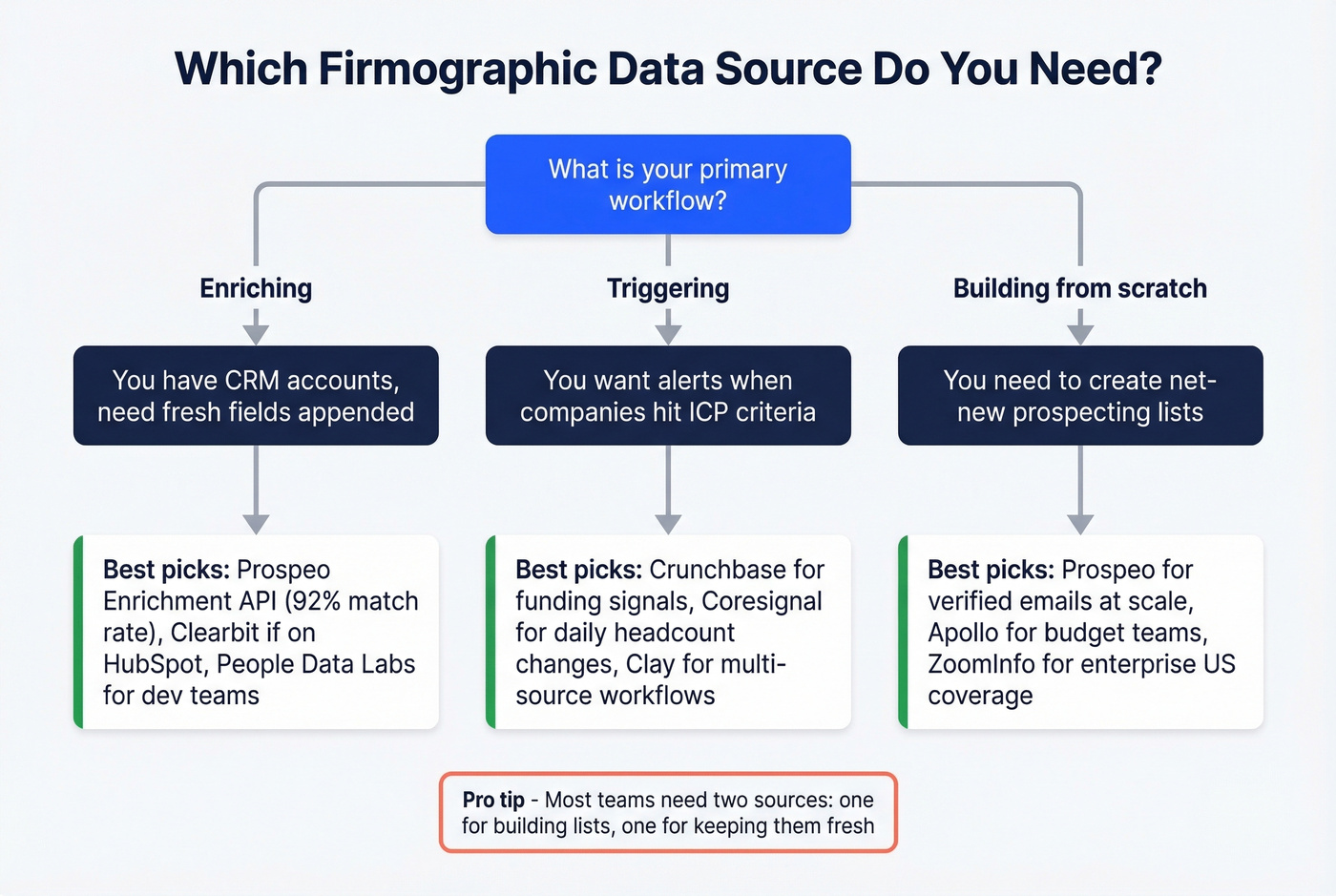
Enriching existing CRM records - You already have accounts; you need fresh emails, phones, and firmographic fields appended. Look for providers with enrichment APIs returning 50+ data points and match rates above 90%. Clearbit works if you're already on HubSpot. Prospeo's enrichment API hits a 92% match rate and returns 50+ data points per contact, which makes it a strong fit for RevOps teams running automated workflows.
Trigger-based outbound - Funding rounds, hiring surges, job changes. Crustdata or 6sense handle this well, though both are enterprise-priced with custom quotes. These tools excel at real-time signals and webhooks, not static lists.
All-in-one outreach + data - Apollo or ZoomInfo. Apollo for budget, ZoomInfo for depth. Pick based on your ACV and team size.
DIY pipeline / developer-first - People Data Labs, Coresignal, MixRank, or Bright Data. You're building custom enrichment workflows via API and need raw data at scale. Skip this path if your team doesn't have engineering resources to maintain the pipeline - the setup and maintenance cost more than most teams expect.
Compliance in 2026
California's updated CCPA regulations took effect January 1, 2026, adding cybersecurity audit and risk assessment requirements. Any firmographic data provider you use needs to demonstrate both GDPR and CCPA compliance - this isn't optional anymore, even for US-only teams selling into California. Confirm opt-out enforcement and DPA availability with any provider before you sign.
FAQ
What's the difference between firmographic and technographic data?
Firmographic data describes company attributes - size, revenue, industry, location. Technographic data describes a company's tech stack. Most commercial providers bundle both, so you can target companies using specific tools without a separate subscription.
How often should I refresh firmographic data?
At minimum, quarterly. B2B data decays roughly 2.1% per month, so a six-month-old list has about 12% stale records. For active outbound, weekly refresh keeps bounce rates under 5% without manual re-enrichment.
Are there good free firmographic data sources?
Yes - SEC EDGAR, OpenCorporates, Census County Business Patterns, and state business registries all provide company-level data at no cost. They're useful for TAM estimation and validating commercial data, but they lack emails, phone numbers, and normalized fields. For outbound prospecting, pair them with a commercial provider that offers a free tier so you can test before committing budget.