

Firmographic Segmentation: Variables, Framework & Data for 2026
84% of reps missed quota last year. Not because they couldn't sell - because they were selling to the wrong accounts. When 80% of B2B interactions happen in digital channels and the average buying committee runs seven people deep, spraying outbound at every company in your TAM isn't a strategy. It's a waste of pipeline.
Firmographic segmentation is how you fix the targeting problem before it becomes a revenue problem.
The Short Version
Firmographic segmentation groups companies by shared attributes - industry, size, revenue, location - so your sales and marketing teams focus on accounts that actually fit your ICP. Most guides stop at definitions. We're covering the 8 core variables, a step-by-step implementation framework, a data provider comparison with real pricing, and the critical "fit vs. timing" insight most teams skip entirely.
What Is Firmographic Segmentation?
The word itself is straightforward: "firm" (company) + "demographic" (descriptive attributes). It's the B2B equivalent of consumer demographics. Instead of segmenting people by age, income, and education, you're segmenting companies by industry, headcount, revenue, and geography.
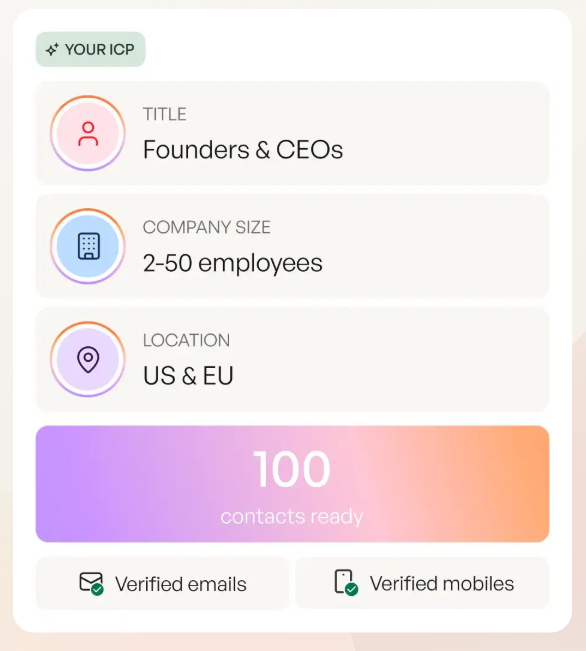
The goal is figuring out which types of companies are worth pursuing and which aren't, before you spend a dollar on outreach. 88% of B2B marketers already use third-party firmographic data to do this. The difference between teams that get ROI and teams that don't comes down to execution - which variables you pick, how you layer them, and whether you actually activate the segments you build.
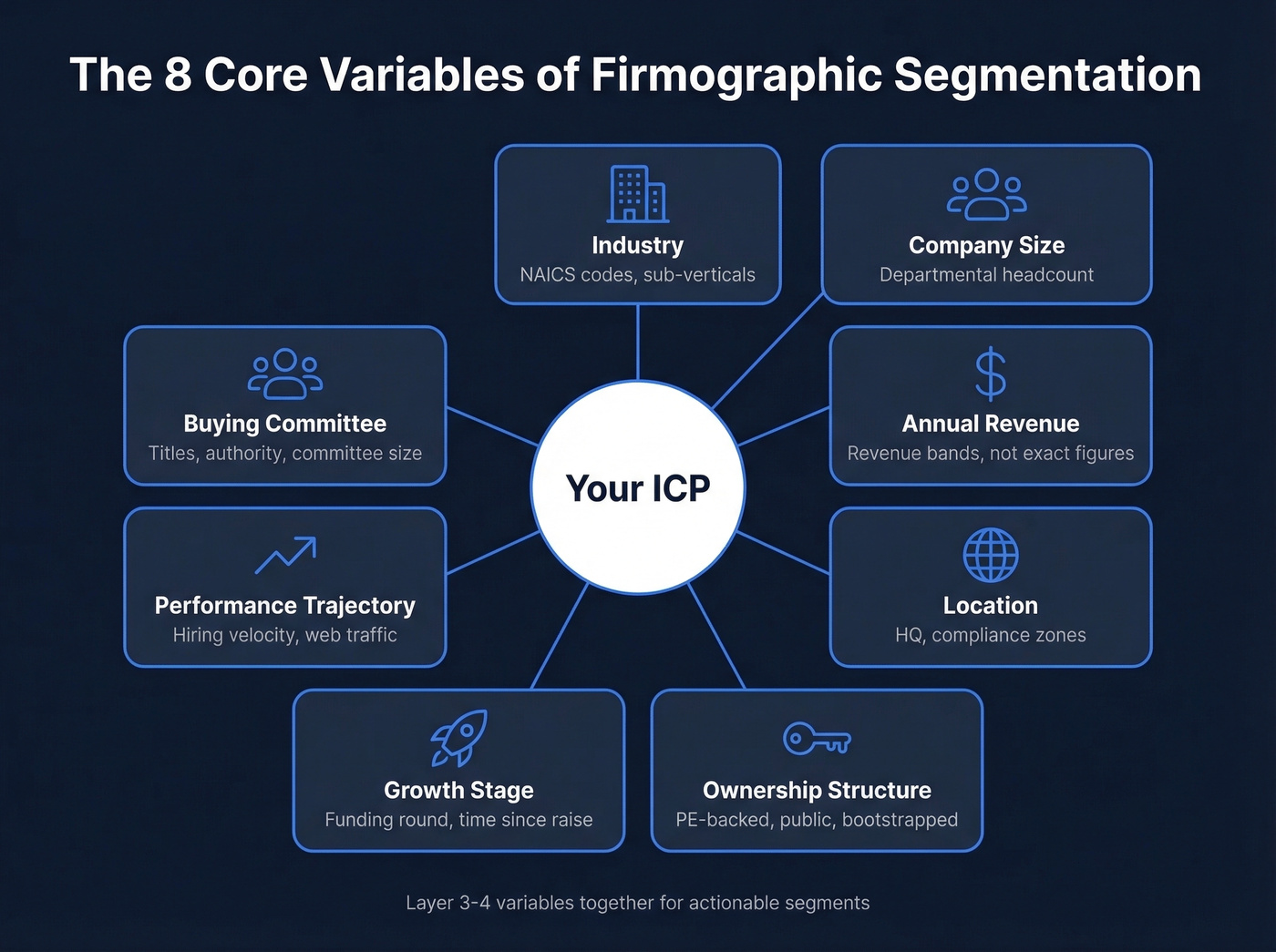
The 8 Core Variables
Industry
Industry is the most intuitive variable and the most deceptive. Most teams default to NAICS or SIC codes, but SIC was created in 1937 and last updated in 1987. NAICS is better - developed in 1997 with 1,000+ categories - but it still struggles with modern classifications. Search "Software" in ZoomInfo and you'll get 339,506 companies. Even after filtering to US/Canada with 100+ employees, you're still looking at 9,839 accounts.
Drill down to 4-6 digit NAICS codes minimum, and consider building custom sub-verticals that reflect how your buyers actually describe themselves.
Company Size
Raw headcount is a blunt instrument. A 500-person company with 200 engineers and a 500-person company with 200 salespeople have completely different needs. Where possible, use departmental headcount - how many people sit in the function your product serves. Job posting data works as a proxy for department growth when exact numbers aren't available. Company size is one of the most common starting points for B2B segmentation, but it works best when layered with other variables rather than used alone.
Annual Revenue
Revenue tells you budget capacity, but for private companies it's almost always an estimate. We've seen the same company listed at "$50M revenue" in one database and "$20M" in another. Use revenue bands rather than precise figures to absorb that variance. Revenue-based segments also inform pricing and packaging - enterprise tiers, mid-market bundles, and SMB self-serve plans should map directly to how your ICP segments break down.
Location & Geography
Geography affects buying behavior, compliance requirements, and sales motion. A company headquartered in Germany has different procurement norms than one in Texas. Location also triggers regulatory considerations - GDPR in the EU, CCPA in California - that affect how you collect and use firmographic data itself.
Teams that ignore geography end up with compliance headaches and mismatched sales motions.
Ownership & Legal Structure
Public vs. private, PE-backed vs. bootstrapped, franchise vs. independent - ownership structure shapes purchasing authority, budget cycles, and decision speed. A PE-backed company in its first year post-acquisition has different urgency than a family-owned business that's operated the same way for 30 years.
Growth Stage & Funding
Seed-stage startups and Series D companies both have 200 employees sometimes, but they buy very differently. Funding stage, last round size, and time since last raise all signal where a company sits in its growth arc and how aggressively it's spending.
Performance & Trajectory
Static firmographics tell you what a company is. Trajectory tells you where it's going. Headcount changes, hiring velocity, web traffic trends, and funding announcements are the advanced signals that separate stale segments from actionable ones.
Buying Committee Structure
This variable bridges firmographics and contact-level data. Understanding how many people are involved in purchasing decisions - and which titles hold budget authority - determines your outbound strategy. A 7-person buying committee at a mid-market company requires multi-threading, not single-thread SDR outreach.
Why Timing Matters More Than Fit
Here's the thing most segmentation guides won't tell you: firmographic segmentation tells you who could buy. It doesn't tell you who will buy now.
This is the gap that kills most segmentation projects. Think of it as fit vs. timing. Fit is your firmographic ICP - right industry, right size, right revenue. Timing is the trigger that makes them ready to act: leadership changes, failed audits, new funding rounds, hiring surges in a specific department. The concept of a Minimum Viable Segment captures this well - the smallest group sharing the same struggle, urgency, and trigger.
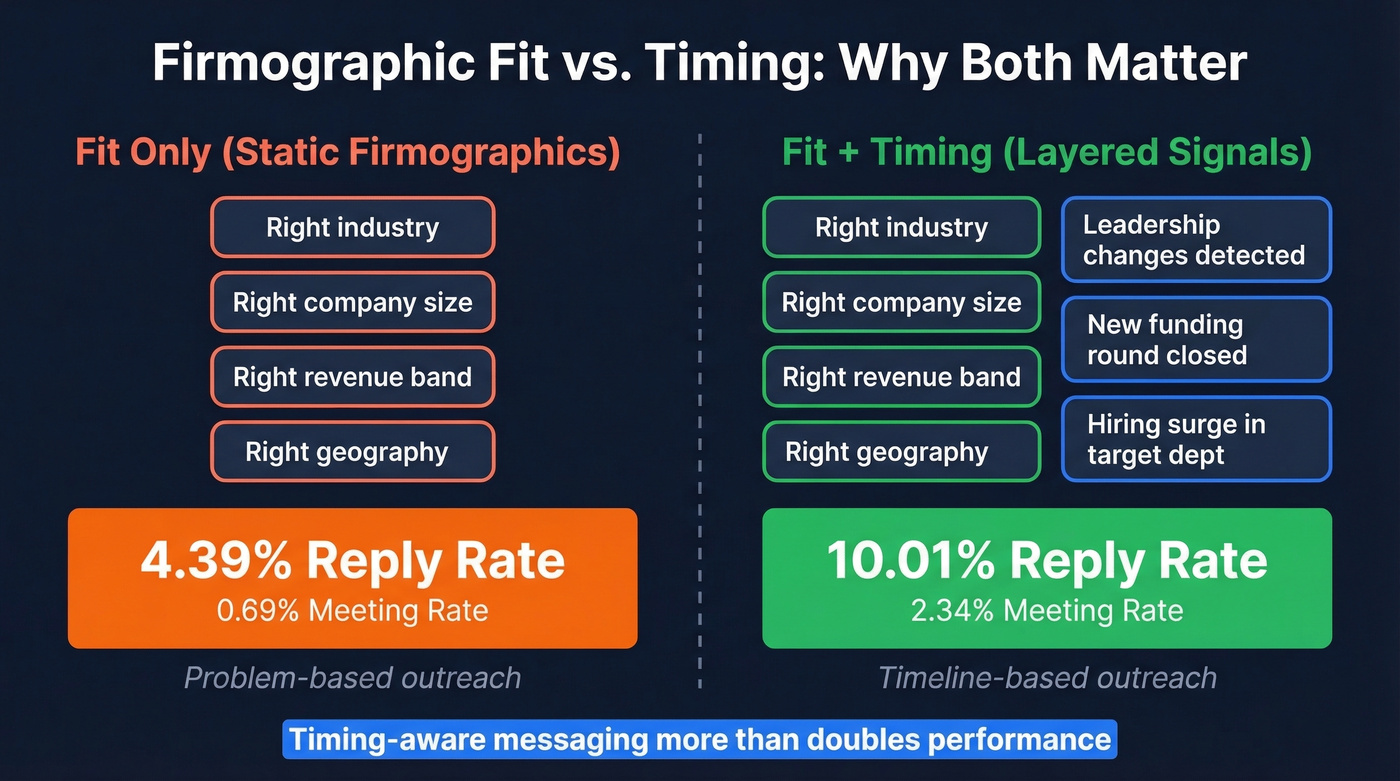
The data backs this up. Timeline-based cold email hooks generate a 10.01% reply rate vs. 4.39% for problem-based hooks - and meeting rates are 2.34% vs. 0.69%. Timing-aware messaging more than doubles performance.
Let's be honest: if your average deal size is under $15K, you probably don't need a $40K intent data platform. But you absolutely need some timing layer - even if it's just tracking job changes and funding rounds on top of your segments. The teams still running pure firmographic outbound in 2026 are the ones watching reply rates crater.
The practical move is to layer intent signals on top of your segments. Prospeo's intent data tracks 15,000 topics via Bombora, so you can identify which accounts in your ICP are actively researching solutions right now. Combine that with hiring velocity and funding signals, and you're not just segmenting - you're prioritizing.

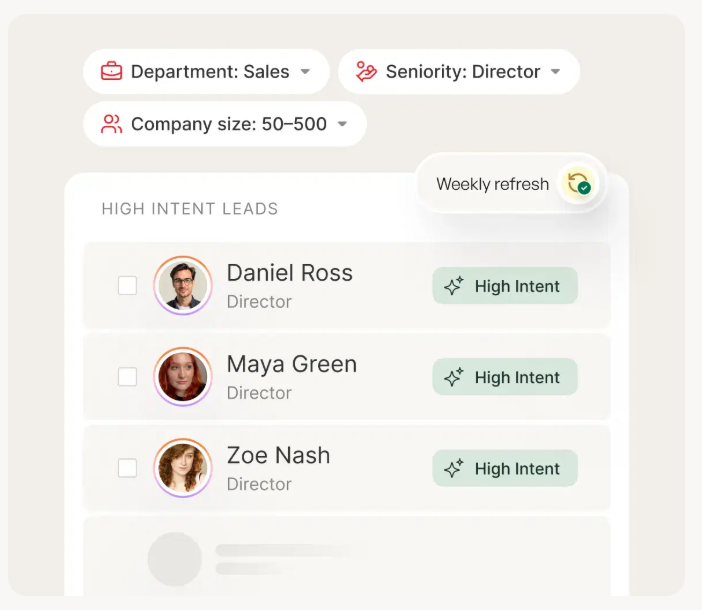
Firmographic segmentation only works when the underlying data is accurate. Prospeo gives you 30+ filters - industry, headcount, revenue, funding, department size, technographics, and buyer intent across 15,000 topics - all refreshed every 7 days. That means your segments reflect reality, not a snapshot from six weeks ago.
Stop segmenting on stale data. Build segments that actually convert.
How to Build Firmographic Segments (7 Steps)
This framework takes 2-6 weeks depending on your data quality and scope. Don't rush it. A bad segmentation model is worse than no model, because it gives you false confidence.
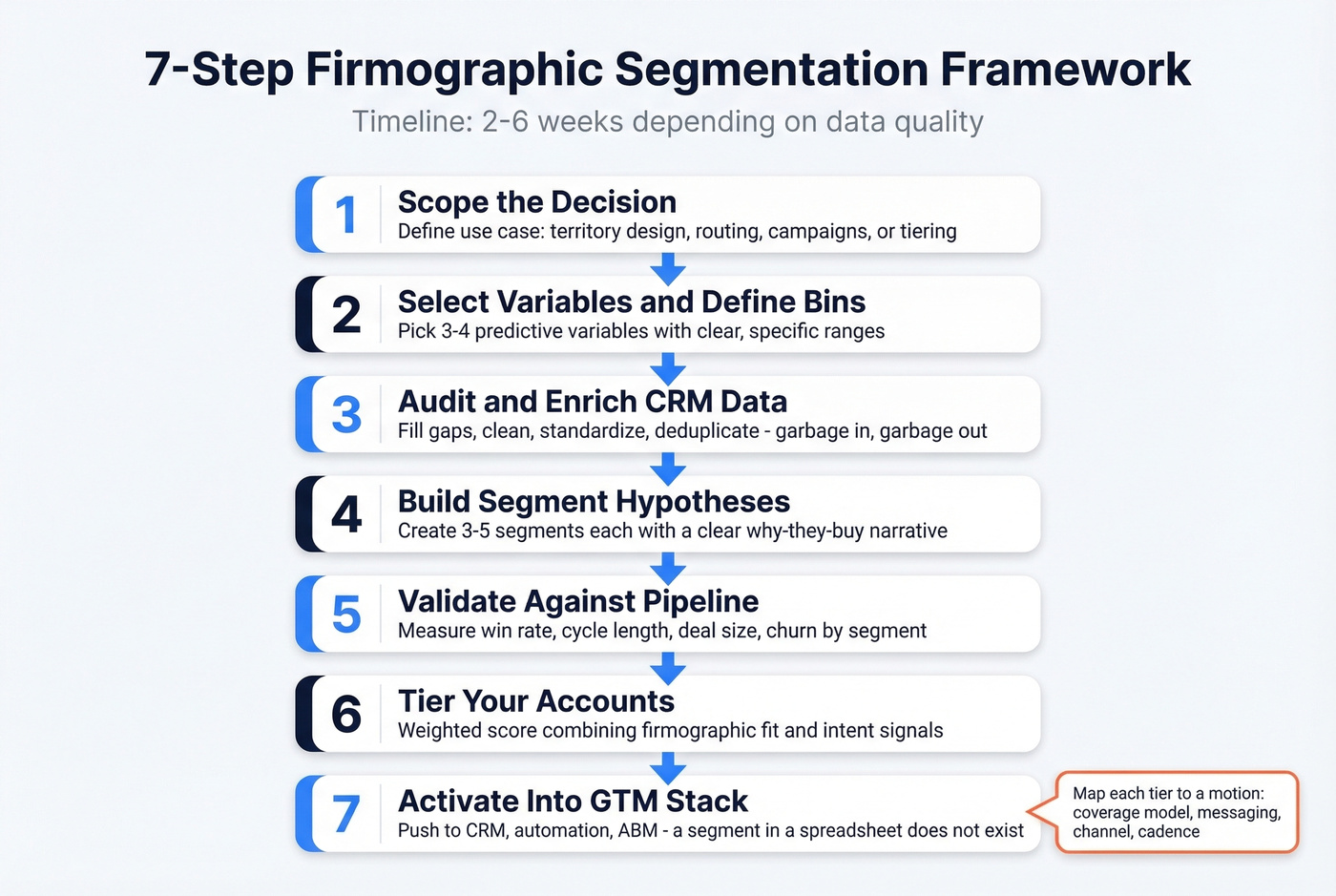
1. Scope the decision. What are you segmenting for? Territory design, lead routing, campaign targeting, account tiering? The use case determines which variables matter most.
2. Select variables and define bins. Pick 3-4 variables that predict conversion. Define clear bins - "50-200 employees" not "SMB." Ambiguous categories create ambiguous segments.
3. Audit and enrich your CRM data. Most CRMs are 30-50% incomplete on firmographic fields. Use an enrichment tool to fill those gaps. Clean, standardize, and deduplicate before you segment. We've found that skipping this step is the single biggest reason segmentation projects stall - garbage in, garbage out.
4. Build initial segment hypotheses. Create 3-5 segments based on your variables. Each should represent a distinct ICP with a clear "why they buy" narrative.
5. Validate against pipeline data. Pull your last 12 months of closed-won and closed-lost deals. Measure lead-to-opportunity rate, win rate, sales cycle length, average deal size, and churn by segment. If a segment doesn't outperform your baseline, it's not a real segment.
6. Tier your accounts. Use a weighted score combining firmographic fit and intent signals. Tier 1 gets dedicated AE coverage. Tier 2 gets sequenced outbound. Tier 3 gets marketing nurture.
7. Activate into your GTM stack. Push segments into your CRM, marketing automation, and ABM tools. A segment that lives in a spreadsheet is a segment that doesn't exist. Map each tier to a specific motion - coverage model, messaging, channel, and cadence.
Activating Segments Across Your GTM
Once your segments are built, the real value comes from activating them across your marketing and sales motions. Firmographic targeting drives everything from ad spend to content personalization to ABM campaign design. When your paid media platform knows that Tier 1 accounts are Series B+ SaaS companies with 200-1,000 employees, you can run campaigns that speak directly to their pain points instead of broadcasting generic messaging.
Analyzing churn patterns by segment reveals which company profiles stick and which ones churn early - letting you adjust your ICP and qualification criteria before bad-fit accounts clog your pipeline. In our experience, teams that review churn by segment quarterly catch ICP drift months before it shows up in top-line numbers.
Data Providers Compared
Not all firmographic data is created equal. We've seen teams burn months on a provider that looked great in a demo but delivered double-digit bounce rates in production.

| Provider | Database Size | Key Strength | Pricing | Best For |
|---|---|---|---|---|
| Prospeo | 300M+ profiles | 98% accuracy, self-serve, intent | Free tier, ~$0.01/email | Enterprise data without enterprise pricing |
| ZoomInfo | 110M+ companies | Deepest firmographics | ~$15K-$40K/yr | Large orgs with budget |
| Apollo.io | 73M+ companies, 275M+ contacts | All-in-one prospecting | $49-$119/user/mo | SMBs bundling data + outreach |
| Cognism | 400M+ contacts | EMEA/GDPR compliance | ~$1K-$3K/mo | EMEA-focused teams |
| Lusha | 100M+ profiles | Chrome extension speed | ~$22-$52/user/mo | Quick contact lookups |
| Clearbit / Breeze | 44M+ companies | HubSpot-native enrichment | Credit packs ~$30-$700/mo | HubSpot-native teams |
| 6sense | 1T+ signals/day | Intent signal processing | $30K-$100K+/yr | Enterprise ABM |
| Demandbase | ABM platform | Account orchestration | $30K-$100K+/yr | Enterprise ABM |
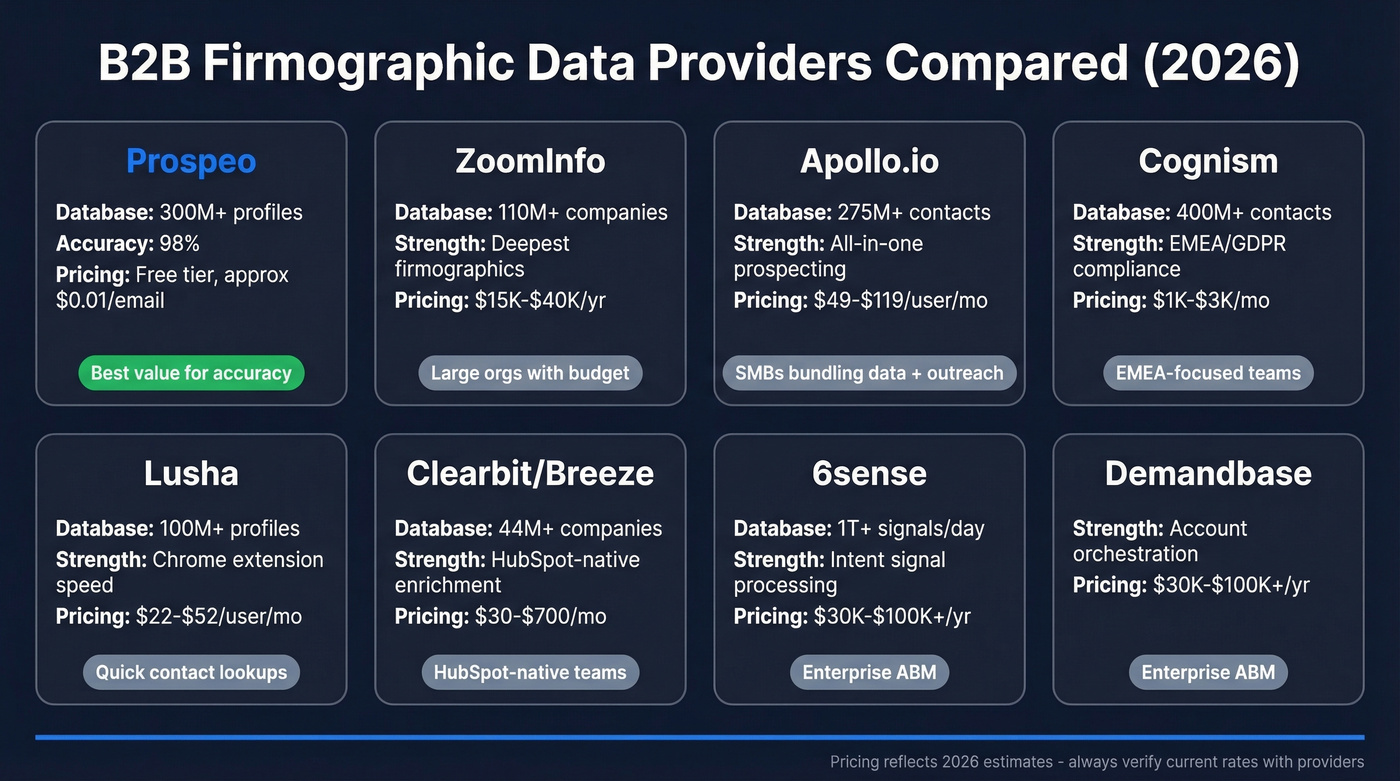
A few operational gotchas worth knowing. ZoomInfo's real cost often lands higher than the sticker price once you add modules, credits, and overages - the credit system is a recurring pain point in sales ops communities, and auto-renewal windows catch people off guard. Apollo is the best value play for SMBs bundling data with outreach, but bounce rates climb outside the US, and the platform has had breach incidents in 2018 and 2021 worth factoring into vendor risk assessments. Dun & Bradstreet's product packaging is notoriously confusing - practitioners on Reddit consistently flag that it's hard to understand what you're actually buying.
Skip 6sense and Demandbase if your team is under 50 people or your ACV is below $30K. Those platforms are built for enterprise ABM motions with dedicated ops teams. For everyone else, the ROI math doesn't work.
If you're evaluating vendors, start with a ranked list of the best B2B databases and narrow from there.
You just learned that timing doubles reply rates. Prospeo layers Bombora intent data across 15,000 topics on top of firmographic filters - so you're not just identifying accounts that fit your ICP, you're prioritizing the ones actively researching solutions right now. All at $0.01 per email with 98% accuracy.
Turn fit-plus-timing from theory into your next campaign.
Benchmarks: What Good Looks Like
Teams that segment well see measurable lifts. Precise firmographic targeting typically yields 20-40% higher response rates compared to broad campaigns. Firmographic-based lead routing increases lead-to-opportunity conversion by 15-25% while cutting response time from days to hours. Suppressing accounts that don't fit your ICP reduces wasted marketing spend by 10-20%.
The most concrete case study we've found is Personio's 16% lift in demo signups after implementing firmographic customer segmentation - a meaningful number for a company at scale. Meanwhile, average cold email reply rates have declined from 6.8% to 5.8% year over year. The teams holding steady or improving are the ones layering intent and timing signals on top of static segments.
5 Mistakes That Kill Your Segments
Single-variable reliance. Segmenting by industry alone is like hiring based on a resume headline. Layer at least 3 variables - industry + size + revenue is the minimum viable combination.
Over-segmentation. Creating 20 micro-segments feels sophisticated. It's not. If your sales team can't remember which segment a prospect belongs to, you've over-engineered it. Start with 3-5.
Stale data. Firmographic data decays fast - companies get acquired, headcounts shift, revenue changes. Review and refresh segments every 6-12 months at minimum. Weekly enrichment cycles help keep the underlying data current.
Ignoring timing and triggers. Static firmographics tell you who fits. Intent signals and trigger events tell you who's ready. You need both. If you want a practical system, use a repeatable process to identify buyer intent signals and feed them into your scoring.
Segmenting without activating. Look, this is the most common failure mode we see. A team spends six weeks building beautiful segments, puts them in a deck, and never pushes them into the CRM or sequencer. You don't need 12 variables. You need 3-4 that predict conversion, validated against your own pipeline, and activated into your GTM motions.
FAQ
What's the difference between firmographic and demographic segmentation?
Firmographics describe companies - industry, size, revenue, location, ownership. Demographics describe individuals - age, income, education, job title. In B2B, firmographic segmentation targets the right accounts before you target the right people within them. Firmographics are the company-level filter; demographics are the contact-level filter.
How many segments should I create?
Start with 3-5 segments built around your highest-signal variables - usually industry, company size, and revenue. Validate each against 12 months of pipeline data before adding complexity. Unvalidated segments add noise and dilute your team's focus.
Where can I get firmographic data without a large contract?
Self-serve platforms like Prospeo (free tier, 300M+ profiles, 30+ filters including intent data) and Apollo ($49/user/mo) offer firmographic data with transparent pricing and no annual lock-in. Enterprise platforms like ZoomInfo start at ~$15K/year and typically require annual contracts with sales-led procurement.
How often should I refresh my segments?
Review segment definitions every 6-12 months and refresh the underlying data continuously. Companies get acquired, headcounts shift, and revenue changes quarterly. A 7-day data refresh cycle - versus the 6-week industry average - makes a real difference in keeping segments accurate.
Firmographic segmentation comes down to three moves: pick 3-4 variables, validate against your pipeline, and activate into your GTM stack. That's the whole playbook.