

Folk vs HubSpot: Pricing, Features, and the Honest Verdict (2026)
Your 4-person team just outgrew Google Sheets. Someone says "let's get a real CRM," and suddenly the Folk vs HubSpot decision lands on your desk.
This isn't really a "features" debate. It's a bet on how much process you want to enforce, how much time you can spend setting things up, and how fast your costs will climb once you add seats. Let's break it down.
30-second verdict
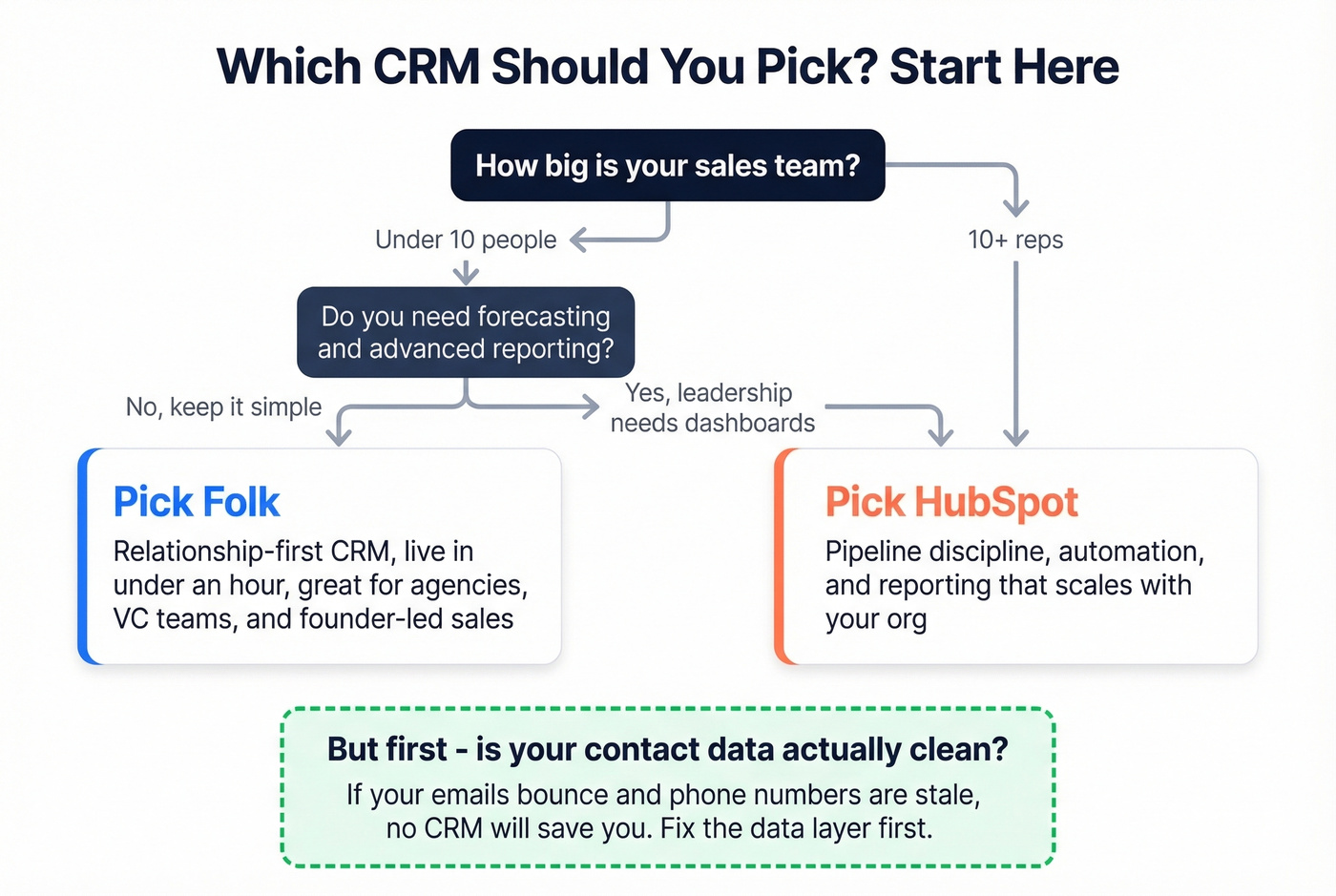
Pick Folk if you're under 10 people and you want a lightweight, relationship-first CRM you can set up in an afternoon without turning your week into an implementation project.
Pick HubSpot if you're running a real sales org (10+ reps, defined stages, forecasting expectations) and you need pipeline discipline, advanced reporting, and an integration ecosystem that can grow with you.
Our take: Folk is a 7/10 for small teams. HubSpot is an 8/10 for scaling sales orgs.
Pricing side by side
This is where the conversation gets real. Folk looks cheap until you scale. HubSpot looks reasonable until you realize how often "we just need one more thing" means "we need the next tier."
| Folk Standard | Folk Premium | HubSpot Sales Hub Starter | HubSpot Sales Hub Professional | |
|---|---|---|---|---|
| Price | $30/member/mo | $60/member/mo | Starts at $20/mo | Starts at $100/mo |
| Annual (Folk) | $24/member/mo | $48/member/mo | - | - |
| Included monthly credits | 500 enrichments/mo (workspace) | 1,000 enrichments/mo (workspace) | 500 HubSpot Credits/mo | 3,000 HubSpot Credits/mo |
| Email sequences | ✗ | ✓ | ✗ | ✓ |
| API access | ✗ | ✓ | - | - |
| Typical implementation/onboarding cost | None | None | None | ~$3k-$6k |
A detail people miss: Folk's enrichment credits are workspace-wide, not per seat. So a 5-person team on Standard shares 500 enrichments a month. That's 100 per person if usage is even (it never is).
Folk also offers a Custom tier from $100/member/month billed monthly or from $80/member/month billed yearly for teams that need higher limits.
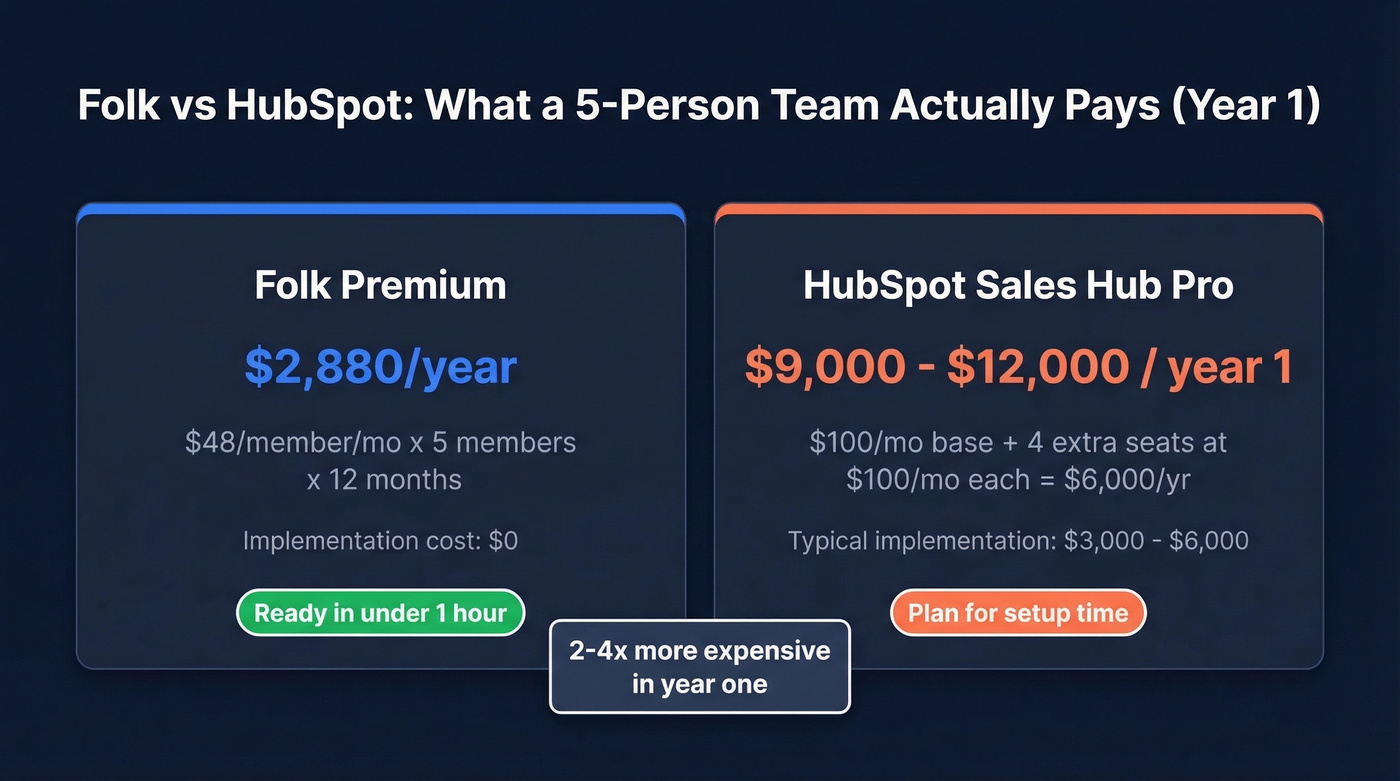
Total cost for a 5-person team (annual):
- Folk Premium: $48 x 5 x 12 = $2,880/year
- HubSpot Sales Hub Professional (5 sales seats): $100/month base (includes 1 sales seat) + 4 x $100/month = $500/month = $6,000/year + typical implementation = $9,000-$12,000 year one
That's a 2-4x difference in year one, and it's not a rare edge case. We've run this math with a lot of small teams, and the same thing happens: they budget for Starter, then discover the workflow/reporting/sequence stuff they actually want lives higher up the ladder.
For HubSpot's own plan details, start here: https://www.hubspot.com/pricing/sales

Folk's 500 enrichment credits won't last a week. HubSpot's data decays faster than you can update it. Prospeo gives you 300M+ profiles with 98% email accuracy at ~$0.01/email - and refreshes every 7 days so your CRM never rots.
Stop debating CRMs and start fixing the data inside them.
Feature comparison
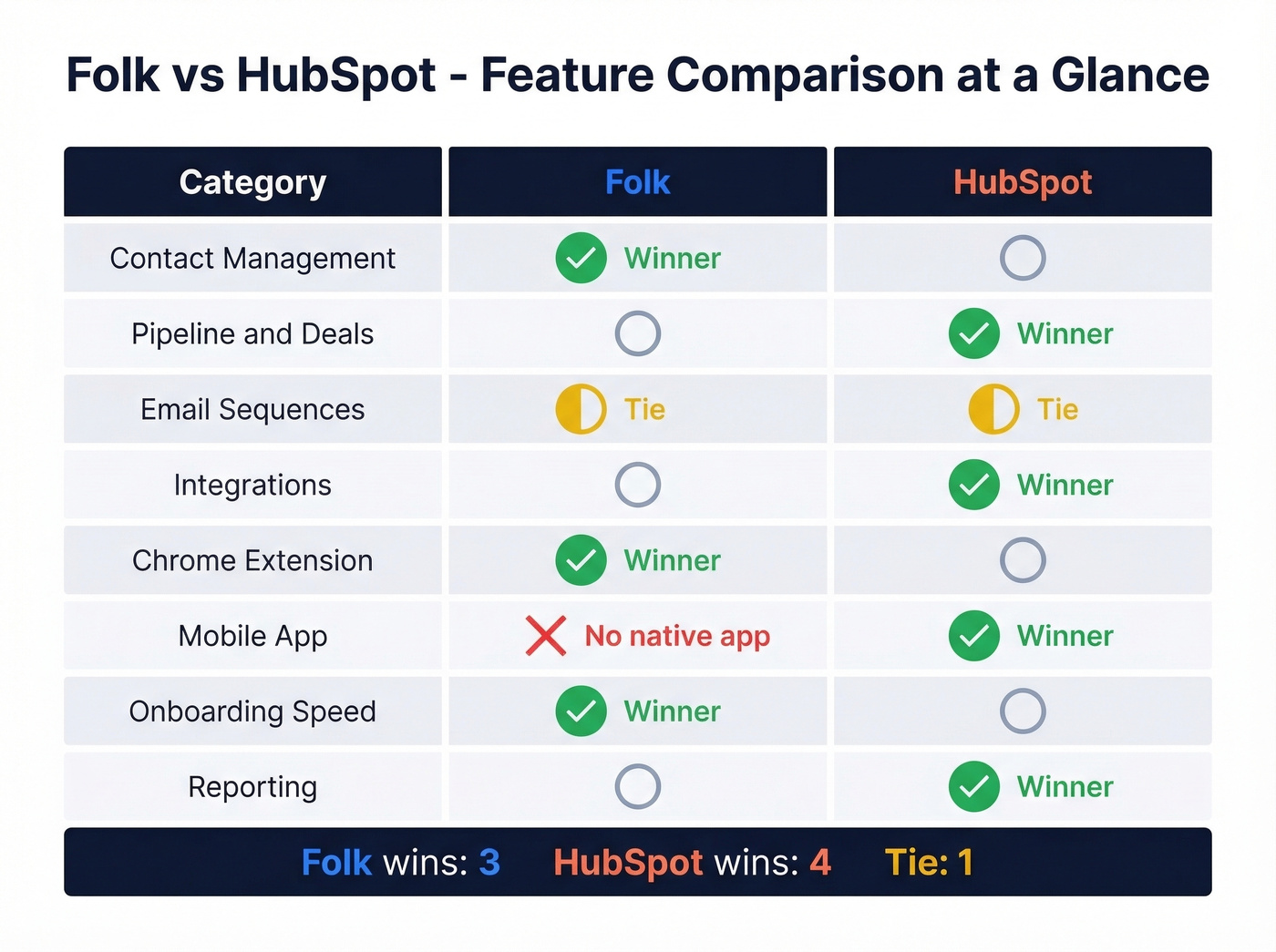
| Category | Winner | Why |
|---|---|---|
| Contact management | Folk | Spreadsheet-style UI, fast to adopt |
| Pipeline & deals | HubSpot | Built for structured pipeline management and scaling |
| Email sequences | Tie | Both push this behind paid tiers |
| Integrations | HubSpot | Bigger app marketplace and deeper native options |
| Chrome extension | Folk | folkX captures contacts from web pages and other web sources |
| Mobile app | HubSpot | Folk doesn't have a native mobile app |
| Onboarding speed | Folk | Under an hour for tiny teams vs at least a day for HubSpot |
| Reporting | HubSpot | Strong dashboards, forecasting, and reporting depth |
Folk treats contacts like relationships. HubSpot treats contacts like revenue motion: stages, probabilities, tasks, SLAs, and reporting that makes a VP of Sales happy.
Here's the thing: if your reps live in spreadsheets and hate "CRM admin energy," Folk's UI feels like relief. If your Monday meeting includes a forecast call and a pipeline inspection, HubSpot's built for that world.
Hot take: most teams closing deals under $10k don't need HubSpot-level infrastructure. They need a CRM their reps will actually open every morning, and they need it to stay clean without someone babysitting it.
If you're still mapping what counts as a CRM (and what doesn't), see these examples of a CRM.
What users actually say
Folk: simple, but shallow
Folk sits at 4.5/5 on G2 across 318 reviews. The praise is consistent: it's easy to use, the interface feels clean, and support tends to respond like real humans.
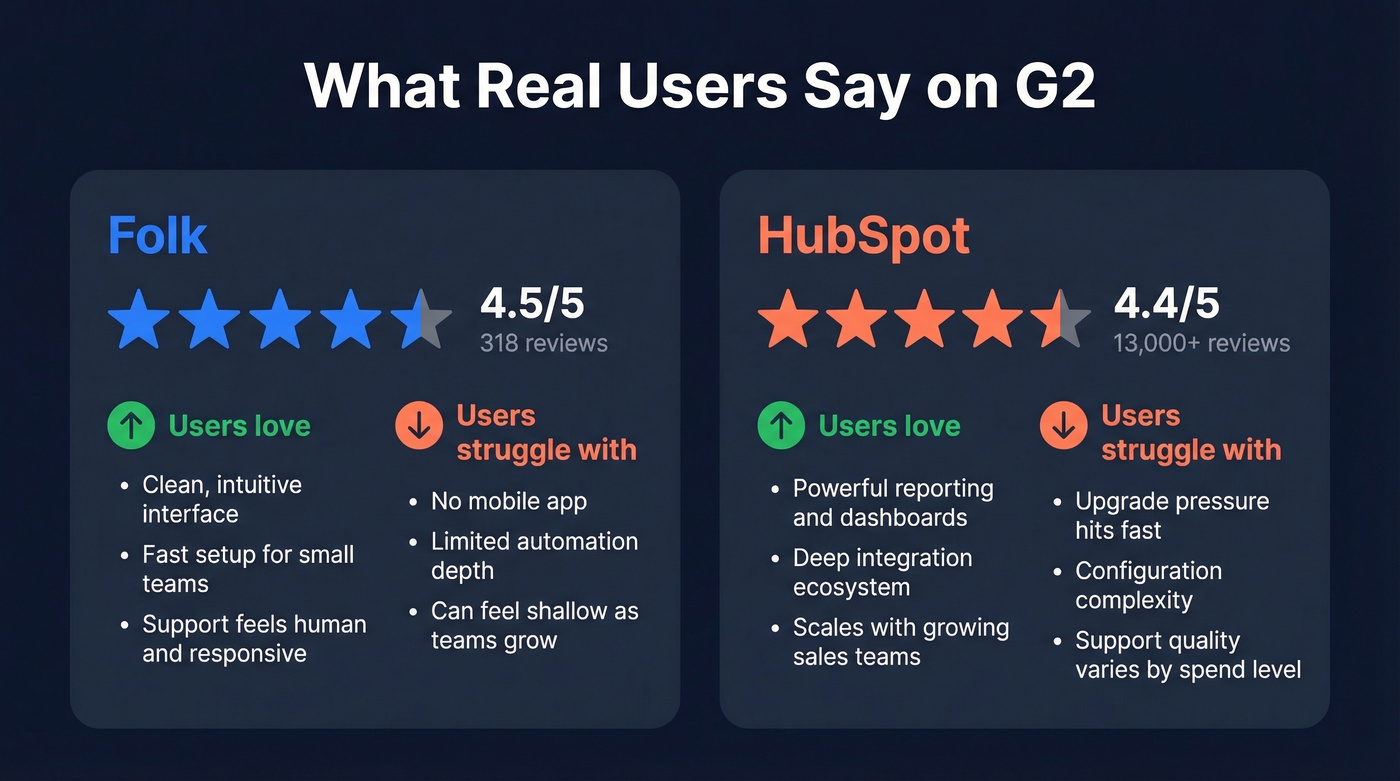
The complaints are just as consistent. Missing features (especially the lack of a mobile app) comes up a lot, and teams that want deeper automation or more mature integrations can feel boxed in.
A scenario we've seen: a small partnerships team loves Folk for six months, then the company hires two AEs and suddenly everyone wants deal stages, forecasting, and more granular reporting. That's when Folk starts to feel like a very nice contact manager with a few CRM features, not the system of record.
You can check the latest review mix directly on G2: https://www.g2.com/products/folk/reviews
HubSpot: powerful, but punishing
HubSpot Sales Hub holds 4.4/5 on G2 with 13,000+ reviews. It's a serious product. It's also the one that triggers the most "why is this so hard?" messages in team chats.
Real talk: the frustration usually isn't "HubSpot can't do it." It's "HubSpot can do it, but only after we pay more, configure more, and train more." Reddit threads on r/hubspot and r/sales consistently mention upgrade pressure, UI changes that break muscle memory, and support experiences that feel wildly different depending on how much you're spending.
We've also watched teams buy HubSpot with the best intentions, then end up with a half-configured portal where reps work out of their inbox anyway. That isn't HubSpot's fault, but it is the most common failure mode.
If you're comparing other CRMs in the same "scaling sales org" category, this Bitrix24 vs HubSpot breakdown is a useful second read.
For the current product overview, HubSpot's Sales Hub page is the cleanest reference: https://www.hubspot.com/products/sales
When to pick each
Pick Folk
Folk fits teams under 10 with relationship-heavy workflows: agencies, VC and partnerships teams, founders doing founder-led sales, and anyone who wants a CRM that behaves like a smart spreadsheet.
If you're mostly trying to organize relationships and stay lightweight, you may also want to look at contact management software options before you commit to a full sales stack.
If you want to be live today, not "live after RevOps finishes the build," Folk's hard to beat.
Pick HubSpot
HubSpot fits structured sales teams that need consistent stages, automation, and reporting that stands up to leadership scrutiny. If you're already thinking in terms of pipeline hygiene, forecasting, and a real integration stack, HubSpot earns its price.
If forecasting is a core requirement, compare your options in these sales forecasting solutions before you lock in a tier.
Just go in with eyes open: you'll spend time configuring it, and you'll probably spend more than the number you first saw on the pricing page.
Skip both if your problem is data
Look, this is the part that drives us nuts: teams will debate CRMs for weeks, then dump stale, bouncing contacts into whichever tool they pick and wonder why outbound performance tanks.
If your issue is coverage, accuracy, and freshness, the CRM UI won't save you. You need a dedicated data layer that keeps records verified and refreshed, then pushes clean data into Folk or HubSpot.
This is exactly what data enrichment services are built for - especially when your CRM becomes the system of record.
Prospeo is built for that job: 300M+ professional profiles, 143M+ verified emails, 125M+ verified mobile numbers, and 98% email accuracy, with a 7-day refresh cycle (the industry average is about 6 weeks). It also returns 50+ data points per contact, with an 83% enrichment match rate and a 92% API match rate, so your CRM doesn't slowly rot the moment you import a list.
If you're building outbound on top of that data, these sales prospecting techniques help you turn clean records into meetings.
If you're curious about how the integration side works, start here: https://prospeo.io/integrations

Whichever CRM you pick, it's only as good as the contacts you put in it. Prospeo enriches your Folk or HubSpot records with 50+ data points per contact, hits an 83% match rate, and integrates natively with HubSpot - no RevOps project required.
Plug verified data into your CRM in minutes, not months.
FAQ
Can Folk replace HubSpot for a sales team?
For teams under 10 running simple pipelines, yes. Folk covers contact management, basic deals, and email outreach on its Premium plan.
Once you pass 10 reps or you need forecasting, advanced reporting, and tighter automation, you'll feel Folk's ceiling fast. That's when HubSpot (or another sales-led CRM) starts to make sense.
Is HubSpot's free CRM actually free?
The core CRM is free, but the useful sales features are mostly in paid tiers. Sequences, deeper reporting, and many integrations typically push teams into Sales Hub plans.
Sales Hub pricing starts at $20/month for Starter and $100/month for Professional, and seat types plus add-ons can move the real total up quickly.
How do you keep CRM contact data accurate in 2026?
Assume contact data decays constantly. People change jobs, companies rebrand domains, and inboxes get locked down.
The cleanest approach is to run ongoing verification and enrichment on a short refresh cycle, then sync the results into your CRM so reps aren't working dead records.
Which CRM is better for agencies managing multiple clients?
Folk usually wins for small agencies (under 10 people) because it's quick to set up and doesn't force heavy process.
Agencies with larger teams, multiple pipelines, and reporting requirements tend to get more value from HubSpot's automation and integration depth.