

Follow-Up Email to Client After Quotation (2026 Guide)
You sent the quote three days ago. The client said they'd "review it and get back to you." Now it's Thursday afternoon, your inbox is empty, and you're drafting something like: "Hey _____ just following up, did you receive our quote? Let me know if you have any questions!"
That sounds desperate because it is.
Writing a follow-up email to client after quotation silence is one of the most overthought tasks in sales - and it shouldn't be. Silence isn't rejection. It's a timing problem, and timing problems have a fix. You don't need 15 templates. You need four, sent at the right intervals, to a verified email address.
Why Clients Go Silent After a Quote
Before you rewrite your follow-up for the fifth time, understand what's actually happening on the other end:
- They're busy. Your quote is sitting in a browser tab they meant to come back to Monday.
- They're comparing. Most buyers evaluate multiple quotes. Yours might be the frontrunner, but they're waiting on the last one to come in.
- Budget or timing shifted. A stakeholder went on PTO, or finance flagged the spend. None of that has anything to do with your price.
A contractor on r/smallbusiness nailed it: "No yes and no no." That's the limbo most quotes live in. Your follow-up cadence should treat silence as delay, not disinterest.
The 4-Email Quotation Follow-Up Cadence
55% of cold email replies come from follow-ups, not the initial send - which means your quote email was just the opening move. The best post-quote cadence is a graduated sequence: Day 2, Day 4, Day 7, Day 14. Tight early when the quote is fresh, then wider as you shift from helpful reminder to final check-in.
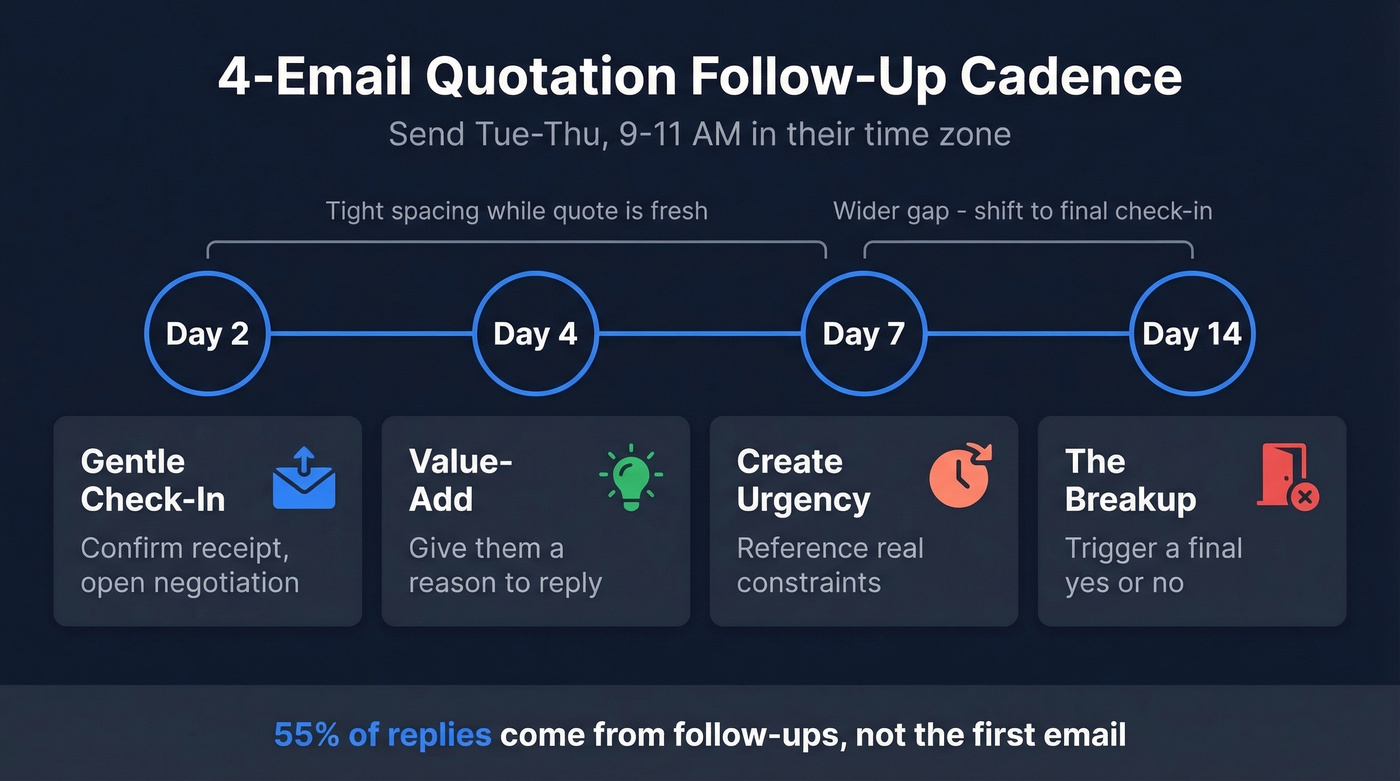
A few numbers to anchor this: Belkins analyzed 16.5 million cold emails and found the highest reply rate - 8.4% - comes from the first email. Each additional follow-up sees diminishing returns, and sending 4+ emails in a sequence more than triples unsubscribe and spam complaint rates. So keep your sequence tight and intentional. Don't drag it out forever.
Send Tuesday through Thursday, 9-11 AM in the recipient's time zone. Avoid Monday mornings and Friday afternoons.
| Day | Goal | |
|---|---|---|
| 2 | Gentle check-in | Confirm receipt, open negotiation |
| 4 | Value-add | Give them a reason to reply |
| 7 | Create urgency | Reference real constraints |
| 14 | Breakup | Trigger a final yes or no |
Template 1 - Gentle Check-In (Day 2)
Subject: Quick question on the [project name] quote
Hi [Name],
Wanted to make sure the quote for [project/service] came through clearly. If anything needs adjusting - scope, timeline, payment terms - I'm happy to revise.
Would a 10-minute call this week help move things along?
Low-pressure. You're confirming receipt and opening the door for negotiation, not pushing for a signature.
Template 2 - Add Value (Day 4)
Every follow-up that doesn't give the client new information is just inbox clutter. Before you write this one, find something worth sharing: a case study, a relevant data point, a clarification they didn't ask for but should've. In our experience, this is usually the email that earns the most replies because it gives them a concrete reason to respond.
Subject: One thing I forgot to mention re: [project]
Hi [Name],
Since sending the quote, I realized I didn't mention [relevant case study / ROI stat / implementation detail]. For context, [one sentence of proof].
Happy to walk through how that applies to your situation. What does your Thursday look like?
Template 3 - Create Urgency (Day 7)
Subject: Scheduling note for [project name]
Hi [Name],
I want to make sure we can hold [timeline/availability/pricing] for your project. Our [production schedule / team availability / current pricing] is locked through [date], so if you'd like to move forward, the next few days would be ideal.
If the timing has shifted on your end, totally understand - just let me know and I'll follow up when it makes sense.
Real urgency, not manufactured scarcity. You're referencing actual constraints - your team's calendar, a pricing window, a production queue. The escape hatch at the end gives them permission to say "not now" without ghosting forever.
Template 4 - The Breakup (Day 14)
Subject: Should I close this out?
Hi [Name],
I haven't heard back on the [project] quote, so I'm guessing the timing isn't right. I'll close this out on my end, but if things change down the road, I'm an email away.
Thanks for considering us either way.
HubSpot reports a 33% response rate on breakup emails. Something about "I'm closing this out" triggers action - either "wait, we're still interested" or a clear "we went another direction." If they respond with a no, reply graciously and ask what tipped the decision. That intel improves your next quote.

Your 4-email cadence means nothing if the quote lands in a dead inbox. Prospeo verifies emails with 98% accuracy across 143M+ addresses - so every follow-up actually reaches the client who requested your quote.
Stop following up into the void. Verify the address first.
5 Post-Quote Email Mistakes
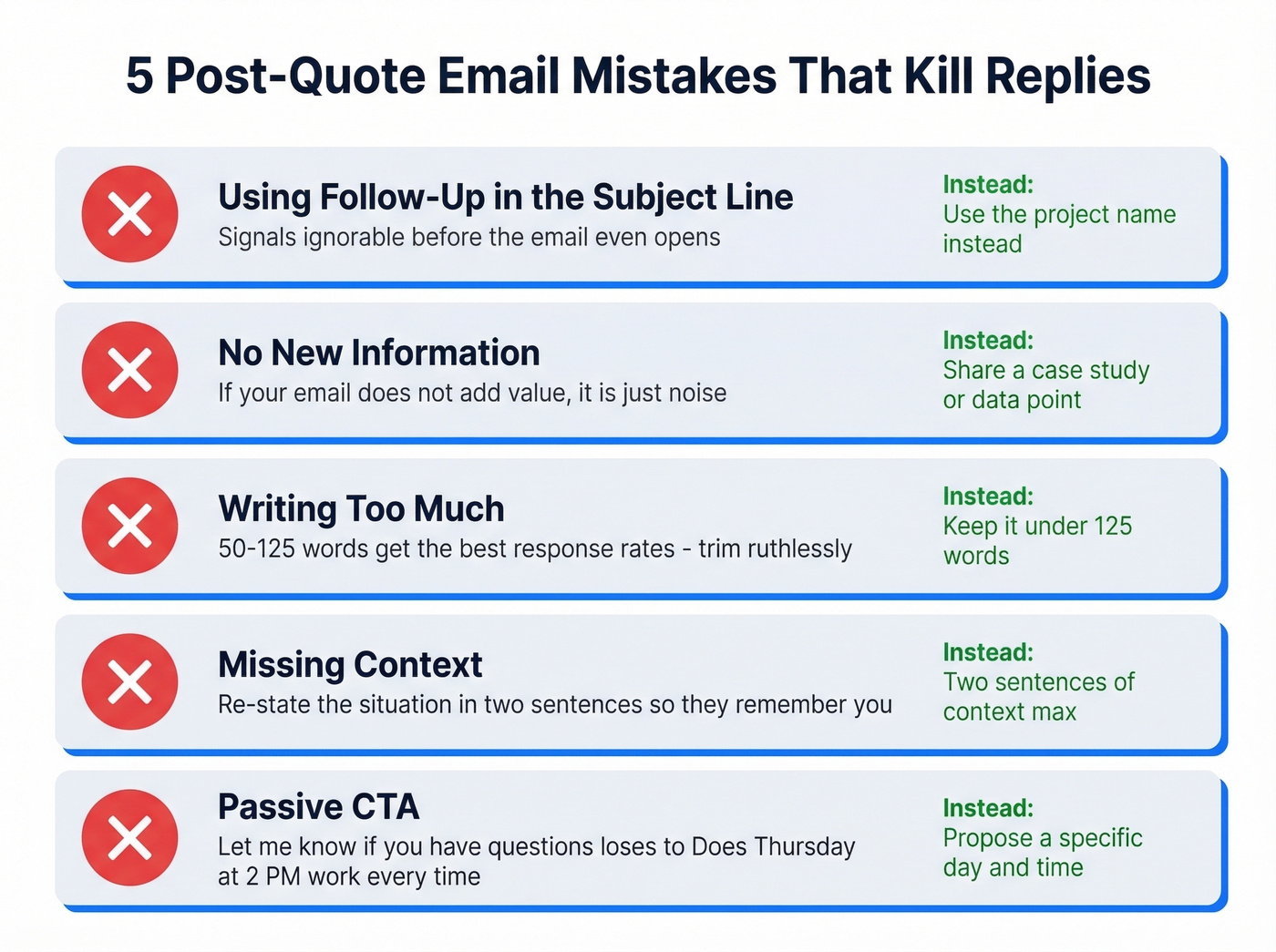
- "Follow-up" in the subject line. GlockApps flagged this as an anti-pattern - it signals "ignorable" before the email even opens.
- No new information. If your email doesn't add value, it's noise.
- Too long. Boomerang's data shows 50-125 words get the best response rates. Trim ruthlessly.
- Missing context. Re-state the situation in two sentences or less. Don't make them dig through their inbox to remember who you are.
- Passive CTA. "Let me know if you have questions" loses to "Does Thursday at 2 PM work?" every time.
Subject Lines That Get Opened
Boomerang found that 3-4 word subject lines perform best, and Zendesk recommends aiming for about 41 characters. The overlap is the real rule: keep it short and specific. Specificity beats cleverness:
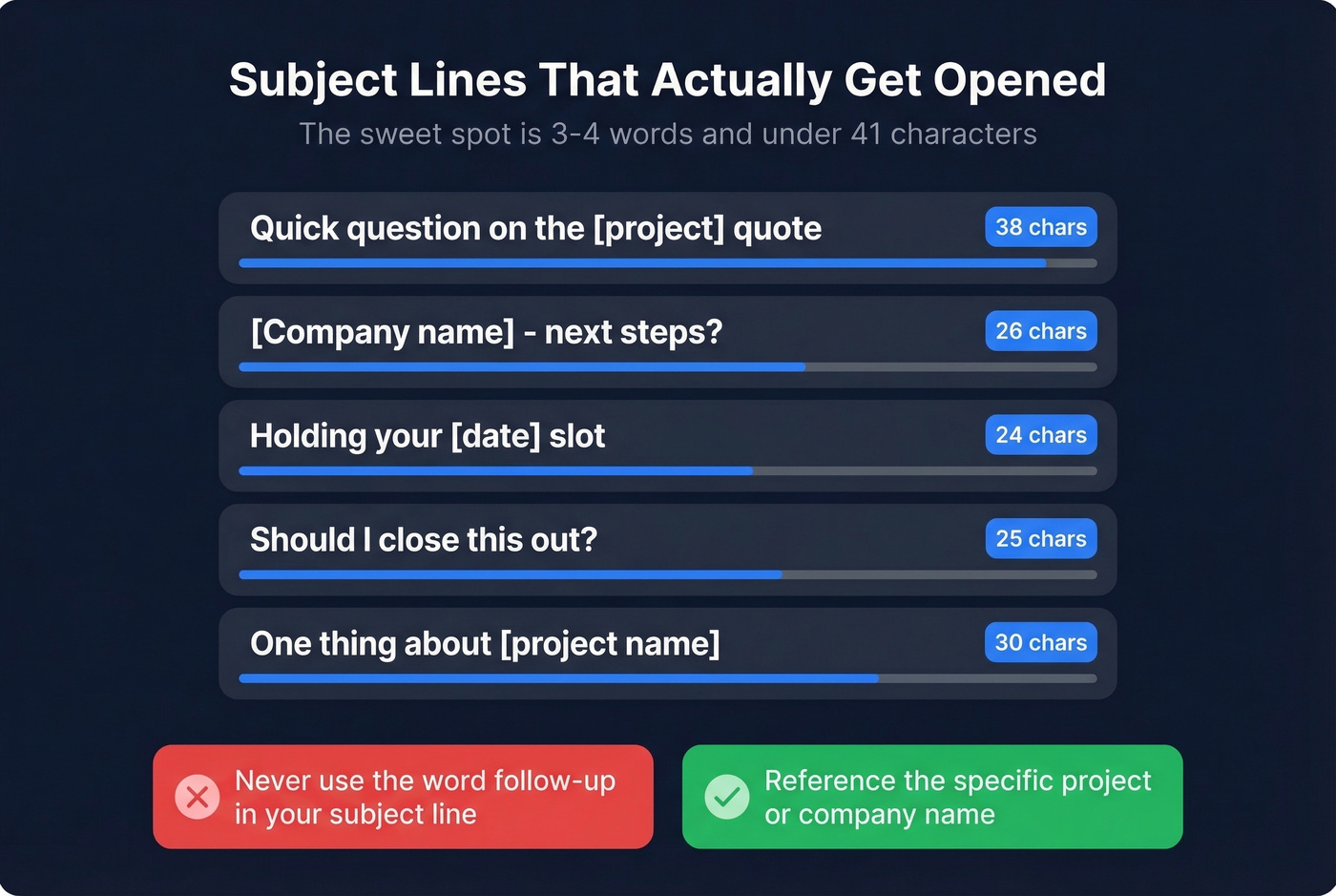
- Quick question on the [project] quote
- [Company name] - next steps?
- Holding your [date] slot
- Should I close this out?
- One thing about [project name]
Verify the Email First
Here's the thing most people miss: the majority of follow-up problems aren't copywriting problems. They're data problems. We've seen teams waste entire cadences on bounced emails, and one Reddit user described sending 15-30 custom quotes per day using Gmail Snooze to manage follow-ups. That's a lot of effort to burn on an invalid address.
Before you start any cadence, verify the recipient's email. Prospeo handles this with 98% accuracy across 143M+ verified emails - the free tier gives you 75 verified emails per month, which covers most small business and freelance workflows without spending a dime. If you're sending quotes at volume, the Chrome extension lets you verify addresses in one click before the quote even goes out.
If you want more options beyond these four, use these sales follow-up templates as a starting point.
If you're building a repeatable system, follow-up email software can help you schedule and track the sequence.
If you're trying to improve replies, start with email copywriting and tighten your CTA.
If deliverability is the real issue, use an email deliverability guide to fix the basics first.
If you're seeing bounces, check your email bounce rate and clean the list before you send.

Sending 15-30 custom quotes a day? That's too much effort to waste on bounced emails. Prospeo's free tier gives you 75 verified emails per month - enough to confirm every recipient before your cadence starts.
Verify every quote recipient in one click for $0.01 each.
FAQ
How long should I wait before following up on a quotation?
Two to three business days for small business and freelance quotes. For enterprise deals with multiple stakeholders, three to five days gives the buying committee time to circulate the proposal internally. Urgency fades fast after a week, so don't let the quote go stale.
How many follow-up emails should I send after a quote?
Four total - three follow-ups plus one breakup email. At 4+ emails in a sequence, unsubscribe and spam complaint rates more than triple according to Belkins' analysis of 16.5 million emails. Keep it tight and purposeful.
What if my quotation follow-ups get zero response?
First, verify the email address is valid - a bounced email means zero chance of a reply. Then confirm you're reaching the actual decision-maker, not a gatekeeper. If email fails entirely, a brief WhatsApp or text message can break through when inbox noise won't.
What's the best subject line for a follow-up email to client after quotation?
Keep it under seven words and reference the specific project or company name. "Quick question on the [project] quote" and "Should I close this out?" consistently outperform generic lines. Never put the word "follow-up" in the subject - it signals ignorable.