

How to Write a Follow Up Letter After No Response
You sent the email. You waited. Nothing came back.
That silence feels personal, but it almost never is - people are busy, and your message got buried under 50 others before lunch. Writing a follow up letter after no response is one of the most underrated professional skills, and the data backs that up: Belkins' study of 16.5M cold emails found the first email gets an 8.4% reply rate, yet 35% of people give up after one or two attempts. Most people quit right when persistence would start paying off. The follow-up isn't desperate - it's where the actual results live.
Quick Playbook
- Wait 3 business days before your first follow-up - this timing yields 31% more replies than following up immediately.
- Use the 3-5-7 cadence for proposals: follow up after 3 days, then 5 more, then 7 more.
- Keep it 50-125 words. That's the sweet spot.
- Email works for most situations. A physical letter signals seriousness for executive outreach or when email has failed twice.
- Every follow-up needs new value - not just "checking in."
- If the platform allows it, embedding a short video can boost click-through rates by 65%.
When to Follow Up
Timing matters more than wording. Send too early and you seem pushy. Wait too long and they've moved on entirely.
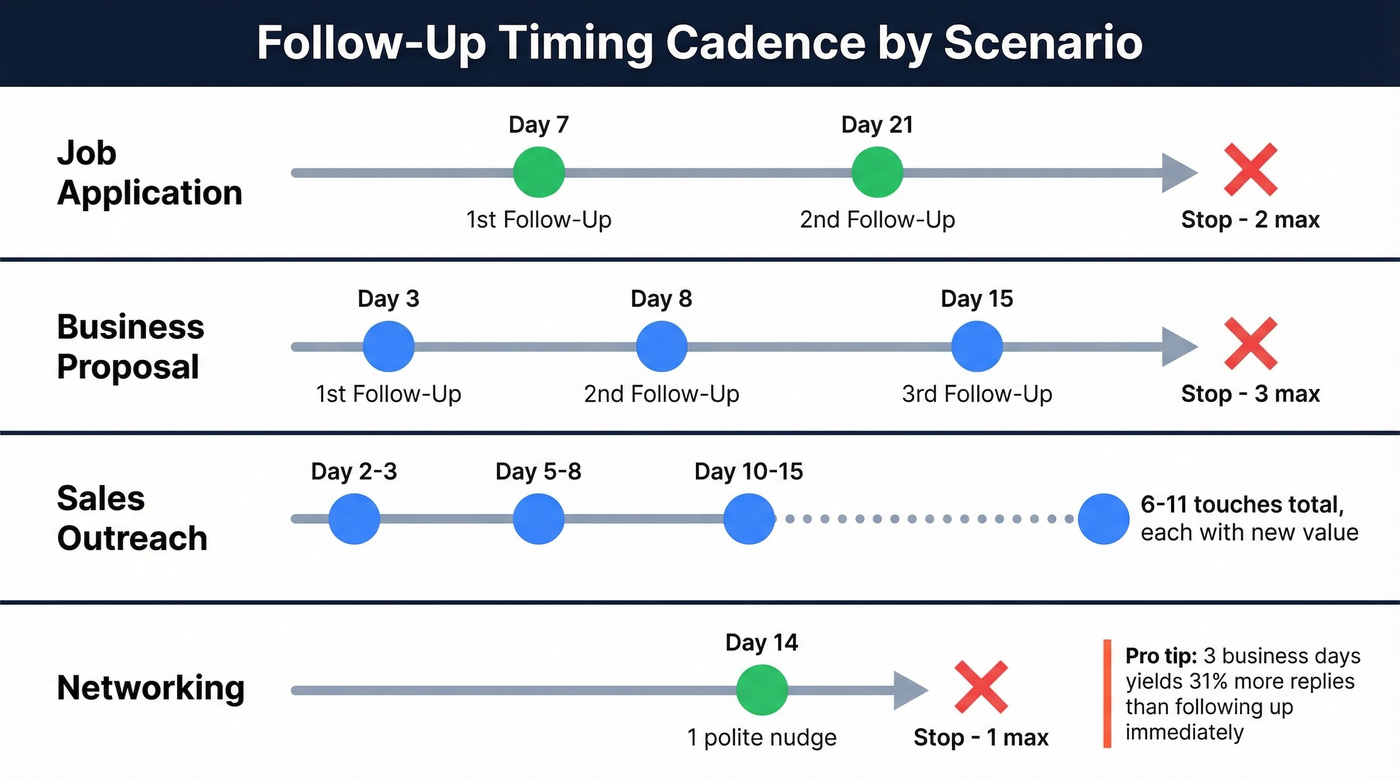
| Scenario | First Follow-Up | Second Follow-Up | Max Attempts |
|---|---|---|---|
| Job application | 1 week | 2 weeks | 2 |
| Business proposal | 3 days | +5 days | 3 |
| Sales outreach | 2-3 days | +3-5 days | 6-11 |
| Networking | 2 weeks | - | 1 nudge |
On r/jobsearchhacks, a common question is whether following up with a friend-of-a-friend contact is "too much." It's not - as long as you wait two weeks and keep it to a single nudge.

The biggest follow-up killer? Sending to an address that doesn't exist. Prospeo's 5-step email verification delivers 98% accuracy across 143M+ verified emails - so every follow-up actually lands in a real inbox.
Stop following up into the void. Start with verified data.
Templates by Scenario
Job Application
Wait one full week, then contact one specific person - the hiring manager if you can find them, otherwise the recruiter. Reference your application date and highlight one relevant skill.
Subject: Following up - [Job Title] application ([Date])
Hi [Name],
I applied for the [Job Title] role on [Date] and wanted to follow up. My background in [specific skill] aligns closely with what you're building, and I'd welcome the chance to discuss how I could contribute.
Best, [Your Name]
Short, specific, and easy to reply to. That's all it needs to be.
Business Proposal
The 3-5-7 rule works well here: follow up after 3 business days, then 5 more, then a final check at 7. Each touch should add something new - a case study, a clarification, a relevant insight.
Subject: Re: [Proposal Name] - quick thought
Hi [Name],
I wanted to share [new resource/insight] relevant to what we discussed. I think it reinforces why [specific benefit] would move the needle for [their company]. Would [specific day] work for a quick call?
[Your Name]
Sales Follow-Up: Before and After
Only 8.5% of sales outreach emails get responses. A lot of replies happen on follow-ups two, three, or four - not the first touch. The difference between a reply and the trash folder often comes down to whether you lead with value or a reminder.
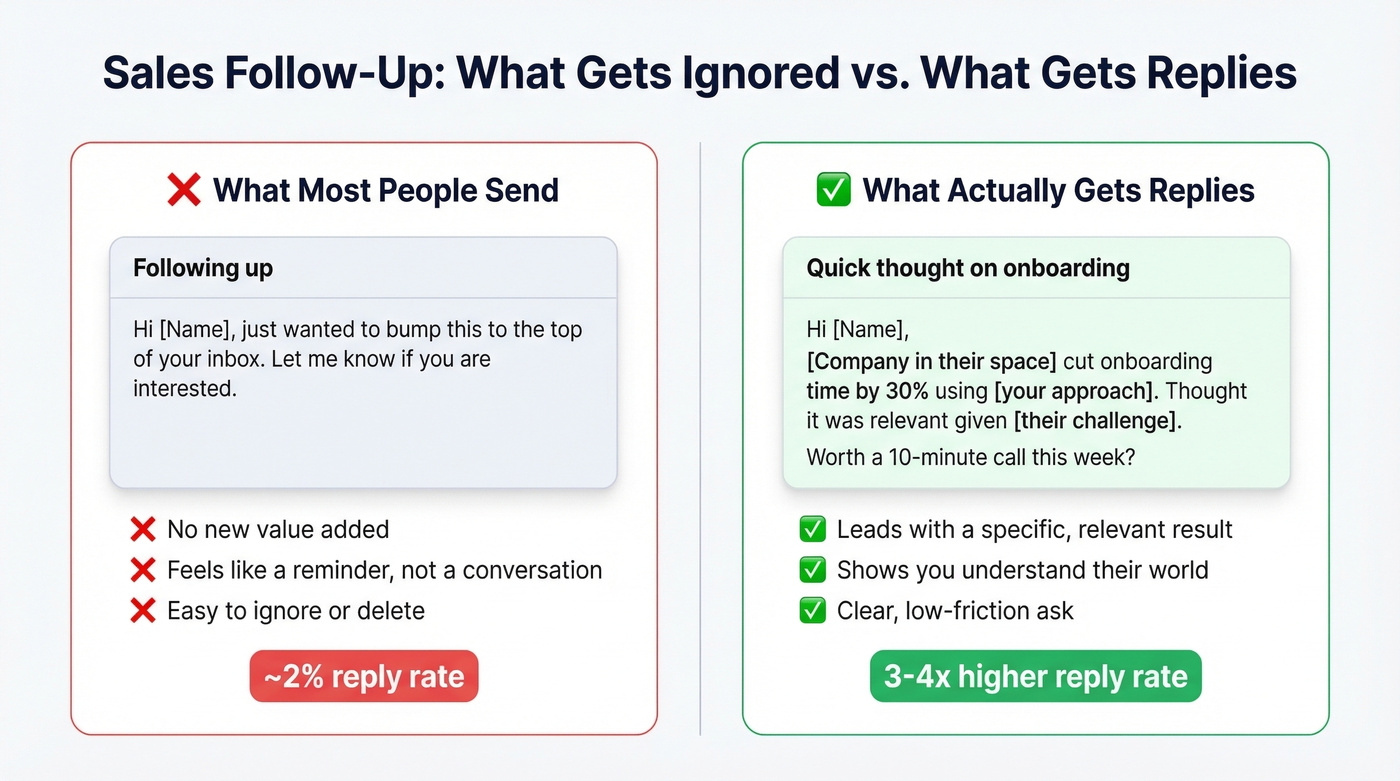
What most people send:
"Hi [Name], just wanted to bump this to the top of your inbox. Let me know if you're interested."
What actually gets replies:
"Hi [Name], [Company in their space] cut onboarding time by 30% using [approach from your proposal]. Thought it was relevant given [their challenge]. Worth a 10-minute call this week?"
The first version asks for attention without earning it. The second gives the recipient a reason to care. We've A/B tested dozens of variations like this across outbound campaigns, and the pattern holds every time: specificity wins, vagueness loses.
If you want more plug-and-play options, use these Sales Follow-Up Templates and customize the value line.
Formal Letter (Not Email)
A physical letter works when email has failed twice, when you're reaching a senior executive, or when the situation is formal - legal matters, high-stakes proposals, post-interview follow-ups to C-suite leaders.
[Your Name] [Your Address] [Date]
[Recipient Name], [Title] [Company] [Address]
Dear [Mr./Ms. Last Name],
I'm writing to follow up on [specific matter] from [date]. I understand schedules are demanding, and I wanted to reiterate [one key value proposition].
[One sentence adding new context or value.]
I'd welcome the opportunity to discuss this at your convenience. I can be reached at [phone] or [email].
Respectfully, [Your Signature]
Use a clean, professional format, a standard business envelope, and include a business card if you have one. Hand-sign it. In a world of automated sequences, a physical letter stands out precisely because nobody sends them anymore.
Mistakes That Kill Your Reply Rate
Here's the thing: the single biggest follow-up killer isn't bad wording - it's sending to an address that doesn't exist. But there are four other mistakes that are almost as deadly.
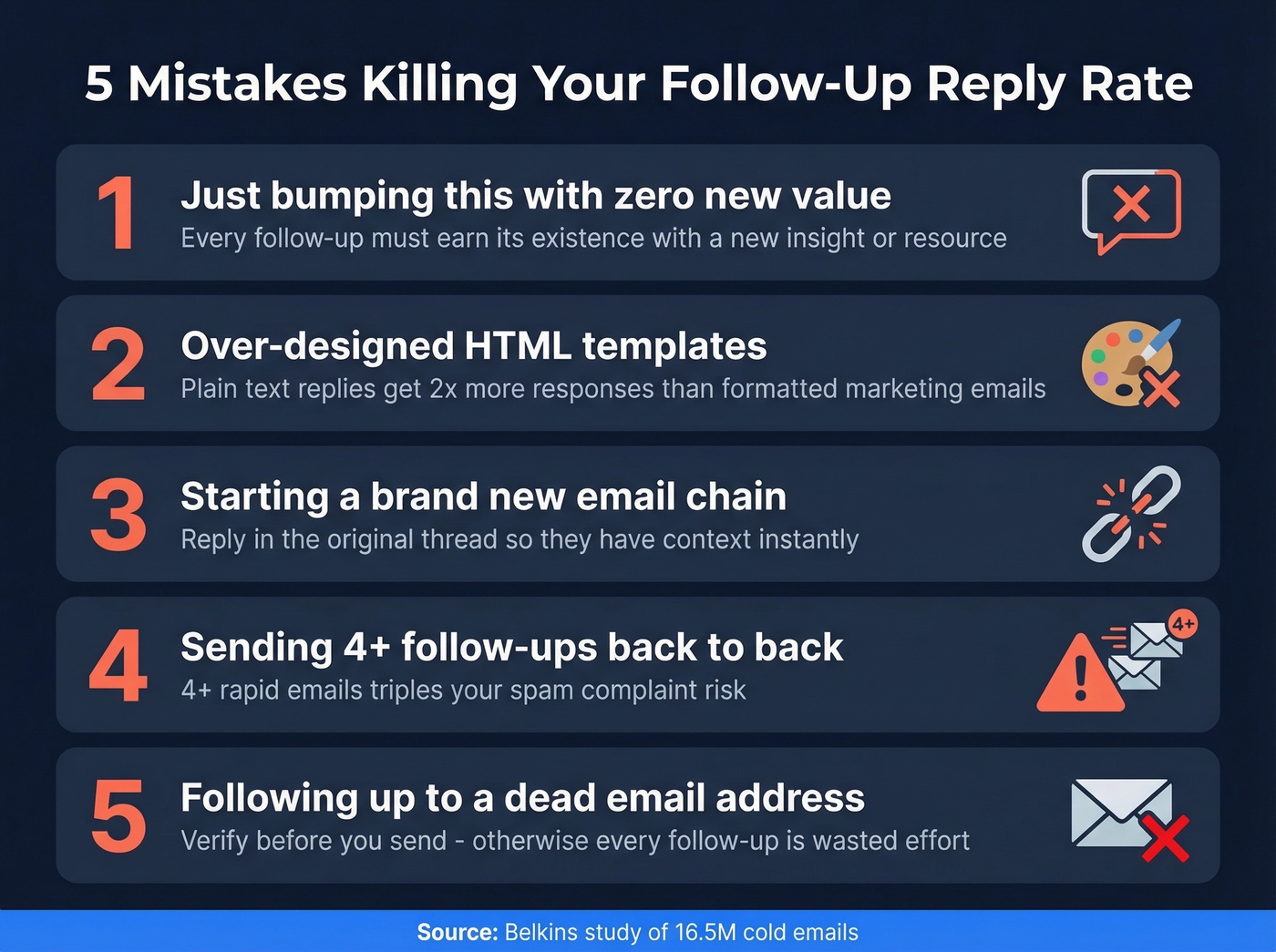
1. "Just bumping this" with no new value.
Every follow-up needs to earn its existence. "Just wanted to bump this" is noise. Instead, tie your message to something new - a relevant article, a competitor move, a case study. Give them a reason to open it beyond guilt. (If you need a framework, this guide on how to add value breaks it down.)
2. Emails that don't look real.
Over-designed templates with banners and heavy formatting scream "mass email." Plain text, short, and sent as a reply in the original thread feels like a real person writing. We've seen reply rates double just by stripping out HTML formatting. If you're troubleshooting deliverability, start with an email deliverability guide.
3. Starting a new email chain.
This forces the recipient to remember who you are. Reply to your original message so the context is right there. It's a small thing that makes a big difference. Better subject lines help too - see these email subject line examples.
4. Sending 4+ follow-ups in rapid succession.
Belkins' data shows that four or more emails in a sequence more than triples spam complaint risk. Space them out and know when to stop. If you're running sequences at scale, watch your email velocity.
5. Following up to a dead email address.
When to Stop Following Up
Not every silence is a "not yet." Sometimes it's a "no."
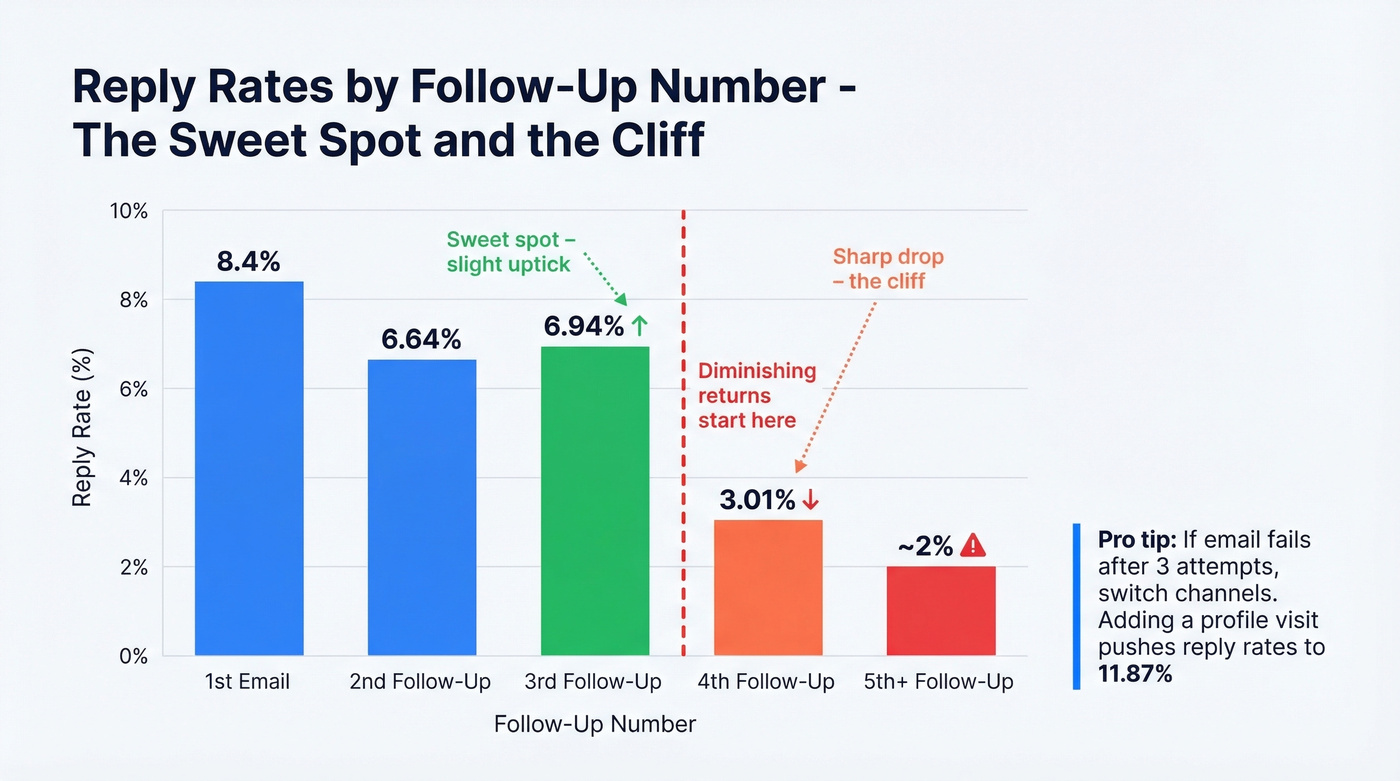
For job applications, stop after 2 attempts - your energy is better spent on new opportunities. For proposals, 3 touches using the 3-5-7 cadence. For sales outreach, 6-11 touches, but only if each adds new value. For networking, one polite nudge after two weeks.
Belkins found that founders' reply rates actually tick up slightly through the second follow-up (6.64% to 6.94%) before dropping sharply at the fourth attempt (3.01%). The sweet spot exists, but it has a cliff.
Let's be honest: if email isn't working after three attempts, switch channels entirely. Belkins found that combining a message with a profile visit on professional networks pushed reply rates to 11.87%. Most people keep hammering the same inbox. Don't be most people. (For more timing guidance, see when should I follow up on an email.)
When you do stop, send a brief breakup message:
Hi [Name], I haven't heard back and don't want to crowd your inbox. If [topic] becomes a priority down the road, I'm here. Wishing you all the best.
That closing note respects their time and leaves the door open without pressure. We've seen people reply to breakup emails months later - often with more urgency than they would have shown the first time around.
Can't find the hiring manager's email or the decision-maker's direct line? Prospeo gives you 300M+ professional profiles with verified emails and 125M+ mobile numbers - so your follow-up reaches the right person, not a dead inbox.
Find the right contact in seconds, then follow up with confidence.
FAQ
How do I write a follow up letter after no response?
Reply to your original thread so the recipient has context. Reference your previous message with a specific date, add one piece of new value - a relevant insight, resource, or case study - and close with a clear, low-friction ask. Keep the entire message between 50 and 125 words. The templates above cover every common scenario.
Should I follow up by email or physical letter?
Email for speed and most professional contexts. A physical letter works for formal situations - executive outreach, legal matters, or when email has gone unanswered twice and you want to signal seriousness.
How long should I wait before my first follow-up?
Three business days minimum for sales and proposals - this timing yields 31% more replies than following up immediately. For job applications, wait one full week before reaching out again.
How do I confirm my follow-up actually reached them?
Use an email verification tool before sending. Real-time verification catches invalid addresses before they bounce, which protects both your message and your sender reputation for every future email.
Can I reuse a template for different situations?
Yes, but always customize it. A generic template signals mass outreach, which kills reply rates. Start with a proven structure - like the ones in this guide - then swap in details specific to the recipient, their company, and your previous interaction. Personalization turns a template into a message worth answering.