

The Follow Up Letter Format That Gets Replies
You're sitting in your car after the interview, adrenaline still buzzing, thumbing through your phone wondering what to write. Here's what most people don't realize: interviewers often upload their feedback to the ATS within a few hours, and hiring committees sometimes meet right after the final round. Your follow-up isn't a courtesy - it's a tiebreaker that lands while they're still deciding. Nail the follow up letter format and you're remembered. Skip it and you're forgotten.
Yes, follow-ups still matter in 2026. Thank-you notes rarely flip a "no" to a "yes," but they absolutely break ties and signal the kind of professionalism that gets remembered. One Reddit user sent a follow-up and got a job offer 20 minutes later. Coincidence? Probably. But you don't want to be the candidate who didn't bother.
Quick-Reference Checklist
Before you scroll to the templates, memorize these basics:
- Three rules: Gratitude, Specificity, Brevity
- Timing: Send as soon as possible - ideally within a few hours, not 24
- Thread: Reply in the existing email thread; don't start a new one
- Format: Plain text, around 3-6 sentences, no HTML formatting
- Personalize: Reference something specific from the conversation
Jump to the scenario you need: Job Interview · Job Application · No Response · Business Meeting · Proposal
The Universal Structure
A quick distinction worth knowing: a thank-you note goes out the same day as your interview or meeting, while a follow-up letter can come days or weeks later to re-engage a stalled conversation. Both share the same skeleton, but the timing and intent differ. Most of the templates below work for either scenario - just adjust the opening line.
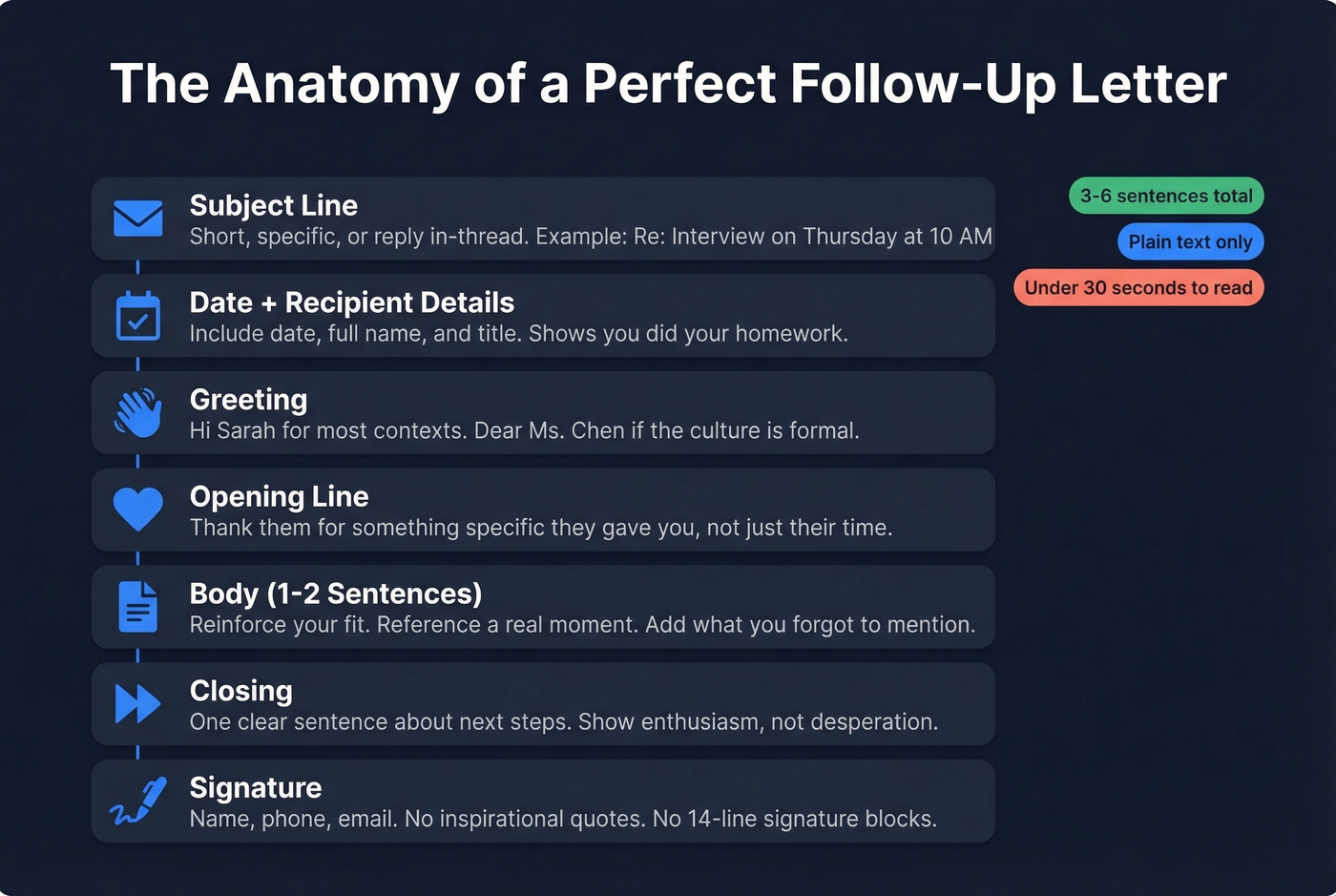
Every follow-up shares this anatomy:
Subject line: Short, specific, tied to the conversation. Or better yet, reply in the existing thread so it reads "Re: Interview on Thursday at 10 AM."
Date and recipient details: Include the date you're sending, and address the recipient by name and title when you know them. "Hi Sarah Chen, Marketing Director" signals you've done your homework.
Greeting: "Hi Sarah" works for most professional contexts. "Dear Ms. Chen" if the culture skews formal.
Opening line: Express genuine thanks for something specific - their time, an insight they shared, a question that made you think.
Body (1-2 sentences): Reinforce your fit, recap a key point, or add something you forgot to mention. This is where specificity separates you from every other candidate sending a generic note. If the role requires specific certifications or technical skills, a 2-3 bullet summary of your qualifications after the body paragraph works well.
Closing: One clear sentence about next steps or enthusiasm. "I'm looking forward to hearing about next steps" beats "Please don't hesitate to reach out at your earliest convenience."
Signature: Name, phone, email. No inspirational quotes, no 14-line corporate signature blocks.
Email beats a printed letter for the vast majority of situations. It's faster, it's trackable, and it arrives while the conversation is still fresh. Save handwritten notes for board-level executives or deeply traditional industries. And since most people read email on their phones, keep paragraphs to 2-3 lines max - a wall of text on a 6-inch screen gets skimmed or skipped.
Three Rules Every Follow-Up Must Follow
Yale's Career Development Office calls this the "magic recipe": Gratitude, Specificity, Brevity.
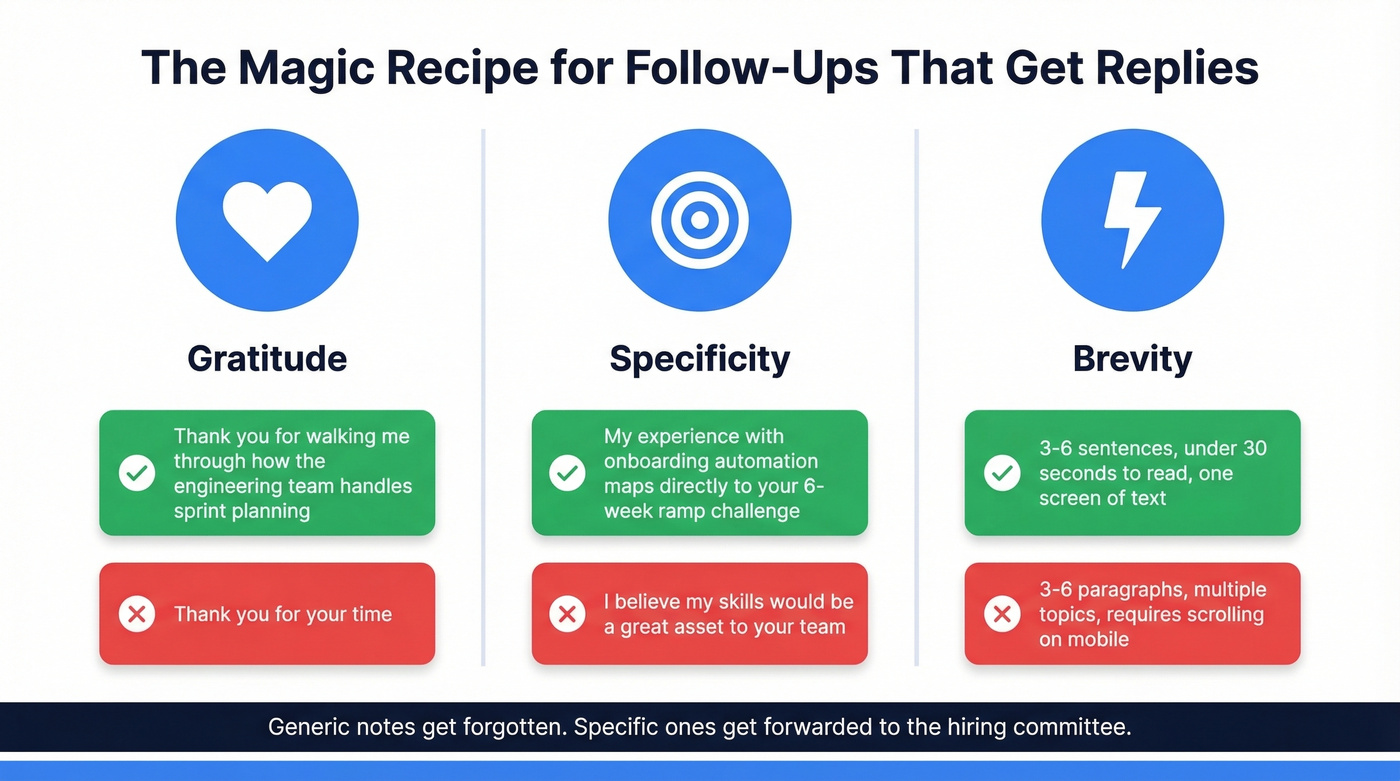
Gratitude doesn't mean "thank you for your time." It means thanking them for something they actually gave you - an insight, a candid answer, a window into the team's challenges. "Thank you for walking me through how the engineering team handles sprint planning" lands far better than "thank you for meeting with me."
Specificity is the differentiator. Reference a real moment from the conversation. If they mentioned their biggest challenge is onboarding new reps in under 6 weeks, your follow-up should connect your experience to that exact problem. Generic notes get forgotten. Specific ones get forwarded to the hiring committee.
Brevity means a short note. Not 3-6 paragraphs. The follow-ups that get responses share one trait: they respect the reader's time. If your follow-up takes more than 30 seconds to read, it's too long. Learning how to write a polite follow-up is really about mastering restraint - say what matters and stop.
Templates for Every Scenario
After a Job Interview
When to send: As soon after the interview as possible - ideally within a few hours. Interviewers may upload ATS feedback fast, and your note needs to arrive while your conversation is still top of mind.
Subject line: Reply in-thread if possible. If you need a fresh subject, try "Great speaking with you, [Name]!" or "Excited about the [Role] opportunity."
Hi [Name],
Thank you for taking the time to walk me through the [role] today - especially your insight about [specific topic discussed]. It gave me a much clearer picture of [challenge/goal they mentioned].
Our conversation reinforced my excitement about this role. My experience with [relevant skill/project] maps directly to [their stated need], and I'd love the chance to contribute to [team goal they mentioned].
Looking forward to next steps. Please don't hesitate to reach out if you need anything else from me.
Best, [Your Name] [Phone] · [Email]
Use this sample as a starting point, then swap in details from your actual conversation. The template is the skeleton; your specifics are what bring it to life.
Pro tip: The best follow-up content comes from questions you ask during the interview. See the three questions that write your follow-up for you →
If you didn't get the hiring manager's email, send your note to whoever scheduled the interview. They'll forward it - and they usually do.
After Submitting a Job Application
When to send: Wait at least two weeks. Following up on day three makes you look impatient, not eager.
Subject line: "Following up on my [Position Title] application" or "Did you receive my [Position] application?"
Hi [Name],
I submitted my application for the [Position] role on [date] and wanted to confirm it was received. I'm very interested in this opportunity - my background in [relevant experience] aligns well with what you're looking for.
I've attached my resume for easy reference. I'd welcome the chance to discuss how I can contribute to your team.
Thank you for your time, [Your Name] [Phone] · [Email]
Don't bring up salary, benefits, or vacation days at this stage. You haven't even gotten an interview yet. Keep the focus on fit and enthusiasm.
When You Get No Response
This is the scenario that causes the most anxiety - and where most people give up too early. In sales follow-ups, data points like "2% close on the first touch" and "10% with four follow-ups" get cited constantly, and the persistence principle carries over to job searches too. The trick is nudging without sounding pushy. (If you're doing this in a sales context, steal a few follow-up templates that are built for replies.)
The golden rule: Reply in the same email thread. A subject line that reads "Re: Interview on Thursday at 10 AM" is far more likely to get opened than a fresh email from an unfamiliar sender.
If you already sent a thank-you and heard nothing:
Hi [Name],
I wanted to check in on the [Role] position - I'm still very enthusiastic about the opportunity and would love to hear any updates on timing.
Is there a sense of when the team expects to make a decision? Happy to provide any additional information that would be helpful.
Best, [Your Name]
Short, specific, and gives the recipient an easy way to reply. That's all you need.
The value-add follow-up - use this on your second or third nudge. It's the single most underused format, and in our experience, it outperforms a plain "checking in" email every time:
Hi [Name],
I came across [article/report/insight] that reminded me of our conversation about [their challenge]. Thought you'd find it useful: [link].
Still very interested in the [Role] - happy to chat whenever timing works on your end.
Best, [Your Name]
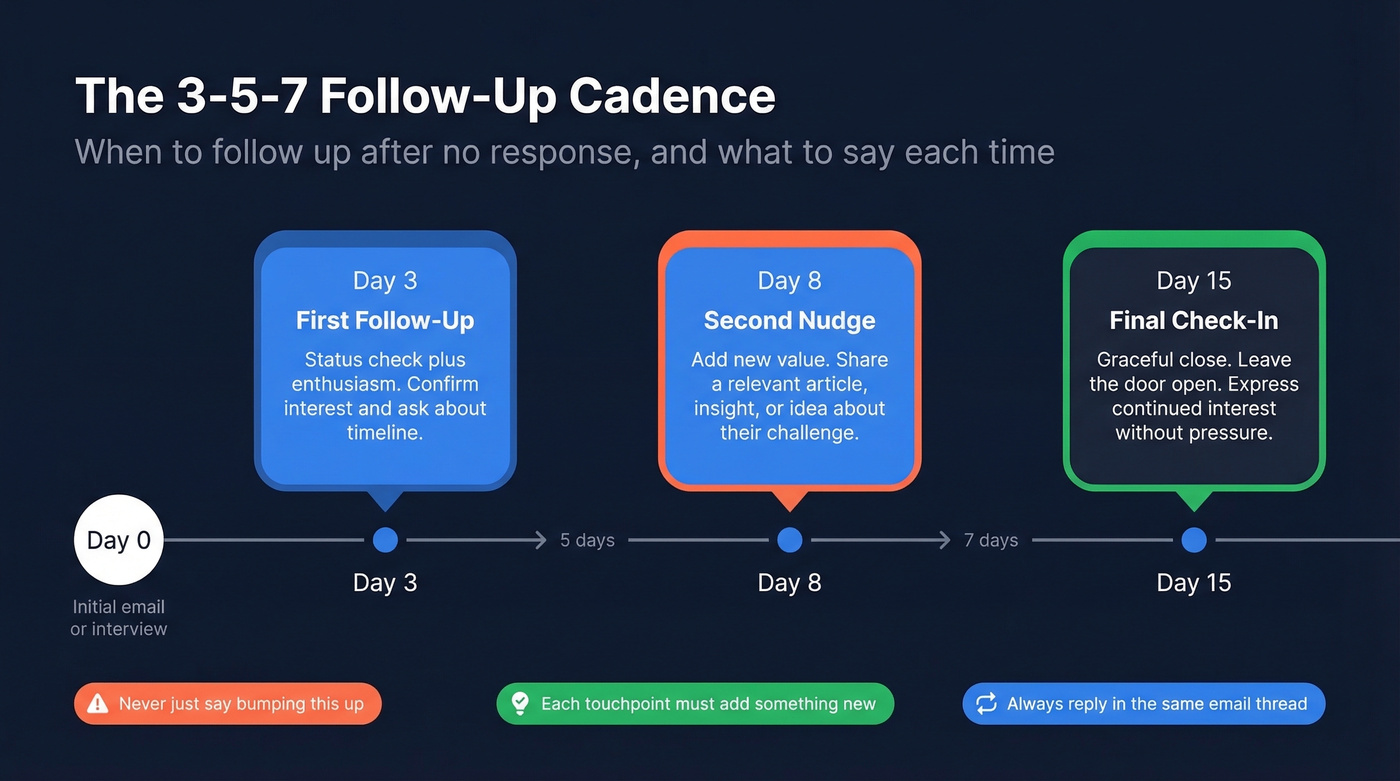
The follow-up cadence: Use the 3-5-7 rule. Follow up after 3 business days, then 5 more days, then 7 more days for a final check-in. Each touchpoint must add something new - a relevant article, a thought you had about their challenge, a project update. Never just "bumping this to the top of your inbox."
| Touchpoint | Timing | What to Include |
|---|---|---|
| First follow-up | Day 3 | Status check + enthusiasm |
| Second nudge | Day 8 | New value (insight, article) |
| Final check-in | Day 15 | Graceful close + open door |
Reaching Senior Management
Sending a follow-up to a VP or C-suite exec requires a different approach. These people are time-starved, so brevity matters even more than usual. Lead with the single most important point, skip the pleasantries, and make your ask crystal clear.
When to send: Same day or next morning. Executives move fast and forget faster.
Subject line: Keep it under six words. "[Project Name] - next step" or "Quick follow up from [day]."
Hi [Name],
Writing to follow up on [topic]. The key question for your team: [one clear question or decision point].
Happy to send additional detail or jump on a 10-minute call - whatever works best for your schedule.
Best, [Your Name]
The more senior the recipient, the shorter the message. One question, one ask, one screen of text.
After a Business Meeting
When to send: Same day or next morning. Momentum dies fast.
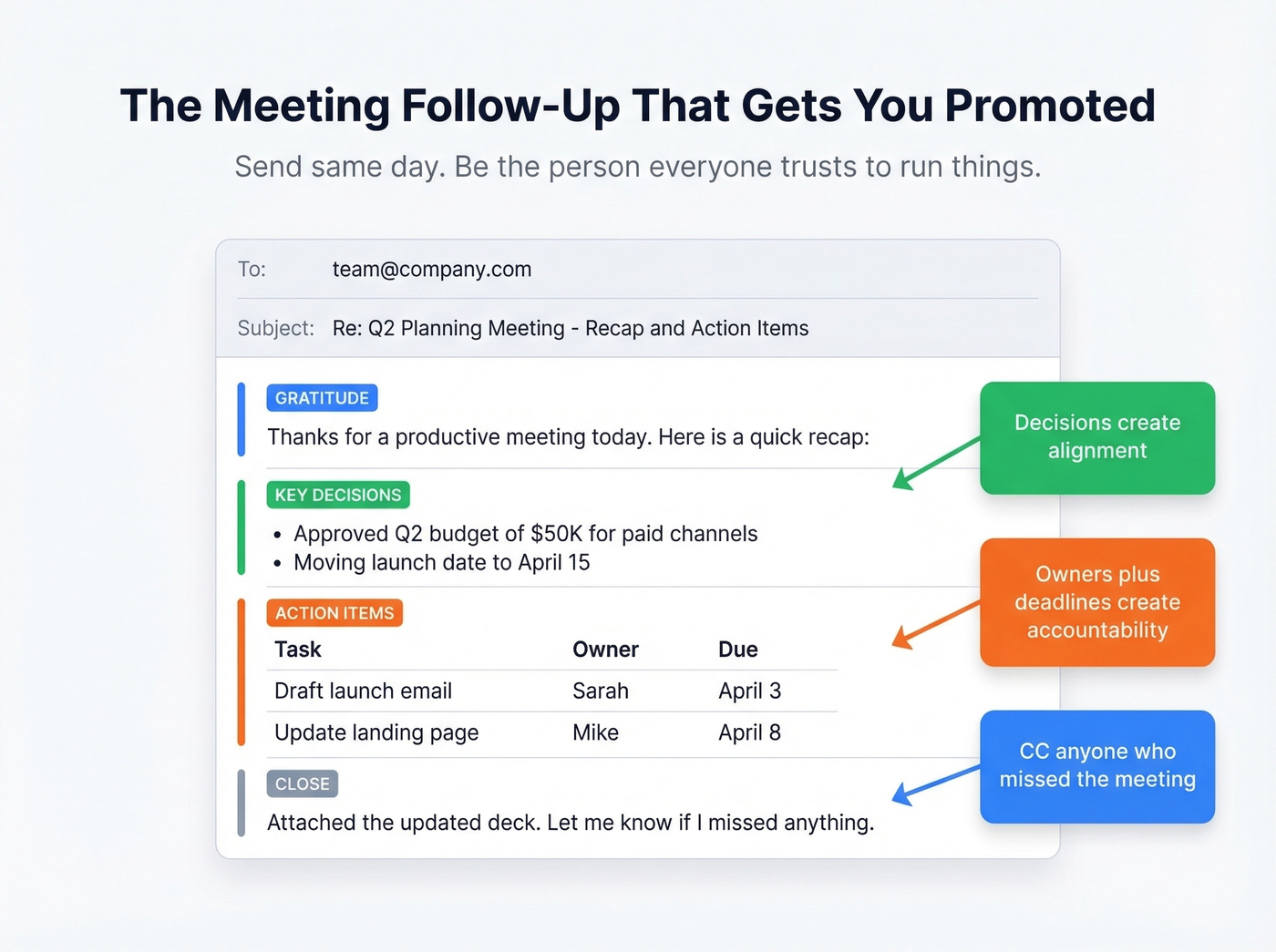
Who sends it: The person who organized the meeting or owned the agenda. If that's unclear, volunteer - it shows initiative and positions you as the person who gets things done.
Hi everyone,
Thanks for a productive meeting today. Here's a quick recap:
Key decisions:
- [Decision 1]
- [Decision 2]
Action items:
- [Task] - Owner: [Name] - Due: [Date]
- [Task] - Owner: [Name] - Due: [Date]
I've attached [relevant document/deck]. Let me know if I missed anything or if there are questions.
Best, [Your Name]
The recap + action items + owners + due dates structure holds everyone accountable. Copy anyone who missed the meeting but needs to stay informed, and CC executive assistants for senior leaders so the follow-up actually gets seen.
Here's my hot take on meeting follow-ups: they're more career-defining than interview thank-you notes. Anyone can send a post-interview email. The person who consistently sends crisp meeting recaps with clear owners and deadlines becomes the person everyone trusts to run things. That's how you get promoted without asking.
After Sending a Proposal
Proposal follow-ups require a different rhythm than job search follow-ups. The decision involves more stakeholders, more budget conversations, and more internal politics. Patience matters, but so does persistence.
Cadence: Follow a 2-3-5-7-10-14 day schedule. First check-in at 2-3 days, second at 5-7 days, final at 10-14 days.
Hi [Name],
I wanted to check in on the [Project Name] proposal I sent over on [date]. I'd love to hear your initial thoughts or answer any questions the team might have.
Would a quick 15-minute call this week work to walk through the details?
Best, [Your Name]
End every proposal follow-up with a soft next step - "Would a quick call work?" or "Happy to revise the scope if anything shifted." Never just ask "Did you get my proposal?" That puts the burden on them without offering value. A strong proposal follow-up always closes with a clear, low-friction action the recipient can take.

A perfect follow-up letter format means nothing if it bounces. Prospeo finds and verifies professional emails with 98% accuracy - so your carefully crafted follow-up actually reaches the hiring manager or decision-maker.
Stop sending follow-ups into the void. Get the right email first.
Subject Lines That Get Opened
Skip putting the word "follow-up" in your subject line when you can. It often reads like "you owe me something" and gets mentally filed under "later." (If you want more options, pull from these email subject line examples.)
| Scenario | Subject Line |
|---|---|
| Post-interview (thread) | Re: [Original subject] |
| Post-interview (new) | Great speaking with you, [Name]! |
| Application check-in | Following up: [Position] app |
| No response (thread) | Re: [Original subject] |
| No response (value-add) | Thought you'd find this useful |
| Post-meeting | [Topic] - recap and next steps |
| Post-meeting | Action items from today's call |
| Proposal follow-up | Next steps for [Project]? |
Your default strategy should always be replying in the existing thread. The "Re:" prefix signals context and familiarity - it's more likely to get opened than anything you write from scratch.
Seven Format Mistakes to Avoid
Bumping with no new information. "Just checking in" and "wanted to make sure you saw this" add zero value. Every follow-up needs a reason to exist - a new insight, a question, an update. (If you need alternatives, here’s how to say just checking in professionally.)
Putting "follow-up" in the subject line. It's the email equivalent of "per my last email." Use specific, conversational subject lines instead.
Waiting 24+ hours after an interview. By then, the interviewer may have already submitted their ATS feedback and moved on. A few hours is the window you're aiming for.
Writing "thank you for your time" with zero specifics. This is the most common mistake, and it makes you indistinguishable from every other candidate. Reference a real moment from the conversation.
Discussing salary or benefits too early. If you're following up on an application, keep the focus on fit and enthusiasm. Compensation conversations come later.
Following up too frequently - or not enough. Three follow-ups over 15 days is the sweet spot for most job searches. More than that without a response, and you're pushing into uncomfortable territory. (For timing benchmarks, see when you should follow up on an email.)
Using HTML-heavy formatting. Rich text, colored fonts, embedded images - all of it looks broken on mobile and screams "mass email." Stick to plain text with short paragraphs. It reads as personal and intentional.
Tips That Outperform Generic Nudges
Beyond templates, here are the approaches that consistently get responses:
Lead with value, not a request. Share an article, a relevant data point, or a thought that connects to the recipient's challenge. This works for every scenario - job search, sales, or post-meeting recap. (This is also the core of emails that get responses.)
Mirror their communication style. If they write short, punchy emails, match that energy. If they're more formal, adjust accordingly. We've found that tone-matching alone can double your reply rate on cold outreach, and the same principle applies to warm follow-ups.
Use templates as a starting point, not a crutch. Templates get you 80% of the way there. The last 20% - the specifics from your actual conversation - is what makes the difference.
Ask one question, not three. A single clear question gets a reply. Three questions get deferred to "when I have time," which means never. (If you’re trying to land a call, use proven email wording to schedule a meeting.)
When you need to ask for feedback - say, after a project deliverable or a presentation - the same principles apply. Reference the specific work, ask one focused question, and keep it under five sentences.
Prep Your Follow-Up During the Interview
The best follow-up emails aren't written after the interview. They're set up during it.
Before your interview wraps, ask these three questions:
- "What are the key attributes that make someone successful in this role?"
- "What are the biggest challenges someone in this position faces?"
- "What are your team's primary goals to accomplish this year?"
Each answer gives you a paragraph for your follow-up. Their answer to question one becomes your "here's why I'm a fit" paragraph. Question two becomes your "I've solved this before" proof point. Question three becomes your "I'm excited about where this team is headed" closing.
A hiring manager who's conducted over 1,000 interviews swears by this approach. When you reference their own words back to them - with specifics - your follow-up doesn't read like a template. It reads like a conversation continuation. In our experience, this approach consistently outperforms generic thank-you notes because the specificity makes the difference. The same principle behind the value-add template applies here: the more specific your reference, the more your note stands out from the pile of "Thanks for your time!" messages cluttering the hiring manager's inbox.
If you're applying through the ATS, keep your follow-up just as scannable as your resume: clear subject, short paragraphs, and one obvious next step.
Can't find the hiring manager's email? Prospeo's Chrome extension pulls verified contact data from company websites and LinkedIn profiles in one click - used by 40,000+ professionals who refuse to guess at email addresses.
Never send a follow-up to the wrong inbox again.
FAQ
What's the correct follow up letter format for a job interview?
Open with a specific thank-you referencing something from the conversation, add 1-2 sentences connecting your experience to their stated needs, and close with enthusiasm about next steps. Keep it plain text, under six sentences, and send within a few hours. Always reply in the existing email thread.
How do you send a polite follow-up email?
Express genuine gratitude, add value or context instead of just asking for a response, and keep it under five sentences. Avoid phrases like "per my last email" - instead, reference a specific detail from your previous conversation and give the recipient an easy way to reply.
Does sending a follow-up actually make a difference?
It won't rescue a bad interview, but it absolutely breaks ties. One Reddit user sent a follow-up and received an offer 20 minutes later - likely coincidence, but the principle holds. A thoughtful follow-up is cheap insurance on the time you already invested.
How many follow-ups is too many?
Three follow-ups over 15 business days is the sweet spot for job searches using the 3-5-7 cadence. The non-negotiable rule: each one must add something new - a relevant insight, an update, a thoughtful question. The moment you're just "bumping," you've crossed the line.
What if I can't find the hiring manager's email?
Send your note to whoever scheduled the interview - they'll forward it. If you need the hiring manager's direct address, Prospeo's Email Finder lets you paste in a name and company domain to get a verified email in seconds, with 98% accuracy and 75 free lookups per month.