

Free Email Verification: What Actually Works (and What Doesn't)
You just imported 5,000 leads from a trade show. You load them into your sequencer, hit send, and watch your bounce rate climb past 8% before lunch. Your domain reputation tanks. Your deliverability craters. Half those "leads" were dead addresses to begin with. The average bounce rate across email campaigns sits around 0.7% - anything above 2% is a red flag that can wreck your sender reputation.
Free email verification promises to fix this, and some tools actually deliver - within limits. But "free" means wildly different things depending on who's saying it. Three free checks? That's a demo. A hundred per month? Useful for spot-checking, not for cleaning a list. And the accuracy claims plastered across every landing page? Mostly fiction.
Here's what actually works, what the real accuracy numbers look like, and which free verifiers are worth your time.
What You Need (Quick Version)
| Use Case | Best Pick | Why |
|---|---|---|
| Quick single checks | Hunter | No signup needed |
| Max free credits | Emailable | 250 one-time credits |
| Cheapest paid upgrade | EmailListVerify | $24/10K verified |
Most free tiers cap at 3-250 checks. If you're cleaning a list of any real size, you're paying. The question is how much - and how accurate.
How Email Verification Works
Every verification tool runs roughly the same pipeline, whether it's free or enterprise-grade. The difference is how well each step is executed and whether the tool handles the edge cases that trip up cheap verifiers.
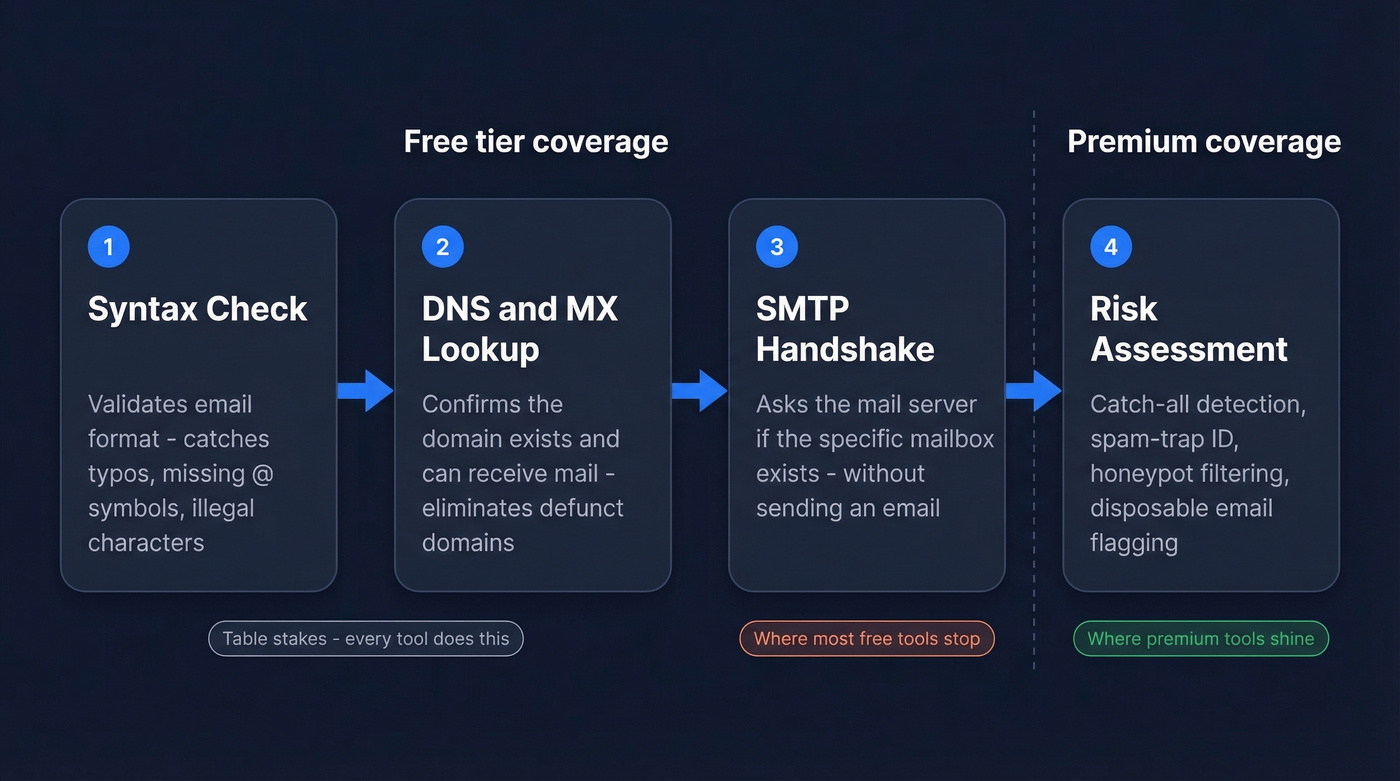
Step 1: Syntax check. The tool confirms the email follows a valid format - no missing @ symbols, no illegal characters, no double dots. This catches typos and garbage entries. Table stakes.
Step 2: DNS and MX lookup. The tool checks whether the domain exists and has mail exchange records configured. No MX record means the domain can't receive email. This eliminates defunct domains and misspelled company names.
Step 3: SMTP handshake. Here's where most of the real verification happens. The tool connects to the mail server and asks whether the specific mailbox exists - without actually sending an email. Some servers refuse to answer. Others lie. This is where things get complicated, and it's the step that separates decent verifiers from useless ones.
Step 4: Risk assessment. The best tools add a final layer: catch-all detection, spam-trap identification, honeypot filtering, and disposable email flagging. This is where free tools and premium tools diverge most sharply. A tool that stops at step 3 will mark catch-all addresses as "unknown" and leave you guessing.
No email is actually sent during verification. The entire process happens through server-to-server communication. That's why it's fast - and why it's imperfect.
The Truth About Accuracy
Every email verification vendor plasters 97-99% accuracy on their landing page. These numbers are aspirational at best.
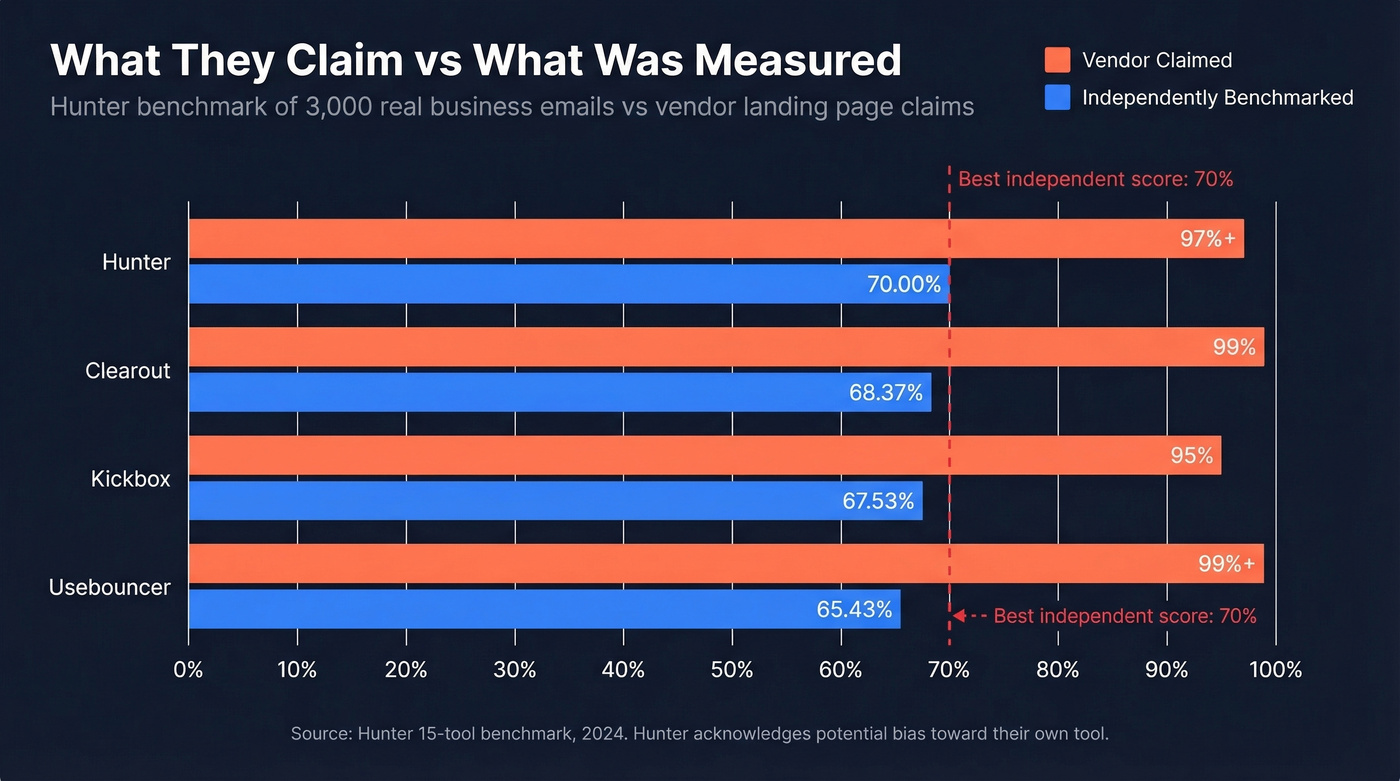
Hunter's own benchmark of 15 email verifiers - which they acknowledge may favor their tool since they used Hunter-observed email activity to label validity - tested 3,000 real business emails segmented by company size. The top score was Hunter at 70.00%. Clearout came in at 68.37%. Kickbox hit 67.53%. Usebouncer landed at 65.43%. That's a massive gap between the 99% on the landing page and the 65-70% in the real world. It gets worse on enterprise domains, where stricter mail server configurations block verification attempts entirely.
Free Email Validation Tools Compared
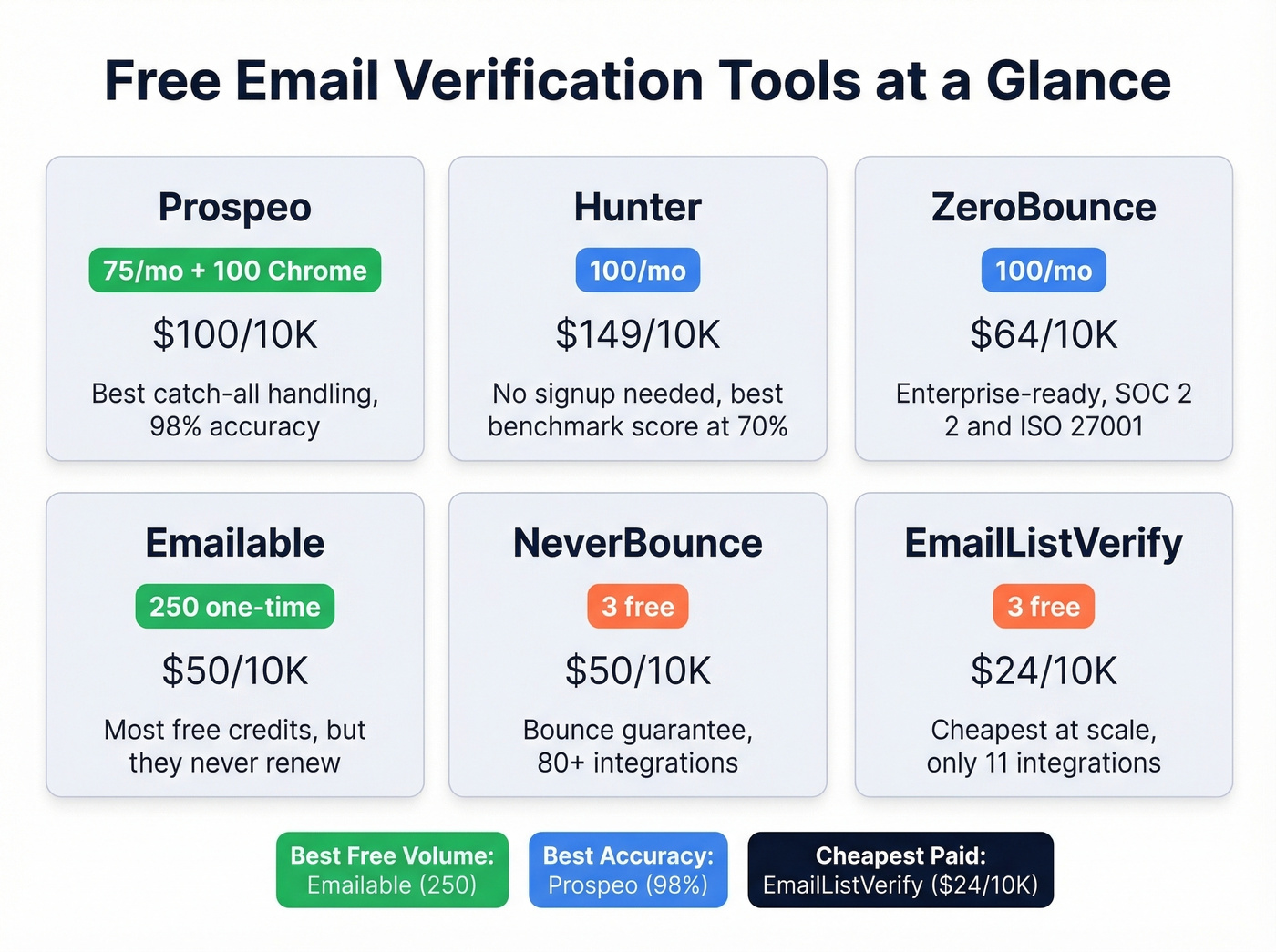
Here are the tools worth considering. Benchmark accuracy is shown where we have it from Hunter's 15-tool test; everything else is vendor-reported.
| Tool | Free Tier | $/10K | Accuracy | Key Note |
|---|---|---|---|---|
| Prospeo | 75/mo + 100 Chrome | ~$100/10K | 98% | Catch-all handling included |
| Hunter | 100/mo (singles free) | $149 | 70.00% (benchmarked) | No signup for single checks |
| ZeroBounce | 100/mo | $64 | 99% (vendor-reported) | 45 integrations, SOC 2 Type II + ISO 27001 |
| Emailable | 250 one-time | $50 | 99%+ (vendor-reported) | Credits don't renew |
| NeverBounce | 3 free | $50 | 97% (vendor-reported) | 80+ integrations, bounce guarantee |
| EmailListVerify | 3 free | $24 | 97% (vendor-reported) | Cheapest at scale |
| Bouncer | 100 free | $45 | 99%+ (vendor-reported) | Solid mid-range |
| Kickbox | 100 free | $80 | 95% (vendor-reported) | Pricey for what you get |
| Clearout | 100 free | $58 | 68.37% (benchmarked) | Strong independent score |
| Verifalia | Free singles | ~$60-80 est. | Not public | Pricing varies by volume |
The cheapest path to 10,000 verified emails is EmailListVerify at $24. The best accuracy-to-price ratio depends on how you weigh catch-all handling - which we'll get to.
If you're building lists from scratch, start with free lead generation tools and verify at the point of capture instead of cleaning later.

The best independent benchmark scored 70% accuracy. Prospeo's 5-step verification - with catch-all handling, spam-trap removal, and honeypot filtering - hits 98%. Start with 75 free verifications per month at ~$0.01/email when you scale.
Stop guessing on catch-all domains. Get a clear valid or invalid verdict.
Top Free Verifier Options
Hunter
Use this if: You need to verify a single email address right now, without creating an account, without entering a credit card, without any friction at all.
Skip this if: You're cleaning lists in bulk or need catch-all resolution.
Hunter's free single-check tool is the fastest path from "is this email real?" to an answer. No signup required for individual checks. Their free plan includes up to 100 verifications per month once you create an account, which is decent for spot-checking prospects before adding them to a sequence.
At $149 per 10,000 verifications, Hunter is one of the most expensive options on this list - more than 6x what EmailListVerify charges. Their benchmark showed them leading at 70% in independent conditions, which is honest, and it's still the best comparative accuracy data available for any verifier.
If you're comparing options beyond Hunter, see our breakdown of Hunter alternatives.

Prospeo
Use this if: You care about accuracy more than free volume, and you want catch-all addresses handled instead of dumped into "unknown."
Skip this if: You only need a one-time bulk clean of a massive list and don't care about ongoing data quality.
Prospeo runs a 5-step pipeline: syntax validation, DNS/MX lookup, SMTP handshake, catch-all handling, and spam-trap/honeypot removal. That last step separates it from most free validation tools. Where many verifiers return "unknown" or "accept-all" on catch-all domains - which represent 30-40% of B2B addresses - Prospeo gives you a clear valid/invalid verdict.
The free tier gives you 75 email verifications per month plus 100 Chrome extension credits. That's enough for ongoing prospect verification, not enough for list cleaning. Paid plans run about $0.01 per email, with a 7-day data refresh cycle versus the 6-week industry average.
If you want a deeper technical breakdown, see our guide on AI Email Checker.
ZeroBounce
ZeroBounce is the enterprise-friendly pick. 100 free verifications per month, 45 integrations, SOC 2 Type II and ISO 27001 compliance - if your security team needs to sign off on a verification vendor, ZeroBounce makes that conversation easier. At $64 per 10,000 credits, it's mid-range pricing.
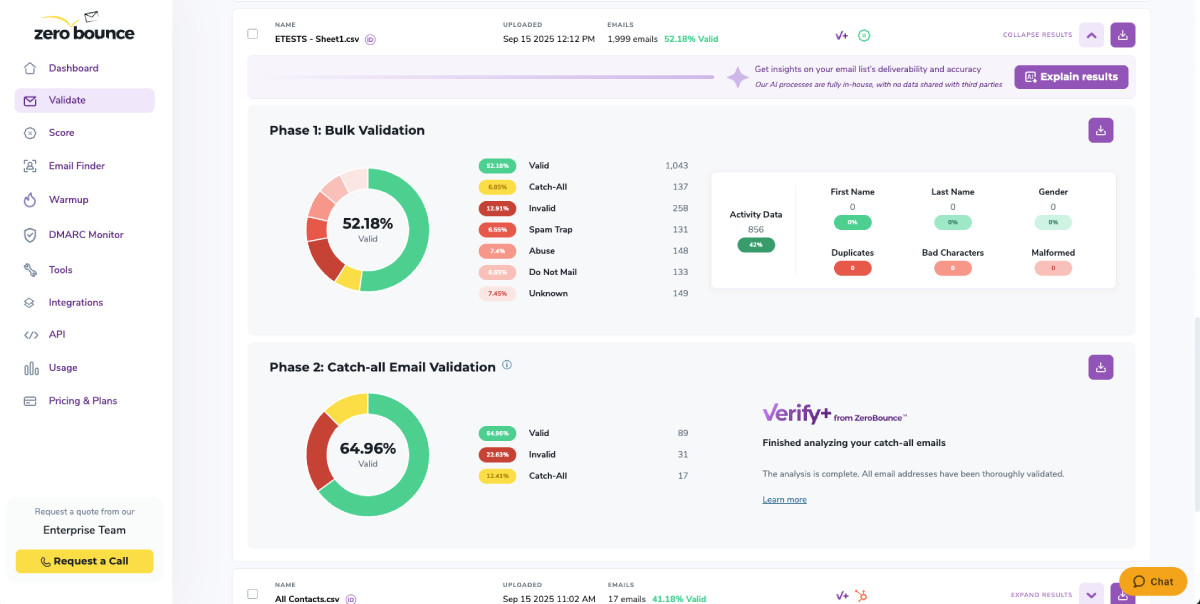
The catch: ZeroBounce requires a business or premium domain email to sign up, which locks out freelancers and early-stage founders using Gmail. ZeroBounce also tends to be more permissive than conservative - in head-to-head testing, it marked 61 more emails as safe compared to NeverBounce on the same 563-email list. More on that tradeoff below.
If you're trying to protect deliverability while scaling, pair verification with email reputation tools.
NeverBounce
NeverBounce's free tier is 3 checks. Three. That's not a free tier - it's a product demo.
The real value is their pay-as-you-go pricing at $8 per 1,000 credits and a delivery guarantee: bounce more than 3% and they refund the difference. With 80+ integrations, it's one of the most connected tools on this list. Growth plans start at $49/month for up to 10,000 verifications. Use this if you want the safety net of a bounce guarantee and deep integration options.
Emailable
Emailable gives you 250 free credits - the highest one-time allotment on this list. They don't renew monthly. Once they're gone, you're on paid plans at $50 per 10,000. Processing speed is impressive at 2 million emails per hour, which matters if you're cleaning large lists. Twenty-two integrations cover the major CRMs and ESPs. Use this if you have one list to clean and want to stretch free credits as far as possible.
If you're deciding between Emailable and other tools, our comparison of Emailable vs Generect may help.
EmailListVerify
The cheapest verification tool at scale, period. EmailListVerify charges $24 per 10,000 - less than half what most competitors charge. The tradeoff is only 11 integrations, so you'll likely need to export CSVs and upload manually. The free tier is just 3 checks. For price-sensitive teams that don't mind a less polished workflow, it's hard to beat. Skip it if you need native CRM connections.
Bouncer
A solid mid-range verifier with 100 free checks, $45 per 10,000 on paid plans, and processing speeds of 180,000 emails per hour. It's the Honda Civic of email verification - reliable, affordable, unremarkable. Sixteen integrations cover the basics.
If you're shopping around, see our list of Bouncer alternatives.
Kickbox & Clearout
Kickbox offers 100 free checks but charges $80 per 10,000 - hard to justify when EmailListVerify does the same job for $24. Twenty-seven integrations. Use it if it's already in your stack. Skip it if you're shopping fresh.
Clearout is more interesting: 100 free checks, $58 per 10,000, and it scored second in Hunter's benchmark at 68.37% accuracy. That independently benchmarked number is more meaningful than any self-reported 99%. Thirty-eight integrations round out a quietly competent option.
Verifalia
Verifalia offers free single-email checks through their website. For bulk verification, expect roughly $60-80 per 10,000 based on comparable tools in this tier. If you need to verify one email right now and Hunter's site is down, Verifalia works. For anything else, look elsewhere.
The Catch-All Problem
Here's the thing most verification comparisons skip entirely: between 30 and 40% of B2B email addresses sit on catch-all domains. These are domains configured to accept all incoming mail regardless of whether a specific mailbox exists. When a verifier runs an SMTP handshake against a catch-all domain, the server says "sure, send it" for every address - real or fake.
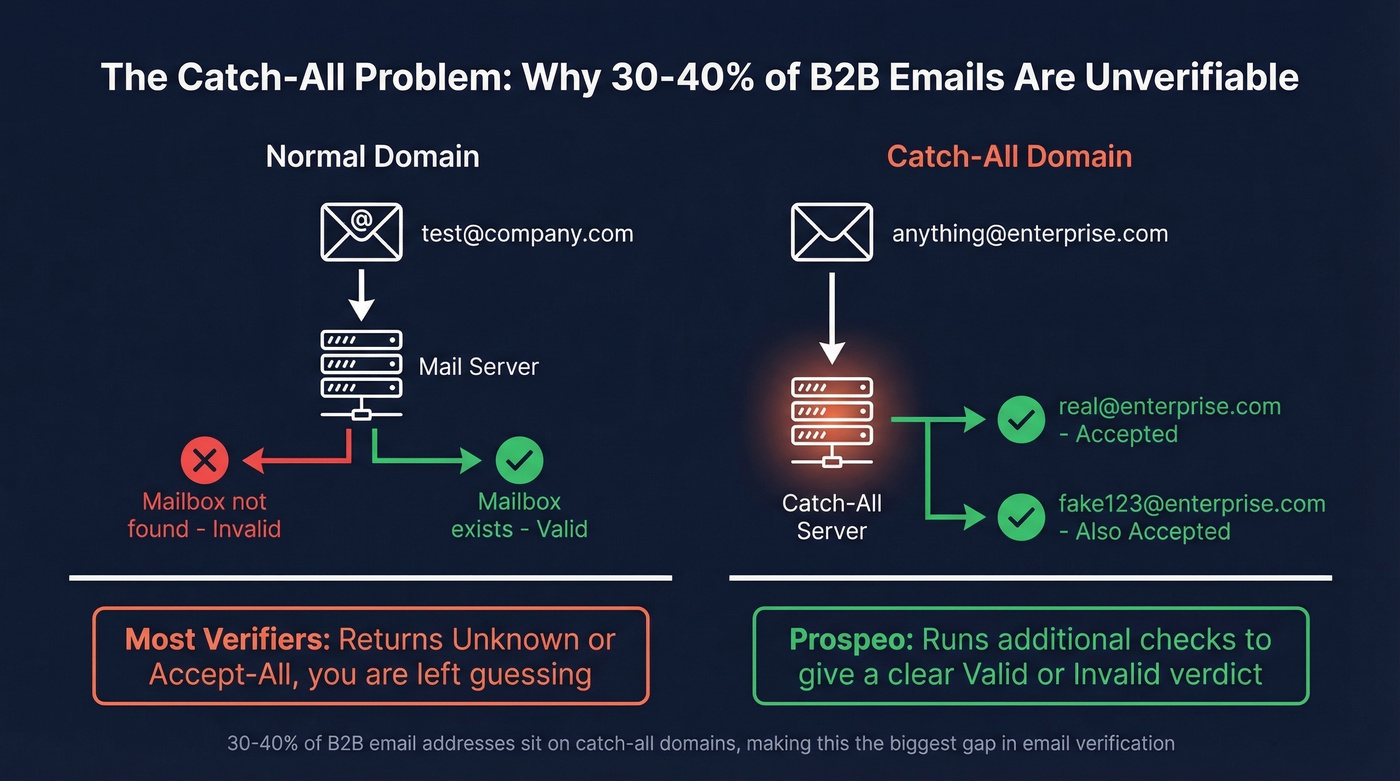
Most tools return "unknown" or "accept-all" for these addresses. It's not a bug - the verifier genuinely can't tell. This is the single biggest limitation of any verification tool that relies solely on SMTP responses.
It gets worse at the enterprise level. Secure email gateways like Proofpoint, Mimecast, and Microsoft Defender actively block verification attempts through greylisting and rate limiting. Even valid mailboxes on these domains come back as "unknown."
Let's be honest: if your average deal size is under $5K and a third of your list is coming back "unknown," you probably don't need a verification tool at all - you need a better data source. Verification is a band-aid for bad data. The best fix is starting with verified emails from the beginning, not cleaning up garbage after the fact.
For teams that do need to deal with catch-all addresses, a multi-signal approach - combining domain behavior patterns, network pattern recognition, and identity matching - is the only way to produce a binary valid/invalid verdict instead of a shrug.
If you're sourcing contacts, start with higher-quality providers (see: email list providers) and enrich missing fields with data enrichment services.

Strict vs. Permissive Verifiers
Not all verifiers make the same judgment calls, and this matters more than most people realize.
A head-to-head test of ZeroBounce and NeverBounce on 563 emails illustrates the tradeoff perfectly. ZeroBounce marked 61 more emails as safe to send than NeverBounce did on the identical list. When the tester actually sent to ZeroBounce's "valid" list of 453 emails, 2 bounced. NeverBounce had flagged those exact 2 as invalid. On the 392 emails NeverBounce approved, the bounce rate was 0%.
That's the core tradeoff. Permissive verifiers give you more emails to send to, but some will bounce. Conservative verifiers protect your sender reputation at the cost of missing valid addresses. Neither approach is wrong - it depends on whether you'd rather maximize volume or minimize risk.
We've seen this play out repeatedly in production. Teams with new domains or fragile sender reputations should lean conservative. Teams with established domains and high-volume outbound can afford to be more permissive. Know your situation before you pick a tool.
If you're troubleshooting bounces specifically, see our guide on email bounce rate.
How Often Should You Verify?
Email lists decay by 20-30% per year. People change jobs, companies get acquired, domains expire. A list that was clean in January is measurably dirtier by April.
At point of capture. Connect your signup form or CRM to a validation API that checks each email the moment it's entered - before it ever hits your database. This prevents bad data from entering your system in the first place.
Quarterly minimum. Clean your full active list every 90 days. This catches job changes and domain shifts.
Before every major campaign. If you're sending to a list that's been sitting for more than 30 days, verify it again. The cost of verification is trivial compared to the cost of a deliverability hit.
After any data import. Trade show lists, purchased lists, partner data - verify everything before it touches your sequencer. No exceptions.
The underlying data freshness of your verification tool matters too. Most platforms refresh their data about every 4-6 weeks. A tool refreshing weekly means when you verify an email, you're checking against data that's at most 7 days old - not six weeks stale. That's a subtle difference that compounds over time.
If you're running outbound at scale, also watch email velocity and follow a proper email deliverability guide.
Most free tiers cap at 100 checks and skip catch-all domains entirely. Prospeo's 7-day data refresh means every email you verify reflects reality - not a 6-week-old snapshot. 75 free monthly verifications, no credit card required.
Your bounce rate won't fix itself. Verify with 98% accuracy today.
Self-Hosted Options for Developers
If you want full control over your verification pipeline, developers on r/opensource have shared a self-hosted verifier on GitHub built in Go. It requires Redis for domain caching, supports Docker deployment, and handles MX verification, disposable detection, and batch processing. It's not a replacement for a commercial tool - you'll need to manage your own IP reputation and handle rate limiting yourself - but for technical teams running high-volume verification internally, it's worth evaluating.
FAQ
Is free email verification accurate?
Independent benchmarks show top verifiers scoring 65-70% accuracy on real business emails - far below the 97-99% vendors advertise. Free tiers use the same engine as paid plans, so accuracy doesn't change with plan level. The limitation is volume, not quality. Tools with catch-all handling close the gap significantly.
How many free checks can I get per month?
Most tools offer 3-250 free verifications. Emailable gives 250 one-time credits that don't renew. Prospeo offers 75 monthly credits plus 100 Chrome extension credits. NeverBounce's "free" tier is just 3 checks - barely enough to test the interface.
What does "catch-all" mean in verification results?
It means the email domain accepts all incoming mail, so the verifier can't confirm whether a specific mailbox exists. This affects 30-40% of B2B addresses and is the single biggest source of unresolved contacts in any verification workflow. Multi-signal verifiers resolve these to valid/invalid instead of returning "unknown."
Which free email verification tool is most accurate?
Tools with multi-step pipelines and catch-all handling outperform those that stop at the SMTP handshake. In Hunter's independent 15-tool benchmark, Hunter scored highest at 70%. Prospeo's 5-step pipeline delivers 98% accuracy in production, with real customer results showing bounce rates consistently under 4%.
Can I verify a bulk list for free?
Not meaningfully. Free tiers cap at 3-250 checks. For lists over a few hundred emails, you'll need a paid plan. EmailListVerify at $24 per 10,000 is the cheapest option for bulk cleaning.