


FullEnrich Pros and Cons: An Honest 2026 Review
Your SDR manager pulls up last month's bounce report: 19%. Nearly one in five emails never reached a human inbox, and your sequences are bleeding sender reputation. FullEnrich promises to fix this with waterfall enrichment - querying 20+ data vendors until it finds a match. But does the reality match the pitch?
We've dug through 172 G2 reviews, run the credit math, and compared alternatives so you don't have to guess.
What FullEnrich Actually Does
FullEnrich is a cascade (waterfall) enrichment platform. Instead of pulling contact data from a single provider like Apollo or Lusha, it sequentially queries 20+ data vendors - Hunter, Datagma, Clearbit, ContactOut, and others - until it finds an email or mobile number. If no provider returns a result, you don't pay. The official find rate averages around 80%, found emails go through triple verification, and mobile numbers get a deep validation check.
But waterfall enrichment has structural risks most vendors won't mention. Multiple providers can create data conflicts where one source overwrites a verified number with an incorrect one, and compliance complexity multiplies with every third party in the chain. FullEnrich integrates with Clay, Make, Zapier, HubSpot, and Salesforce Sales Cloud, though users report the connections aren't always smooth.
What 172 G2 Reviews Reveal
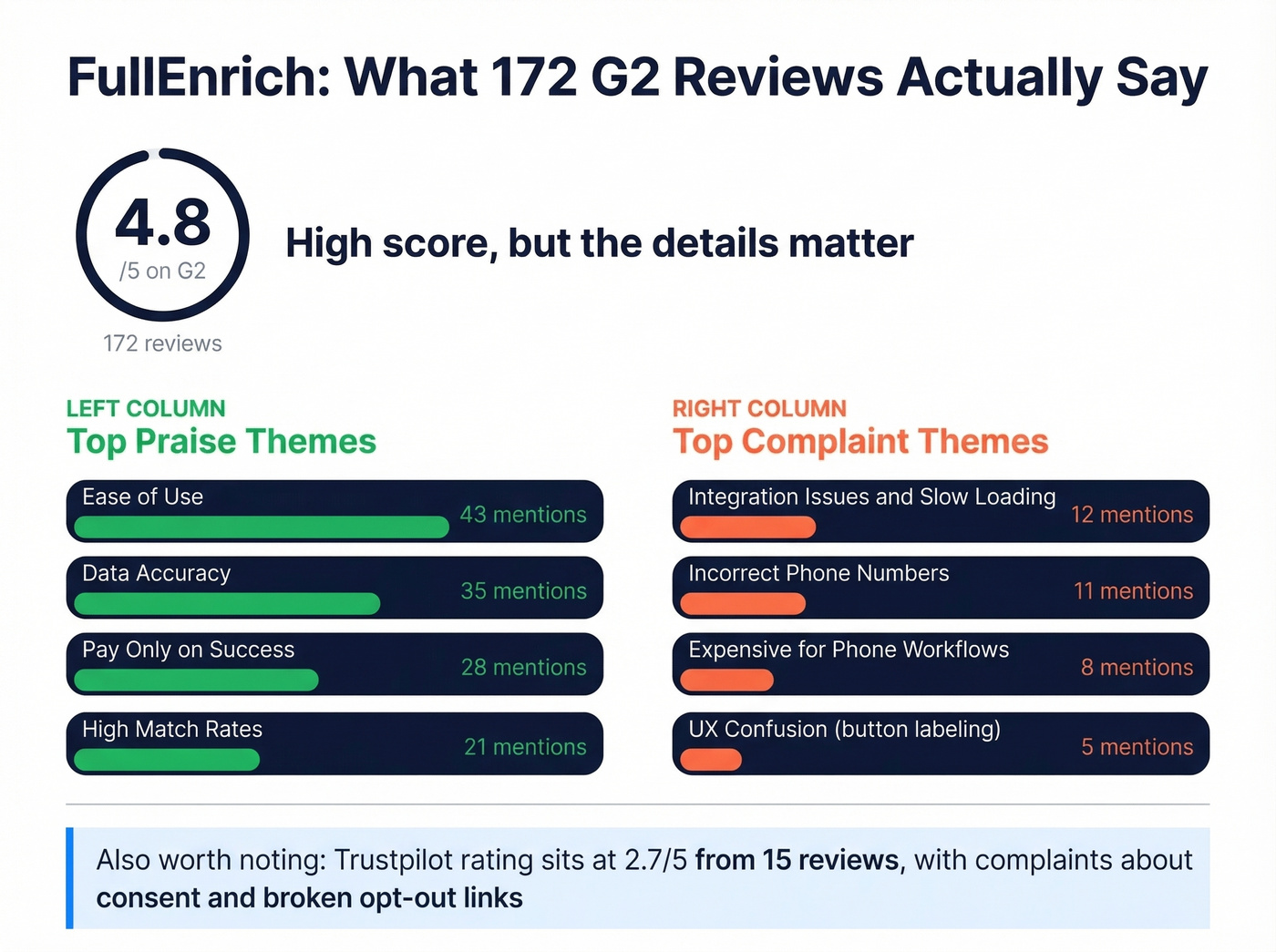
FullEnrich carries a 4.8/5 on G2 across 172 reviews - unusually high for an enrichment tool. But the aggregate score hides real friction.
| ✅ Pros | ❌ Cons |
|---|---|
| High match rates - waterfall enrichment consistently beats single-source tools. One Reddit user reported jumping from 60-70% valid emails with Apollo/Lusha to ~90% with FullEnrich. | Incorrect phone numbers (11 G2 mentions) - the single most common complaint. At 10 credits per mobile number, bad data stings. |
| Pay-only-on-success credits - no charge when enrichment fails. 50 free credits to start, minimal setup required. | Expensive for phone-heavy workflows (8 mentions) - the 10x credit cost for mobiles catches teams off guard. |
| Strong email validity lift - triple verification meaningfully reduces bounces. Top G2 themes: Data Accuracy (35 mentions), Ease of Use (43). | Integration issues + slow loading (12 combined mentions) - button labeling confusion between "add contact" and "enrich contact" creates unnecessary UX friction. |
| Credits roll over - 3 months on monthly plans, 1 year on yearly, shared across unlimited team seats. | Trustpilot sits at 2.7/5 from 15 reviews - complaints about personal data obtained without consent, broken opt-out links, and unresponsive support. Small sample, but a compliance perception risk. |
Here's the thing: FullEnrich is effectively an email-first tool for budget-conscious teams. The moment you add phones to your workflow, the credit math breaks. Most teams don't realize this until they've burned through a month's credits in a week.
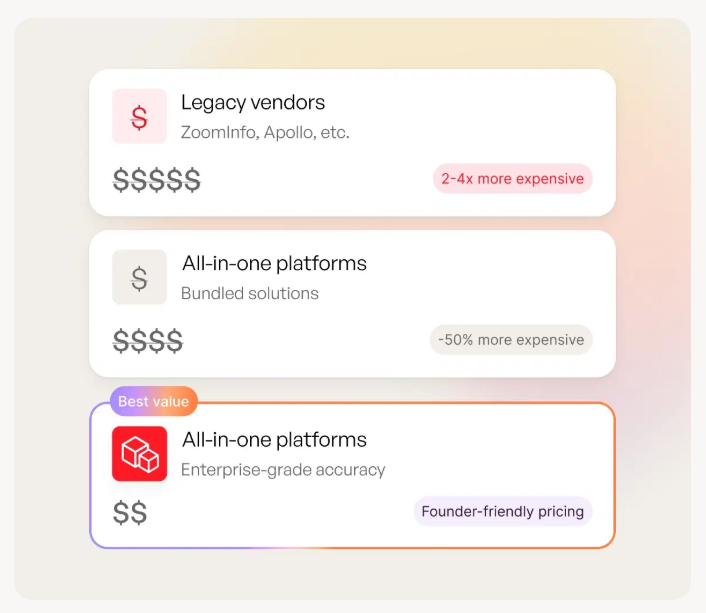

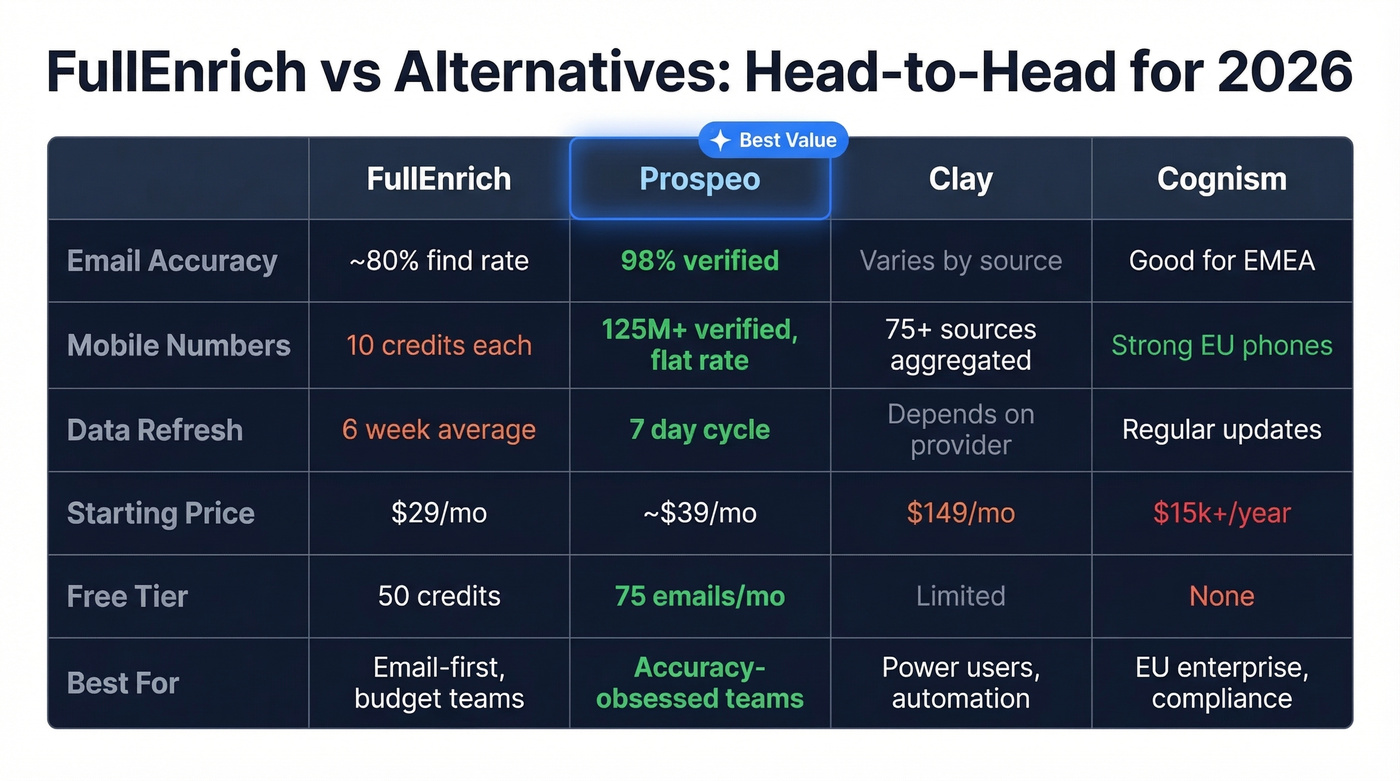
FullEnrich's waterfall model queries 20+ third-party vendors - Prospeo owns the entire email-finding pipeline. That's why Prospeo hits 98% email accuracy with a 7-day refresh cycle, not the 6-week industry average. No credit multipliers for phones either: 125M+ verified mobiles at a flat rate.
Stop subsidizing 20 vendors. Get cleaner data from one source.
How Credits Work
| Action | Credit Cost |
|---|---|
| Work email found | 1 credit |
| Personal email found | 3 credits |
| Mobile phone number found | 10 credits |
| Reverse lookup | 1 credit |
| Person/company data | 0.25 credit standalone (free with lookup) |
| Plan | Credits | Price |
|---|---|---|
| Free Trial | 50 | $0 |
| Starter | 500 | $29/mo |
| Pro | 1,000 | $55/mo |
| Growth | 50,000 | $1,950/mo |
Credits roll over for 3 months on monthly plans and 1 year on yearly. They're shared across unlimited users.
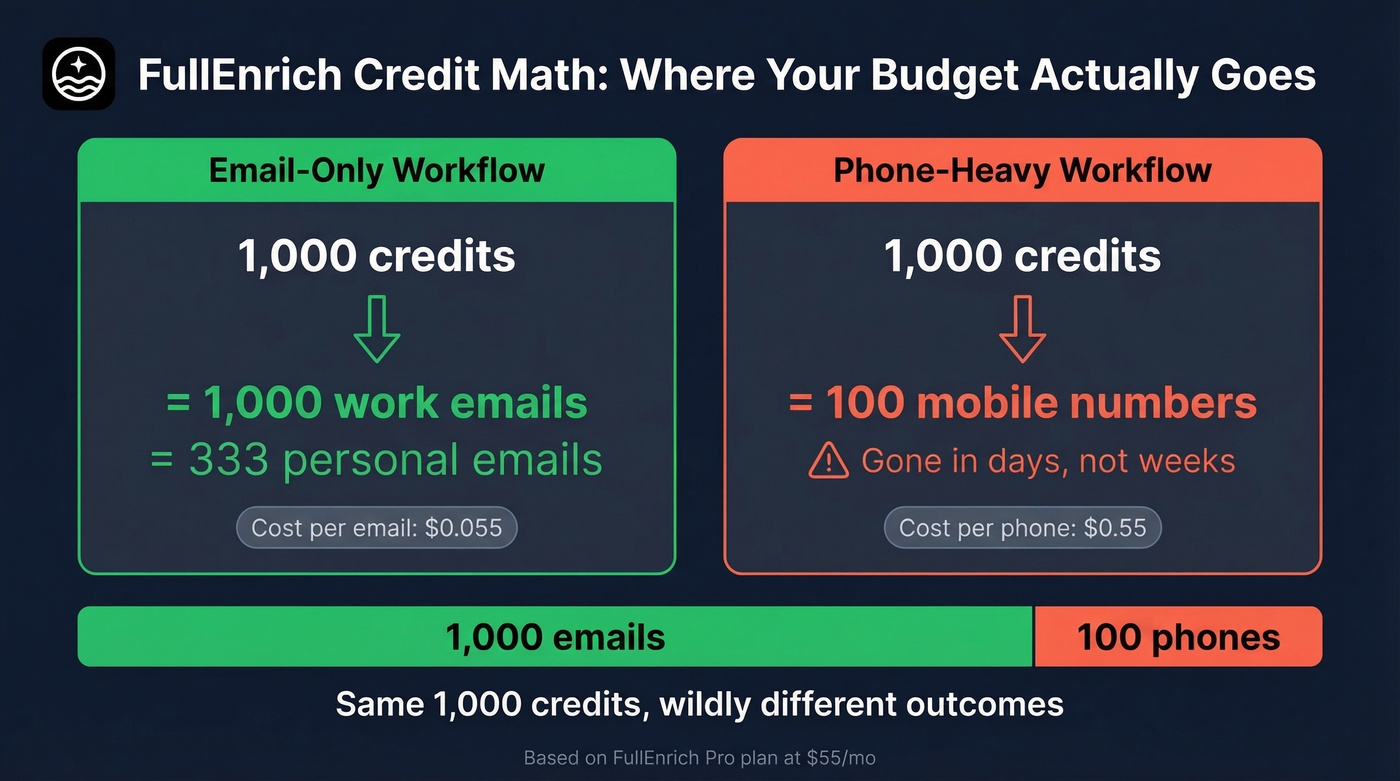
Let's do the math: 1,000 credits sounds generous until you need phones. That's 1,000 work emails - or just 100 mobile numbers. One Reddit benchmark tested 100 France-based enterprise/government leads and got 87% phone success at $0.52 per find. Solid, but that cost compounds fast at scale.
Who Should (and Shouldn't) Use It
FullEnrich's core value is simple: higher match rates and cleaner emails without you having to juggle multiple enrichment vendors.
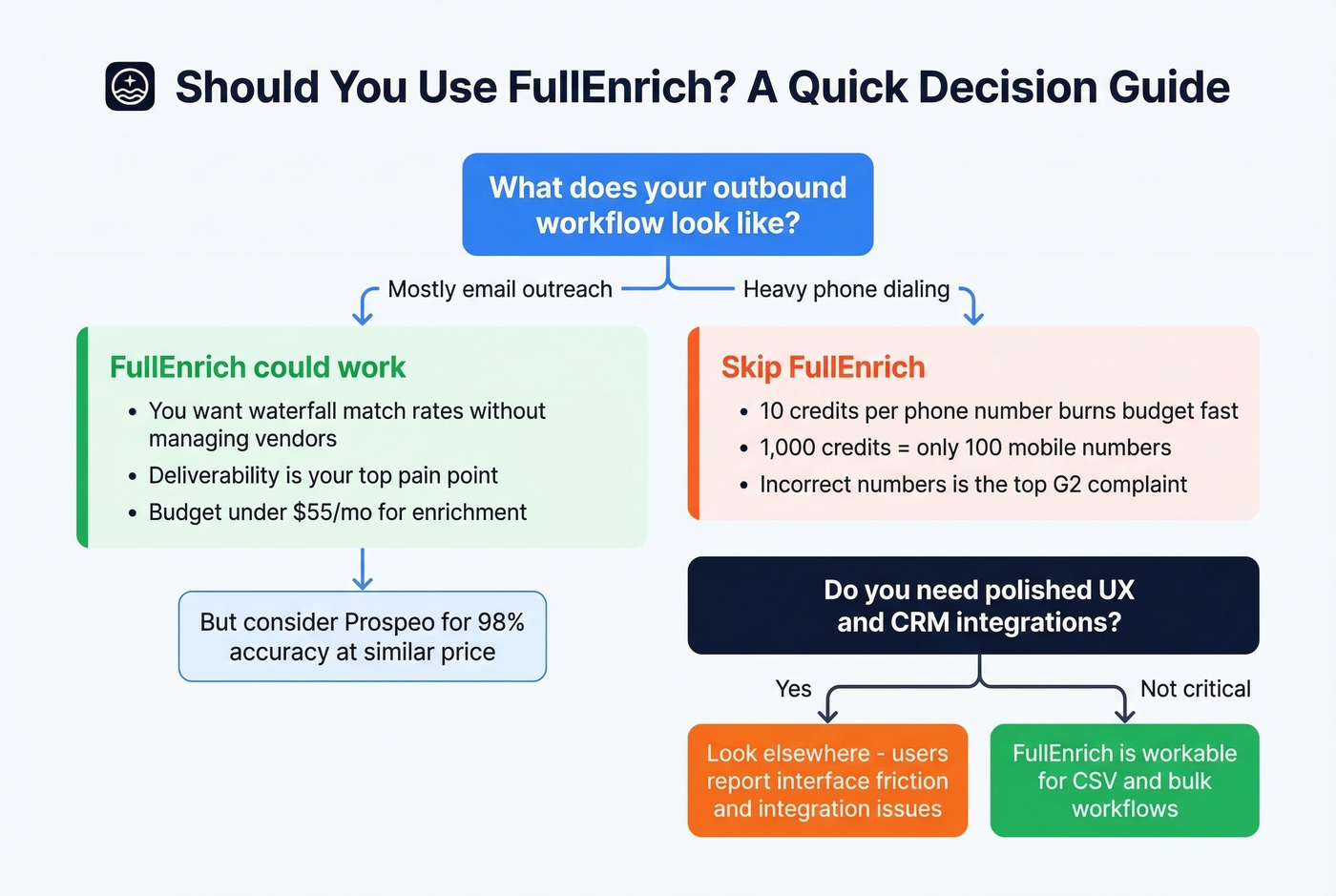
Use FullEnrich if you want waterfall match rates without managing multiple vendor contracts, your workflow is email-first, and deliverability is your top pain point.
Skip FullEnrich if polished UX and frictionless CRM integrations matter to your team - the interface has rough edges. Phone-heavy outbound teams will hate the 10x credit cost. Compliance-sensitive orgs should weigh the Trustpilot signal carefully. And the Chrome extension no longer supports direct enrichment, so many teams run FullEnrich via CSV/bulk workflows instead.
For email-first teams on a budget, FullEnrich delivers real value. For everyone else, the credit math and UX friction make it a hard sell.
Alternatives Worth Testing
Prospeo - Email Accuracy Leader
We've tested a lot of enrichment tools internally, and Prospeo consistently wins on email accuracy: 98% verified accuracy across 300M+ professional profiles, with a 7-day data refresh cycle where the industry average is six weeks. It runs proprietary email-finding infrastructure rather than depending on third-party providers, so verification happens in-house end to end. Beyond emails, Prospeo offers 125M+ verified mobile numbers with a 30% pickup rate, plus 30+ search filters including buyer intent, technographics, and job-change signals. Free tier includes 75 emails/month, paid plans from ~$39/mo, no contracts. Teams switching from FullEnrich typically see cleaner deliverability because of the 5-step verification process with catch-all handling, spam-trap removal, and honeypot filtering.
Clay - Workflow Orchestration
Don't come to Clay expecting a simple enrichment tool. It aggregates 75+ data sources into a spreadsheet-like orchestration layer where you chain enrichment, research, and automation steps. The learning curve is steep - think "enrichment IDE." Plans start at ~$149/mo. Best for power users who need enrichment as one step in a larger automated pipeline. If you just want clean contact data without building workflows, it's overkill.
Cognism - European Phone Coverage
Cognism runs $15k+/year, which puts it firmly in enterprise territory. If your ICP is European and you need compliant, phone-verified mobile data, it's the specialist - strong GDPR positioning, solid direct dials for EMEA. But unless EU compliance and phone coverage are your primary buying criteria, the price tag is hard to justify for most teams.
FullEnrich's 1,000-credit Pro plan gets you just 100 mobile numbers. Prospeo delivers 125M+ verified mobiles with a 30% pickup rate - and emails at ~$0.01 each with 98% accuracy. No contracts, no credit card to start, and 5-step verification kills bounces before they happen.
Run your FullEnrich exports through Prospeo and see the difference.
FAQ
Does FullEnrich charge for failed enrichments?
No. Credits are only consumed when FullEnrich successfully finds an email or mobile phone number. Failed lookups cost nothing.
How accurate are FullEnrich phone numbers?
One benchmark showed 87% success at $0.52 per phone on France-based enterprise/government leads. That said, "incorrect numbers" is the top G2 complaint with 11 mentions, so accuracy varies by region and segment.
Do FullEnrich credits roll over?
Yes. Monthly plans roll over unused credits for up to 3 months; yearly plans roll over for up to 1 year. All credits are shared across unlimited team seats at no extra cost.
What's a more accurate alternative for email enrichment?
Prospeo delivers 98% email accuracy with a 7-day refresh cycle and proprietary verification - no third-party email providers in the chain. The free tier includes 75 verified emails per month, so you can benchmark it against FullEnrich on your own list before committing.