

Gamification in Sales: The Playbook for What Actually Works
It's Wednesday afternoon. Your SDR team is staring at screens, halfway through a quota period that feels like it started six months ago. Someone suggests a contest - "let's make it fun." Three weeks later, the contest is dead, the prizes are unclaimed, and morale is worse than before.
That's the gamification in sales story most teams know. But the global gamification market is growing at 26% CAGR - from $19.42B in 2025 to a projected $92.5B by 2030. Somebody's making this work. We've spent the last two years watching teams implement these programs, and the difference between success and failure isn't enthusiasm. It's design.
The quick version: HP saw a 30-42% revenue lift in two months. Autodesk drove a 29% increase in channel revenue. Most implementations fail because of design mistakes, not the concept itself. Before you buy a platform, you need clean contact data, a scoring matrix, and a 30-day manual pilot. And if you're ready for software, start with SalesScreen for distributed teams, Spinify for budget-friendly setups, or Ambition for Salesforce-heavy orgs. If you're not ready, a Slack channel and a spreadsheet get you 80% of the results.
What Is Sales Gamification?
Sales gamification applies game mechanics - leaderboards, points, badges, contests, progress bars - to the daily work of selling. The goal isn't to make sales "fun" in some abstract sense. It's to use behavioral triggers that make reps more likely to do the activities that produce revenue.
Internal gamification motivates your reps through leaderboards, streak tracking, and milestone badges. Customer-facing gamification - what Simon-Kucher calls "pull marketing" - incentivizes buyers to explore products or engage with content. This article focuses on the internal side, because that's where most teams start and where the biggest design mistakes happen.
Does It Actually Work?
Short answer: yes, when the design is right.
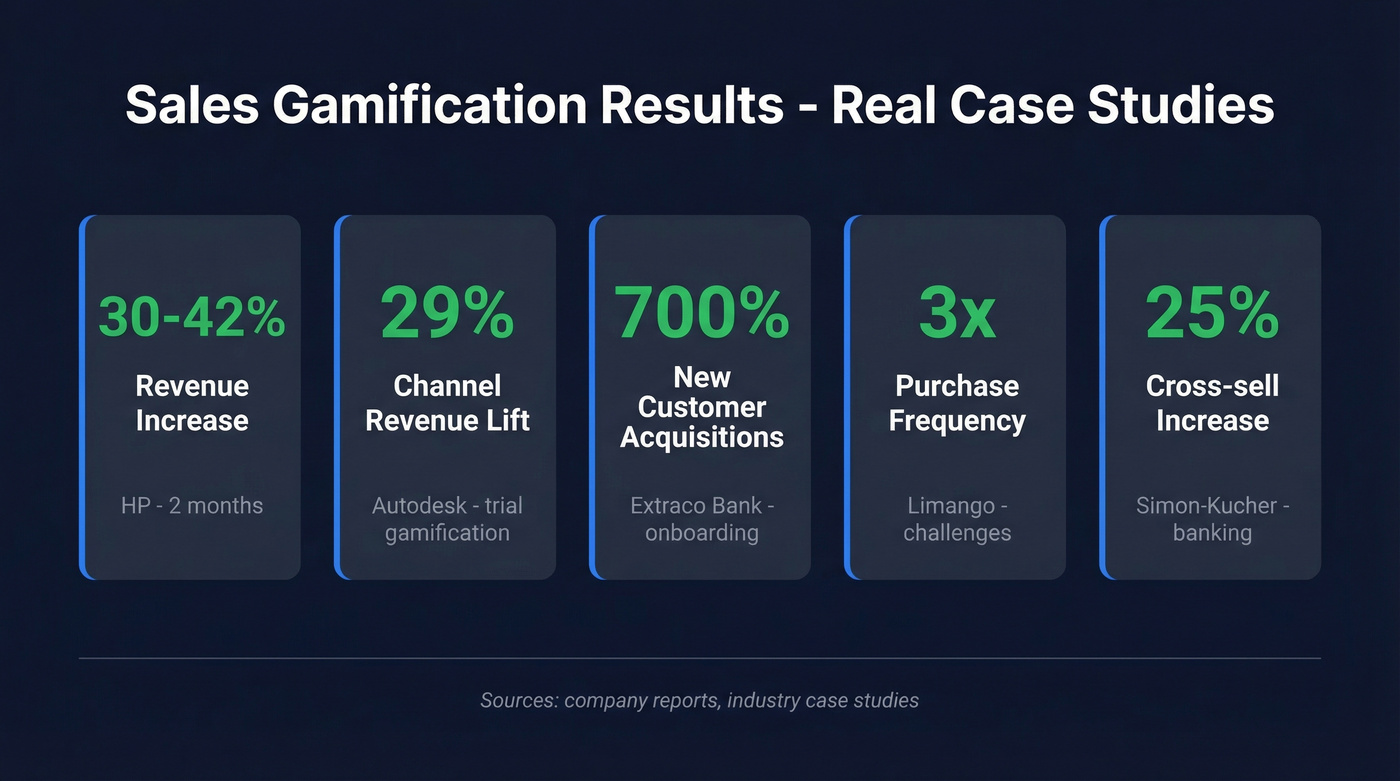
HP deployed game mechanics across its sales organization and reported a 30-42% revenue increase in two months. Not engagement lift. Revenue. Autodesk gamified its free trial experience and saw 54% higher trial usage, 15% more buy clicks, and a 29% increase in channel revenue - impact across the entire buying journey from a single design change. Extraco Bank used gamified onboarding to achieve a 700% increase in new customer acquisitions. Limango ran gamified challenges that drove a 3x increase in purchase frequency, proving the mechanic works in both transactional and relationship-based models.
The most interesting case might be Simon-Kucher's "Home-bank Program" in banking. They increased cross-selling by 25% in the first year. But here's the kicker: customers reacted positively despite checking account price increases of up to 30%. Churn from the price increase fell to near zero. Gamification didn't just drive activity - it changed how customers felt about paying more.
A 2025 field experiment in the Journal of Personal Selling & Sales Management confirmed that gamification enhances sales reps' enjoyment and motivation during virtual training. The academic literature is catching up to what practitioners already know.
Let's be honest, though: this works when you have clear metrics, a CRM that tracks them, and leadership willing to invest in design - not just prizes. Game mechanics amplify culture. They don't replace it.
The Psychology Behind It
Gamification works because it exploits well-documented cognitive biases. Understanding these directly determines which mechanics you should use.
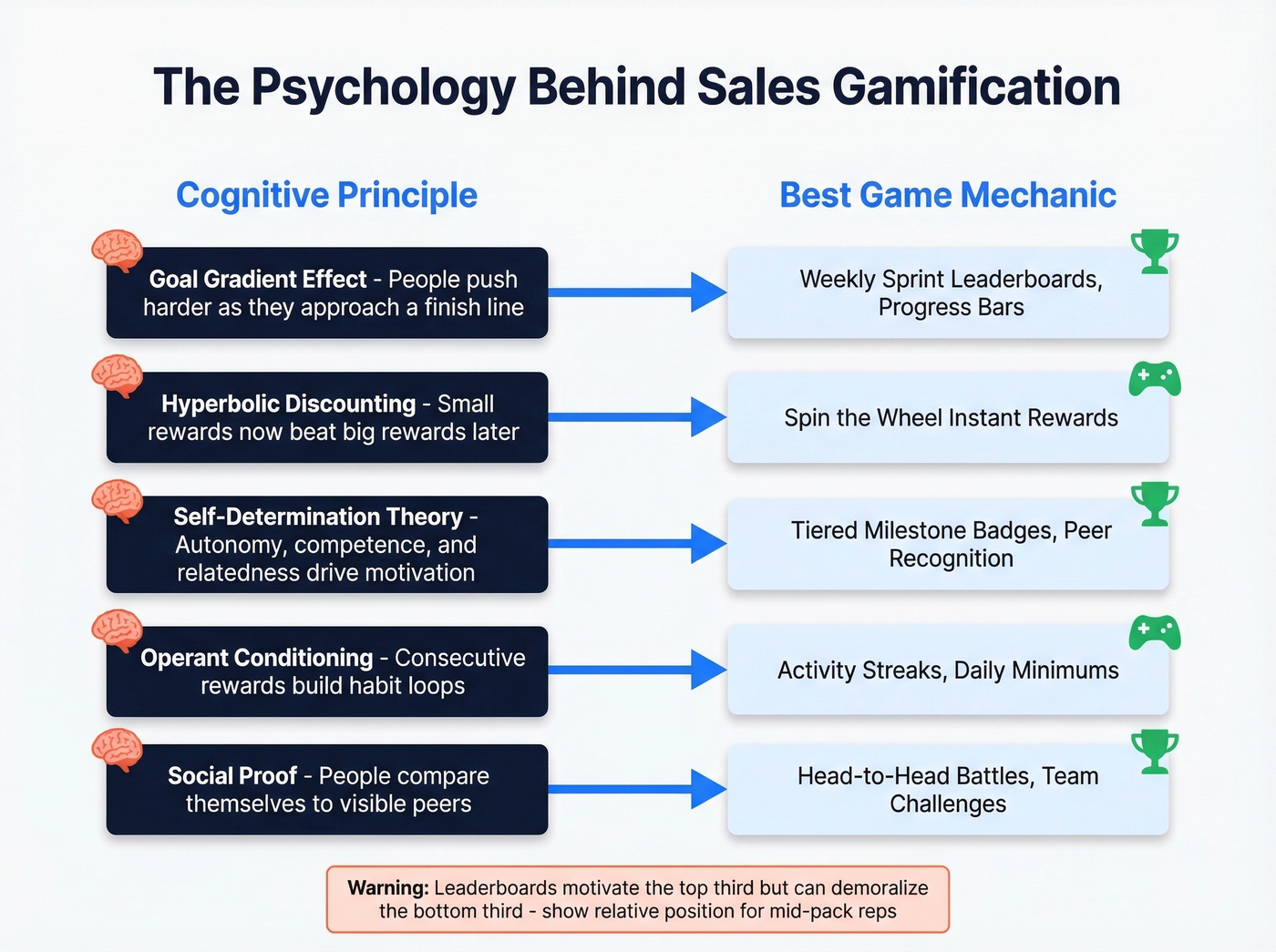
Goal gradient effect. People accelerate effort as they approach a goal. Breaking a quarterly quota into weekly milestones with visible progress bars works far better than a single number 90 days away. A rep at 73% of a weekly target pushes harder than a rep at 24% of a quarterly target, even if the math is identical.
Hyperbolic discounting. Humans irrationally prefer smaller-sooner rewards over larger-later ones. A $25 gift card this Friday beats a $100 bonus next quarter in terms of behavioral motivation. That's why "spin the wheel" instant rewards outperform end-of-quarter prize pools every time.
Self-determination theory identifies three drivers of intrinsic motivation: autonomy, competence, and relatedness. A 2024 experiment with 184 participants confirmed that gamification significantly influences purchase intention through these mechanisms - and that the effect is moderated by time poverty. People who feel overwhelmed respond less, which explains why quest overload kills programs.
Operant conditioning is the engine behind streak mechanics: consecutive-day rewards create habit loops that persist even after the formal incentive ends. Social proof via leaderboards triggers comparison and recognition drives - but public rankings motivate the top third and can demoralize the bottom third. The design fix: show relative position, not absolute rankings, for mid-pack performers.
9 Ideas to Gamify Your Sales Process
Weekly Sprint Leaderboards
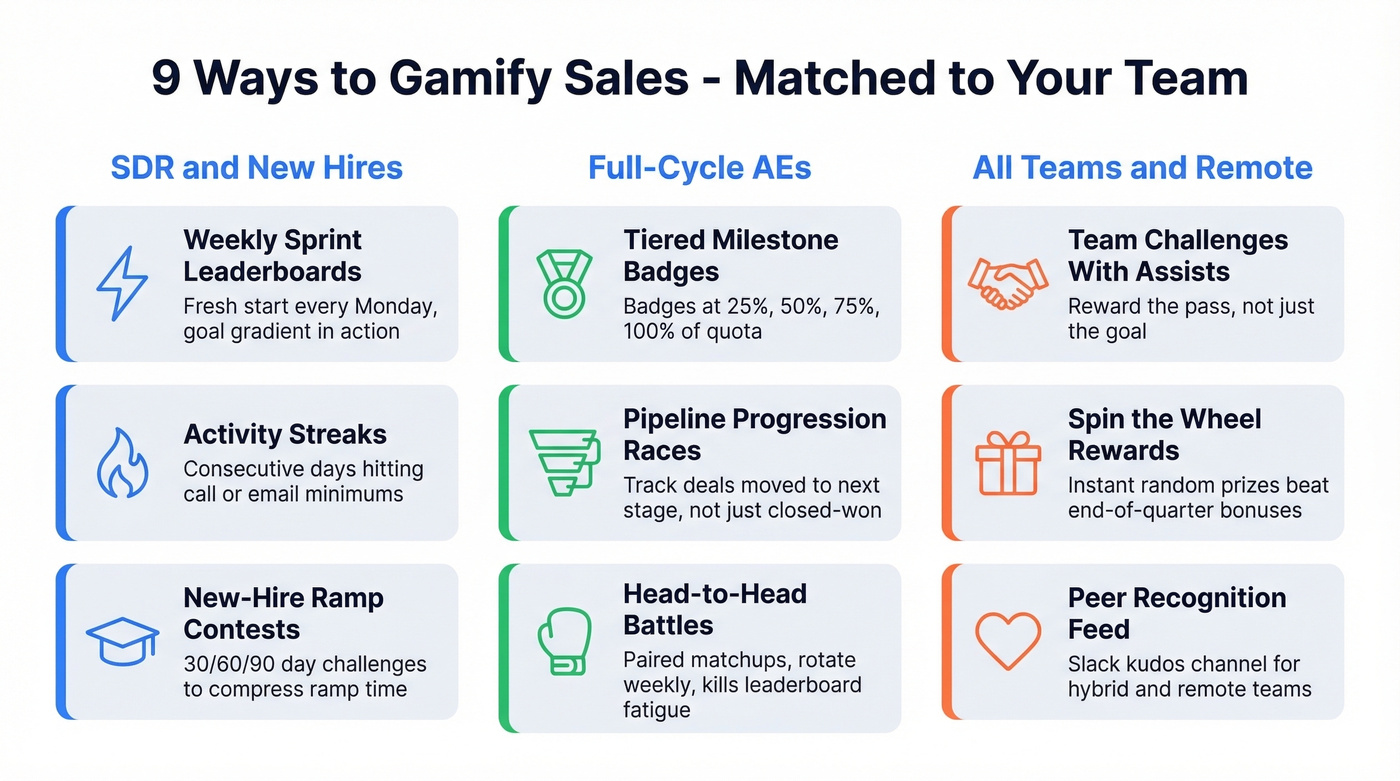
Run weekly sprints instead of monthly contests. Reps get a fresh start every Monday, and mid-pack performers stay engaged because they're never more than a few days from a reset. The goal gradient effect makes shorter cycles create more "finish line" moments. Best for SDR teams with high-volume activity metrics.
Tiered Milestone Badges
Set badges at 25%, 50%, 75%, and 100% of quota. This gives every rep something achievable to chase, not just the closers. Display badges in Slack or on dashboards. Best for full-cycle AEs with longer deal cycles.
Head-to-Head Battles
Imagine your team leaderboard - the same three names at the top every week. Now imagine pairing reps for one-on-one matchups instead. Suddenly the rep ranked #7 has a real shot at beating #8, and both of them care. Rotate pairs weekly. This eliminates the "I can never win" effect that kills mid-pack motivation. Best for teams of 10+ where leaderboard fatigue has set in.
Activity Streaks
Track consecutive days where reps hit minimum call or email thresholds. The streak itself becomes the reward - operant conditioning in action. But activity-based contests only work if the underlying data is accurate. If reps are emailing bounced addresses, their streak breaks through no fault of their own. Verify your contact data before you launch activity-based mechanics. Best for new SDRs building habits.
Team Challenges With Assist Tracking
Don't do this: Group reps into teams and only measure closed deals. The top closer carries the pod while everyone else coasts.
Do this instead: Track assists - discovery calls that another rep closes, intros made, intel shared. Gamifying collaborative behaviors builds peer accountability and reduces internal hoarding. One insight from Centrical's approach: rewarding the pass, not just the goal, changes team dynamics overnight. Best for organizations trying to break silo behavior.
New-Hire Ramp Contests
Deloitte data shows a 30% rise in adoption of gamified training programs. Give new hires a 30/60/90-day challenge with clear milestones: first qualified meeting, first pipeline created, first deal closed. The structured competition compresses ramp time and gives managers early signal on who needs coaching.
"Spin the Wheel" Instant Rewards
When a rep hits a target, they spin a digital wheel for an instant prize - coffee gift card, early Friday, lunch on the company. The randomness adds dopamine. The immediacy beats any end-of-quarter bonus. Best for daily or weekly micro-targets.
Pipeline Progression Races
Track deals moved to the next stage, not just closed-won. This gamifies the behaviors that create revenue - discovery calls completed, proposals sent, champions identified - rather than just the final result. Best for complex B2B sales with 3+ stage pipelines.
Peer Recognition Feed
A post on r/SalesOperations flagged the core problem with remote gamification: in-office reps get hallway high-fives while remote reps feel invisible. A digital recognition feed in Slack where reps give kudos to teammates solves this. Best for hybrid and fully remote teams.

Activity streaks and sprint leaderboards only work when reps reach real people. If 20% of your emails bounce, your gamification program is rewarding wasted effort. Prospeo delivers 98% email accuracy with a 7-day refresh cycle - so every call, every email your reps send actually counts toward the scoreboard.
Clean data is the foundation every sales contest needs to actually move revenue.
How Sales Gamification Backfires
Most gamification programs fail. Not because the concept is flawed, but because the design violates basic behavioral principles.
Fuzzy Goals and Vague Scoring
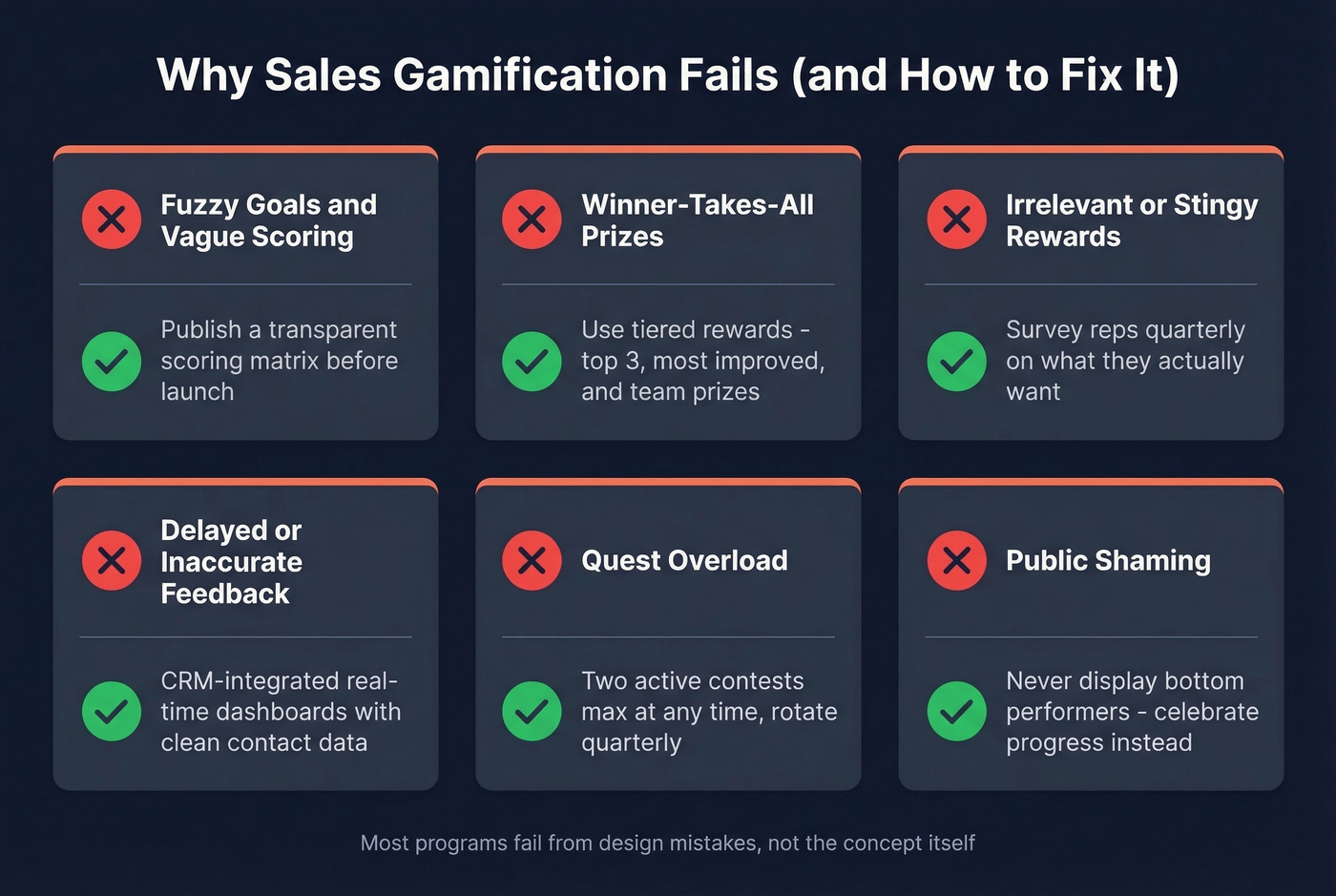
When reps don't understand how points are calculated, they stop trusting the system. Google News tried badges to drive engagement - users felt monitored and confused about what triggered rewards. Some stopped using the product entirely. The fix: publish a transparent scoring matrix before launch. Every rep should be able to calculate their own score from CRM data.
Winner-Takes-All Prizes
This is the single fastest way to demotivate 80% of your team. When only the top rep wins, mid-pack performers do the math by week two and check out. Foursquare's "mayor" mechanic showed this perfectly - power users made it impossible for newcomers to compete, and newcomers left. The fix: tiered rewards. Top 3, most improved, and team-based prizes ensure everyone has a shot.
Irrelevant or Stingy Rewards
A $10 Starbucks card for hitting 150% of quota is insulting. GAP ran a one-day giveaway of 10,000 jeans - once they were gone, motivation collapsed completely. The fix: survey reps quarterly on what they actually want.
Delayed or Inaccurate Feedback
Here's the thing: when leaderboards update once a day - or worse, when the data is wrong - fairness concerns explode. Rep A gets a clean territory; Rep B gets recycled leads with 30% bounce rates. The leaderboard says Rep A is better. The data says Rep B never had a fair shot. Clean your contact data before launching any contest. Tools like Prospeo keep bounce rates under 5% with a 7-day refresh cycle, so reps aren't penalized for stale records. The broader fix: CRM-integrated, real-time updates. If your CRM can't feed a live dashboard, you're not ready for dedicated software.
Quest Overload
Three contests running simultaneously with different scoring rules. Reps experience decision fatigue and ignore all of them. One practitioner on r/Sales_Professionals managing ~300 reps flagged novelty decay as their top concern. The fix: two active contests max at any time. Rotate mechanics quarterly.
We've found that gamification works best when deployed intermittently, not constantly. The moment reps expect a contest every week, it stops being a motivator and becomes an entitlement. The best programs run 3-4 focused sprints per quarter with breathing room between them.
Public Shaming
Skip this entirely. Displaying the "bottom five" or deducting points for missed targets creates fear, not motivation. Coach privately, celebrate publicly. Leaderboards should show top performers and each rep's own position - not a ranked list from best to worst.
What to Gamify (and What Not To)
Not all gamified actions produce revenue. A field study published via Springer found surprising results when testing which customer actions to incentivize:
| Action | Impact on Frequency | Impact on Revenue |
|---|---|---|
| Newsletter signups | Shortens cycles | No increase |
| Product reviews | Shortens cycles | No increase |
| Wish-list adds | Decreases | Decreases |
| Liking/sharing | Increases | Increases |
The sales translation: gamify leading indicators that correlate with revenue - meetings booked, pipeline created, deals advanced. Don't gamify vanity metrics like calls logged or emails sent. A rep who sends 200 emails to bad addresses isn't outperforming a rep who sends 50 emails that generate 5 meetings. Activity without quality is noise.
Connecting Mechanics to Deal Outcomes
The case studies above prove that gamification drives activity - but the real payoff comes when you connect game mechanics to deal outcomes, not just effort metrics. Pipeline progression races reward reps for advancing deals through stages, which directly shortens sales cycles and improves win rates. When you tie motivation to the behaviors that close revenue - multi-threading into accounts, sending proposals within 24 hours of discovery, booking next steps before ending a call - you move from "reps are busy" to "reps are effective."
Sales Gamification Tools and Pricing
| Tool | Best For | Starting Price | G2 Rating |
|---|---|---|---|
| SalesScreen | Distributed teams | $250/mo (10 users) | 4.7/5 (474 reviews) |
| Spinify | Budget-friendly | ~$16/user/mo | - |
| Ambition | Salesforce shops | ~$30-50/user/mo | - |
| Hoopla | TV-first experience | ~$22-30/user/mo | - |
| Plecto | Dashboard + reward store | ~$200/mo | - |
| Centrical | Enterprise L&D | ~$25-50/user/mo | - |
| Pointagram | Budget option | ~$5/user/mo | - |
| SmartWinnr | Enterprise mobile-first | ~$20-40/user/mo | - |
SalesScreen is the leader for distributed teams wanting TV dashboards and real-time competitions. Pricing starts at $250/mo for 10 users, with Pro at $675/mo for 15 users. The median annual contract runs about $19,000 per Vendr's procurement data. G2 reviewers love the real-time visibility but flag TV setup friction.
Spinify is the best value per seat at around $16/user/mo - leaderboards, competitions, and TV displays without the enterprise price tag. For teams under 30 reps, it's the obvious starting point.
Ambition goes deep on scorecards, coaching workflows, and Salesforce-native integrations. If your entire revenue stack runs through Salesforce, Ambition fits cleanly. On HubSpot? Look elsewhere.
Plecto stands out for its "Reward Store" - reps earn virtual coins through gamified activities and redeem them for prizes they actually want. It's more dashboard tool than gamification platform, but that coin mechanic solves the stale-prize problem elegantly.
For teams under 20 reps, skip the platform entirely. A shared dashboard, weekly contests, and a $50 prize budget will get you 80% of the results. We've seen teams spend months evaluating software when the real problem was unclear metrics and stale data.
Rolling It Out Without Flopping
Six steps that prevent the most common failures:
- Audit your contact data. If bounce rates exceed 5%, fix your data before launching any activity-based contest. Reps can't hit email targets when a third of their list is dead.
- Define 2-3 metrics tied to revenue outcomes. Meetings booked, pipeline created, deals advanced. Not calls logged. (If you need a menu, start with these sales activities.)
- Publish a scoring matrix before launch. Every rep should be able to calculate their own score. Transparency prevents gaming.
- Run a 30-day manual pilot. Slack channel + spreadsheet. If the mechanics don't work manually, software won't save them.
- Survey reps on reward preferences. Don't assume everyone wants gift cards. Ask.
- Rotate mechanics quarterly. The contest that electrified your team in January will bore them by April.
You're designing head-to-head battles and assist tracking - but your reps are dialing dead numbers. Prospeo's 125M+ verified mobiles hit a 30% pickup rate, 3x the industry average. Give your team contacts that connect so your gamification mechanics reward real selling, not busywork.
Stop gamifying activity that goes nowhere. Start with data that connects.
FAQ
Does gamification work for remote sales teams?
Yes - and often better than in-office. Digital leaderboards and Slack-based contests give distributed reps structured visibility they'd otherwise lack. Remote teams benefit most from peer recognition feeds because they miss the hallway high-fives that office reps take for granted.
How much does sales gamification software cost?
Expect $5-50/user/month depending on features. Pointagram starts at ~$5/user/mo for basics; SalesScreen Pro runs $675/mo for 15 users. Teams under 20 reps should start with a spreadsheet and Slack before investing in a dedicated platform.
What's the biggest mistake teams make?
Winner-takes-all contests that motivate the top 10% and demoralize everyone else. Use tiered rewards instead: top 3 performers, most improved, and a team-based prize so 30-40% of reps win something meaningful each cycle.
How do you prevent reps from gaming the system?
Publish a transparent scoring matrix, tie metrics to revenue outcomes like meetings booked and pipeline created instead of raw activity, and audit for fake activities monthly. Pair this with clean contact data so reps can't inflate email counts with dead addresses.
How often should you run sales contests?
Run 3-4 focused sprints per quarter with breathing room between them. Constant contests create entitlement, not motivation. Rotate mechanics - leaderboards one month, head-to-head battles the next - to prevent novelty decay.