

Gap Selling: What It Is, How It Works, and How to Actually Implement It
You asked three great discovery questions. The prospect opened up about their pipeline problem. Then you panicked, jumped straight to the demo, and the deal stalled two weeks later.
That's the exact failure mode gap selling was built to prevent - and why this methodology has become one of the most talked-about discovery frameworks for complex B2B sales teams.
The Short Version
Gap Selling is a problem-centric sales methodology created by Keenan (Jim Keenan) that maps the distance between a buyer's current state and their desired future state, then positions your solution as the bridge. It's one of the strongest discovery frameworks for complex B2B sales, but it's overkill for transactional or procurement-led deals. One takeaway: never present your product before you understand the buyer's problem, its root cause, and its business impact.
What Is Gap Selling?
This methodology flips the traditional sales conversation. Instead of leading with features and hoping the buyer connects the dots, you spend the first chunk of every deal understanding three things: where the buyer is now (current state), where they want to be (future state), and the measurable distance between those two points.
Your product isn't the hero. The gap is.
Think of it like a doctor's visit. A good doctor doesn't hand you a prescription the moment you walk in. They ask about symptoms, run diagnostics, understand the severity, and only then recommend treatment. Keenan - CEO of A Sales Growth Company, Forbes contributor, and a speaker whose live keynotes run $30,000-$50,000 - built the methodology on that same diagnostic logic through years of training and coaching sales teams.
His argument is simple. Pain alone doesn't drive change. What drives change is understanding what that pain costs the business in revenue, missed goals, and team capacity. When you can say "you're losing $400k/year in pipeline leakage because your reps spend 6 hours a week on manual data entry, and your target state eliminates that entirely," you've built a business case - not a pitch.
The Core Framework
The framework rests on five elements that define the buyer's current state. Miss any one and your gap calculation falls apart.
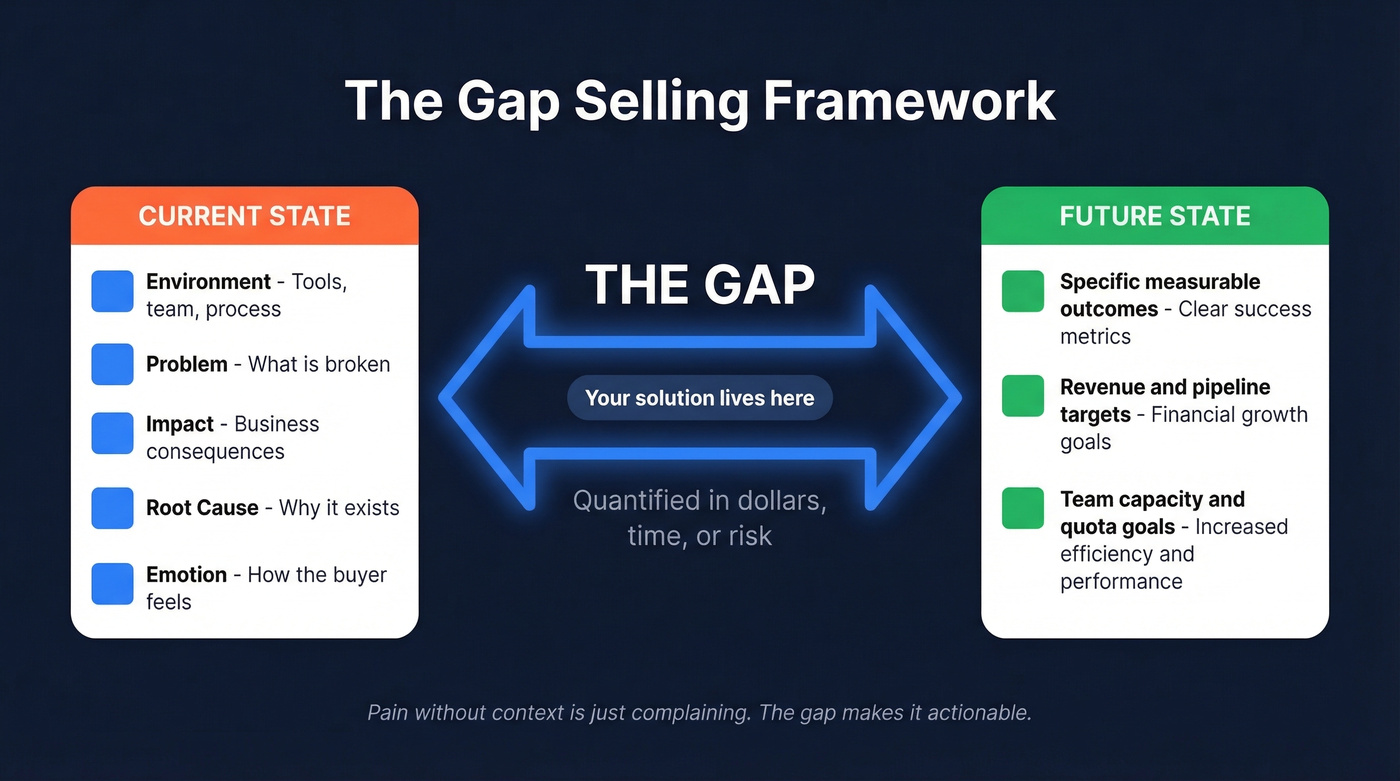
| Element | What It Means | Example Question |
|---|---|---|
| Environment | The buyer's world - tools, team, process | "Walk me through your outbound workflow." |
| Problem | What's broken or underperforming | "Where are deals stalling most often?" |
| Impact | Business consequences | "What does that cost you per quarter?" |
| Root Cause | Why the problem exists | "Why do reps default to that behavior?" |
| Emotion | How the buyer feels about it | "How's the team reacting to missed targets?" |
Once you've mapped the current state, you shift to the future state. This is where the framework diverges from most methodologies - you don't just ask "what do you want?" You ask the buyer to describe their ideal outcome in specific, measurable terms. What does their pipeline look like in 12 months? What close rate are they targeting? How many reps should be hitting quota?
The gap is the quantified distance between those two states. Most methodologies stop at pain. This approach insists that pain without context is just complaining - you need to know what that pain does to revenue, to goals at risk, to team velocity. That's what makes the gap actionable.
Discovery Questions That Work
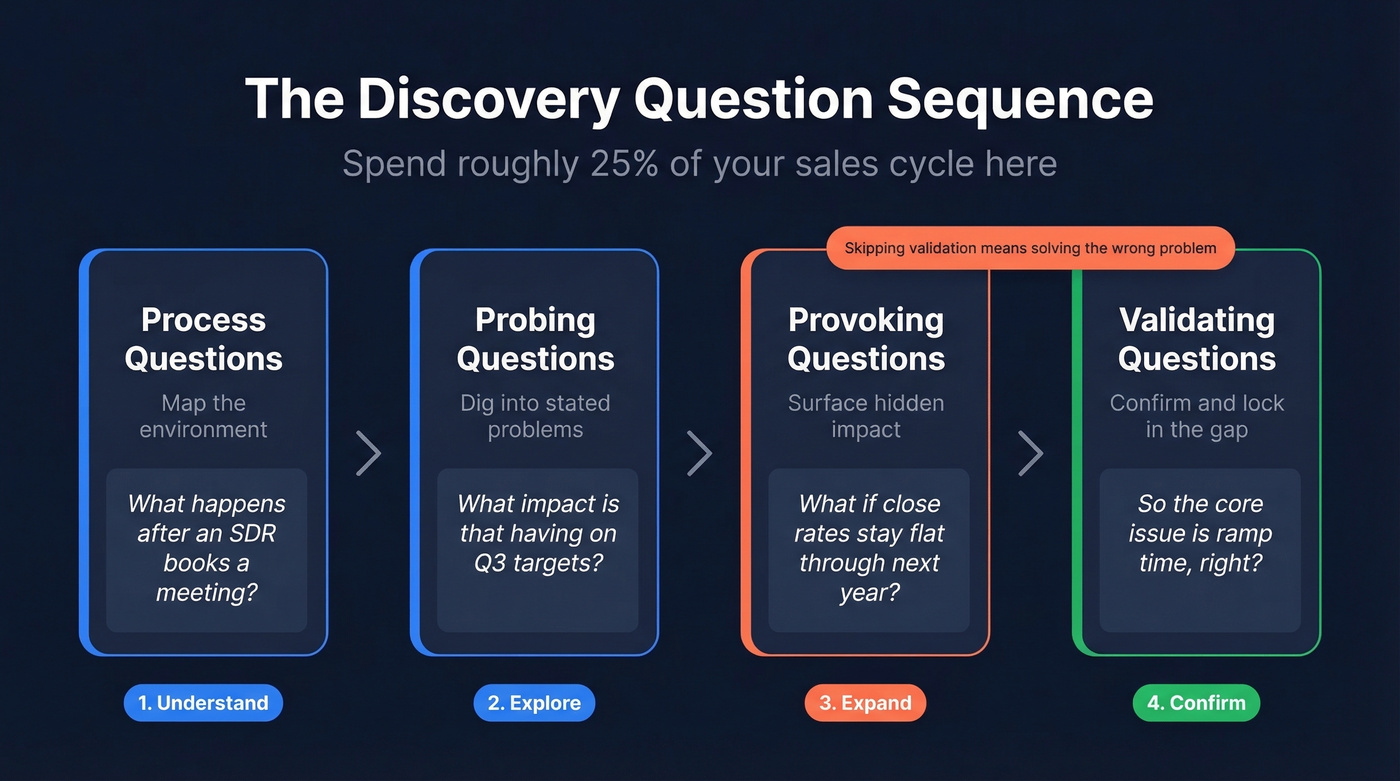
Keenan recommends spending roughly 25% of the sales cycle on current and future state discovery. Gong's breakdown of Gap Selling organizes discovery into four question types:
| Question Type | Purpose | Example |
|---|---|---|
| Probing | Dig into stated problems | "What impact is that having on Q3?" |
| Process | Map current workflows | "What happens after an SDR books a meeting?" |
| Provoking | Surface hidden impact | "What if close rates stay flat next year?" |
| Validating | Confirm and lock in the gap | "The core issue is ramp time - right?" |
The sequence matters. Start with process questions to understand the environment. Move to probing when a problem surfaces. Use provoking questions to expand the impact beyond what the buyer initially described. Validate before you move to the future state. Skipping validation is how you end up solving the wrong problem - and we've watched it happen on recorded calls more times than we'd like to admit.
How to Implement Gap Selling
The methodology lives or dies on pre-call work. Here's the step-by-step breakdown.
Pre-Call Research
Your discovery call is only as good as your preparation. The biggest mistake reps make isn't asking bad questions - it's walking in with zero context and burning the first 10 minutes on questions they could've answered beforehand.
Build a Problem Identification Chart before every significant call:
| Problem | Impact | Root Cause |
|---|---|---|
| Reps missing quota | $1.2M pipeline gap this quarter | No verified contact data; 30% bounce rate |
| Long sales cycles | Deals stall at technical eval | Single-threaded to one champion |
| Low outbound response | 2% reply rate | Outdated prospect data; generic messaging |
Fill in what you can before the call. Research the prospect's tech stack, recent funding rounds, org structure, and public signals about their priorities. A tool like Prospeo gives you 50+ data points per enrichment plus buyer intent data across 15,000 topics, so you walk into the call with context instead of guesswork.
Here's the thing: pre-call research is the most neglected step in this methodology. We've seen teams adopt the question framework but skip preparation entirely, then wonder why discovery calls feel shallow. You can't ask a provoking question about a company's hiring slowdown if you didn't know they had one.
During the Call: Build the Gap
Your SDR just booked a discovery call with a VP of Operations at a 500-person company. You have 30 minutes.
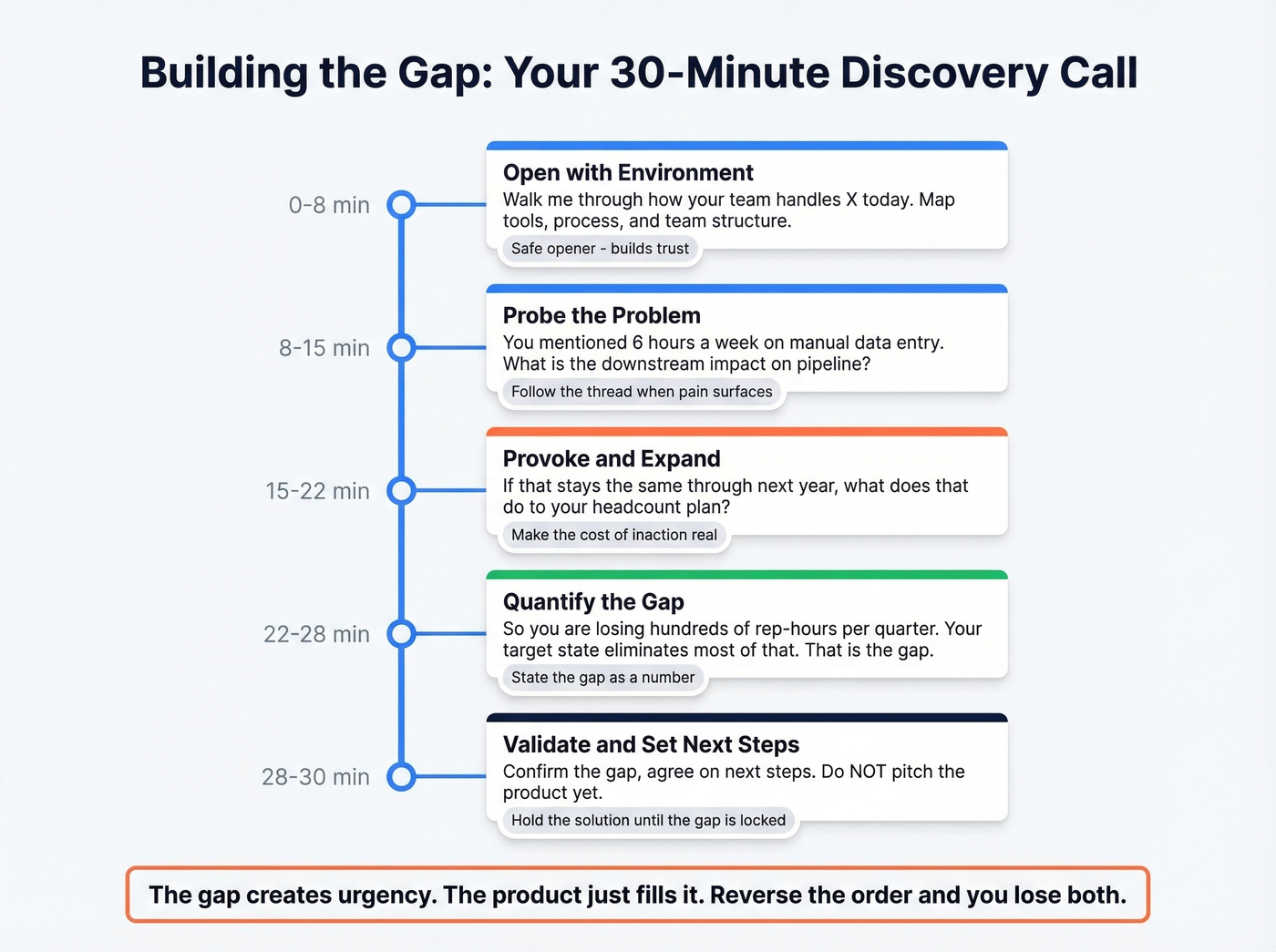
Open with environment questions. "Walk me through how your team handles X today." This feels safe for the buyer and gives you a working picture of their current process, tools, and team structure early in the conversation.
When a problem surfaces - and it will - shift to probing. "You mentioned your team spends 6 hours a week on manual data entry. What's the downstream impact?" Then provoke: "If that stays the same through next year, what does that do to your headcount plan?"
Quantify the gap in dollars, time, or risk. The build-the-gap technique works because you're making the distance between current and future state impossible to ignore. "So you're losing hundreds of rep-hours per quarter to manual work. Your target state eliminates most of that. That's the gap we're solving." When you state the gap as a number, you've built the business case for the buyer - they're not taking your word for it, they're looking at their own math.
After the Call
Map findings back to the Problem Identification Chart. Update root causes, quantify the gap with real numbers from the conversation. This chart becomes the backbone of your proposal and the document you reference in every follow-up.
If you need a tighter post-call process, use a few proven sales follow-up templates to keep momentum without jumping to a pitch.

Your Problem Identification Chart is only as strong as your pre-call data. Prospeo enriches every prospect with 50+ data points - tech stack, funding, headcount growth, and buyer intent across 15,000 topics - so you walk into discovery calls ready to probe, provoke, and quantify the gap.
Stop burning discovery calls on questions you should already know the answers to.
The #1 Mistake Reps Make
Keenan puts it bluntly: "Never send the product information before you get the problem information."
Here's what happens when you break that rule. You ask three solid probing questions. The prospect opens up. You get excited and say "let me send over a deck and a case study." The buyer now has everything they need to evaluate you on their own timeline. They go dark. You follow up three times. Nothing.
The mechanism is simple: once the buyer has product information, they control the pace. They can loop in other vendors or decide the problem isn't urgent enough. By holding solution details until the gap is fully mapped, you maintain the urgency that drives deals forward. The gap creates urgency. The product just fills it. Reverse the order and you lose both.
Let's be honest - this is the hardest habit to break. Every rep has felt that rush when a prospect leans in, and the instinct to pitch is almost physical. Fighting it takes deliberate practice.
Gap Selling vs. Other Methodologies
There's a common sentiment on r/sales that all methodologies boil down to the same fundamentals: need, budget, stakeholders, timeline. Fair enough. But the differences in emphasis matter more than the similarities, especially at scale.
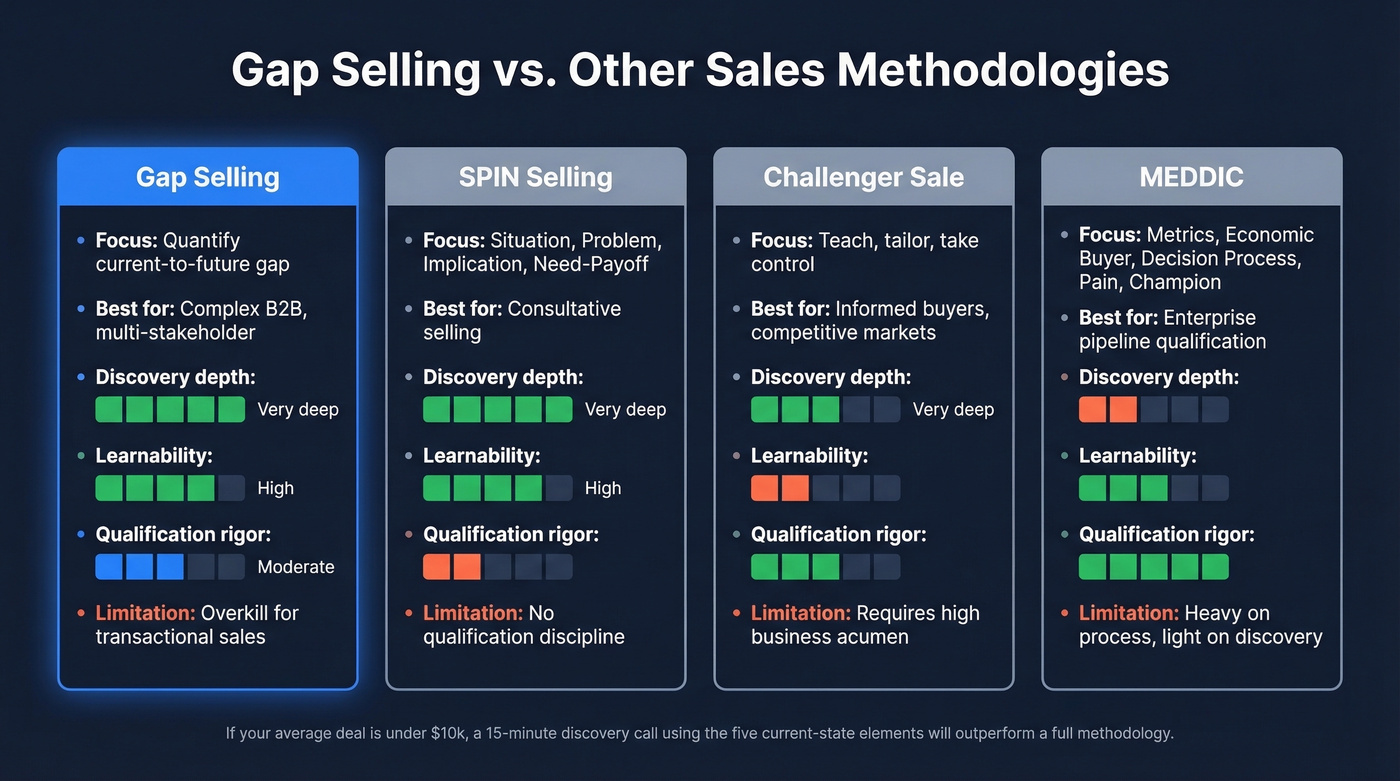
| Methodology | Core Approach | Best For | Key Limitation |
|---|---|---|---|
| Gap Selling | Quantify current-to-future gap | Complex B2B, multi-stakeholder | Overkill for transactional sales |
| SPIN | Situation, Problem, Implication, Need-Payoff | Consultative selling | No qualification discipline |
| Challenger | Teach, tailor, take control | Informed buyers, competitive markets | Requires high business acumen |
| MEDDIC | Metrics, Economic Buyer, Decision Criteria/Process, Pain, Champion | Enterprise pipeline qualification | Heavy on process, light on discovery |
SPIN infers the future state through implication and need-payoff questions but never makes it explicit. It also doesn't address today's buying groups that often involve 6-10 stakeholders. Challenger teaches reps to lead with insight but doesn't provide the same step-by-step discovery structure. MEDDIC is primarily a qualification framework - heavier on process and deal rigor than deep discovery.
Gap Selling is the most complete because it explicitly maps both states and quantifies the distance between them. For context, companies like Xerox reported a 17% increase in sales and $65M in contract value after implementing Challenger - but Challenger's skills barrier is real. The problem-centric question framework is more learnable for average reps, which matters when you're rolling it out across a 30-person team, not just coaching your top three closers.
Hot take: If your average deal size is under $10k, you probably don't need any of these methodologies in their full form. A 15-minute discovery call using the five current-state elements will outperform a straight pitch every time - and it won't scare off buyers who just want a quote.
Benefits and When to Skip It
Use this methodology if you're selling:
- Complex B2B SaaS with 2+ stakeholders
- Managed IT, commercial insurance, or custom solutions
- Anything where the buyer's problem isn't obvious to them yet
- Deals where a priority gap between current performance and business targets needs to be surfaced
Skip it if you're selling:
- Transactional products where the buyer already knows what they want
- Into procurement-led environments where your contact has no access to business goals
- Quote-driven deals where the buyer has three vendors and wants pricing by Friday
The core benefits - larger deal sizes, shorter cycles, and stronger business cases - show up most clearly in multi-stakeholder environments where the buyer hasn't fully quantified their own pain.
A practitioner on Reddit nailed the friction point: "drilling your customer on numerical goals" feels impractical when your contact is a procurement manager who won't bring superiors into meetings and just wants a timely quote. Another common complaint from r/sales threads: prospects sometimes feel deep discovery wastes their time and want you to "get to the point." Both are real limitations. Too many questions in those contexts pushes the buyer to a competitor who'll just send the quote.
That said, practitioners in those same threads have called the methodology "life changing" as a mindset shift. The discipline of understanding the problem before presenting the solution transforms how reps think about deals, even when they can't run the full framework.
Real-World Examples and Results
The most concrete example comes from a practitioner who implemented the methodology in late 2018. Average deal size jumped from $45k to $105k. Annual sales went from $850k to $1.3M - and that $1.3M came in just 8 months before a promotion to Director of Business Development. The standout deal involved a 4-hour discovery with 17 stakeholders across a multi-hospital health system, resulting in a $250k first-year contract.
That's a single testimonial hosted on Keenan's site, not an independent study. But the numbers are concrete and consistent with what we've seen across teams that invest in structured discovery. Teams rolling out a methodology like this typically target 10-20% win-rate improvement and 10-30% cycle-time reduction. The testimonial numbers exceed those benchmarks, which suggests explicit gap quantification adds real leverage beyond generic "ask better questions" training.
Post-training survey data from A Sales Growth Company: 98% of CROs/VPs/Directors surveyed believe the methodology will help them hit goals, 93% say reps use it daily, and 91% say the training exceeded expectations.
Training and Pricing
| Resource | Format | Price |
|---|---|---|
| Gap Selling (book) | Paperback / Kindle / Audible | ~$27 / ~$10 / Free with trial |
| Individual training | Online, annual | $499/yr |
| Team training | Online, annual | $2,599/yr |
| Small company training | Online, annual | $5,299/yr |
| Large company training | Online, annual | $14,999/yr |
| Keenan speaking (live) | In-person keynote | $30,000-$50,000 |
| Keenan speaking (virtual) | Virtual keynote | $10,000-$20,000 |
The book is the obvious starting point - read it in a weekend, start applying the Problem Identification Chart on Monday. The $499/yr individual tier is reasonable for a solo AE who wants structured practice. For teams, the $2,599/yr tier adds coaching structure that makes the difference between "we read a book" and "we changed how we sell."
If you're building a repeatable rollout, it helps to standardize sales activities and tighten your sales process optimization so discovery quality doesn't vary rep to rep.
Gap selling dies when reps can't reach the right buyers. A 30% bounce rate isn't just a deliverability problem - it's a gap in your own current state. Prospeo delivers 98% email accuracy on 300M+ profiles, refreshed every 7 days, so your outreach actually lands with the decision-makers you just spent 30 minutes diagnosing.
Close the gap between great discovery and dead-end contact data.
FAQ
Is gap selling only for enterprise deals?
No - it works for any consultative B2B sale with multiple stakeholders, including mid-market. For purely transactional or quote-driven sales, the full framework is overkill. The five-element current state analysis scales down well for deals in the $15k-$50k range.
How is gap selling different from SPIN?
Both are discovery-focused, but gap selling explicitly maps the buyer's desired future state and quantifies the distance from current state in dollars or time. SPIN infers the future state through implication and need-payoff questions without making it explicit. Gap Selling also emphasizes root cause analysis more heavily.
How long does it take to learn?
You can read Keenan's book in a weekend and start applying the Problem Identification Chart on your next call. Mastery - especially the discipline of not jumping to product information - typically takes 2-3 months of deliberate practice with coaching reinforcement.
What tools help with pre-call research?
The methodology depends on deep pre-call research into the prospect's environment, problems, and org structure. Any good B2B data platform that gives you company intelligence, tech stack details, and buyer intent signals will make your discovery calls sharper. Pair that with your CRM and a tool like Gong for call analysis.
How do I roll this out across a full sales team?
Start with the book as required reading, then run a workshop where reps build Problem Identification Charts for their active deals. Add a CRM field that captures current state, future state, and quantified gap for every opportunity. Review those fields in pipeline meetings to reinforce the habit. The $2,599/yr team training tier from A Sales Growth Company adds structured coaching if you want formal enablement beyond internal rollout.