

Gap Selling Questions: 50+ Discovery Questions by Type
"The sale is won at the beginning, not the end." Keenan's line cuts through every sales methodology debate because it's obviously true - and obviously ignored. Most reps over-prepare the pitch and under-invest in discovery. The best reps flip that ratio entirely, spending twice as long on questions as they do on slides.
What follows is a bank of 50+ gap selling questions organized by Keenan's four types, sequenced into a call flow you can steal tomorrow morning.
The Framework in 60 Seconds
Gap Selling rests on three pillars:
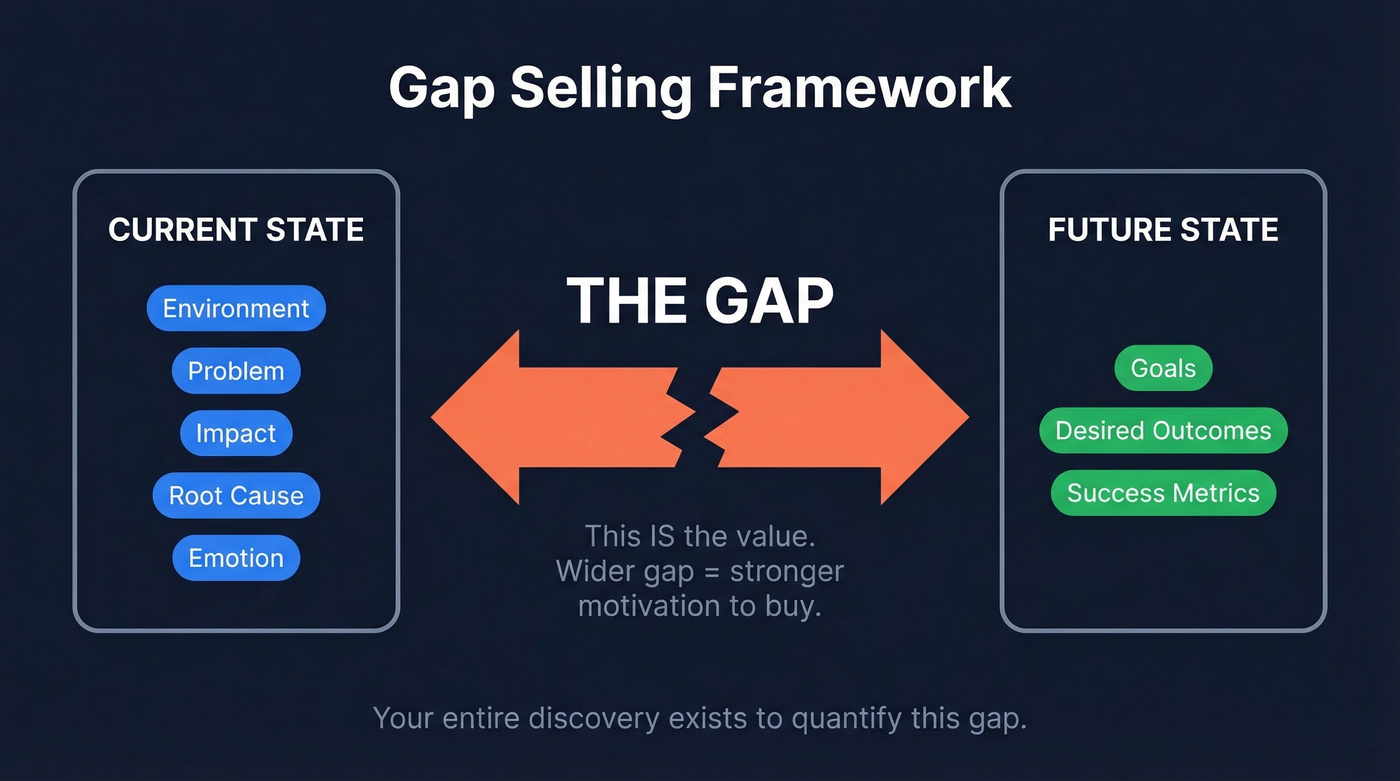
- Current state - five elements to uncover: environment, problem, impact, root cause, and emotion.
- Future state - where the buyer wants to be: goals, desired outcomes, success metrics.
- The gap - the distance between the two. This IS the value. The wider the gap, the stronger the motivation to buy.
Your entire discovery exists to quantify that gap. Every question below maps to one of these elements. If a question doesn't widen or clarify the gap, cut it.
Complete Discovery Questions Bank
Probing Questions
Probing questions explore the buyer's environment, problems, and impact. The goal isn't to check boxes - it's to get the buyer talking at length. Gong's research shows a strong link between longer buyer responses and closed deals, so phrase these to invite narrative answers, not one-word replies.
- "Can you help me understand how your team currently handles [process]?"
- "What does a typical day look like for the people doing this work?"
- "You mentioned [problem] - can you tell me more about what that looks like in practice?"
- "How long has this been an issue, and what's changed recently?"
- "What kind of impact is [problem] having on your team's output?"
- "Who else feels this pain, and how does it show up for them?"
- "What's your opinion on why this is happening?" - This is one of the strongest probing stems in the entire framework. It hands the buyer the mic and surfaces root causes you'd never guess.
- "What metrics are you tracking today, and which ones are moving in the wrong direction?"
- "If you had to put a number on the cost of this problem - hours, revenue, headcount - what would it be?"
- "How widely felt is this across the organization?"
- "Walk me through what happened the last time this problem caused a real fire drill."
- "What does your leadership team say about this when it comes up?"
- "How is this problem affecting your team's morale or retention?"
- "What would your team say is the single biggest bottleneck in their workflow right now?"
- "When did you first realize this was more than a minor annoyance?"
"Can you help me understand..." is the single best question stem for probing. It signals you want a real answer, not a yes/no.
Process Questions
Process questions map the buyer's current workflow, decision-making structure, and stakeholders. Think of these as your org-chart and workflow X-ray. We've watched reps skip process questions and end up presenting to the wrong person three weeks later - that's a deal killer you never see coming.
- "Can you walk me through what happens before and after [process]?"
- "Who's involved in this workflow today, and what's each person's role?"
- "How do you evaluate whether this process is working?"
- "What tools or systems are you using to manage this right now?"
- "When you've tried to fix this before, what happened?"
- "Who would need to sign off on a change like this?"
- "What does your decision-making process look like for a purchase in this range?"
- "Walk me through how budget gets allocated for projects like this."
- "What's the timeline you're working against?"
- "Are there other initiatives competing for the same resources right now?"
- "If we moved forward, who would own the implementation on your side?"
- "What's the approval chain look like - single sign-off or committee decision?"
- "How does your team typically evaluate new vendors or solutions?"
Use "Walk me through..." liberally. It keeps the conversation flowing naturally and feels collaborative, not interrogative.
Provoking Questions and Rational Drowning
Here's the thing: provoking questions are where deals are won or lost. Most reps under-invest here because these questions require business acumen and a willingness to challenge the buyer's assumptions. They create urgency without pressure tactics. Done well, this phase triggers what Keenan calls rational drowning - the moment the buyer realizes, through their own logic and data, that the cost of inaction is too high to ignore.
Picture this: you're 15 minutes into a call with a VP of Revenue Operations. She's described a messy handoff between SDRs and AEs. You've mapped the process. Now you say: "If your competitor solved this handoff problem before you did, what would that mean for your win rates this quarter?" Watch the energy shift. That's a provoking question doing its job.
- "If we fast-forward 12 months and nothing's changed, what does that look like?"
- "Have you considered what would happen if [provocative insight]?"
- "What's the ripple effect of this problem on other departments?"
- "What's the cost of doing nothing for another quarter?"
- "If your competitor solved this problem before you did, what would that mean?"
- "You mentioned [metric] - what happens to that number if this trend continues?"
- "What would it mean for your team if you could get [desired outcome] in half the time?"
- "Is this a problem your board is aware of, or is it still flying under the radar?"
- "If you had to stack-rank your top three priorities, where does this fall - and why?"
- "What's the opportunity cost of the workaround you're using today?"
- "How does this problem affect your ability to hit [specific goal] this year?"
- "What would change in your day-to-day if this just... worked?"
- "What happens to your team's credibility internally if this doesn't get fixed?"
- "How much pipeline are you leaving on the table every month this stays broken?"
The "go back in time" technique - popular among practitioners on r/sales - works beautifully for inbound buyers already evaluating solutions. Ask about their evaluation process, then rewind: "Take me back to the moment you realized you needed to look for something new. What triggered that?" It surfaces the original pain that started the buying journey.
Validating Questions
Validating questions confirm your understanding, lock in commitments, and set up next steps. They're the bridge between discovery and action - and they're where Keenan's "No discovery, no demo" principle comes alive. If you can't validate the gap, you haven't earned the right to demo anything.
- "To me, it seems like [problem] is the main issue here - am I understanding you correctly?"
- "So the biggest impact is [X], and the root cause is [Y]. Does that match your view?"
- "If we could solve [specific problem], would that be enough to justify moving forward?"
- "What's changed since we last talked?" - Open every follow-up call with this. It re-engages the buyer and surfaces new information without rehashing old ground.
- "Based on what you've shared, here's what I'm hearing as the priority - does that resonate?"
- "Is there anything I'm missing that would change how we approach this?"
- "If we showed you a solution that addresses [gap], who else would need to see it?"
- "What would a successful outcome look like for you personally?"
- "On a scale of 1 to 10, how urgent is solving this - and what would make it a 10?"
- "If we could demonstrate [specific outcome] in a focused demo, would that be worth 30 minutes of your team's time?"
After discovery, stick to six features or fewer. Every feature beyond six dilutes the gap you just worked so hard to quantify.

Great discovery questions quantify the gap. But you still need to reach the right buyers. Prospeo gives you 98% verified emails and 125M+ direct dials so every deal you uncover in discovery actually gets worked.
Stop losing deals between discovery and outreach.
Sequencing Into a 20-Minute Call
Having 50+ questions doesn't mean firing them in sequence like a deposition. Here's how to structure a 20-to-25-minute discovery call so it feels like a conversation, not a cross-examination.
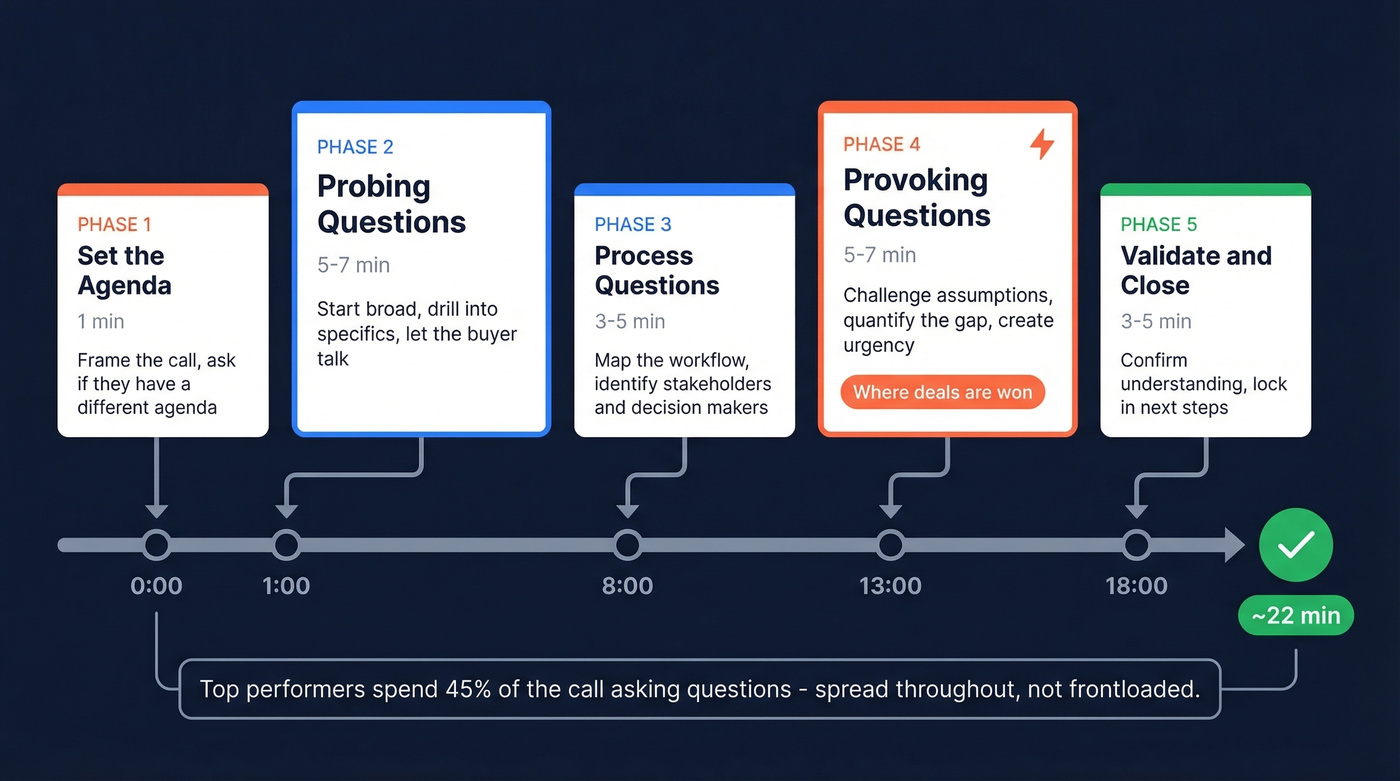
- Set the agenda (1 min): "Thanks for taking the call. I'd love to learn about your challenges, share a few ideas, and we'll figure out if it makes sense to keep talking. Sound good? And let me know if you have a different agenda."
- Open with probing (5-7 min): Start broad, then drill into specifics. Let the buyer talk.
- Layer in process questions (3-5 min): Map the workflow and stakeholders.
- Provoke (5-7 min): Challenge assumptions, quantify the gap, create urgency.
- Validate and close (3-5 min): Confirm understanding, agree on next steps.
Gong data shows top performers spend 45% of their calls asking questions and spread them throughout the conversation - not frontloaded in the first five minutes. Use mirroring (repeat one to three key words with an upward tone) to keep the buyer talking without stacking more questions.
Some coaches argue that asking lots of questions is actively damaging. They're half right - bad questions damage trust. The fix isn't fewer questions; it's better questions mapped to a diagnostic framework. Demoboost's research pegs the average SaaS conversation-to-appointment rate at 23%, so every call needs to count. They also note that in more than 50% of discovery sessions, no product is shown - which is exactly what makes them feel like interrogations. Give the buyer autonomy, use mirroring instead of rapid-fire follow-ups, and make every question earn its spot.
We've seen the best results when provoking questions get at least 5 minutes of airtime. Most reps rush through them to get to the pitch. Resist that instinct.
Build Your Problem Identification Chart First
Keenan's problem identification chart is your pre-call cheat sheet - the "questions to ask yourself" before you ever get on the phone. Three columns, one row per problem you suspect:
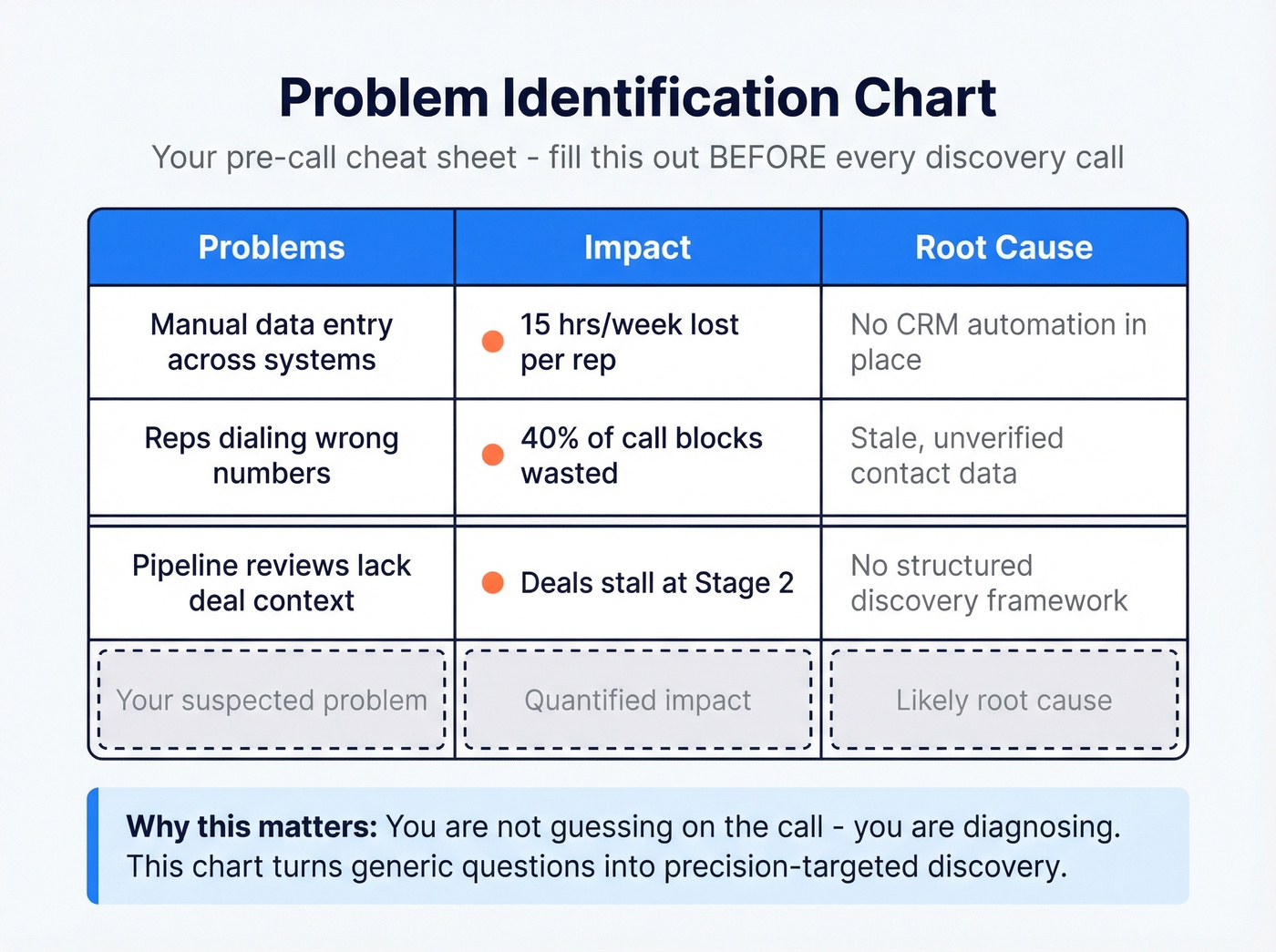
| Problems | Impact | Root Cause |
|---|---|---|
| Manual data entry | 15 hrs/week lost | No CRM automation |
| Reps dialing wrong numbers | 40% of call blocks wasted | Stale contact data |
| Pipeline reviews lack context | Deals stall at Stage 2 | No discovery framework |
This chart gives you a hypothesis to test on the call. You're not guessing - you're diagnosing. Filling it out forces you to research the buyer's industry, role, and likely pain points so your discovery questions land with precision instead of sounding generic. Skip this step and your provoking questions will fall flat, because you won't have the business context to make them sting.
Gap Selling vs. SPIN vs. Challenger
| Gap Selling | SPIN Selling | Challenger Sale | |
|---|---|---|---|
| Core focus | Diagnose the gap | Structured question sequence | Teach-tailor-take control |
| Best for | Complex B2B, custom solutions | Any B2B with multi-step sales | Insight-led enterprise deals |
| Question emphasis | 4 types, 5 current-state elements | 4 categories (S-P-I-N) | Reframe, not discovery-heavy |
| Research base | Keenan's practitioner framework | 35,000 sales calls (Rackham) | CEB research |
| Weakness | Requires strong business acumen | Can feel mechanical | Less diagnostic depth |
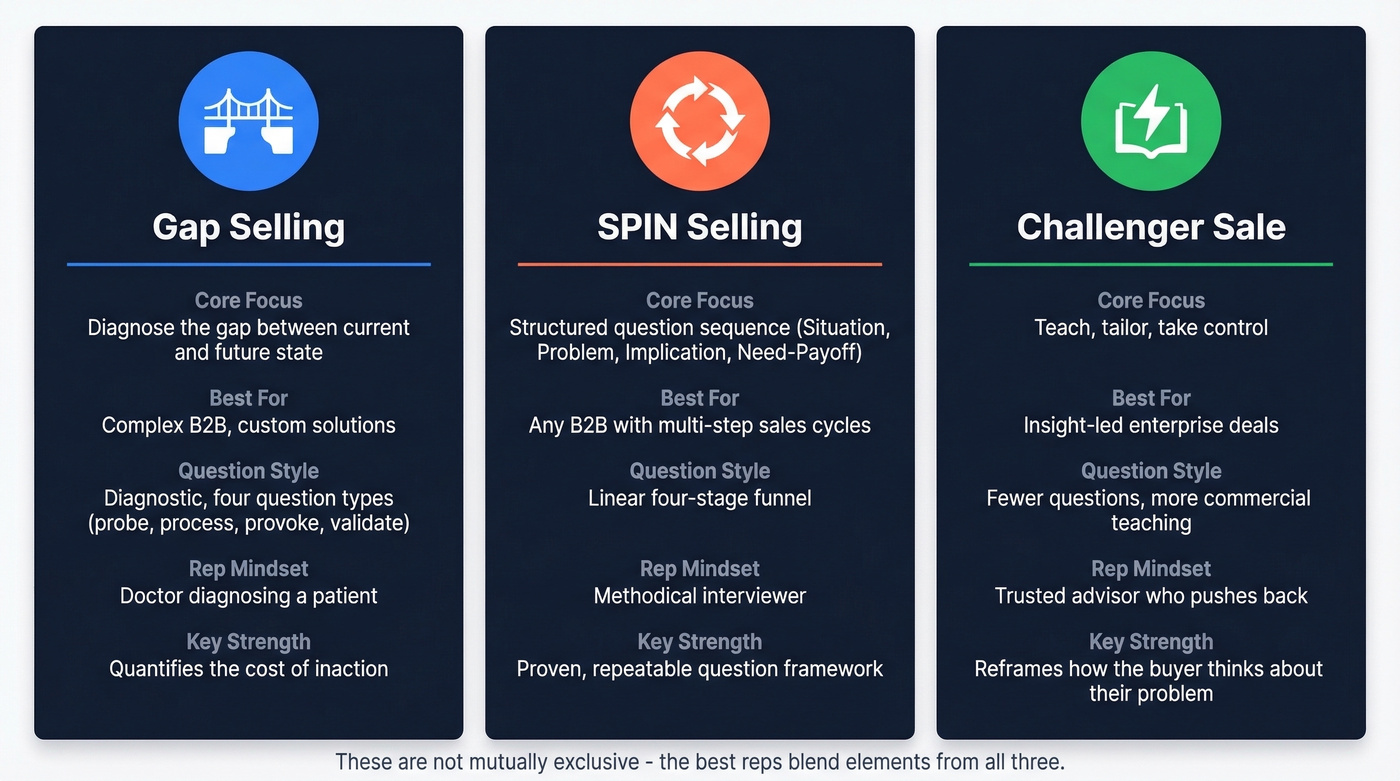
HubSpot's analysis of SPIN found that a solid questioning strategy can improve closure rates by roughly 20% - and that holds regardless of which framework you pick. But Gap Selling is the most complete diagnostic framework for complex B2B. It forces you to understand the problem before you ever pitch the solution. SPIN gives you structure; Challenger gives you insight. Gap Selling gives you the full diagnostic.
Let's be honest: if your team lacks deep industry knowledge, start with SPIN's structure and graduate to Gap Selling as your business acumen grows. Gap Selling without business acumen is just expensive small talk.
Gap selling fails when you're pitching the wrong person. Prospeo's 30+ filters - buyer intent, job changes, department headcount - help you map the full buying committee before you even pick up the phone.
Know every stakeholder before your first probing question.
FAQ
How many questions should I ask on a discovery call?
Aim for 12-18 purposeful questions spread throughout a 20-minute call. Top performers spend 45% of the conversation asking questions. Quality and sequencing beat raw count every time.
Does Gap Selling work for transactional sales?
No. It's built for complex B2B with multi-stakeholder decisions and deal sizes above $15K. For simple, low-cost transactions, it's overkill and will frustrate the buyer. Skip this framework and use a shorter qualification model instead.
What if the prospect doesn't think they have a problem?
Use cost-of-inaction framing: "If nothing changes in 12 months, what does that look like?" Layer question after question about downstream consequences until the buyer's own logic makes inaction feel untenable. Your job is to surface the unquantified gap, not accept "everything's fine."
What are the four types of gap selling questions?
Probing (explore the current state), Process (map workflows and stakeholders), Provoking (challenge assumptions and create urgency), and Validating (confirm understanding and lock in next steps). Each type maps to a specific phase of a 20-minute discovery call.
How do I find verified contact data before a discovery call?
Prospeo's B2B database covers 300M+ professionals with 98% email accuracy and 125M+ verified mobiles. Its 7-day refresh cycle means you're dialing current numbers, not stale data. The free tier includes 75 email credits per month - enough to validate a week's worth of discovery targets.