

SPIN Selling: What the Book Gets Right, What It Misses, and How Top Reps Actually Use It in 2026
Picture your last discovery call. You opened with "So, tell me about your current process," and the VP on the other end said, "It's on our website." That's the gap SPIN selling was built to close - replacing lazy interrogation with questions that make buyers want to keep talking.
Neil Rackham published the framework in 1988, backed by a massive observational study often summarized as 35,000+ sales calls over 12 years . Xerox funded the early research, and Rackham's team studied selling across multiple countries and found top performers followed the same pattern. Is a book older than most SDRs still relevant? The data says yes - but only if you use it as a mental model, not a script.
The Short Version
SPIN is one of the most research-backed sales methodologies ever created - 35,000+ calls, 12 years of data, across 20+ countries. It works, but only as a thinking framework, not a checklist. Implication questions are where deals are won. Most reps skip them. Use the people/process/price/scarcity framework below to generate them on the fly. The book is $15-20. Start there. Skip the $5K/rep training programs until you've practiced for 90 days.
What Is SPIN Selling?
The meaning is straightforward: it's a research-backed questioning methodology that guides buyers from awareness of a problem to urgency about solving it. SPIN stands for four question types - Situation, Problem, Implication, and Need-Payoff. Rackham developed it after leading the largest observational study of sales effectiveness ever conducted.
The core insight sounds obvious until you try to execute it: traditional closing techniques - trial closes, assumptive closes, urgency plays - actually hurt win rates in complex B2B sales.
Complex deals involve multiple stakeholders, long evaluation cycles, and real financial risk. Buyers don't respond to pressure. They respond to questions that help them feel the full weight of their own problems. The framework's power is guiding the buyer on an emotional and logical journey from their current state to a future state, making them feel the cost of staying put.
For transactional, short-cycle sales - a $500 SaaS subscription with a single decision-maker - this level of discovery is overkill. Simpler frameworks like BANT work fine. But for six-figure deals with procurement committees and 90-day cycles, SPIN's questioning architecture is still the gold standard.
The Research Behind It
Most sales methodologies are built on opinion. SPIN was built on data.
Xerox funded the early research. The study observed more than 35,000 sales conversations involving about 10,000 sellers across 23 countries over twelve years. Rackham's team wasn't selling anything - they were measuring what top performers actually did differently. The findings held across every country they studied: successful sellers followed the same pattern. Rackham also highlighted a major performance gap, with the top 10% outselling the bottom 10% by 3:1.
Today, roughly 30% of the 100 largest companies worldwide use SPIN in some form. The framework has outlived dozens of trendier methodologies because Rackham didn't start with a hypothesis about how selling should work. He watched what did work, then reverse-engineered the pattern.
What Does SPIN Stand For?
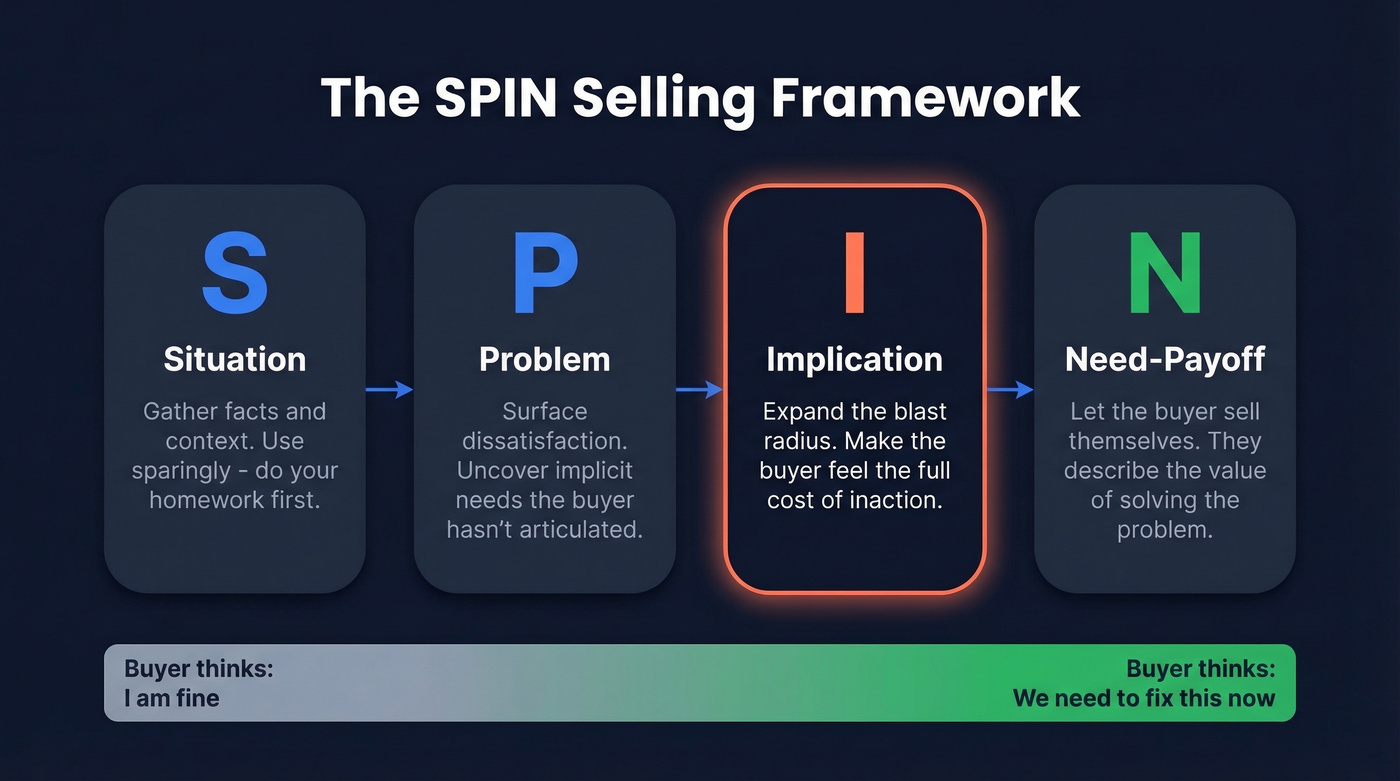
Each letter maps to a question type that moves the buyer from "I'm fine" to "We need to fix this now." Here's how they work, illustrated through a running example of selling a data platform to a VP of Sales whose outbound team is struggling with bad contact data.
Situation Questions
Use these to fill gaps in your pre-call research - and only gaps. Skip them when the answer is on the prospect's website or 10-K.
Situation questions gather facts: "How many reps are on your team?" "What CRM are you using?" They're necessary, but buyers hate them. Every minute on Situation questions is a minute the buyer is thinking, "This person didn't do their homework."
Pull firmographic and technographic data before the call. Tools like Prospeo give you company size, tech stack, and org structure across 30+ search filters with a 7-day data refresh cycle - so your first question can be a Problem question, not "Tell me about your current setup." Top performers ask fewer Situation questions than average reps. They front-load research and save the call for what only conversation reveals: pain, politics, and priorities.
Running example: You already know the VP's team is 45 reps using Salesforce. You skip straight to problems.
Problem Questions
Problem questions surface the buyer's dissatisfaction with their current state. They uncover what Rackham calls implicit needs - dissatisfactions the buyer hasn't fully articulated.
- "What's the biggest bottleneck in your outbound workflow right now?"
- "How often do your reps hit prospects with outdated contact info?"
- "Where does your pipeline generation process break down?"
- "Are you seeing the conversion rates you expected from that channel?"
The buyer says, "Yeah, our bounce rate is higher than we'd like." That's an implicit need - not urgent enough to drive action on its own. Your job is to make it urgent.
Running example: The VP says, "Honestly, our bounce rate is around 30%. It's been a problem."
Implication Questions
This is where deals are won or lost. Top performers ask 4x more Implication questions than average reps.
The consensus on r/sales is that implication questions are the hardest part of the methodology because they require thinking two steps ahead of the buyer's stated problem. We've seen this firsthand - even experienced reps default to surface-level discovery when they haven't prepped Implications.
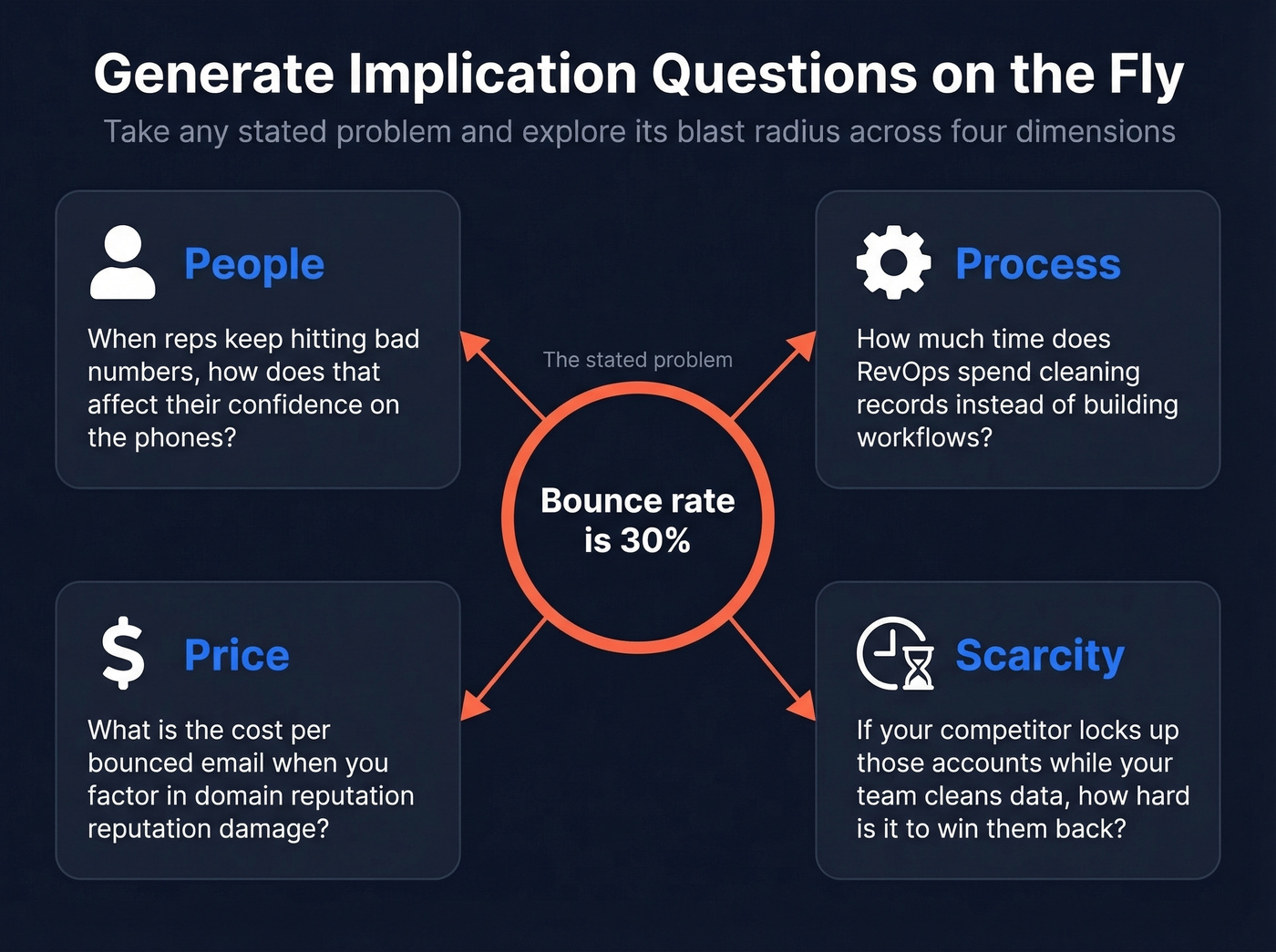
An Implication question takes a Problem and expands its blast radius. The VP said their bounce rate is 30%? Now you explore what that costs - in pipeline, rep morale, domain reputation, and missed quota. Use the people/process/price/scarcity framework to generate Implications on the fly:
- People: "When reps keep hitting bad numbers, how does that affect their confidence on the phones?"
- Process: "How much time does your RevOps team spend cleaning records instead of building workflows?"
- Price: "What's the cost per bounced email when you factor in domain reputation damage?"
- Scarcity: "If your main competitor locks up those accounts while your team is still cleaning data, how hard is it to win them back?"
A strong Implication question about downstream effects asks what happens to customer success when handoff data is incomplete, or how pipeline slippage this quarter reshapes the board's confidence in the growth forecast. The goal is to make the buyer feel the compounding cost of inaction across every dimension of their business.
Running example: The VP pauses. "Actually, we lost two reps last quarter who cited frustration with data quality. And our domain sender score dropped, so even the good emails are landing in spam now."
Write out 5-10 Implication questions before every major call. You can edit down, but you can't improvise what you haven't thought through.
Need-Payoff Questions
Need-Payoff questions let the buyer sell themselves. Instead of pitching, you ask the buyer to describe the value of solving the problem you've just expanded.
- "If you could cut your bounce rate to under 3%, what would that mean for your outbound pipeline?"
- "How would it change your team's workflow if every contact in your CRM was verified weekly?"
- "What would your team do with the 10 hours a week they currently spend on manual data cleanup?"
When explicit needs are developed before pitching, the average number of objections per selling hour drops by 55%. By the time you present your solution, the buyer has already articulated why they need it. You're confirming what they've said out loud, not overcoming resistance.
Running example: The VP says, "If bounce rates dropped to 3%, we'd probably add 30% more pipeline just from the emails that actually land. And I'd stop losing reps."
Four Stages of a SPIN Call
SPIN questions live inside a broader call structure:
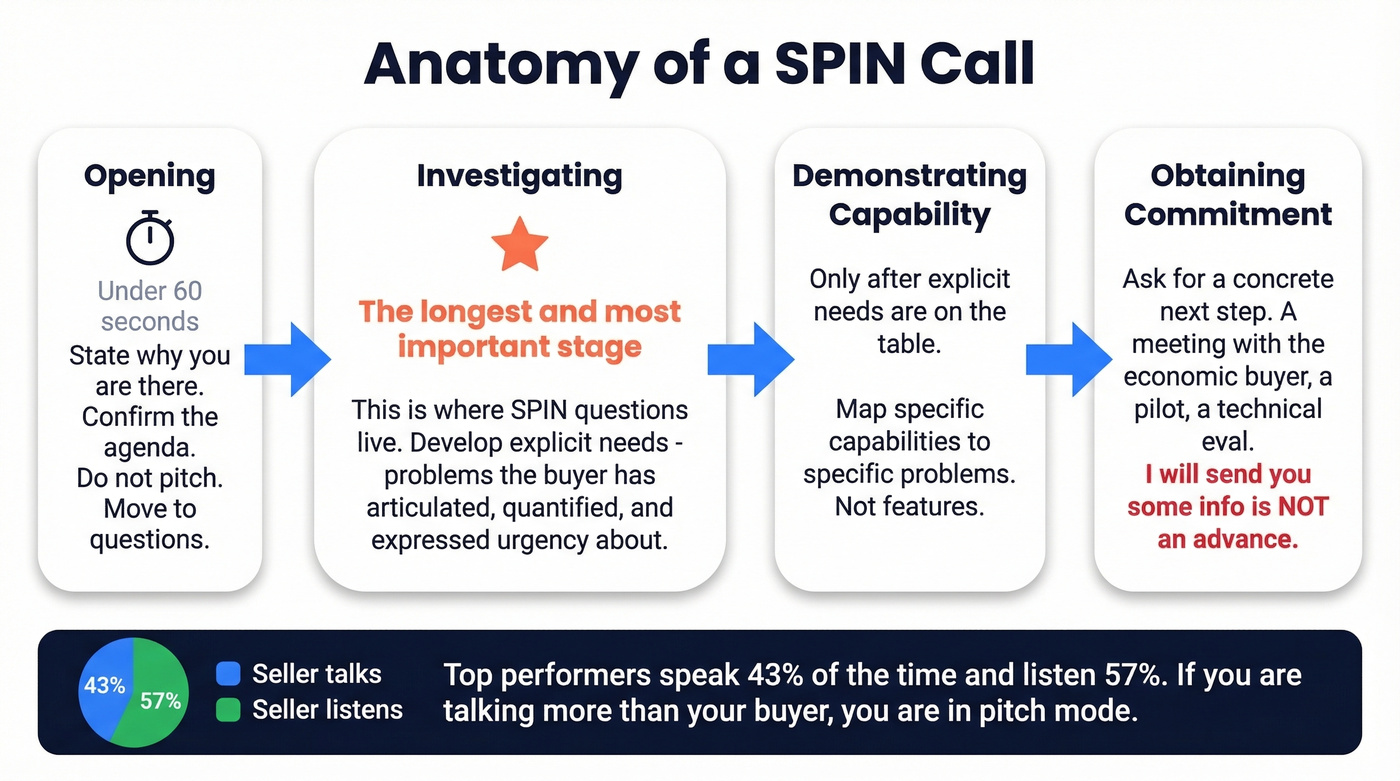
- Opening: Keep it under 60 seconds. Don't pitch. State why you're there, confirm the agenda, move to questions.
- Investigating: Where SPIN questions live. The longest and most important stage. Develop explicit needs - problems the buyer has articulated, quantified, and expressed urgency about.
- Demonstrating Capability: Only after explicit needs are on the table. Not features. Specific capabilities mapped to specific problems.
- Obtaining Commitment: Ask for a concrete next step - a meeting with the economic buyer, a technical evaluation, a pilot. "I'll send you some info" isn't an advance. It's a polite brush-off.
The talk/listen ratio from Rackham's research: successful sellers speak 43% of the time and listen 57%. If you're talking more than your buyer, you're in pitch mode.

The article says top SPIN sellers front-load research so their first question is a Problem question, not "tell me about your setup." Prospeo gives you firmographics, tech stack, org charts, and intent signals across 30+ filters - refreshed every 7 days. Walk into every discovery call already knowing the Situation.
Replace Situation questions with Problem questions. Start with better data.
Measuring Effectiveness
Every call ends in one of four outcomes:
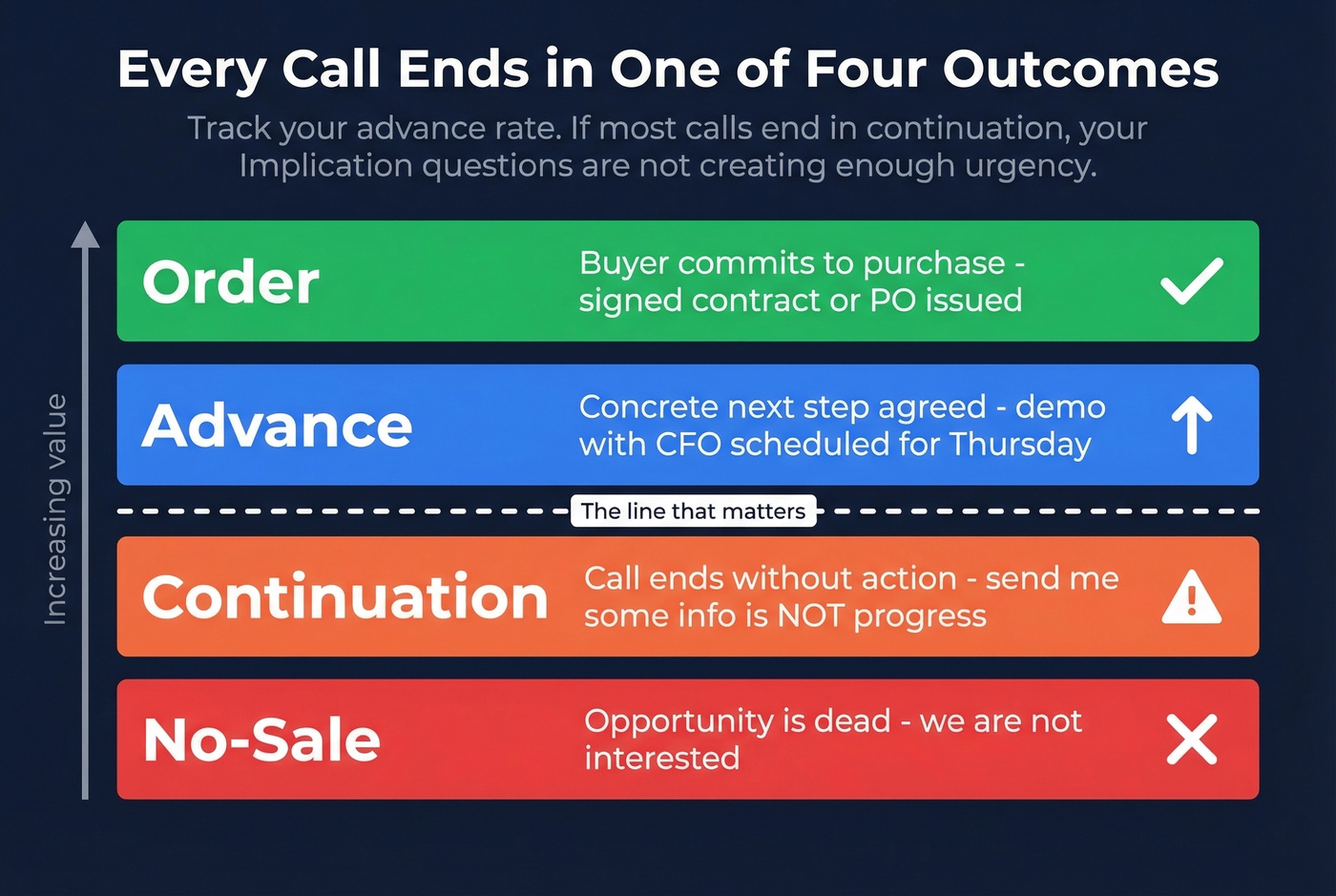
| Outcome | Definition | Example |
|---|---|---|
| Order | Buyer commits to purchase | Signed contract, PO issued |
| Advance | Concrete next step agreed | Demo with CFO scheduled for Thursday |
| Continuation | Call ends without action | "Send me some info" |
| No-Sale | Opportunity is dead | "We're not interested" |
"Send me some info" is a continuation, not an advance. It feels like progress, but it isn't. If your pipeline is full of follow-up emails that never get replies, your Implication questions aren't creating enough urgency.
Track your advance rate. If most discovery calls don't result in a concrete next step with a specific date and attendee list, you've got an Implication question problem.
How Top Reps Adapt SPIN in 2026
The framework is 38 years old. The buying environment isn't. Here's what's changed.
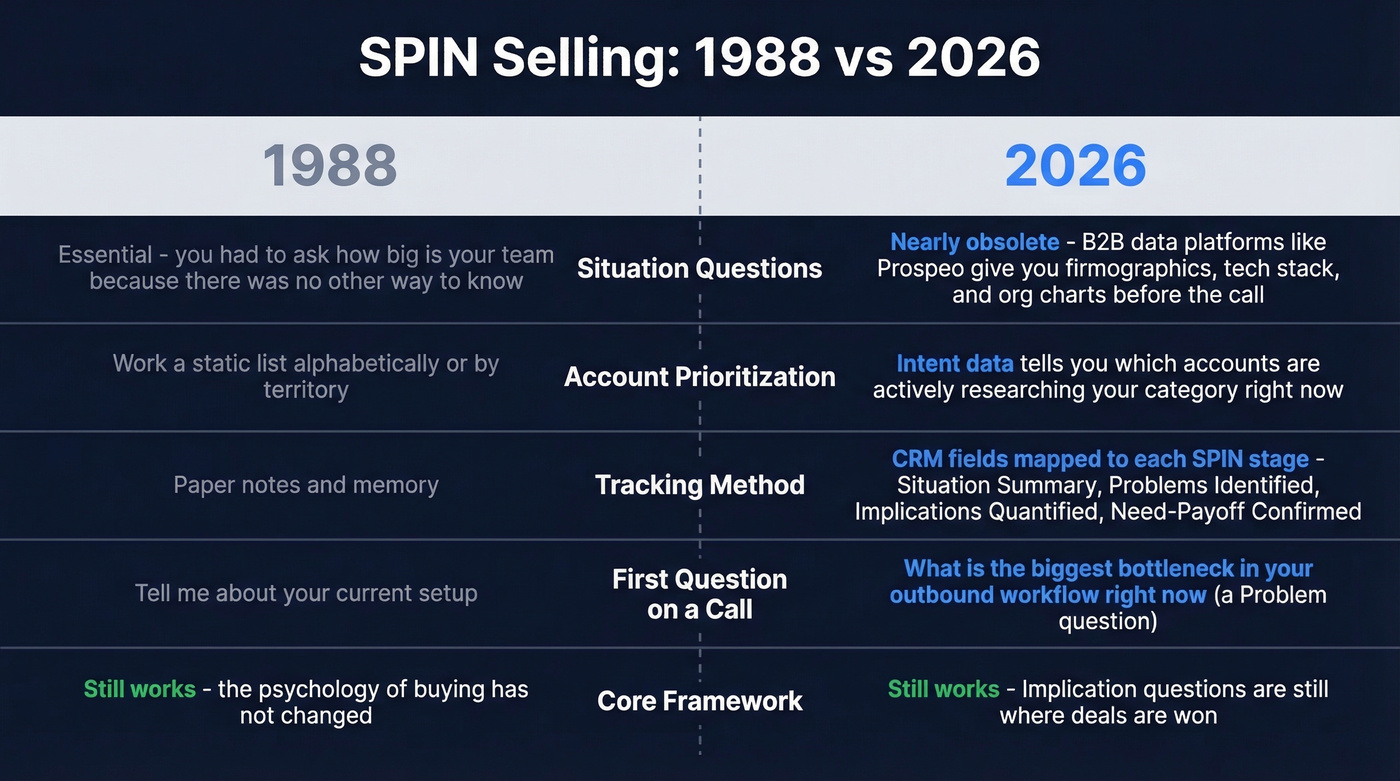
Situation questions are nearly obsolete. In 1988, you had to ask "How big is your team?" because there was no other way to find out. In 2026, B2B data platforms give you verified contact data, tech stack signals, and buyer intent before you pick up the phone. Your first question should be a Problem question.
Intent data changes account prioritization. Instead of working a static list, reps focus discovery conversations on accounts actively researching relevant topics - so Implication questions land harder because the buyer is already thinking about the problem.
CRM field mapping makes the methodology measurable. Map four fields to every opportunity: Situation Summary, Problems Identified, Implications Quantified, Need-Payoff Confirmed. When managers can see which reps consistently develop Implications versus stopping at Problems, coaching becomes targeted.
Multi-threaded deals require questioning at every level. The economic buyer cares about different Implications than the end user. Run separate discovery sequences for each stakeholder - same Problem, different Implication angles.
Here's the thing: reps spend just 28% of their week actually selling. The modern advantage goes to teams that automate the research layer so reps spend their limited selling time on questions that move deals forward.
SPIN vs. Challenger vs. MEDDIC
Let's be honest - the r/sales take is blunt: all sales methodologies basically sound the same. Need, budget, stakeholders, timeline. There's truth in that. But the differences matter when you're choosing what to train on.
| Framework | Research Base | Best For | Weakness |
|---|---|---|---|
| SPIN | 35K calls, 20+ countries | Discovery depth | Less CRM-structured |
| Challenger | 6K reps (CEB) | Insight-led selling | Requires deep expertise |
| MEDDIC | Practitioner-developed | Qualification rigor | Doesn't teach discovery |
Challenger is built on a CEB study of 6,000+ reps. Xerox reported a 17% increase in sales and $65M in contract value after implementing it. But Challenger assumes you have a provocative insight to deliver. SPIN assumes you don't know the answer yet and need to discover it alongside the buyer.
MEDDIC is the most AI-friendly framework because every element maps cleanly to a CRM field that automation can populate. SPIN's outputs are conversational - harder to structure, but richer.
Our take: use SPIN for discovery, MEDDIC for qualification, Challenger for insight delivery. They're layers, not competitors. The teams that win consistently don't pick one methodology - they pick the right one for each stage of the deal.
Common Mistakes
60-70% of SPIN implementations fail. That's not a methodology problem - it's a behavior change problem.
Behavioral relapse. Reps attend a two-day workshop, practice for a week, then revert to their default style. The framework requires sustained coaching. Managers should review two recorded calls per rep per week for at least 90 days.
Implication planning difficulty. Reps generate Situation and Problem questions intuitively. Implications require preparation, and most reps don't prep. The people/process/price/scarcity framework exists specifically to solve this - print it out and use it before every call.
CRM overload. Some teams try to log 10-15 related fields per opportunity. Reps stop filling them out within a month. Four fields. That's it.
The biggest meta-mistake is treating SPIN as a rigid sequence. Huthwaite's own guidance is clear: it's a logical framework, not a script. You loop back, skip ahead, follow the conversation. One Reddit poster nailed it: consciously "running SPIN" makes calls feel robotic. The goal is to internalize the question types so deeply that you deploy them instinctively. Understanding what the methodology means in practice - a way of thinking, not a checklist - is the difference between reps who see results and reps who abandon the framework after a week.
Is the Training Worth It?
The book costs $15-20. Read it twice. Practice for 90 days. That's the highest-ROI path for individual reps and small teams. One insurance rep on r/sales reported doubling their workers' comp renewal applications after applying the questioning structure.
Formal Huthwaite workshops run $1,500-$5,000 per rep. Team programs with coaching and customization land in the $15K-$50K range. Accenture's research suggests corporate training delivers 353% ROI on average, and top producers generate 10x more revenue than bottom producers - so the math works at scale.
I'd say invest in formal training only after your team has practiced with the book for 90 days and you have 10+ reps who need behavioral change at scale. For a 3-person SDR team, the book plus weekly call reviews with a manager who understands the framework is more than enough.
Skip this if your average deal size is under $15K. You probably don't need this level of discovery depth. A tighter framework like BANT or a simple pain/impact/timeline structure will get you to close faster. SPIN's ROI scales with deal complexity - the higher the stakes, the more Implication questions pay off.
A 30% bounce rate doesn't just kill pipeline - it kills rep confidence, domain reputation, and quota. That's exactly the Implication chain this article describes. Prospeo delivers 98% email accuracy with 5-step verification, so your reps spend calls asking Implication questions instead of apologizing for bounced emails.
Hard to run SPIN Selling when your emails never reach the buyer.
FAQ
Is SPIN Selling outdated?
No. The 1988 examples feel dated, but the questioning framework is backed by 35,000+ calls across 20+ countries over 12 years. Roughly 30% of the world's 100 largest companies still use it. The principles are behavioral, not technological - which is why they've outlasted trendier methodologies for nearly four decades.
Does SPIN work for transactional sales?
Not well. The methodology was designed for complex, multi-stakeholder B2B deals with long evaluation cycles. For short-cycle sales under $5K with a single decision-maker, BANT is more efficient. Implication questions only pay off when the stakes justify deep exploration.
What's the hardest part of the framework?
Implication questions - by far. Most reps default to Situation and Problem questions because they're intuitive. Implications require thinking two steps ahead. Use the people/process/price/scarcity framework to brainstorm 5-10 before every major call, and review recorded calls weekly to track your ratio.
Can you combine SPIN with other methodologies?
Yes, and top-performing teams do exactly that. Map SPIN to discovery, MEDDIC to qualification, and Challenger to insight delivery. They address different deal stages and complement each other naturally - treating them as layers rather than competitors.
What tools help reps prepare for SPIN calls?
Any platform that eliminates Situation questions by front-loading research. Prospeo's 30+ search filters, intent data across 15,000 topics, and 7-day data refresh cycle let reps walk into calls already knowing firmographics, tech stack, and buying signals - so they open with Problem questions instead of wasting time on facts they could've looked up.