

Sales Questioning Techniques: What 326K Calls Reveal About Winning Discovery
You ran a discovery call that felt great - 25 questions, engaged prospect, good energy - and then they ghosted. Your questions were all Situation, no Implication. You were interrogating, not discovering.
The data backs this up.
The Short Version
- Winners ask 15-16 questions per call, not 20+. Depth beats volume every time.
- SPIN + TED prompts is the fastest path to better discovery for most B2B reps.
- Before you ask anything, verify who you're talking to. Research the account so your Situation questions sound informed, not generic.
The Data Most Training Ignores
32% of sales teams waste time on unqualified leads. Bad discovery questions are the root cause.
An analysis of 326K sales calls found something counterintuitive: reps who asked fewer questions won more deals. Won deals averaged 15-16 questions. Lost deals? Around 20. Every "50 powerful sales questions" listicle you've bookmarked is optimizing for the wrong metric. Learning how to ask the right questions matters far more than memorizing a long list.
The Numbers Behind Great Discovery
Gong's benchmark for discovery is 43% talk, 57% listen.
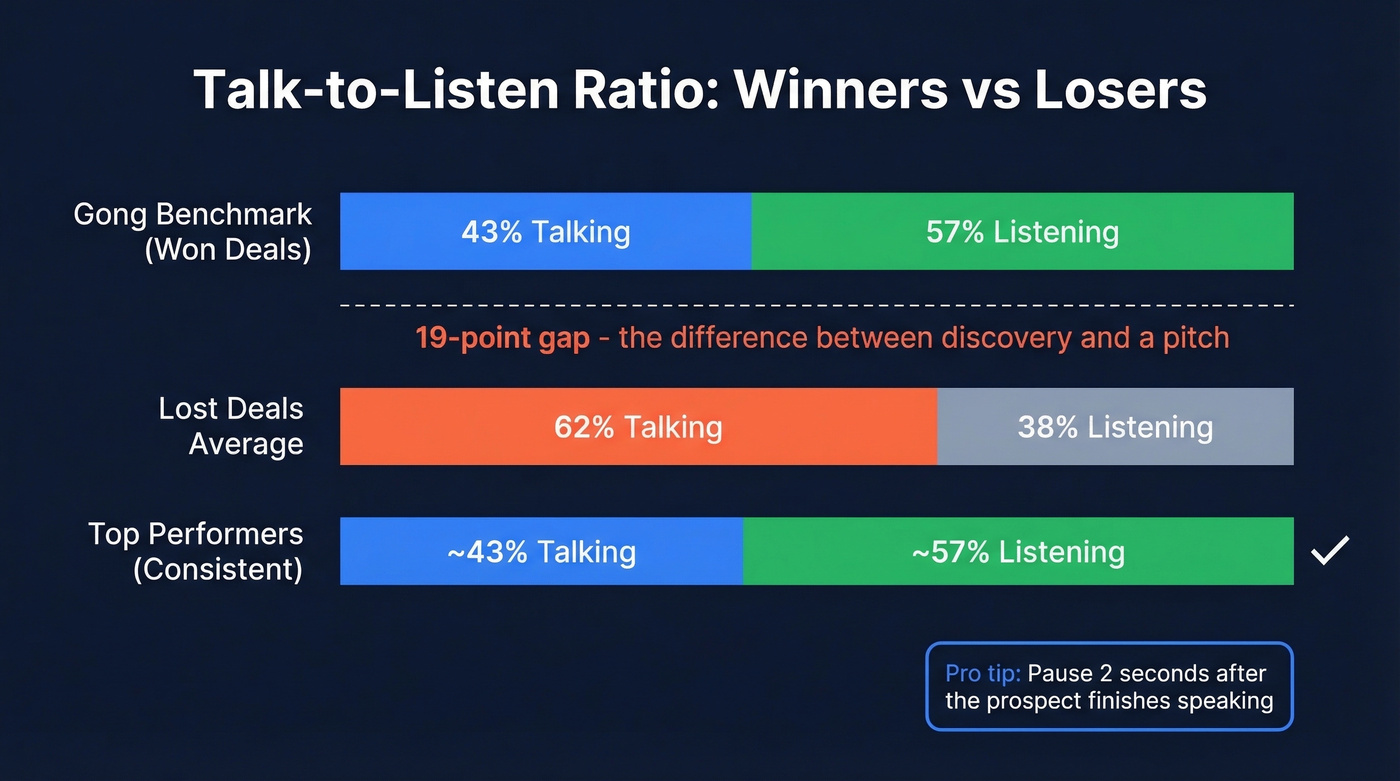
In the 326K-call analysis, lost deals averaged 62% talk time. That's a 19-point gap from the benchmark - and it's the difference between discovery and a one-sided pitch.
Here's what's interesting, though. The real separator isn't hitting 43% on one call. It's consistency. Low performers swing roughly 10 points between won and lost calls (54% talk on wins, 64% on losses). Top performers keep a similar ratio regardless of outcome. They've built the habit into muscle memory, and it shows in their pipeline numbers across quarters, not just individual conversations.
One practical hack: pause two seconds after the prospect finishes speaking. It reduces interrupting, invites elaboration, and signals you're actually listening.

You only get 15-16 questions per winning discovery call. Don't waste a single one on someone who can't sign. Prospeo gives you 50+ data points per contact - role, funding stage, tech stack, intent signals - so every Situation question sounds like homework, not fishing.
Prep smarter discovery with 98% accurate contact data at $0.01 per lead.
Five Frameworks Compared
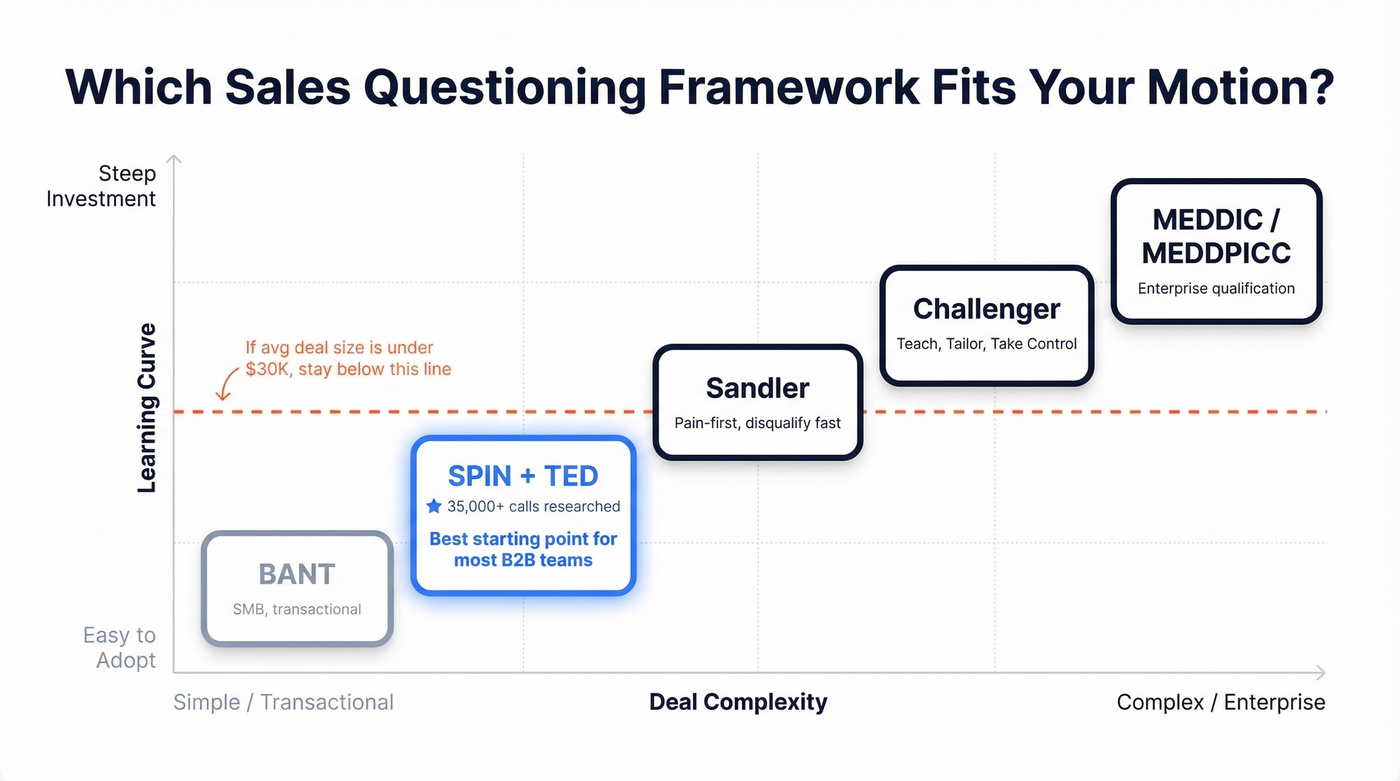
Every framework has a sweet spot. The mistake is picking one based on what sounds impressive instead of what fits your deal motion.
| Framework | Core Idea | Best For | Limitation |
|---|---|---|---|
| SPIN | Situation → Problem → Implication → Need-Payoff | Mid-market B2B, SaaS | Can feel light in complex enterprise buying |
| Sandler | Upfront contract, pain-first, disqualify fast | Orgs needing culture shift | Steep learning curve |
| Challenger | Teach → Tailor → Take Control | Complex, status-quo deals | Needs deep industry expertise |
| MEDDIC/MEDDPICC | 6-8 qualification criteria | Enterprise deals | Overkill for high-velocity |
| BANT | Budget, Authority, Need, Timeline | SMB, transactional | Breaks with 3+ stakeholders |
SPIN's research base is the deepest - 35,000+ calls across 20+ countries. Challenger works brilliantly in status-quo deals where the buyer needs a strong reframe. MEDDIC earns its keep in enterprise where deals die from qualification gaps. BANT is fine for SMB and transactional motions but falls apart the moment procurement gets involved.
Let's be honest: if your average deal size is under $30K, you don't need MEDDPICC. You need SPIN, a tight talk-to-listen ratio, and verified contact data so you're not burning discovery calls on people who can't sign. Most B2B teams should start with SPIN and layer in MEDDIC criteria only as deal sizes grow.
SPIN + TED: The Default Starting Point
SPIN maps cleanly to call stages. In the opening, you ask light Situation questions - just enough to show you've done homework. During investigation, you run the full SPIN sequence. At commitment, you reinforce what they've already told you they need.
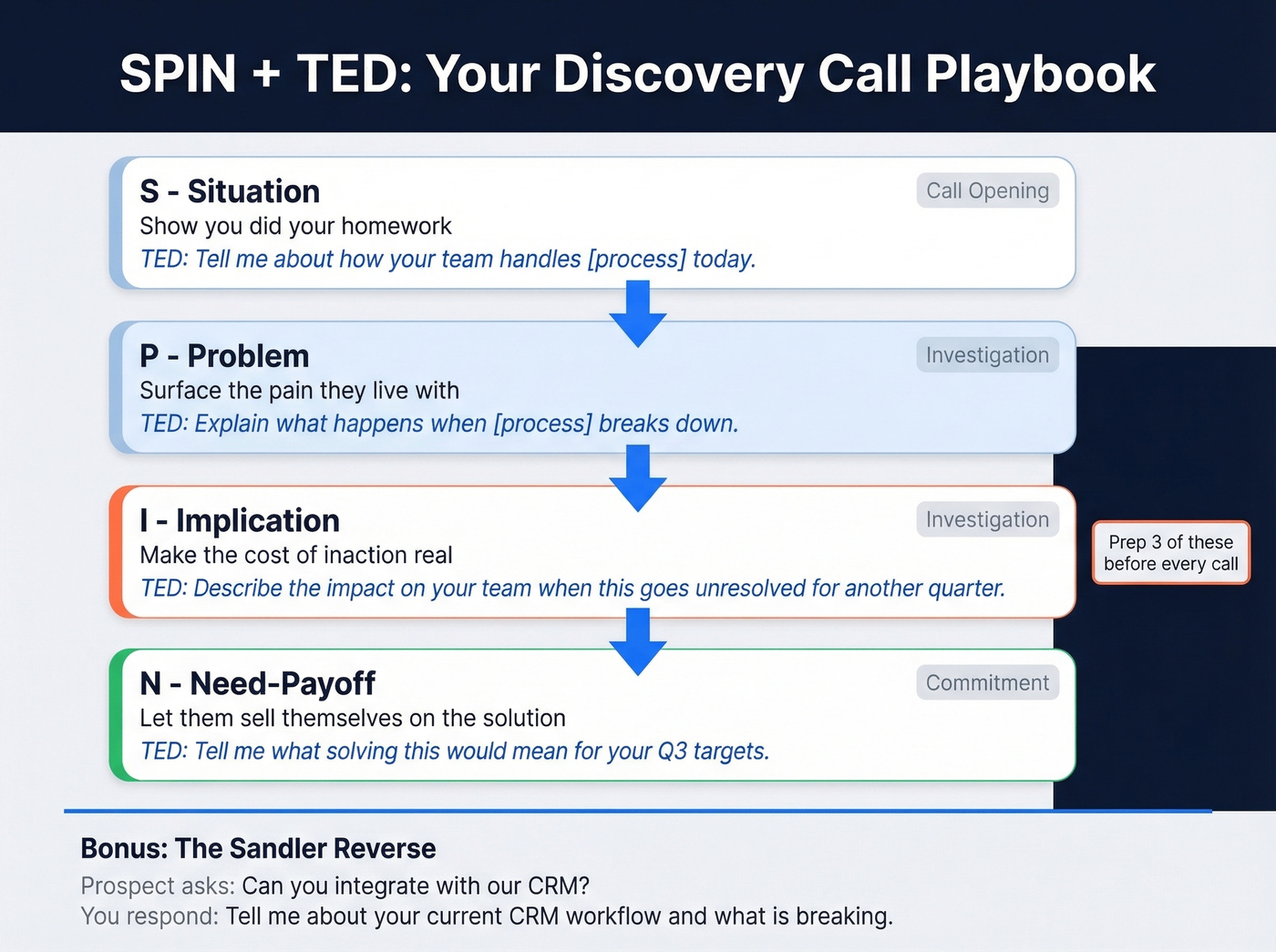
TED prompts - Tell me, Explain, Describe - layer inside each SPIN step to force open-ended elaboration. They replace yes/no dead ends with rich, diagnostic conversations. Instead of "Do you have a problem with manual data entry?" try: "Tell me about how your team handles data entry today."
The r/salestechniques community endorses this combination because it's simple to remember under pressure. Situation → Problem → Implication → Need-Payoff, with "Tell me / Explain / Describe" as your default question starters.
One technique worth borrowing from Sandler: "reversing" - answering a prospect's question with a clarifying question. When they ask "Can you integrate with our CRM?" you respond: "Tell me about your current CRM workflow and what's breaking." It keeps you in discovery mode instead of pitching prematurely, and it uncovers the real need behind the surface-level ask.
We've found that reps who prep three Implication questions before the call run tighter discovery than reps who wing it. Three. Not ten.
How to Ask by Stage
Move from broad to specific as the conversation progresses. RAIN Group's framework emphasizes this pattern and adds an important nuance: balance pain-focused questions with aspiration-focused ones. Not every buyer responds to "what's broken?" - some respond better to "what could be better?"
Prospecting: Before your first question, verify you're reaching the right person. Prospeo surfaces 50+ data points per contact - role, company size, funding stage, tech stack - so your Situation questions demonstrate homework, not fishing. (If you want a broader system, start with these sales prospecting techniques.)
- "I noticed your team grew 40% this year. How's that changed your [process]?"
- "What prompted you to take this call today?"

Qualifying: This is where targeted questioning separates pipeline from dead weight. Probing here exposes deal-breakers early so you don't waste cycles. For a deeper list, see our discovery questions.
- "Walk me through your decision process for a purchase like this."
- "What's the cost of doing nothing for another quarter?"
Objection Handling: Open-ended questions keep the conversation collaborative instead of adversarial. Questions that challenge assumptions can also reframe a stalled deal. If objections are a recurring pattern, use a structured approach to reduce sales objection rate.
- "Tell me more about that concern - what's driving it?"
- "If we could solve [specific objection], what would that change for you?"
Closing:
- "Based on everything we've discussed, what would need to be true for you to move forward this month?" (If you need a repeatable process, follow these steps to close a sale.)
Mistakes That Kill Discovery Calls
Talking too much. Lost calls averaged 62% talk time. If you're past the halfway mark, you're pitching, not discovering.
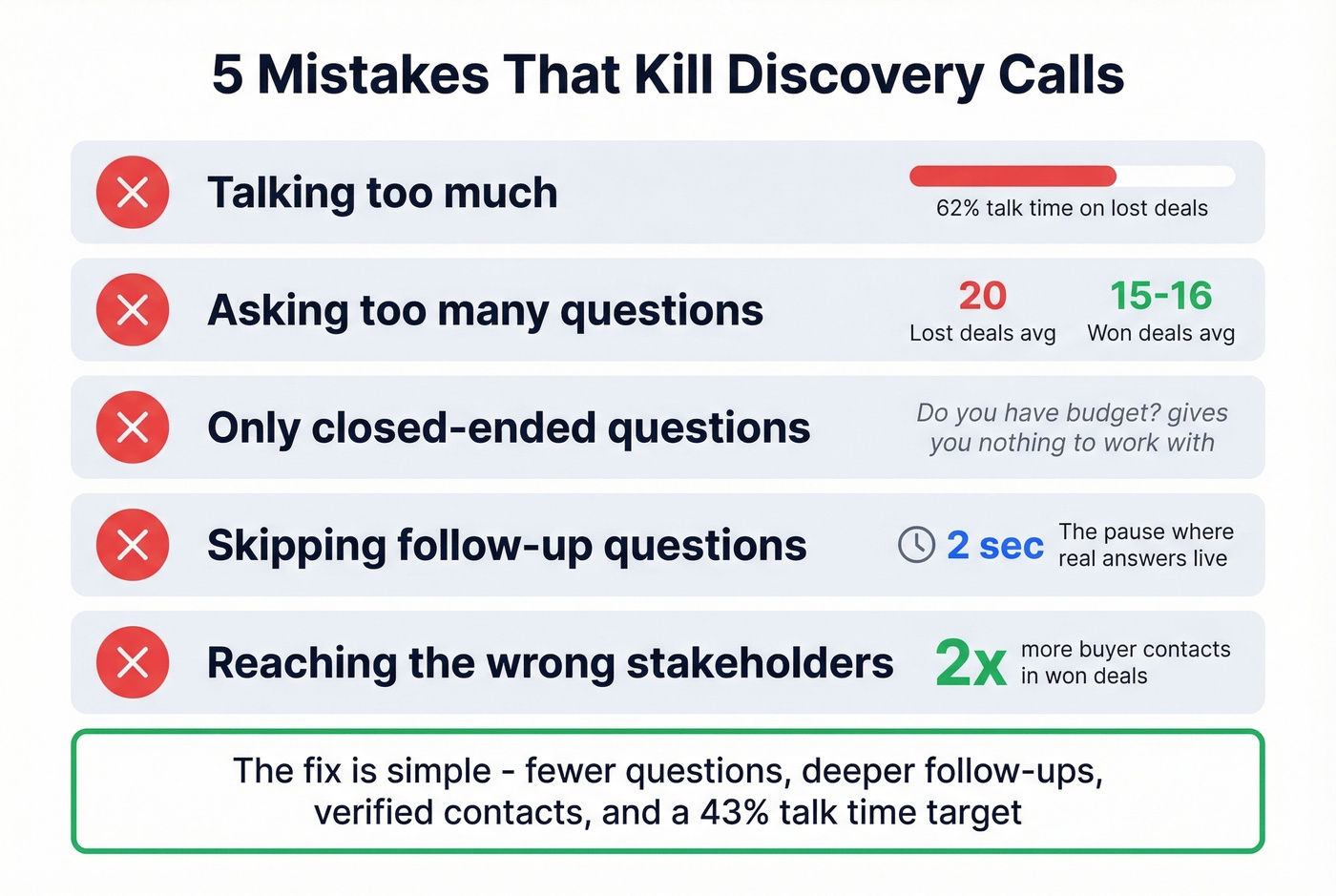
Asking too many questions. Twenty questions feels thorough. It actually feels like an interrogation to the person on the other end. Stick to 15-16 and go deeper on each one.
Relying only on closed-ended questions. "Do you have budget?" gives you a yes or no and nothing else. Closed questions have their place for confirming details, but they shouldn't dominate your discovery. Mix in questions that force the prospect to articulate the real impact of their challenges - that's where buying urgency lives.
Skipping follow-up questions. That two-second pause after the prospect finishes? It's where the real answers live. Most reps fill it with their next question and miss the elaboration that would've closed the deal. When you do follow up, having a clean next step helps - use these sales follow-up templates.
Reaching the wrong stakeholders. Closed-won deals involve 2x as many buyer contacts as closed-lost. We've seen teams cut their no-show rate dramatically just by verifying contacts before dialing - stale data from six weeks ago isn't just annoying, it's expensive. Bringing in a sales engineer at the right stage can lift win rates by up to 30%, but only if you're talking to the right people in the first place. (This is also why lead scoring and a clear ideal customer profile matter.)
The 326K-call data is clear: depth beats volume. But depth requires reaching the right buyer first. Prospeo's 30+ search filters - including buyer intent, job changes, and headcount growth - let you build lists of decision-makers worth discovering, not gatekeepers worth ghosting you.
Find the right person before you craft the right question.
FAQ
How many questions should I ask on a discovery call?
Data from 326K calls shows 15-16 questions on won deals versus around 20 on lost deals. Focus on depth with Implication and Need-Payoff questions rather than volume. Hypothetical questions like "What would happen if this problem doubled next quarter?" drive urgency without inflating your question count.
Which questioning framework is best for beginners?
SPIN Selling combined with TED prompts (Tell me, Explain, Describe). It's research-backed across 35,000+ calls and easy to remember under pressure. It naturally structures every conversation around the buyer's pain and desired outcomes - no memorization of 50-question lists required.
How do I prepare better questions before a sales call?
Start with the prospect's role, company size, and recent changes. Tools like Prospeo return 50+ data points per contact including tech stack and intent signals, so you can prep informed Implication questions in minutes. That single habit separates good discovery from great.
What's the ideal talk-to-listen ratio?
Aim for 43% talk time and 57% listen time, based on Gong's analysis of winning calls. Lost deals average 62% rep talk time. Track your ratio across 10+ calls to find your baseline, then adjust downward until you consistently stay below 45%.