

Gazelle vs Ocean.io: Which One Do You Actually Need?
Teams confuse Gazelle and Ocean.io because both say "company data." But comparing them is like comparing a weather forecast to a fishing net - they do fundamentally different things. Gazelle scores companies likely to expand, built for economic development teams and site selectors. Ocean.io builds lookalike prospect lists for outbound sales. The real question isn't which is better. It's whether either one actually solves your problem.
30-Second Verdict
Use Gazelle if you work in economic development, site selection, or investment research and need to identify companies with high growth potential. It scores a 4.7/5 on G2 across 61 reviews, with users skewing heavily toward government administration, international trade, and non-profit sectors.
Use Ocean.io if you're running outbound sales and want to find companies that resemble your best customers. The lookalike search engine is the core value prop. But with only 12 G2 reviews and a 3.1/5 rating, the recurring theme is data accuracy and value for money.
Side-by-Side Comparison
| Gazelle | Ocean.io | |
|---|---|---|
| Core use case | Growth scoring | Lookalike lists |
| G2 rating | 4.7/5 (61 reviews) | 3.1/5 (12 reviews) |
| Database | 9.8M+ company profiles | 55M company profiles |
| Pricing | ~$9,000/user/yr CAD | From ~$576 (9,000-credit min) |
| Free trial | Yes | 14-day (no CC) |
| Integrations | Not a CRM-first tool | HubSpot, Pipedrive |
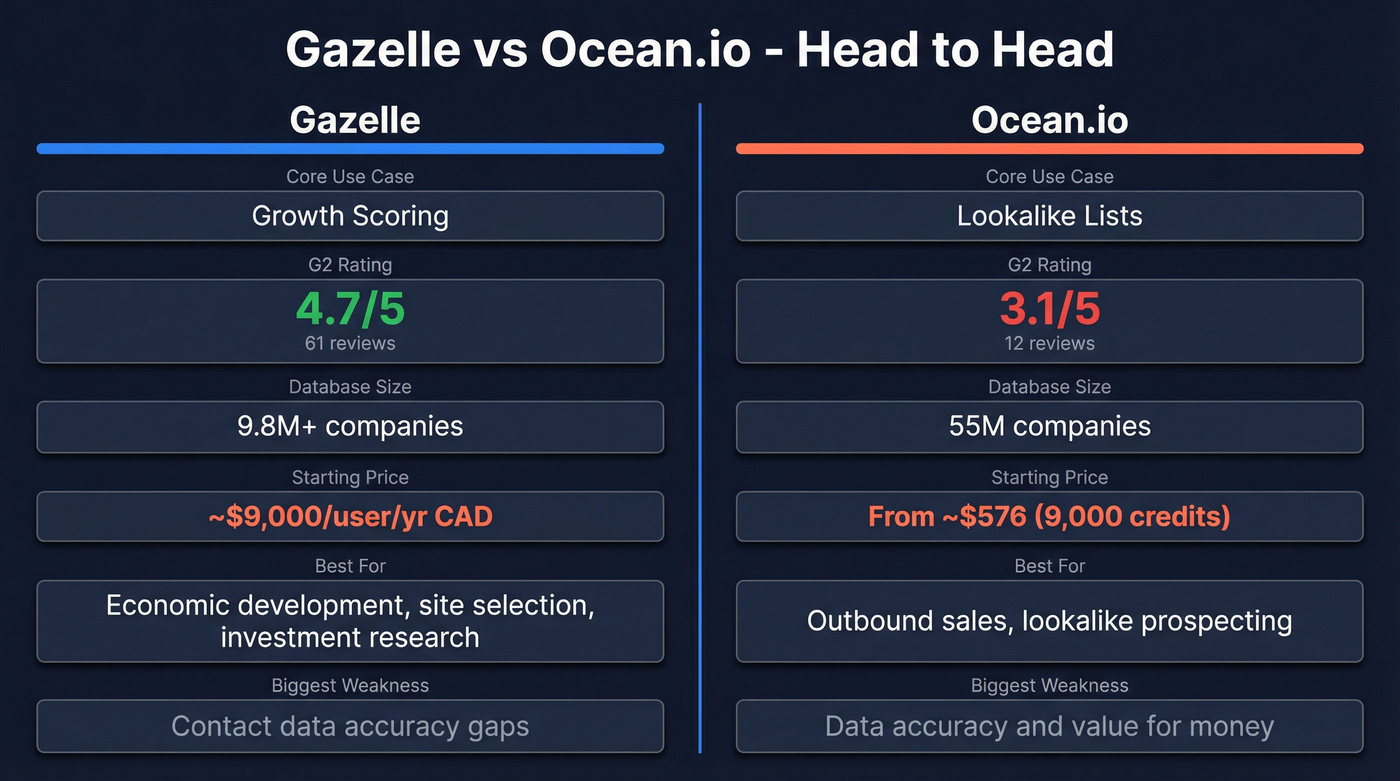
On Ocean.io's pricing: Ocean.io markets "from $79/mo," but the pricing page shows a minimum of 9,000 credits at $0.064 each - that's $576 for the minimum credit block. Phone numbers cost 10 credits each, so heavy-dialing teams burn through allowances fast. Budget accordingly.
On Gazelle's pricing: At ~$9,000/user/year CAD, this is enterprise research pricing. You're paying for proprietary growth intelligence, not a prospecting tool. G2 lists typical implementation at about one month.
Ocean.io pricing details
Here's the thing: if your team's primary goal is booking meetings, neither of these tools should be your first purchase. Company intelligence is useless without accurate contact data to act on it. Start with the contact layer, then add company intelligence on top.
What Gazelle Actually Does
Gazelle isn't a prospecting tool. It's a company intelligence platform for people who need to know which businesses are about to expand, hire, or relocate - economic development agencies, site selection consultants, and regional investment teams.

The platform indexes companies by likelihood to expand using 240+ data signals tracked across a 10-year time series dataset. Their algorithms were trained on a control group of 6,000+ companies known to have expanded, identifying signals that appeared 18 months before growth events. That's not a small sample. Gazelle's in-house team also conducts 120,000 company interviews per year to surface expansion plans 18-36 months out, which gives them a qualitative edge that pure data-scraping tools can't match.
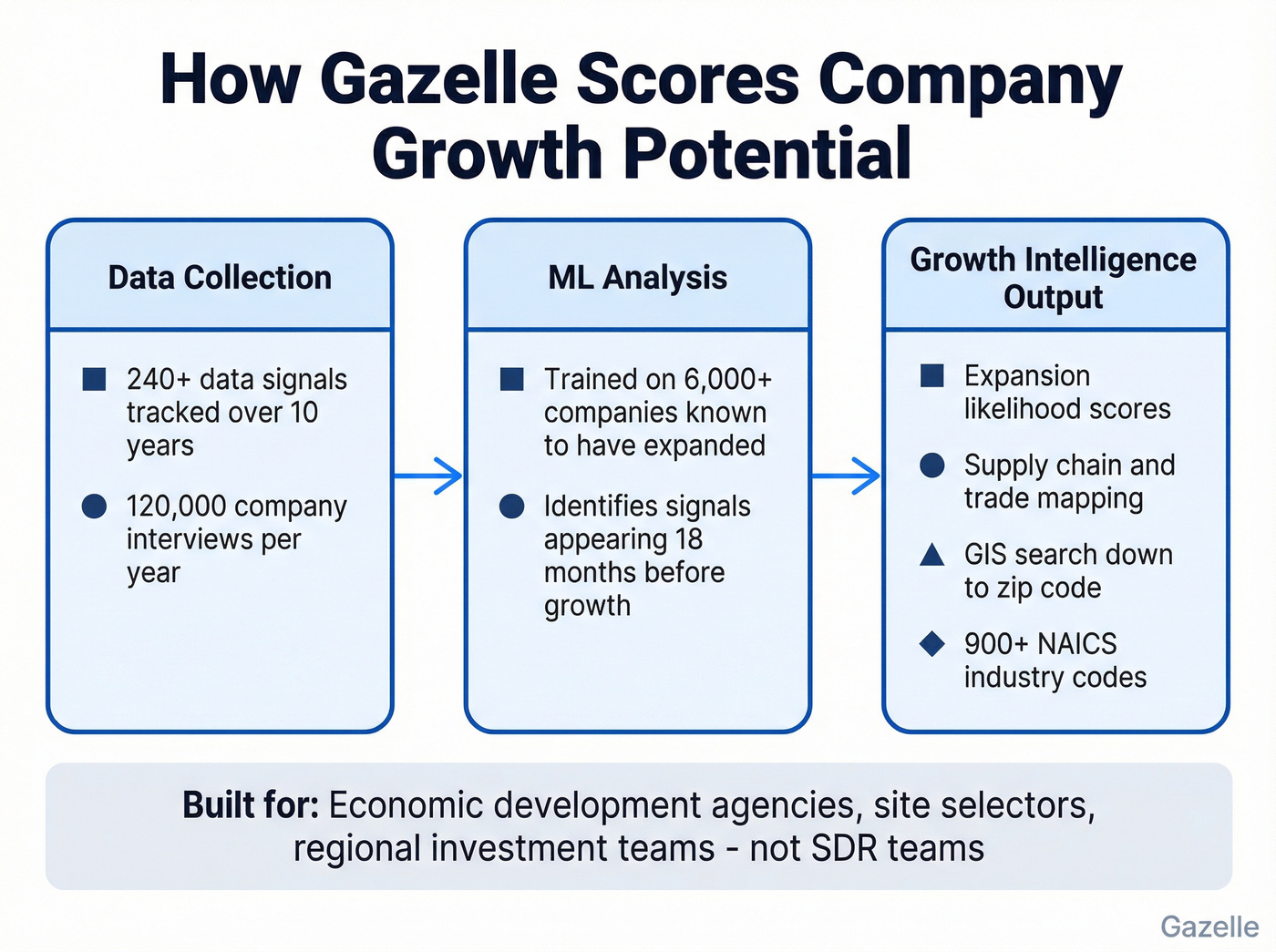
Beyond growth scoring, Gazelle handles trade and supply-chain questions - importers/exporters, buyer/seller ecosystem mapping, GIS-based search down to zip code level, and industry heatmaps across 900+ six-digit NAICS codes. If you're building a broader stack around B2B company data, this is the "where should we look?" layer, not the "who do we email?" layer. The G2 reviewer base confirms the niche: 16 of 61 reviewers work in government administration, 9 in international trade, 8 in non-profit. If you're an SDR team, this tool wasn't built for you.

Growth scores and lookalike lists don't book meetings - verified contact data does. Prospeo delivers 98% email accuracy on 300M+ profiles, refreshed every 7 days. Layer it on top of Gazelle or Ocean.io and turn company intelligence into pipeline.
Find the companies anywhere. Reach the people with Prospeo.
What Ocean.io Actually Does
Ocean.io's workflow boils down to three steps. Paste URLs of your best customers into the lookalike search engine. ML and NLP analyze what those companies say about themselves on their websites - not just industry codes. Then you get a list of companies that match the same profile.

Ocean.io claims analysis of 350M+ company profiles across the web, and it also advertises access to 55M company profiles with 250M+ employee profiles. The lookalike concept is genuinely clever - when it works. We've seen lookalike tools succeed only when the team already has a clean ICP (use an Ideal Customer Profile template if you don't) and a reliable contact layer underneath.
All Ocean.io plans include unlimited seats and API access. The platform integrates with HubSpot and Pipedrive. But the real question is what happens after you find the companies - and that's where the cracks show.
What Real Users Say
Gazelle: The Economic Development Favorite
Users consistently praise the UI and customer service. The growth-scoring methodology gets high marks from economic development professionals who need defensible data for investment decisions.
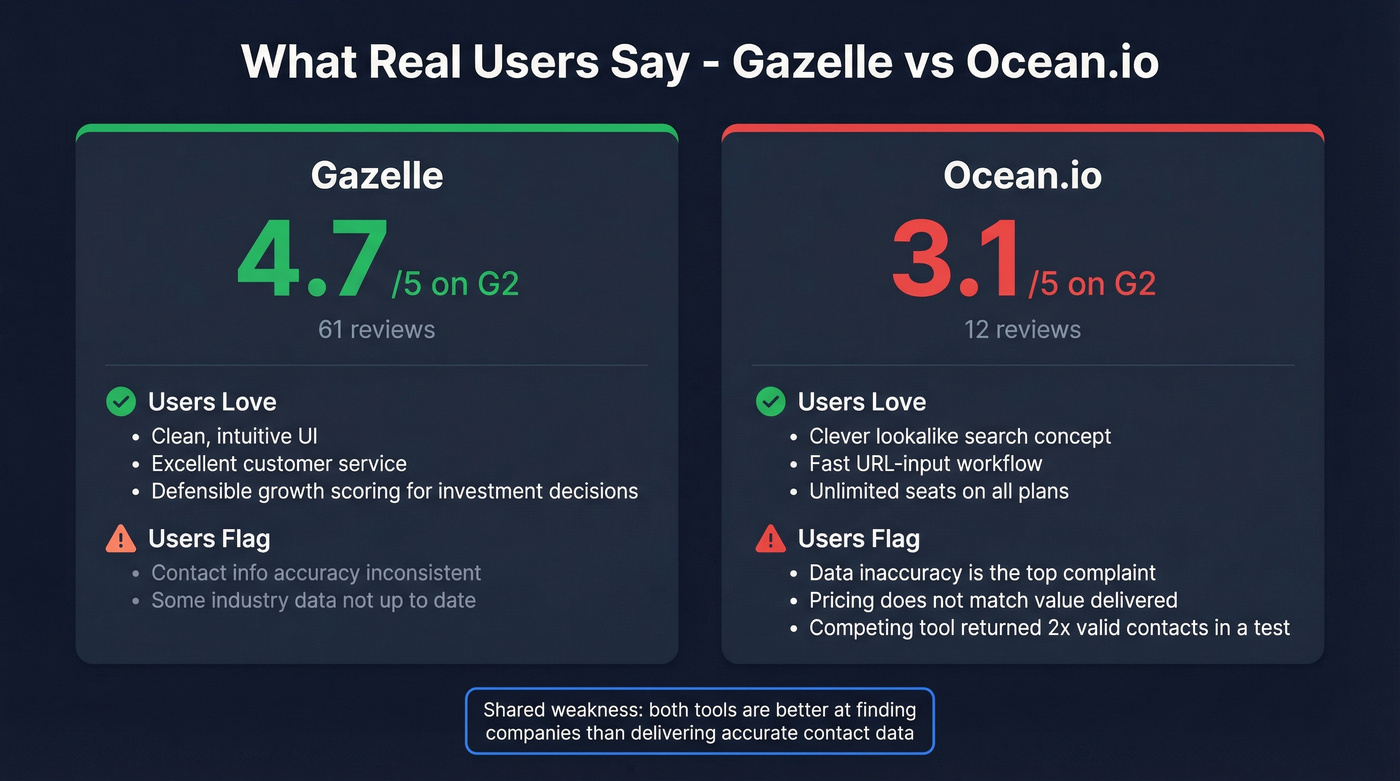
The main knock: contact information accuracy is inconsistent. A TrustRadius snippet mentions some industry data not being up to date. At ~$9k/user/year, contact data inconsistency stings - unless you're buying it purely for growth intelligence, which most Gazelle users are.
Ocean.io: Great Concept, Shaky Execution
The lookalike search concept gets praise. Users like the speed of finding similar companies and the URL-input workflow. But the complaints are hard to ignore.
Data inaccuracy is the top issue, followed by pricing that doesn't match the value delivered and frustrating export limitations. A Reddit user test comparing Ocean.io against Panda Match on 10,000 contacts found Panda Match returned roughly 2x the valid contacts. One G2 reviewer in early 2026 alleged questionable data sourcing practices - treat that as a single reviewer's allegation, not established fact. But combined with the accuracy complaints, it paints a picture of a platform where the discovery engine outpaces the underlying data quality.
Both tools share the same fundamental weakness: they're better at identifying companies than delivering accurate contact data for the people inside those companies.
When You Need the Contact Layer
Gazelle and Ocean.io help you find the right organizations - Gazelle through growth signals, Ocean.io through lookalike modeling. But when it's time to actually reach someone at those companies, you need a contact data layer built around verification, not discovery. If you're evaluating options, start with data enrichment services and then get specific about verification.

Also worth considering: Apollo.io. For teams that want an all-in-one platform combining prospecting, sequencing, and a large contact database, Apollo is the most commonly recommended alternative. It's strong on breadth but weaker on email accuracy and data freshness compared to dedicated verification tools.
If deliverability is a priority, you’ll want to understand email bounce rate benchmarks and how verification impacts them, plus the basics of an email deliverability guide before scaling outbound.
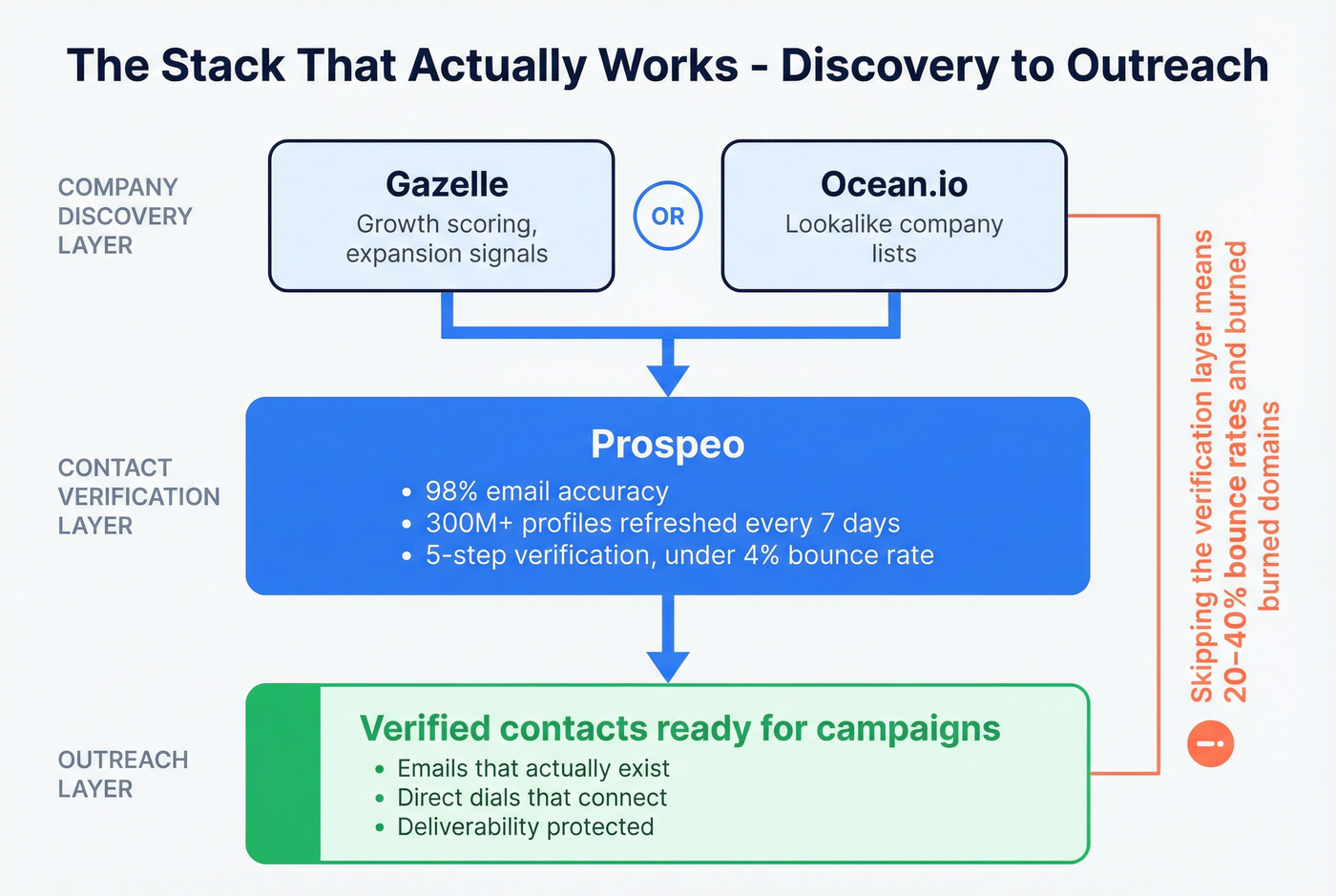
Both tools share the same gap: contact accuracy. Prospeo's 5-step verification and proprietary email infrastructure mean bounce rates under 4% - at ~$0.01 per email. Export your company lists from any tool, enrich through Prospeo, and only send to contacts that actually exist.
Stop bleeding deliverability on unverified data from discovery tools.
FAQ
Do Gazelle and Ocean.io solve the same problem?
No. Gazelle identifies growth companies for economic development and site selection using 240+ signals and company interviews. Ocean.io builds lookalike prospect lists for outbound sales teams using ML-driven website analysis. They serve fundamentally different buyers with different workflows and budgets.
Is Ocean.io's data accurate enough for outbound?
Ocean.io scores 3.1/5 on G2, with multiple reviewers citing data inaccuracy as the primary complaint. A Reddit user test found a competing tool returned roughly 2x the valid contacts from the same input list. For deliverability-sensitive campaigns, pair any Ocean.io company list with a verification layer before sending.
What does Ocean.io actually cost?
Despite the "from $79/mo" headline, the pricing page shows a 9,000-credit minimum at $0.064 per credit - around $576. Phone numbers cost 10 credits each, verified emails cost 1 credit each, and search results cost 0.2 credits each.
Can I use Gazelle or Ocean.io for cold outreach?
Gazelle is designed for economic development research, not sales outreach - it lacks sequencing, CRM integrations, and verified contact data at scale. Ocean.io gets closer with its lookalike lists and HubSpot integration, but its contact accuracy issues mean you'll still need a dedicated tool for verified emails and direct dials before launching campaigns.