

Gazelle vs ZoomInfo: They're Not Really Competitors
Gazelle ranks fast-growing companies for economic development teams. ZoomInfo sells contact data and intent signals to sales orgs. Comparing Gazelle vs ZoomInfo is like comparing a market research subscription to a prospecting engine - they overlap on exactly one word: "data." If you're genuinely trying to choose between these two platforms, here's what each one actually does and who should pick which.
30-Second Verdict
Pick Gazelle if you're in economic development, site selection, or growth-company research. It's a market intelligence tool, not a sales database.
Pick ZoomInfo if you're running enterprise outbound and have the budget for a $15K+/year contract with intent data, enrichment, and workflow automation.
Skip both if you just need verified contact data for prospecting. A purpose-built contact data tool will get you there faster and cheaper.
What Gazelle Actually Does
Lightcast Gazelle is a business intelligence platform built around one core idea: identifying which companies are most likely to expand. Its proprietary G-Score uses AI to rank over 9.8 million company profiles - including 1.3 million growth businesses across 910+ industry sectors - pulling from data partners like LexisNexis, Crunchbase, databaseUSA, and Acton.
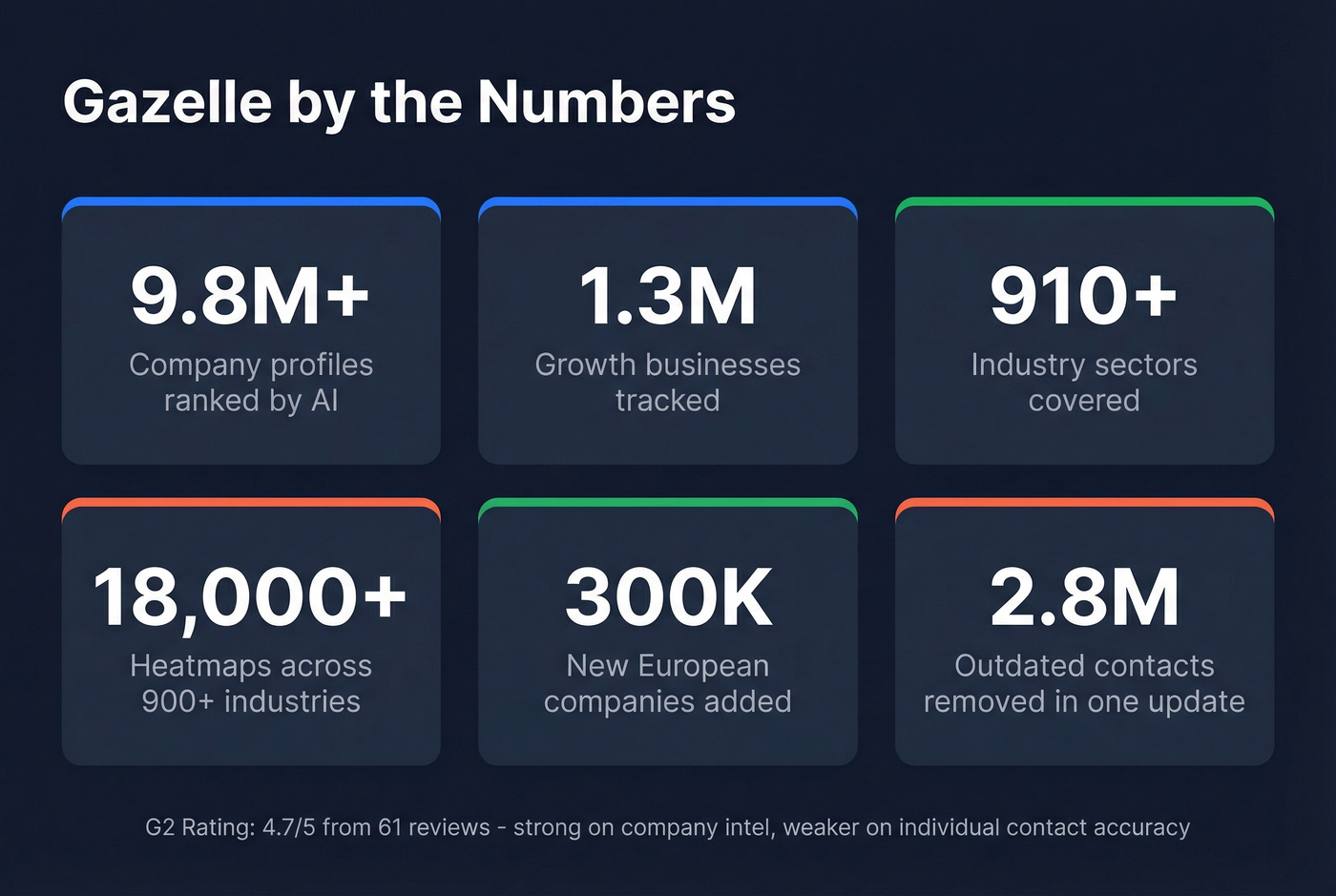
The platform's real strength is market-level intelligence. It offers 18,000+ heatmaps tracking 900+ industries, covering indicators like employment, establishments, salaries, sales, profits, and five-year growth values. Economic development organizations and site selectors use these to pinpoint where growth is happening geographically. A recent update added 300,000 new European companies, including 90,000+ headquarters.
Gazelle takes data quality seriously. In a single update, the team removed 2.8M outdated contacts and added 1.5M new verified ones, refreshing more than 9M contacts total. G2 reviewers give it a 4.7/5 from 61 reviews, though they consistently note that contact accuracy can be inconsistent - the platform's strength is company intelligence, not individual contact data. Implementation typically takes about a month.
What ZoomInfo Actually Does
ZoomInfo is the default B2B sales intelligence platform. It combines a massive contact database - hundreds of millions of contacts - with intent data, workflow automation, and a Chrome extension, all aimed at helping sales teams find and reach buyers faster.
The numbers back up its market position: 4.5/5 on G2 from over 9,000 reviews, and 93% of TrustRadius respondents say they'd buy it again. G2 tags for "Contact Information" (413 mentions) and "Ease of Use" (403) show the platform delivers when the data is fresh. But the complaint tags tell a rougher story: "Inaccurate Data" and "Outdated Data" each carry 232 mentions, making data quality the platform's most consistent criticism.
Reddit sentiment tracks with those complaints. One r/sales thread describes the Chrome extension crashing a 32GB MacBook, phone numbers routing to reception desks instead of direct lines, and a contract dispute that dragged on for months. We've seen this pattern repeat across multiple threads - it's not a one-off.

ZoomInfo's most consistent G2 complaint is outdated data. Prospeo refreshes every 7 days - not every 6 weeks. With 300M+ profiles, 98% email accuracy, and 125M+ verified mobiles, you get enterprise-grade contact data without the enterprise contract.
Stop paying $25K/year to bounce emails. Start with 75 free.
Head-to-Head Comparison
| Dimension | Gazelle | ZoomInfo |
|---|---|---|
| Primary use case | Growth-company intel | Sales prospecting |
| G2 rating | 4.7/5 (61 reviews) | 4.5/5 (9,037 reviews) |
| Pricing | ~$5K-$15K/yr (est.) | $15K-$45K+/yr |
| Database | 9.8M+ companies | Hundreds of millions of contacts |
| Best for | Econ. dev., site selection | Enterprise sales teams |
| Contracts | Quote-based, not public | Annual, auto-renew |
| Data refresh | Dataset refresh + verification updates | Not published |
| Community footprint | Essentially zero | Active (mixed sentiment) |
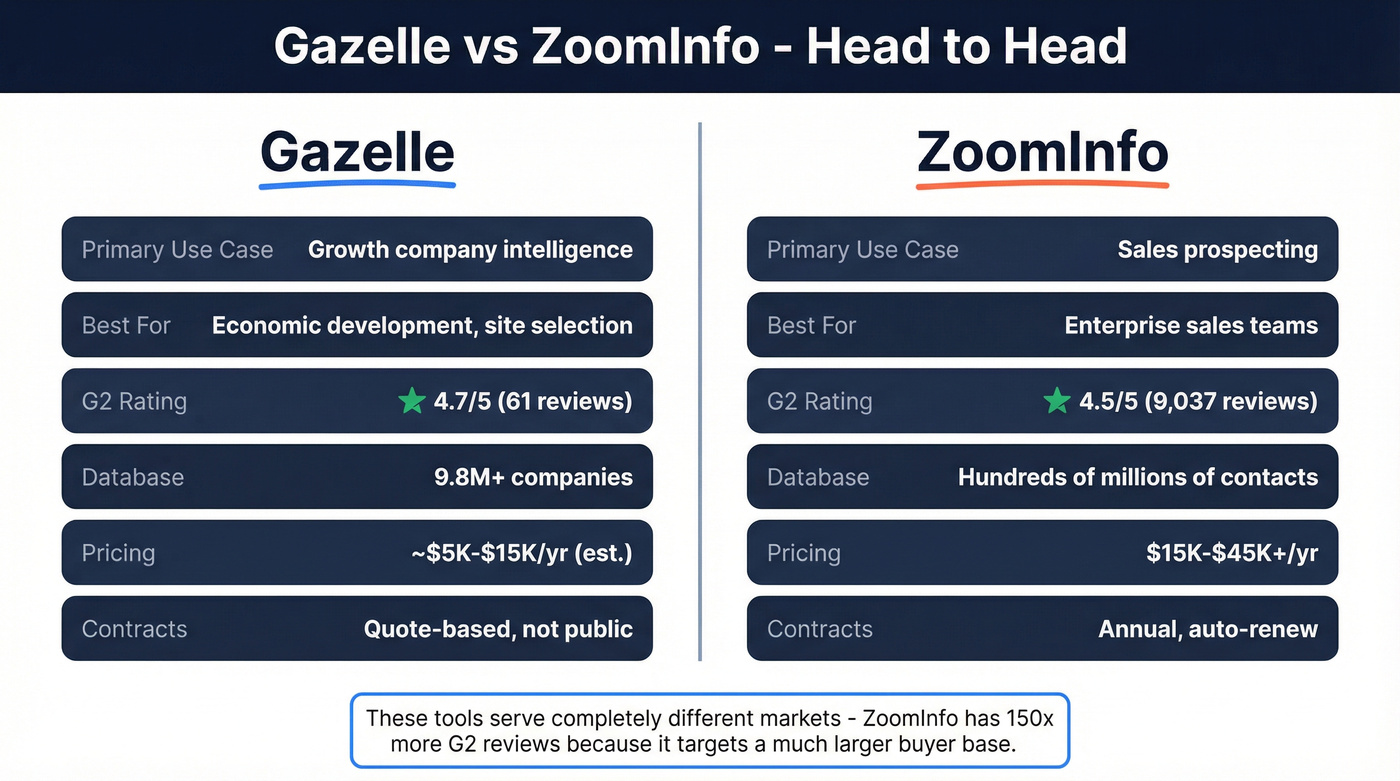
The review volume gap matters. ZoomInfo has about 150x more G2 reviews than Gazelle. That doesn't mean ZoomInfo is better - it means these tools serve completely different markets.
Pricing Breakdown
Neither tool publishes transparent list pricing in 2026. Frustrating, but deliberate.
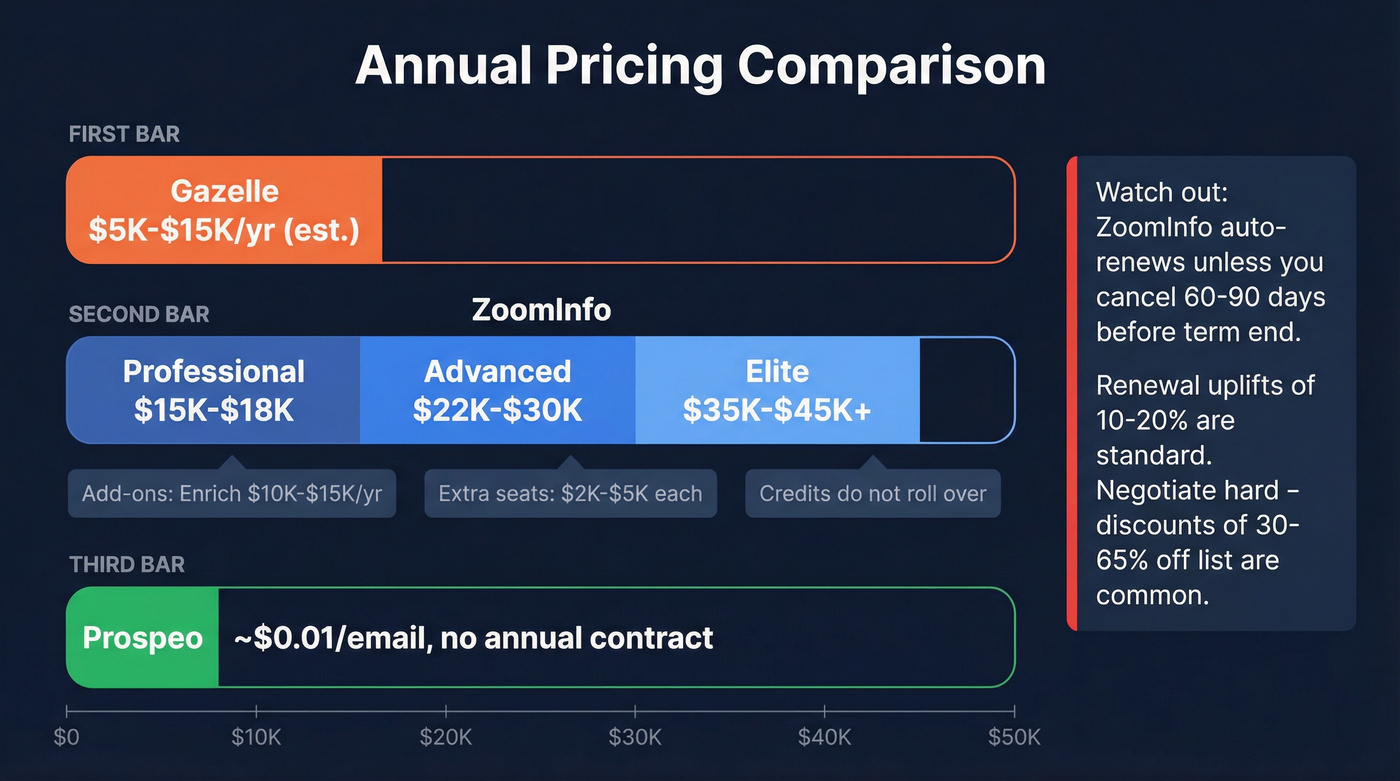
ZoomInfo runs on three tiers. Professional starts at $15K-$18K/year for roughly three seats. Advanced runs $22K-$30K. Elite hits $35K-$45K+. Add-ons like Enrich ($10K-$15K/year) and extra seats ($2K-$5K each) stack fast, and bulk credit unit economics run about $0.60 each at low volume, dropping to $0.20 at scale.
All contracts are annual, credits don't roll over, and auto-renewal kicks in unless you cancel 60-90 days before term end. In our experience, the sticker price is rarely what teams end up paying - discounts of 30-65% off list are common if you negotiate hard, and renewal uplifts of 10-20% are standard. Go in expecting a fight.
Gazelle doesn't publish pricing either. Based on its market position as a niche intelligence platform, expect $5K-$15K/year depending on seats and data export needs.
Who Should Pick Which
You need growth-company intelligence for economic development or site selection. Gazelle is purpose-built for this. ZoomInfo doesn't compete here - its company data is structured for sales targeting, not market analysis with heatmaps and industry-level profiles.
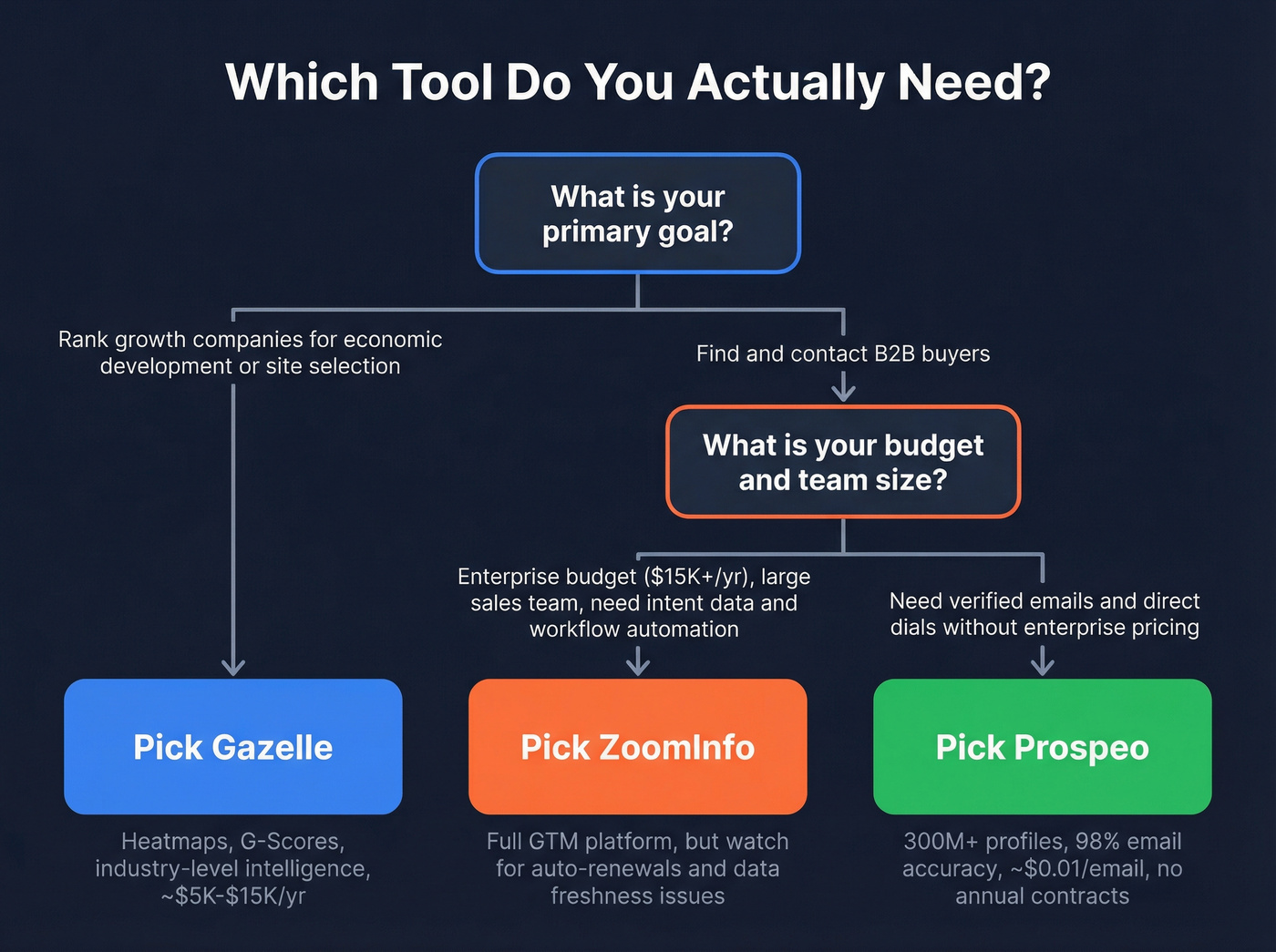
You're running enterprise outbound with budget for a full GTM platform. ZoomInfo makes sense if you'll actually use intent signals, enrichment, and native integrations across a large sales team. Just go in with eyes open on the contract terms.
Here's the thing, though: most teams we talk to don't need either of these tools.
You need verified emails and direct dials without enterprise pricing. For teams where the core job is "find the right person's contact info and reach them," neither Gazelle nor ZoomInfo is the most efficient path. Prospeo covers 300M+ professional profiles with 98% email accuracy and 125M+ verified mobile numbers on a 7-day data refresh cycle. The free tier gives you 75 verified emails per month, paid plans scale at roughly $0.01 per email, and there are no annual contracts or auto-renewal traps. If you're comparing options, start with sales prospecting fundamentals and then pick the database that matches your workflow.

Let's be honest about what we've seen in practice: if your average deal size sits below five figures, you almost certainly don't need ZoomInfo-level infrastructure. Most teams paying $25K+ for ZoomInfo use about 20% of the platform. A dedicated contact data tool paired with your existing CRM will outperform a bloated all-in-one you barely touch. One of our customers, Snyk, had 50 AEs prospecting 4-6 hours per week and saw bounce rates drop from 35-40% to under 5% after switching - that's the kind of improvement that comes from better data, not more features. If you're cleaning lists and protecting deliverability, it also helps to track your email bounce rate and follow a proper email deliverability guide.
Neither Gazelle nor ZoomInfo is built for teams that just need accurate contact data fast. Prospeo gives you 30+ search filters, buyer intent signals, and verified direct dials at ~$0.01/email - no annual lock-in, no auto-renewal traps, no sales calls.
Snyk's 50 AEs dropped bounce rates from 40% to under 5%. Your team can too.
FAQ
Is Gazelle a ZoomInfo competitor?
No. Gazelle ranks fast-growing companies for economic development teams and site selectors. ZoomInfo is a contact database for outbound prospecting. They serve different buyers solving different problems - the only overlap is that both platforms contain company records.
How much does ZoomInfo cost per year?
Professional starts at $15K-$18K/year for three seats. Advanced runs $22K-$30K, Elite hits $35K-$45K+. All contracts are annual with auto-renewal, and renewal uplifts of 10-20% are standard. Negotiate hard - discounts of 30-65% off list are common.
What's the cheapest way to get verified B2B emails?
Prospeo offers 75 free verified emails per month and scales at roughly $0.01 per email with 98% accuracy. No contracts, no sales calls, and a 7-day data refresh cycle that keeps bounce rates under 4%.