

How to Generate Demand That Actually Builds Pipeline
Your VP of Sales just told you 60% of the leads marketing sent last quarter never responded. Not "weren't qualified" - never responded. No reply, no call back, no sign of life. That's not a lead quality problem. That's a demand problem.
The winning vendor appears on the buyer's Day One shortlist 95% of the time. If you're not on that list, you're fighting for scraps. And 92% of B2B buyers start their research with at least one vendor already in mind. So the question isn't whether your outbound sequences are optimized. It's whether anyone knows who you are before the buying cycle starts.
The fix isn't better lead scoring or another nurture sequence. It's learning how to generate demand before buyers start looking - so when they do, you're already on the shortlist.
The Short Version
Demand gen isn't lead gen with better branding. It's the system that gets you on the buyer's Day One shortlist. Three things to do right now:
- Shift from MQL volume to pipeline-sourced metrics. If marketing's primary KPI is form fills, you're measuring the wrong thing.
- Build preference with the 95% who aren't buying yet while capturing the 3-5% who are.
- Start with 1-2 programs per funnel stage, not 50 tactics. Depth beats breadth every time.
What Is Demand Marketing?
Demand generation is the full-cycle process of building awareness, educating your market, and creating preference for your brand - so that when buyers enter a purchase cycle, you're already a known quantity. It's not one tactic. It's the operating system that connects content, distribution, data, and sales into a pipeline engine. Some teams call this discipline demand marketing. The label matters less than the operating model behind it.
Don't confuse demand gen with growth marketing. Growth marketing spans the full lifecycle including retention and expansion, while demand gen focuses specifically on building awareness and preference that drives new pipeline.
The distinction that trips most teams up is demand creation versus demand capture. Demand creation targets the 95% who aren't buying yet - it's the long game of brand, education, and trust. Demand capture targets the 3-5% who are actively in-market - it's the SEO, paid search, review sites, and intent-triggered outbound that converts existing interest into pipeline. A practitioner on r/LeadGeneration described pure demand capture as "boiling the ocean to catch a few fish." That's the right mental model. If all you do is capture, you'll burn through your TAM with weak offers and wonder why pipeline dried up.
| Demand Generation | Lead Generation | Demand Capture | |
|---|---|---|---|
| Goal | Build awareness + preference | Collect contact info | Convert active buyers |
| Timeframe | 6-12 months | Ongoing | 1-3 months |
| Primary metric | Pipeline influenced | MQL volume | Pipeline sourced |
| Example tactic | Podcast, ungated content | Gated ebook, webinar reg | Paid search, intent outbound |
Why It Matters for Pipeline
Let's look at the numbers.
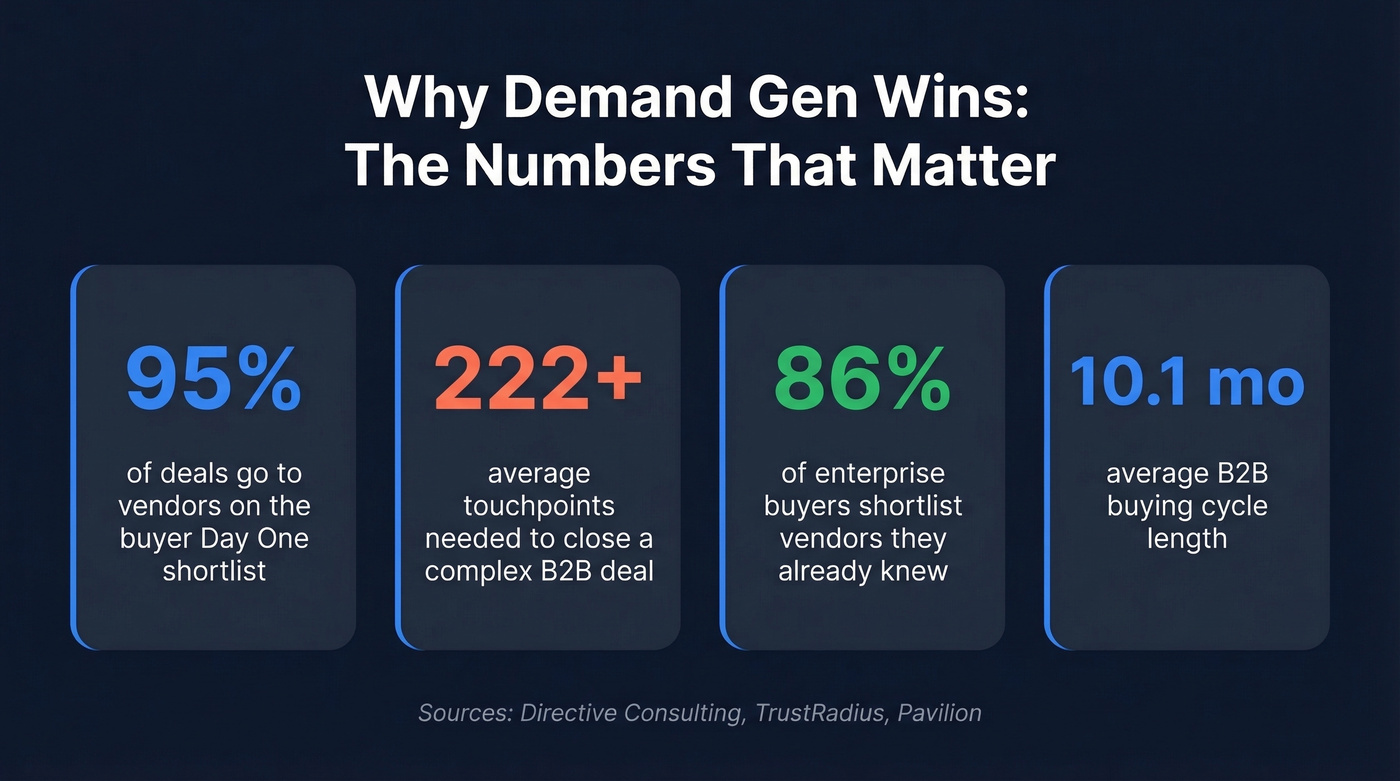
41% of B2B buyers have a preferred vendor before they even begin formal evaluation. The average B2B buying cycle runs 10.1 months. And a TrustRadius + Pavilion study found that 86% of enterprise buyers shortlist vendors they'd heard of before starting research.
Here's the stat that should change how you think about marketing: an analysis of 1.5M+ contacts across 50+ B2B SaaS companies found it takes 222+ touchpoints on average to close a complex deal. That's not a typo. Two hundred and twenty-two interactions before a deal closes. Meanwhile, 56% of buyers say there's too much content out there. You need hundreds of touchpoints, but buyers are drowning in noise. The only way to thread that needle is to be genuinely useful long before someone's ready to buy.
The benefits extend beyond pipeline volume. Teams that invest in creating demand early see shorter sales cycles, higher win rates, and lower customer acquisition costs - because buyers arrive already trusting the brand. If your strategy only targets the 3-5% who are ready to buy right now, you're ignoring 95% of your future pipeline. That's not a strategy. That's a lottery ticket.
The Three-Level Framework
We've watched too many teams try to launch 15 programs simultaneously and end up doing none of them well. The framework that actually works breaks demand into three levels, each with a different timeline and a different goal. Pick 1-2 core programs per level and execute them deeply before expanding.
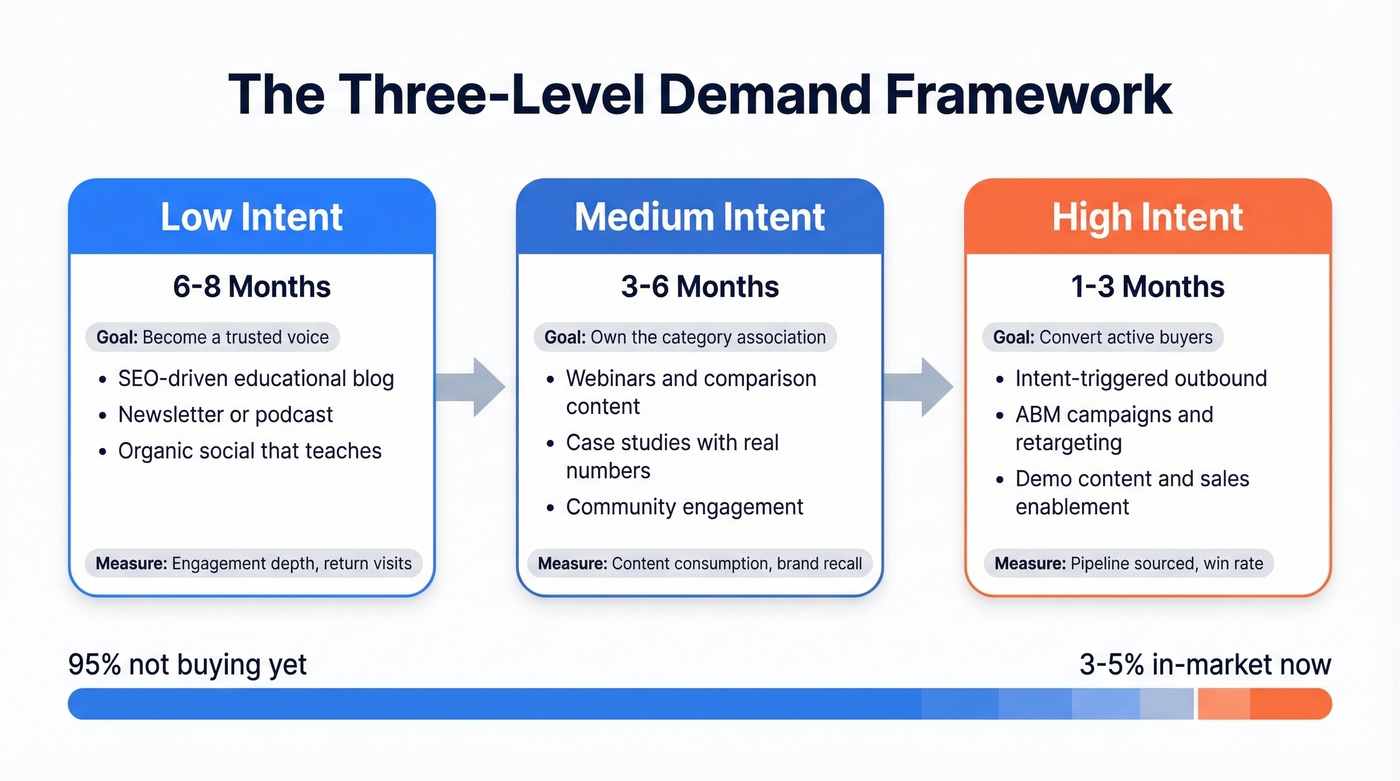
Low Intent (6-8 Months)
This is where you build trust with people who don't know they have a problem yet - or know they have one but aren't looking for a solution. The goal isn't leads. It's becoming a trusted voice in your category.
Core programs include an educational blog driven by SEO and authored by subject matter experts, a newsletter or podcast, and organic social that teaches rather than promotes. Measure engagement depth - time on page, return visits, subscriber growth - not form fills. This is the layer most teams skip because it doesn't produce pipeline in Q1. It's also the layer that makes everything else work.
Medium Intent (3-6 Months)
Now your audience knows they have a problem and is exploring solution categories. Your job is to be the name they associate with the category.
Webinars, comparison content, case studies, and community engagement all live here. Buyers at this stage are consuming content voraciously - give them substance, not gated fluff. Companies that produce genuinely useful comparison content, even mentioning competitors, build more trust than those that pretend alternatives don't exist. This is where real brand preference gets built.
High Intent (1-3 Months)
The buyer has a shortlist. They're evaluating vendors. This is demand capture territory: intent-triggered outbound, ABM campaigns, retargeting, demo content, and sales enablement.
The mistake most teams make is spending 90% of their budget here and wondering why the shortlist never includes them. You can't capture demand you never created.
Core Strategies to Generate Demand
Ungated Educational Content
The gated ebook is dying, and the data explains why. 56% of buyers already feel overwhelmed by content. Putting a form in front of a mediocre PDF doesn't create interest - it generates resentment and fake email addresses.
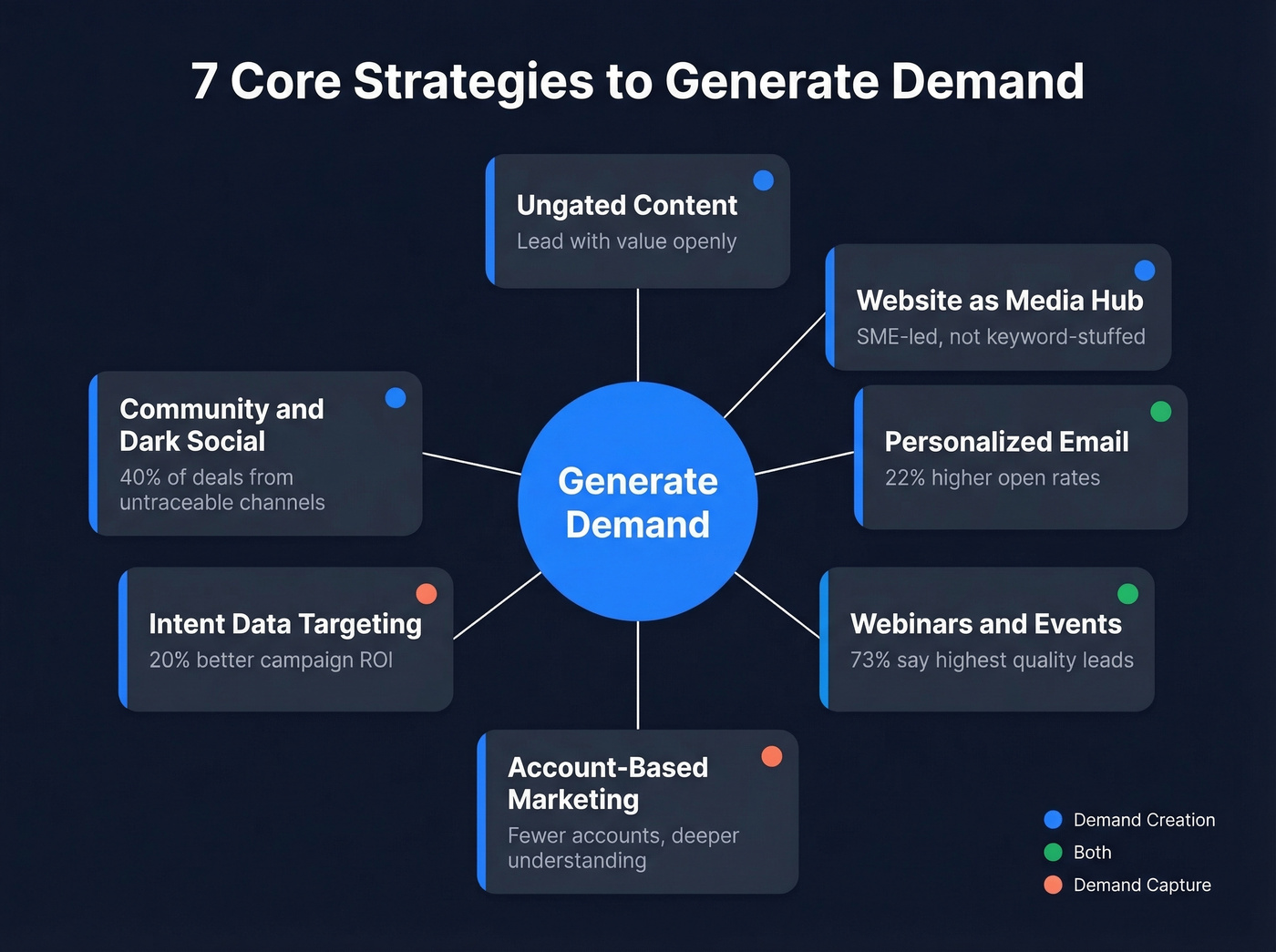
Lead with value. Publish your best thinking openly. The people who find it valuable will remember your name when they're ready to buy.
Your Website as a Media Hub
Stop treating your blog like a content farm. It should be the searchable hub for your entire media operation - SME-led content, not keyword-stuffed filler. Timely, journalistic, informed by what your sales team hears on calls and what your community discusses in Slack channels and forums. SEO compounds. A well-executed content program becomes your cheapest pipeline source by month 12.
Personalized Email at Scale
Personalized emails deliver 22% higher open rates than generic blasts. But personalization only works when you're reaching the right person at a real email address. A 15% bounce rate doesn't just waste sends - it tanks your domain reputation and makes every future email less likely to land. Clean data is the prerequisite, not the nice-to-have.
Speed matters too. Responding to a web lead within 5 minutes makes you 9x more likely to convert. That means your data infrastructure needs to deliver verified contacts fast enough for sales to act on them in real time.
Webinars and Events
73% of B2B marketers say webinars produce their highest-quality leads. But the real value is in what happens after the live event. Record them, clip them, distribute them across channels. A single webinar should generate 10+ pieces of derivative content. Data shows that prospects who view 9+ demos close at 8-10x the rate of those who don't - so make that content easy to find and binge.
Account-Based Marketing
ABM isn't "outbound to a list." It's fewer accounts with deeper understanding. The process that works: marketing proposes a target list based on revenue analysis, segment breakdown, and intent signals. Sales validates. Then both teams coordinate on multi-threaded engagement. In our experience, when ABM fails, it's almost always because sales dictated the list based on gut feel rather than data.
Intent Data as a Targeting Layer
Here's the question every demand gen team eventually asks: how do we know who's actually in-market right now?
That's what intent data answers. Personalization through intent data can improve campaign ROI by up to 20%, and 61% of marketers now use it to identify and prioritize accounts. The play is layering intent signals showing who's researching your category with firmographic targeting that confirms ICP fit, narrowing from 10,000 potential accounts to the 500 that actually matter right now. This is especially critical in competitive categories where timing is everything.
Community-Led Growth and Dark Social
The conversations that drive purchase decisions increasingly happen in places you can't track - Slack communities, private messages, group chats, podcasts. This is "dark social." You can't attribute it in your MAP, but you can fuel it by creating content worth sharing and building a genuine community presence.
One B2B team we know traces 40% of their closed-won deals to Slack community conversations that never showed up in any attribution report. This approach is particularly effective for mid-market SaaS where word-of-mouth among practitioners carries more weight than any ad. Ask new customers how they heard about you. The answer is rarely "your nurture sequence."

222 touchpoints to close a deal - and every bounced email is a wasted one. Prospeo's 98% email accuracy and 7-day data refresh mean your demand gen campaigns actually reach real buyers, not dead inboxes. Stop burning budget on contacts that never respond.
Build pipeline on data that connects, starting at $0.01 per verified email.
Challenges That Kill Pipeline
If you've ever watched marketing celebrate hitting an MQL target while sales complains none of the leads are real - you understand why demand gen exists.
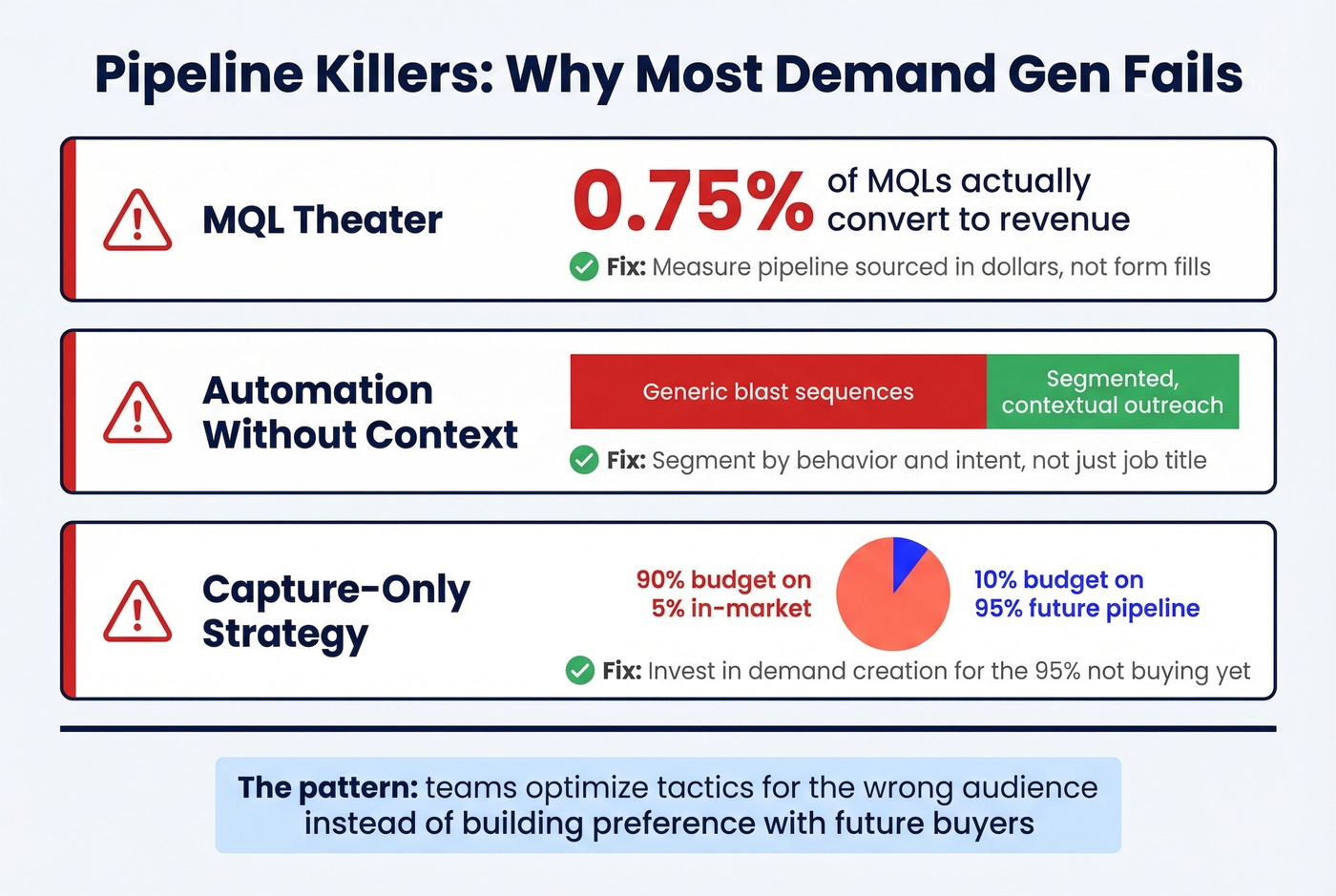
MQL theater. Only 0.75% of MQLs convert to revenue. That's not a pipeline - it's a vanity metric. Measure pipeline sourced and influenced by marketing, not form fills. When the board asks "what did marketing produce?", the answer should be a dollar amount, not a lead count.
Automation without context. Scaling automated sequences without segmentation just scales sameness. Opens and clicks aren't intent signals - they're activity signals. A prospect who watched 3 webinars and visited your pricing page twice is fundamentally different from someone who downloaded one ebook. Segment by actual buying behavior.
Broad targeting and ad waste. Running campaigns against 10,000 accounts dilutes everything - budget, messaging, and sales follow-up capacity. Start with intent data and firmographic filters that narrow your audience to 500 accounts showing real buying signals.
Gated content obsession. Gating every asset creates a database of people who wanted your content, not people who want your product. Ungate your best work and measure engagement depth instead of download counts.
No attribution model. If you can't trace pipeline from first touch to closed deal, you can't prove ROI, and you can't defend your budget. Integrate your CRM, MAP, and analytics platform. Multi-touch attribution isn't perfect, but it's infinitely better than flying blind.
The Demand Gen Tech Stack
If we were building a demand gen stack from scratch, we'd start with three tools: HubSpot for marketing automation (the free tier is genuinely useful), Prospeo for verified contact data and intent signals, and a content platform. Everything else is optimization.
Prospeo covers the data layer with 300M+ professional profiles, 143M+ verified emails at 98% accuracy, and 125M+ verified mobile numbers with a 30% pickup rate. Intent data tracks 15,000 topics via Bombora, so you can layer buying signals with firmographic targeting in a single platform. Data refreshes every 7 days - the industry average is 6 weeks, which means most databases are serving stale contacts by the time you hit send. At roughly $0.01 per email, with a free tier to start, it's the highest-leverage data investment for teams that don't have a six-figure budget. Snyk's sales team saw AE-sourced pipeline jump 180% after switching - that's the kind of lift clean data produces.
| Category | Tool | Starting Price | Best For |
|---|---|---|---|
| Marketing Automation | HubSpot | Free / $890/mo / $3,600/mo Enterprise | Full-funnel orchestration |
| B2B Data & Enrichment | Prospeo | Free; ~$0.01/email | Verified contacts + intent |
| Intent & ABM | 6sense | ~$60K/yr | Enterprise intent orchestration |
| B2B Intelligence | ZoomInfo | ~$15K/yr | Large-scale data access |
| ABM Platform | Demandbase | ~$30K/yr | Account-based orchestration |
For most teams under 50 people, skip the enterprise platforms and start with HubSpot free + Prospeo. You'll cover automation and data for under $100/month for small-volume outbound and get better email accuracy than teams paying $60K+ for enterprise tools. Add 6sense or Demandbase only when you have a dedicated ABM team and the implementation bandwidth to justify 6+ months of setup. 6sense alone takes 3-6 months to reach full value. If your average deal size is under $15K, you almost certainly don't need that level of tooling.
Targeting the 3-5% who are actively buying requires precision. Prospeo tracks 15,000 intent topics via Bombora and layers them with job changes, headcount growth, and technographics - so your demand capture hits in-market buyers the moment they start looking.
Get on the shortlist before buyers even know they're buying.
Transitioning from Lead Gen
You can't flip a switch. We've watched teams try to blow up their MQL model on day one - it never works. Break the transition into manageable parts while keeping what currently works.
Improve content quality first. Use subject matter experts, not just marketers writing from templates. Your head of product knows more about the problem space than your content team - get them on camera or on a podcast.
Shift social from promotional to value-led. Stop posting product announcements. Start posting insights, frameworks, and opinions that your audience actually wants to share.
Build one subscription channel. Newsletter or podcast - pick one and commit for 6 months. The Full-Funnel newsletter built 25,000+ subscribers with a 31% open rate through consistent, value-led publishing. That's proof the subscription model works when you commit to it.
Reframe your blog as a searchable hub. SME-led, timely, journalistic. Informed by the questions your community is actually asking in Slack channels and forums.
Introduce intent-based targeting alongside your existing MQL model. Don't replace MQLs yet. Layer intent signals on top so sales can prioritize the leads that are actually in-market. Then gradually shift measurement from MQL volume to pipeline influenced. When leadership sees the correlation between demand gen programs and closed revenue, the MQL conversation resolves itself.
For teams at new companies, nail content and community before investing in paid channels. You need a point of view before you need a media budget.
Measuring What Matters
The metrics that matter for demand gen are fundamentally different from lead gen metrics.
| Track This | Stop Obsessing Over This |
|---|---|
| Pipeline sourced by marketing | Raw MQL count |
| Pipeline influenced (multi-touch) | Form fills |
| CAC by channel | Cost per lead alone |
| Sales cycle length trend | Vanity traffic |
| Brand search volume growth | Social impressions |
| Engagement depth (time, pages, returns) | Email open rate alone |
B2B organizations allocate roughly 31% of marketing budgets to demand generation, and marketing budgets average 7.7% of company revenue. If you're spending less than that on demand gen, you're over-indexed on capture and under-investing in the programs that fill the top of the funnel 6-12 months from now.
The hardest part isn't picking the right metrics - it's getting leadership to be patient with them. Pipeline influenced by a podcast episode published in January might not close until September. Build the reporting infrastructure to show that connection, or you'll lose budget before the programs mature.
AI in Demand Generation
AI adoption in marketing hit 90% by 2024, and it's only accelerated since. In 2026, 84% of marketers use AI to align content with search intent. But there's a tension worth paying attention to: 52% of consumers are less engaged with content they suspect is AI-generated, and 26% perceive it as impersonal.
The takeaway isn't "don't use AI." It's "use AI where it's invisible and valuable." Research, personalization, data analysis, intent signal processing, content distribution optimization - these are all high-value applications that buyers never see. What they do see is your content. And if it reads like it was generated by a prompt, you've lost the trust you spent months building. The consensus on r/marketing is that "AI slop" is creating real backlash - and an opening for teams that invest in genuinely human content.
Let's be honest: 49% of genAI decision-makers expect ROI in 1-3 years, not months. Treat AI as infrastructure, not a magic button. Build governance around it - privacy, consent, bias mitigation - before you scale.
FAQ
What's the difference between demand gen and lead gen?
Lead gen captures contact info from people who don't necessarily care about you yet. Demand gen builds awareness and preference so that when buyers are ready, you're already on their shortlist. Lead gen is a tactic within demand gen - it handles the capture moment, but it can't create the preference that makes capture work.
How long does it take to generate demand?
Expect 6-8 months for content-driven programs to produce measurable pipeline. Intent-based outbound and ABM can show results in 1-3 months. The average B2B buying cycle is 10.1 months - plan your measurement windows accordingly and commit to at least two full quarters before evaluating results.
How much should we budget?
B2B organizations allocate roughly 31% of marketing budgets to demand generation, with marketing budgets averaging 7.7% of revenue. Start with content plus one solid data tool before scaling paid channels - you don't need a six-figure tech stack to start building pipeline.
How do I fix bad data hurting my campaigns?
Bad contact data causes bounces, damages domain reputation, and makes your metrics unreliable. Use a verification tool that checks emails in real time and flags catch-all domains, spam traps, and honeypots before you send. Aim for under 3% bounce rate - anything above 5% is actively degrading your deliverability.
How do I build demand in a new market?
Lead with education over product promotion. Start by understanding the market's existing awareness level, then invest in ungated content and community presence that establishes credibility before running any capture campaigns. Combining inbound content with outbound targeting informed by intent data is the fastest path to pipeline in unfamiliar territory.