

Generect vs QuickEnrich: Which Enrichment Tool Wins in 2026?
There's almost no public head-to-head coverage comparing these two tools. We reviewed both platforms' API docs and pricing pages to build this comparison from scratch. Both are lean enrichment tools for teams that don't want ZoomInfo prices - but they solve the problem in very different ways.
30-Second Verdict
Generect wins if you want pay-as-you-go flexibility, real-time data on every search, and the comfort of a 5.0/5 rating on G2 from 32 reviews.
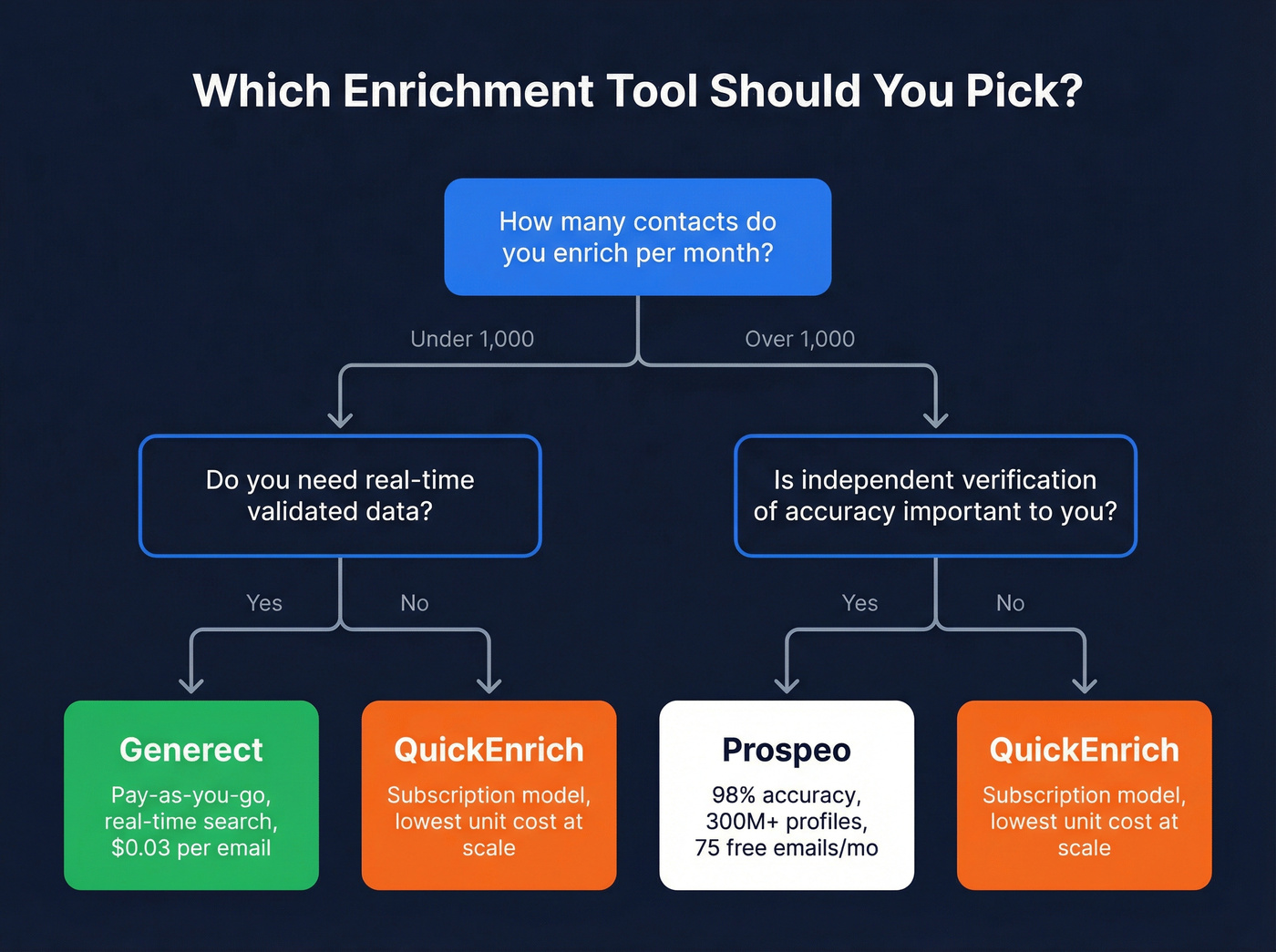
QuickEnrich wins if you need bulk enrichment at the lowest per-record cost and you're comfortable with a tool that has no major third-party reviews we could find.
Generect at a Glance
Use this if you're doing low-to-mid volume prospecting and want to pay only for what you find. Searches are free - you pay $0.03 per valid email and $0.02 per export. New accounts get a $5 credit, which covers roughly 166 valid emails before you spend a dollar (exports are billed separately). The real-time search model means data is pulled fresh on every query, not served from a stale database.
Independent reviewers consistently praise ease of use, speed, and data accuracy. HubSpot and Salesforce integrations come up frequently in G2 reviews. Generect also offers an enrichment API with MCP connectivity, letting teams control enrichment via natural language through LLMs. That's a genuinely novel feature - we haven't seen another enrichment tool ship anything like it.
Skip this if you need strong reporting. Reviewers flag it as basic, and that's the main gap.

Choosing between real-time validation and bulk pricing shouldn't mean sacrificing accuracy or scale. Prospeo's 5-step verification delivers 98% email accuracy across 300M+ profiles - refreshed every 7 days, not 6 weeks. At ~$0.01 per email, you pay less than Generect and get verified data QuickEnrich can't independently prove.
Stop debating trade-offs. Get accuracy, scale, and price in one platform.
QuickEnrich at a Glance
QuickEnrich takes the opposite approach: a 130M+ contact database with subscription pricing. The Starter plan runs $29/mo ($24/mo billed annually), and Growth is $99/mo ($83/mo annually). On the Growth plan, you're paying about $0.004 per found email/phone monthly, or roughly $0.00332 on an annual commitment.
Phone lookups only charge a credit when a number is actually found, which is a fair model.
The API includes employees/search, employees/phone-search, and employees/dataset-search with a 1,000 req/min default rate limit, plus an n8n community node and Clay integration. QuickEnrich claims 97% accuracy with double-verified emails, ~25% mobile phone coverage, 30% more coverage than most providers, and 250% more email domains.
Here's the thing: bold marketing claims without independent verification aren't claims - they're hopes. QuickEnrich has limited presence on major review sites, and no Reddit threads surfaced in our research. Industry benchmarks show single-source tools typically deliver 75-88% email accuracy in real-world testing. Test a small batch before committing.
Side-by-Side Feature Comparison
| Generect | QuickEnrich | Prospeo | |
|---|---|---|---|
| Best for | Low-volume, pay-per-use | Bulk enrichment on a budget | Scale + accuracy + fresh data |
| Pricing model | Pay-as-you-go | Subscription | Credit-based |
| Cost per email | $0.03 | ~$0.00332-$0.004 | ~$0.01 |
| Database size | Not disclosed | 130M+ contacts | 300M+ profiles |
| Claimed accuracy | Not specified | 97% | 98% |
| Verification | Real-time validation | Double verified | 5-step proprietary |
| Mobile numbers | Available | ~25% find rate | 125M+, 30% pickup |
| API access | Yes + MCP | Yes (3 endpoints) | Search + Enrich |
| Free tier | $5 credit | Free start (details unclear) | 75 emails/mo |
| Independent reviews | 5.0/5 (32 reviews) | Limited | Available on G2 |
| Data refresh | Real-time search | Database-first | 7-day cycle |
| CRM integrations | HubSpot, Salesforce | Clay, n8n | Salesforce, HubSpot, +7 more |
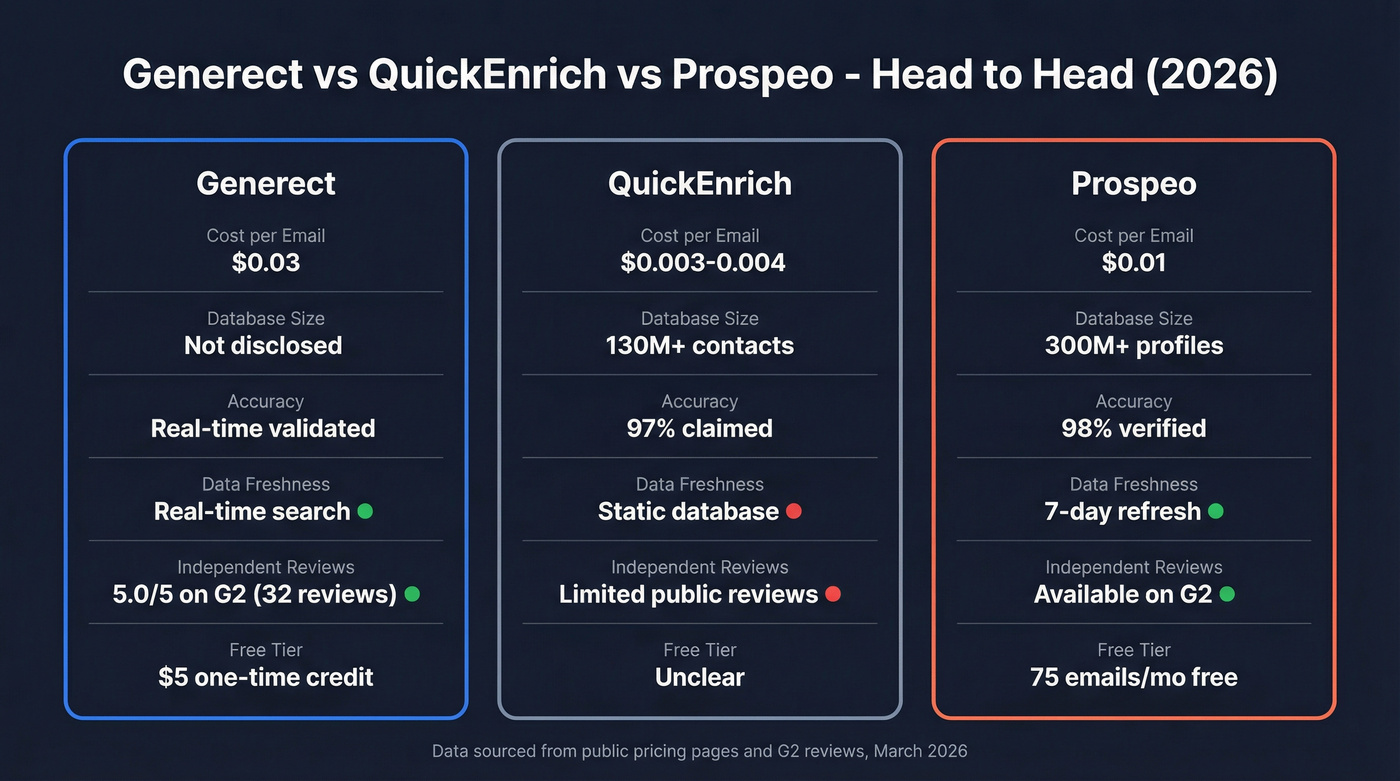
Three differences stand out.
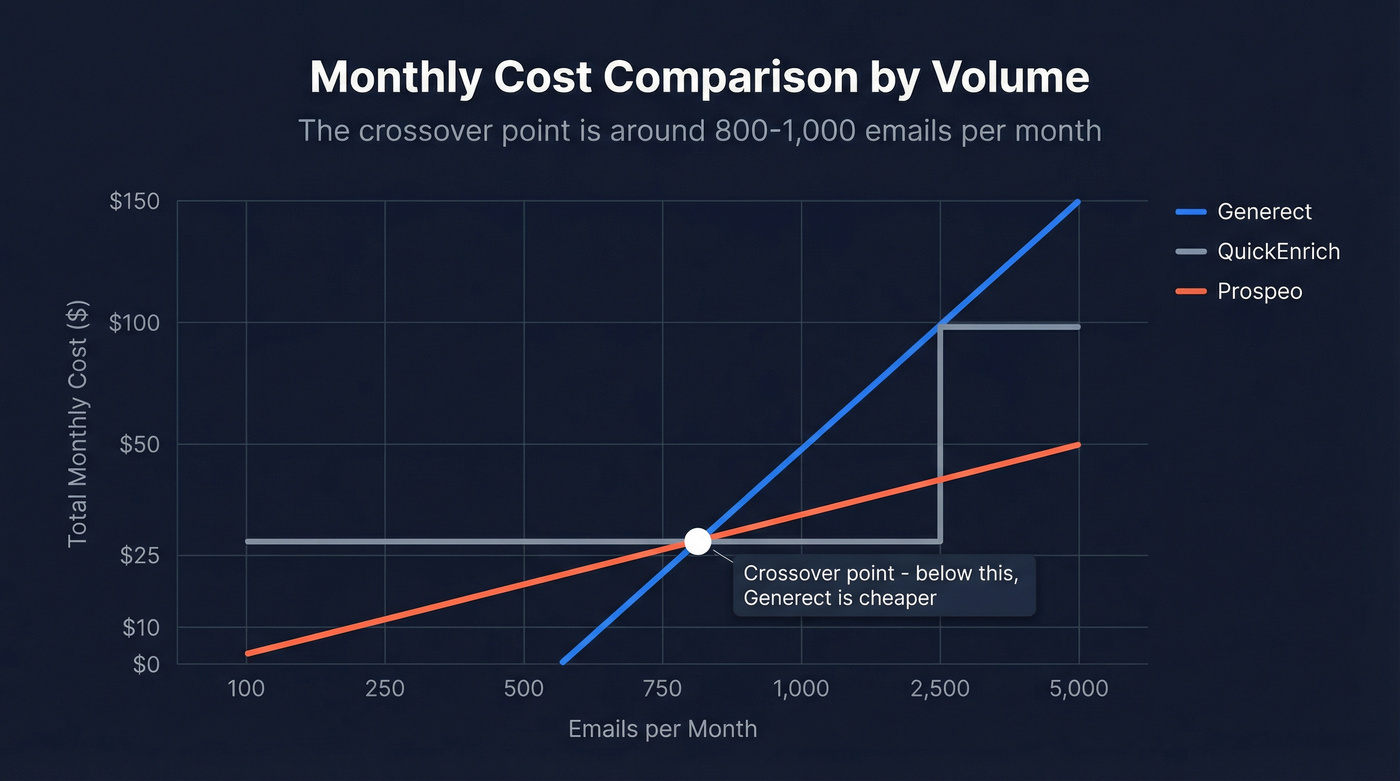
Pricing structure. Generect charges per record; QuickEnrich charges per month. At low volume, Generect's pay-as-you-go wins. At high volume, QuickEnrich's subscription is cheaper per unit. The crossover point sits somewhere around 800-1,000 emails per month - below that, Generect costs less; above it, QuickEnrich pulls ahead on raw unit economics.
Data freshness. Generect pulls real-time on every search. QuickEnrich is database-first. The industry average refresh cycle is 6 weeks - real-time beats static every time for accuracy-sensitive workflows, and it's not close. If you're comparing vendors, it helps to understand how data enrichment services handle refresh and verification.
Social proof. This gap is stark. Generect has 32 independent reviews at a perfect 5.0. QuickEnrich has limited public proof on major review platforms. In the Reddit threads we found about mid-budget enrichment stacks, the tools mentioned included Apollo and FullEnrich - neither Generect nor QuickEnrich has entered that conversation yet. For teams that need to justify a vendor choice internally, that matters more than most people admit.
When to Pick Which

Bad data costs the US economy an estimated $3.1 trillion annually. Per-unit price means nothing if half your emails bounce. If you're seeing bounces, use email bounce rate benchmarks to sanity-check your list quality.
Under 500 contacts/month: Generect. Real-time validation and pay-as-you-go keep costs proportional to results. You won't overpay for capacity you don't use. This is especially true if your workflow depends on sales prospecting techniques where list quality matters more than list size.
Bulk enrichment under $100/mo: QuickEnrich. The unit economics are hard to beat. But verify a sample first - we can't stress this enough given the lack of independent benchmarks. If you're building lists from multiple sources, a lead generation workflow can help you standardize QA before you enrich.
FAQ
Is QuickEnrich's 97% accuracy claim reliable?
No major third-party reviews or independent benchmarks surfaced in our research. Industry data puts single-source tools at 75-88% email accuracy in real-world testing. Run a 200-record sample against a known list before committing real budget.
Does Generect have a free plan?
Not a subscription-based free plan, but new users get a $5 credit. Since searches are free and emails cost $0.03 each, that covers ~166 valid emails - enough to evaluate quality before spending more.
What's a good free alternative to both tools?
Prospeo's free tier includes 75 emails and 100 Chrome extension credits per month with full verification - no credit card required. That's more usable than Generect's one-time $5 credit for teams running ongoing prospecting.
Which tool has the best API for enrichment workflows?
Generect's MCP-enabled API is innovative for LLM-powered workflows. QuickEnrich offers three endpoints with a 1,000 req/min limit. Prospeo's enrichment API returns 50+ data points per contact at a 92% match rate, with native Clay, Zapier, n8n, and Make integrations - the broadest automation coverage of the three.
QuickEnrich claims 97% accuracy with no public reviews to back it up. Generect doesn't disclose database size. Prospeo puts the numbers on the table: 300M+ profiles, 125M+ verified mobiles with 30% pickup, 92% API match rate, and a free tier with 75 verified emails per month - no credit card, no contract.
Test 75 emails free and see what verified data actually looks like.