

Generect vs Thomson Data: Honest Comparison (2026)
If you're evaluating Generect vs Thomson Data, you're comparing a real-time search engine to a static list broker. That's not a subtle difference - it's two fundamentally different philosophies about how B2B data should work.
Here's why the model matters: [23-30% of email addresses decay](https://www.mediapost.com/publications/article/403361/) every year. Buy a list in January, and by summer a quarter of it is dead weight dragging your sender reputation down. The architecture behind your data source isn't an abstract concern - it determines whether your emails land in inboxes or spam folders.
30-second verdict: Generect wins for self-serve, real-time prospecting with transparent pricing. Thomson Data serves a narrow niche if you need bulk pre-compiled technology user lists and you're comfortable with custom quotes and bounce risk.
Side-by-Side Comparison
| Factor | Generect | Thomson Data | Edge |
|---|---|---|---|
| Data model | Real-time search | Static list broker | Generect |
| Database size | Not publicly stated | 323M+ profiles (claimed) | Thomson Data (on paper) |
| Accuracy | 98%+, bounce rates under 2% | ~90% (Datarade panel) | Generect |
| G2 rating | 5.0/5 (32 reviews) | 0/5 (0 reviews) | Generect |
| Trustpilot | N/A | 4.4/5 (10 reviews) | Thomson Data (by default) |
| Pricing | $0.03/email, $0.02/export | ~$1K-$10K+/project | Generect |
| CRM integrations | HubSpot, Salesforce | Not listed | Generect |
| Free tier | $5 onboarding credit | None | Generect |
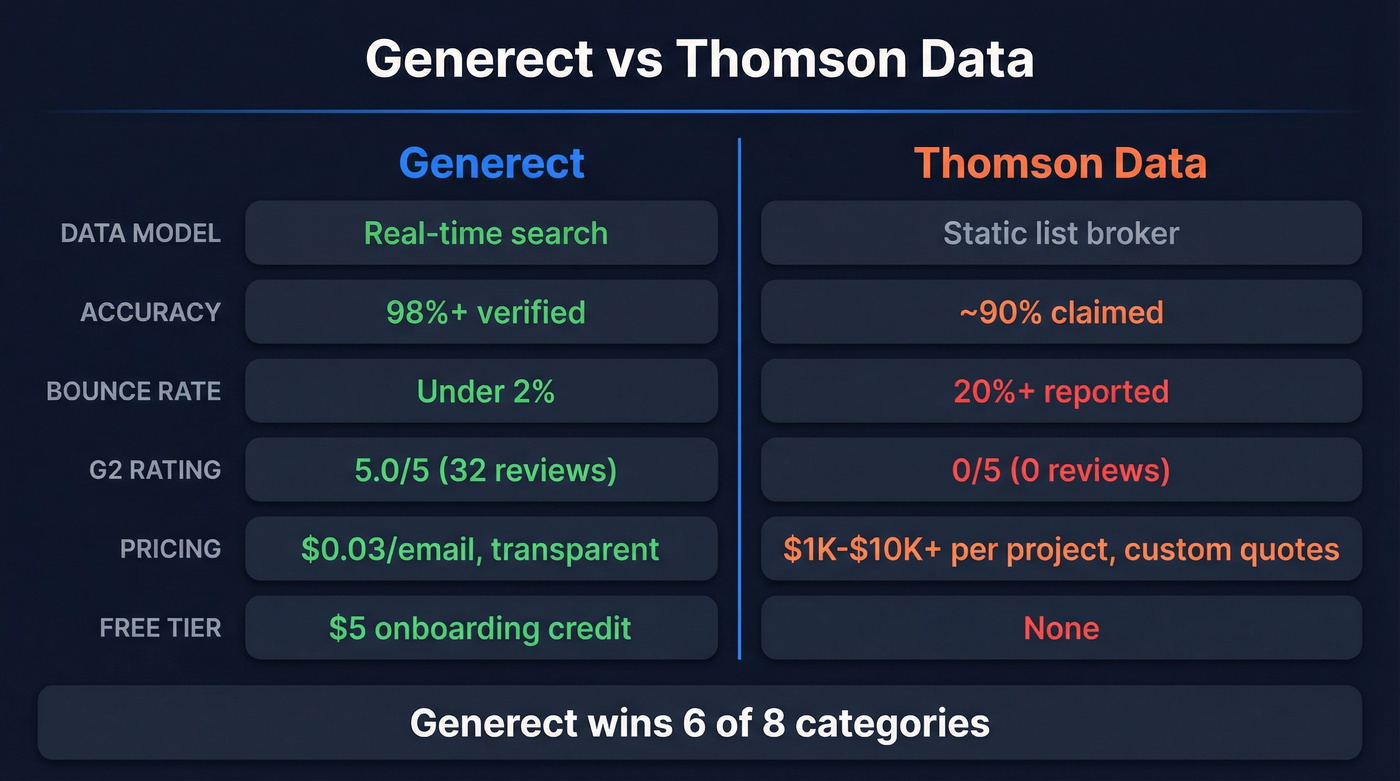
Generect wins 6 of 8 rows. Thomson Data's main advantages are a larger claimed database and a Trustpilot profile with reviews - but size means nothing if you're seeing 20%+ hard bounces like multiple Trustpilot buyers reported.
Real-Time Search vs Static Lists
Generect runs a real-time search engine. It pulls from public sources and verifies contact info when a lead is viewed. Thomson Data operates as a traditional list broker, compiling datasets you purchase in bulk.
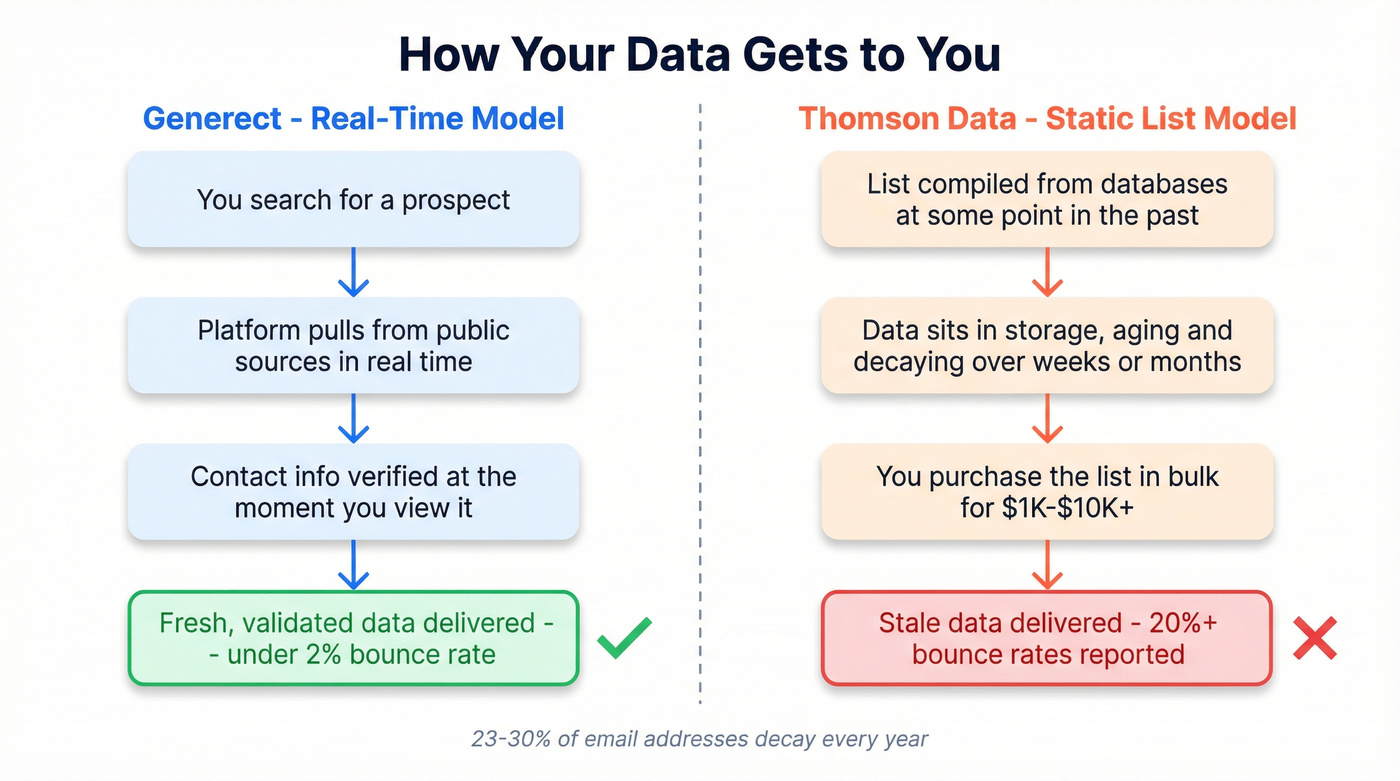
The problem with static lists is decay. 70% of CRM data is outdated or inaccurate at any given time, and a list that was 90% accurate when compiled can drop to 70% within months. Real-time verification eliminates this - you get data validated at the moment you need it.
Thomson Data's genuine strength is pre-compiled technology user lists. Targeting specific CRM/ERP or cloud-software users by industry and region? That's their wheelhouse. If that's your exact use case and you accept the bounce risk, static lists can still make sense. For everything else, real-time wins.

Data Quality and Bounce Rates
Here's where the comparison gets uncomfortable for Thomson Data. Multiple Trustpilot reviews report 20%+ hard bounce rates on purchased lists. One older review alleges receiving 37 companies after paying £1,000 for 267. Thomson Data replaced contacts in some cases, but a 20% hard bounce rate can torch your sender reputation before replacements arrive.
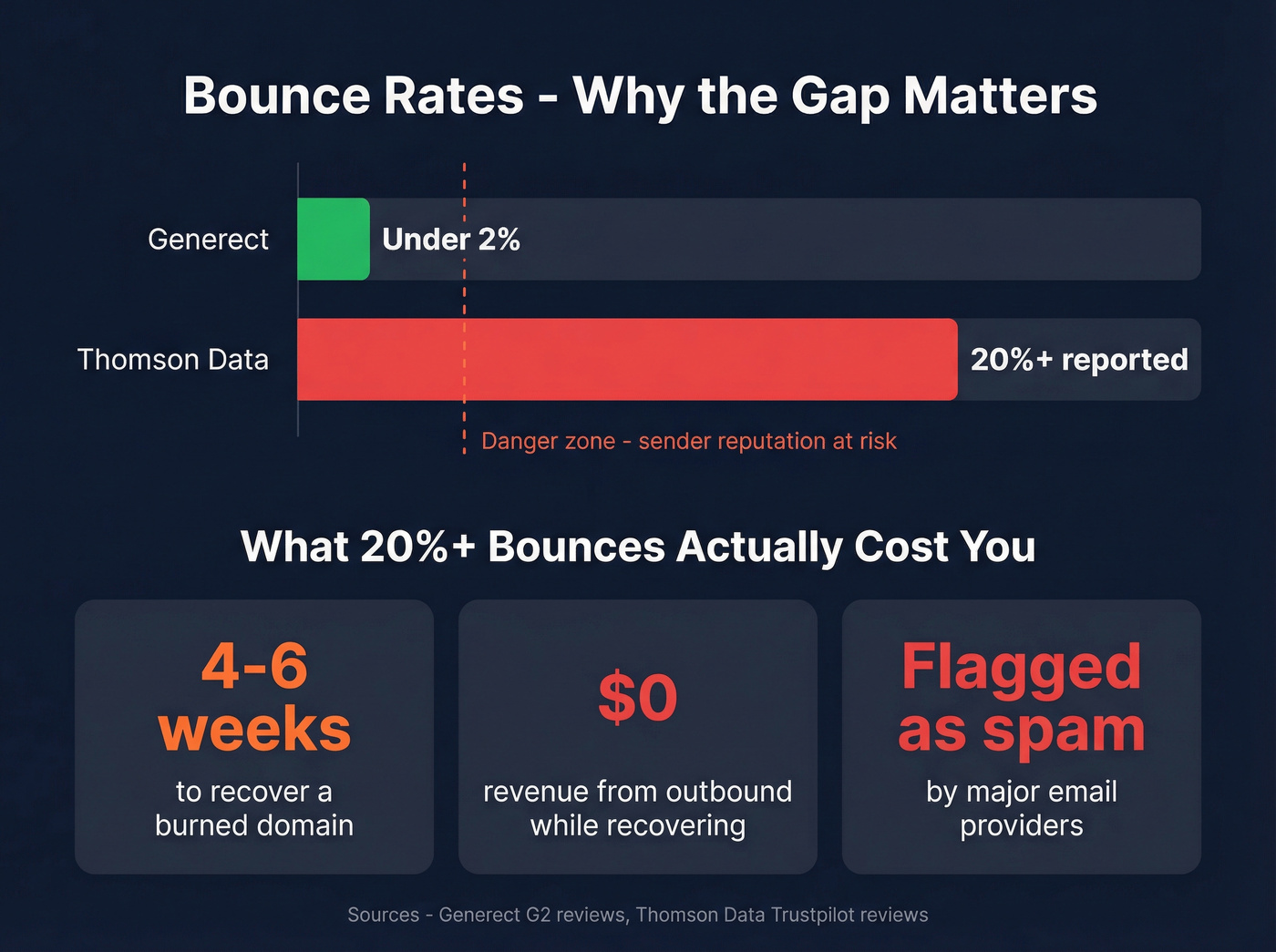
We've seen teams burn domains on bad list data - recovery typically takes 4-6 weeks of warm-up, and during that time your entire outbound program is dead in the water. The gap between 2% and 20% bounces isn't incremental. It's the difference between a healthy pipeline and an IP address flagged as spam.
Thomson Data's site claims 35% more leads and 3.4X ROI in case studies. Those numbers are hard to reconcile with the bounce rates buyers describe on Trustpilot.
Generect's G2 reviewers consistently praise data accuracy, and the platform backs bounce rates under 2%. That tracks with what we'd expect from a real-time verification model.

Static lists decay. Real-time tools still miss. Prospeo's 7-day refresh cycle and 5-step verification deliver 98% email accuracy across 300M+ profiles - at $0.01 per email, not $1,000 per list.
Stop choosing between bounce risk and overpriced data.
Pricing Transparency
Use Generect if you want to know exactly what you're paying before you commit. $0.03 per valid email, $0.02 per export, $20 minimum top-up. No sales calls, no custom quotes, no negotiation games.
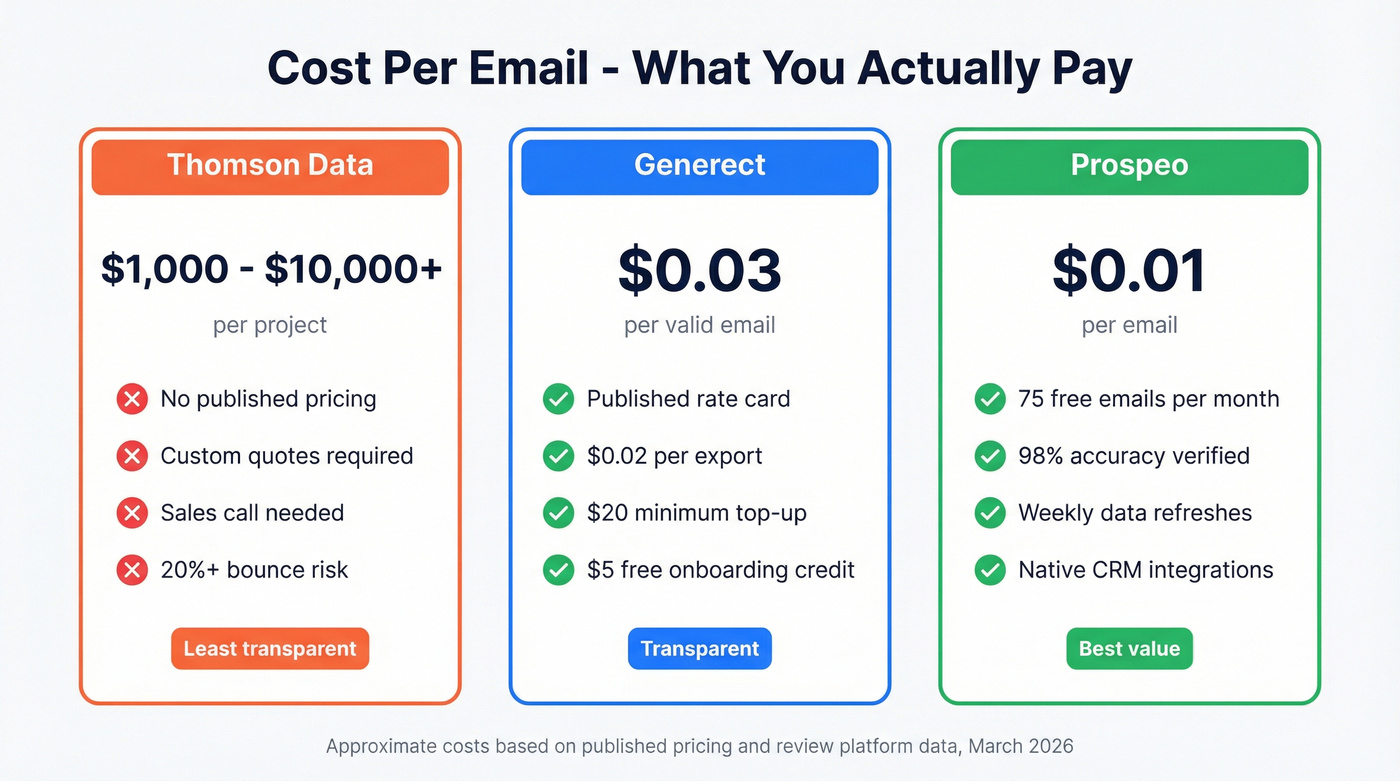
Skip Thomson Data if opaque pricing frustrates you. There's no public pricing on G2, Datarade, or Thomson Data's own site. Based on typical list-broker engagements, expect $1,000-$10,000+ per project depending on volume and targeting criteria.
Let's be honest: if your average deal size sits below $15K, you almost certainly can't justify Thomson Data's pricing model. The math only works for high-ACV enterprise deals where a single conversion covers the list cost.
Reviews and Trust Signals
A zero-review G2 profile is always a warning sign. Generect holds a 5.0/5 on G2 across 32 reviews - 100% five-star, with users highlighting ease of use, speed, and accuracy.
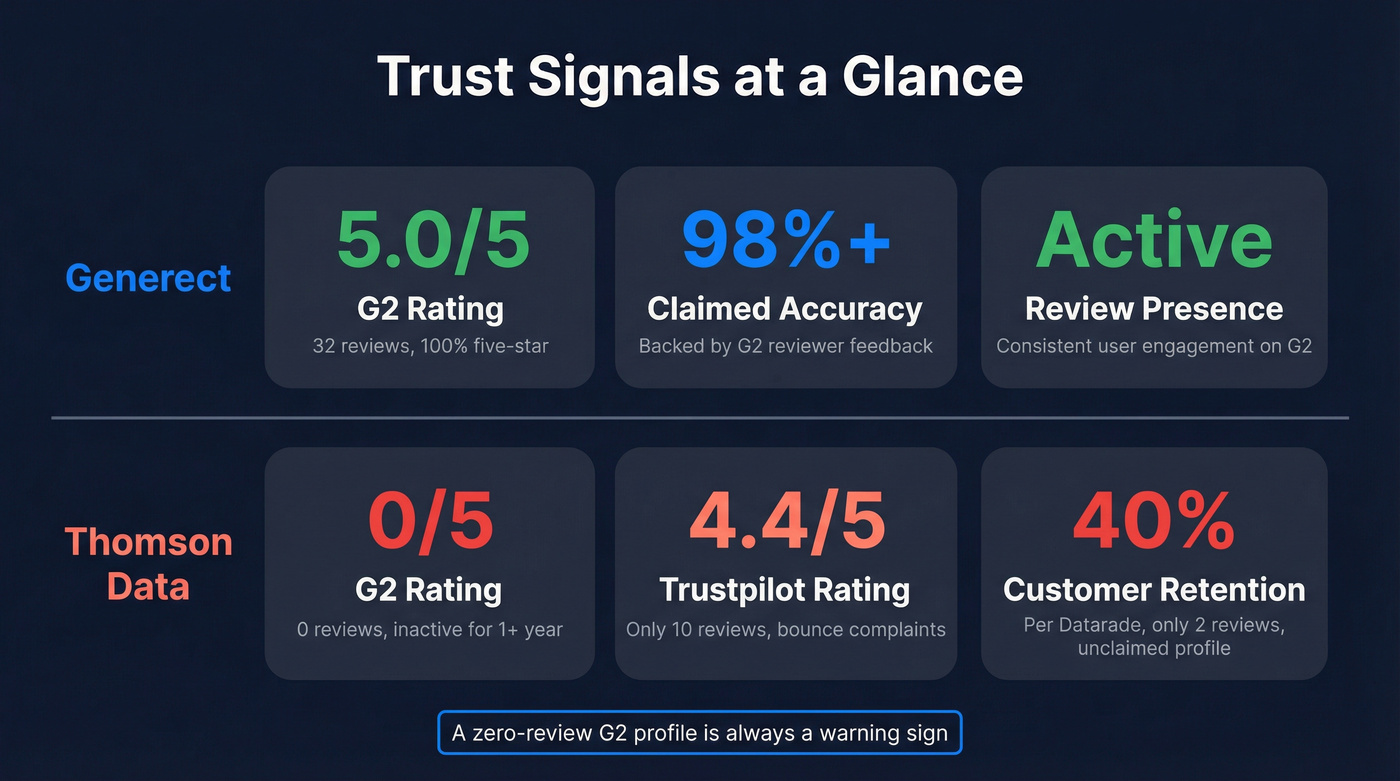
Thomson Data's G2 profile has zero reviews and hasn't been active in over a year. Their Datarade profile is unclaimed, showing 4.7/5 from just 2 reviews and a 40% customer retention rate. On Trustpilot, they hold 4.4/5 from 10 reviews, but the bounce-rate complaints undercut that number significantly. When a tool has essentially no presence in the SaaS review ecosystem, you have to ask: where are the users?
When to Skip Both
For teams that want a verification layer on top of any data source - or just want better economics - Prospeo covers 300M+ professional profiles with 98% email accuracy and 125M+ verified mobile numbers hitting a 30% pickup rate. Data refreshes every 7 days versus a 6-week industry average. At roughly $0.01 per email with a free tier of 75 emails/month, it's the most cost-effective path to clean data we've found. Native integrations with Salesforce, HubSpot, Lemlist, and Instantly mean zero friction with existing workflows.
If you're comparing vendors in this category, start with a broader view of B2B data and how it impacts outbound performance.

Generect charges $0.03/email. Thomson Data charges thousands per list with 20%+ bounce risk. Prospeo gives you 98% accuracy, 125M+ verified mobiles, and native HubSpot/Salesforce integrations - starting free.
Get enterprise-grade data without the enterprise invoice.
Which One Should You Pick?
Choose Generect if you're a small-to-mid team that wants real-time, pay-as-you-go prospecting with transparent pricing and solid sales prospecting workflows.
Choose Thomson Data if you're an enterprise buyer who needs bulk technology user lists with custom segmentation and you're comfortable navigating a sales process and managing bounce risk.
Whichever direction you go, prioritize deliverability over database size. A smaller, verified list will always outperform a massive, decaying one.
FAQ
Does Thomson Data publish pricing?
No. Every review platform says "contact sales." Based on typical list-broker engagements, expect $1,000-$10,000+ per custom list depending on volume and targeting criteria. There's no self-serve option or published rate card.
Is Generect better for small teams?
Yes. Pay-as-you-go pricing at $0.03 per valid email, no contracts, and a $5 onboarding credit make it accessible at any scale. You're never locked into a minimum spend beyond the $20 wallet top-up.
What's a cost-effective alternative to both?
Prospeo offers 75 free verified emails per month at 98% accuracy with no contract. At roughly $0.01 per email on paid plans, it's about 3x cheaper than Generect and an order of magnitude below Thomson Data's project-based pricing - with weekly data refreshes included.