


GetProspect vs Power Almanac: Different Tools for Different Jobs
GetProspect and Power Almanac aren't really competitors. Comparing GetProspect vs Power Almanac like they're interchangeable is how teams end up buying the wrong dataset, then blaming the tool.
Here's the clean way to think about it: Power Almanac is built for US local government org charts and direct contacts. GetProspect is built for broad, budget-friendly B2B email finding. Same general outcome (you get contacts), totally different worlds.
Let's break this down without pretending there's a single "winner."
30-second verdict
- Pick Power Almanac if you sell to US local government. It's purpose-built for that niche, and the role mapping matters more than people expect.
- Pick GetProspect if you need low-cost B2B list building and you're OK with a 61.9% verified email rate.
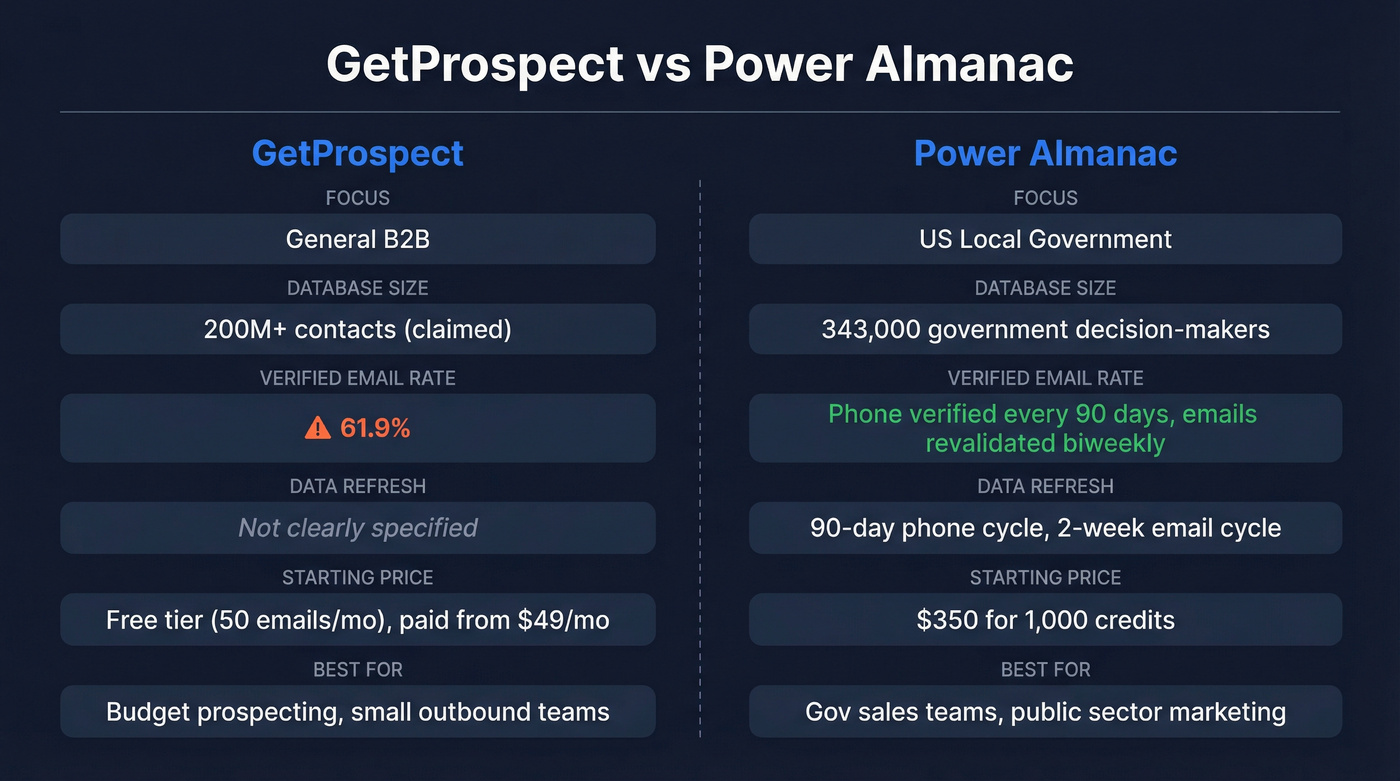
Side-by-side comparison
| Feature | Power Almanac | GetProspect |
|---|---|---|
| Focus | US local government | General B2B |
| Coverage | ~22,000 local governments | 200M+ contacts (per GetProspect) |
| Records | ~343,000 government decision-makers | Not clearly defined as "verified records" |
| Accuracy approach | Phone verification + frequent email validation | Email finding + verification (varies by source) |
| Data refresh | 90-day phone verification; biweekly email validation | Not clearly specified |
| Starting price | $350 for 1,000 credits | Free tier (50 emails/month); paid from $49/month |
| Best for | Gov sales teams, public sector marketing | Budget prospecting, smaller outbound programs |
What Power Almanac is (and why it exists)
Power Almanac covers about 22,000 local governments and roughly 343,000 decision-maker records, and it's been around since 2011. It was acquired by GovExec in 2022, which tracks with what you'd expect from a product that's basically "infrastructure" for public sector go-to-market teams.

The part most people miss is the role-based targeting. In local government, titles are inconsistent to the point of being useless. The person who owns IT spend might be "Director of Technology" in one county, "MIS Coordinator" in another, and "CIO" nowhere at all. Power Almanac maps contacts by role so you can still build a list that makes sense across thousands of municipalities.
Their process is also unusually explicit: a research team calls all 22,000 governments every 90 days, and emails are revalidated every two weeks using two independent validation programs (they mention ZeroBounce). They even publish a 4.1% monthly contact decay rate, which is a nerdy detail, but a useful one if you're planning outreach cadences and list refreshes.
Exports are straightforward (CSV for CRM import), and G2 reviewers regularly mention that Salesforce uploads are painless. That's not glamorous, but it's the difference between "we bought data" and "we actually used it."
Pricing is credit-based: $350 for 1,000 credits up to about $12,000/year for 75,000 credits, per Power Almanac reviews on G2. It's expensive per record. It also doesn't have real substitutes if your ICP is cities, counties, townships, utilities, and special districts.
Skip this if you sell to commercial B2B accounts. Power Almanac has zero coverage outside US local government, and trying to force it into a general B2B workflow is just lighting budget on fire.

GetProspect's 61.9% verified email rate means nearly 4 in 10 contacts bounce or damage your domain. Prospeo delivers 98% email accuracy across 143M+ verified emails, with a 7-day data refresh cycle - not weeks of stale records feeding your sequencer.
Stop firefighting deliverability. Start with data that's actually verified.
What GetProspect is (and what to watch out for)
GetProspect is a general-purpose B2B email finder with a Chrome extension, list building, and outbound sequences. It's the kind of tool teams grab when they want to move fast: upload a list, enrich it, and start sending.

Now the blunt part. In our experience, the "email finder" category is where teams get hurt the fastest, because bad data doesn't just waste credits - it trashes deliverability. Once your domain reputation takes a hit, you don't fix it with a new tool. You fix it with weeks of warmup, list hygiene, and a lot of internal explaining.
A third-party benchmark of 5,000 contacts measured GetProspect at a 61.9% verified email rate. That's not a rounding error. At any real volume, it means a big chunk of your sends are going to bounce or land you in the "this sender looks sketchy" bucket.
On the user-feedback side, GetProspect scores 4.2/5 on Trustpilot. People like how quickly they can build lists. Complaints tend to cluster around credit rules being confusing and support being slow when something breaks.
Pricing is straightforward: free tier includes 50 emails/month, and paid plans run from $49/month to $399/month across tiers.
The difference that actually matters: who you sell to
These tools don't belong in the same buying conversation unless your team sells to both public sector and commercial accounts. If you're stuck choosing between them, it's usually a sign the requirements doc is missing the most important line: "Who is the customer?"
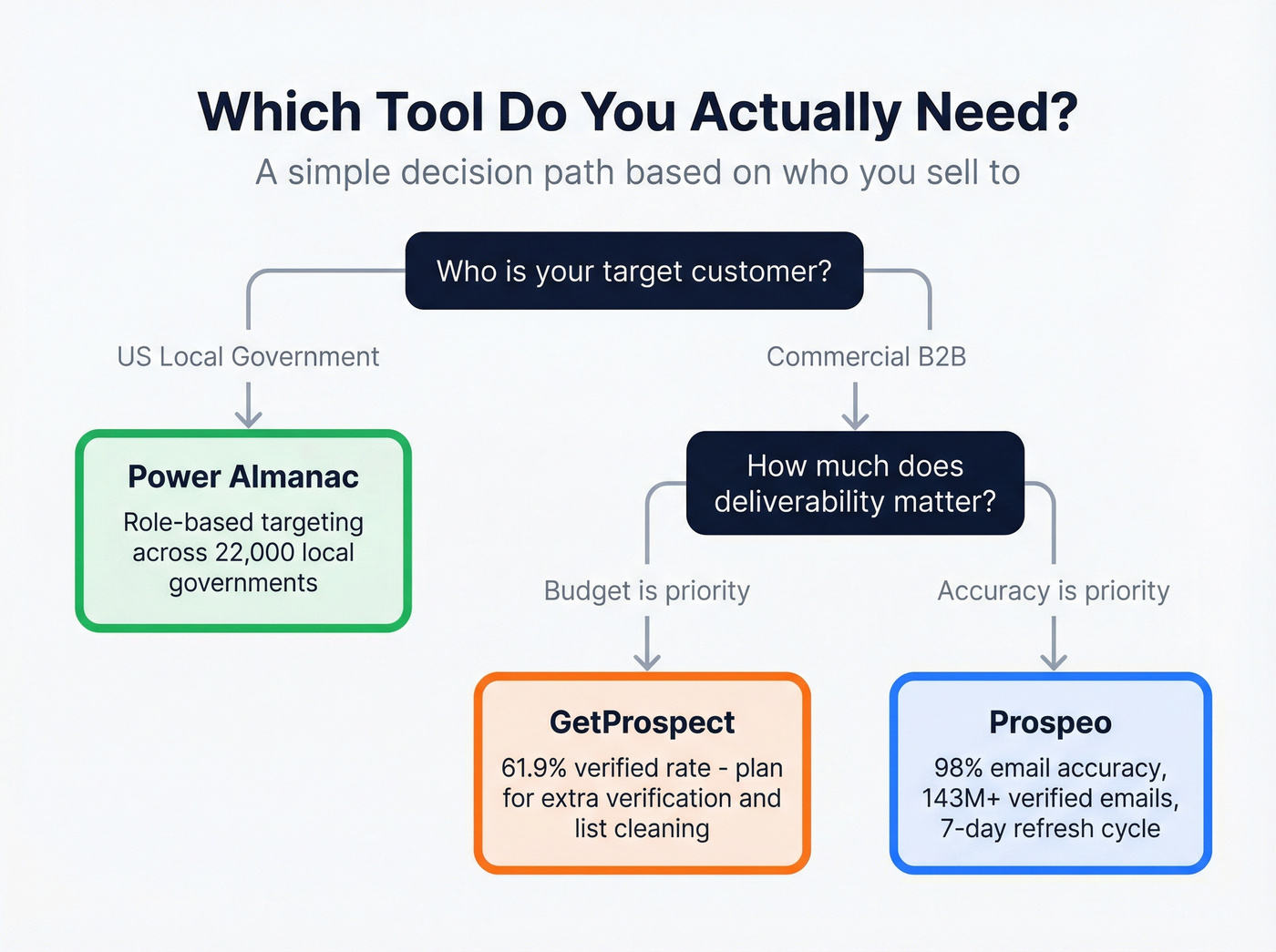
Here's a simple decision path:
- Selling to cities, counties, townships, or special districts? Go with Power Almanac. The role mapping is the whole product.
- Selling to commercial B2B accounts and budget is tight? GetProspect can work, but plan for verification and list cleaning as part of the workflow, not an optional extra.
- Selling to commercial B2B accounts and you care about deliverability? Don't gamble on 60-ish percent verification. Use a platform built around verified data.
Look, this is where teams get annoyed: they buy a "good enough" email finder, then wonder why reply rates fall off a cliff after two weeks. It's not the copy. It's not the offer. It's the bounce rate and the quiet deliverability damage that follows.
A better option for general B2B (where Prospeo fits)
If your goal is accurate commercial B2B data, Prospeo is the cleaner answer. We use it when we need to pull lists that are actually safe to send, not just "big."
If you're comparing options in this category, start with a shortlist of sales prospecting databases and then validate the workflow end-to-end.
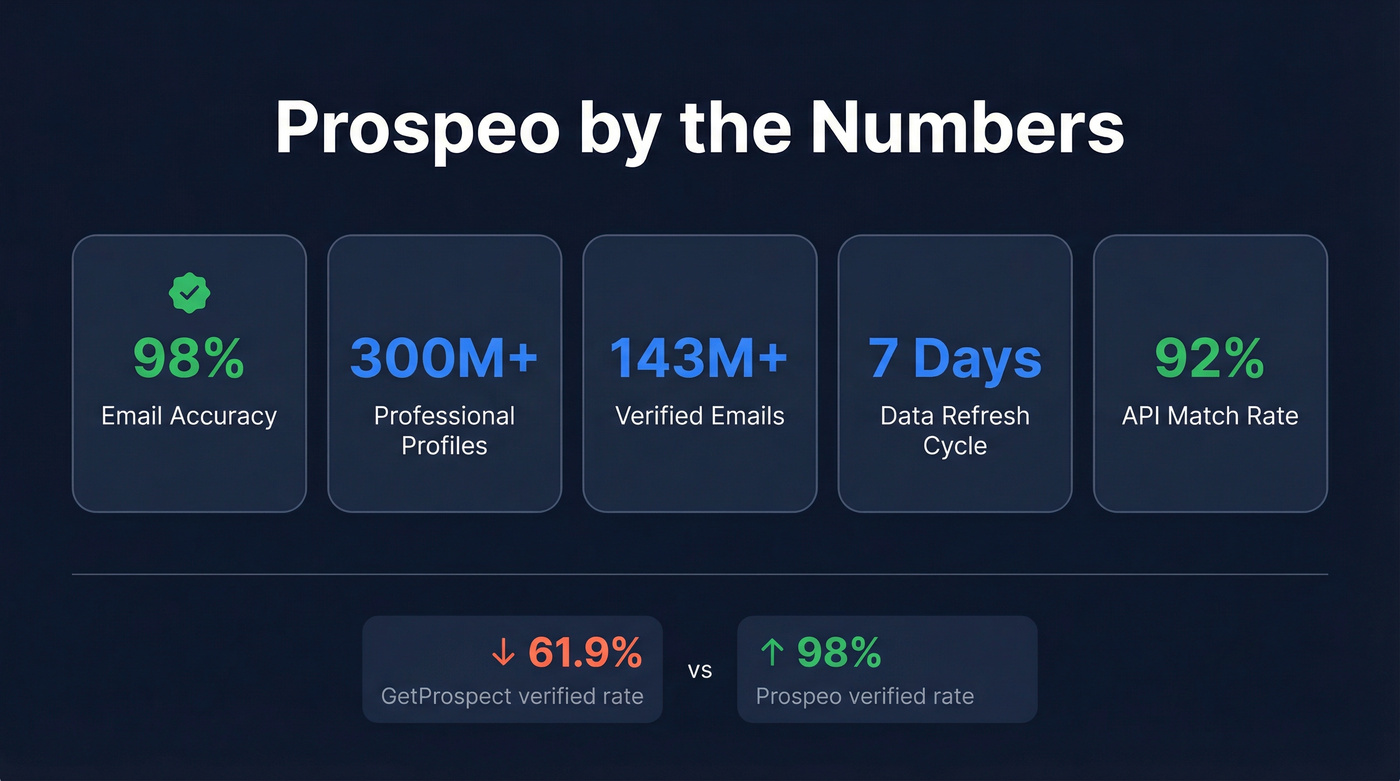
Prospeo has 300M+ professional profiles, 143M+ verified emails, and 125M+ verified mobile numbers, with 98% email accuracy. Records refresh on a 7-day cycle, which matters more than most teams admit: stale data is why your "perfect list" turns into a bounce-fest by the time it hits the sequencer.
Prospeo's email verification is built into the workflow (including catch-all handling, spam-trap removal, and honeypot filtering), so you're not duct-taping three tools together just to avoid burning a domain. And if you run enrichment, the numbers are strong: 83% of leads come back with contact data, and the API match rate is 92%, returning 50+ data points per enrichment.
A quick real-world scenario we see a lot: an agency pulls 5,000 contacts for a client campaign, sends in batches, and suddenly bounces spike. With higher-accuracy data and weekly refresh, that same workflow stays stable long enough to iterate on messaging instead of firefighting deliverability.
If you're doing public sector, keep Power Almanac in the stack. If you're doing commercial B2B, run Prospeo for the data layer and stop treating verification like an afterthought. If you want a deeper playbook on keeping inbox placement stable, use an email deliverability guide alongside your data provider.

Selling to commercial B2B accounts? You need more than a budget email finder. Prospeo gives you 300M+ profiles, 30+ search filters including buyer intent and technographics, and 83% enrichment match rates - at roughly $0.01 per email.
Enterprise-grade B2B data without the enterprise contract or the bounced emails.
FAQ
Is GetProspect or Power Almanac better for B2B prospecting?
Neither is universally better because they're built for different markets. Power Almanac is for US local government contacts and role-based targeting. GetProspect is for broad B2B list building, but its verified email rate is much lower than what most outbound teams can safely run at scale.
How accurate is GetProspect for cold outreach?
A third-party benchmark measured GetProspect at 61.9% verified emails across 5,000 contacts. That's risky for deliverability if you're sending volume. If you still use it, pair it with strict verification and bounce monitoring.
For background on why bounces and complaints matter so much, Google's sender guidelines are worth reading: https://support.google.com/a/answer/81126 and https://support.google.com/mail/answer/81126.
Do I need both tools?
Only if you sell to both local government and commercial B2B accounts. In that case, use Power Almanac for government contacts and a high-accuracy B2B data platform for commercial outreach. Most teams are better off picking one lane and doing it well.