

The Best Gmail Validators That Actually Work
Most Gmail validators are lying to you about what they can verify. You upload 500 Gmail addresses, hit send, and watch 40% bounce because Gmail's servers told your verification tool every address was valid - even the fake ones. Your sender reputation tanks overnight. The problem wasn't your list. It was a tool that couldn't handle Gmail.
We've run lists through all the tools below, and the catch-all resolution gap is even wider than the numbers suggest. Here's what actually works for validating @gmail.com and Google Workspace addresses in 2026.
Our Picks (TL;DR)
| Pick | Tool | Why | Price |
|---|---|---|---|
| Best overall | Prospeo | 98% accuracy, 5-step verification with catch-all resolution | ~$0.01/email |
| Most established | ZeroBounce | 45+ integrations, reliable for high-volume lists | ~$65/10k |
| Best database-assisted catch-all handling | Hunter | Cross-references B2B database for accept-all domains | ~$149/10k |
| Budget pick | MillionVerifier | Cheapest by 7x+ | ~$6/10k |
Why Gmail Validation Is Harder Than Standard Verification
Most email verification works by performing an SMTP handshake - your tool connects to the recipient's mail server, asks "does this mailbox exist?", and reads the response code. A 250 means "yes." A 550 means "no." Simple enough.
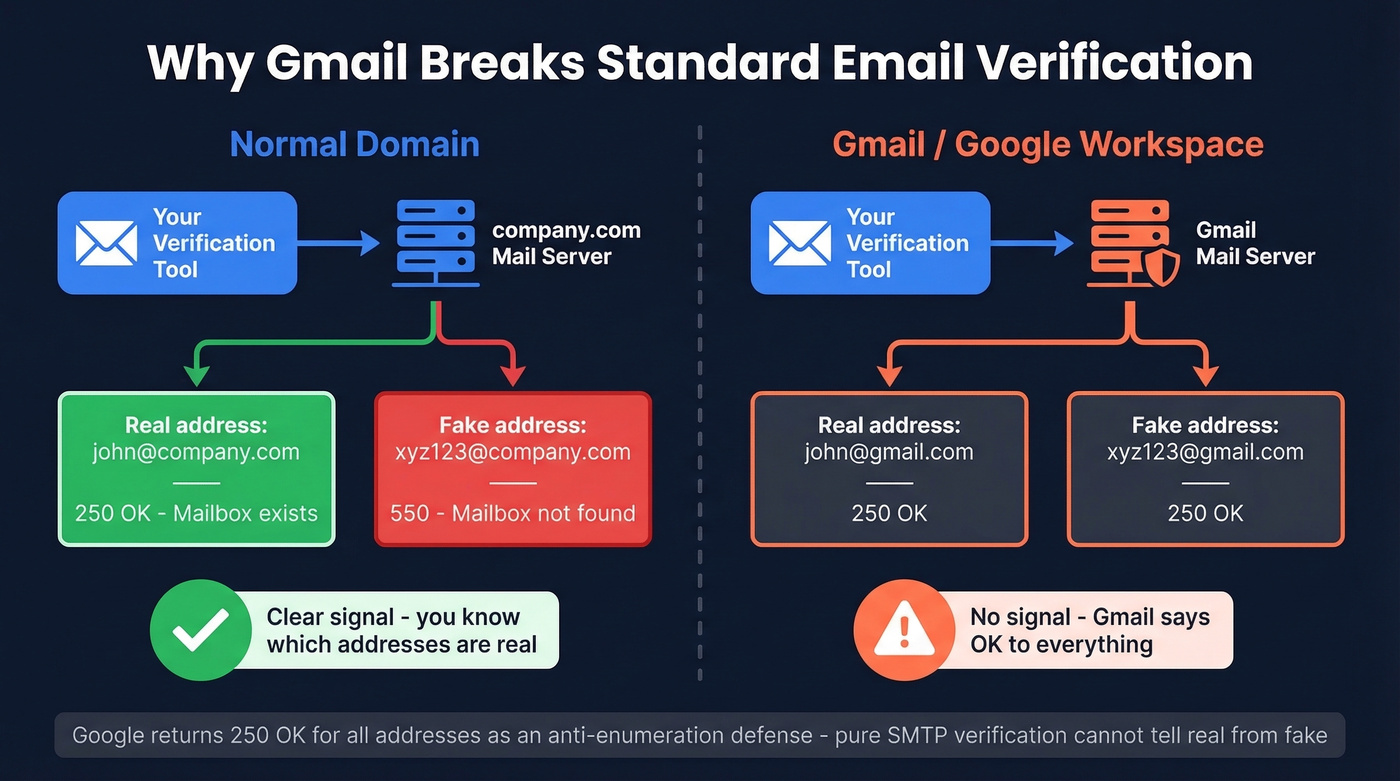
Gmail breaks this model. Its servers return 250 OK for non-existent mailboxes, effectively acting like a catch-all domain at the protocol level. A developer on r/AskProgramming put it bluntly: "Gmail always returns OK 250 no matter what." That's Google's anti-enumeration defense - they don't want anyone scraping which addresses exist.
Google also rate-limits alternative verification methods like account recovery page checks and signup username lookups, triggering CAPTCHAs from datacenter IPs almost immediately. Manual workarounds don't scale.
This matters more than you'd think. Catch-all domains represent 8.6%-30% of typical B2B email lists, and that number climbs when you factor in Google Workspace domains, which behave the same way. Any verification tool that relies purely on SMTP is guessing on a significant chunk of your list.
How Email Verification Works
Good validators don't stop at SMTP. They layer multiple checks, and the quality of those layers is what separates a $6/10k tool from a $100/10k one.
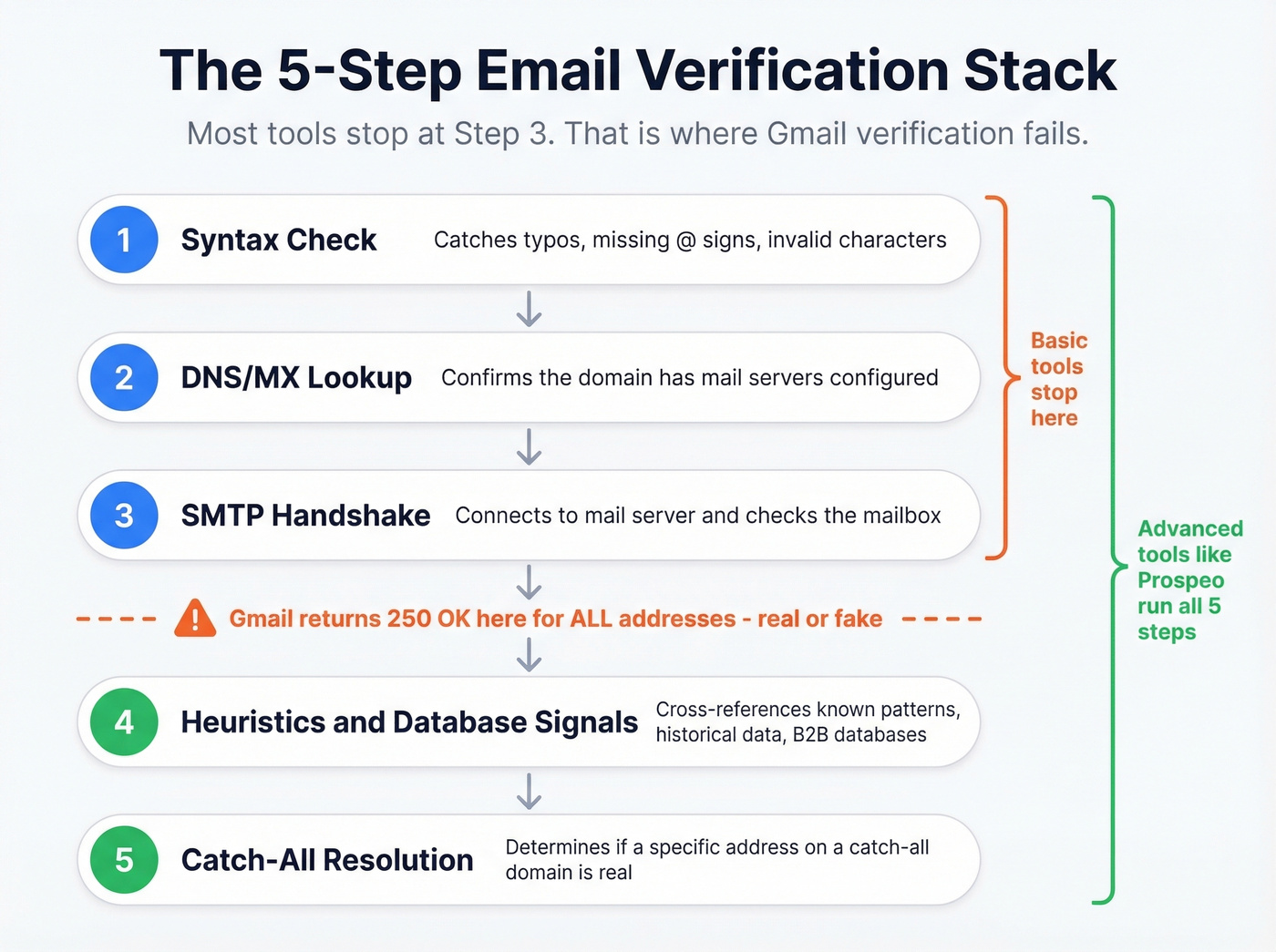
The standard verification stack:
- Syntax check - catches typos, missing @ signs, invalid characters
- DNS/MX lookup - confirms the domain has mail servers configured
- SMTP handshake - connects to the mail server and checks the mailbox (this is where Gmail lies)
- Heuristics and database signals - cross-references known patterns, historical data, and data enrichment databases to validate beyond SMTP
- Catch-all resolution - attempts to determine whether a specific address on a catch-all domain is real or fabricated
People use verification, validation, and hygiene interchangeably, but they're different things. Verification is a one-time screen before sending. Validation is real-time checking at signup. Hygiene covers broader cleanup like deduplication and suppression syncing. The distinction matters when you're evaluating tools because some are built for one use case and shoehorned into the others.
SMTP response codes you'll see in results: 250 means accepted, but on catch-all domains this tells you nothing. 550 is a hard reject - the mailbox doesn't exist. 450 is a temporary failure from greylisting, and good tools retry automatically.

Most validators guess on Gmail addresses because SMTP returns 250 OK for every mailbox. Prospeo's 5-step verification cross-references 143M+ verified emails to resolve catch-all domains - including Gmail and Google Workspace - at 98% accuracy.
Stop marking Gmail addresses as "unknown" and start sending with confidence.
Gmail Validator Comparison
These numbers draw from a 10,000-email benchmark test run across real outbound B2B lists with 28% catch-all addresses, plus vendor-reported specs and third-party pricing data. We've bolded the winner in each column.
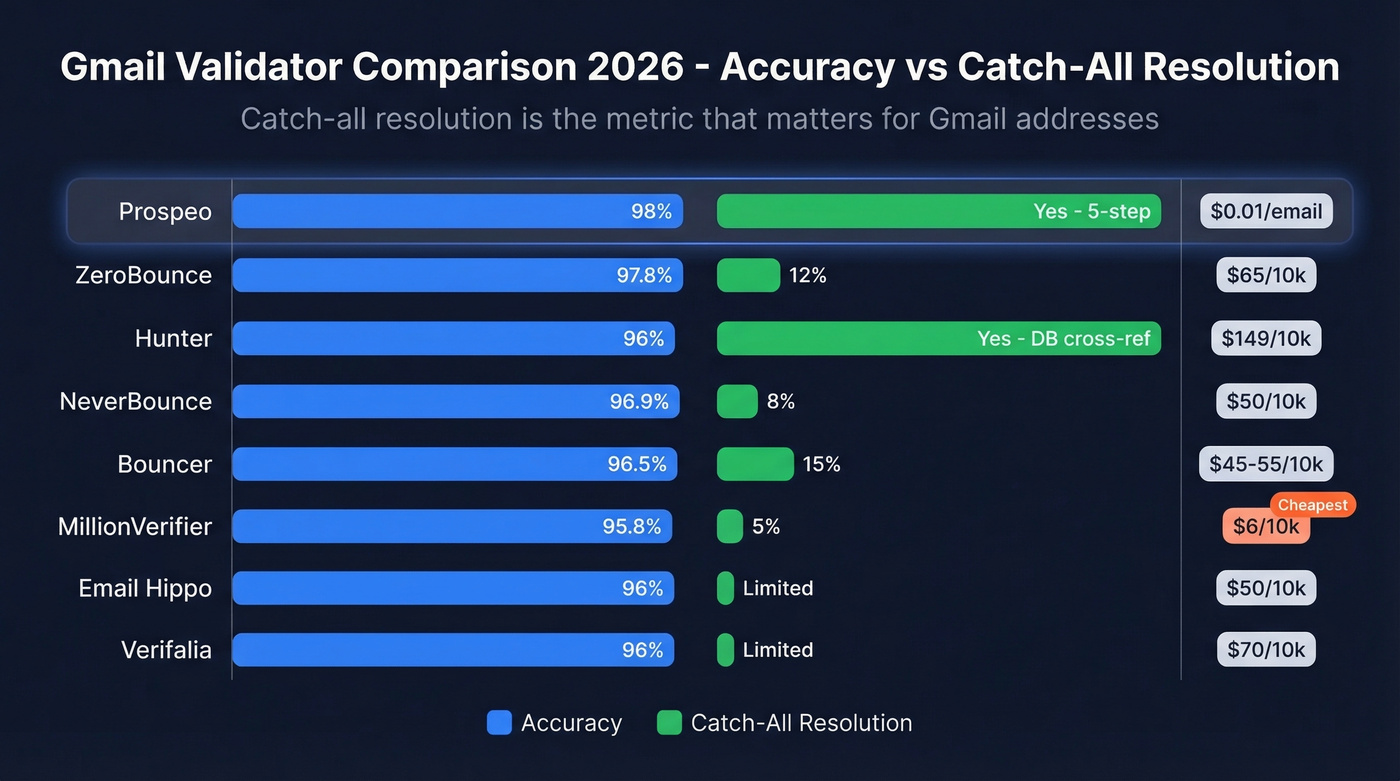
| Tool | Accuracy | Catch-All Resolution | Free Tier | Cost/10k | Integrations |
|---|---|---|---|---|---|
| Prospeo | 98% | Yes (5-step) | 75/mo | ~$100 | Salesforce, HubSpot, Instantly, Lemlist, Clay, Zapier |
| ZeroBounce | 97.8% | 12% | 100/mo | ~$65 | 45+ |
| Hunter | ~96% | Yes (DB cross-ref) | 50 credits/mo | ~$149 | HubSpot, Salesforce, Zapier |
| NeverBounce | 96.9% | 8% | ~1,000 | ~$50 | Salesforce, HubSpot, Zapier |
| Bouncer | 96.5% | 15% | 100 | ~$45-55 | 16 |
| MillionVerifier | 95.8% | 5% | - | ~$6 | API, CSV only |
| Email Hippo | ~96% | Limited | 100/day | ~$50 est. | API, CSV bulk |
| Verifalia | ~96% | Limited | Free singles | ~$70 est. | API, SDKs |
The catch-all resolution column is the one to watch. That's where Gmail address validation lives or dies.
The Best Gmail Validators Reviewed
Prospeo
Prospeo's 5-step verification doesn't just check SMTP - it cross-references results against 300M+ professional profiles and 143M+ verified emails, which is how it resolves catch-all domains that pure SMTP tools mark as "unknown." The system runs on proprietary email-finding infrastructure rather than relying on third-party providers, and includes spam-trap removal and honeypot filtering. All data refreshes on a 7-day cycle, which is roughly six times faster than the industry average.
In our testing, Prospeo consistently resolved catch-all addresses that other tools returned as unknown. The real-world results back this up: Meritt switched to Prospeo and saw their bounce rate drop from 35% to under 4%. That's not a marginal improvement - that's the difference between a healthy sending domain and a blacklisted one.
Skip this if you only need syntax-level validation for a marketing signup form. Prospeo's strength is B2B verification depth, and simpler tools handle basic form validation fine.
Pricing starts free at 75 emails/month plus 100 Chrome extension credits, with paid plans running about $0.01 per email. No contracts, self-serve signup.
ZeroBounce
ZeroBounce is the safe, boring pick - and I mean that as a compliment. With 45+ integrations, it's the path of least resistance for marketing ops teams that need to plug verification into existing workflows. Their 97.8% accuracy on standard domains is solid, and 100 free monthly verifications let you test before committing.
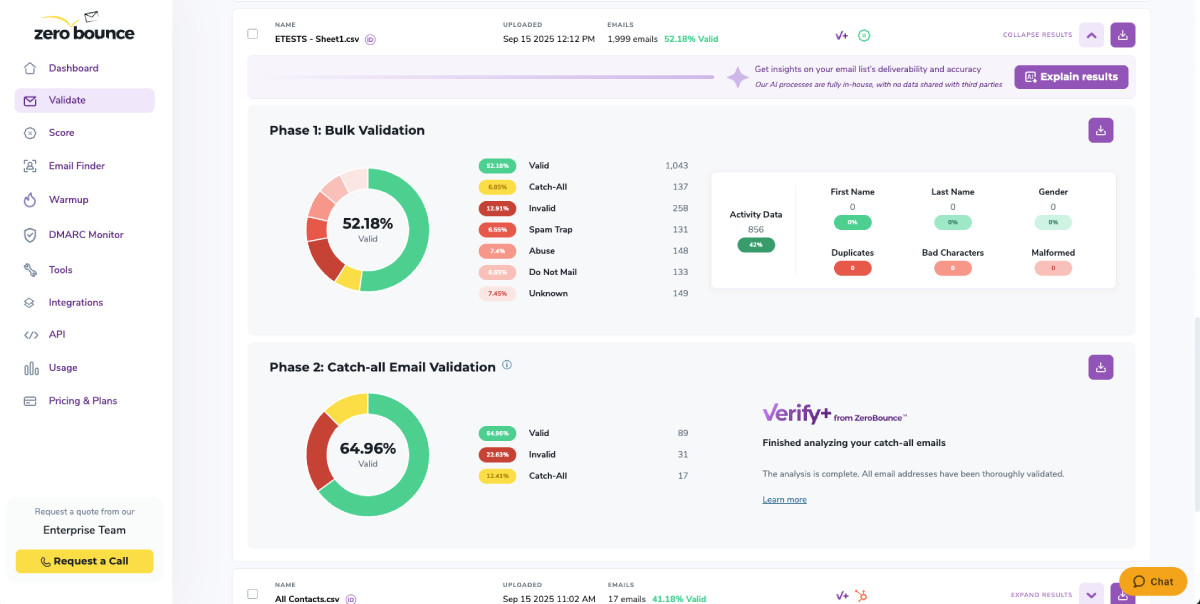
Here's the thing: ZeroBounce only resolves about 12% of catch-all addresses. For a tool this established, that's surprisingly weak. If your list is heavy on Gmail and Google Workspace addresses, you'll get a lot of "unknown" results back. Pricing runs ~$65 per 10k on pay-as-you-go, or $39-49/month on a Starter subscription.
Hunter
Hunter's verifier takes a smart approach to catch-all domains. Instead of just running SMTP checks, it cross-references results against its own B2B database to determine whether an accept-all address is likely real. One customer reported a 15-20% improvement in valid/invalid determination after switching - a genuinely clever approach and one of the few that adds signal beyond the SMTP layer.

The tradeoff is price. Hunter's Growth plan runs $104-149/month, and their 10k verification cost of ~$149 is one of the highest on this list. You're paying for database intelligence, not just the SMTP check. The free tier gives you 50 credits per month, which translates to about 100 verifications at 0.5 credits each. Ratings sit at 4.6 on Capterra and 4.4 on G2.
NeverBounce
NeverBounce is the reliable mid-tier option: 96.9% accuracy, fast list processing, and a clean ~$50 per 10k price point. If your lists are mostly standard corporate domains with proper SMTP responses, it handles the job without drama.
At 8% catch-all resolution, though, NeverBounce is essentially punting on the hardest part of Gmail verification. For Gmail-heavy lists, you'll get too many unknowns to make confident sending decisions. Solid tool, easier problem.
Bouncer
Bouncer's real differentiator isn't accuracy - it's compliance. SOC2 and GDPR certifications make it a strong choice for environments with strict data handling requirements.
What surprised us: at 15% catch-all resolution, Bouncer actually beats ZeroBounce on the metric that matters most for verifying Gmail addresses. Capterra reviewers clearly agree - it holds a 4.9 rating across 233 reviews, the highest of any tool on this list. The integration ecosystem is smaller at 16 connections, and pricing runs ~$45-55 per 10k with 100 free verifications to start.
MillionVerifier
Hot take: if your average deal size is under five figures and your list is mostly corporate domains, MillionVerifier is all you need. At ~$6 per 10k verifications, it's 7x cheaper than the next option. The 95.8% accuracy is acceptable for clean lists where catch-all isn't a major factor.
Don't use it for Gmail or Google Workspace addresses at scale. With only 5% catch-all resolution, you're getting essentially no useful signal on the addresses that are hardest to verify.
Email Hippo & Verifalia
Email Hippo has been around since 2009 and offers 100 free daily verifications - one of the most generous free tiers on this list. Their product line spans CORE for bulk CSV, MORE for API, and ASSESS for fraud and risk scoring. Solid for one-off checks and small-volume validation at ~$50 per 10k.
Verifalia takes a different approach: free single-email checks, making it a fast way to spot-check an address before you fire off an important cold email. Their focus is enterprise and API-first, with SDKs for multiple languages. Expect ~$70 per 10k for bulk work. Neither tool offers meaningful catch-all resolution, so treat them as utility players rather than your primary tool for validating Gmail addresses.
Meritt cut their bounce rate from 35% to under 4% after switching to Prospeo. That's what happens when your validator doesn't rely on SMTP alone - it checks against 300M+ profiles refreshed every 7 days, with spam-trap and honeypot filtering built in.
Validate your Gmail-heavy list at $0.01 per email with no contracts.
How to Choose the Right Tool
B2B outbound with Gmail or Google Workspace addresses: Prospeo. The combination of SMTP verification and database cross-referencing is purpose-built for this problem, and catch-all resolution is the whole ballgame for Gmail.
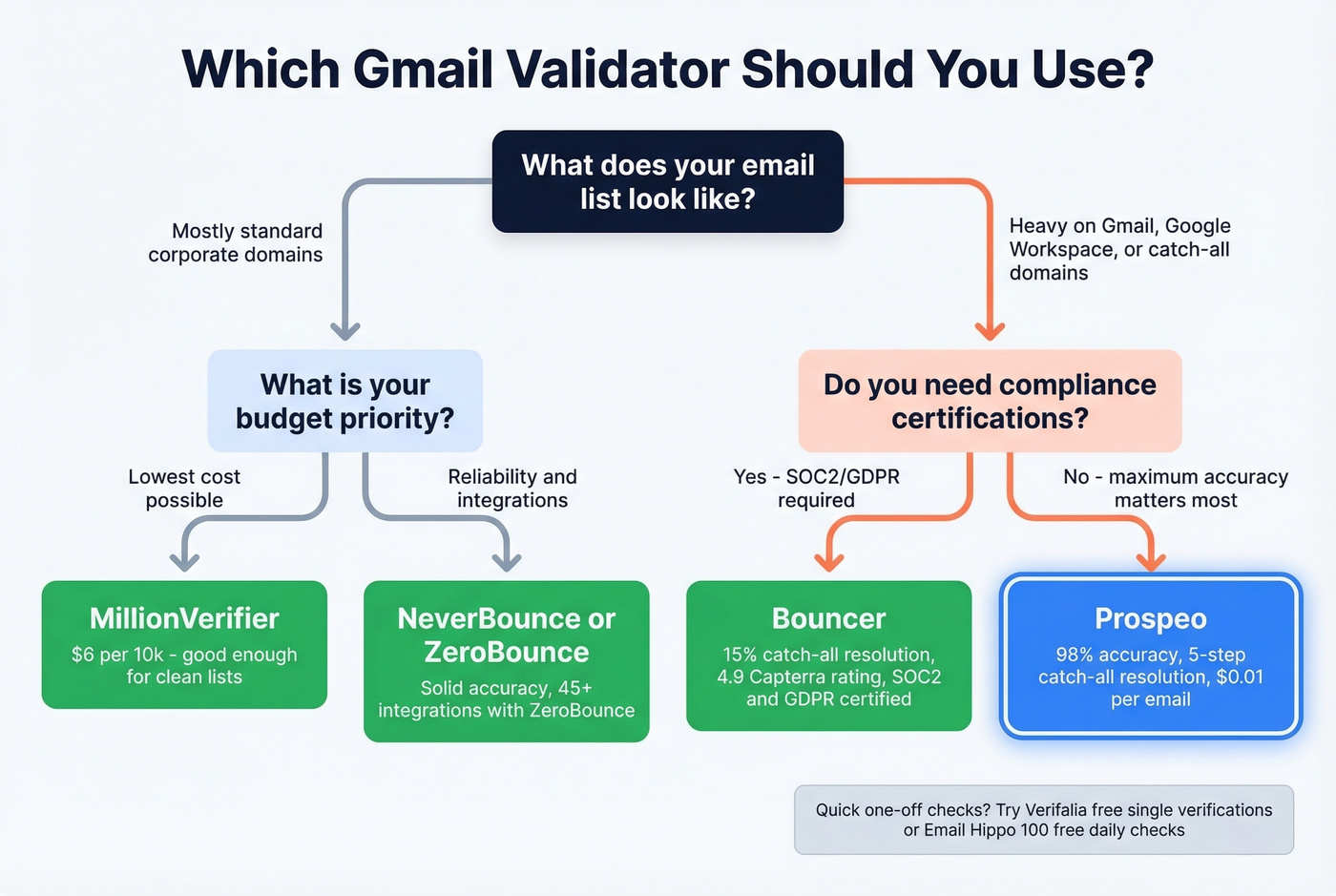
High-volume marketing campaigns: ZeroBounce territory. The integration depth and processing speed make it an easy choice for marketing ops teams that need verification inside existing workflows.
Budget-constrained, mostly corporate domains: MillionVerifier at $6 per 10k lets you verify massive lists without thinking about cost. Just don't expect catch-all magic.
Compliance-first environments: Default to Bouncer. SOC2 plus GDPR certification with solid accuracy justifies the price for regulated industries.
Developer and API-first workflows: Hunter if you need database intelligence layered on top, or Verifalia if you just need clean API endpoints and SDK support.
Let's be honest about the stakes here. If your bounce rate is above 5%, you're already damaging your sender reputation. Industry benchmarks range from 0.29% in e-commerce to 0.93% in software. Any of these tools can get you under 2% when implemented correctly. The question is whether you need catch-all resolution - and if your list has significant Gmail or Google Workspace addresses, you do.
If you're trying to protect deliverability long-term, pair verification with a plan to improve sender reputation and monitor your email bounce rate trends over time.
FAQ
Can you actually verify if a Gmail address exists?
Not through SMTP alone - Gmail returns 250 OK for non-existent mailboxes as an anti-enumeration measure. Tools that layer SMTP with database cross-referencing and catch-all resolution get closest to a definitive answer by validating against known professional profiles. Basic SMTP-only tools return "unknown" for most Gmail addresses.
What does "catch-all" mean in email verification?
A catch-all server accepts all incoming mail regardless of whether the specific mailbox exists, returning SMTP 250 for every address. This makes standard SMTP verification useless for distinguishing valid from invalid emails on that domain. Gmail and many Google Workspace domains behave this way.
How often should I re-verify my email list?
Every 30-90 days for active outbound lists. Email addresses decay at roughly 2-3% per month due to job changes, deactivations, and domain switches. Tools with automatic refresh cycles reduce this maintenance burden significantly.
What bounce rate is too high?
Under 2% is safe for sender reputation. Above 5% risks deliverability damage and potential blacklisting. Industry averages range from 0.29% in e-commerce to 0.93% in software - most well-maintained lists stay well under the danger zone.
Are free Gmail validators accurate enough?
For one-off checks, free tiers from Email Hippo (100/day) or ZeroBounce (100/month) work fine. For bulk validation, free tools lack catch-all resolution and advanced heuristics - expect significantly more "unknown" results. Prospeo's free tier (75 emails/month) includes full 5-step verification with catch-all handling, making it the strongest free option for Gmail addresses specifically.