

Go to Market Example: The Filled-In Plan Nobody Else Shows You
Every GTM template you've downloaded has the same problem: it's a skeleton. Boxes that say "insert ICP here" and "define channels" without showing you what a filled-in version actually looks like.
If you've ever searched for a go to market example and landed on another 40-slide deck full of empty frameworks, you're not alone - PMM candidates on Reddit regularly complain that most templates are "very high-level" and beg for rough plans from real companies with real context. Bain has run 4,500+ GTM engagements over the past decade, and the companies that get it right see 10-20% topline improvement. The ones that don't burn a quarter arguing about personas.
Below you'll find a fully worked enterprise SaaS GTM plan with real metrics, followed by five brand examples across PLG, inbound, and channel-led motions - each one a reference you can adapt to your own launch.
A Fully Worked GTM Plan
Let's build a real plan. Meet "Anakin" - an India-based enterprise SaaS company selling workflow automation to large e-commerce players. Starting position: $3M ARR, roughly 70 employees, one enterprise sales manager who grew revenue from $1M to $3M over 24 months. The goal is $12M ARR within 12 months.
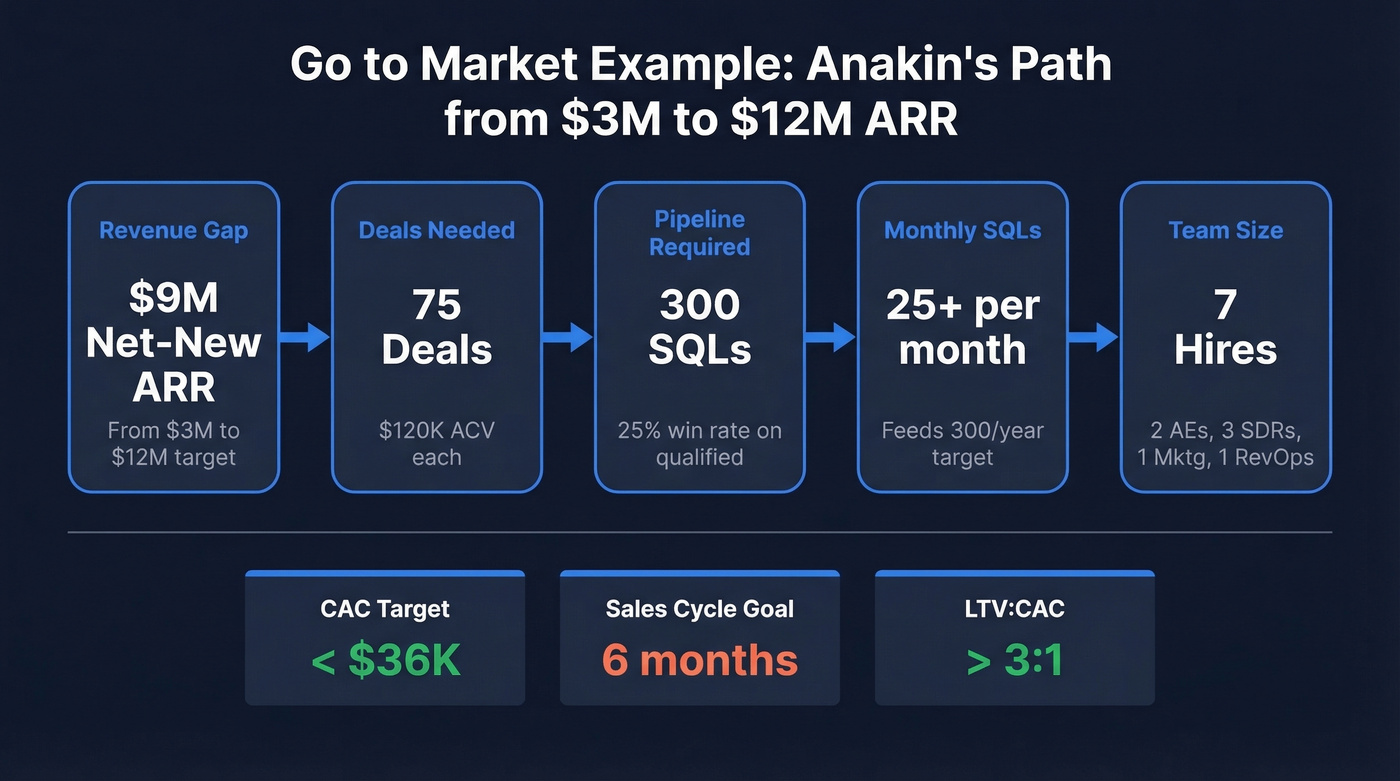
That's a 4x jump. Aggressive, but not impossible if the GTM plan is tight.
ICP definition. Anakin sells $120K+ annual contracts with 6-9 month sales cycles. The ideal customer is a well-funded e-commerce company doing ~$100M+ in revenue - think VP of Operations or CTO at a company that's outgrown its internal tooling. Geographic focus is global, but the beachhead is North America and Western Europe where enterprise e-commerce infrastructure spend is concentrated.
Channel strategy. With zero marketing spend historically, Anakin needs to pick two channels and own them. For a $120K ACV with a 6-9 month cycle, the play is outbound + ABM. Content marketing and SEO won't generate pipeline fast enough for a 12-month sprint. Outbound gets meetings on the calendar now. ABM concentrates spend on the 200-300 accounts that actually match the ICP.
Here's the thing about outbound: it lives or dies on data quality. If your contact data is stale, your SDRs waste cycles, bounce rates climb, and deliverability tanks. We've seen teams using Prospeo's 7-day data refresh cycle (vs. a 6-week industry average) cut bounce rates from 35-40% to under 5% - Snyk's team saw AE-sourced pipeline jump 180% with 200+ new opportunities per month after making that switch.

Headcount plan. To get from $3M ARR to $12M ARR, Anakin needs $9M in net-new ARR. At $120K ACV, that's roughly 75 new deals.
With a 25% win rate on qualified pipeline, that means 300 qualified opportunities (75 / 0.25). Working backward: 2 enterprise AEs each managing 12-15 active deals, 3 SDRs feeding the top of funnel, 1 marketing hire to run ABM campaigns, and 1 RevOps person to instrument the whole thing. That's seven hires, not twenty - and every one of them has a number attached to their name from day one.
KPI dashboard. Every metric below gets reviewed weekly, not monthly.
| Metric | Target | Why It Matters |
|---|---|---|
| Pipeline velocity | 6 months avg | Compress from 9 to 6 |
| CAC | < $36K | 30% of first-year ACV |
| Win rate | 25%+ on qualified | Below 20% = ICP problem |
| Payback period | < 12 months | Cash flow constraint |
| SQLs per month | 25+ | Feeds 300/year target |
| LTV:CAC | > 3:1 | Sustainability threshold |
Swap in your ACV, your cycle length, your headcount budget - and the math either works or it doesn't. That's the best go to market example we can offer: one that shows the math, not just the narrative.
5 Real-World GTM Examples by Motion
Slack - Product-Led Growth
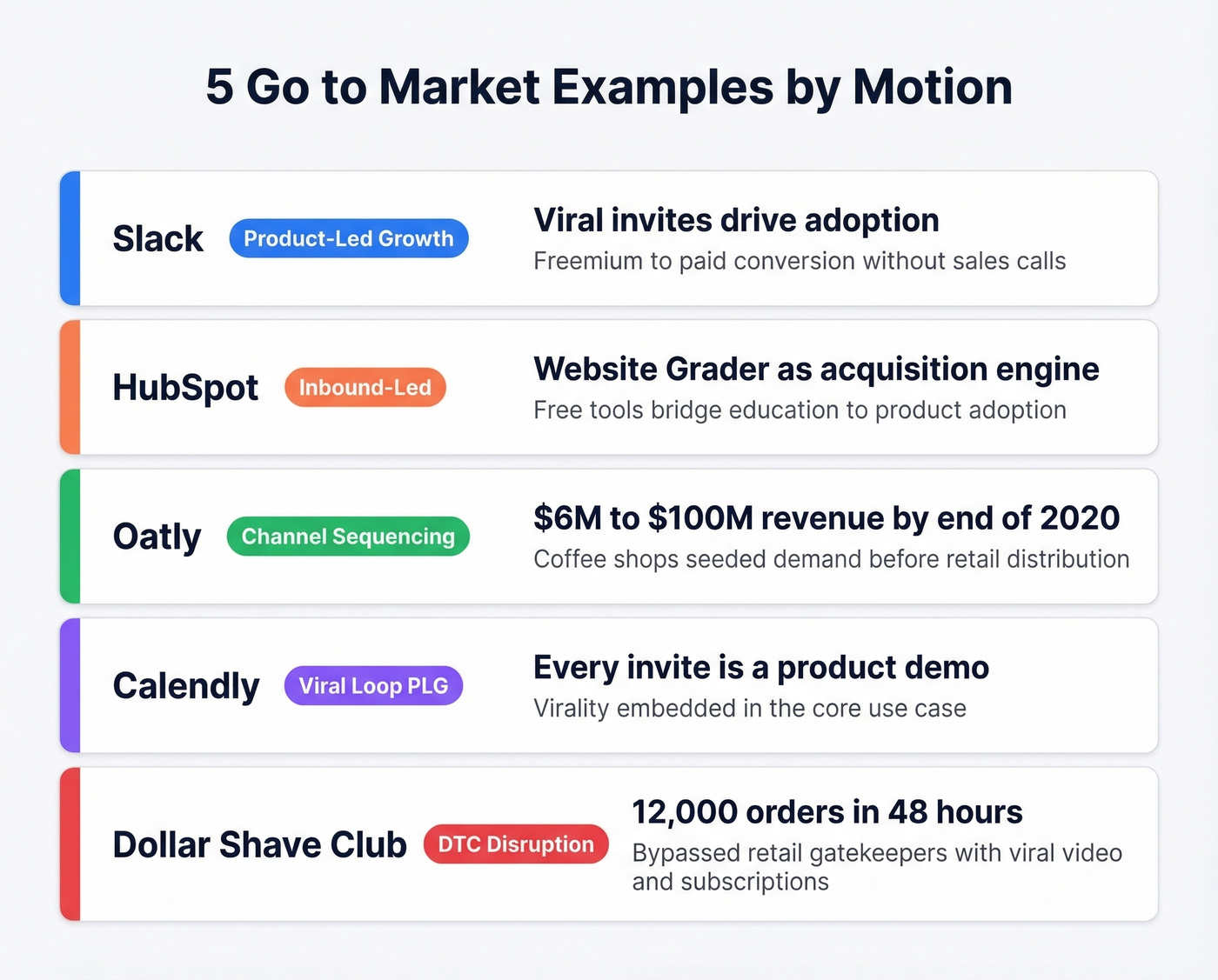
Slack's GTM edge wasn't just the product - it was activation. When you opened a new workspace, in-app prompts guided you to invite teammates, set up channels, and send your first message. Every invitation was a viral loop. The freemium model meant teams could adopt without procurement approval, and conversion from free to paid happened naturally as teams hit limits and needed admin controls. No sales call required.
HubSpot - Inbound-Led Growth
HubSpot didn't just write about inbound marketing - they built free tools that demonstrated it. Website Grader was an early acquisition engine: enter your URL, get a score, realize you need help. The content flywheel - blog to ebook to webinar to free CRM - created a loop where every piece of content pushed users closer to the product. The key tactic was bridging from education to product adoption without a hard sell, and it worked because the free tools delivered genuine value before asking for a dollar.
Oatly - Channel Sequencing
Oatly's North American launch is a masterclass in channel sequencing. They didn't go straight to grocery shelves. Instead, they partnered with specialty coffee shops - Blue Bottle, La Colombe - where baristas became product evangelists. The Barista Edition, formulated specifically for espresso foaming, reportedly drove nearly 40% of cafe sales. By the time Oatly hit Whole Foods in 2018, demand was so high that shelves emptied for weeks and cartons resold online for $15 each. US revenue grew from about $6M to $100M by the end of 2020 - a jump that shows what happens when you seed demand before you scale distribution.
Calendly - Viral Loop PLG
Every Calendly meeting invite is a product demo. You receive a scheduling link, pick a time, and think "I need this too." Simple as that. The viral coefficient is baked into the core use case - you can't use the product without exposing it to non-users. Calendly scaled early growth through product-driven distribution instead of a heavy sales motion.
Dollar Shave Club - DTC Disruption
A viral video, a subscription model, and a willingness to bypass retail gatekeepers entirely. Dollar Shave Club bet that men hated buying razors at drugstores and would happily subscribe if someone made it easy and funny. The video generated 12,000 orders in the first 48 hours. The lesson: if your distribution channel has a gatekeeper - retailers, procurement, app stores - sometimes the GTM play is to route around them completely.
| Company | Motion | Key Metric | Core Lesson |
|---|---|---|---|
| Slack | Product-led growth | Viral invites drive adoption | Make adoption frictionless |
| HubSpot | Inbound-led | Website Grader as acquisition engine | Build tools, not just content |
| Oatly | Channel sequencing | $6M to $100M by end of 2020 | Seed demand before scaling distribution |
| Calendly | Viral loop PLG | Every invite = product demo | Embed virality in the use case |
| Dollar Shave Club | DTC disruption | 12K orders in 48 hours | Route around gatekeepers |
B2B vs. B2C: Different Buyers, Different Plans
Getting a product to market looks completely different depending on who's buying. A B2B sale to a 6-10 person buying committee over 6-12 months looks nothing like a consumer impulse purchase.
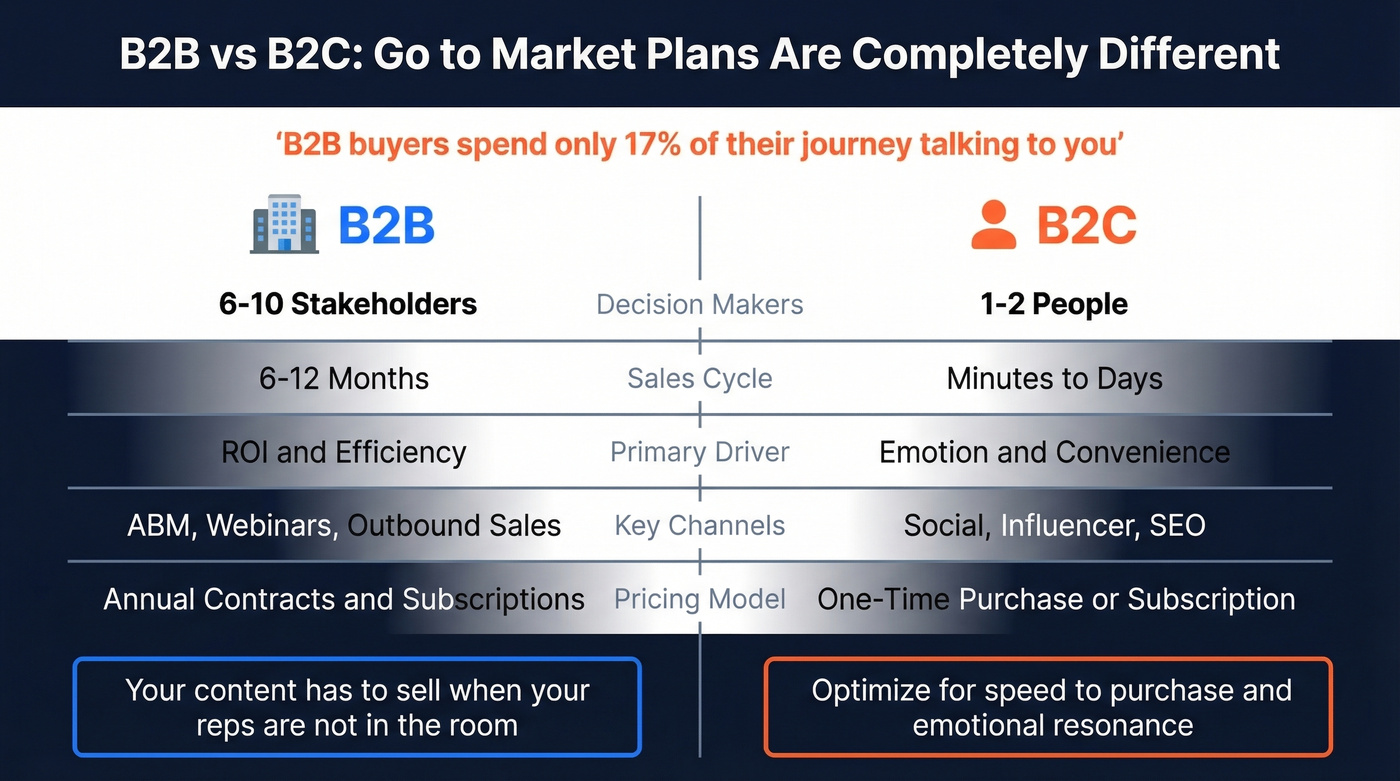
And here's a stat that should change how you think about B2B GTM: buyers spend only 17% of their purchase journey interacting with suppliers. The other 83% happens without you in the room - which means your positioning, content, and data have to do the selling when your reps can't.
| Dimension | B2B | B2C |
|---|---|---|
| Decision makers | 6-10 stakeholders | 1-2 people |
| Sales cycle | 6-12 months | Minutes to days |
| Primary driver | ROI / efficiency | Emotion / convenience |
| Key channels | ABM, webinars, sales | Social, influencer, SEO |
| Pricing model | Contract / subscription | One-time / subscription |
B2B GTM plans need to account for procurement, legal review, and multi-stakeholder alignment. Your messaging has to work for the end user who wants the product AND the CFO who's signing the check. B2C plans optimize for speed-to-purchase and emotional resonance - the buyer and the user are usually the same person.

Anakin's plan needs 300 qualified opportunities to hit $12M ARR. That math breaks instantly if your outbound data bounces. Prospeo's 7-day refresh cycle and 98% email accuracy keep SDRs booking meetings instead of cleaning lists - Snyk's 50 AEs saw pipeline jump 180% after switching.
Stop feeding your GTM plan with stale data that kills pipeline velocity.
7 Mistakes That Kill Launches
We've watched teams make every one of these. Most are avoidable if you know what to look for.
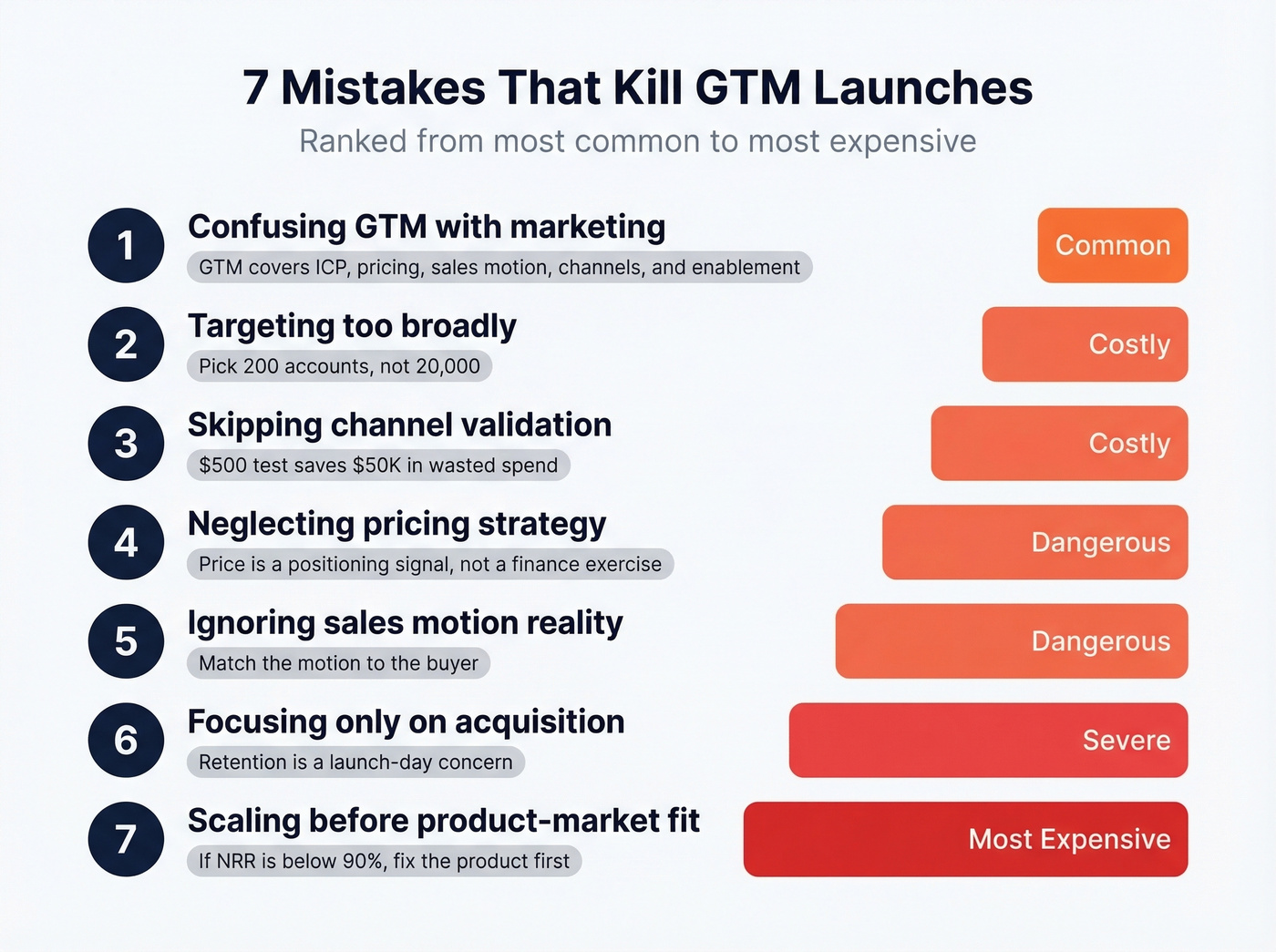
Confusing GTM with marketing. GTM covers ICP, pricing, sales motion, channels, and enablement. Marketing is one piece.
Targeting too broadly. No beachhead market means no concentrated wins. Pick the 200 accounts that look like your best customers and ignore the rest until you've won 20 of them.
Skipping channel validation. Run small tests before committing budget. A channel that costs $500 to validate saves you $50K in wasted spend.
Neglecting pricing strategy. Pricing isn't a finance exercise - it's a positioning signal. Your price needs to match your sales motion and your buyer's expectations.
Ignoring sales motion reality. If your buyer has procurement and legal review, self-serve checkout won't work. Match the motion to the buyer.
Focusing only on acquisition. The leaky bucket problem. Retention isn't a post-launch concern - it's a launch-day concern. (If you're seeing churn early, start with a proper churn analysis.)
Scaling before product-market fit. If your NRR is below 90%, fix the product before you fix the funnel. This is the most expensive mistake on the list.
Let's be honest: you don't need a 50-slide deck. You need five things - a clear ICP, a one-sentence positioning statement, two channels you'll own in 90 days, a pricing model that matches your sales motion, and a weekly KPI dashboard. If your average deal size is under $10K, you probably don't need a complex multi-channel plan at all. Pick one channel, nail it, expand from there. Skip the 40-slide presentation decks that circulate on SlideShare - a focused 5-7 page working document beats a deck that gets forgotten after the all-hands.
Building Your GTM Presentation
If you do need to present your GTM plan to leadership or investors, keep the structure tight. The best presentations follow a simple arc: problem, ICP, positioning, channels, unit economics, and a 90-day timeline. Six slides, not sixty.
Lead with the market problem and the revenue math, not the product features. Show the ICP with real firmographic criteria, not vague descriptions like "mid-market companies." Include one slide on competitive positioning - where you win and where you don't. End with the KPI dashboard and the first 90-day milestones so stakeholders know exactly how you'll measure success.
The goal isn't to impress with volume. It's to prove you've done the thinking.
Your 90-Day GTM Launch Plan
Based on the framework from Uplift GTM and patterns we've seen work across dozens of launches, here's what the first 90 days should look like.
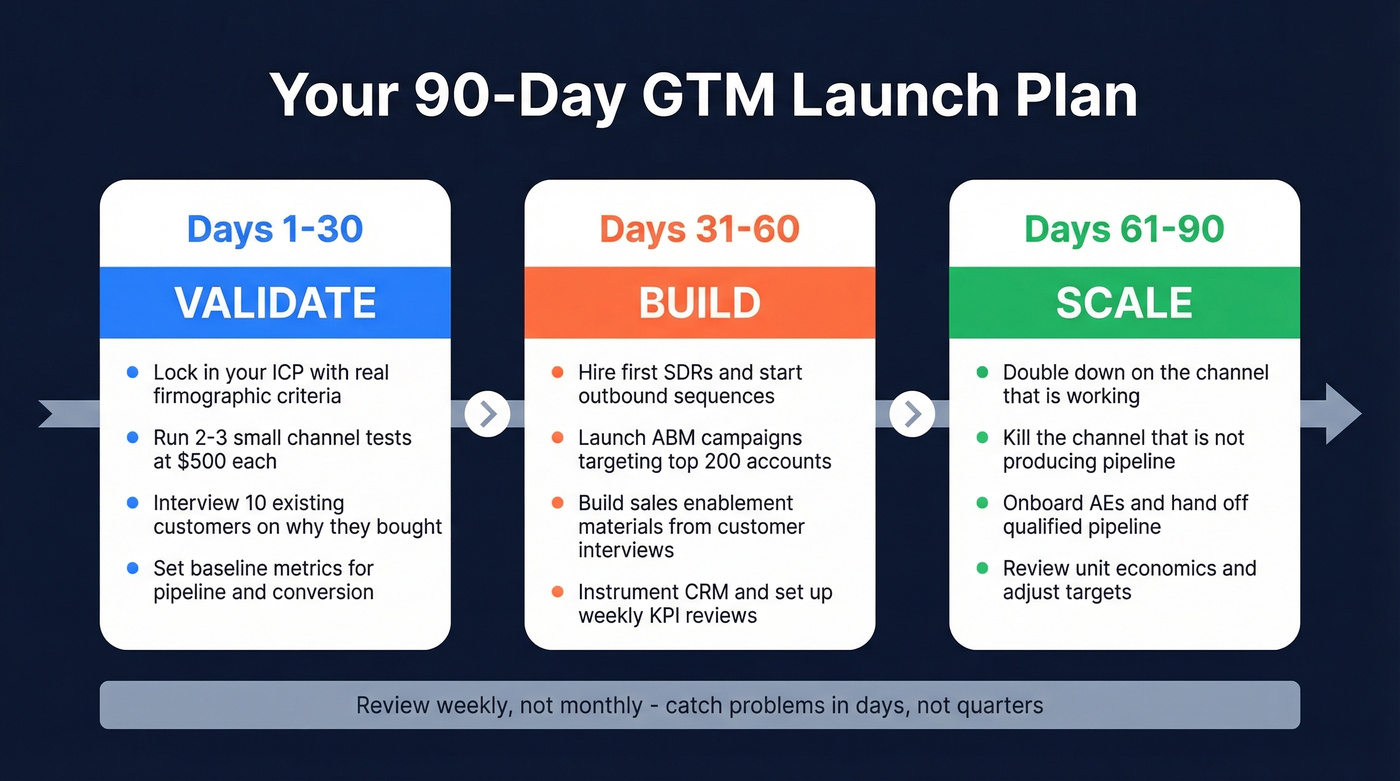
Days 1-30: Validate. Confirm your ICP with real data, not assumptions. Interview 10-15 current customers. Pressure-test your positioning statement - can every rep say it in one sentence? Pick your two priority channels and define what "working" looks like for each.
Days 31-60: Build. Develop the narrative and sales enablement materials. Align SDRs on messaging, objection handling, and target account lists. Set up measurement infrastructure - CRM stages, attribution, dashboards. Before SDRs start dialing, verify your prospect data. Stale records that bounce on first touch will crater your domain reputation before you even get started.
Days 61-90: Launch and optimize. Activate your first two channels. Instrument the scorecard from day one. McKinsey's research shows GTM optimization can drive up to 20% faster lead-to-deal times - but only if you're measuring from the start.
The "first 72 hours" rule. Set up real-time dashboards and daily standups before launch, not after. Response rates, bounce rates, meeting conversion - these signals show up immediately and tell you more than three weeks of quarterly reviews ever will.
GTM Deliverables Checklist
Every GTM plan should produce these artifacts before launch day. If you're missing any, you aren't ready.
Your foundational documents are the ICP definition covering firmographic, technographic, and behavioral criteria for your ideal buyer, a one-sentence positioning statement that explains who you serve, what you solve, and why you're different, and a competitive brief covering your top 3-5 alternatives with their positioning and where you win.
The operational pieces matter just as much:
- Channel plan - two channels max for launch, with budget, owners, and success metrics
- Pricing model documentation - tiers, packaging, discount authority, and competitive benchmarks
- Launch calendar with owners - every deliverable, every deadline, every name attached
- KPI dashboard - pipeline velocity, CAC, LTV:CAC, win rate, payback period, all updated weekly
- Post-launch optimization protocol - first 72 hours monitoring plan, daily standup cadence, escalation triggers
If your GTM plan doesn't fit on 5-7 pages plus a dashboard, it's too long. The best plans are working documents that get updated weekly, not slide decks that get presented once and forgotten.
Every GTM example above - Slack, HubSpot, Oatly - succeeded because they reached the right buyers at the right time. For B2B outbound and ABM motions, that means verified emails at $0.01 each, 125M+ direct dials, and intent data across 15,000 topics to find accounts actively in-market.
Build your target account list with data that actually connects you to buyers.
FAQ
What does a strong go to market example include?
A strong go to market example includes a specific ICP with firmographic criteria, a channel strategy tied to deal size and sales cycle, a headcount plan with math that works backward from revenue targets, and a KPI dashboard reviewed weekly. The Anakin walkthrough above shows this with real numbers - $120K ACV, 25% win rate, 300 qualified opportunities needed to hit $12M ARR.
How long does a GTM strategy take to build?
Expect 30-90 days depending on complexity. A focused team can validate ICP and positioning in 30 days, build sales enablement and channel infrastructure by day 60, and launch first plays by day 90. Compressing below 30 days usually means skipping validation - which costs more time later when pipeline stalls.
What's the difference between GTM strategy and marketing strategy?
GTM strategy covers the entire path from product to revenue - ICP, pricing, sales motion, channels, enablement, and measurement. Marketing strategy is one component within it. Teams that treat GTM as "the marketing plan" end up with campaigns but no revenue model, no sales alignment, and no pricing strategy.
Which GTM motion fits my product?
If your product delivers value in under 5 minutes with no setup, consider PLG. If your average deal exceeds $50K, go sales-led with dedicated AEs. If your market actively searches for solutions, start with content-led inbound. Master one motion before layering a second - running all three simultaneously is how you run all three poorly.
How do I build a prospect list for outbound GTM?
Start with your ICP criteria - industry, headcount, revenue, tech stack, funding stage - then use a B2B data platform to find verified emails and direct dials matching those filters. Aim for under 3% bounce rates to keep deliverability high, and verify every record before it hits your sequence. Stale data is the fastest way to kill an outbound channel before it starts producing.