

Go-to-Market Strategy for B2B Products: Benchmarks, Frameworks, and a 90-Day Sprint
61% of B2B buyers now prefer a rep-free buying experience, according to Gartner's 2026 sales survey. That's not a trend. It's the new default. And 73% of those buyers actively filter out suppliers who send irrelevant outreach, which means your go-to-market strategy for B2B products can't be a 47-slide deck collecting dust in a shared drive - it needs to be an operating system that ships pipeline.
Here's the short version: buyers self-educate, self-qualify, and self-select. Your GTM either meets them on those terms or gets filtered out. We're going to walk through a 90-day sprint with hard go/no-go gates, not a six-month planning cycle that produces nothing but consensus fatigue.
One thing we don't see enough teams talk about: data quality. Your outbound isn't failing because your copy is weak. It's failing because half your emails bounce.
What a GTM Strategy Actually Is
A go-to-market strategy isn't a marketing plan. It's the cross-functional operating system that connects ICP definition, pricing, sales motion, enablement, and feedback loops into one coordinated effort.
This matters because over 80% of B2B deals end in "no decision." Buyers aren't choosing your competitor - they're choosing inaction. Meanwhile, 69% of buyers report inconsistencies between what your website says and what your sellers say. That's not a messaging problem. That's an operating system failure, and a slide deck won't fix it. An operational playbook with SLAs, funnel math, and iteration cadence will.
Choosing Your GTM Motion
Before you build anything, pick a motion. This isn't philosophical - it's a math problem driven by ACV, time-to-value, and buyer persona.
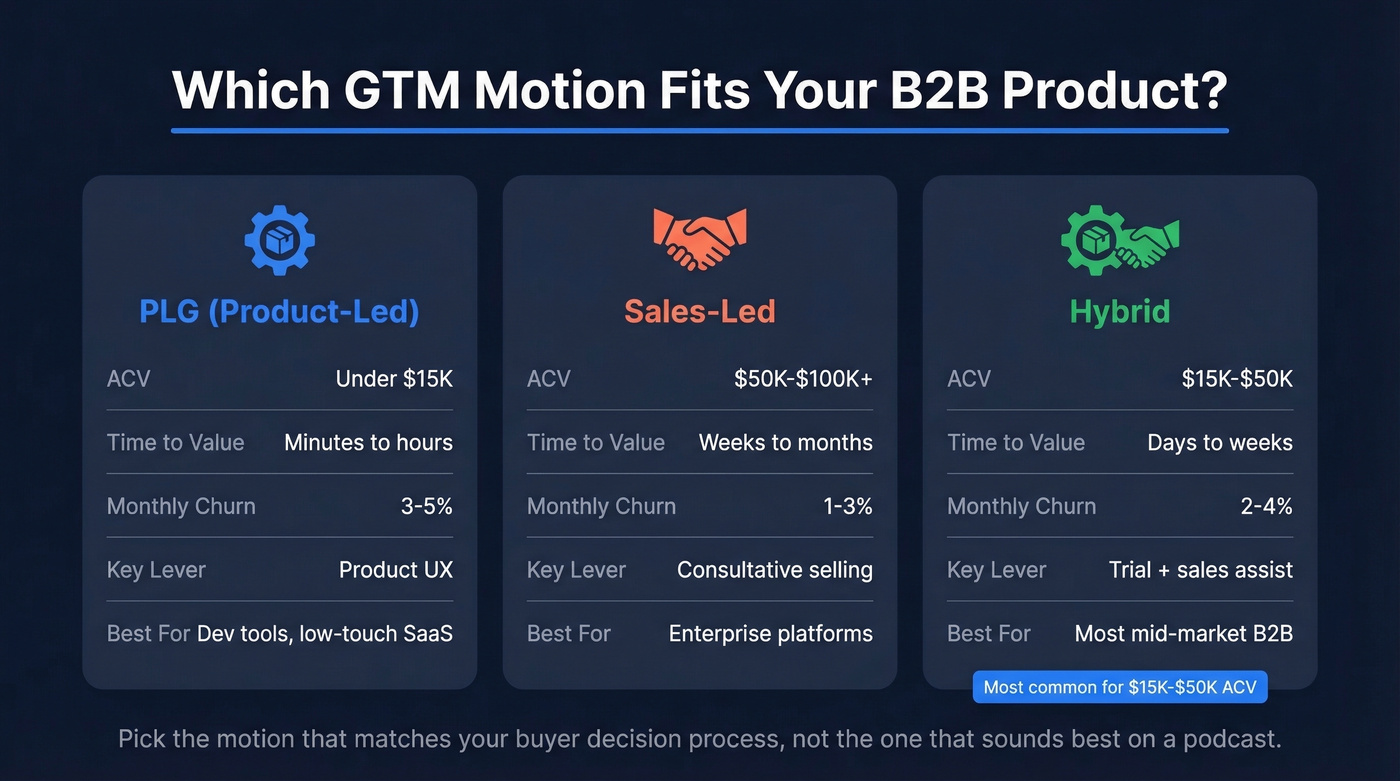
| Criteria | PLG | Sales-Led | Hybrid |
|---|---|---|---|
| ACV sweet spot | Under $15K | $50K-$100K+ | $15K-$50K |
| Time-to-value | Minutes/hours | Weeks/months | Days/weeks |
| Monthly churn | 3-5% | 1-3% | 2-4% |
| Key lever | Product UX | Consultative selling | Trial + sales assist |
| Best for | Dev tools, low-touch SaaS | Enterprise platforms | Most mid-market B2B |
PLG works when your product delivers value before a human touches the deal. Sales-led works when implementation complexity demands a consultative process. Most B2B products between $15K and $50K ACV land in hybrid territory - and that's fine. Don't overthink this. Pick the motion that matches your buyer's decision process, not the one that sounds best on a podcast.
Here's the thing: if your deal size is under $25K and you're running a fully sales-led motion, you're probably burning 40% of your CAC on deals that would close themselves with a good free trial. We've watched teams double conversion rates just by adding self-serve activation.
The 90-Day GTM Sprint
The average software company runs 10.5 GTM efforts simultaneously - 5 core channels plus 5.5 experimental initiatives. That's how you burn cash without learning anything.
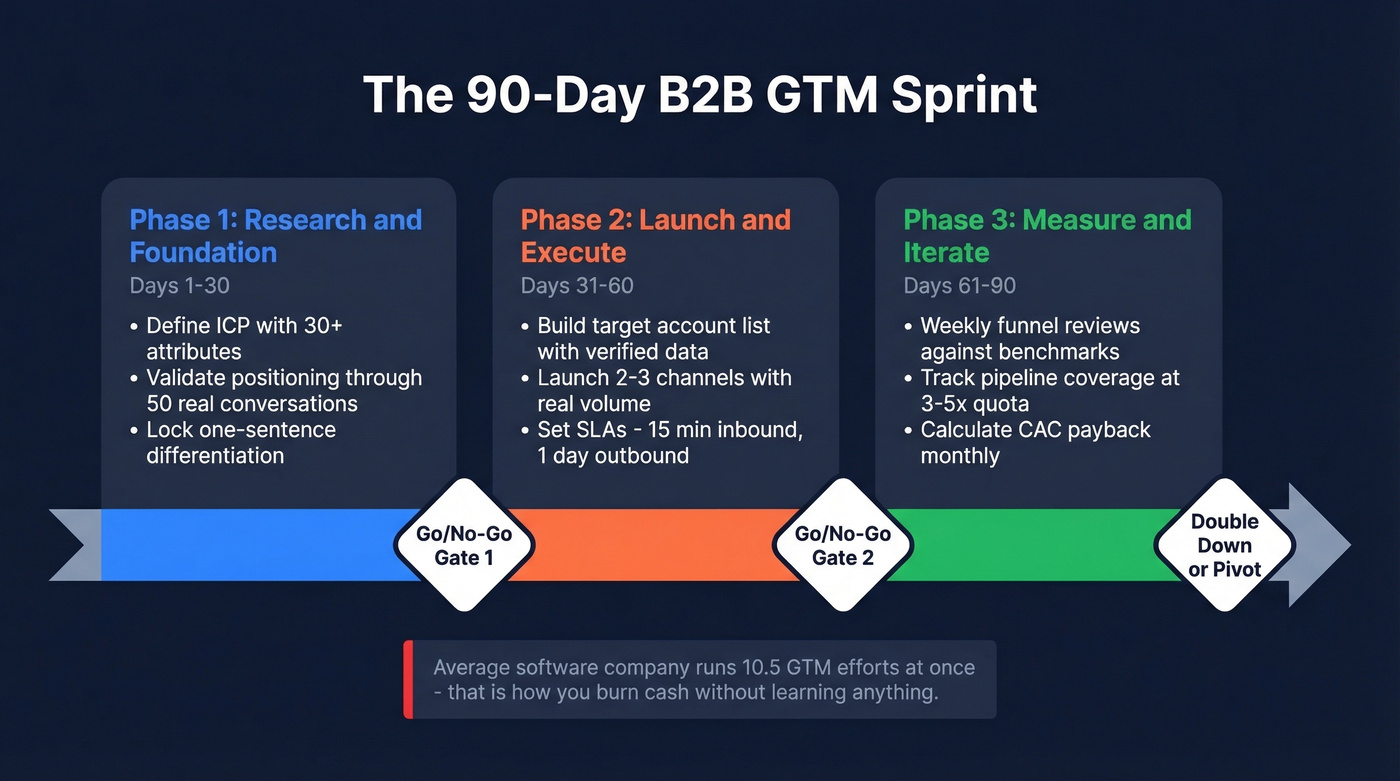
Phase 1: Research and Foundation (Days 1-30)
Start with real ICP definition - 30+ attributes across firmographics and buying signals: industry, headcount, tech stack, funding stage, hiring velocity, department growth. Then validate positioning through 50 real conversations. Not surveys. Conversations. In our experience, teams that skip this step waste weeks on positioning that doesn't resonate with anyone who actually writes checks.
Your go/no-go gate: if you can't articulate in one sentence why a prospect should pick you over the incumbent, you aren't ready for Phase 2. Full stop.
Phase 2: Launch and Execute (Days 31-60)
Build your target account list and launch two or three channels with enough volume to generate statistically meaningful signal within 30 days.
Set SLAs immediately. Inbound demo requests get contacted within 15 minutes. Outbound replies get answered within one business day. Every lead gets 5-7 follow-ups over 10 days. These aren't aspirational - they're the baseline that separates teams who close from teams who "nurture" leads into oblivion.
Your pipeline velocity formula - Opportunities x Deal Size x Win Rate / Cycle Days - breaks down when a big chunk of your emails bounce. Data quality isn't a nice-to-have; it's execution infrastructure. Prospeo's B2B database gives you 300M+ profiles with 30+ filters including buyer intent, technographics, job changes, and headcount growth, plus 98% email accuracy on a 7-day refresh cycle. It starts free, no contracts.

Phase 3: Measure and Iterate (Days 61-90)
Track these funnel benchmarks weekly, not quarterly:
- MQL-to-SQL conversion - 25-35% is healthy mid-market
- SQL-to-Opportunity - 50%+ or your qualification criteria are too loose
- Win rate - 20%+ or your positioning needs work
- Pipeline coverage - 3-5x quota depending on cycle length
We've found pipeline coverage below 3x almost always leads to missed quarters. If you're past day 90 with no MQL-to-SQL conversion, the answer isn't "more budget." Go back and revisit your ICP or pivot the channel entirely.

Your 90-day GTM sprint dies at Phase 2 if half your emails bounce. Prospeo's B2B database gives you 300M+ profiles with 30+ filters - buyer intent, technographics, job changes, headcount growth - at 98% email accuracy on a 7-day refresh cycle. That's pipeline velocity math that actually works.
Stop burning your GTM budget on bad data. Start free, no contracts.
2026 Benchmarks That Matter
SaaS Health Metrics
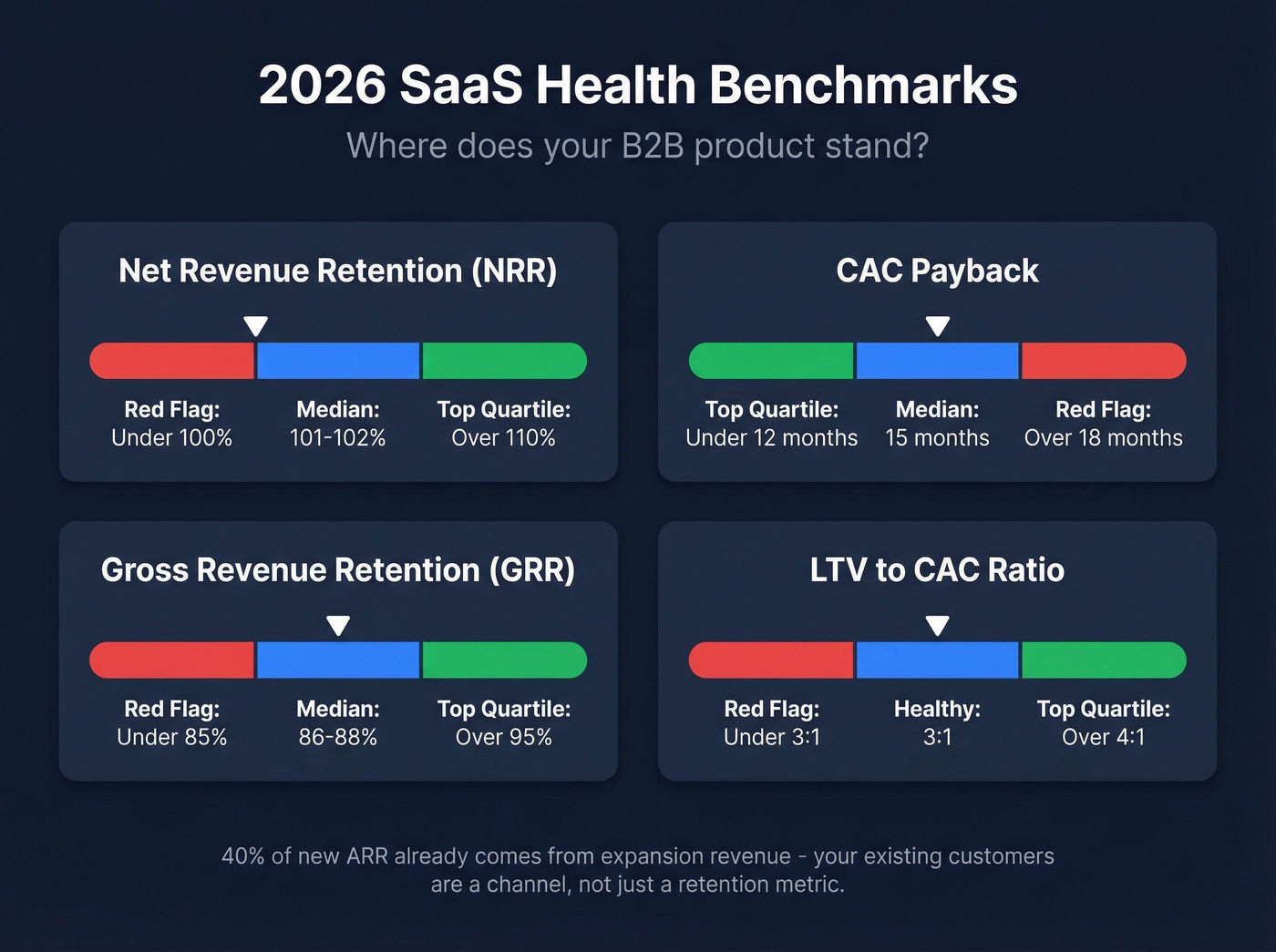
| Metric | Median | Top Quartile | Red Flag |
|---|---|---|---|
| NRR | 101-102% | >110% | <100% |
| CAC payback | 15 months | <12 months | >18 months |
| GRR | 86-88% | >95% | <85% |
| LTV:CAC | 3:1 | >4:1 | <3:1 |
Channel Performance
| Channel/Metric | Average | Target |
|---|---|---|
| Website conversion | 1.8% | 3-5% |
| B2B CPL | ~$200 | Varies by motion |
| Cold email reply rate | 5.8% (down from 6.8%) | 8%+ with intent data |
| Cold email hooks | Timeline hooks: 10% reply vs. problem hooks: 4.4% | Lead with timeline |
One stat worth flagging: Gartner projects traditional search volume will drop 25% by 2026 as buyers shift to AI tools. If your GTM relies heavily on inbound SEO, diversify now. About 40% of new ARR already comes from expansion revenue - your existing customers are a channel, not just a retention metric.
Why B2B GTM Strategies Fail
We've seen the same five failure patterns kill GTM launches over and over. Let's break them down.
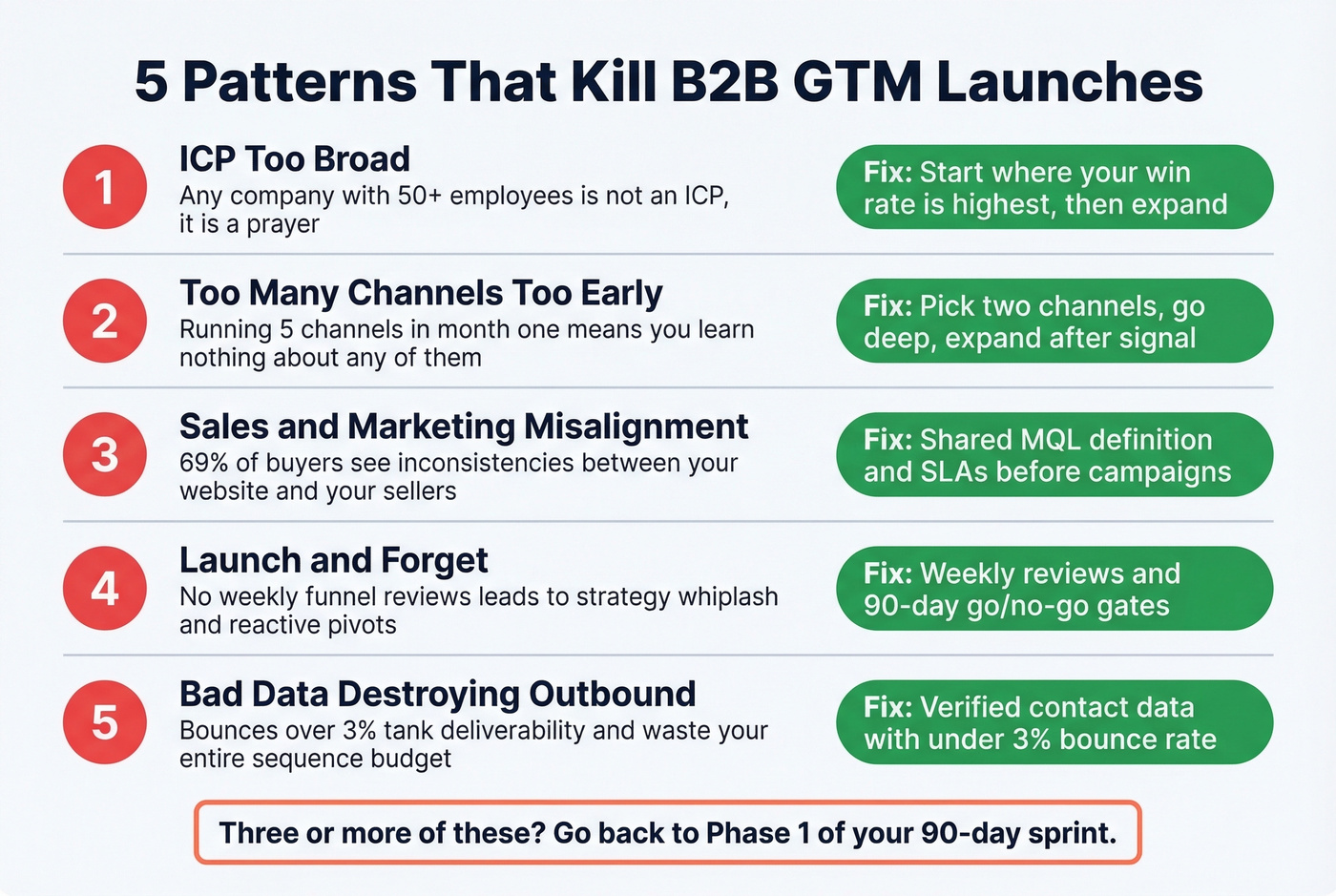
1. ICP too broad. "Any company with 50+ employees" isn't an ICP - it's a prayer. Narrowing the ICP is the single highest-leverage fix for most early GTM teams. Start with the segment where your win rate is highest, then expand. Skip this if you enjoy watching your SDRs send 500 emails a day to people who'll never buy.
2. Too many channels too early. Running paid, organic, outbound, events, and webinars in month one means you learn nothing about any of them. Pick two. Go deep. You can expand once you've found signal.
3. Sales and marketing misalignment. That 69% buyer-inconsistency number? It happens when marketing defines an MQL differently than sales defines a "good lead." Fix SLAs before you fix campaigns. The r/sales community talks about this constantly - reps getting "qualified" leads that have never heard of the product, marketing blaming sales for not following up. The fix is a shared definition, not a shared Slack channel.
4. Launch and forget. Teams without weekly funnel reviews and 90-day go/no-go gates end up with strategy whiplash - pivoting reactively instead of learning systematically. I've seen a Series B company run the same underperforming outbound sequence for five months because nobody owned the review cadence.
5. Bad data destroying outbound. This one's frustrating because it's so fixable. Stack Optimize built from $0 to $1M ARR with client deliverability hitting 94%+, bounces under 3%, and zero domain flags across all clients. The difference was verified contact data, not better subject lines.
Red flags your GTM needs a reset:
- Forecasting off by 30%+
- Always the last vendor invited to evaluations
- Best customers love you but can't explain why you're different
- Sales and marketing blame each other for pipeline gaps
Three or more? Go back to Phase 1.
Your GTM Launch Checklist
Preparation (Before Day 1)
- Business goals tied to revenue targets, not vanity metrics
- ICP defined with 30+ firmographic and intent filters
- Competitive audit completed - one-sentence differentiation locked
- Messaging validated through 50 real conversations
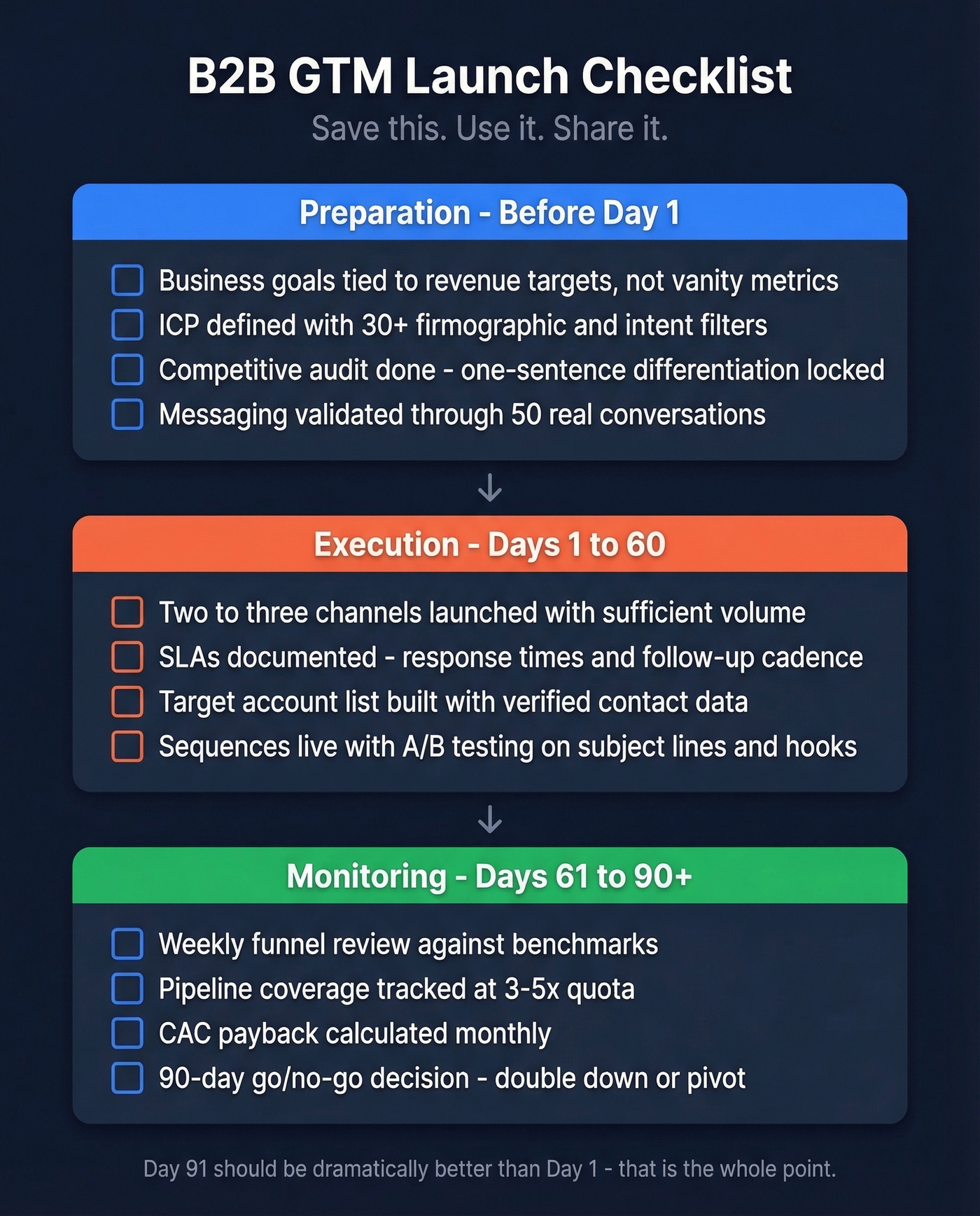
Execution (Days 1-60)
- Two or three channels launched with sufficient volume
- SLAs documented: response times, follow-up cadence
- Target account list built with verified contact data
- Sequences live, A/B testing subject lines and hooks
Monitoring (Days 61-90+)
- Weekly funnel review against benchmarks
- Pipeline coverage tracked at 3-5x quota
- CAC payback calculated monthly
- 90-day go/no-go decision: double down or pivot
A solid go-to-market strategy for B2B products isn't about perfection on day one. It's about building the feedback loops that make day 91 dramatically better than day 1.
The article says it plainly: ICP definition needs 30+ attributes across firmographics and buying signals. Prospeo lets you filter by all of them - intent data across 15,000 topics, tech stack, funding stage, department headcount growth - then delivers verified emails at $0.01 each. That's how you go from ICP slide to live pipeline in days.
Turn your ICP definition into a ready-to-launch target account list today.
GTM Strategy FAQ
How long does a B2B go-to-market strategy take to show results?
Most teams see pipeline signals within 60-90 days of execution, not planning. If you're past 90 days with no MQL-to-SQL conversion, revisit your ICP or channel mix before scaling spend. The 90-day sprint framework above gives you hard gates for that decision.
What's the difference between a GTM strategy and a marketing plan?
A marketing plan covers channels and budgets. A GTM strategy includes ICP definition, pricing, sales motion, enablement, and cross-functional SLAs - marketing is one layer inside the broader operating system.
Should a B2B startup use PLG or sales-led growth?
Under $15K ACV with fast onboarding - PLG. Over $50K with complex implementation - sales-led. Most B2B products in between benefit from hybrid: free trial for activation, sales assist for conversion.
What tools do I need to launch a B2B GTM?
At minimum: a CRM like HubSpot or Salesforce, a B2B data platform for verified contacts like Prospeo (98% email accuracy, 300M+ profiles), and a sequencing tool like Instantly, Smartlead, or Lemlist. Add attribution tooling after the 90-day sprint, not before.