

The Go-to-Market Strategy Guide That Actually Helps Startups
A RevOps lead we know spent eight months building a product, launched to crickets, and burned through $200K in runway before landing a single paying customer. The product was solid. The go-to-market strategy was nonexistent - no defined buyer, no channel plan, no pricing logic. Companies with a defined GTM process see 10% higher launch success rates and 3x higher median revenue growth than those winging it. That gap isn't luck. It's process.
The Short Version
Before we get into the full framework, here's what matters most:
Your first GTM motion is founder-led outbound - not ads, not content, not PLG. Pick one ICP segment and validate it with 50+ discovery calls before you scale anything. Know your CAC benchmarks (we've got them below) and target a 3:1 LTV:CAC ratio. Your entire GTM plan should fit on one page. Everything else is a hypothesis you test after launch.
What a GTM Strategy Actually Is
A go-to-market strategy isn't a marketing plan. Marketing is one channel inside your GTM. A startup GTM strategy covers the entire commercial motion: who you're selling to, how you price, which channels reach buyers, what your sales motion looks like, and how you measure whether any of it's working.
Here's the thing - if your plan doesn't fit on one page, you're overthinking it. The rest is hypotheses you validate with real customers.
One framing distinction matters more than people realize. B2B and B2C GTM are fundamentally different animals. B2B buying involves 6-10 stakeholders and 6-12 month cycles driven by ROI justification. B2C is individual decision-making in minutes to days, driven by emotion and convenience. Everything downstream - channels, pricing, sales motion - changes based on which world you're in.
The 7-Step GTM Framework for Startups
1. Define Your ICP (One Segment Only)
The single biggest GTM mistake is targeting too broadly. Pick one segment. One persona. One problem.
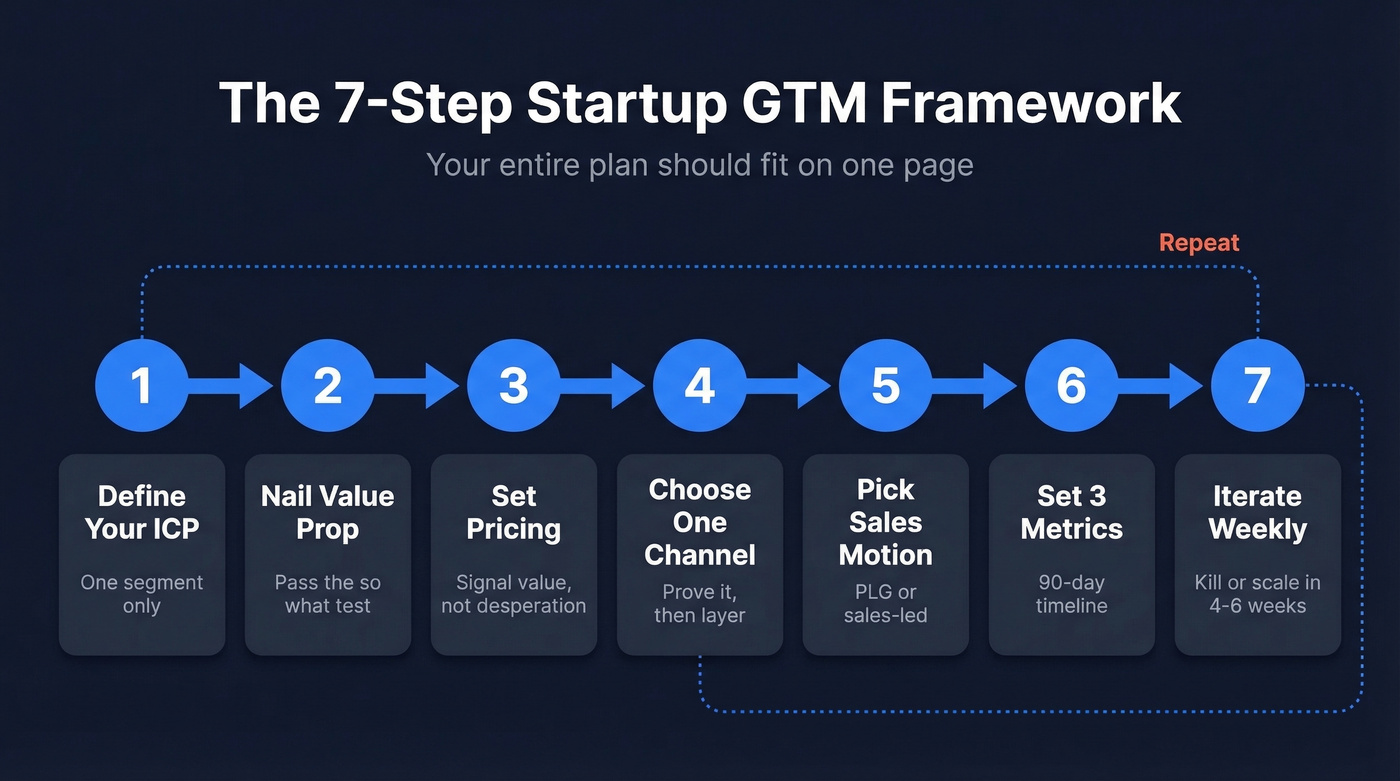
The "Anti-ICP" concept is just as important: explicitly define who you're not selling to. Narrowing feels counterintuitive when you're desperate for revenue, but it pays off with sharper messaging, higher conversion rates, and lower CAC. We've watched founders resist this advice for months, then finally narrow their focus and close more deals in two weeks than they did in the previous quarter.
2. Nail Your Value Proposition
Your value prop needs to pass the "so what?" test. If a prospect reads it and shrugs, you've written a feature list, not a value prop. One sentence. What changes for the buyer if they use your product? Don't describe what you built. Describe the outcome they get.
3. Set Pricing That Signals Value
Underpricing doesn't win customers - it erodes trust. There's a well-known anecdote of a SaaS startup underpricing by 70%, then watching conversion rates increase after raising prices because buyers finally took the product seriously. Your price is a signal. If you're selling to enterprise buyers, a $29/month price tag tells them you aren't serious about their problems.
4. Choose One Channel and Prove It
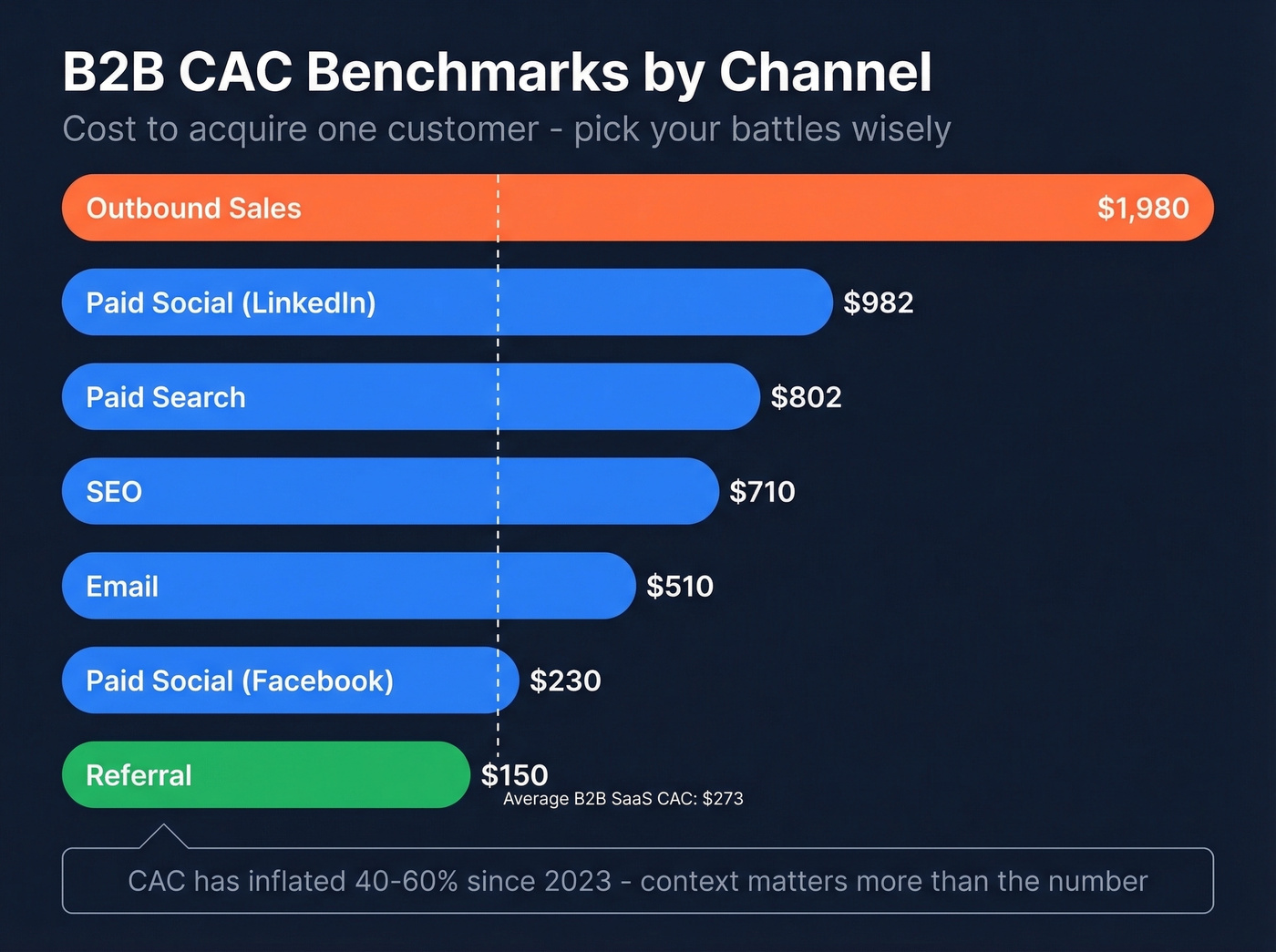
Don't spread across five channels. Pick one, prove it works, then layer on the next. Channel CAC benchmarks tell a useful story:
| Channel | B2B CAC | B2C CAC |
|---|---|---|
| Paid Search | $802 | $230 |
| Paid Social (LinkedIn) | $982 | - |
| Paid Social (Facebook) | $230 | $212 |
| SEO | $480-$942 | $298 |
| Referral | $150 | $68 |
| Outbound Sales | $1,980 | - |
| $510 | $287 |
The average B2B SaaS CAC sits around $273, but that number masks huge channel-level variation. CAC has inflated 40-60% since 2023 thanks to competition, privacy changes, and attribution decay. That $150 referral CAC looks great until you realize referral programs take 6-12 months to build momentum. Outbound at $1,980 looks expensive until you realize it's the fastest channel to validate product-market fit. Context matters more than the number.
5. Pick Your Sales Motion
This decision shapes everything else - your hiring plan, your tech stack, your pricing model, your onboarding flow. We break down the PLG vs. sales-led decision in detail below, but the short version: most startups start sales-led whether they plan to or not.
6. Set 3 Metrics and a 90-Day Timeline
Don't track 15 KPIs. Pick three that matter for your stage. For most early-stage startups, that's pipeline generated, conversion rate, and CAC. Target a 3:1 LTV:CAC ratio as your profitability benchmark. Expect 3-9 months to get a repeatable signal from any single channel.
7. Iterate Weekly
Your GTM is a living document, not a slide deck you present once and file away. If a channel isn't showing signal in 4-6 weeks, kill it and try the next one. That weekly iteration cadence is the difference between startups that find PMF and startups that run out of runway debating strategy.
Applying the Framework: VaultShield Example
Let's make this concrete. Imagine a pre-seed B2B cybersecurity SaaS - call it VaultShield - selling automated compliance monitoring to Series A fintech startups.
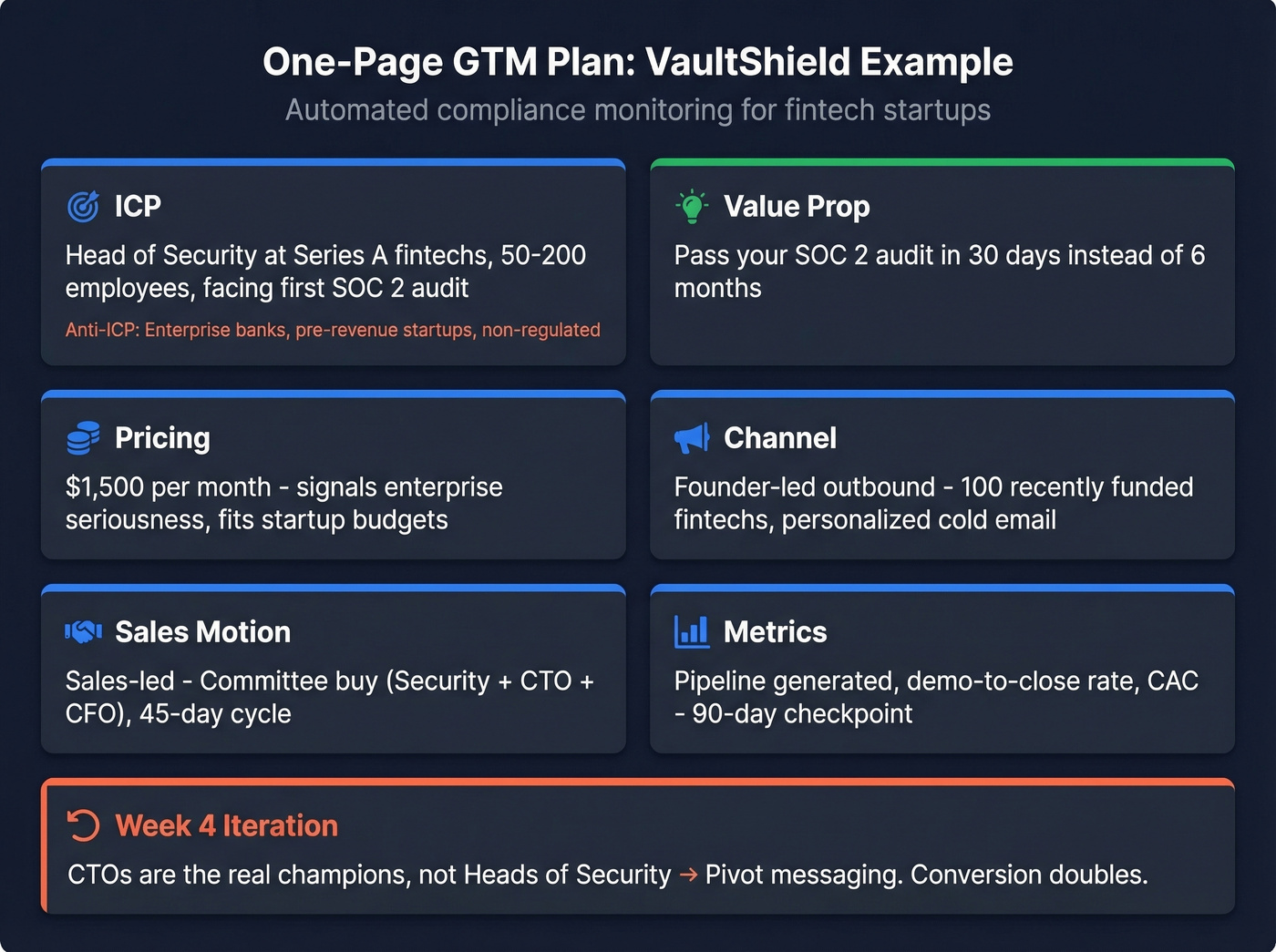
ICP: Head of Security at fintech startups with 50-200 employees who just raised Series A and face their first SOC 2 audit. Anti-ICP: enterprise banks, pre-revenue startups, non-regulated industries.
Value prop: "Pass your SOC 2 audit in 30 days instead of 6 months."
Pricing: $1,500/month - high enough to signal enterprise seriousness, low enough for a startup budget.
Channel: Founder-led outbound. The founder builds a list of 100 recently funded fintechs, sends personalized cold emails referencing their funding round, and books 15 discovery calls in week one.
Sales motion: Sales-led. Committee buying (Head of Security + CTO + CFO), 45-day cycle.
Metrics: Pipeline generated, demo-to-close rate, CAC. 90-day checkpoint.
Iteration: After 4 weeks, the founder notices CTOs are the real champions, not Heads of Security. Messaging pivots. Conversion doubles.
That's the entire startup GTM plan on one page. Everything else is a hypothesis.

Founder-led outbound only works when your emails actually land. Prospeo delivers 98% email accuracy with a 7-day data refresh - so the prospect list you build today isn't stale by next week. Use 30+ filters to nail your one ICP segment: buyer intent, funding stage, headcount growth, technographics.
Build your first 100-prospect list in minutes, not days.
PLG vs. Sales-Led - How to Choose
Not every startup should do product-led growth. A dataset of 474 Series A startups found that only 39% enable self-serve and just 25% offer a free tier. Even in DevTools - the most PLG-friendly category - only 50% go product-led.
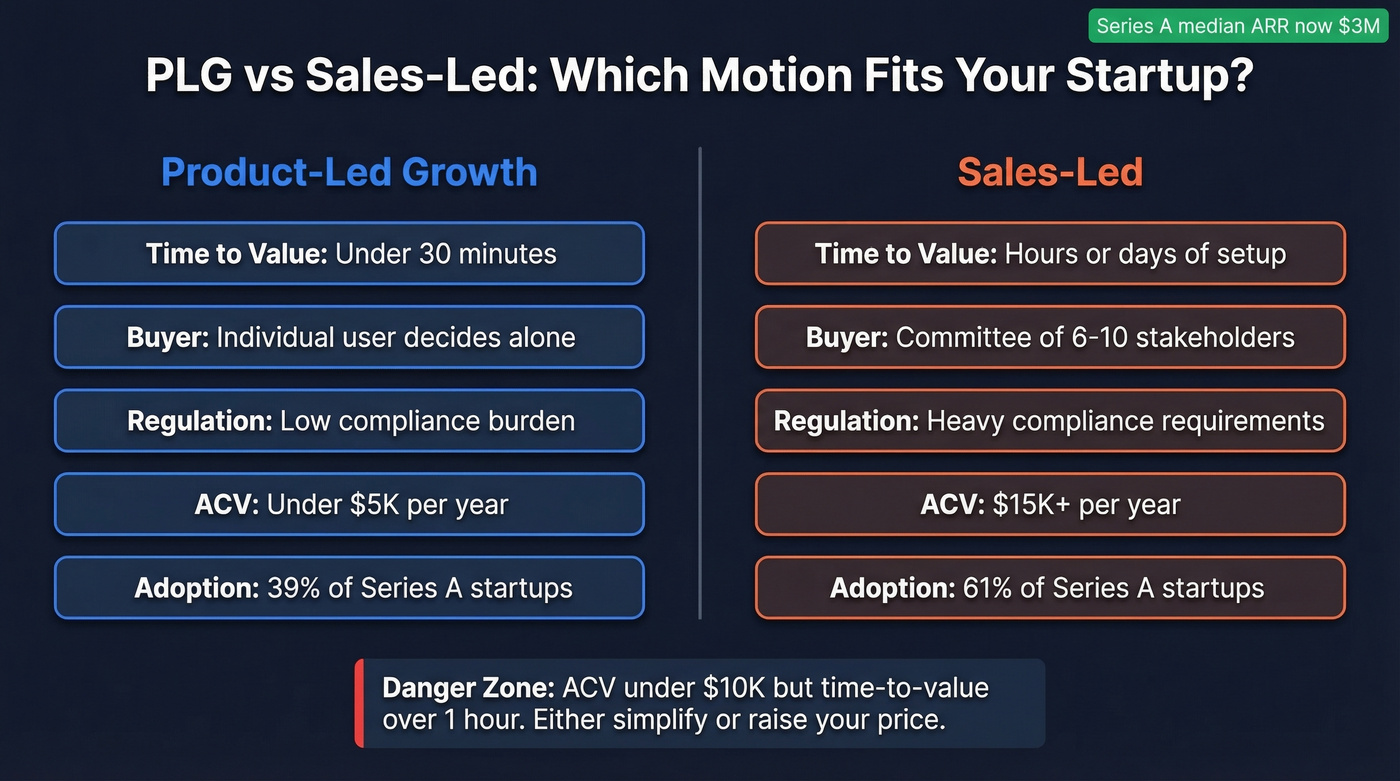
The Series A bar has shifted dramatically: median ARR needed is now roughly $3M, up from about $1.3M in 2021-22. Your GTM motion needs to generate real revenue faster, regardless of which model you pick.
| Signal | PLG Viable | Sales-Led Better |
|---|---|---|
| Time-to-value | Under 30 min | Hours or days |
| Buyer type | Individual user | Committee (6-10) |
| Regulatory load | Low | High (compliance) |
| ACV range | Under $5K | $15K+ |
| Self-serve data | 39% of Series A | 61% of Series A |
PLG doesn't mean free. Most PLG companies charge from day one. The "product-led" part is about removing friction from the buying process, not removing the price tag.
If your deal size is under $10K and your time-to-value is over an hour, you're in no-man's-land - too cheap for a real sales team, too complex for self-serve. Either simplify the product or raise the price. Straddling both motions at seed stage is how startups die slowly.
For teams selling into regulated industries, vertical markets, or workflow-heavy use cases, you're sales-led with product assist. Horizontal, fast time-to-value, individual-user-driven? Self-serve with sales assist makes sense.
Founder-Led Sales - Your Default GTM Motion
Before you hire a single SDR, you sell. Every successful B2B startup we've studied follows the same pattern: the founder is the first salesperson, and the quality of those early conversations determines everything that comes after.
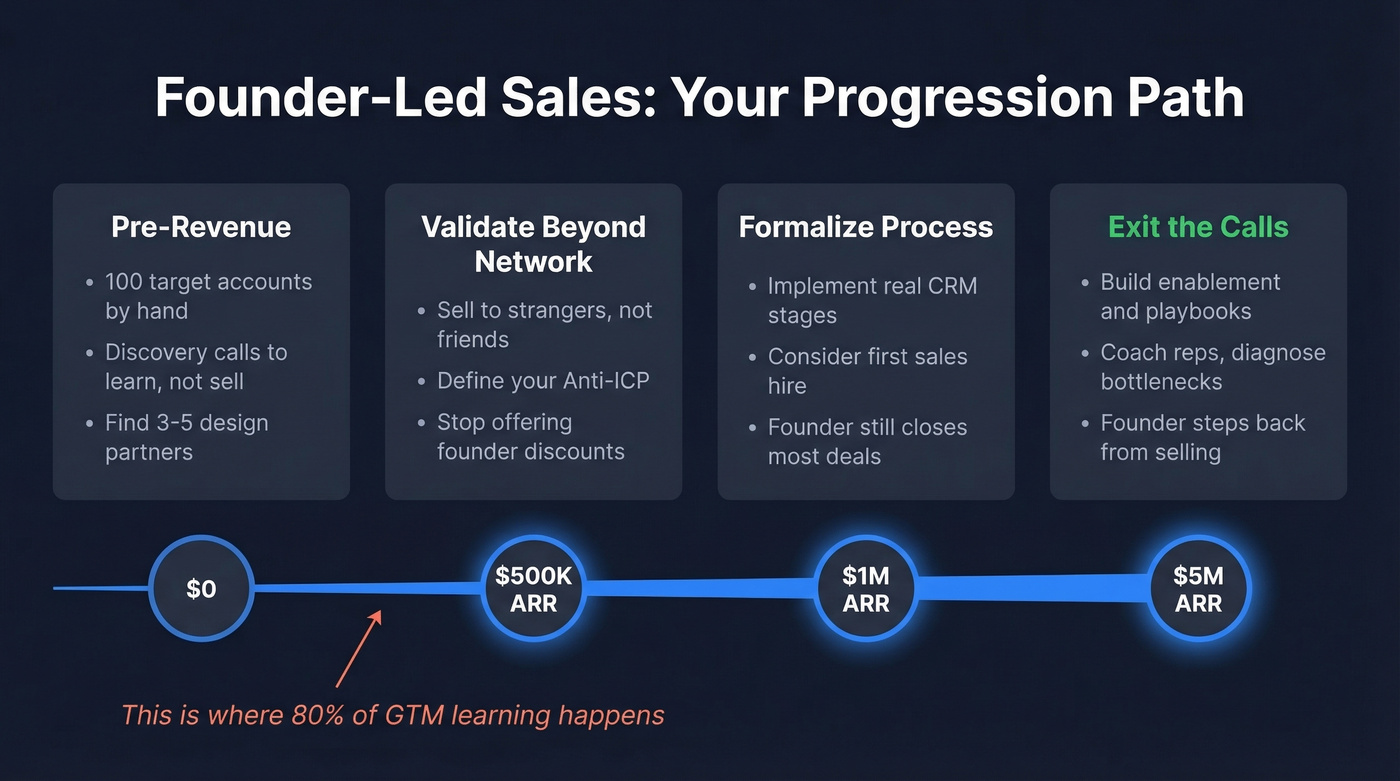
Pre-Revenue: 100 Targets, Manual Outreach
Build a list of 100 target accounts by hand. Not 1,000. Not 10,000. One hundred companies that perfectly match your ICP. Run discovery calls - the goal isn't to sell, it's to learn. Document every objection. Identify 3-5 design partners willing to use an early product and give honest feedback.
$500K ARR: Validate Beyond Your Network
Your first customers often come from warm intros and your personal network. That feels like traction - until you try to sell to strangers.
This is where you validate that cold prospects will buy. Define your Anti-ICP, the segments that waste your time. Standardize your pitch. And stop offering founder discounts. If the product can't sell at full price, you don't have product-market fit.
$1M ARR: Formalize the Process
Implement real CRM stages: Discovery, Qualification, Demo, Proposal, Close. This is also when you start thinking about your first sales hire, but the founder should still be closing the majority of deals.
$5M ARR: Exit the Calls
The founder needs to step back from day-to-day selling and build enablement materials, training, and a repeatable playbook. Your job shifts from closing deals to diagnosing bottlenecks and coaching reps.
Building Your Prospect List
Here's a scenario that plays out constantly: a founder sends 500 cold emails, 180 bounce, 12 get replies, zero convert, and now their domain reputation is damaged for months. Data quality is the unsexy GTM dependency nobody talks about until it wrecks their outbound.
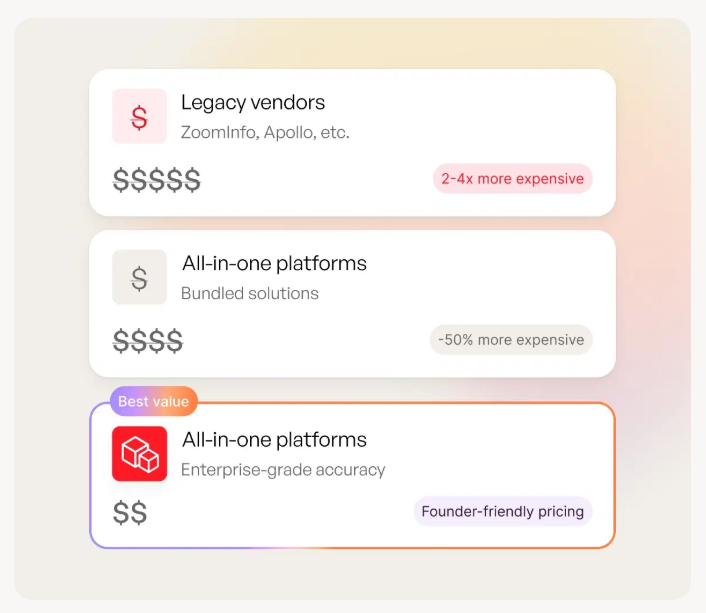
The cost contrast is stark. Enterprise data platforms run $30K+ per year. For a pre-seed startup doing founder-led outbound, that's absurd.
Prospeo covers 300M+ professional profiles with 98% email accuracy and a 7-day data refresh cycle, compared to the 6-week industry average. The Chrome extension lets you find verified emails from any website in one click. Start free with 75 emails per month, then scale at roughly $0.01 per lead - no contracts, no sales calls required. When Meritt switched to Prospeo, their bounce rate dropped from 35% to under 4% and pipeline tripled from $100K to $300K per week.
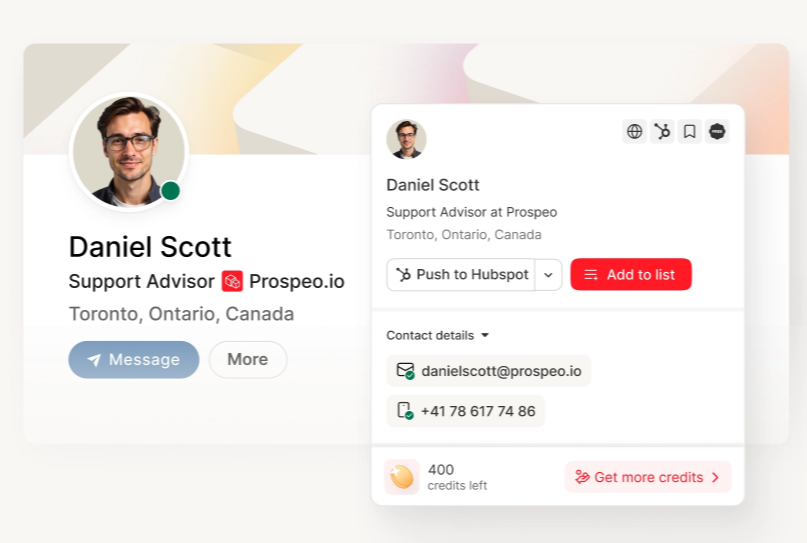
VaultShield's founder needed recently funded fintechs. You need your version of that list. Prospeo's database covers 300M+ profiles with filters for funding round, department headcount, and tech stack - so you can go from ICP definition to personalized outbound in a single afternoon. At $0.01 per email, your CAC stays startup-friendly.
Stop burning runway on bad data. Validate your GTM with contacts that connect.
GTM Strategies That Worked
These aren't templates to copy. They're patterns to learn from.
| Brand | GTM Type | Core Tactic | Outcome |
|---|---|---|---|
| Slack | PLG | Internal evangelism + WOM | 8M DAU, 3M paid, $27.7B acquisition |
| Dropbox | PLG | Referral give/get (free storage) | Viral loop, millions of signups |
| Notion | Community-led | Templates + tutorials ecosystem | Community became growth engine |
| HubSpot | Content/SEO | Free CRM as lead magnet + blog | Defined inbound marketing category |
| Gong | Content/SEO | Data-led content from anonymized sales calls | Owned "revenue intelligence" |
| Brex | Niche-first | Startups underserved by banks | Created new fintech category |
The pattern across all of these: they picked one motion and went deep before diversifying. Slack didn't run paid ads to get to 8M DAU. HubSpot didn't start with outbound. Brex didn't try to serve everyone. Pick your lane.
Let's be honest - most of these are famous companies with unusual advantages. Your startup probably won't replicate Slack's viral loop. But the principle holds: one channel, proven, then expand.
7 GTM Mistakes That Kill Startups
1. Confusing GTM with marketing. Running ads and writing blog posts isn't a GTM strategy. If you haven't defined your ICP, pricing, sales motion, and success metrics, you don't have a strategy - you have a marketing budget.
2. Targeting too broadly. "Our product is for any company with 50+ employees" isn't an ICP. It's a prayer. The broader you go, the more generic your messaging, the lower your conversion rates.
3. Not validating channels. Your first 10 customers came from warm intros. That's not a channel - it's your network. Before you scale spend on any channel, prove it works with cold traffic. And verify your list before you send - real-time email verification keeps bounce rates under 4%, so you're not torching your domain on the first campaign.
4. Underpricing. Pricing too low doesn't just leave money on the table - it actively signals that your product isn't serious. Raise prices. Watch what happens.
5. Ignoring sales motion fit. Trying to PLG your way into enterprise procurement is a recipe for stalled deals and confused buyers. Match the motion to the buyer.
6. Focusing only on acquisition. If your churn rate is 8% monthly, no amount of top-of-funnel will save you. Fix the leaky bucket before you pour more water in.
7. Scaling before PMF. Spending your seed round on SDRs and paid ads while the product still churns 15% monthly is the fastest way to run out of runway. Nail retention first, then scale. A solid go-to-market strategy for startups always prioritizes retention before acquisition spend.
FAQ
What's the difference between a GTM strategy and a marketing strategy?
GTM covers your entire commercial motion - ICP definition, pricing, channels, sales motion, and success metrics. Marketing is one channel within that plan. Great marketing paired with wrong pricing or a mismatched sales motion still fails.
How long does it take to validate a startup GTM strategy?
Expect 3-9 months for a repeatable signal from any single channel. Set a 90-day timeline with three clear metrics (pipeline, conversion rate, CAC), then iterate weekly based on real data.
Should every startup do product-led growth?
No. Only 39% of Series A startups enable self-serve. PLG works when time-to-value is under 30 minutes and the buyer is an individual user. Most B2B startups start sales-led.
What's a good CAC for a B2B SaaS startup?
The average B2B SaaS CAC is roughly $273, but it varies wildly by channel - referral averages $150, outbound runs $1,980. Target a 3:1 LTV:CAC ratio as your profitability benchmark.
How do I build a prospect list without enterprise budget?
Skip the $30K+ legacy platforms. Self-serve data tools with credit-based pricing at roughly $0.01 per lead give you 98%-accurate verified emails without contracts or sales calls required. Start with a free tier, validate your outbound, then scale spend as pipeline grows.