

How to Build an Outbound GTM Strategy That Generates Pipeline in 2026
Your CEO just asked why outbound isn't generating pipeline. The SDR team is sending hundreds of emails a day, rotating subject lines, testing new templates - but the meeting count hasn't moved in two quarters. Average cold email reply rates dropped to 5.8% in 2025, down from 6.8% the year before. Expect further compression this year.
Lazy outbound is dead. A modern outbound GTM strategy requires signal-based targeting, clean data, and multichannel execution - not more volume. Here's the playbook that replaces spray-and-pray.
Should You Even Run Outbound?
Not every company should. The decision comes down to four variables: TAM, ACV, category maturity, and existing demand.
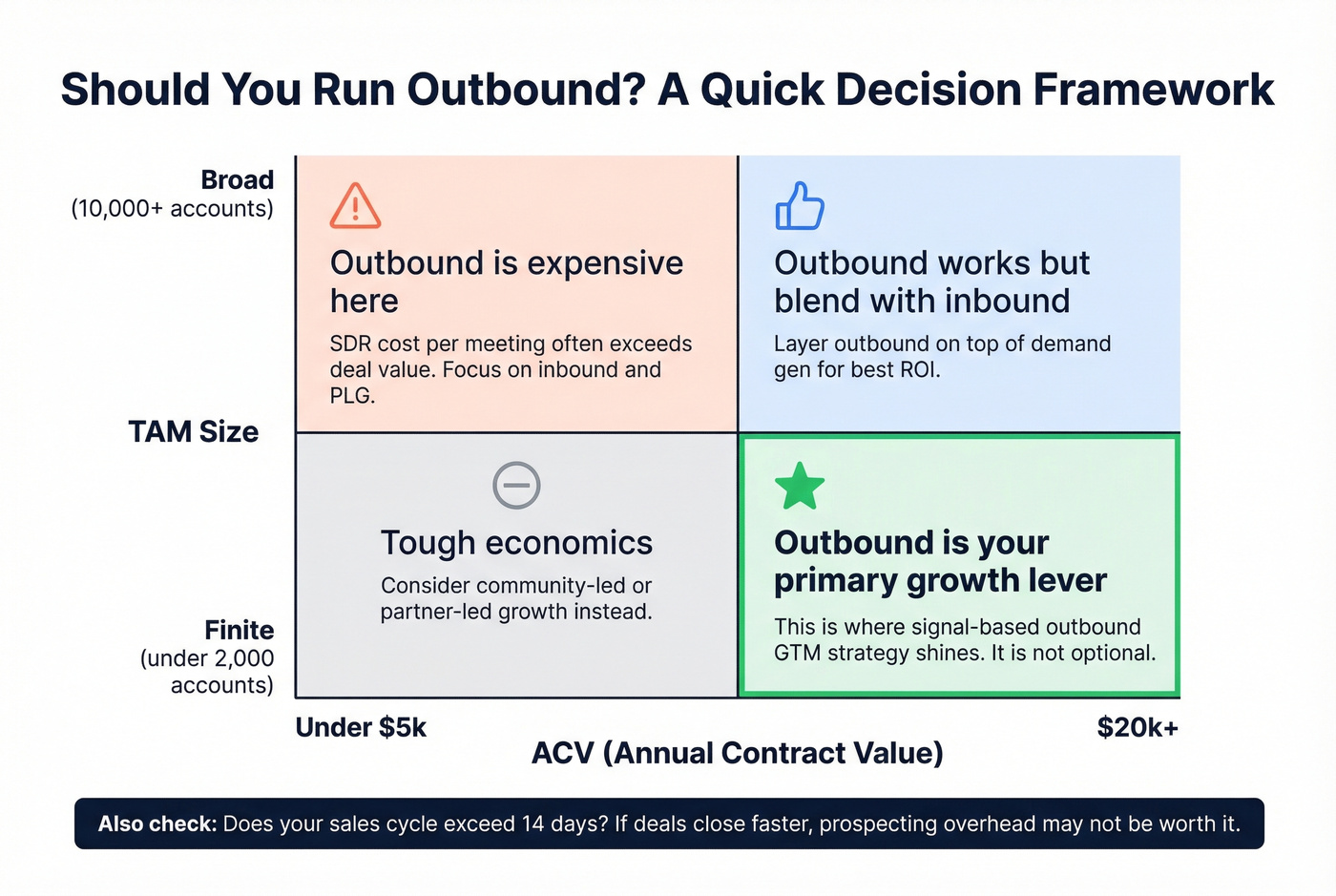
If your ACV is under $5k, outbound economics get brutal fast - the cost of an SDR's time per meeting booked often exceeds the deal value. But if your ACV is $20k+ and your TAM is finite (say, 2,000 target accounts), outbound isn't optional. It's the primary growth lever. Also factor in sales cycle length. Deals that close in under 14 days rarely justify the prospecting overhead.
Here's the thing most teams get wrong: go-to-market failures usually stem from misalignment between product, marketing, and sales - not from choosing the wrong channel. Before scaling outbound, make sure your team agrees on who you're targeting and why. A solid sales development motion starts with that internal alignment, not with a new tool purchase.
Signal-Based Targeting
The 2026 version of outbound doesn't start with lists. It starts with signal monitors.
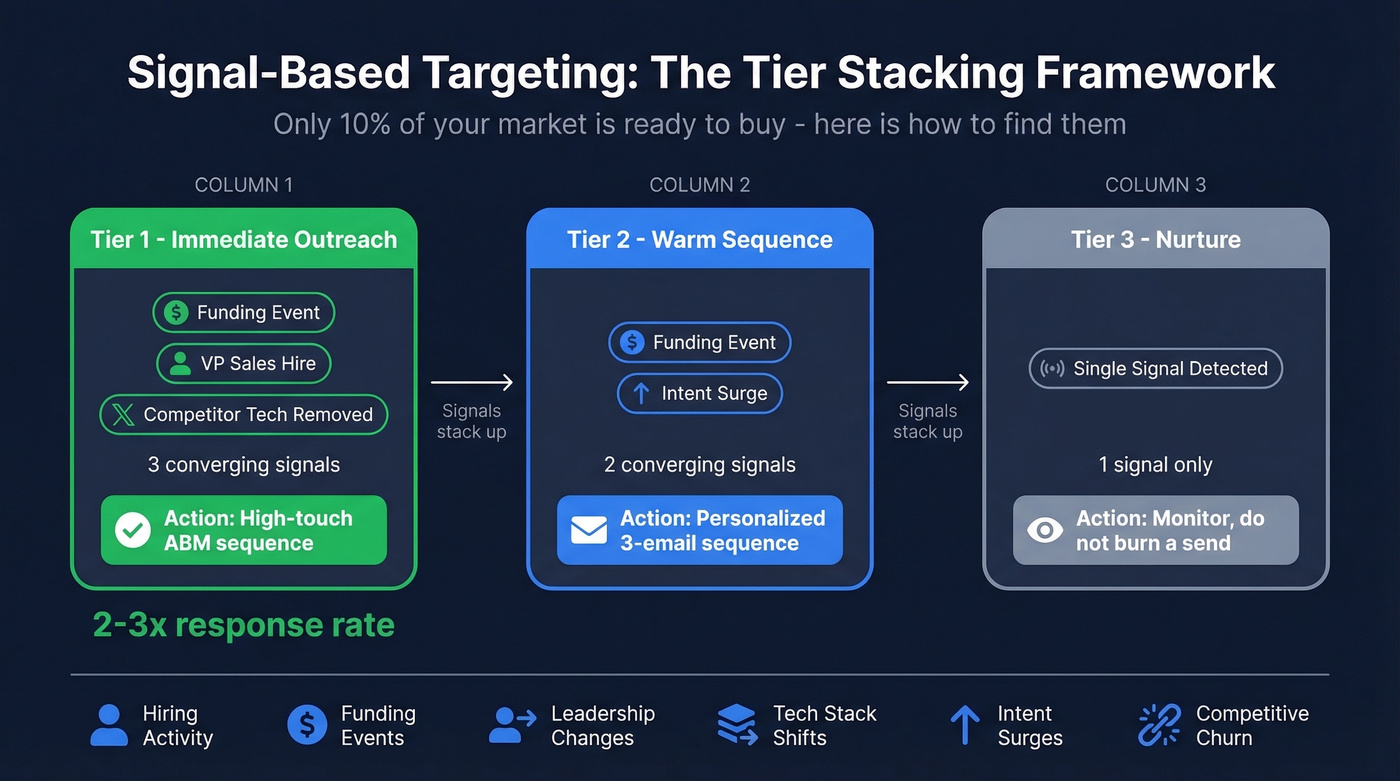
Only 3-5% of your market is actively buying at any given moment, with another ~7% open to a conversation. Signal-based targeting finds that ~10% instead of blasting the 90% who'll ignore you. 65% of marketers say intent signals improved their pipeline forecasting accuracy, and warm outbound drives 2-3x the response rate of cold.
The signals that matter: hiring activity (a VP of Sales posting means pipeline capacity is being built), funding events (fresh capital = new initiatives), leadership changes (new execs audit tools within 90 days), technographic shifts (removing a competitor's product), intent surges (multiple stakeholders researching your category), and competitive churn (negative reviews, contract expirations).
One signal is noise. The real value comes from stacking them. Here's what that looks like in practice:
- Tier 1 - immediate outreach: Account shows funding + VP Sales hire + competitor tech removed. Three converging signals = active buying pattern. This is where account-based outbound pays off. You invest heavily in a small number of high-probability accounts.
- Tier 2 - warm sequence: Account shows funding + intent surge. Two signals = worth a personalized touch.
- Tier 3 - nurture: Account shows only one signal. Add to monitoring, don't burn a send.
With 6-10 stakeholders on the average B2B buying committee, you need to multi-thread across the org - not just email the VP and hope.
Build Your Prospecting List
Data quality isn't a feature of your strategy. It is the strategy.
Bounce rates above 5% destroy domain reputation, and most data platforms refresh records roughly every 6 weeks - meaning a meaningful percentage of your "verified" list is stale by the time you hit send. We've seen teams burn through three domains in a single quarter because they trusted a database that hadn't been updated in a month. That's not a copy problem or a targeting problem. That's a data problem, and it'll tank your outbound GTM strategy before you write a single email.
Prospeo's database covers 300M+ professional profiles with 98% email accuracy across 143M+ verified emails and 125M+ verified mobile numbers, refreshed on a 7-day cycle. With 30+ search filters and intent data across 15,000 topics powered by Bombora, you can build signal-stacked lists natively instead of stitching together three tools. Native integrations with Smartlead, Instantly, Lemlist, HubSpot, and Salesforce mean verified contacts flow straight into sequences without a CSV detour.

Before you build any list, create an ICP card with six fields: company profile, buyer persona, trigger event, pain point, dream outcome, and proof point. If you can't fill in all six, your targeting isn't specific enough. Then validate it with 15 interviews - 5 existing customers, 5 competitor customers, 5 target market prospects. If 8 or more describe the same core pain, you've got a strong ICP signal. Fewer than 8? Your targeting needs more work before you spend a dollar on outbound.

Signal-based outbound only works when the data behind it is fresh. Prospeo refreshes 300M+ profiles every 7 days - not every 6 weeks like most providers. Stack buyer intent across 15,000 Bombora topics with technographic and hiring signals, then push verified contacts straight to Smartlead, Instantly, or HubSpot. No CSV detours. No bounced emails tanking your domain.
Build your Tier 1 account list with signals that actually convert.
You just read why bounce rates above 5% destroy domain reputation. Teams on Prospeo keep bounce rates under 4% with 98% email accuracy and 125M+ verified mobile numbers for multichannel sequences. At ~$0.01/email with no contracts, your outbound GTM economics finally make sense - even at scale.
Stop burning domains. Send to contacts that are real and reachable.
Deliverability Infrastructure
Perfect data and perfect copy mean nothing if your emails land in spam. Set this up before you send a single message.
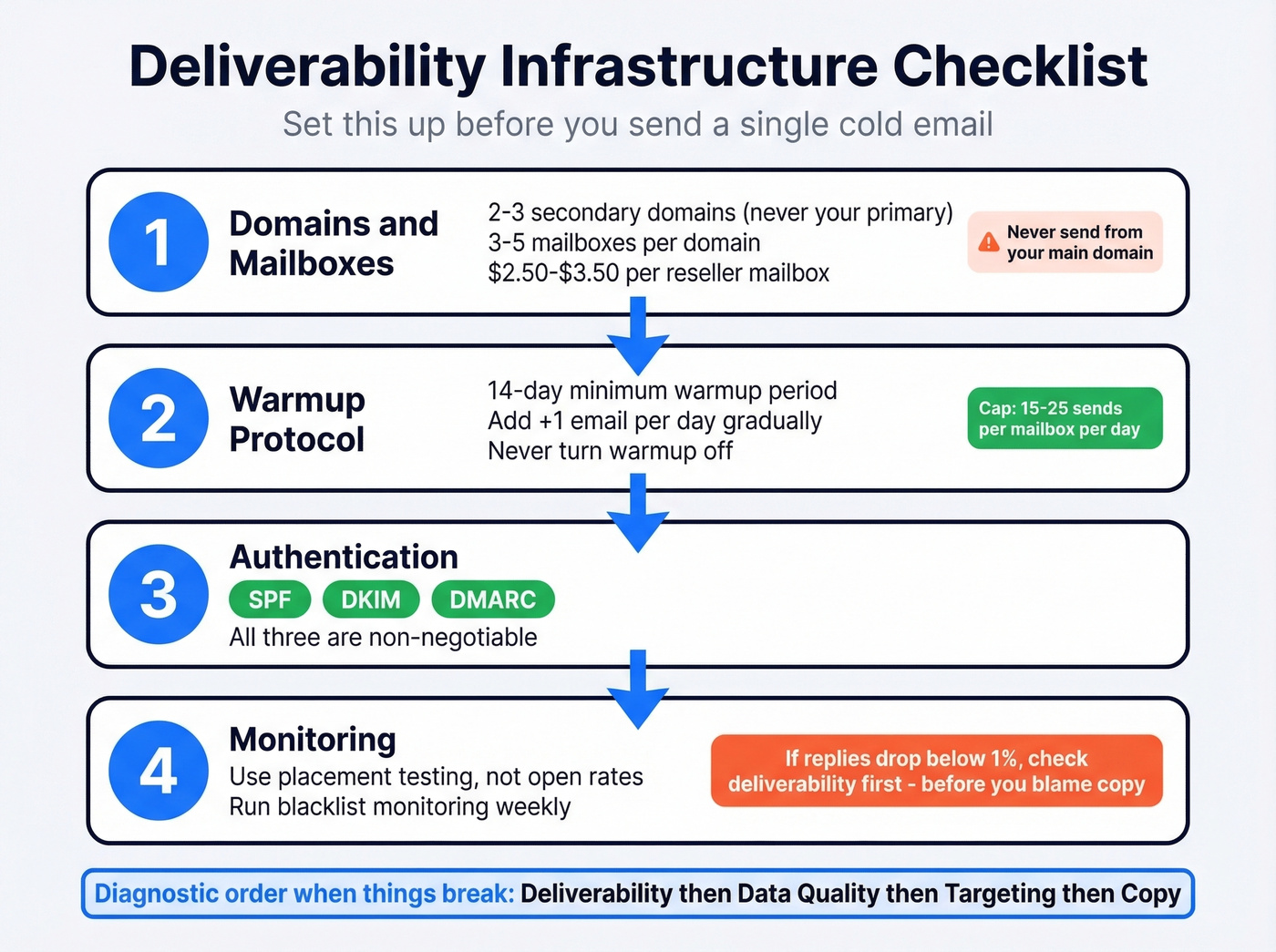
Domains and mailboxes: Never send cold email from your primary domain. Buy 2-3 secondary domains across different registrars. Set up 3-5 mailboxes per domain at $2.50-$3.50 per reseller mailbox. This isn't optional - it's table stakes.
Warmup: 14-day minimum, adding +1 email per day. Never turn warmup off. Once warmed, cap at 15-25 sends per mailbox per day on Google Workspace or Microsoft 365. Some agencies push 40-50 per inbox, but we've found 15-25 is safer for long-term domain health.
Authentication: SPF, DKIM, and DMARC are non-negotiable.
Monitoring: Open rates are unreliable thanks to Apple Mail Privacy Protection. Use placement testing and blacklist monitoring instead. If replies drop below 1%, check deliverability first - before you blame copy or targeting.
Cold Email Execution
The consensus on r/b2bmarketing and r/coldemail is clear: 3-4 emails max. The first email does all the work. Follow-ups beyond #3 have diminishing returns, and you're better off relaunching with a new angle two weeks later than grinding through a 7-step sequence nobody asked for.
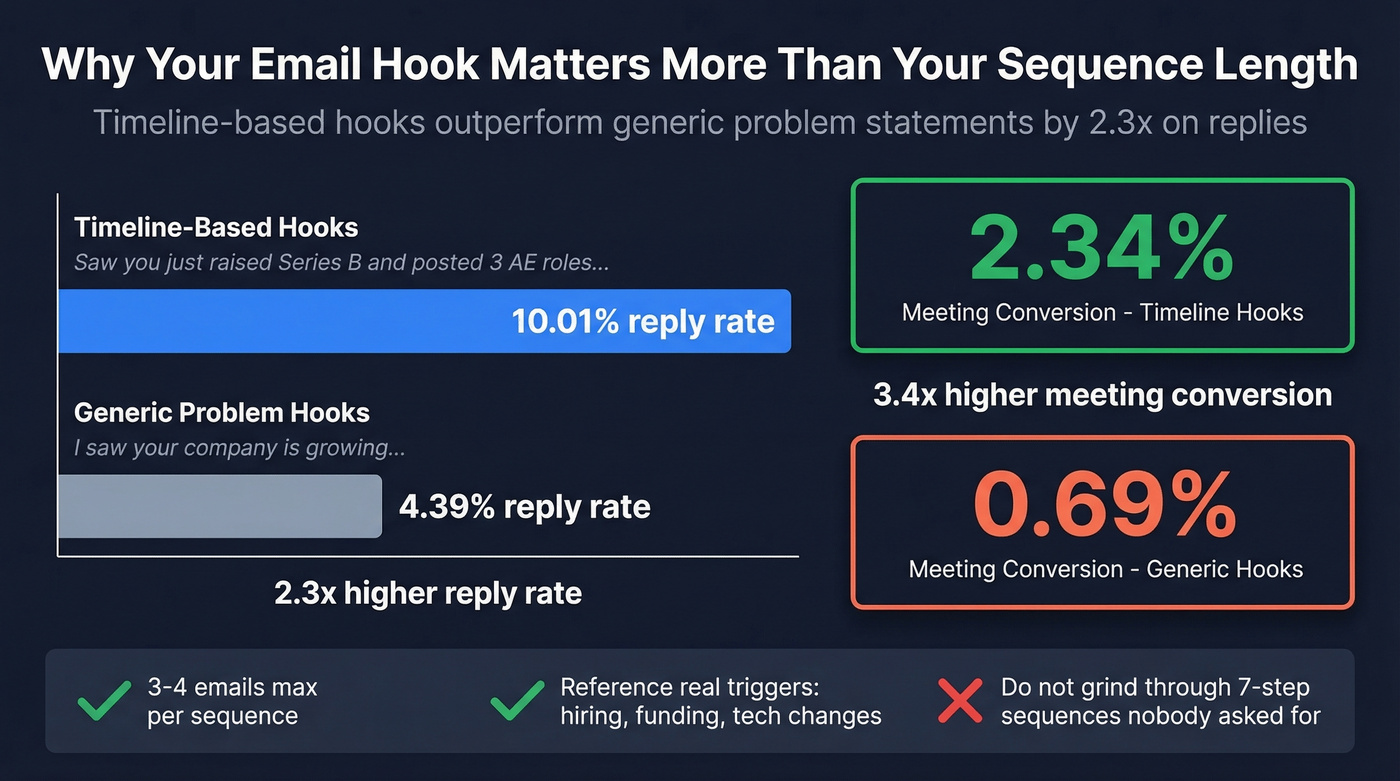
What moves reply rates is the hook. Timeline-based hooks - referencing a specific event or timing trigger - hit 10.01% reply rates versus 4.39% for generic problem-statement hooks. That's 2.3x on replies and 3.4x on meeting conversion (2.34% vs 0.69%). Reference real receipts: their hiring page, a tech change on their stack, a recent funding round, a leadership move.
What doesn't work: generic personalization ("I saw your company is growing..."), long sequences that feel like drip campaigns, and anything that reads like a template engine wrote it. Buyers in 2026 can smell automation from the subject line.
Email is the backbone, but don't ignore phone and social touches. In our experience, teams that layer in even one phone attempt per sequence see 10-20% higher meeting conversion than email-only workflows. The channel mix shifts depending on whether the motion is sales-led or marketing-led, but the principle holds: multichannel outperforms single-channel every time we've measured it.
The Modern Outbound Stack
The old model - 10 SDRs at $4k-$8k/month each plus a $25k+/year ZoomInfo contract - is getting replaced. One GTM engineer with the right automation stack can match the output of a mid-size SDR team at a fraction of the cost.
A connected prospecting stack in 2026:
| Category | Tool Examples | Approx. Cost |
|---|---|---|
| Intent + Enrichment | Prospeo, Demandbase | ~$0.01/email; Demandbase $30k-$100k+/yr |
| Sending | Smartlead, Lemlist, Instantly | ~$39-$149/mo per user |
| CRM | HubSpot, Salesforce | Free tier-$300/mo+ |
| Orchestration | Clay, Zapier, Make | Clay ~$149-$349/mo; others vary |
The key word is connected. If your outreach lives across Gmail, spreadsheets, and disconnected CRM notes, you'll stay busy without building momentum. Every tool should feed data forward automatically. That's what separates a scalable go-to-market engine from a team manually copy-pasting leads between tabs.
Skip the enterprise intent platforms if you're under 50 employees. Tools like Demandbase and 6sense are powerful but priced for large orgs with dedicated RevOps teams. For smaller teams, Prospeo's intent data layer paired with Clay for orchestration gets you 80% of the signal coverage at a tenth of the cost.
Benchmarks and KPIs
| Metric | Standard | Top-Tier |
|---|---|---|
| Reply rate | 5-10% | >10% |
| Meeting conversion | 20-30% of replies | 30%+ |
| Bounce rate | <5% | <2% |
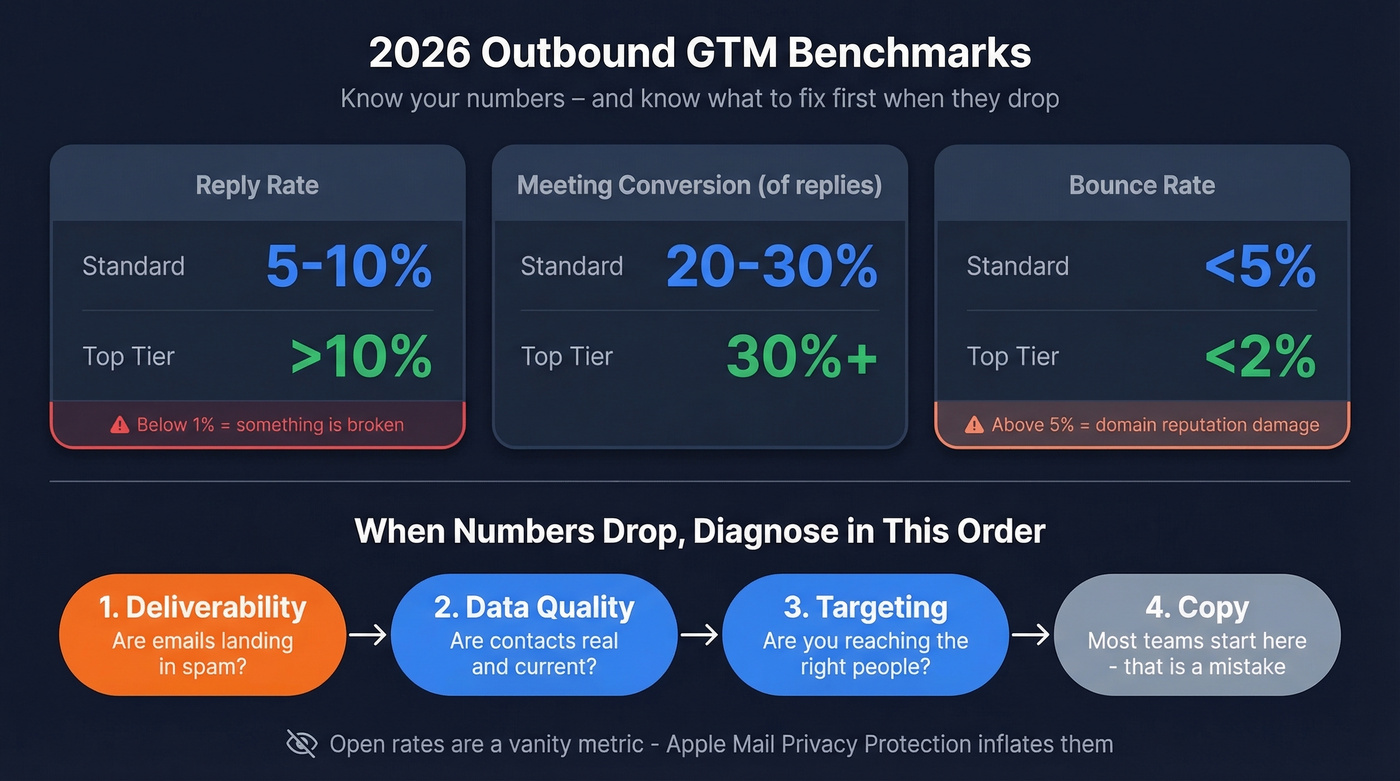
Let's be honest about what these numbers mean in context. Average cold email reply rates have been compressing year over year, and 2026 won't reverse that trend. If your reply rate is below 1%, something is broken. Run the diagnostic in this order: deliverability first, then data quality, then targeting, then copy. Most teams jump straight to rewriting emails when the real problem is their messages are landing in spam.
Open rates are a vanity metric. Apple Mail Privacy Protection inflates them across the board. Don't optimize against a number you can't trust.
FAQ
What's the difference between outbound and inbound GTM?
Outbound proactively reaches prospects through cold email, calls, and social selling, while inbound attracts them via content, SEO, and paid ads. Most B2B teams run both - outbound generates pipeline faster while inbound compounds over time. Your go-to-market strategy should define which channel gets priority based on ACV and TAM.
How many cold emails should I send per day?
Cap at 15-25 per mailbox per day across 3-5 mailboxes per secondary domain. Sending more burns domain reputation and tanks deliverability - the silent killer most teams diagnose too late.
What tools do I need for an outbound GTM strategy?
At minimum: a data platform with verified emails, a sending tool like Smartlead or Lemlist, and a CRM. Add intent data and enrichment orchestration through Clay as you scale. The whole stack runs under $500/month for a small team.
How does account-based outbound differ from traditional prospecting?
Traditional outbound casts a wide net - large lists, generic messaging, volume-driven metrics. Account-based outbound flips the model: you select a finite set of high-value accounts, research them deeply, and coordinate personalized outreach across multiple stakeholders. Pipeline quality is significantly higher, but it requires tighter alignment between marketing and sales.