

Google Ads for B2B: The Practitioner's Playbook (2026 Benchmarks)
A RevOps lead we work with ran a Google Ads audit last quarter. Of $14,000 in monthly spend, roughly $8,000 was going to job seekers, students, and people searching for "free CRM templates." That's not an outlier. A practitioner managing $2M+ in B2B SaaS spend estimates that in about 60% of audits, more than half the budget is wasted on wrong audiences.
Running Google Ads for B2B profitably isn't complicated - it's just tedious enough that most teams skip the fundamentals.
The Short Version
Feed offline conversions - SQLs, not form fills - back to Google. That's the single highest-leverage fix. Expect roughly $5-6 CPC and $70-105 CPL depending on category, and budget at least $3K-5K/month if you want meaningful learning data. Strip your landing page to one CTA, five fields max, and proof. The median B2B page converts at 6.6% and most underperform because of clutter. Quality leads from paid search start with tracking and page discipline, not more budget.
Why B2B Paid Search Is Different
The average B2B sales cycle runs 2.1 months. Each deal involves multiple stakeholders. Google's algorithm is built to optimize for fast, high-volume conversions - fundamentally misaligned with how B2B revenue works.
The upside? Higher ACVs mean you can tolerate a $100+ CPL and still print money, if the leads are real. The entire game is teaching Google what "real" means for your business.
2026 Benchmarks Worth Knowing
Here's what to actually expect, based on 16,000+ campaigns tracked by WordStream/LocaliQ:
| Category | Avg CPC | Avg CTR | Avg CPL |
|---|---|---|---|
| All Industries | $5.26 | 6.66% | $70.11 |
| Business Services | $5.58 | 5.65% | $103.54 |
| Industrial & Commercial | $5.70 | 6.23% | $85.63 |
Year-over-year, CPCs rose for 87% of industries. CTR improved 3.74% YoY. CPL increased about 5% on average.
Clicks are getting more expensive, but conversion rates are improving for teams that invest in tracking and landing page quality. If you're far above your category's benchmark CPL, something's broken - and it's usually conversion tracking, landing page relevance, or a weak negative keyword list.
Campaign Structure That Works
Split campaigns by funnel stage: 60% of budget to bottom-of-funnel keywords (demo, pricing, buy), 30% to mid-funnel (comparison, reviews, vs), and 10% or less to top-of-funnel (what is, how to). Most B2B accounts shouldn't touch TOFU on paid search at all until BOFU is saturated.
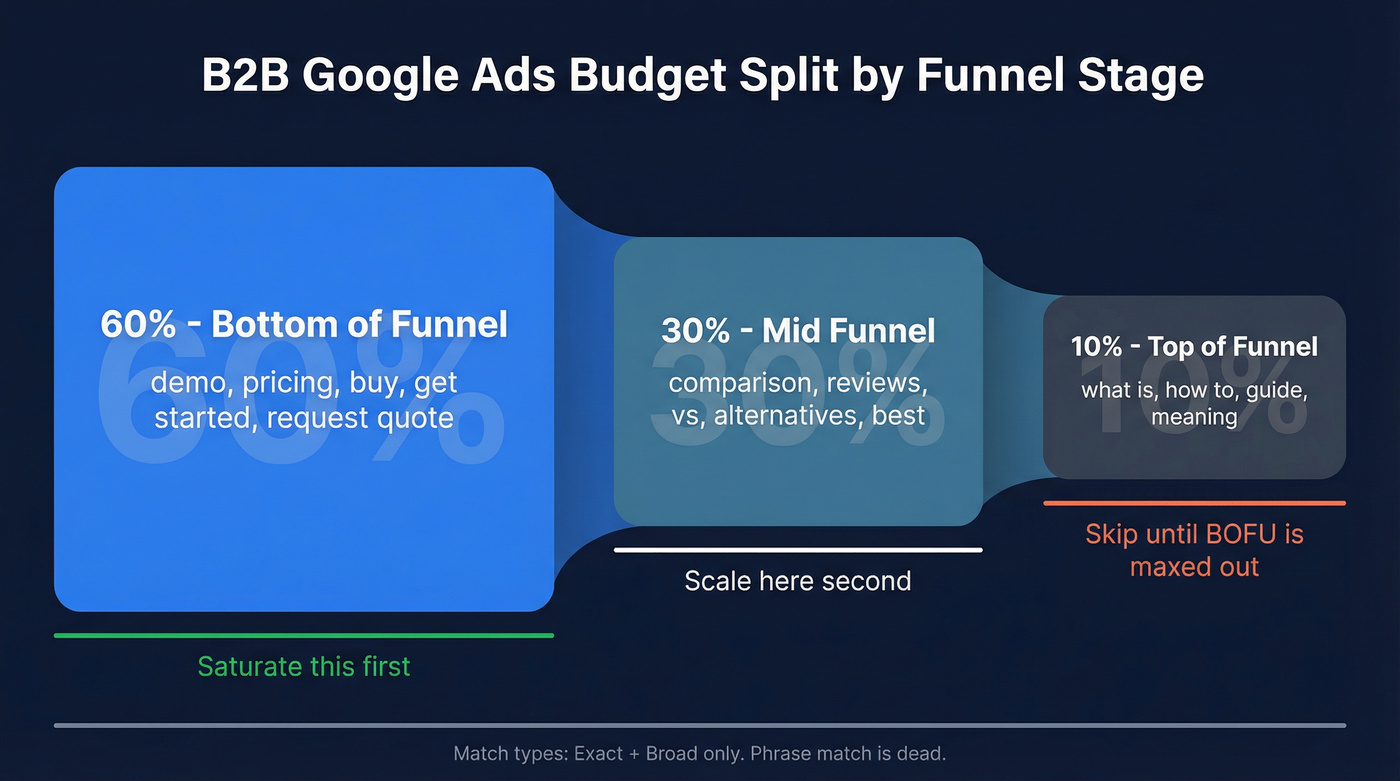
Within each campaign, build tight thematic ad groups with 5-10 keywords. SKAGs are dead. For match types, the consensus on r/googleads is blunt: use exact and broad. Phrase match is essentially dead - too unpredictable, and it overlaps with broad in ways that waste budget.
Your ad copy should repel bad-fit clicks. One practitioner cut cost per SQL significantly by adding "Enterprise-only solution" to their headlines. Pre-qualifying in the ad saves you from paying $5.58 per click for someone who needs a $29/month tool. Responsive search ads give you three 30-character headlines and two 90-character descriptions. Every word has to earn its place.
Your Negative Keyword List Is Too Short
84% of advertisers use fewer than 50 negative keywords. That's a common reason B2B accounts leak budget into job seekers, students, and "free" intent.
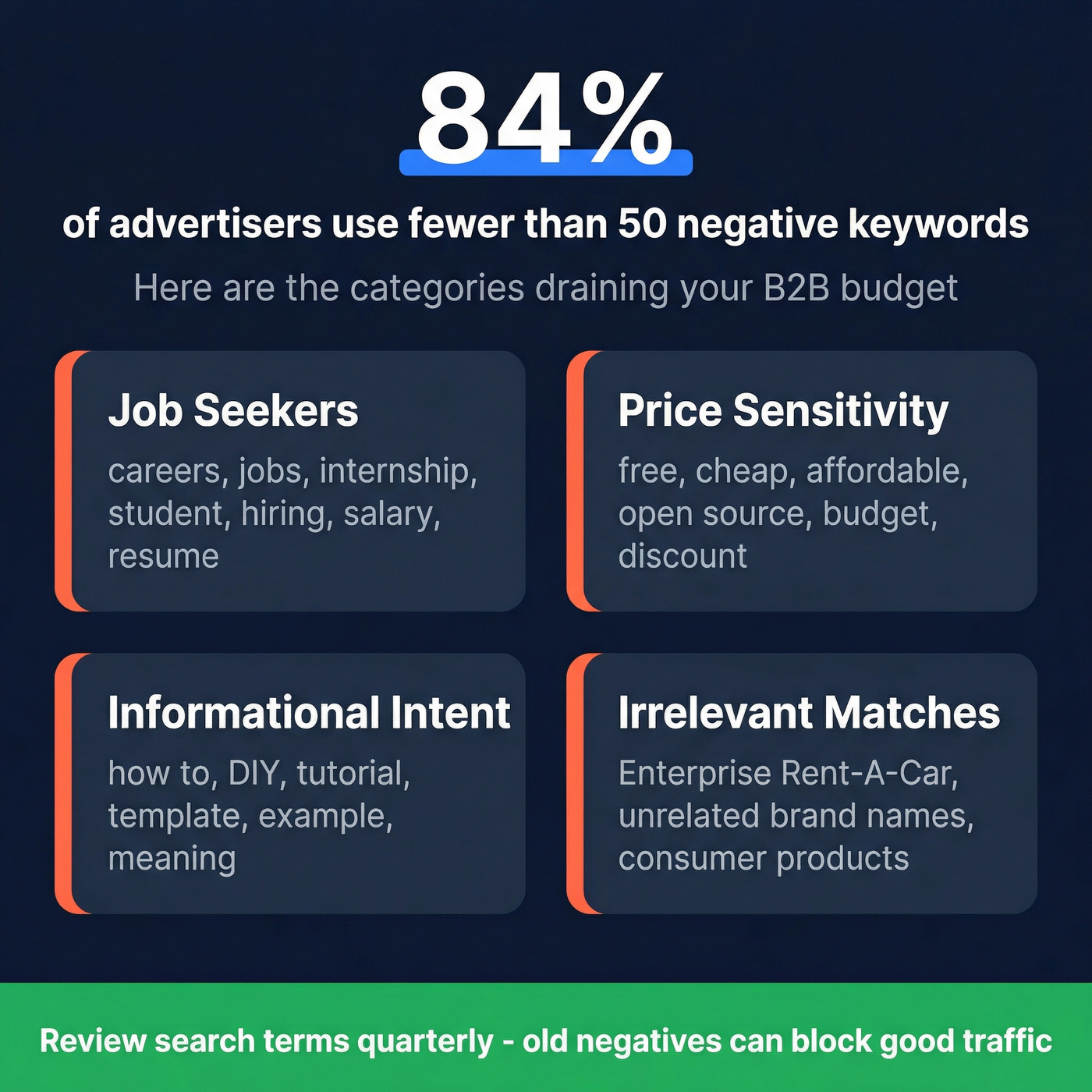
Build your negatives by category:
- Job seekers: careers, jobs, internship, student, hiring, salary, resume
- Price sensitivity: free, cheap, affordable, open source, budget
- Informational: how to, DIY, tutorial, template, example
- Irrelevant matches: if you're bidding on "enterprise," you're probably paying for Enterprise Rent-A-Car clicks
Review your search terms report quarterly. Old negatives can block good traffic as Google's matching evolves, and new garbage queries appear constantly. Cleaning up search terms is one of the fastest ways to increase leads without spending another dollar.

Bad data doesn't just hurt outbound - it tanks your Google Ads performance. When you upload offline conversions with stale emails and mismatched contacts, Google's Smart Bidding learns from garbage. Prospeo's 98% email accuracy and 7-day data refresh keep your CRM clean so match rates stay near 100% and every GCLID upload actually trains the algorithm on real pipeline.
Fix your conversion data before you touch another bid.
Offline Conversion Tracking (Non-Negotiable)
Here's the thing: without offline conversion data, Google optimizes for form fills - finding the cheapest, lowest-quality leads possible. With it, you're training Smart Bidding on what actually becomes pipeline. This is the single biggest lever in B2B paid search.
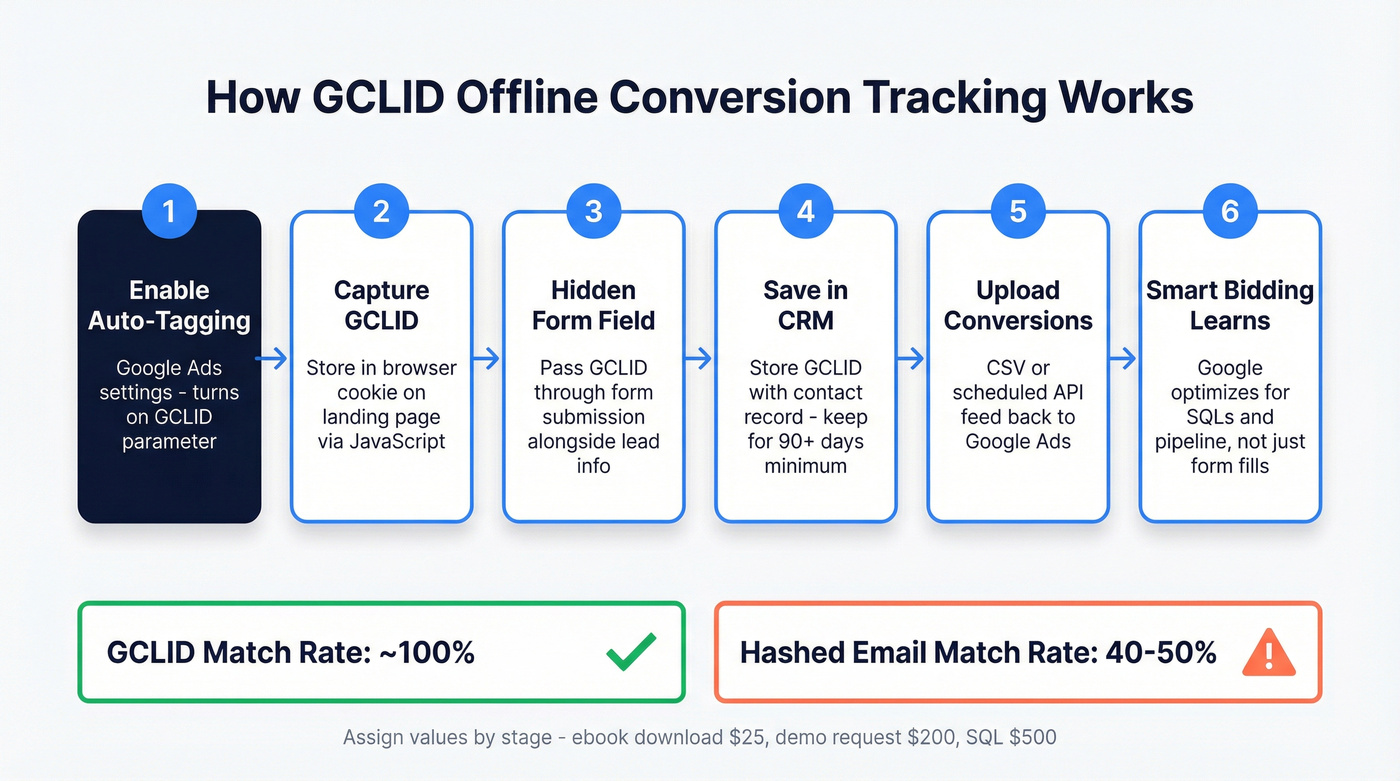
The setup: enable auto-tagging, capture the GCLID, store it in a cookie, pass it through a hidden form field, save it in your CRM for at least 90 days, then upload conversions back to Google via CSV or scheduled feed.
Why GCLID and not hashed email? Match rates. Enhanced Conversions using hashed emails typically hit 40-50% match rates. GCLID matching runs near 100%. That's the difference between Google seeing half your pipeline and seeing all of it.
Assign conversion values by stage: ebook download = $25, demo request = $200, SQL = $500. Juniper Networks implemented this approach and saw -86% CPL and +326% conversion rate. Clean CRM data matters here - if your records are full of bad emails and mismatched contacts, match rates suffer. We've found that running enrichment with a tool like Prospeo before uploading conversions keeps match rates high, since its 98% email accuracy and 7-day refresh cycle catch stale records before they pollute your data.
Search vs Performance Max
Performance Max historically failed B2B teams. It optimized for volume, not quality, and flooded pipelines with job seekers and junk leads.
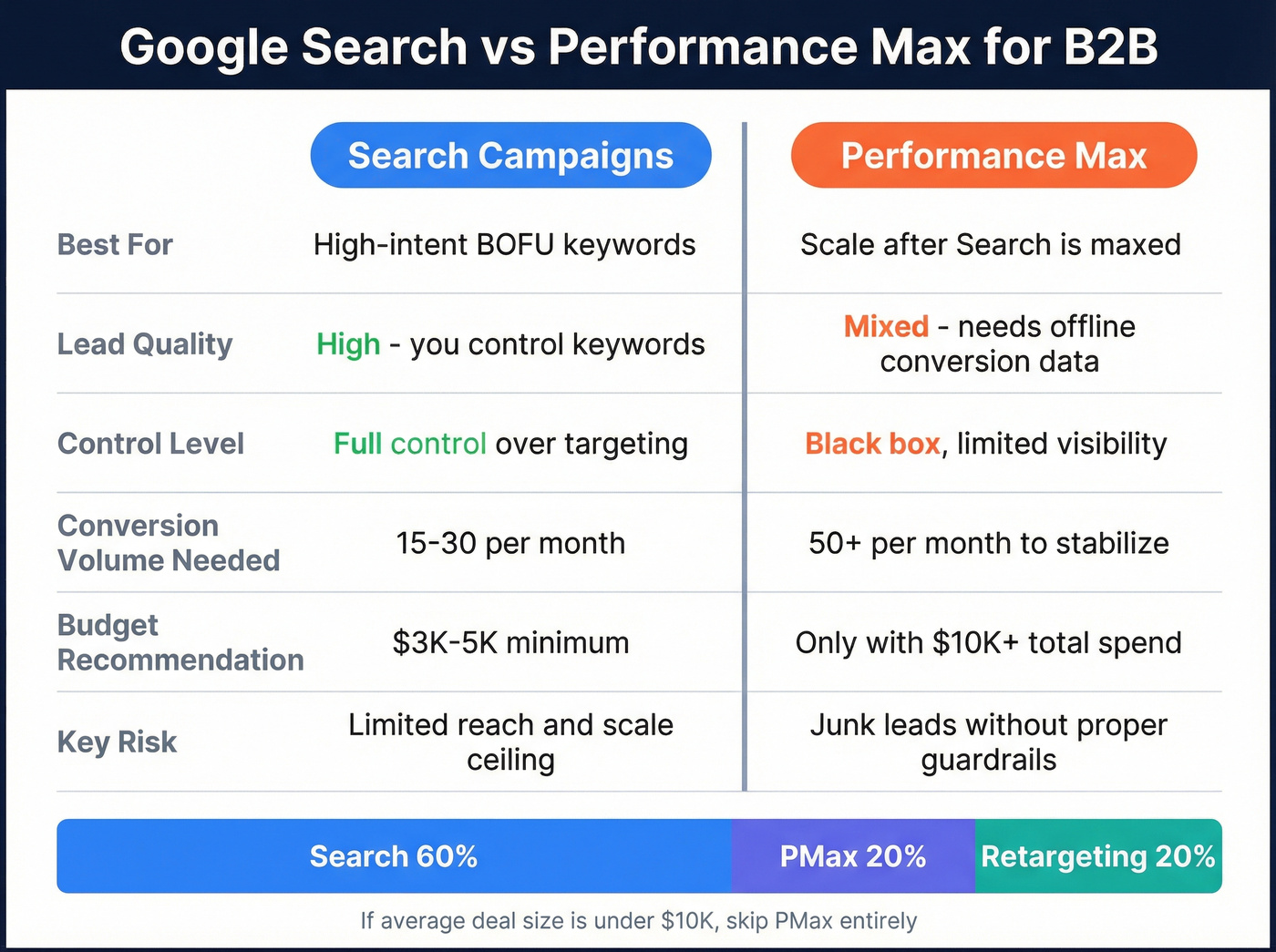
That's changing - but slowly. Account-level negative keyword lists arrived in Q1 2025. AI Max launched in May 2025, delivering up to 27% performance lift in early tests. Real improvements, but PMax still requires guardrails.
To make PMax work for B2B:
- Count only MQL/SQL as conversions, never raw form fills
- Upload ABM lists and competitor URLs as audience signals
- Restrict Final URL expansion to maintain landing page relevance
- Set brand exclusions so PMax doesn't cannibalize branded Search
- Exclude kids' apps and irrelevant YouTube placements
Let's be honest about PMax's learning phase: it needs roughly 50+ conversions per month to stabilize. Most B2B accounts don't hit that on Search alone, which is why the 60% Search / 20% PMax / 20% retargeting split works - it concentrates conversion data where it matters most. If your average deal size is under $10K, skip PMax entirely. Stick with Search and retargeting until your conversion volume justifies the experiment.
Landing Pages That Convert
B2B buyers conduct an average of 12 online searches before engaging with a vendor. Your landing page is competing with everything they've already seen. The median B2B landing page converts at 6.6% across 41,000 pages. SaaS sits lower at 3.8%.
If you're below these numbers, your landing page is the bottleneck - not your ads.
Pages with 5 or fewer form fields convert 120% better than longer forms, and 68%+ of B2B buyers research on mobile. Strip the navigation, use a single CTA, and lead with proof - logos, case study numbers, specific results. Finning applied these principles and saw +86% conversions with -24% CPA.
How Much Should You Spend
Work backward from revenue. Take your revenue target, divide by average deal size, factor in win rate to get required SQLs, then multiply by your CPL ceiling. That's your monthly budget.
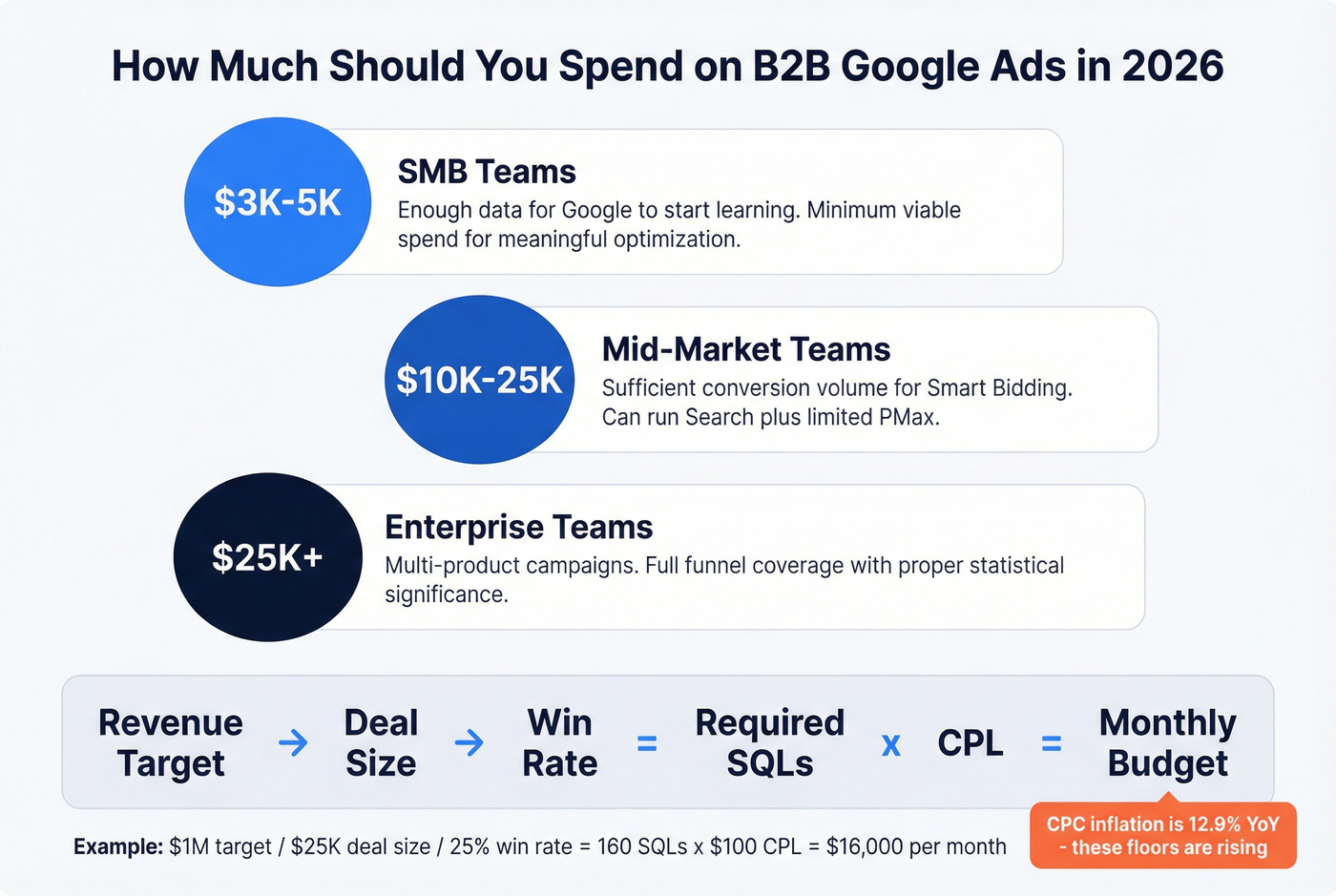
For SMB teams, $3K-5K/month generates enough data for Google's algorithm to learn. Mid-market teams need $10K-25K/month. Enterprise teams running multi-product campaigns typically spend $25K+ monthly. One 2026 strategy breakdown pegs CPC inflation at 12.9% YoY, so these floors are rising. Underspending doesn't save money - it just means Google never has enough conversion data to optimize properly.
Turn Every Lead Into a Pipeline Conversation
You just paid $100+ for a single form fill. But B2B deals involve multiple stakeholders - that marketing manager who downloaded your whitepaper isn't signing the contract. The VP of Engineering, the CFO, and the procurement lead are.
We use Prospeo to pull verified emails and direct dials for the rest of the buying committee at roughly $0.01 per email, drawing from 300M+ professional profiles and 125M+ verified mobile numbers. When your CPL is $100+ and enrichment costs pennies, one ad conversion becomes five or six real conversations across the buying committee. That's how you turn paid search leads into closed revenue.
You're paying $5.58 per click in Business Services. Every lead that bounces or ghosts is money burned twice - once on the click, again on the follow-up. Prospeo returns 50+ verified data points per contact at $0.01/email, so your sales team reaches real buyers from every form fill, not dead ends.
Turn expensive clicks into conversations that actually close.
FAQ
What's a good CPL for B2B Google Ads?
$70-105 depending on category. Business Services averages $103.54, Industrial & Commercial runs $85.63. If you're far above your category benchmark, audit your negative keywords and conversion tracking first - those two fixes alone can cut CPL by 30-50%.
Should I use Performance Max for B2B?
Only after importing offline conversions so PMax optimizes for lead quality, not volume. Without SQL-level conversion data, PMax will flood you with junk. Set brand exclusions, restrict Final URL expansion, and use ABM lists as audience signals.
How long before campaigns produce reliable results?
Plan for 60-90 days of learning. Google's Smart Bidding needs conversion volume to optimize, and B2B sales cycles mean your offline conversion data takes weeks to flow back. Budget enough - $3K-5K/month minimum - to generate statistically meaningful data during this window.
How do I get more SQLs without raising my budget?
Tighten your negative keyword list to stop paying for irrelevant clicks, optimize landing pages for fewer form fields and a single CTA, and feed offline conversion data back to Google so Smart Bidding targets higher-quality prospects. Then enrich every inbound lead - expanding one form fill into 5-6 verified contacts across the buying committee. These changes compound: teams that implement all three routinely see 30-50% more SQLs at the same spend.