

Greeting Email Subject Lines That Get Opened (2026)
You're staring at a blank subject line field, cursor blinking, knowing this tiny string of text will decide whether your email gets opened or deleted. That's not hyperbole: 47% of recipients open emails based on the subject line alone, and 69% use it to decide whether to hit the spam button. With email delivering roughly $36 for every $1 spent, a bad greeting email subject line isn't just a missed open - it's lost revenue.
What a Good Open Rate Looks Like in 2026
Before optimizing anything, you need a baseline. The latest ActiveCampaign benchmark study puts the overall average open rate at 39.26% with a 6.21% click rate.
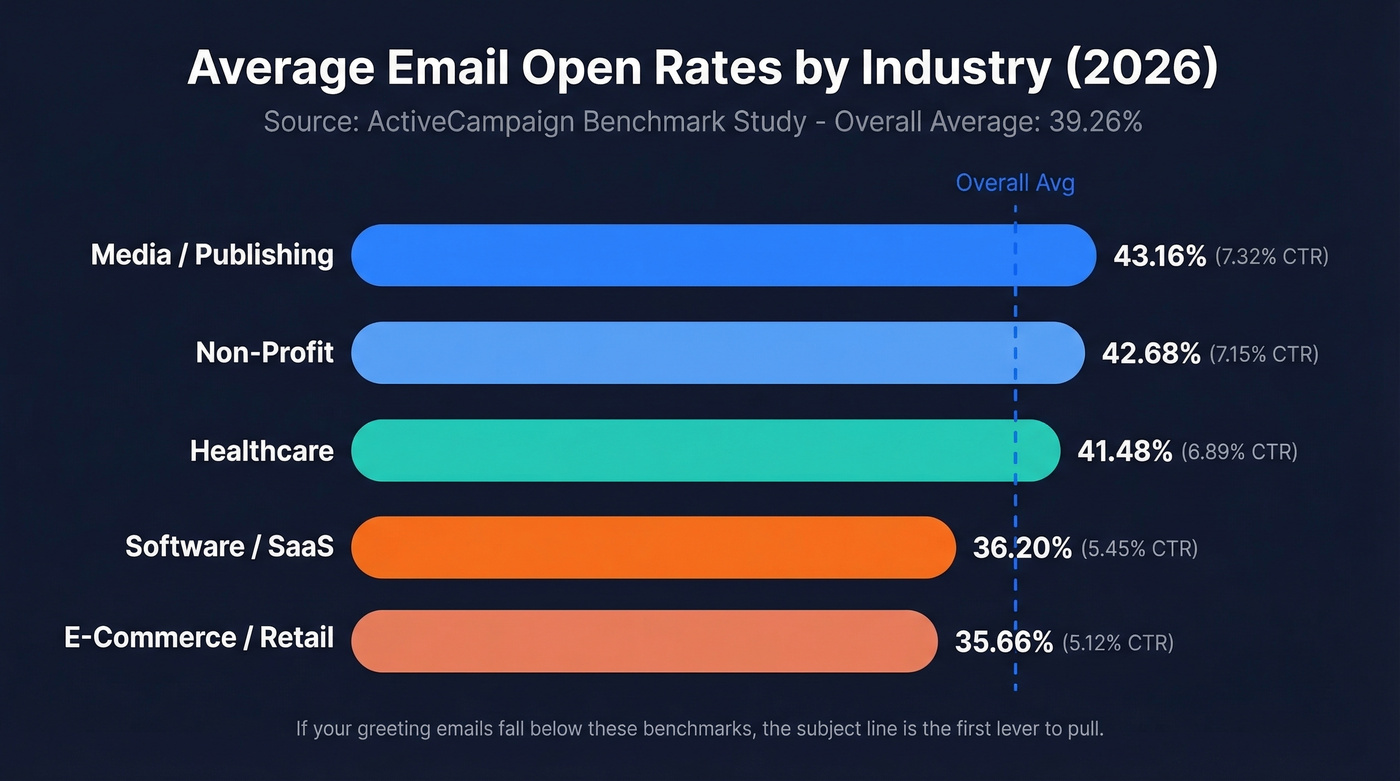
| Industry | Avg Open Rate | Avg Click Rate |
|---|---|---|
| Media / Publishing | 43.16% | 7.32% |
| Non-Profit | 42.68% | 6.44% |
| Healthcare | 41.48% | 5.89% |
| Software / SaaS | 36.20% | 6.67% |
| E-Commerce / Retail | 35.66% | 5.07% |
These are marketing email averages. Cold outreach and transactional emails behave differently, but the directional truth holds: if your greeting emails land below these numbers, the subject line is the first lever to pull.
50+ Greeting Email Subject Lines by Category
Professional & First-Contact
These are for the emails where first impressions matter most - reaching out to a prospect, a new colleague, or someone you've never emailed before. Personalized subject lines achieve 44% open rates, so every example below includes a personalization slot.
- Quick intro: [Your Name] from [Company]
- [Recipient], connecting on [Topic/Mutual Interest]
- Hello from [Company] - [one-line reason for reaching out]
- [Your Name] + [Recipient Name] - a brief introduction
- Reaching out re: [specific project or initiative]
- Introduction: [Your Name], [Your Role] at [Company]
- [Mutual Connection] suggested I reach out
- A note from [Your Name] at [Company] about [Topic]
- Connecting with you on [specific shared interest]
- [Recipient], quick hello from [City/Event/Context]
"Quick intro: [Your Name] from [Company]" is our go-to recommendation. At roughly 33 characters filled in, it fits on the smallest mobile inbox views and tells the recipient exactly who's emailing and why. Compare that to a bare "Hello!" - which people regularly call out as too empty or unprofessional in r/AskProfessors threads. A subject line that just says "Hello" is the email equivalent of a limp handshake.
"[Mutual Connection] suggested I reach out" taps social proof. Recipients open it because ignoring a mutual contact feels rude.
Casual & Networking
For warm contacts, former colleagues, and people you've met at events, friendly email subject lines beat vague warmth every time. Specificity is what actually drives opens.
- Great meeting you at [Event] - let's stay in touch
- [First Name], it's been a while!
- Just saying hello - hope things are going well
- Coffee sometime? [Your Name] here
- Loved your [talk/post/article] on [Topic]
- Hey [First Name] - quick hello from [Your Name]
- Circling back - would love to catch up
"Loved your [talk/post/article] on [Topic]" consistently outperforms generic warm hellos because it proves you're paying attention. It triggers curiosity - they want to know what you thought. Specificity is the cheat code.
Welcome Email Subject Lines
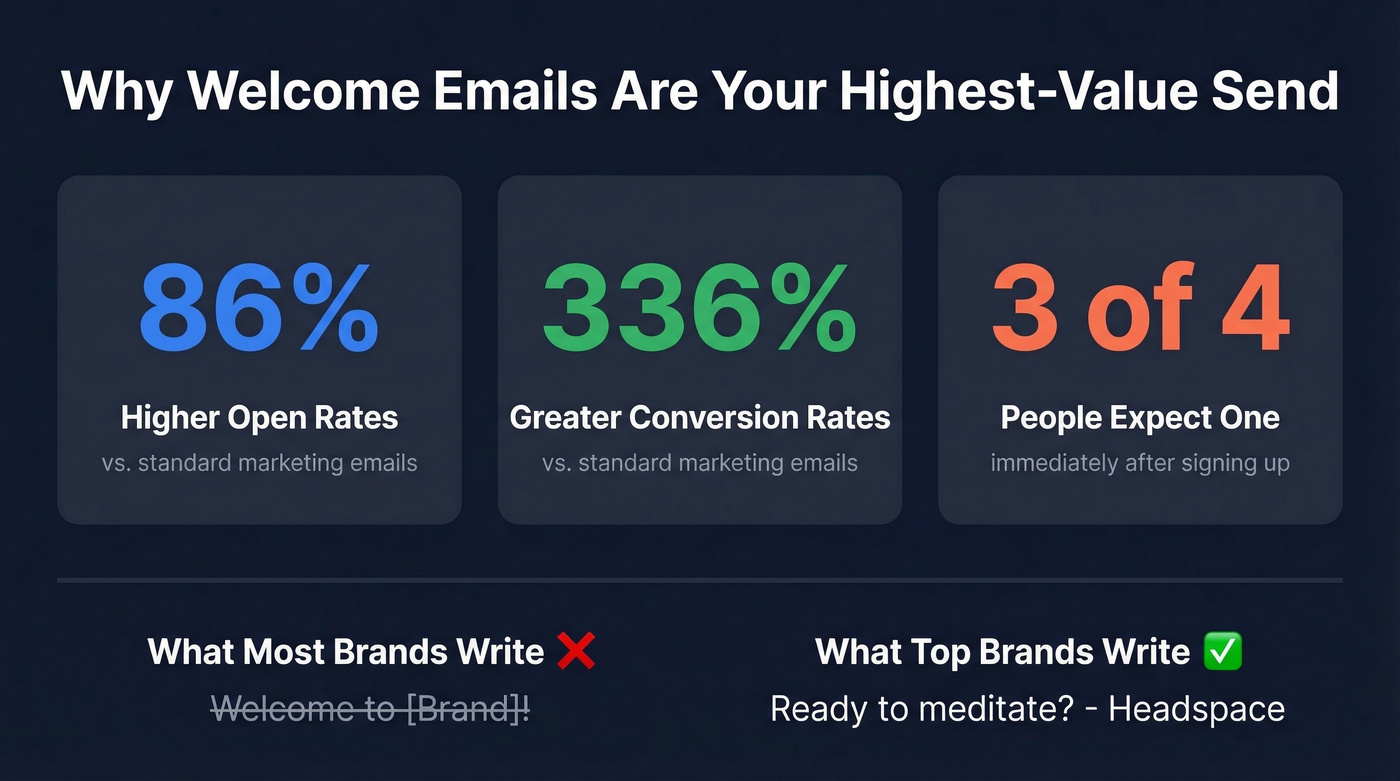
Three out of four people expect a welcome email immediately after signing up. These emails deliver 86% higher open rates and 336% greater conversion rates than standard marketing emails. Wasting this slot on "Welcome to [Brand]!" is malpractice.
- Welcome to [Brand] - here's what happens next
- You're in, [First Name]. Let's get started.
- Welcome to Uber, [First Name]
- Ready to meditate? (Headspace's actual subject line)
- Your [Brand] account is live - 3 things to try first
- [First Name], welcome aboard. Here's your quick-start guide.
- You just joined [Brand]. Here's why that was smart.
- Welcome! Your $25 off is waiting inside
Notice the pattern from the best brands: they don't just say "welcome." They give the recipient a next step, a benefit, or a specific action. Headspace's "Ready to meditate?" is shorter than "Welcome to Headspace!" and infinitely more compelling - it creates anticipation instead of stating the obvious.
In our experience, generic welcome subjects underperform every time. The fix is always the same: replace the label with a reason to open.
Seasonal & Holiday Greetings
- Happy holidays from the [Company] team
- Wishing you a great start to 2026, [First Name]
- Season's greetings - and a quick thank-you
- [First Name], happy New Year from [Company]
- Cheers to a great year - from all of us at [Company]
- Spring check-in: how's Q2 shaping up, [First Name]?
Seasonal subject lines work best when they pair the greeting with something useful - a thank-you, a check-in question, or a forward-looking prompt. A holiday subject line with no substance is just noise in an already crowded inbox.
Reconnection & Follow-Up
For re-engaging dormant contacts, lapsed customers, or people who went quiet.
- [First Name], it's been a while - quick update from [Company]
- Still interested in [Topic/Product]? New things to share.
- We miss you, [First Name] - here's what's new
- Checking in: anything I can help with?
- [First Name], picking up where we left off
- Remember [specific conversation/project]? Quick follow-up.
"Remember [specific conversation/project]?" works because it triggers recall - the recipient mentally re-engages before they even open the email. Generic "checking in" subjects, meanwhile, are getting crushed by fatigue. Practitioners on r/coldemail report that "Quick question" and "Hey {fname}" are rapidly losing effectiveness as recipients pattern-match them to automated cold outreach.
Ideal Subject Line Length
The answer depends on where your recipients read email.
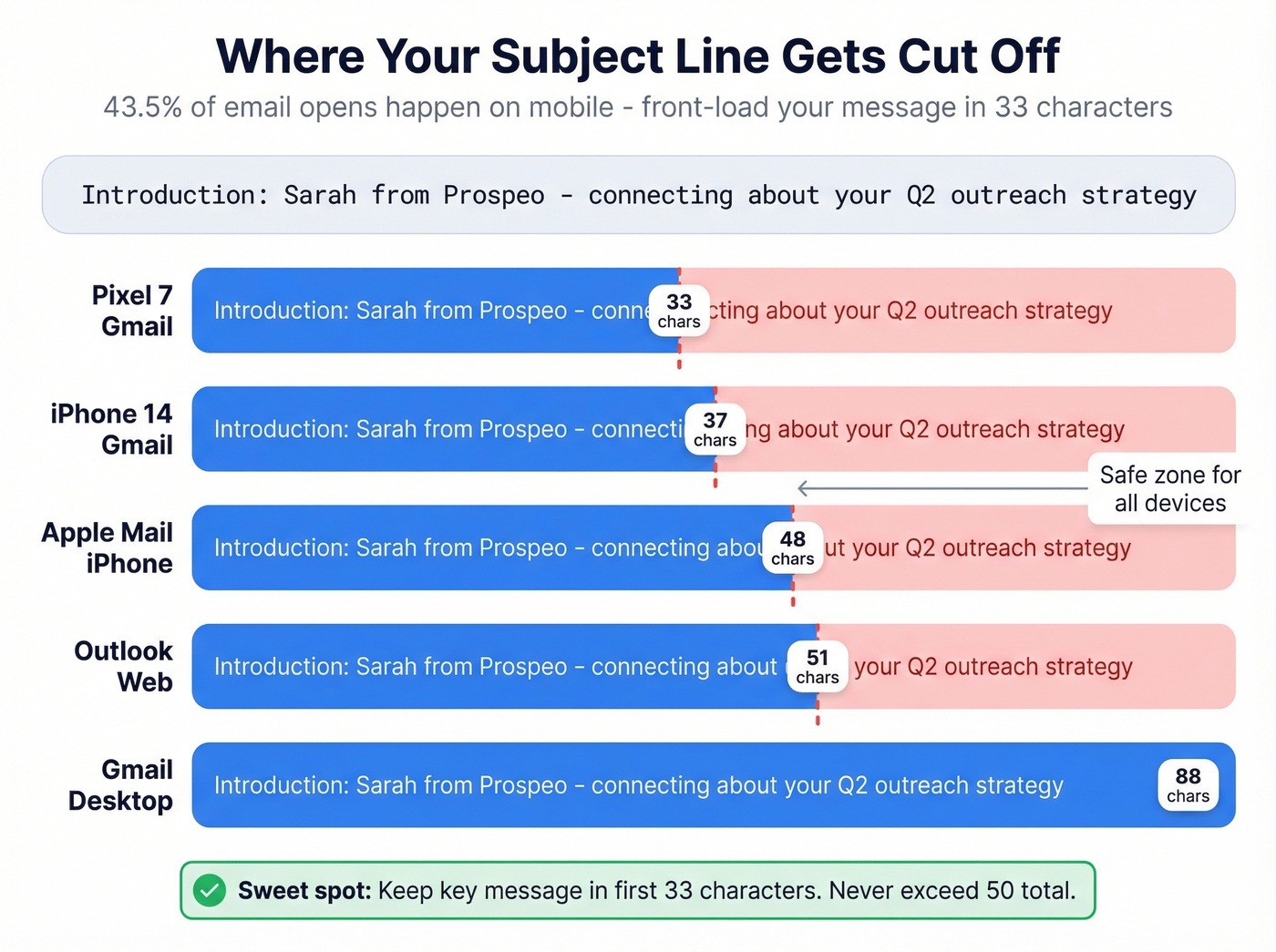
| Device / Client | Visible Characters |
|---|---|
| Pixel 7 (Gmail) | ~33 |
| iPhone 14 (Gmail) | ~37 |
| Apple Mail (iPhone) | ~48 |
| Outlook Web | ~51 |
| Gmail Desktop | ~88 |
With 43.5% of all email opens happening on mobile, truncation isn't an edge case - it's the default reading experience. Front-load your key message in the first 33 characters. Don't exceed 50 total. We've tested this across dozens of campaigns, and front-loaded subject lines consistently outperform back-loaded ones on mobile, often by double-digit percentage points.
A/B test two subject lines per campaign. Keep one variable - length, personalization, or tone - and let your data override any swipe file, including this one. If you want more inspiration beyond greetings, keep a swipe file of email subject line examples and test them against your audience.

Personalized subject lines get 44% open rates - but only if your email actually reaches the inbox. Prospeo's 98% verified emails and 7-day data refresh mean your carefully crafted greeting lands with the right person, not a dead address.
Stop perfecting subject lines for emails that bounce.
5 Mistakes Killing Your Greeting Emails
Subject lines aren't just a copywriting exercise. They're a deliverability signal. ESPs track engagement patterns - opens, deletes-without-reading, spam reports - and use them to decide where your future emails land. If you're seeing issues, start with an email deliverability audit before you rewrite copy.
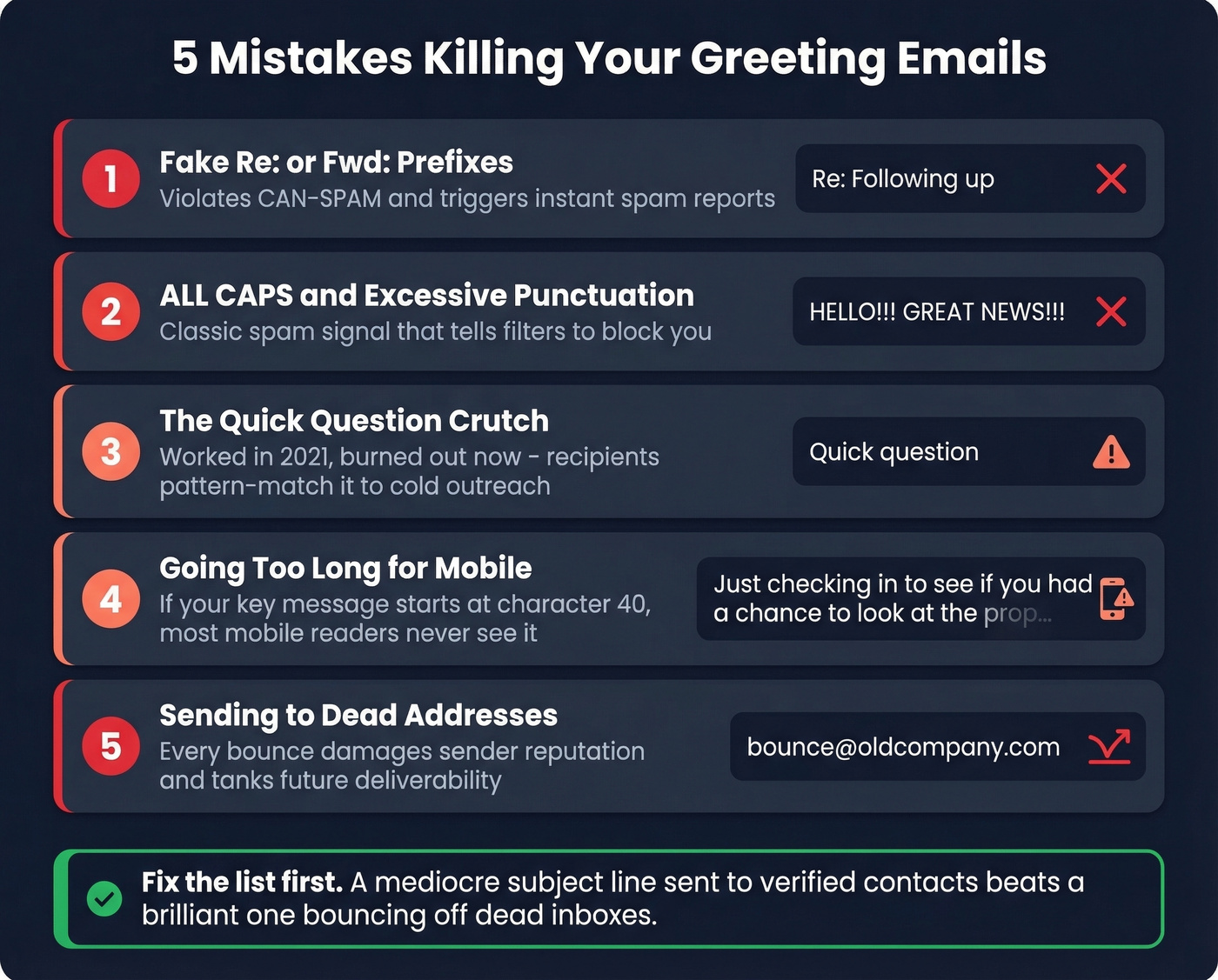
1. Fake "Re:" or "Fwd:" prefixes. When it's misleading, this can violate CAN-SPAM. Recipients who feel tricked hit the spam button immediately.
2. ALL CAPS and excessive punctuation. "HELLO!!! GREAT NEWS!!!" doesn't convey excitement - it's a classic spam signal and tells filters you're exactly the kind of sender they exist to block.
3. The "Quick question" crutch. It worked in 2021. It's burned out now. Recipients pattern-match it to cold outreach instantly, and your open rate pays the price.
4. Going too long for mobile. If your key message starts at character 40, most mobile readers never see it. You've essentially hidden your pitch.
5. Sending to dead addresses. Here's the thing: the best subject line in the world can't save a bounced email. Every bounce damages your sender reputation, which tanks deliverability for every future email you send. Before you optimize a single word of copy, verify you're emailing real addresses. Prospeo's Email Finder validates against 300M+ professional profiles with 98% accuracy on a 7-day refresh cycle - so you're not crafting the perfect greeting email subject line for someone who left the company last quarter.
Let's be honest about where most teams go wrong: they spend hours A/B testing subject line copy while sending to lists full of stale addresses. Fix the list first. A mediocre subject line sent to verified contacts will outperform a brilliant one bouncing off dead inboxes every single time. If bounces are a recurring problem, track your email bounce rate and clean lists before every send.
You just optimized your subject lines. Now make sure every send counts. Prospeo gives you 143M+ verified emails at $0.01 each - with bounce rates under 4%, your greeting emails actually reach decision-makers.
Great copy deserves great data. Start with 75 free emails.
Match Your Greeting to Your Subject Line
Your subject line sets the tone. Your opening salutation confirms it. A mismatch - formal subject line, casual "Hey!" opener - feels jarring and reduces replies.
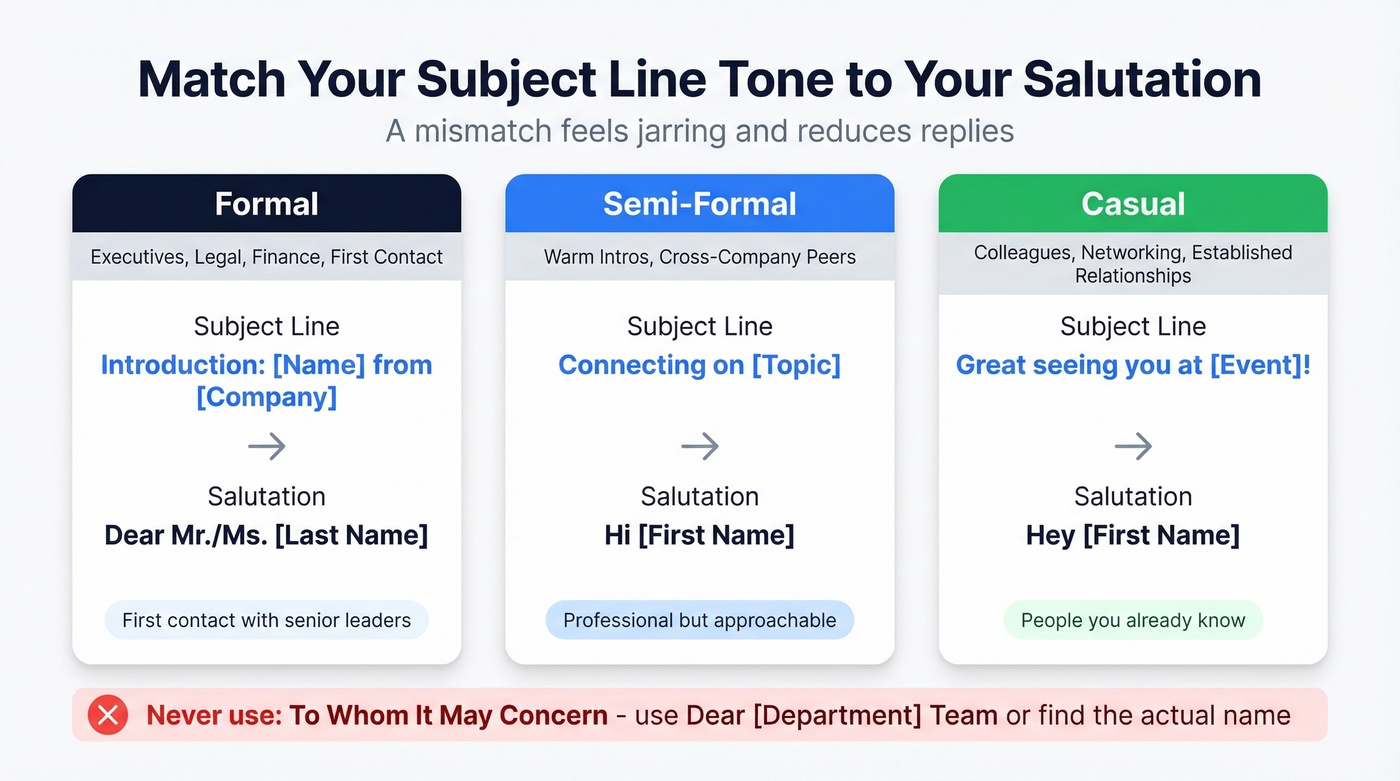
Formal (first contact with executives, legal, finance): A subject line like "Introduction: [Name] from [Company]" pairs with "Dear Mr./Ms. [Last Name]" or "Dear [Full Name]" when you're unsure of preferred title.
Semi-formal (warm introductions, cross-company peers): "Connecting on [Topic]" pairs with "Hi [First Name]" - professional but approachable.
Casual (colleagues, networking contacts, established relationships): "Great seeing you at [Event]!" pairs with "Hey [First Name]" or just "[First Name],"
Skip "To Whom It May Concern" entirely. If you don't know the recipient's name, "Dear [Department] Team" or "Dear Hiring Manager" sounds less robotic and shows you at least tried to narrow down who you're writing to. Better yet, use a Chrome extension to find the actual person's name before you send - addressing someone by name in both the subject and salutation is the single easiest way to stand out in a crowded inbox. (If you're building a repeatable process for this, see our guide to personalized outreach.)
Quick Reference: Subject Line Dos and Don'ts
One last cheat sheet before you go write your next greeting email subject line.
Do:
- Personalize with the recipient's name or a specific reference
- Front-load the important words within 33 characters
- Match the subject line tone to your opening salutation
- A/B test one variable at a time
- Verify your email list before sending
Don't:
- Use deceptive "Re:" or "Fwd:" prefixes
- Write subject lines longer than 50 characters
- Rely on ALL CAPS or emoji clusters for attention
- Send the same "Just checking in" subject to everyone
- Skip list hygiene - bad data kills good copy
FAQ
What's the best subject line for a greeting email?
"Quick intro: [Your Name] from [Company]" consistently outperforms generic options like "Hello!" because it identifies the sender and signals intent. Personalized subject lines achieve 44% open rates - significantly higher than vague alternatives. Always front-load the key detail within 33 characters for mobile visibility.
Should I use emojis in greeting email subject lines?
One relevant emoji can lift open rates for casual or marketing emails - welcome emails and seasonal greetings are fair game. Avoid them in formal first-contact emails. Never use more than two; excessive emojis increase spam complaints and trigger inbox filters.
How do I write friendly subject lines that still sound professional?
Lead with the recipient's name or a specific reference point, then keep the tone conversational without being overly casual. Something like "Hey [First Name] - quick hello from [Your Name]" strikes the right balance between approachable and credible. The key is specificity: vague warmth reads as lazy, while a concrete detail reads as genuine.
How long should a greeting email subject line be?
Aim for 33-50 characters. Mobile inboxes - where 43.5% of emails are opened - truncate aggressively, so your most important words need to appear first. Desktop clients show up to 88 characters, but optimizing for the smallest screen ensures nobody misses your message.