

Growth Mindset in Sales: What It Actually Looks Like on Monday Morning
A tenured rep misses quota for the first time in years and doesn't spiral emotionally - they spiral psychologically. The internal story becomes, "A better salesperson would've gotten that meeting." That's not sadness. It's identity threat. And it's exactly why growth mindset in sales keeps coming up - not because it's cute, but because it builds resilience in sales after a loss.
The data backs the direction: one Wharton summary of Shawn Achor's work ties positive routines to [37% greater sales].
The Short Version
- Treat growth mindset as weekly behaviors, not a personality trait. Start with 30 minutes of call self-review every week.
- Use conversion math to work backward from quota to controllable inputs.
- Handle objections with CALM (Catch, Acknowledge, Loop, Move forward) so you respond instead of react - staying curious rather than defensive.
- Treat every outreach sequence as an experiment with a clear variable and a measurable outcome.
- None of it sticks without the right environment. Coaching time, clean activity data, and psychological safety decide whether reps actually practice.
What This Looks Like on the Sales Floor
Carol Dweck's core idea is simple: skills aren't fixed; they're built. In sales, that means you treat every outcome - talk track, targeting, timing, discovery depth - as data you can train on.
The most useful reframe we've come across was from a career-switcher on Reddit who used a duct tape analogy: you don't force duct tape on someone. You ask if their pool leaks, then see if your solution fits. That mindset drops the pressure, improves discovery, and makes "no" feel like information instead of a verdict.
A growth-oriented sales culture is mostly about curiosity under pressure. Fixed mindset is defensiveness under pressure. You can hear the difference within the first 90 seconds of a call.
What the Research Says
The workplace data is blunt. In TalentLMS's growth mindset report, 80% of executives link employee growth mindset directly to revenue growth, across 300 senior leaders and 1,000 non-executive employees. Not sales science, but a strong performance signal.
The mechanism holds up, too. An EEG lab study (n=25) summarized by the APS Observer found growth mindset correlated with greater error positivity (Pe) and better post-error accuracy - people processed mistakes more deeply and corrected faster. That's exactly what you want after a blown objection or a weak discovery question.
Here's the big caution, though: mindset effects are conditional. The National Study of Learning Mindsets ran a 45-minute intervention across 12,000 students and saw improvements - but mainly when the culture supported challenge-seeking. Scott Barry Kaufman's synthesis of the evidence makes the same point and flags a measurement gap: many mindset scales measure beliefs about intelligence, not skill-building. Context decides whether growth mindset becomes behavior or just a poster on the wall.

You can't run experiments on broken data. If your bounce rate is above 5%, every subject line test and messaging tweak is noise. Prospeo refreshes contact data every 7 days and delivers 98% email accuracy - so when a reply doesn't come, you know it's your approach, not your list.
Stop blaming your copy when the real problem is stale data.
Fixed vs. Growth: Traps That Kill Deals
You lose a deal and immediately narrate it as "I'm bad at sales." That's the same self-blame spiral a 10-year rep described on r/sales - rumination that turns a single call into a story about your identity.
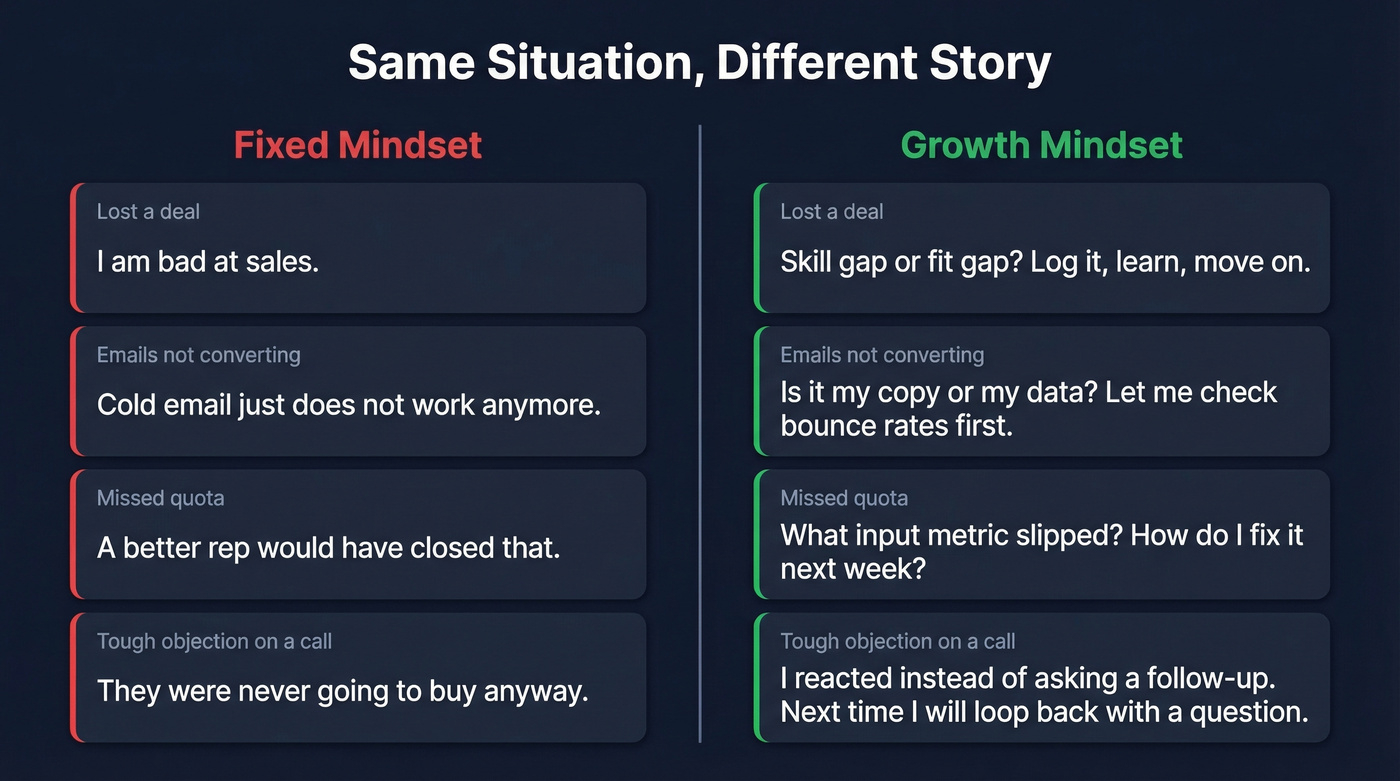
Try this instead: label the loss as skill gap (trainable) or fit gap (not yours to carry). Skill gap gets a specific rep: "Next time, I'll ask X before I pitch Y." Fit gap gets logged and released. Reframing failure this way keeps you learning instead of shrinking.
And here's a modern version of the trap that nobody talks about enough: if an SDR team sends 2,000 emails and 400 bounce - a 20% rate that quietly tanks deliverability - and nobody asks why, they conclude "cold email doesn't work" when the real issue is data quality. An experimentation mindset means questioning the inputs before blaming the channel.
If your bounce rate is above 5%, you don't have a messaging problem. You have a data problem. Fix that first, or every "iteration" on your copy is just noise.
Weekly Habits That Build Resilience
These habits show up in high-performing teams we've studied, and they're lightweight enough to survive a busy quarter.
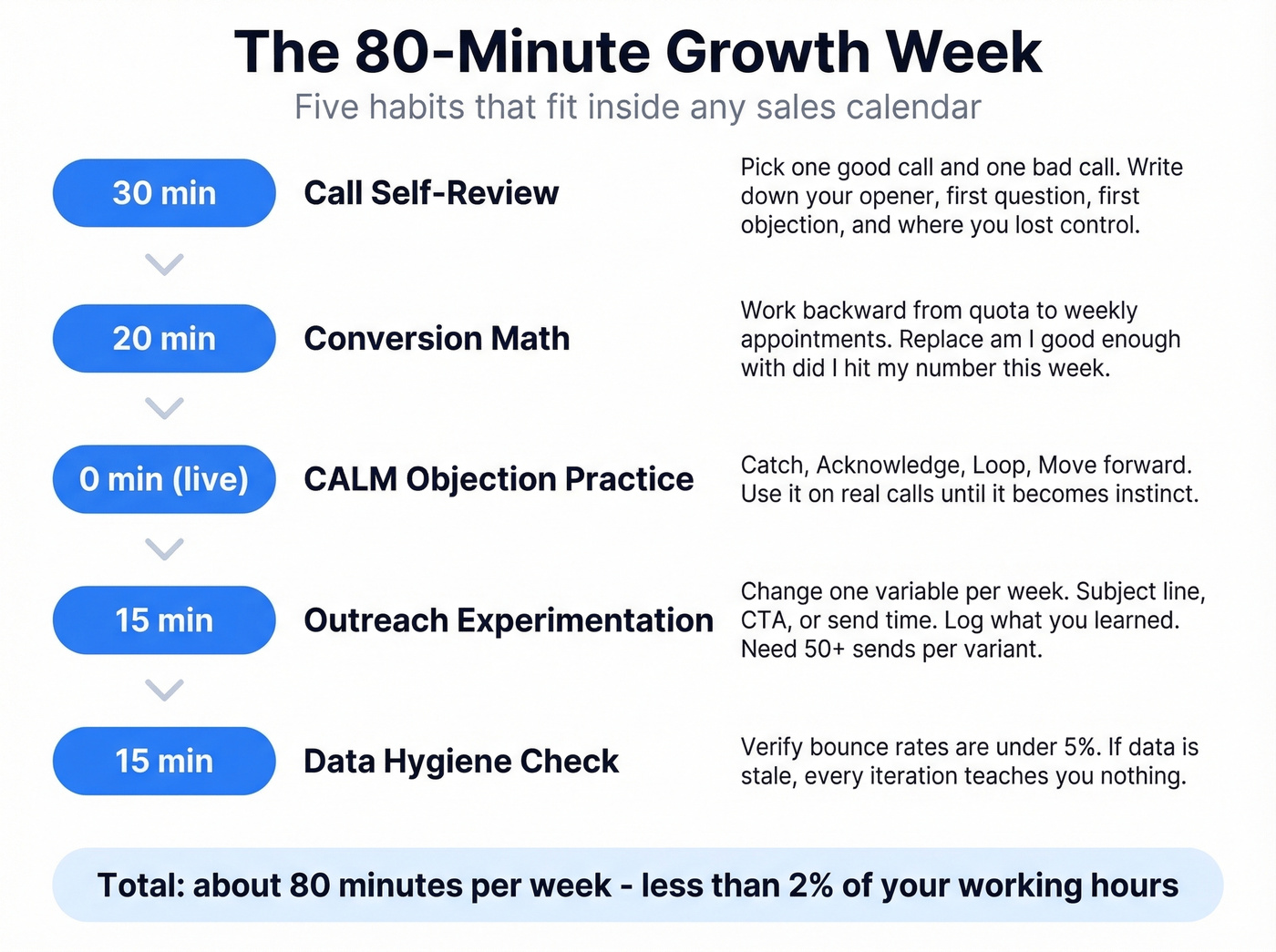
30 min/week - Call Self-Review
Reddit practitioners upvote this constantly, and they're right. Pick one call that went well and one that didn't. Write down your opener, first discovery question, first objection, and where you lost control of the agenda. This is the highest-leverage habit for developing a growth mindset in sales - and it costs nothing but honesty.
20 min/week - Conversion Math
Work backward from the goal. If you want 36 sales/year and it takes roughly 3 appointments per sale, you need 108 appointments - just over 2 per week. That forces reality into the calendar and turns a scary annual number into a manageable daily behavior. Suddenly the question isn't "am I good enough?" but "did I hit my 2 appointments this week?"
The CALM Framework for Objections
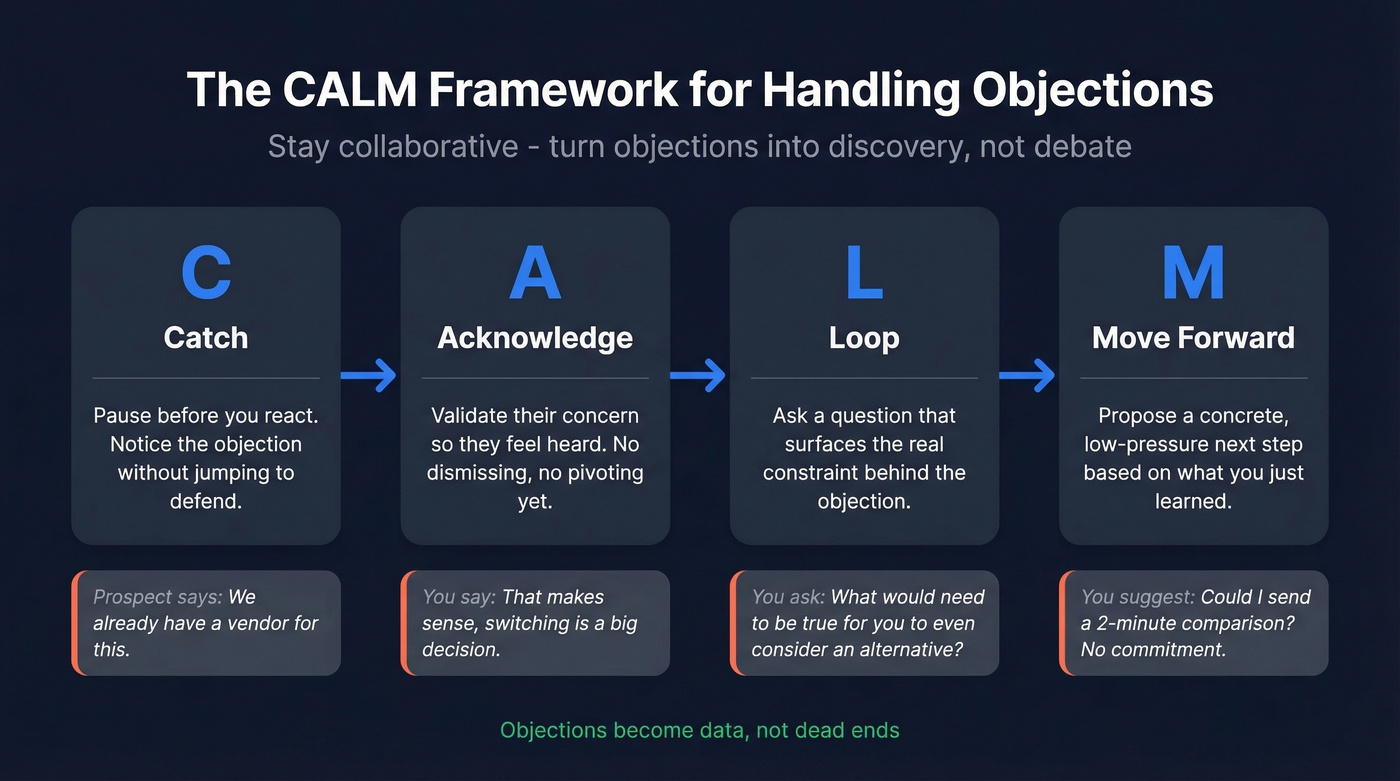
This one deserves more than a bullet, because it changes how objections feel in real time. Developed at Ivey Business School, CALM works in four steps: Catch the objection before you react, Acknowledge it so the prospect feels heard, Loop with a question that surfaces the real constraint, then Move forward with a concrete next step. The whole point is to stay collaborative - objections become discovery instead of debate. Practice it a few times a week on live calls and it becomes instinct fast.
15 min/week - Outreach Experimentation
Treat your sequences like micro-experiments: change one variable per week (subject line, CTA, send time), measure the result, and log what you learned. This keeps your pipeline evolving instead of going stale. Skip this if you don't have at least 50 sends per variant - smaller samples just give you false confidence.
If you want a deeper playbook, borrow a few sales prospecting techniques and run them as controlled tests.
15 min/week - Data Hygiene
Iterating on messaging and learning from reply patterns is the core loop of growth-oriented prospecting. That loop breaks when contact data is stale. If 20% of your emails bounce, you can't tell whether a low reply rate means your messaging needs work or your list is garbage. Tools like Prospeo refresh data every 7 days and verify emails at 98% accuracy, so when an email doesn't get a reply, you know it's your messaging - not your data.
If you’re diagnosing bounces and deliverability, start with email bounce rate and then work through an email deliverability guide to fix root causes.
The 96% vs. 45% Problem
TalentLMS has our favorite stat for calling out performative mindset culture: 96% of executives say they embody a growth mindset, but only 45% of employees agree leadership demonstrates it in practice. Same dataset. Huge gap.
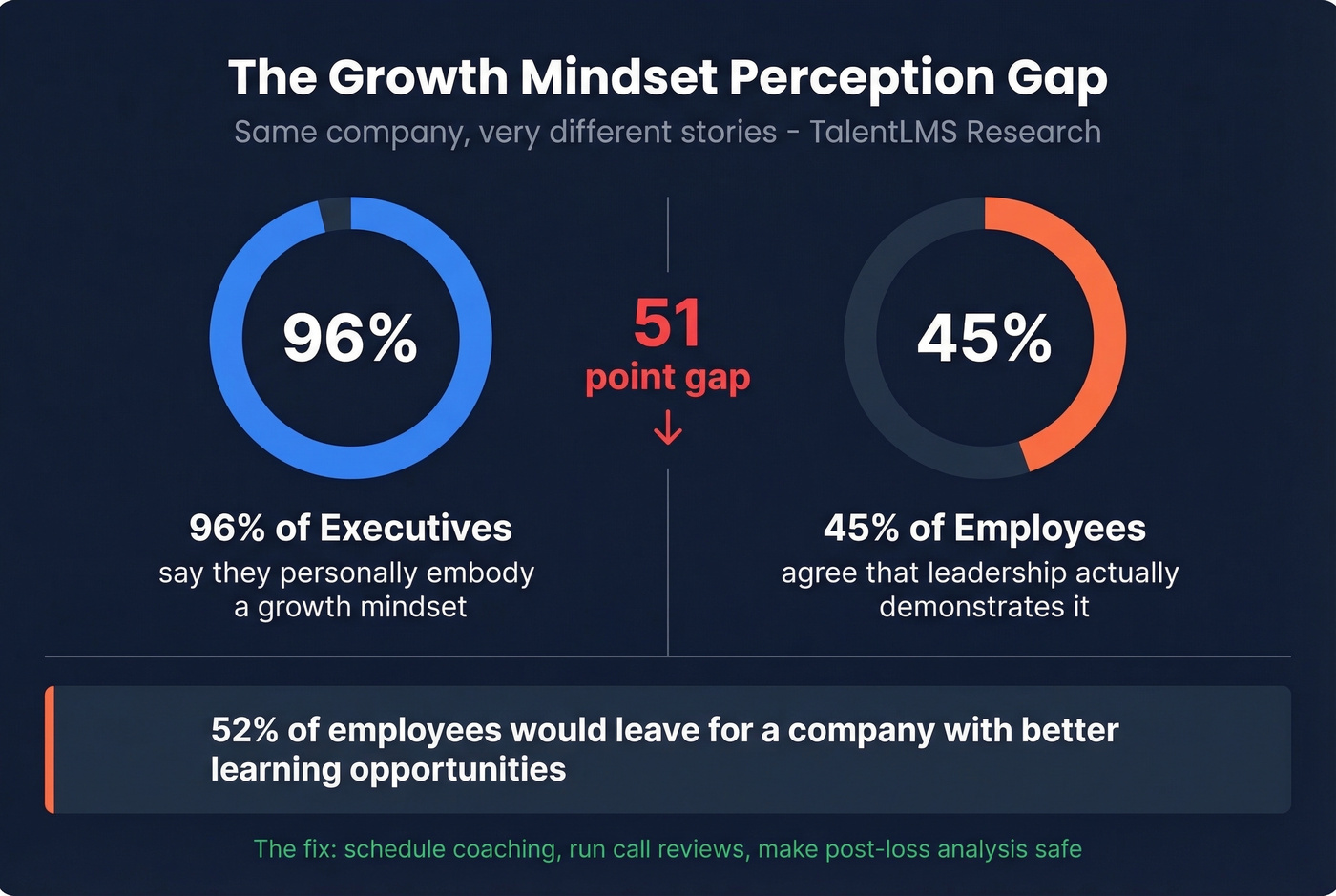
It gets expensive: 52% of employees would leave for a company with better learning opportunities. In sales orgs where ramp time is measured in quarters, that's not a nice-to-have - it's a retention crisis hiding in plain sight.
Let's be honest: managers create the conditions for growth by scheduling it. Put two hours a week on the calendar for coaching, run a weekly call-review circle, and make post-loss analysis psychologically safe. We've seen teams transform just by changing the question from "why did you lose?" to "what did we learn, and what's the next experiment?" (If you need a structure for that cadence, a lightweight 30-60-90 day plan for sales reps helps.)
Growth-minded reps iterate weekly on outreach. That only works when you trust your inputs. Prospeo gives you 300M+ verified profiles at ~$0.01/email - clean enough to run real experiments, cheap enough to scale them.
Make every send count so every iteration teaches you something real.
FAQ
Can you measure growth mindset on a sales team?
Track behaviors, not vibes: call-review frequency, coaching attendance, and post-loss analysis completion rate. If reps consistently review, reflect, and adjust their approach each week, the mindset is already operational. No survey required.
How long does it take to develop a growth mindset in sales?
Most teams see habit formation in 30-90 days. Behavioral shifts like structured call review and conversion math planning start immediately; the compounding effect on win rates typically shows up by the end of the first full quarter.
Why do some sales teams struggle to maintain it?
Broken feedback loops. If 20-35% of emails bounce, reps can't learn from results because they're reading noise, not signal. Clean data and consistent coaching keep the learning cycle intact. Without reliable signals, even disciplined reps end up optimizing against bad information.