

GTM Engineering: What It Is, What It Pays, and Whether It's Worth It
In 2023, Clay coined the "GTM Engineer" role - and the title has been showing up more and more since. GTM engineering and related RevOps postings grew 205% year-over-year, LinkedIn listed 3,000+ open GTM Engineer roles in January 2026, and suddenly everyone had an opinion. Half the sales ops world thinks it's the future. The other half thinks it's RevOps with better branding.
Both sides have a point. Here's the data.
The Short Version
Go-to-market engineering is a real, growing discipline - $127,500 median salary, 205% job growth, and companies like Ramp ($184K) plus top-tier roles at OpenAI ($250K) and Vercel ($252K) paying well north of $180K. The title is debatable. The work isn't.
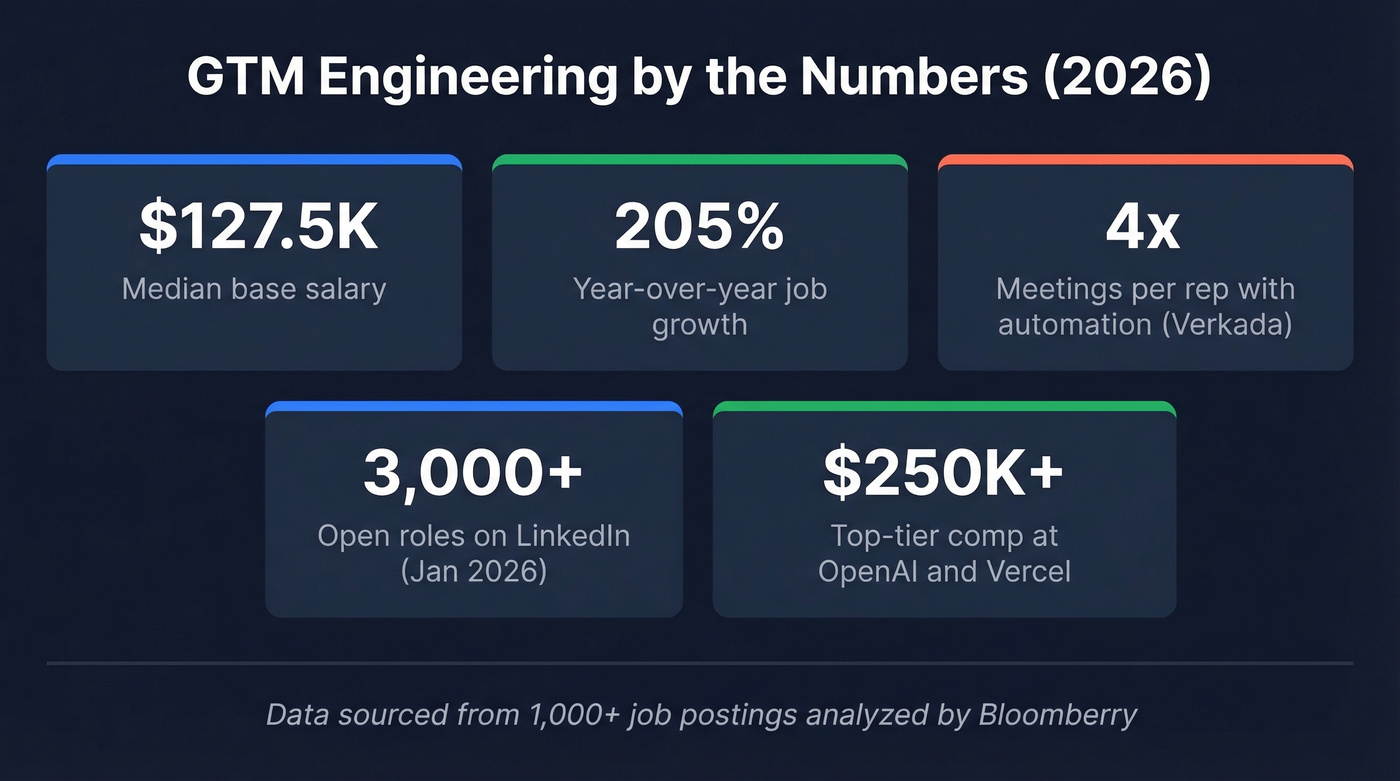
The role: Build and automate the systems that generate pipeline - enrichment workflows, outbound sequences, CRM integrations, signal-based routing. Clay's Verkada case study shows that automating roughly 80% of SDR workflows enabled reps to book 4x meetings per month (80-100 per rep). Rootly reported a 69% increase in scheduled meetings.
The verdict: The job-to-be-done is real even if the title is still finding its footing. The best GTM engineers are evolving from workflow builders into revenue-system architects.
What Is GTM Engineering?
It sits where sales operations, automation, and data infrastructure converge. A GTM engineer uses AI, automation, and data to build systems that directly drive pipeline - not manage process or governance (that's RevOps), but ship the actual machinery that finds, qualifies, and activates prospects.
The term traces back to Clay, which called its internal sales reps "GTM Engineers" because they were building implementation-heavy prospecting systems rather than just dialing phones. The market adopted the label, but the job-to-be-done existed long before anyone coined it.
RevOps teams, growth hackers, and scrappy sales ops managers were already stitching together enrichment waterfalls, conditional routing logic, and multi-tool integrations. What changed is that the AI and automation wave made these systems far more powerful - and more complex - creating enough specialized work to justify a dedicated role. Think of it as applying software engineering principles (modularity, scalability, reliability) to revenue execution.
If your outbound motion involves pulling signals from intent data, enriching contacts through multiple providers, scoring and routing leads, generating personalized copy with AI, and pushing everything into a sequencer - someone has to build and maintain that system. That someone is a go-to-market engineer.
What GTM Engineers Actually Do
The best data comes from an analysis of 1,000+ job postings by Bloomberry. It paints a clear picture.
Core Responsibilities
Three responsibilities dominate:
- Build and automate GTM workflows - enrichment waterfalls, lead routing, signal-based triggers, and multi-step automation sequences. This is the headline.
- Integrate GTM stack tools - connecting Clay to your CRM to your sequencer to your analytics layer. Most GTM stacks run 5-10 tools, and someone has to make them talk to each other.
- Own and optimize the CRM - not just admin work, but ensuring data flows cleanly from enrichment through to closed-won reporting.
The coding requirements tell an interesting story. SQL and Python each appear in 38% of postings. Most roles don't require traditional programming - they're built around no-code and low-code tools. But the roles that do require code tend to pay significantly more.
This isn't an SDR rebrand, either. Only 1.4% of postings mention cold calling. The average experience requirement is 4.11 years. Companies are hiring mid-career operators, not entry-level reps with a new title.
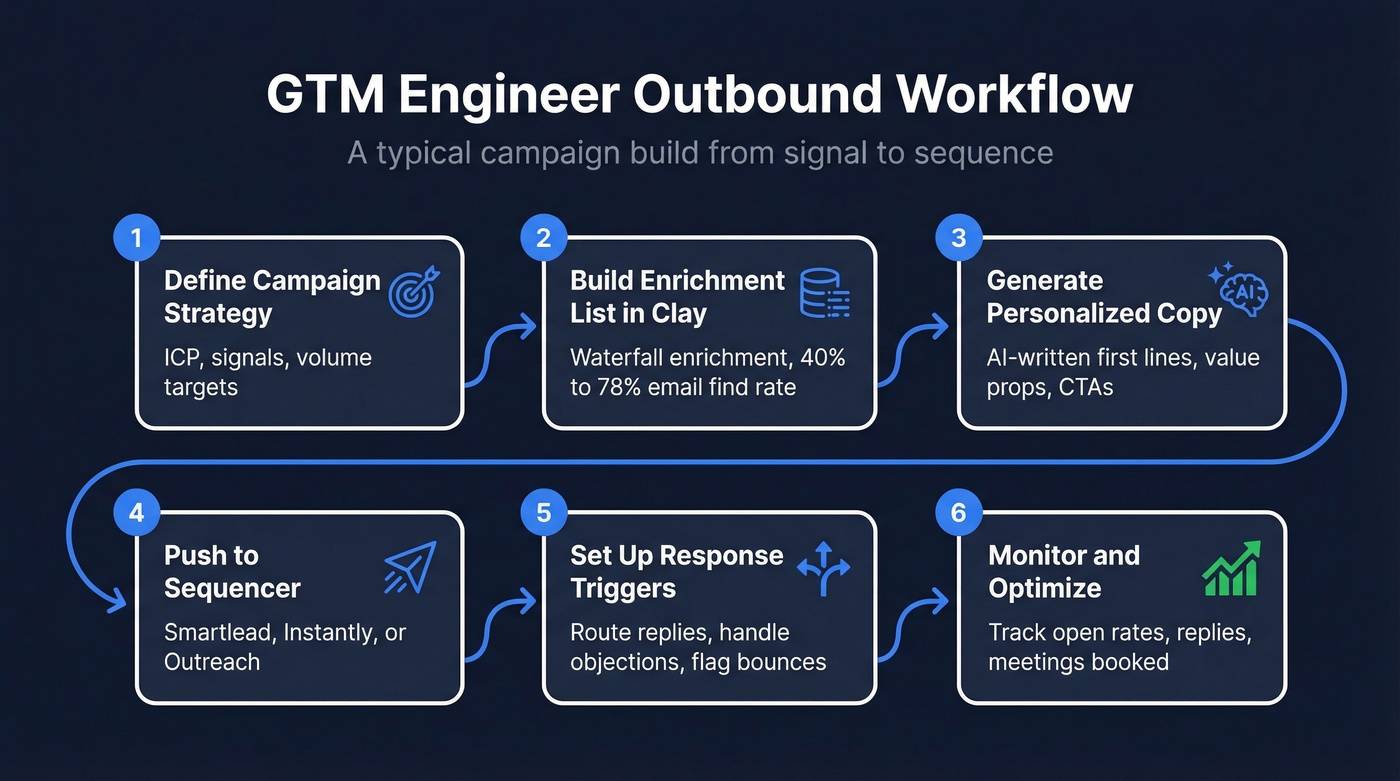
A Real Workflow, Step by Step
Here's what a typical Monday looks like for a GTM engineer running outbound:
- Define campaign strategy - target ICP, select signals (job changes, funding rounds, intent spikes), set volume targets.
- Build the enrichment list in Clay - pull from multiple data providers, run waterfall enrichment to maximize coverage, apply scoring logic. Independent testing cited by Landbase found waterfall enrichment improved email find rates from 40% to 78%.
- Generate personalized copy with AI - use GPT-based tools or Clay's built-in AI to create first lines, value props, and CTAs tailored to each prospect's context.
- Push to sequencer - send verified, personalized contacts to Smartlead or Instantly for automated multi-step outreach.
- Set up response triggers - route interested replies to AEs, handle objections with conditional logic, flag bounces for list hygiene.
That's one campaign. A GTM engineer might run five simultaneously, each targeting different segments with different signals.
GTM Engineer vs. RevOps vs. Growth Engineer
The overlap question comes up constantly, and the data confirms it's warranted. Nine out of ten responsibilities in GTM engineering postings also appear in RevOps postings. The difference isn't what you do - it's what you emphasize.
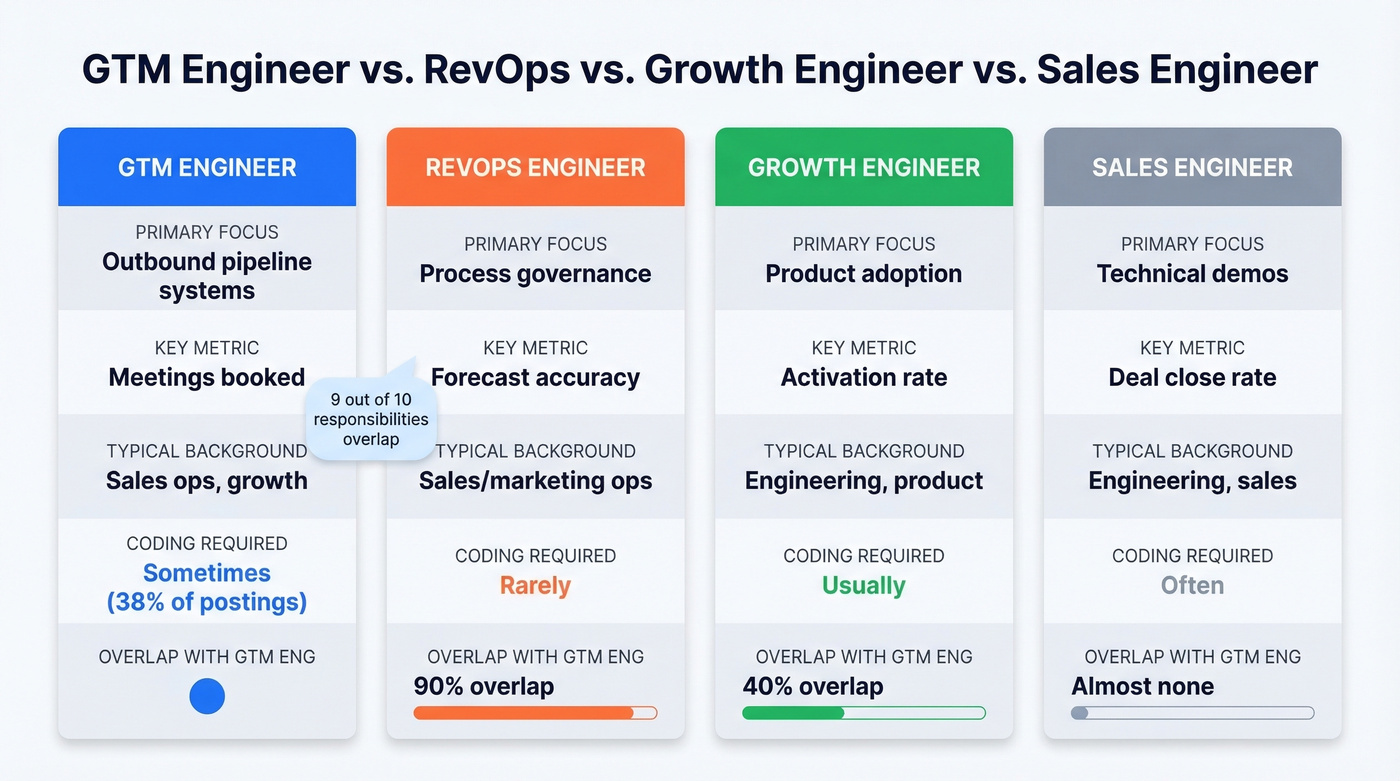
| Role | Primary Focus | Key Difference | Background | Coding? |
|---|---|---|---|---|
| GTM Engineer | Outbound systems | Pipeline automation | Sales ops, growth | Sometimes |
| RevOps Engineer | Process governance | Forecast accuracy | Sales/marketing ops | Rarely |
| Growth Engineer | Product adoption | Top-of-funnel growth | Engineering, product | Usually |
| Sales Engineer | Customer demos | Technical selling | Engineering, sales | Often |
RevOps postings mention forecast accuracy in 76% of listings - it's a governance-oriented role focused on making existing systems run accurately. Go-to-market engineering postings emphasize outbound optimization and prospecting automation. The mandate is narrower and more pipeline-focused.
Growth engineers typically come from engineering backgrounds and write production code. They focus on product-led growth, activation funnels, and top-of-funnel experimentation. There's overlap in the "build systems that generate pipeline" mandate, but growth engineers usually live closer to the product.
Sales engineers? Almost zero overlap. Different job entirely.

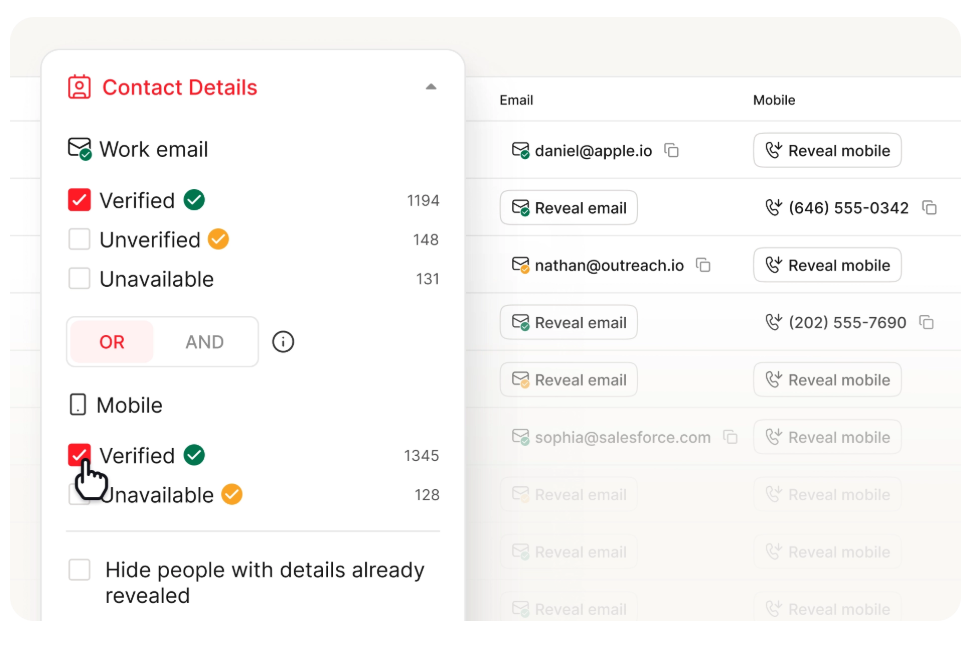
Your enrichment waterfall is only as good as the data feeding it. Prospeo gives GTM engineers 300M+ profiles with 98% email accuracy, 125M+ verified mobiles, and a 7-day refresh cycle - 6x faster than the industry average. Native integrations with Clay, Smartlead, Instantly, and your CRM mean fewer broken workflows.
Stop debugging bad data. Start building pipeline that actually converts.
The GTM Engineering Tech Stack
The tools define the role. Here's what actually shows up in job postings and what it costs.
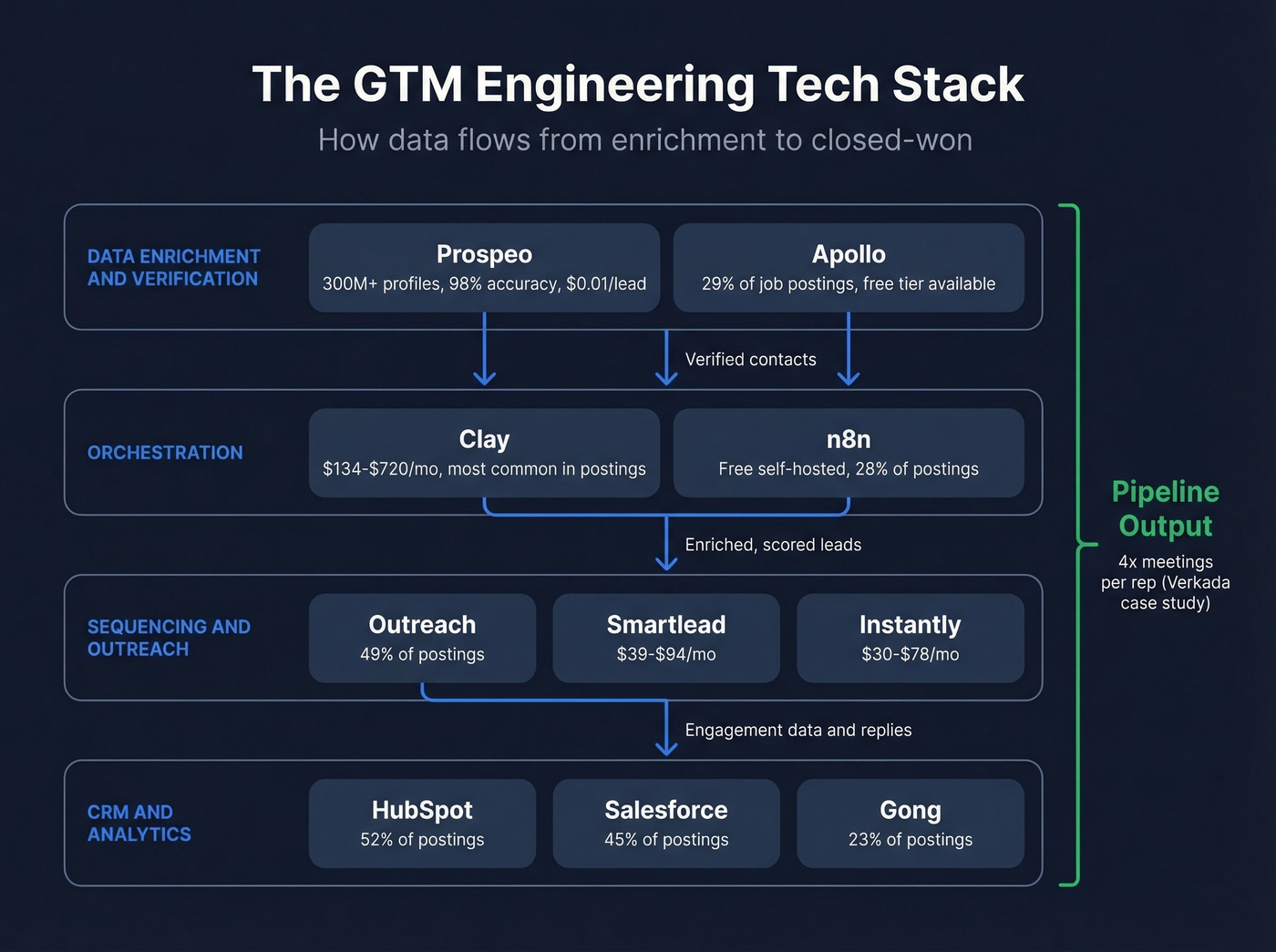
Orchestration
Clay is the most common orchestration tool in postings. It's the layer that connects data providers, enrichment tools, AI models, and sequencers into automated workflows. Plans run from $134/month (Starter) to $720/month (Best Value), with several tiers in between.
The real cost is higher. Annual credit top-ups typically add $1,500-$3,000. Landbase's total-cost breakdown puts annual spend around $4,200-$9,600 once you factor in credits and dependencies. Clay restructured pricing in March 2026, splitting into Data Credits (enrichment) and Actions (workflow usage). Data marketplace costs dropped, but workflow-heavy users pay more.
Use Clay if you're building complex, multi-step enrichment workflows with conditional logic across multiple data providers. Skip it if your outbound is straightforward enough that a simpler tool handles it - n8n is a solid open-source alternative for teams comfortable with a more technical setup.
Data Enrichment & Verification
Every workflow Clay builds is only as good as the data feeding it. This is where most automated outbound silently fails - not because the sequencing logic is wrong, but because 15% of your emails bounce and your domain reputation craters before you hit week two. We've seen this pattern over and over with teams that skip the verification step.
Prospeo handles this layer with 300M+ professional profiles, 143M+ verified emails, 98% email accuracy, and 125M+ verified mobile numbers on a 7-day refresh cycle. At roughly $0.01 per lead, it's about 90% cheaper than enterprise alternatives and integrates natively with Clay, Smartlead, Instantly, Lemlist, Zapier, n8n, and Make.
Apollo is the other major player, appearing in 29% of job postings. It offers a generous free tier and paid plans from $40-$119/month per user. Apollo's strength is its all-in-one approach - database plus sequencing plus dialer - which works well for teams that want fewer tools to manage.
Sequencing & Outreach
Outreach leads in job postings (49%), but the modern stack increasingly favors dedicated cold email tools. Smartlead runs ~$39-$94/month with strong inbox rotation and warmup features. Instantly is similar at ~$30-$78/month. Lemlist adds multi-channel capabilities. For most GTM engineers, the sequencer is a commodity - the differentiation happens upstream in enrichment and orchestration.
CRM, Analytics & Intent
HubSpot appears in 52% of postings, Salesforce in 45%. HubSpot's free CRM is the obvious starting point for smaller teams, with paid tiers scaling up. Salesforce typically runs $25-$300+/user/month and remains the enterprise standard (see Salesforce pricing). Gong (23% of postings) handles conversation intelligence and Looker (17%) covers analytics.
An emerging layer worth watching: visitor identification and intent data tools like Warmly and Factors.ai, which identify up to 75% of anonymous website visitors and feed those signals directly into workflows. This is the kind of signal-based trigger that makes automated revenue systems substantially more effective than manual prospecting.
| Category | Tool | Monthly Cost | In Job Postings |
|---|---|---|---|
| Orchestration | Clay | $134-$720/mo | Most common |
| Orchestration | n8n | Free (self-hosted) | 28% |
| Enrichment | Prospeo | ~$0.01/lead | - |
| Enrichment | Apollo | $40-$119/mo | 29% |
| Sequencing | Outreach | ~$100-$150/user | 49% |
| Sequencing | Smartlead | $39-$94/mo | - |
| Sequencing | Instantly | $30-$78/mo | - |
| CRM | HubSpot | Free + paid tiers | 52% |
| CRM | Salesforce | $25-$300+/user | 45% |
| Analytics | Gong | ~$100-$150/user | 23% |
GTM Engineer Salary in 2026
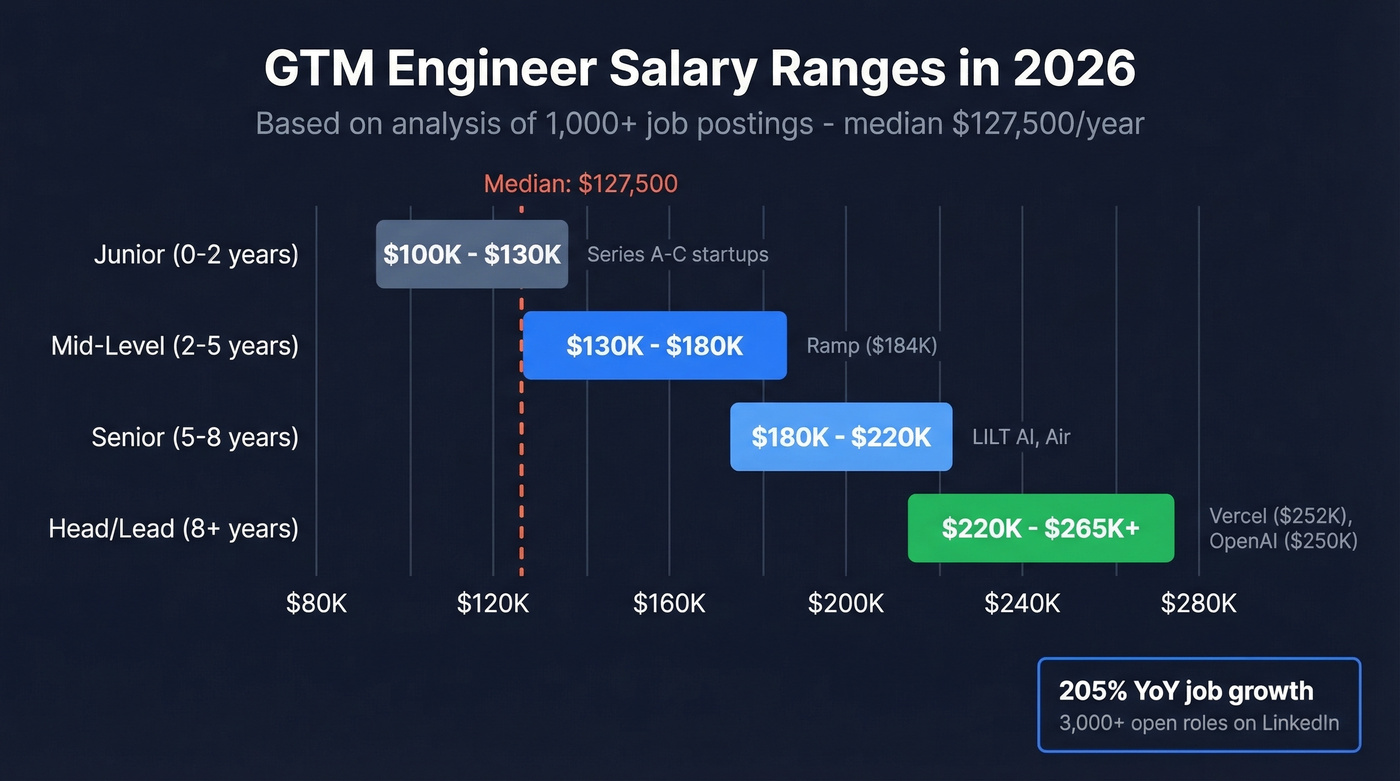
The compensation data is solid. Based on analysis of 1,000+ job postings and aggregated benchmarks:
| Level | Experience | Base Salary | Notable Employers |
|---|---|---|---|
| Junior | 0-2 years | $100K-$130K | Series A-C startups |
| Mid | 2-5 years | $130K-$180K | Ramp, mid-market SaaS |
| Senior | 5-8 years | $180K-$220K | LILT AI, Air |
| Head/Lead | 8+ years | $220K-$265K+ | Vercel, OpenAI |
The median across all postings is $127,500/year. Equity adds 15-40% on top of base depending on company stage - a senior GTM engineer at a Series B company might see $200K base plus $60-80K in annual equity value.
The top payers are exactly who you'd expect: Vercel at $252K, OpenAI at $250K, LILT AI at $221K, Ramp at $184K. These are companies where the discipline is a core competitive advantage, not a nice-to-have hire.
These salaries are competitive with senior software engineering roles at many companies. When companies pay GTM engineers like builders, they're telling you the role creates real value.
Where GTM Engineers Sit in the Org
There's no standard placement yet, which tells you the role is still maturing. But the patterns are instructive.
At Ramp, GTM engineers sit in a "Growth Platform" squad running two-week sprints - essentially a product engineering cadence applied to revenue systems. They ship internal prospecting tools and AI outreach flows. A separate Business Systems group manages Salesforce. This is the most engineering-forward model.
At Verkada, they report into Growth under the CMO. Their charter spans ABM landing pages and automating SDR workflows. It's a marketing-adjacent placement that makes sense when the primary output is pipeline generation.
At Rippling, the function lives in both international and US growth teams, running experiments across outbound and direct mail automation. This distributed model works when the role is embedded in specific market motions rather than centralized.
One stat that jumped out to us: roughly 45% of people with "GTM Engineer" in their title are agencies or consultants, not full-time employees. Many companies are outsourcing this work rather than building the capability in-house, which makes sense given how quickly the tooling evolves.
Is GTM Engineering Overhyped?
Let's be honest - the skepticism is legitimate, and it comes from multiple directions.
An analysis of 28 live job postings found no consensus on scope. Many read like RevOps or marketing ops postings with inflated technical language but no actual coding requirements. The consensus on r/sales and r/salesoperations is blunt: "RevOps with better branding," "made-up term," "good at Clay." One widely shared practitioner take is that the role spiked because building Clay workflows was hard, and now Clay's Sculptor feature lets an SDR with zero experience build a working enrichment workflow in 20 minutes.
There's a useful analogy here. Palantir coined "Forward Deployed Engineer" for what was essentially a solutions engineer. The tasks hadn't changed. The story changed. New acronyms plus AI language create perceived scarcity and prestige even when the job-to-be-done is familiar.
The Clay dependence is real, too. Tools like Origami, Persana, and Bitscale are building "workflowless" alternatives where you describe your ICP in natural language and the system builds the enrichment and outreach pipeline for you. If workflow-building was the moat, that moat is shrinking fast.
But the counter-argument is strong. Ivanti partnered with 6sense and saw a 71% increase in opportunities and $18.4M in new revenue. The best practitioners aren't just building Clay tables - they're designing the overall revenue system, choosing the right signals, orchestrating across tools, and continuously optimizing the pipeline machine. That's systems architecture, not button-clicking.
Here's our take: if your deal sizes sit below $10K, you probably don't need a full-time GTM engineer. A RevOps generalist with Clay skills will get you 80% of the way there. But once average contract values climb above that threshold with any kind of outbound motion, the ROI on a dedicated hire becomes obvious - and the salary data proves companies agree.
The "workflow builder" version of the role is dying. The "revenue-system architect" version is just getting started.
How to Become a GTM Engineer
The universal advice from practitioners is simple: start building. Don't wait for a certification or a title change. Pick a workflow - inbound lead enrichment, account tiering, AI-powered outbound messaging, tradeshow attendee enrichment - and build it end to end.
The motivation is real. Clay's Verkada example shows these systems driving 4x meetings per rep per month. Rootly saw a 69% increase in scheduled meetings. These aren't theoretical gains - they're the kind of results that justify $130K+ salaries and make you impossible to ignore in an interview.
Resources worth your time:
- Clay University - free courses covering workflow building, enrichment waterfalls, and Clay-specific features. Start here.
- Clay Cohort - free, one-week intensive. Good for accelerating from "I've watched tutorials" to "I've built something real."
- Eric Nowoslawski's YouTube - tool-heavy workflow content showing exactly how to build specific systems, step by step.
- Matt Redler's Cold Email Handbook - covers the outbound strategy layer that sits on top of the tooling.
- Cargo-run GTM Engineering Slack - active community for troubleshooting, sharing workflows, and staying current on tooling changes.
- GTM Engineer School - paid program for structured learning. Worth it if you want accountability and cohort-based progression.
GTM engineering isn't about mastering one tool. It's about developing a system-design mindset - understanding how data flows from signal to enrichment to personalization to activation, and knowing which tools to connect at each stage. The specific tools will change. The architecture thinking won't.
Most postings require ~4 years of experience in adjacent roles like sales ops, RevOps, or growth. Career switchers with technical aptitude can ramp in 3-6 months by building real workflows and shipping them. The portfolio matters more than the resume.
If you want a faster path, start with a repeatable lead generation workflow and document the before/after metrics.
The article shows waterfall enrichment jumps email find rates from 40% to 78%. Prospeo's enrichment API hits a 92% match rate with 50+ data points per contact - and at $0.01/email, it costs 90% less than ZoomInfo. Plug it into your Clay workflows via API or native integration.
Ship the GTM system your pipeline deserves for a fraction of the cost.
FAQ
What is GTM engineering?
GTM engineering is the practice of using AI, automation, and data infrastructure to build systems that directly generate pipeline. Unlike RevOps, which focuses on process governance and forecast accuracy, it's narrowly focused on shipping the outbound machinery that finds, qualifies, and activates prospects. The median salary is $127,500 with 205% year-over-year job growth.
Is this just RevOps with a new name?
Nine out of ten responsibilities overlap, but emphasis differs sharply. RevOps manages forecast accuracy and process governance; GTM engineers build outbound systems and prospecting automation. Whether that justifies a separate title depends on your org's complexity - above $15K ACV with dedicated outbound, it usually does.
Do GTM engineers need to code?
SQL and Python appear in 38% of job postings - helpful but not universal. Most day-to-day work uses no-code tools like Clay, Zapier, and n8n. Coding expands what you can build and pushes you into higher salary bands ($180K+), but it's not a prerequisite for breaking in.
Will AI replace GTM engineers?
AI is replacing the "workflow builder" skillset - tools like Clay's Sculptor let anyone build enrichment workflows in minutes. But designing the overall revenue system, choosing the right signals, and orchestrating across tools still requires human judgment. The role evolves from builder to architect; it doesn't disappear.