

GTM Messaging: What It Is, Why Yours Isn't Working, and How to Fix It
Your SDR team is sending hundreds of cold emails a day with messaging that got approved in a Slack thread six months ago - and a painful chunk of those emails bounce. The GTM messaging problem isn't that you don't have words. It's that nobody owns them, nobody tested them, and nobody connected them to verified data.
What Go-to-Market Messaging Actually Is
Positioning and messaging aren't the same thing. Positioning defines your market context - who you're for, what category you compete in, why you're different. Messaging translates that context into specific language your buyers hear. Your go-to-market strategy sets the direction; messaging is the vehicle that carries it into every touchpoint: cold emails, landing pages, demo scripts, sales enablement decks, battle cards.
A messaging document includes your value proposition, proof points, persona-specific variants, and objection handling. It doesn't include taglines, ad copy, or pricing pages. Those are outputs of the messaging, not the messaging itself.
Why Most Messaging Efforts Fail
Fewer than 33% of companies have a formal GTM playbook. The rest run on tribal knowledge and inherited slide decks.
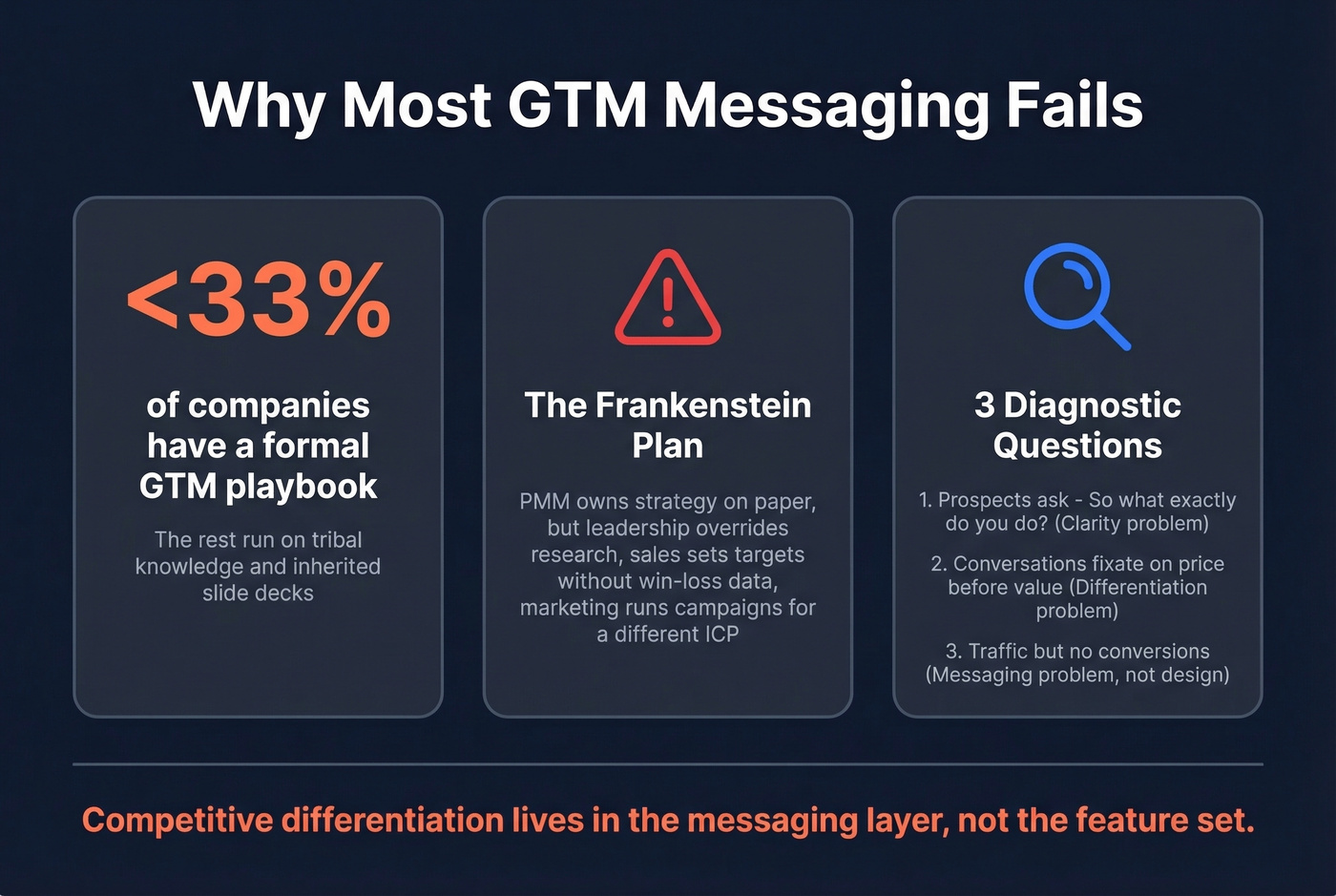
The most common failure mode has a name on Reddit: the "Frankenstein plan." PMM gets tasked with owning strategy, but leadership overrides the research, sales sets targets without win-loss data, and marketing runs campaigns for a different ICP. In our experience, the Frankenstein plan is the default, not the exception. Pipeline pressure before readiness makes it worse - everyone wants leads yesterday, so messaging ships half-baked.
Diagnosing it is straightforward. If your HR tech product looks like "just another ATS" because its unique value isn't communicated, that's a messaging failure, not a product failure. Prospects routinely asking "so what exactly do you do?" means you have a clarity problem. Conversations fixating on price before value means you have a differentiation problem. Competitive differentiation for SaaS companies lives or dies in the messaging layer, not in the feature set. If you're getting traffic but not conversions, the issue is almost always messaging, not design.
Positioning Comes First
You can't write messaging without positioning. April Dunford's method is still the most practical framework available, and it boils down to three steps: let go of your origin category, isolate your uniqueness, and map that uniqueness to customer value.
Userlist ran this exercise and documented the whole thing. They shifted from "email automation" to "customer messaging" - a category creation move that changed every downstream message. Their competitive alternatives clustered into four groups: follow up manually, build in-house, use general-purpose email automation, or use dedicated messaging tools like Intercom. From those clusters, they distilled three value themes focused on effort reduction, user awareness, and adoption growth. Every piece of messaging flowed from that positioning work.
If it's not written down, it doesn't exist.
The Five-Layer Messaging Framework
Wynter's messaging model gives you five layers to diagnose and improve. We've found it's the most actionable framework for B2B teams, and it works whether you're a Series A startup or a scaling enterprise.
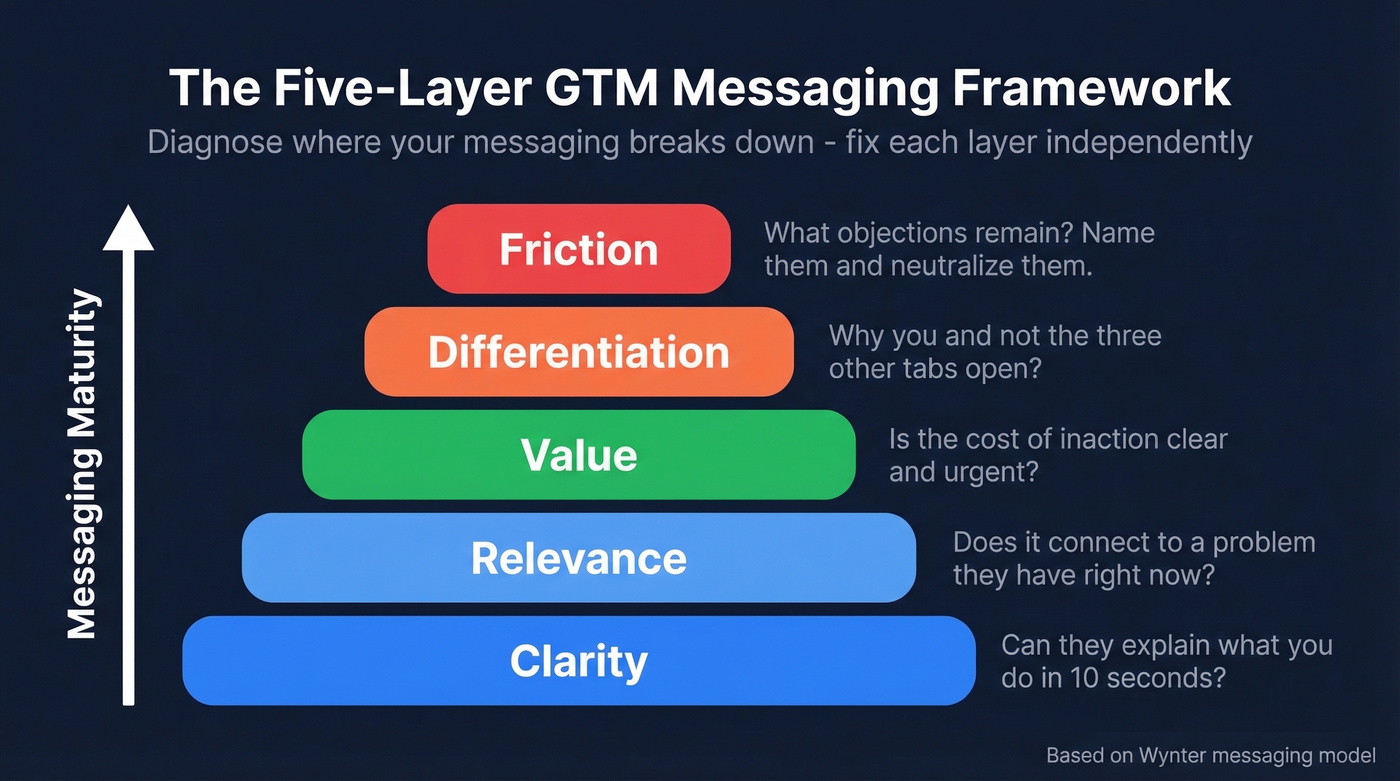
Clarity - do they understand what you do in under 10 seconds? Loom moved from "Show it, say it, send it" to "Loom on. Meetings off." plus a quantified claim of 29% fewer meetings. Night and day.
Relevance - does it connect to a problem they actually have right now? "Boost productivity" fails because it doesn't name a specific pain. "Cut your SDR list-building from 15 hours to 3 hours a week" succeeds because it mirrors a real Tuesday afternoon.
Value - does it make the problem feel urgent enough to act? This is where you quantify the cost of inaction. "Every month without a verified contact database costs your team 40+ hours of wasted outreach" hits harder than "save time."
Differentiation - why you instead of the three other tabs they have open? If you can't answer this in one sentence, your positioning work isn't done.
Friction - what objections or anxieties remain? Security concerns, implementation time, switching costs. Name them and neutralize them in the messaging itself.

Your five-layer messaging framework means nothing if emails bounce. Prospeo's 98% verified email accuracy and 7-day data refresh ensure your carefully crafted GTM messaging actually lands in the right inbox - not a spam trap.
Stop perfecting messages that never get delivered.
Building Your Messaging Document
The messaging hierarchy pyramid gives you a structure that scales across channels and teams:
| Level | What It Contains | Example |
|---|---|---|
| Brand Essence | North star vision | Airbnb: "Belong Anywhere" |
| Core Message | Single key takeaway | Dollar Shave Club: "Shave time. Shave money." |
| Supporting Messages | Segment/use-case variants | Per-persona pain points |
| Proof Points | Data, testimonials, certs | WordPress: "43% of the web" |
The "message house" framework - roof equals core message, pillars equal supporting themes, foundation equals proof points - is another way to visualize the same structure. Pick whichever metaphor clicks with your team. What matters is the written hierarchy. Brand consistency contributes 10-20% of revenue growth, and you don't get consistency without documentation. If it lives in someone's head, it's not messaging. It's a guess.
Your messaging also needs to flex by buyer role and funnel stage. A value messaging matrix prevents the "one message fits all" trap:
| Buyer Role | Top-of-Funnel Hook | Mid-Funnel Proof | Late-Stage Objection Killer |
|---|---|---|---|
| End User / IC | "Cut [task] time by X%" | Product demo, peer testimonial | "Live in 2 days, no IT ticket" |
| VP / Director | "Your team is losing Y hrs/month" | ROI case study, pilot results | "No annual contract required" |
| CFO / Finance | "Reduce cost-per-lead by Z%" | Benchmark comparison, audit data | "Pay only for verified results" |
Customize the specifics, but the structure forces you to write different messages for different people at different stages - which is exactly what the buying committee demands. Teams selling to DACH customers need an additional column for compliance-first proof points, since data privacy objections surface earlier and more forcefully in that market.
Building a Strategic Narrative
Your messaging document covers what you say at each touchpoint, but a strategic narrative ties those individual messages into a single, cohesive story about where the market is heading and why your approach wins. It answers the question prospects don't ask out loud: "Why should the world change in the direction this company is betting on?"
The best go-to-market strategies pair a strong narrative with sharp per-persona messaging. The narrative gives your sales team a story arc for discovery calls and demos; the messaging document gives them the exact words. Without the narrative, your messaging is a collection of disconnected value props. Without the messaging, your narrative is a keynote that never converts.
Test Before You Launch
Here's the thing: average cold email reply rates dropped from 6.8% to 5.8% year-over-year. Your messaging has to work harder than ever.
Testing messaging on 30 ICP-matched people will teach you more than six months of A/B testing landing pages. Test clarity, relevance, and differentiation independently - they fail for different reasons. For clarity specifically, run a 5-second test: show your headline to an ICP-matched respondent for five seconds, then ask them to describe what you do. If they can't, your clarity layer is broken.
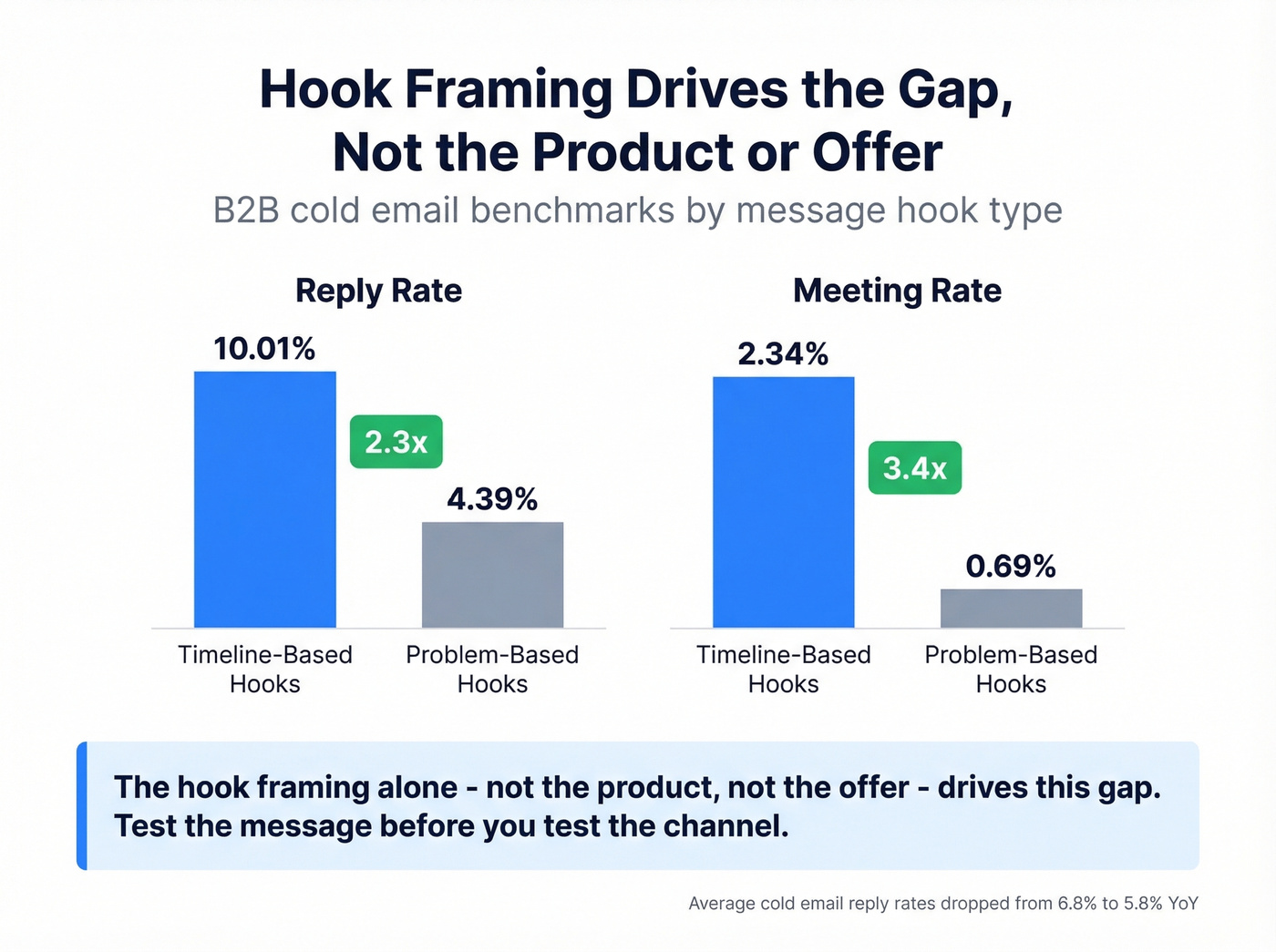
The data backs this up. Timeline-based hooks generate a 10.01% reply rate versus 4.39% for problem-based hooks - that's 2.3x. Meeting rates are even more dramatic: 2.34% versus 0.69%, a 3.4x difference. The hook framing alone - not the product, not the offer - drives that gap. Organizations with documented GTM frameworks see 10% higher launch success rates.
Let's be honest: most teams skip message testing because they think they already know their buyer. They don't. The gap between what your VP of Sales thinks resonates and what your ICP actually responds to is the single biggest source of wasted pipeline in B2B. I've watched teams burn through entire quarters of outbound budget before someone finally runs a message test and discovers the core value prop doesn't land. Test the message before you test the channel.
From Messaging to Pipeline: The Data-Quality Bridge
Perfect messaging sent to bad data is wasted effort. The average B2B purchase involves 6-10 decision-makers, so you need verified contact data across the entire buying committee - not just the one name you found on a company page.
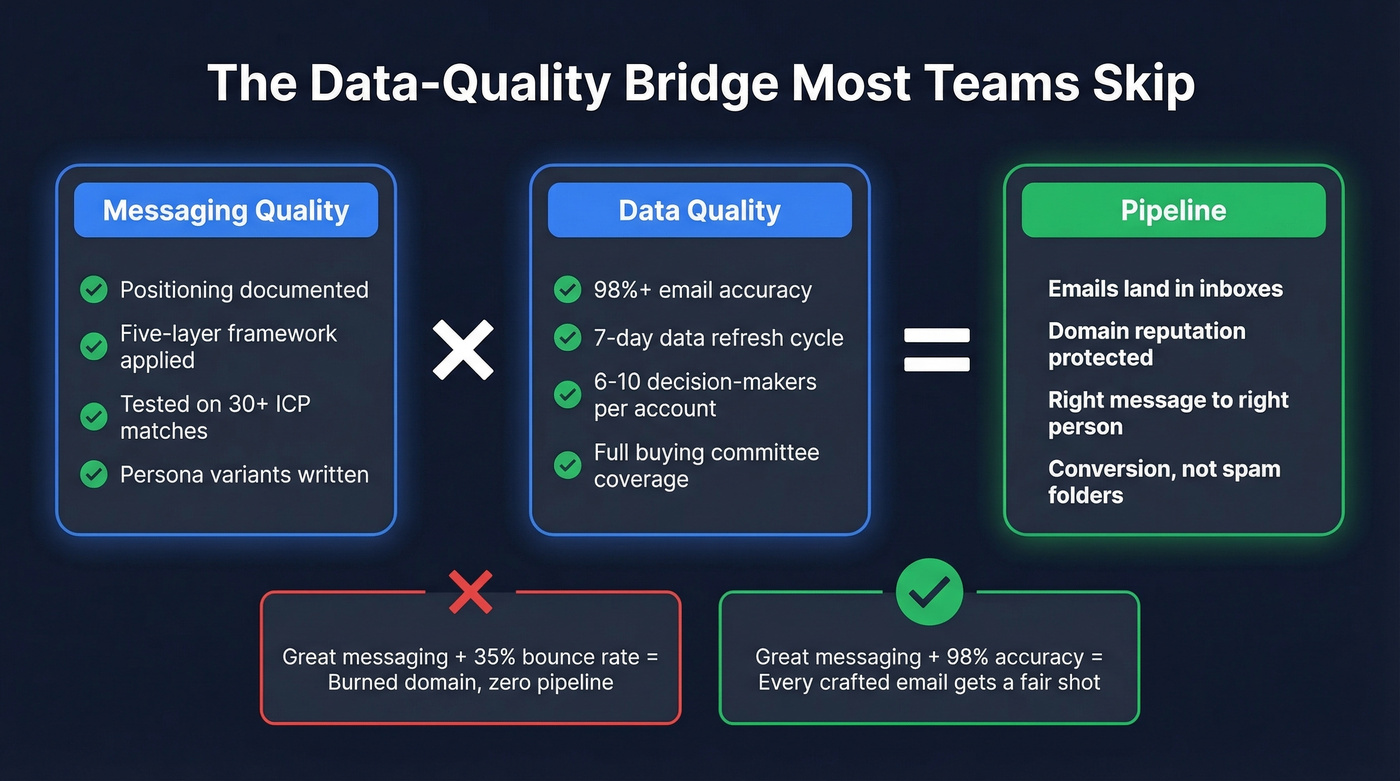
We've seen teams spend months crafting messaging only to send it to lists with 35%+ bounce rates. At that point, your email bounce rate and domain reputation tanks before your message gets a fair shot. Tools like Prospeo, with 98% email accuracy and a 7-day data refresh cycle, exist to solve exactly this problem. The formula is simple: messaging quality multiplied by data quality equals pipeline. Get either one wrong and the whole system breaks.
Skip the data-quality step if you enjoy watching beautifully crafted emails land in spam folders.
Launch Readiness Checklist
Your GTM messaging is ready when:
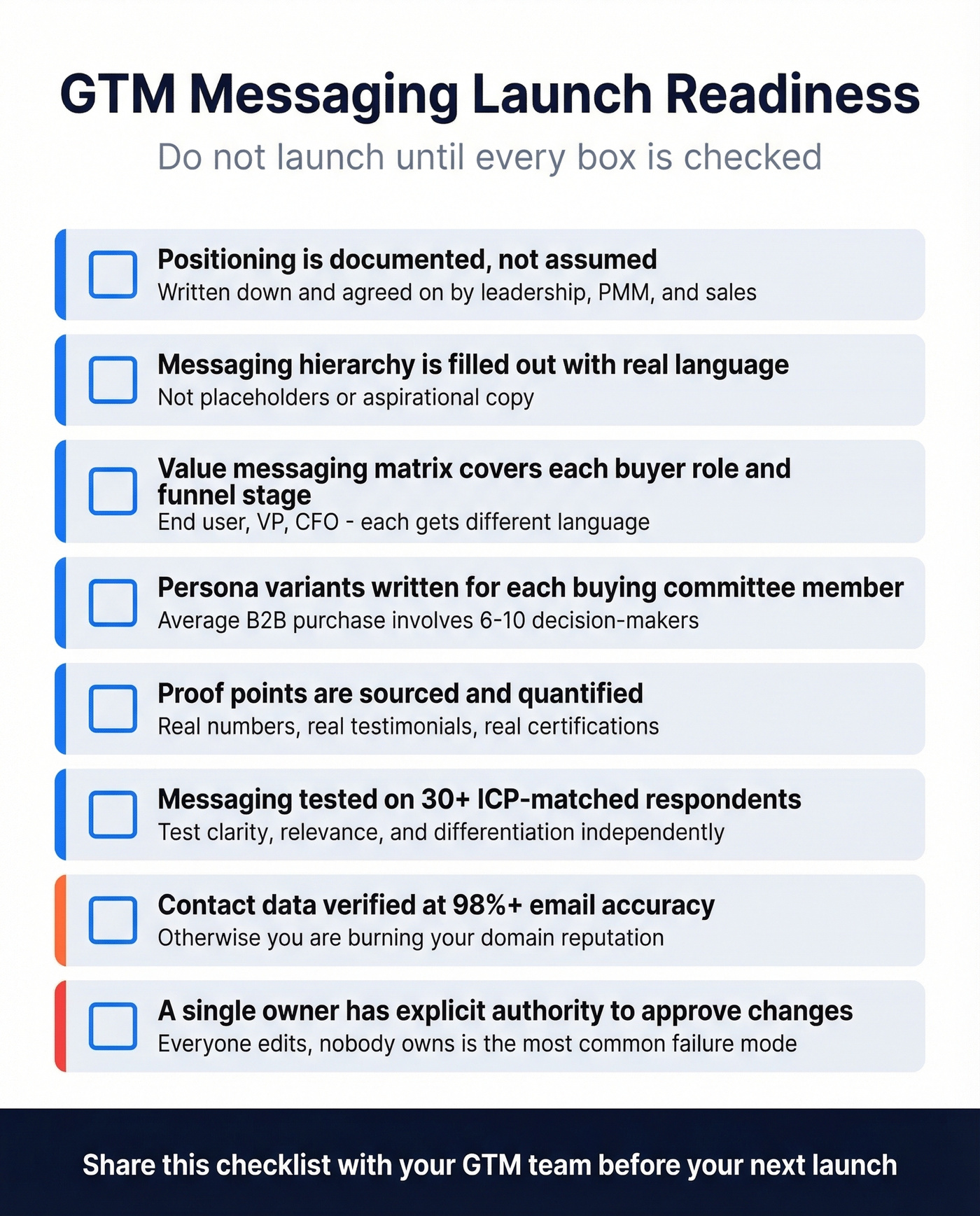
- Positioning is documented, not assumed
- Messaging hierarchy is filled out with real language, not placeholders
- Value messaging matrix covers each buyer role and funnel stage
- Persona variants are written for each buying committee member
- Proof points are sourced and quantified
- Messaging is tested on 30+ ICP-matched respondents
- Contact data is verified at 98%+ email accuracy, or you're burning your domain
- A single owner - ideally PMM - has explicit authority to approve changes (this is the most common complaint in PMM communities, and for good reason: everyone edits, nobody owns)
A value messaging matrix only works when you can reach every buyer in the committee. Prospeo gives you 300M+ profiles with 30+ filters - buyer intent, job changes, department headcount - so your persona-specific messaging hits the right person at the right time.
Match your messaging precision with targeting precision for $0.01 per email.
FAQ
What's the difference between positioning and messaging?
Positioning defines your market context - who you're for, what category you compete in, why you're different. Messaging translates that into specific language: headlines, value props, proof points, objection responses. Positioning is the strategy; messaging is the words that carry it to buyers.
Who should own GTM messaging?
Product marketing should own it, with explicit authority to approve or reject changes. Sales brings objections, product brings capabilities, leadership brings vision - but one person holds the pen. Without single ownership, you get the Frankenstein plan.
How often should you update your messaging?
Review quarterly at minimum, and immediately after major product launches, competitive shifts, or ICP changes. If your SDRs are freelancing their own talk tracks, your messaging has already drifted.
How does messaging connect to competitive strategy?
Strong go-to-market messaging is the execution layer of your broader competitive strategy. It translates differentiation into language buyers remember when comparing options. Without it, even a superior product loses deals to competitors who simply communicate their value more clearly.