

GTM Roles: The Complete Guide to Building Your Go-to-Market Team
You just closed your tenth customer. The board wants a "GTM team." You've got budget for two hires, maybe three - and every job description you find online reads like it was written for a company ten times your size. Most guides to go-to-market roles hand you a 12-person org chart and wish you luck. If you're at $1M ARR, that org chart is fiction.
Here's the thing: 87% of high-growth companies have adopted account-based approaches, and ABM only works when marketing, sales, and CS actually talk to each other. Let's build a team that makes that happen - matched to your stage, your motion, and your budget.
Quick Decision Tree
Between $0 and $3M ARR, you don't need 12 GTM roles. You need 3-5:
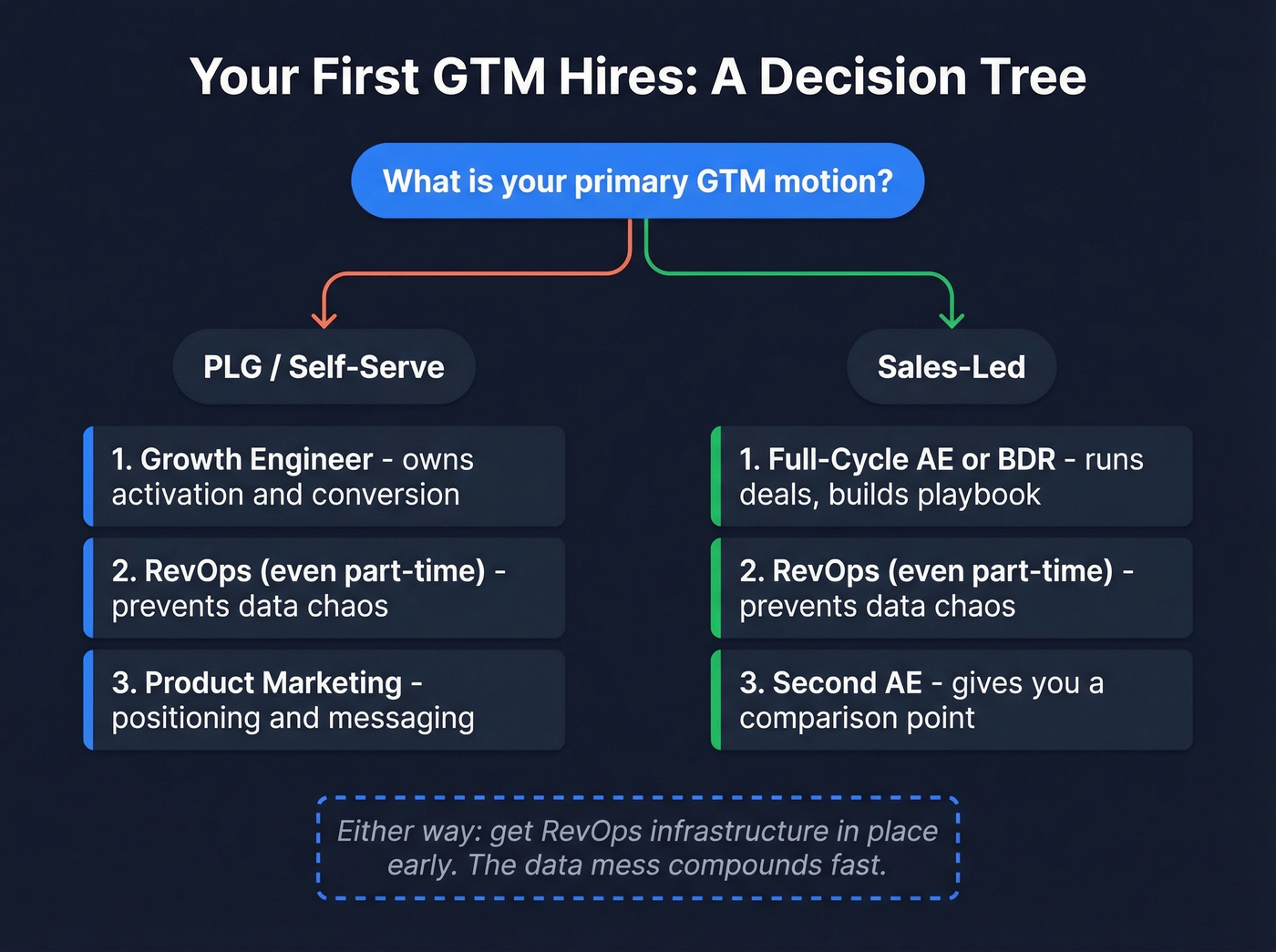
- PLG / self-serve? Hire a growth person first - someone obsessing over activation rates, not cold-calling.
- Sales-led? Hire an IC seller first. A BDR or full-cycle AE who can run deals while you build the playbook.
- Either way: Get RevOps infrastructure in place early. Even a part-time ops hire prevents the data mess that kills your ability to scale later.
What Is a Go-to-Market Team?
A GTM team isn't a department. It's a cross-functional revenue engine spanning marketing, sales, product, customer success, and revenue operations - all aligned around getting your product into the hands of paying customers and keeping them there. In practical terms, think of it as the group collectively responsible for every dollar of revenue, from first touch to renewal.
This framing matters because most companies still operate in silos. Marketing generates leads nobody follows up on. Sales closes deals that churn in 90 days. CS firefights instead of expanding. A go-to-market team fixes this by creating shared accountability for revenue outcomes, not departmental vanity metrics.
Core Go-to-Market Roles
| Role | Primary KPI | Salary Range | When to Hire |
|---|---|---|---|
| GTM Manager | Launch velocity | $120K-$180K | Post-PMF |
| PMM | Win rate | $110K-$170K | Series A+ |
| Sales Manager | Team quota | $130K-$200K | 2+ AEs at quota |
| BDR/SDR Manager | Pipeline created | $80K-$120K | 4+ BDRs |
| CS Manager | NRR / expansion | $100K-$150K | Post-first churn |
| RevOps Manager | Forecast accuracy | $110K-$170K | Early - don't wait |
| Demand Gen Mgr | Pipeline sourced | $100K-$160K | Inbound motion |
| Enablement Mgr | Ramp time | $100K-$150K | 10+ sellers |
GTM Manager
The orchestrator. A GTM manager doesn't own a single channel - they own the cross-functional launch plan: segment prioritization, messaging frameworks, coordinating sales/marketing/product, and KPI monitoring. They need 5+ years in go-to-market strategy with CRM and marketing automation fluency. They're not writing cold emails. They're making sure the people who do are aligned on the same plan.
Product Marketing Manager
PMMs own positioning and messaging for specific products or segments. Where a GTM manager orchestrates the launch, the PMM builds the narrative: competitive battlecards, buyer personas, and sales collateral. Their primary KPI is win rate - if reps are losing deals on messaging, that's a PMM problem.
Sales Manager
Don't hire this person too early. A sales manager builds repeatable process and coaches a team, but you need a team first. The right time is when you've got at least two AEs consistently hitting quota and you need someone to systematize what's working. Leaders shaping the sales process at this stage should focus on documenting what's repeatable before layering in management overhead.
BDR/SDR Manager
Outbound execution lives here. A BDR manager owns pipeline creation targets, activity metrics, and rep coaching. Cold email reply rates dropped to 5.8% by late 2025, down from 6.8% the prior year, and the trend is continuing into 2026. The difference between a 2% reply rate and a 6% reply rate often isn't the copy - it's whether the emails actually land in inboxes and whether the contacts are real.
One tactical insight worth stealing: timeline-based hooks pull a 10.01% reply rate, more than double the 4.39% from problem-based hooks. Share that with your BDRs.

Customer Success Manager
CS is a revenue function, not a support function. Sales and success teams drive 58% of upsells, while product-led expansion accounts for just 10%. A CS manager owns net revenue retention, expansion revenue, and the feedback loop between customers and product. If your NRR is below 100%, this hire is urgent.
RevOps Manager
RevOps sits above sales ops, marketing ops, and CS ops to unify data, processes, and tech stack decisions. We've seen companies lose months of pipeline visibility because marketing and sales couldn't agree on what counted as an "opportunity." RevOps fixes that. If you're above $5M ARR without a RevOps function, your data is already a mess - you just don't know it yet.
Demand Gen and Enablement
Demand gen owns the inbound engine: paid campaigns, content, webinars, SEO, and lead scoring. Primary KPI is marketing-sourced pipeline, not MQLs. If your motion is heavily outbound, this hire can wait.
Enablement owns ramp time, content adoption, and training. Hire when you've got 10+ sellers and onboarding is eating your sales manager's calendar. Before that, enablement is a shared responsibility between the sales leader and PMM.
Emerging Roles in 2026
One of the fastest-growing titles in modern go-to-market orgs is the GTM engineer. This technical role sits at the intersection of RevOps, automation, and data infrastructure, building the systems that make revenue motions actually run: Clay workflows, CRM customizations, and outbound sequencing architecture. Salaries range from $120K-$185K, and the consensus on r/salesengineering is that strong GTM engineers pay for themselves within a quarter.
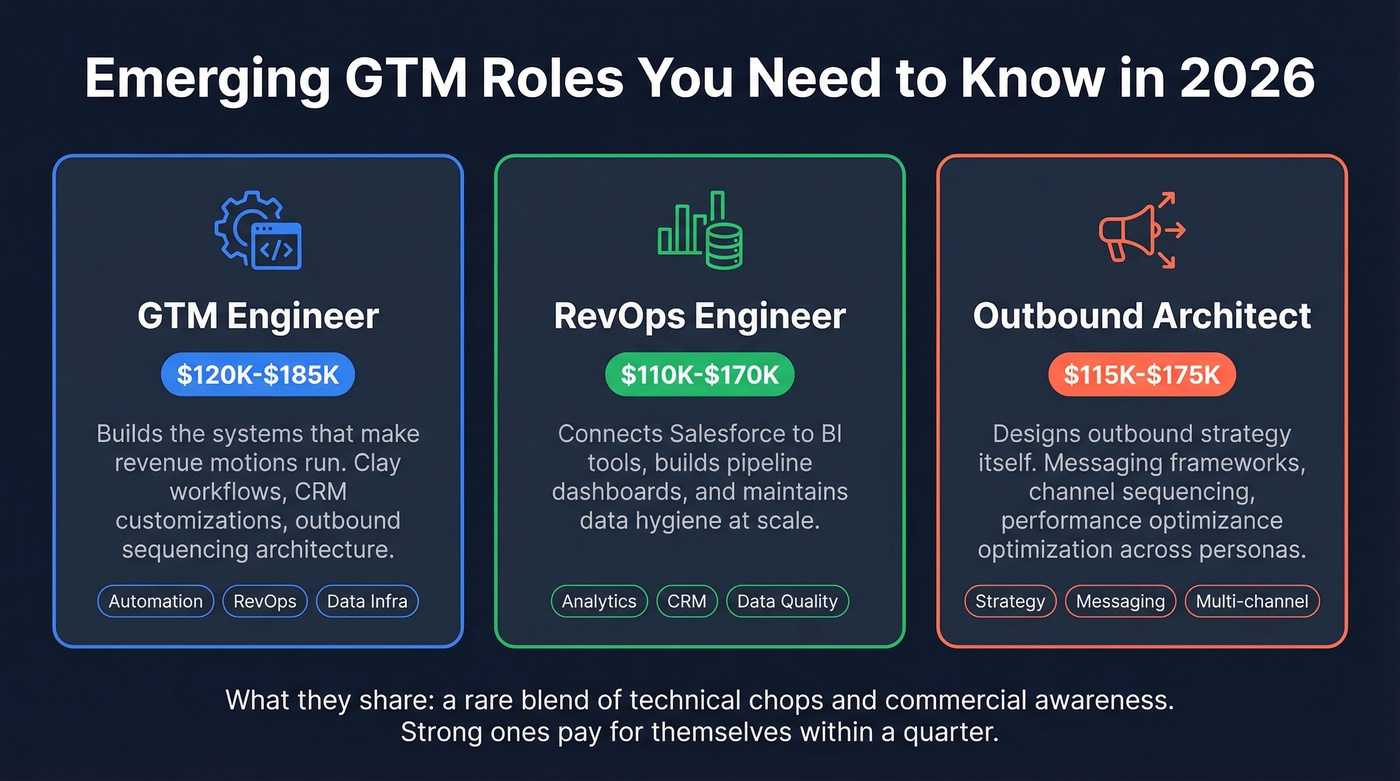
The RevOps engineer is similar but focused on the analytics layer - connecting Salesforce to BI tools, building pipeline dashboards, and maintaining data hygiene at scale. The outbound architect designs outbound strategy itself: messaging frameworks, channel sequencing, and performance optimization across personas and geographies. Each of these positions requires a blend of technical chops and commercial awareness that's genuinely rare, which is why salaries keep climbing.
RevOps vs Sales Ops vs Marketing Ops
| Function | Owns | Reports To |
|---|---|---|
| Sales Ops | Territories, comp, CRM | VP Sales |
| Marketing Ops | Campaigns, automation | CMO |
| RevOps | Unified data + process | CRO / COO |
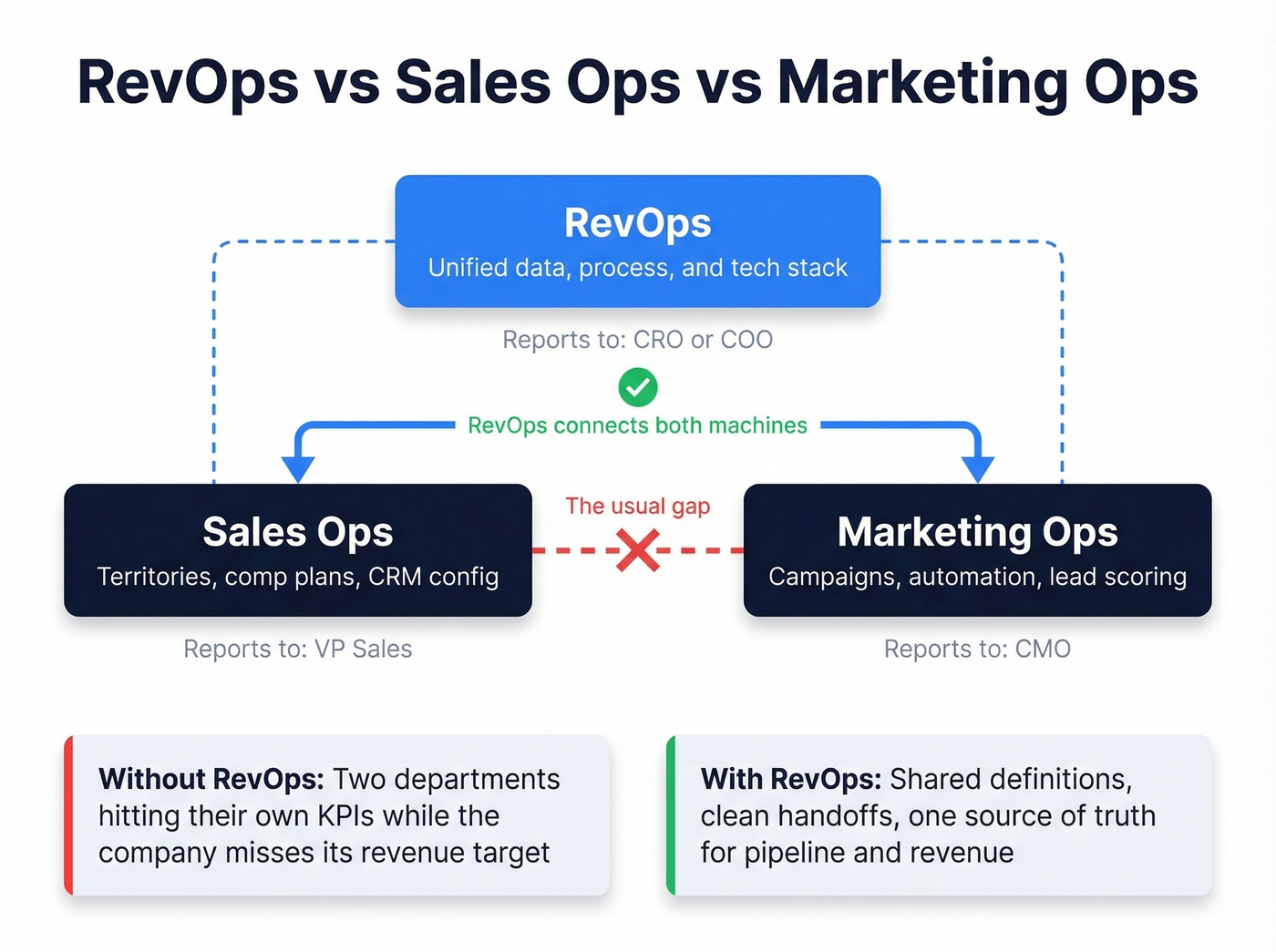
Sales ops optimizes the sales machine. Marketing ops optimizes the marketing machine. RevOps makes sure both machines are connected and pointing in the same direction. It's the difference between two departments hitting their own KPIs and the company hitting its revenue target.

Your BDR team's reply rates live and die on data quality. Prospeo delivers 98% email accuracy with a 7-day refresh cycle, so every rep on your GTM team is reaching real buyers - not bouncing into the void. At $0.01 per email, even a two-person outbound team gets enterprise-grade data.
Stop hiring more BDRs to fix a data problem.
How GTM Motions Shape Team Structure
Your ACV determines your motion, and your motion determines which roles you hire first. This is the single most important variable in go-to-market team design.
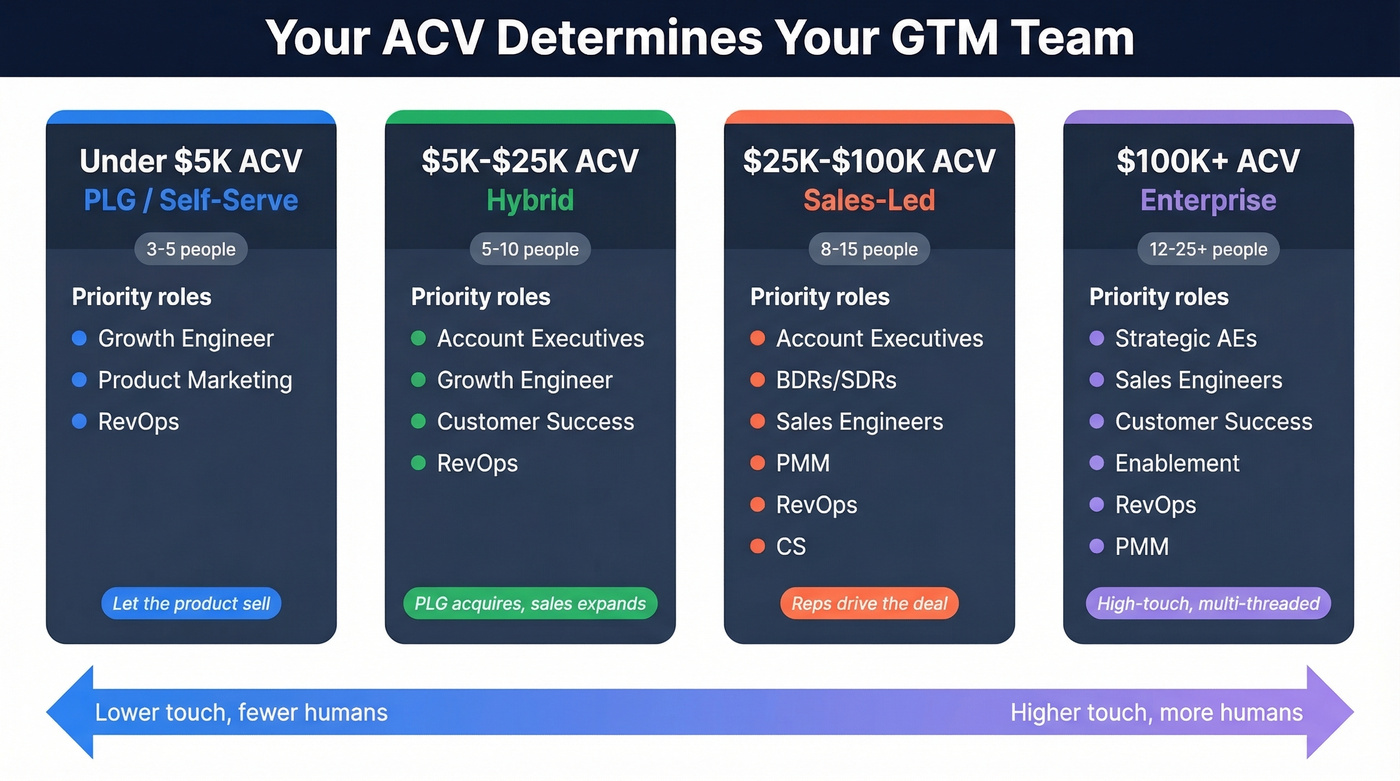
| ACV Range | GTM Motion | Priority Roles | Team Size |
|---|---|---|---|
| Under $5K | PLG / self-serve | Growth, PMM, RevOps | 3-5 |
| $5K-$25K | Hybrid | AEs, Growth, CS | 5-10 |
| $25K-$100K | Sales-led | AEs, BDRs, SE, PMM | 8-15 |
| $100K+ | Enterprise | AEs, SEs, CS, Enablement | 12-25+ |
61% of B2B buyers now prefer rep-free purchasing. That means even sales-led companies need self-serve elements. The hybrid model - PLG for acquisition, sales for expansion - is where most mid-market SaaS companies are landing in 2026.
If your deal size is below $10K, you probably don't need a traditional sales team at all. Invest in product, growth engineering, and RevOps. The companies winning at this price point are the ones who made the product do the selling and hired humans to accelerate expansion, not close initial deals.
Changing motions is expensive and disruptive. A PLG company at $5K ACV hiring enterprise AEs is burning cash. An enterprise seller at $80K ACV trying to go fully self-serve is leaving revenue on the table. Match the team to the motion, not the other way around.
Who to Hire First
Most companies hire in the wrong order. Here's the sequence that works for $0-$3M ARR SaaS:
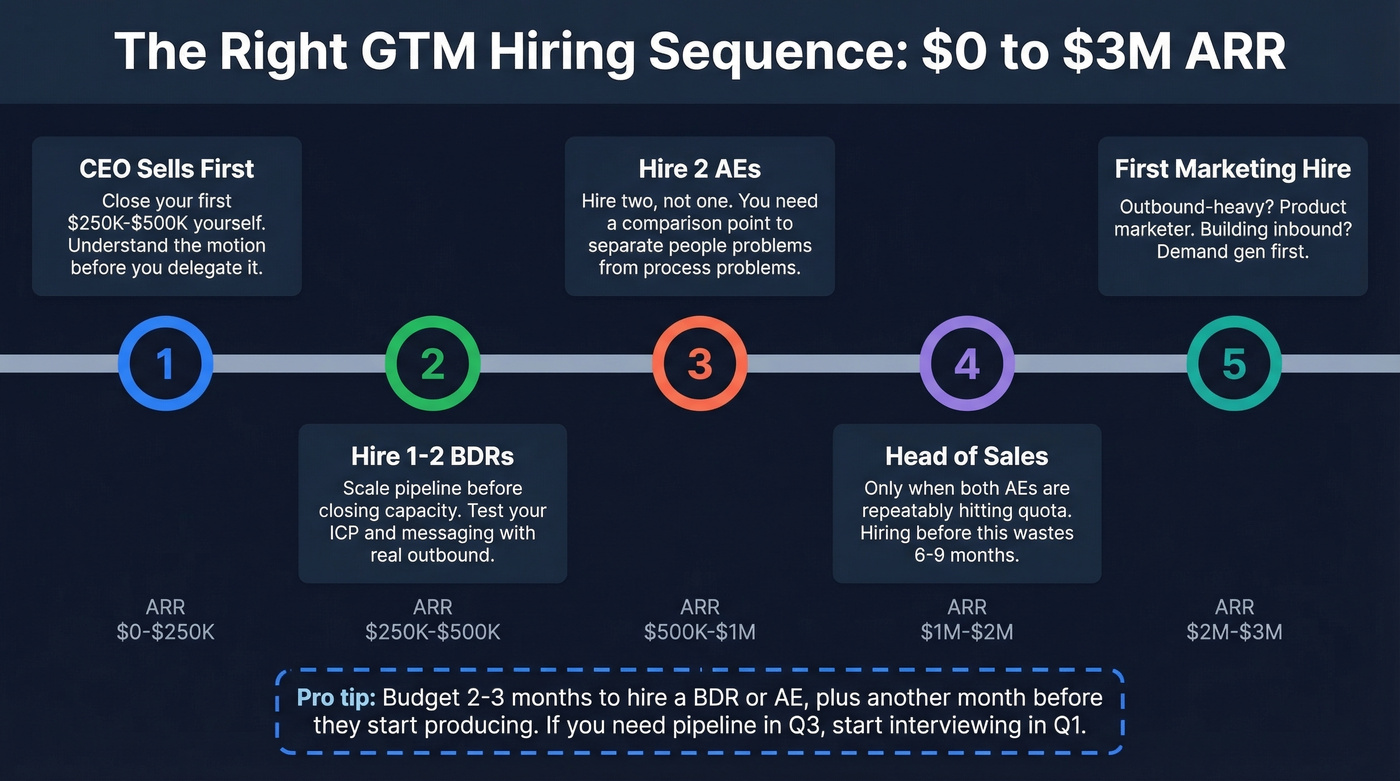
Step 1: CEO sells first. Close your first $250K-$500K in ARR yourself. You need to understand the motion - customer research, personas, competitive positioning - before you can hire someone to run it.
Step 2: Hire 1-2 BDRs. Scale pipeline before closing capacity. BDRs are cheaper than AEs and they'll tell you whether your ICP and messaging actually work. Arm them with verified data from the start - Prospeo's 98% email accuracy and 125M+ verified mobiles mean your BDRs spend time selling instead of bouncing, and your domain reputation stays intact.
Step 3: Hire 2 AEs. Once pipeline exists, bring in closers. Hire two, not one - you need a comparison point to know if performance is a people problem or a process problem.
Step 4: Head of Sales. Only when both AEs are repeatably at or near quota. Hiring a sales leader before you have a repeatable motion is the most expensive mistake early-stage companies make. In our experience, it wastes 6-9 months and often ends in a mis-hire.
Step 5: First marketing hire. Outbound-heavy? Hire a product marketer for messaging and collateral. Building inbound? Hire demand gen first.
PLG companies should prioritize a growth hire first first, plus clean data and RevOps infrastructure to experiment and iterate. Budget 2-3 months to hire a BDR or AE, plus another month before they start. If you need pipeline in Q3, start interviewing in Q1.
Go-to-Market Team Leadership
Scaling from five people to fifteen requires a different kind of leadership than the founder-led selling phase. At this stage, you need a VP or Head of GTM who can build systems - comp plans, territory models, forecasting cadences - without losing the scrappy experimentation that got you here.
The best go-to-market leaders don't just manage people; they manage the handoffs between functions. The marketing-to-sales handoff. The sales-to-CS handoff. The CS-to-product feedback loop. If any of those seams are leaking, revenue suffers regardless of how well individual teams perform.
Salary Benchmarks (2026)
These are practical 2026 compensation bands based on current job postings and common SaaS comp ranges:
| Role | Base Salary | OTE |
|---|---|---|
| BDR/SDR | $45K-$75K | $65K-$110K |
| AE (SMB) | $60K-$90K | $100K-$150K |
| AE (Enterprise) | $90K-$150K | $180K-$300K |
| PMM | $110K-$170K | Rare OTE |
| RevOps Manager | $110K-$170K | Rare OTE |
| GTM Engineer | $120K-$185K | Rare OTE |
| VP / Head of GTM | $180K-$280K | $250K-$400K |
| CRO | $200K-$350K | $350K-$600K+ |
These ranges skew toward US tech hubs. Adjust 15-25% lower for remote-first or non-coastal positions.
Benchmarks Every Role Should Track
Here are the latest available benchmarks heading into 2026, based on 2025 industry data:
| Metric | Benchmark |
|---|---|
| GTM initiatives per company | 10.5 avg (5 core + 5.5 experimental) |
| Cold email reply rate | 5.8% (down from 6.8% in 2024) |
| Timeline hooks reply rate | 10.01% (2.3x better than problem hooks) |
| PLG activation (top quartile) | >65% vs 33% average |
| Best-in-class NRR | >120% |
That reply rate decline is the number to watch. Outbound teams need to do more with less, and data quality is the lever most teams underinvest in.

Tools GTM Teams Run in 2026
CRM: Salesforce or HubSpot. Outreach: Outreach, Instantly, Smartlead, or Lemlist depending on motion. Automation: Zapier, Make, Clay. Conversation Intelligence: Gong. Customer Success: Gainsight for enterprise; ChurnZero or Vitally for mid-market. Data and Enrichment: Prospeo covers 300M+ profiles with 98% email accuracy and 125M+ verified mobiles - credit-based pricing starts free with 75 emails/month plus 100 Chrome extension credits/month, no contracts required.
Skip tools that lock you into annual contracts before you've validated your motion. We've watched too many early-stage teams sign $30K/year data contracts only to pivot their ICP six months later.
If you're comparing vendors, start with a shortlist of data enrichment options and a clear view of your lead enrichment workflow.
RevOps exists to unify your GTM data. Prospeo's enrichment API returns 50+ data points per contact at a 92% match rate - plugging directly into Salesforce, HubSpot, Clay, and your existing stack. No manual cleanup. No six-week-old records. Every record refreshed weekly.
Give your RevOps team a data source they don't have to babysit.
FAQ
What are GTM roles?
GTM roles are specialized positions within a go-to-market team responsible for bringing a product to market and driving revenue. They span marketing, sales, customer success, and revenue operations - from BDRs generating pipeline to RevOps managers unifying data across functions. Most early-stage SaaS companies need 3-5 of these positions, not the 12-person org chart you see in enterprise playbooks.
What does a GTM manager do?
A GTM manager orchestrates cross-functional go-to-market plans across sales, marketing, and product - owning launch coordination, segment prioritization, and KPI monitoring. Expect to pay $120K-$180K base. It's a strategic role, not an execution one; they don't write cold emails, they align the teams that do.
What's the difference between a PMM and a GTM manager?
PMMs own positioning and messaging for specific products; GTM managers coordinate the cross-functional rollout that brings that messaging to market. Think of the PMM as the storyteller and the GTM manager as the project lead who ensures every team tells the same story at the right time.
How big should a go-to-market team be?
At $1M-$3M ARR, 3-5 people. At $10M+, 15-25 across sales, marketing, CS, and ops. Match headcount to your ACV and motion - a PLG company at $5K ACV needs a fundamentally different team than an enterprise seller at $100K+.
What tools do go-to-market teams need for outbound?
At minimum: a CRM, a sequencing tool, and a verified data source. Prospeo's free tier - 75 verified emails plus 100 Chrome extension credits per month - gives early teams accurate data without enterprise pricing, which matters when every bounced email chips away at domain reputation.