

GTM Strategies: The Operational Playbook With Real Numbers
A 10-person startup and a 500-person scale-up both say they need "GTM strategies." They mean completely different things. One needs a focused launch plan with a single channel and a prayer. The other needs coordination across sales, marketing, product, and CS - with pipeline math that actually holds up.
Most guides on go-to-market strategies treat both situations the same, hand you a definition, and call it a day. This is the operational version. Real CAC numbers by channel, a decision tree for picking your motion, and a one-page template you can fill out this week.
What a GTM Strategy Actually Is
A go-to-market strategy isn't a marketing plan. Marketing is ongoing - brand, demand gen, content, campaigns. A GTM strategy is time-bound and event-driven: the plan for bringing a specific product to a specific market, covering pricing, channels, sales motion, positioning, and launch execution.
Three triggers create the need for one: launching a new product, entering a new market, or relaunching something that didn't land the first time. If none of those are happening, you don't need a new go-to-market plan. You need better execution on the one you already have.
What You Need (Quick Version)
- Pick ONE GTM motion based on your ACV and time-to-value. The decision tree in Section 4 makes this a 5-minute exercise.
- Choose 1-3 channels using the CAC benchmarks table below - not gut feel, not what your competitor does.
- Use the one-page GTM plan template at the end to ship a credible plan this week.
9 Types of Go-to-Market Strategies
Most teams think in two buckets: inbound or outbound. The reality is messier. The GTM Alliance taxonomy identifies nine distinct motions, and understanding the different types prevents the classic mistake of forcing a sales-led playbook onto a product-led opportunity.
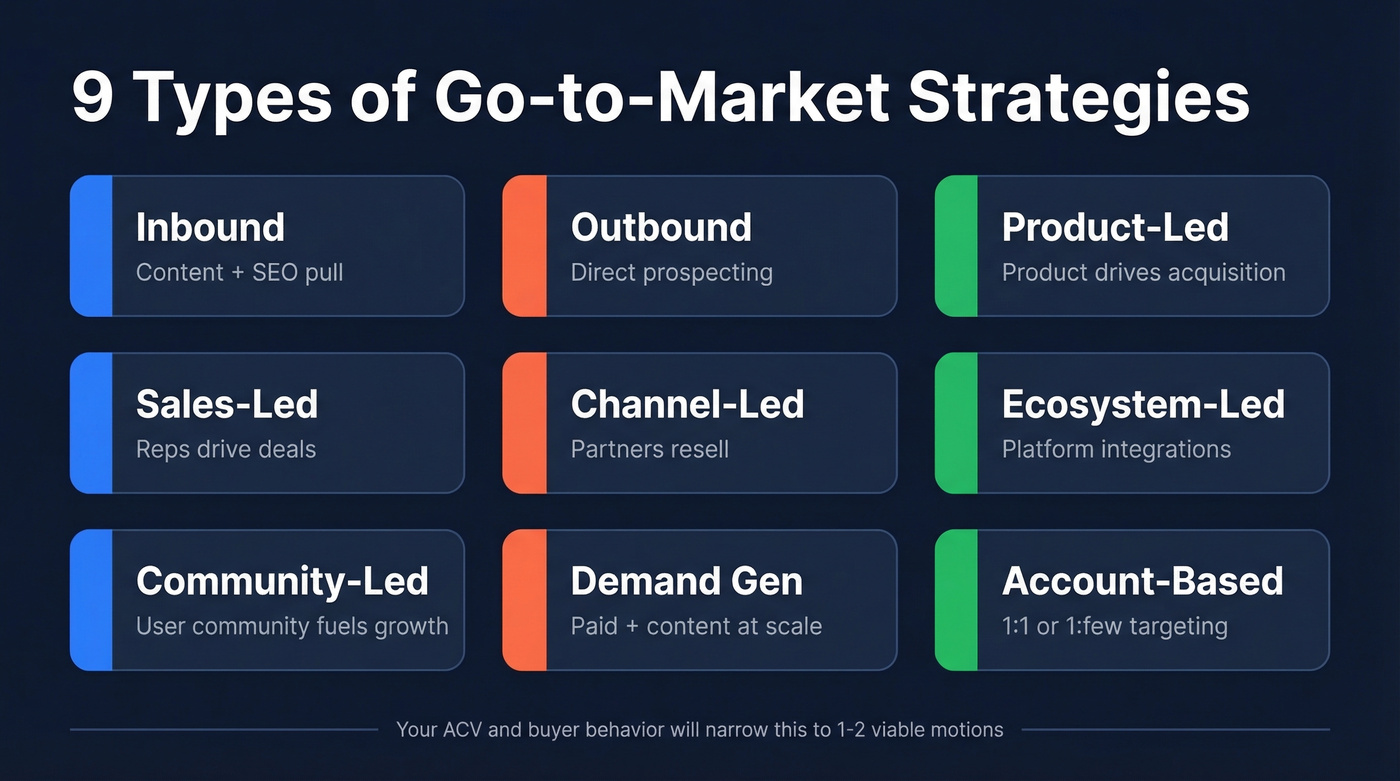
| Type | What It Means | Best For |
|---|---|---|
| Inbound | Content + SEO pull | Markets that require education and trust-building |
| Outbound | Direct prospecting | High ACV, defined ICP |
| Product-led | Product drives acquisition | Low ACV, fast time-to-value |
| Sales-led | Reps drive deals | Enterprise, procurement-heavy |
| Channel-led | Partners resell | Expansion via partners and resellers |
| Ecosystem-led | Platform integrations | API/marketplace products |
| Community-led | User community fuels growth | Dev tools, niche SaaS |
| Demand gen | Paid + content at scale | Teams that can fund consistent paid acquisition |
| Account-based | 1:1 or 1:few targeting | Enterprise account lists |
Use this table as a starting filter - your ACV and buyer behavior will narrow it to one or two viable motions. As Kyle Poyar puts it, product-led growth isn't just about the product. It's about the entire user experience across product, pricing, marketing, and buying. That's also why PLG companies typically run with fewer sales reps.
PLG vs. Sales-Led vs. Hybrid
Picking the wrong motion wastes 6-12 months. Let's make this concrete.
| Dimension | Product-Led | Sales-Led | Hybrid |
|---|---|---|---|
| Time-to-value | <1 hour | 30-180 day cycle | Hours to days |
| Free-to-paid | 2-5% | N/A | Varies by assist model |
| Lead to Opp | N/A (PQL-driven) | 15-30% | Dual funnel |
| Opp to Close | 20-40% (PQL) | 20-40% | 20-40% |
| Examples | Slack, Notion, Figma | Salesforce, Oracle | HubSpot, Atlassian |
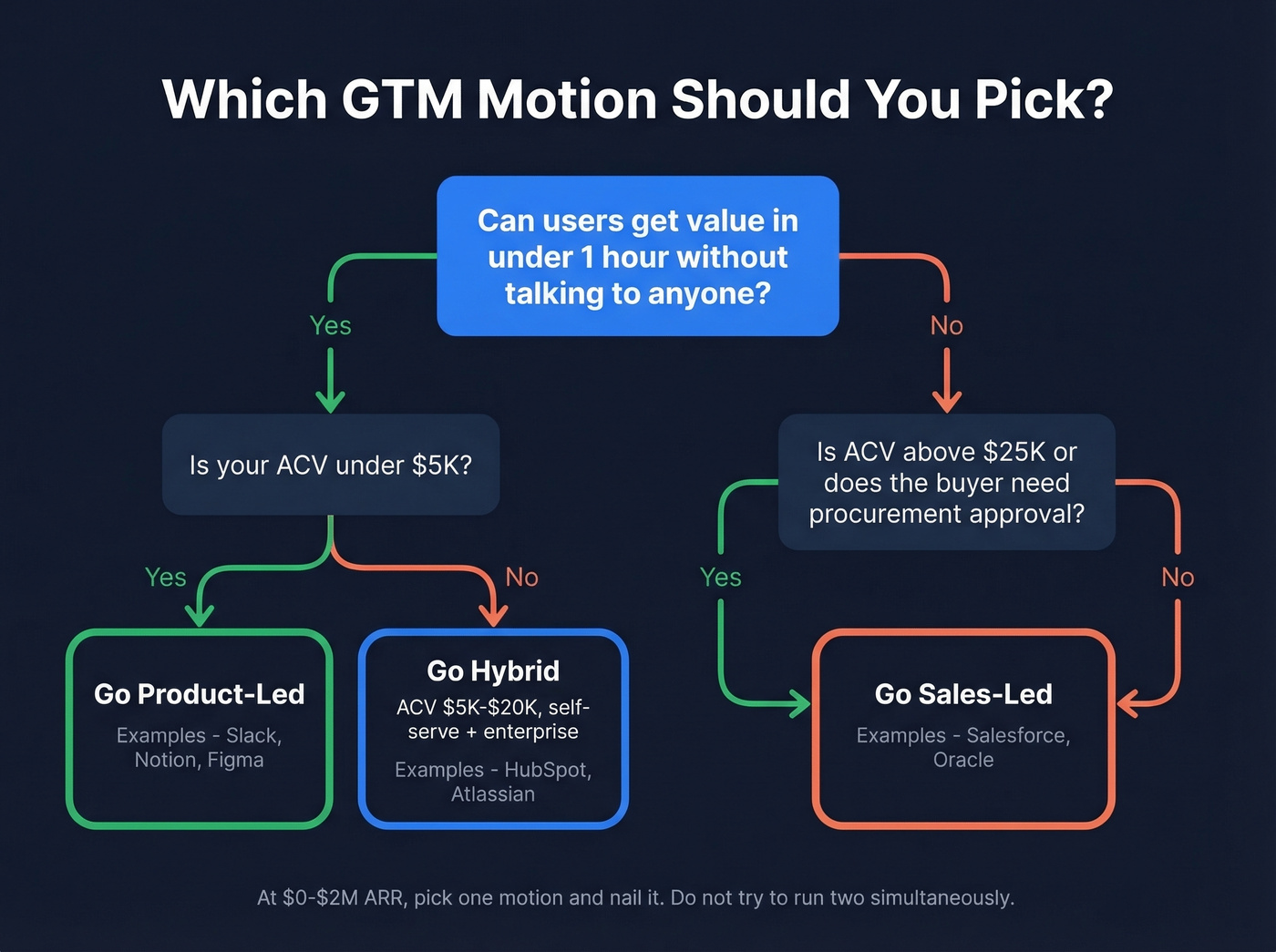
The decision tree is simpler than people make it. If users can get value in under an hour without talking to anyone, go PLG. If your ACV exceeds $25K or buyers need procurement approval, go sales-led. Somewhere in between - say, a $5K-$20K ACV with both self-serve and enterprise buyers - you're building a hybrid.
A study of 446 B2B SaaS companies found that companies making even a modest self-serve transition (from $0 to $100K-$500K in self-serve revenue) reported 68% profitability versus 36.4% for companies with no self-serve revenue. They also saw +25.9% better free-to-paid conversion and +18.3% faster time-to-value. The data is clear: even sales-led companies benefit from adding a self-serve layer. Companies that deliberately design their free tier rather than just offering a stripped-down version see 57% better free-to-paid conversion.
If you're at $0-$2M ARR, pick one motion and nail it. Don't try to run PLG and enterprise sales simultaneously with a 5-person team.

You just picked your GTM motion. Now you need the data to fuel it. Prospeo gives you 300M+ profiles with 30+ filters - buyer intent, technographics, job changes, funding - so your ICP isn't a guess, it's a targetable list. At $0.01 per verified email with 98% accuracy, your outbound CAC drops while your pipeline climbs.
Build your ICP list in minutes, not weeks.
How to Build a GTM Strategy in 9 Steps
Define the Problem You Solve
Before product-market fit comes problem-market fit. If the problem you're solving isn't painful enough for someone to pay for a solution, your go-to-market plan is irrelevant. Ask yourself: what changes for the customer if your product disappears tomorrow?
Build Your ICP
Your ICP isn't "B2B SaaS companies with 50-500 employees." That's a demographic, not a profile. A real ICP combines firmographic criteria - industry, headcount, revenue, tech stack - with behavioral signals like hiring patterns, funding events, and intent data.
The anti-pattern is targeting too broadly. In founder communities and across r/startups, the most common GTM regret is exactly this: trying to serve four buyer personas with one message and one channel. Pick a beachhead market where you can win decisively, then expand.
Research Competition and Demand
Size your market with TAM/SAM/SOM, but don't spend three months on it. A rough estimate is fine. What matters more is competitive positioning: where do you win, and against whom? If you can't articulate why a prospect should pick you over the incumbent in two sentences, your positioning isn't ready.
Craft Positioning and Messaging
Your value proposition answers one question: why should this specific buyer care? Use a simple format: "For [ICP] who [pain point], [product] is the [category] that [key differentiator], unlike [alternative]." It sounds formulaic because it is - and that's the point. Formulaic beats vague.
Set Pricing
Pricing signals value. One of the most common mistakes we see: SaaS companies pricing 70% below competitors, thinking it'll drive adoption. Instead, it creates quality doubts. If your product is genuinely better, price it like it is. For PLG motions, freemium works - but the free tier should create urgency to upgrade, not satisfy every need indefinitely.
Choose Your Channels (With CAC Data)
This is where most go-to-market plans fall apart. Teams pick channels based on what they've seen work for other companies, not what the math supports for their stage and budget.
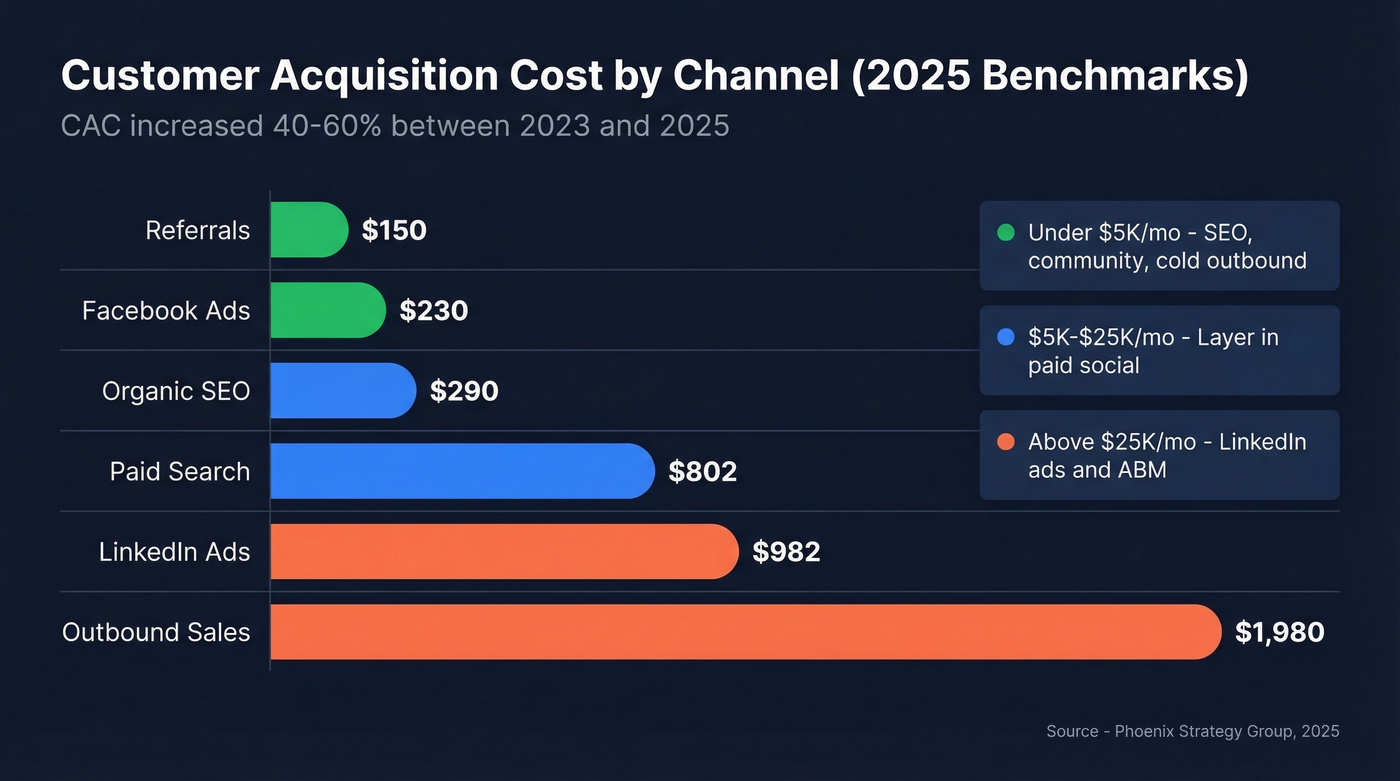
Current CAC benchmarks by channel:
| Channel | Avg CAC |
|---|---|
| Referrals | $150 |
| Facebook Ads | $230 |
| Organic SEO | $290 |
| Paid Search | $802 |
| LinkedIn Ads | $982 |
| Outbound Sales | $1,980 |
CAC increased 40-60% between 2023 and 2025, driven by competition, privacy changes, and attribution headaches. That makes channel selection even more consequential.
Budget-tier recommendations: under $5K/month, focus on SEO, community, and cold outbound. At $5K-$25K, layer in paid social. Above $25K, LinkedIn ads and ABM programs start making sense.
Here's the thing about that $1,980 outbound CAC - a big chunk of it is a data quality problem. When bounce rates are high, you're paying for wasted sends and domain damage. We've seen teams cut their effective outbound CAC in half just by switching to verified contact data with tools like Prospeo, which runs a 7-day refresh cycle and 98% email accuracy. The spend actually reaches prospects instead of evaporating into bounced messages.

Design Your Sales Motion
Match the motion to the buyer. If your prospect has a procurement team, compliance requirements, or a buying committee of 5+, you need a sales-led motion - no amount of PLG will shortcut that. Set clear SLAs: contact inbound demo requests within 15 minutes during business hours, follow up 5-7 times over 10 days, respond to outbound replies within one business day.
Plan Your Launch
Build a launch asset checklist: landing page, demo video, one-pager, email sequences, sales deck, competitive battle cards. Frame everything in 30/60/90-day milestones. Day 30 is about signal - are people engaging? Day 60 is about pipeline - are qualified opportunities forming? Day 90 is about revenue - are deals closing at the rates you modeled?
Set KPIs and an Operating Cadence
This is where your plan either becomes operational or dies on a slide deck. Start with these funnel targets:
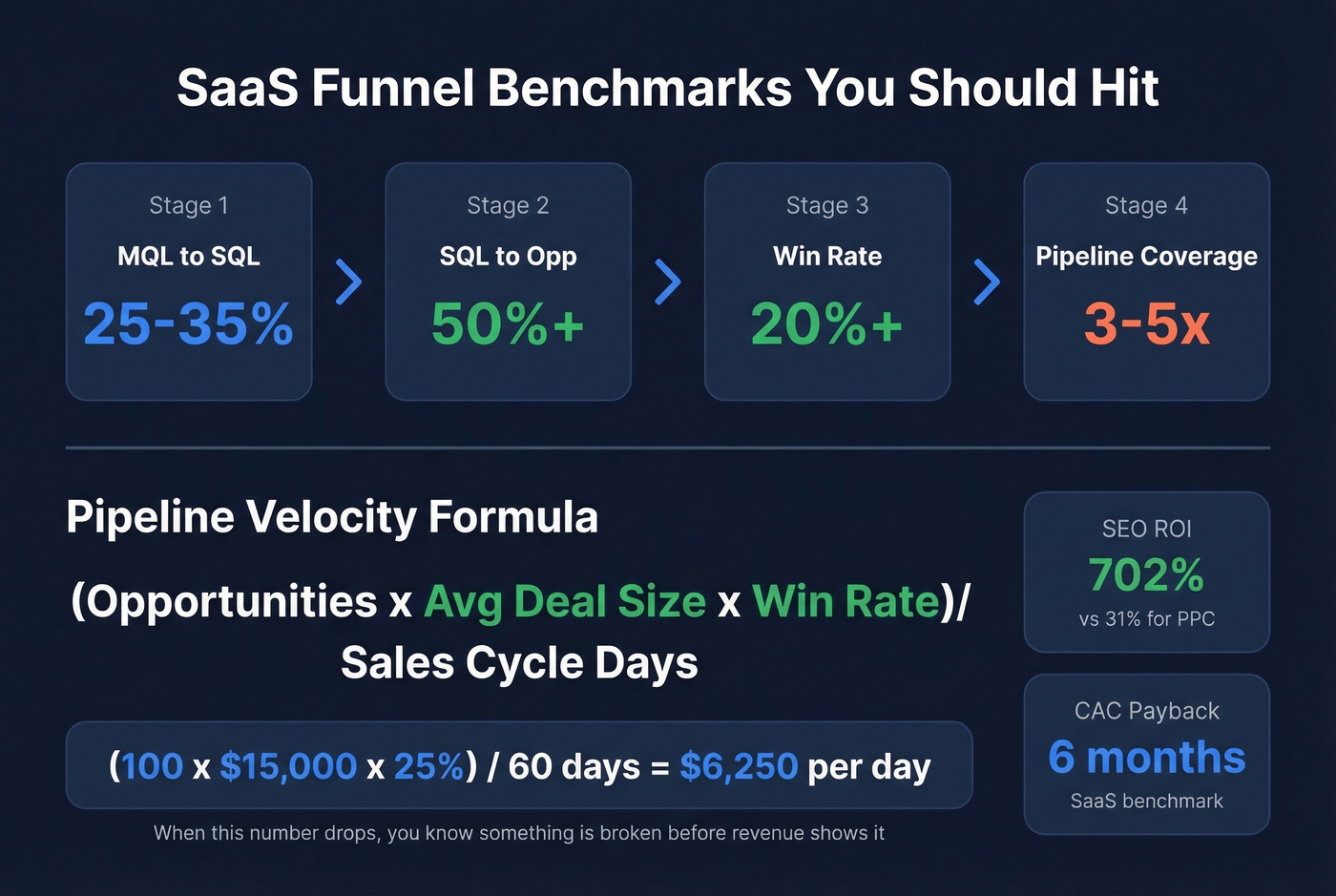
- MQL to SQL: 25-35%
- SQL to Opportunity: 50%+
- Win rate: 20%+
Aim for 3-5x pipeline coverage against quota. Pipeline velocity is the metric that ties everything together: (Number of Opportunities x Average Deal Size x Win Rate) / Sales Cycle in Days. If you have 100 opportunities at $15K average, a 25% win rate, and a 60-day cycle, your pipeline velocity is $6,250/day. When that number drops, you know something's broken before revenue shows it.
For broader context, First Page Sage's SaaS benchmark data puts ARR growth at 68% for sub-$1M companies, CAC payback at 6 months, LTV:CAC at 6:1, and annual churn at 5.2%. SEO ROI runs 702% versus 31% for PPC - which explains why every SaaS company eventually invests in content.
Run a weekly pipeline review and a quarterly strategy review. The weekly cadence catches execution problems. The quarterly cadence catches strategic drift.
Your One-Page GTM Plan
Fill in these fields, commit to a single primary route-to-market, and build from there. This prevents what one planning framework calls "random acts of marketing."
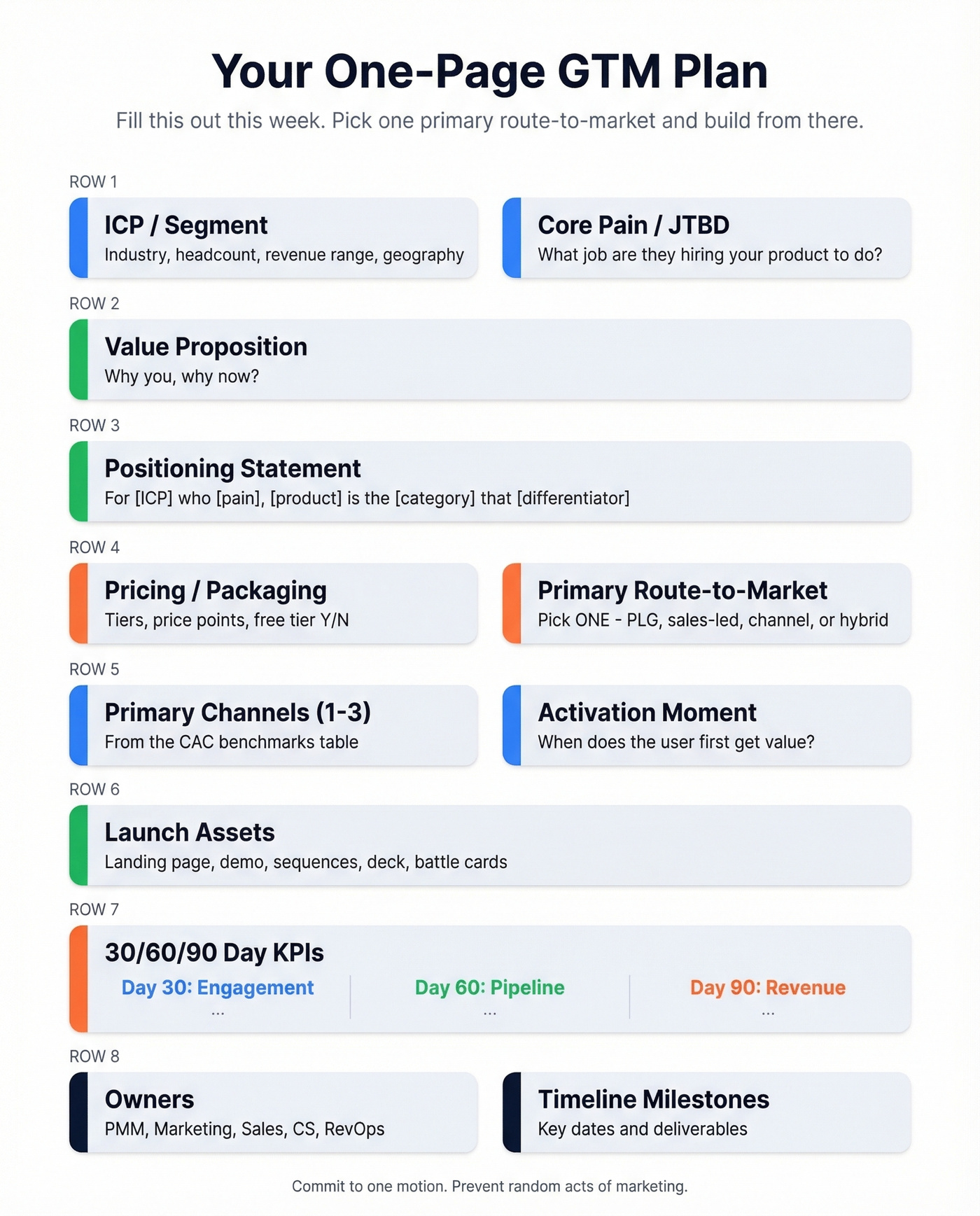
ICP / Segment: [Industry, headcount, revenue range, geography]
Core Pain / JTBD: [One sentence - what job are they hiring your product to do?]
Value Proposition: [Why you, why now?]
Positioning Statement: For [ICP] who [pain], [product] is the [category] that [differentiator].
Key Differentiators: [2-3 bullets]
Pricing / Packaging: [Tiers, price points, free tier Y/N]
Primary Route-to-Market: [Pick ONE - PLG, sales-led, channel, or hybrid]
Primary Channels (1-3): [From the CAC table]
Activation Moment: [When does the user first get value?]
Launch Assets: [Landing page, demo, sequences, deck, battle cards]
30/60/90-Day KPIs: [Day 30: engagement / Day 60: pipeline / Day 90: revenue]
Owners: [PMM / Marketing / Sales / CS / RevOps]
Timeline Milestones: [Key dates and deliverables]
Print this. Pin it to the wall. Every decision for the next 90 days should trace back to one of these fields.
Mistakes That Kill GTM Launches
Confusing GTM with marketing. A climate-tech SaaS company ran ads and published blog posts and called it a go-to-market strategy. They had no pricing model, no sales motion, no channel validation. Marketing is one component - not the whole thing.
Targeting too broadly. A property-tech startup tried to sell to landlords, tenants, agents, and councils simultaneously. They burned through $200K before narrowing to a single segment that actually converted.
Skipping channel validation. Don't commit your entire budget to LinkedIn ads because a competitor does it. Test two channels with small budgets for 30 days. Let the CAC data decide.
Neglecting pricing. Pricing 70% below rivals doesn't signal affordability - it signals that something's wrong.
Ignoring sales motion fit. If your buyer has a procurement team, you need a sales-led motion. Trying to PLG your way through enterprise compliance reviews wastes everyone's time.
Focusing only on acquisition. Retention and referrals are go-to-market levers too. Skip this if you think GTM ends at the closed-won stage - it doesn't.
Scaling before product-market fit. Pouring budget into growth when your product has a leaky bucket is the most expensive mistake on this list. Fix the product first.
Ignoring data quality. Your GTM runs on contact data. When Meritt switched to verified data with Prospeo, their bounce rate dropped from 35% to under 4% and pipeline tripled from $100K to $300K per week. Bad data doesn't just waste money - it damages your domain reputation and makes every subsequent outbound campaign harder.
Most Teams Need a Simpler GTM
Here's our hot take: if your deal size is under $10K, you probably don't need an ABM program, a partner channel, and a PLG motion running simultaneously. You need one channel that works, one message that resonates, and data clean enough to actually reach the people you're targeting. Complexity is earned, not assumed. The companies that scale fastest are the ones that resist adding a second motion until the first one is genuinely maxed out.
I've watched teams with $3M ARR try to run five motions at once. They end up mediocre at all of them.
How AI Is Changing GTM in 2026
AI in go-to-market execution is real but overhyped. McKinsey data shows 88% of organizations use AI in at least one business function, and 62% are experimenting with AI agents. Nearly two-thirds haven't begun scaling AI across the enterprise, and only 23% report scaling an agentic AI system somewhere in their org.
The practical impact is narrower than the hype suggests. As Max Altschuler from GTMfund puts it: "You can do more with less than ever before." That's accurate. AI is compressing the time it takes to research prospects, personalize outreach, and score inbound leads. The shift is toward signal-based prospecting - AI that finds prospects matching specific requirements beyond what a static database query can surface.
But marketing craft still matters. Google Cloud's Alison Wagonfeld makes the point well: you can get out there with more messages faster, but the quality of those messages is what converts. Teams in 2026 need people who can work with AI tools, not people who do the tasks AI now handles.
Real talk: AI is a GTM accelerator, not a strategy. It makes your existing motion faster and more precise. It doesn't replace the hard work of picking the right motion, validating channels, and building a repeatable sales process.
Every CAC dollar wasted on bad data is a dollar your GTM plan can't afford. Teams using Prospeo book 26% more meetings than ZoomInfo and 35% more than Apollo - because 98% email accuracy and 30% mobile pickup rates mean reps actually reach buyers. Stack Optimize built a $1M agency on it. Snyk's 50 AEs grew pipeline 180%.
Stop burning budget on bounced emails. Start connecting.
FAQ
What are GTM strategies?
GTM strategies are time-bound plans for bringing a specific product to a specific market, covering pricing, positioning, channels, sales motion, and launch execution. Unlike ongoing marketing, they're triggered by a specific event: a new product launch, market entry, or relaunch after an initial miss.
What are the main types of go-to-market strategies?
Nine primary types: inbound, outbound, product-led, channel-led, ecosystem-led, community-led, sales-led, demand generation, and account-based. Most B2B SaaS companies start with one motion - PLG or sales-led - and layer a second after reaching $10M ARR.
GTM strategy vs. marketing strategy - what's the difference?
A marketing strategy is ongoing brand and demand work with no fixed end date. A go-to-market strategy is time-bound, covering pricing, channels, sales motion, and launch execution for a specific product and market. Think of marketing as the engine and GTM as the launch sequence.
How long does it take to build a GTM plan?
A credible one-page plan takes 1-2 weeks. A fully validated strategy with ICP research, channel testing, and pricing validation takes 4-8 weeks. The document is fast; the validation requires real market feedback and at least one 30-day channel test.
What's the best go-to-market approach for a SaaS startup?
If users get value in under an hour without talking to anyone, go PLG. If your ACV exceeds $25K or buyers need procurement approval, go sales-led. Either way, verify your outbound data - bad contact info is the fastest way to burn budget and damage your sender reputation before your GTM even gets off the ground.