

=== CURRENT ARTICLE (slug: guided-selling-tools) ===
The Best Guided Selling Tools in 2026: Honest Pricing, Real Categories
Your VP came back from a conference convinced the team needs "AI-guided selling." Now you're evaluating tools, and every vendor demo looks like magic - until you ask about pricing, implementation timelines, and what happens when your CRM data is 40% stale. Gartner predicted 75% of B2B sales orgs would augment playbooks with AI-guided selling by 2025, and the market has moved accordingly. But most evaluations fail because teams buy the workflow before fixing the foundation.
You might not need a guided selling platform at all. You might need clean data and a documented process.
Our Picks (TL;DR)
| Scenario | Pick | Why |
|---|---|---|
| Most B2B sales teams | HubSpot Sales Hub | CRM-native, $1,600/mo for 5 users, up and running in hours |
| Complex manufacturing/CPQ | Tacton CPQ | Purpose-built for configurable products, Forrester-validated ROI |
| Data accuracy layer | Prospeo | 98% email accuracy, 7-day refresh - AI recommendations are only as smart as the data feeding them |
What Guided Selling Means in 2026
Guided selling isn't a product category. It's a capability inside CRMs, CPQ platforms, ecommerce engines, and standalone AI tools. The core idea: ask clarifying questions, understand the use case, recommend the right product. One Reddit thread framed it well - it's replicating in-store associate behavior online.
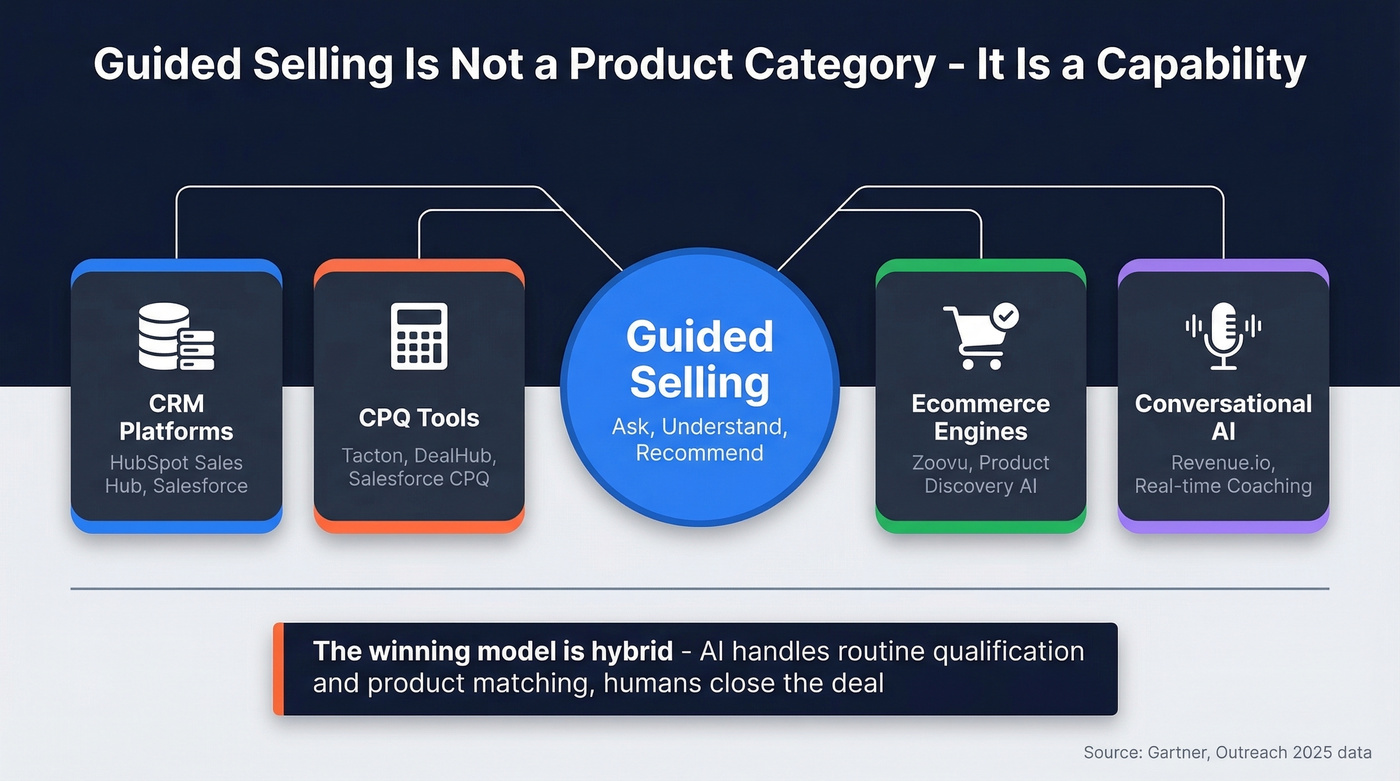
The numbers back it up. Outreach's data shows AI-guided workflows shave 11 days off sales cycles and boost win rates by 10 points on $50K+ deals, while 45% of teams already run a hybrid AI-SDR model. But Gartner predicts by 2030, 75% of B2B buyers will prefer sales experiences that prioritize human interaction over AI. The winning model isn't AI-only - it's hybrid. AI handles routine qualification and product matching. Humans close.
Here's the thing: if your average deal size is under $15K and you sell fewer than 10 products, you don't need a dedicated platform. You need a clean CRM, a documented playbook, and reps who follow it.

Every guided selling tool on this list depends on one thing: clean CRM data. If 40% of your contacts are stale, AI recommendations are guessing - not guiding. Prospeo refreshes 300M+ profiles every 7 days with 98% email accuracy, so your playbooks and deal scoring actually work.
Fix the foundation before you buy the workflow.
Best Tools by Category
Many vendors don't publish pricing. We pulled real numbers from Vendr benchmarks, published tiers, and community discussions where we could find them.
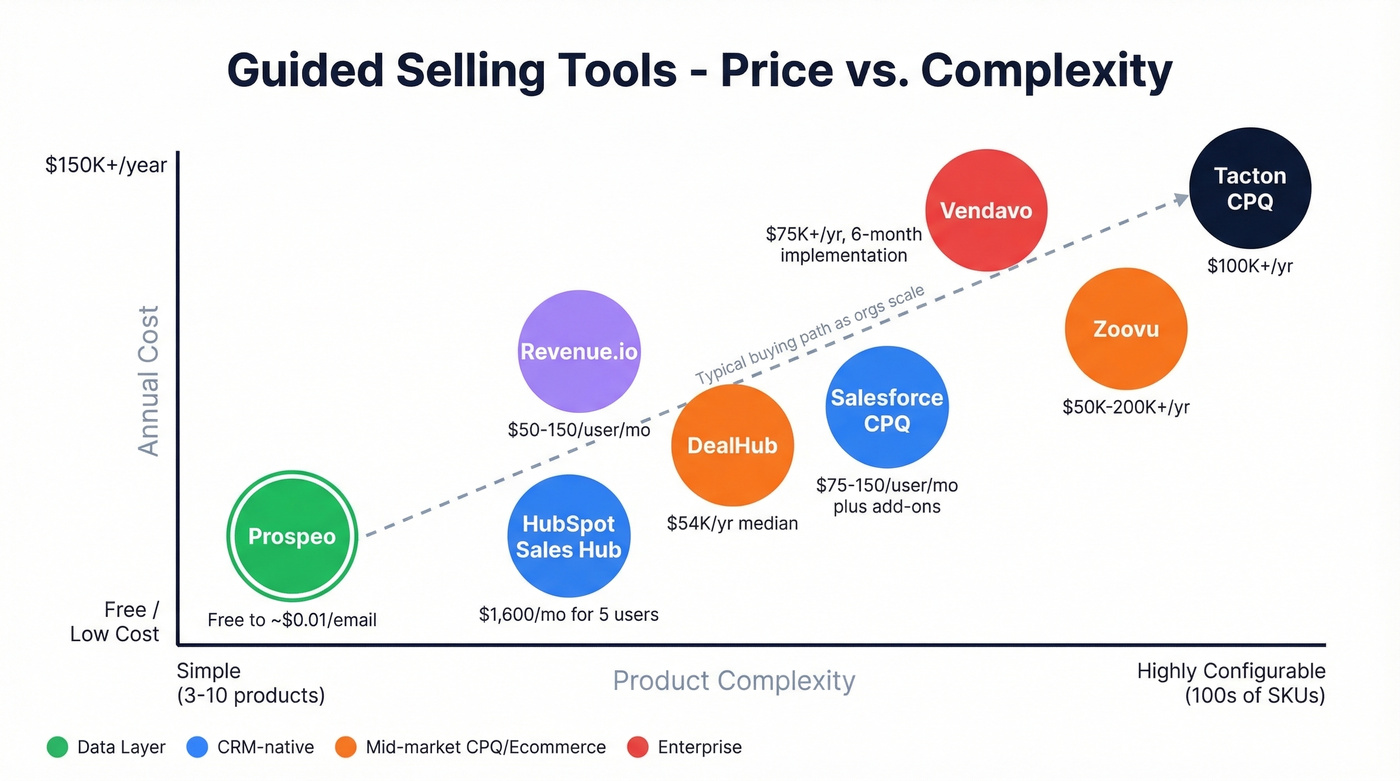
| Tool | Category | Starting Price | Best For | Key Note |
|---|---|---|---|---|
| HubSpot Sales Hub | CRM-native | $1,600/mo (5 users) | Most B2B teams | Not deep CPQ for highly configurable catalogs |
| Tacton CPQ | CPQ | ~$100K+/yr | Manufacturing | Enterprise-only |
| Prospeo | Data quality | Free; ~$0.01/email | Accurate CRM data | Best paired with a workflow tool |
| DealHub | CPQ | $54,520/yr median (Vendr) | Mid-market CPQ | Config complexity |
| Zoovu | Ecommerce | ~$50K+/yr | Product catalogs | Custom enterprise pricing |
| Salesforce CPQ | CPQ (CRM-native) | $75-150/user/mo | Salesforce shops | Config sprawl risk |
| Vendavo | Pricing optimization | ~$75K+/yr | Enterprise pricing | 6-month implementation |
| Revenue.io | Conversational AI | ~$50-150/user/mo | Real-time coaching | Not public pricing |
HubSpot Sales Hub
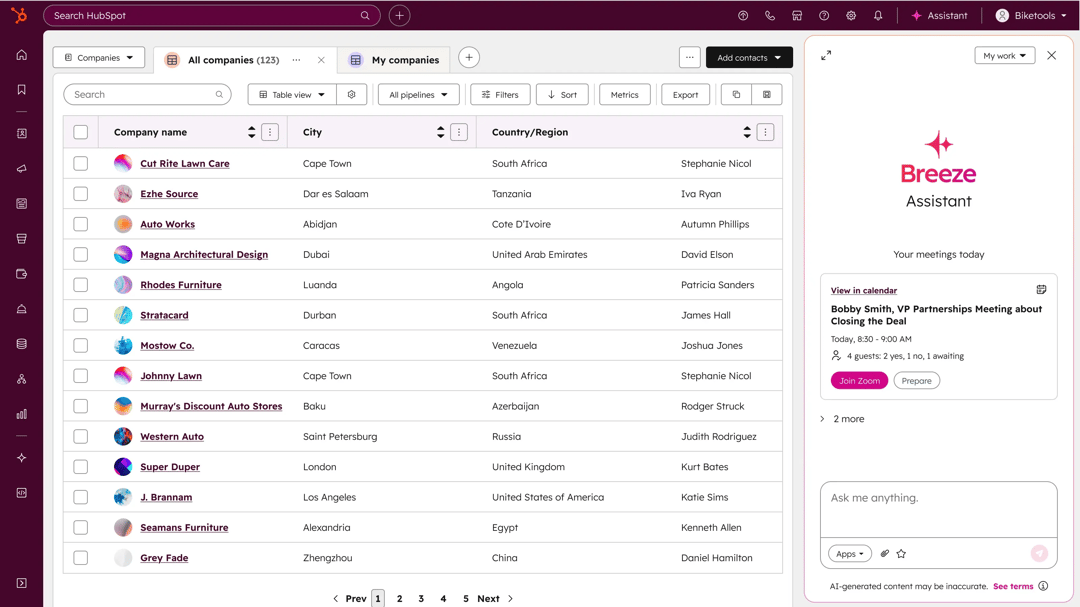
Use this if you're a mid-market B2B team that wants guided selling baked into your CRM without a long implementation. Professional tier runs $1,600/month for 5 users, Enterprise at $5,000/month. You get sequences, playbooks, deal scoring, and AI-powered recommendations - all inside the CRM your reps already live in. HubSpot's approach centers on suggested tasks and next-best actions based on real-time buying signals, plus pre-call prep and post-call follow-ups. The benefits hit fast: shorter ramp time for new reps, consistent deal execution, and fewer deals stalling in mid-pipeline because someone forgot to send a case study.
Skip this if you sell configurable products with hundreds of SKUs and pricing rules. For teams selling 3-10 products where deal execution matters more than product configuration, it's the obvious choice.
If you're still comparing options, start with a quick scan of examples of a CRM to sanity-check what you already own.
Tacton CPQ
Tacton is the tool for manufacturers whose reps spend more time building quotes than selling. Wizard-based product selection, constraint-based modeling, and integrations with Salesforce, Dynamics, SAP, and Oracle. A Forrester study found Tacton delivers over 15% faster quoting, 8% more deals closed, and $710K in average annual benefits. It starts around ~$100K/year and requires a real implementation - this isn't a two-week trial.
For simpler sales motions, it's overkill.
DealHub
DealHub sits in the mid-market CPQ sweet spot. Vendr benchmark data shows a median annual spend of $54,520 across 53 purchases, ranging from $14,304 to $155,702 depending on modules and seats. Three tiers - CPQ+, CPQ+CLM, and Quote-to-Revenue - let you start with quoting and layer in contract lifecycle management as you scale. Vendr buyers save ~16% on average through negotiation, so don't accept the first quote.
The tradeoff: reviewers often flag difficulty navigating large proposals and managing integrations. Without a dedicated RevOps person, expect friction during the first 60-90 days. We've seen teams underestimate this consistently.
Zoovu
Use this if you're an ecommerce or B2B2C company with a large product catalog and buyers drowning in choice paralysis. Zoovu's AI Discovery Platform uses dynamic guided selling to adapt product recommendations in real time based on buyer responses - and the case studies are strong: Microsoft cites a 30x ROI, and Canon cites a 53% increase in conversion plus a 14% bump in revenue. Pricing starts around $50K/year, scaling to $200K+ with catalog complexity.
Skip this if you're a pure B2B sales team. Zoovu finds the right SKU from thousands of options but won't help your AEs prioritize pipeline.
If your bigger issue is qualification (not product matching), tighten your lead scoring first.
Salesforce CPQ
If your org already runs Salesforce, CPQ is the path of least resistance at $75-150/user/month, plus $50+/user/month for Einstein AI features. But the r/salesforce consensus on guided selling is that it becomes "a very messy and complicated way" to build product filtering flows - mirror fields across multiple objects, picklist sync issues, and configuration that "gets out of control." Expect 3-9 months of implementation for complex setups. In our experience, teams that don't have a dedicated Salesforce admin regret this purchase within six months.
If you're budgeting, compare against Salesforce pricing before you commit.
Vendavo
Enterprise pricing optimization for companies where margin leakage is measured in millions. G2 rates it 4.3/5 across 68 reviews with strong marks for analytics. The tradeoff: 6-month implementation, ~$75K+/year, and a steep learning curve. Best fit for large enterprises with dedicated pricing teams. Everyone else should look elsewhere.
Revenue.io
Real-time conversational AI that coaches reps during live calls - guidance at the conversation level rather than the deal level. Pricing isn't public; expect ~$50-150/user/month based on what we've heard from buyers. Best for teams wanting in-call coaching and talk-track recommendations rather than CPQ-style configuration.
If your reps need better talk tracks, keep a library of talk track examples and update it quarterly.
What Goes Wrong With Rollouts
Let's be honest about the pattern that kills implementations:
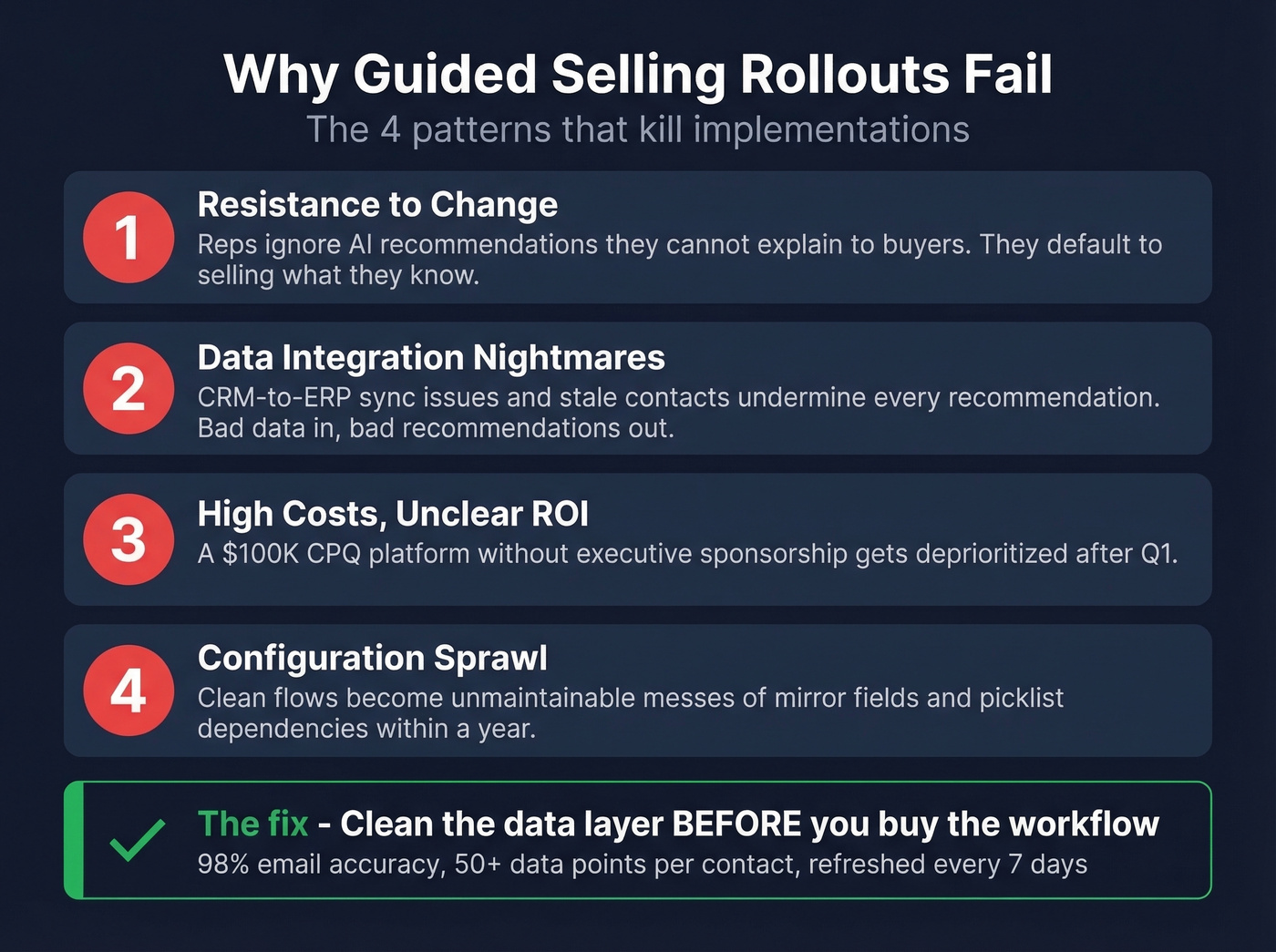
Resistance to change. Reps don't trust AI recommendations they can't explain to buyers. If the tool says "recommend Product B" and the rep can't articulate why, they'll ignore it and sell what they know.
Data integration nightmares. CRM-to-ERP sync issues and stale contacts undermine every recommendation. We've watched teams spend $80K on a guided selling platform only to realize their contact database hadn't been cleaned in two years. Bad data in, bad recommendations out - every single time.
High initial costs with unclear ROI. A $100K CPQ platform needs executive sponsorship or it gets deprioritized after Q1.
Configuration sprawl. Salesforce CPQ is the poster child - clean flows become unmaintainable messes of mirror fields and picklist dependencies within a year.
The common thread? Fix the data layer before you fix the workflow. Prospeo's CRM enrichment returns 50+ data points per contact at a 92% match rate, refreshing records every 7 days - the kind of foundation that makes any guided selling software actually useful instead of confidently wrong. If you're evaluating vendors, start with a shortlist of data enrichment services and map them to your CRM fields.
You don't need a $100K platform to guide reps to the right buyers. Prospeo gives you 30+ filters - buyer intent, technographics, job changes, funding - for ~$0.01 per verified email. Layer that into HubSpot or Salesforce and your reps already have next-best-action data.
Stop paying enterprise prices for what clean data solves for free.
FAQ
What's the difference between guided selling and CPQ?
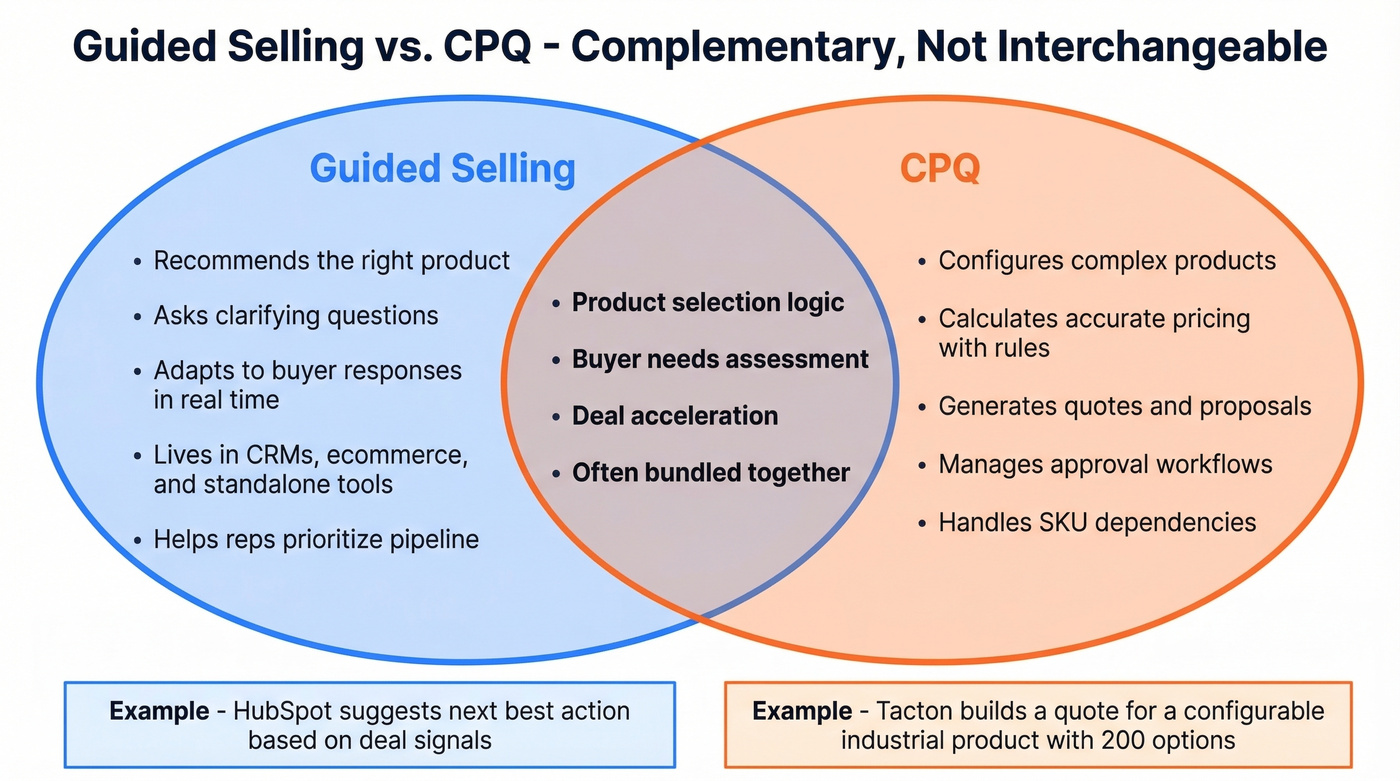
CPQ handles configuration, pricing, and quoting - the mechanics of building an accurate proposal. Guided selling is the recommendation layer that helps reps or buyers navigate to the right product first. Many CPQ tools include it as a module, but it also exists in CRM-native platforms and ecommerce discovery tools. They're complementary, not interchangeable.
How much do these platforms cost?
The range spans from free CRM tiers to $100K+/year for enterprise CPQ. The mid-market median sits around $50K/year based on Vendr benchmark data. Most vendors don't publish pricing - the comparison table above is more transparent than anything on their websites.
Do I need a dedicated tool if I already have a CRM?
If you sell three products, your CRM's built-in deal stages and playbooks are enough. If you sell 300 configurable SKUs with pricing rules and approval workflows, you need a dedicated tool. Either way, your CRM data needs to be accurate first - deals that close within 50 days have a 47% win rate versus 20% after, so stale data that delays outreach by even a week costs real revenue.
What is dynamic guided selling?
Dynamic guided selling adjusts recommendations and next steps in real time as new buyer signals come in, rather than following a static decision tree. Tools like Zoovu and HubSpot's AI-powered playbooks use this approach to surface different products or talk tracks based on how a conversation or browsing session actually unfolds, making the experience more relevant for each buyer.
What's the best free option for fixing data quality first?
Prospeo offers 75 free email credits and 100 Chrome extension credits per month - enough to test whether clean data alone improves your pipeline velocity before committing to a $50K+ platform.