

High Intent Leads: Scoring Model, Signals & Playbook for 2026
Your SDR just pinged you: "This account is surging on G2 - who do I email?" You've got the company name but no verified contact for the VP of Engineering driving the evaluation. By the time you find the right email, the signal is five days old and they've already booked a demo with your competitor.
Intent data is easy to buy. Operationalizing it is what breaks teams. The hard part isn't finding high intent leads - it's reaching the right person before the signal expires. Here's the scoring model, signal hierarchy, and operational playbook we use to close that gap.
What High Intent Leads Actually Are
B2B buyers conduct an average of 12 online searches before visiting a specific brand's website, and they're 57% through their purchase decision before they ever contact a vendor. Leads with high purchase intent are the ones deep into that journey - actively comparing solutions, checking pricing, reading reviews.
Here's the line that matters: downloading a whitepaper isn't high intent. Visiting your pricing page twice in a week, researching your category on G2, requesting a demo - that's active buying behavior. These people aren't browsing. They're shortlisting.
The distinction sounds obvious, but most teams treat every form fill the same way, and that's where pipeline goes to die. The consensus on r/sales backs this up - people have intent data, not workflows. This article gives you the workflow.
Why These Leads Deserve Obsession
Benchmarks from Factors.ai show intent-driven leads convert at 20-25% versus 5-10% for traditional outbound - a 2-3x lift. They close roughly 40% faster and reduce CAC by about 30%. Treat these as directional since your baseline matters, but the pattern holds across every dataset we've seen.
Case-study highlights reinforce the point: Okta achieved 24x higher opportunity conversion rates and a 63% reduction in time-to-close after layering intent into their ABM motions. Salesforce reported +20% conversion rates across the board. These aren't marginal improvements. They're the difference between a team that hits quota and one that doesn't.
Here's the thing: if your average deal size sits below $10K, you probably don't need a $40K intent platform. First-party signals plus a good B2B database will get you 80% of the way there at a fraction of the cost.
Signals That Identify Intent-Rich Prospects
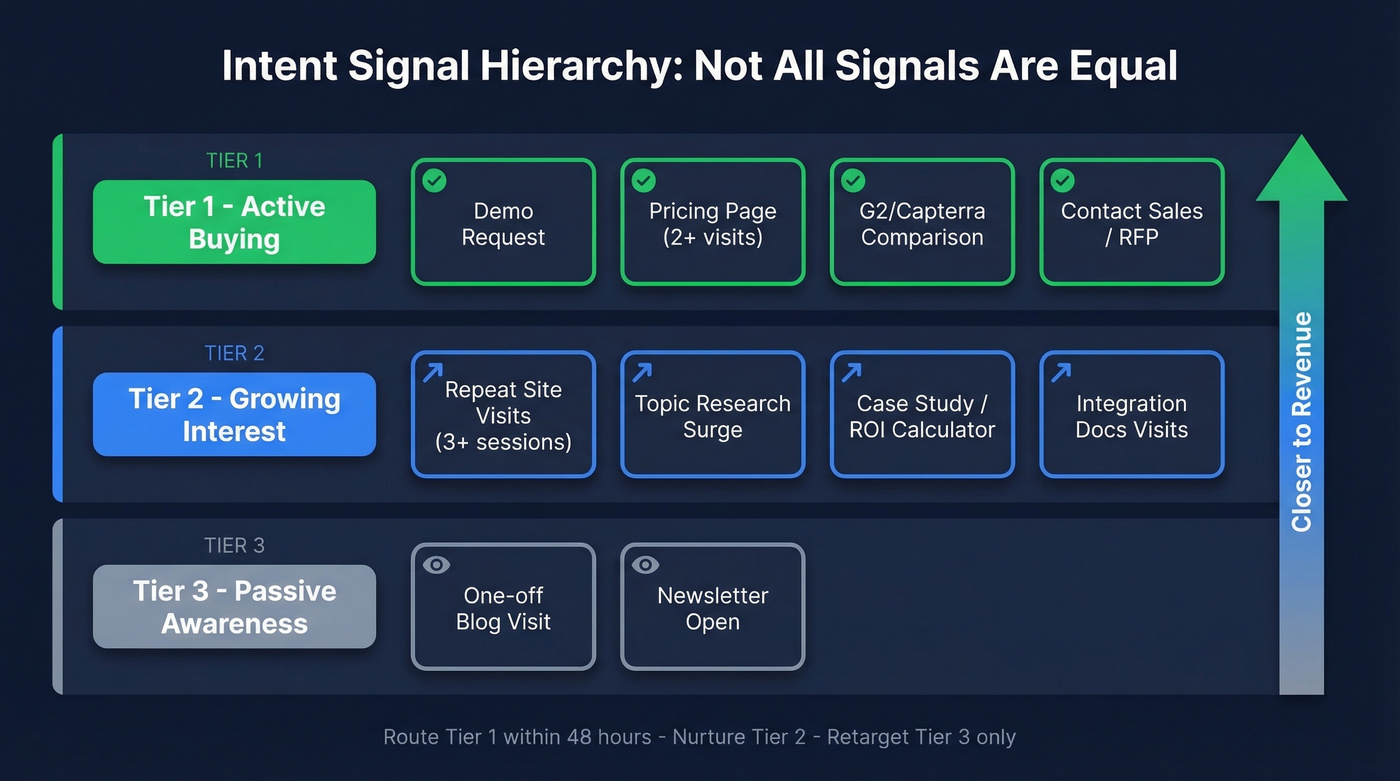
Not all signals carry equal weight. Treating a blog visit the same as a demo request is the fastest way to burn your SDRs' time.
| Tier | Signal | What It Means |
|---|---|---|
| Tier 1 | Demo request | Active buying |
| Tier 1 | Pricing page (2+ visits in 7 days) | Comparing costs |
| Tier 1 | Competitor comparison on G2/Capterra | Shortlisting |
| Tier 1 | Contact sales / RFP submission | Ready to engage |
| Tier 2 | Repeat site engagement (3+ sessions) | Growing interest |
| Tier 2 | Topic research surge (Bombora/similar) | Category exploration |
| Tier 2 | Case study or ROI calculator use | Building a business case |
| Tier 2 | Integration/docs page visits | Technical evaluation |
| Tier 3 | One-off blog visit | Passive awareness |
| Tier 3 | Newsletter open | Low commitment |
Beyond behavioral signals, watch for organizational triggers: new hires in relevant departments, funding rounds, leadership changes, and closed-lost opportunities circling back. These are often the earliest indicators that a buying cycle is restarting - and they're easy to miss if you're only watching website analytics.
How to Score These Leads
Simple scoring models beat 50-variable AI models nobody trusts. We've seen teams spend months building elaborate scoring systems that sales ignores because the logic is opaque. Start with this instead.
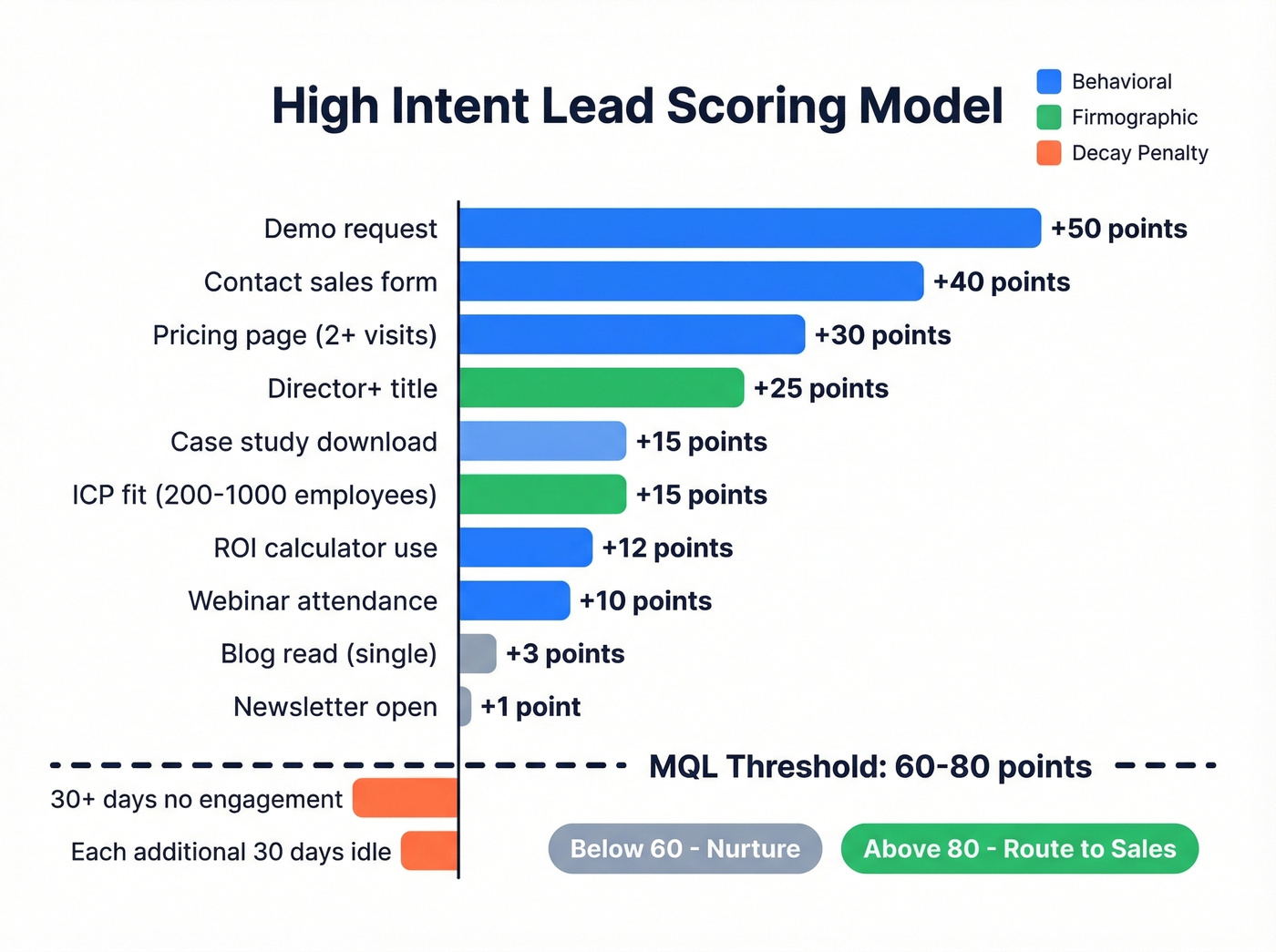
The weights below reflect closeness to revenue. Tier 1 actions dominate because they signal active buying. Firmographic fit adds a multiplier. Decay prevents zombie MQLs from clogging your pipeline.
| Action / Attribute | Points |
|---|---|
| Demo request | +50 |
| Contact sales form | +40 |
| Pricing page (2+ visits) | +30 |
| Case study download | +15 |
| ROI calculator use | +12 |
| Webinar attendance | +10 |
| Blog read (single) | +3 |
| Newsletter open | +1 |
| Director+ title | +25 |
| 200-1,000 employees (ICP fit) | +15 |
| 30+ days no engagement | -10 |
| Decay (per additional 30 days idle) | -5 |
MQL threshold: 60-80 points. Below 60, the lead needs nurturing. Above 80, route directly to sales with a priority SLA. Recalibrate quarterly - scoring models that sit untouched for a year drift badly as your ICP and market shift.

Your scoring model is useless without verified contacts. Prospeo layers Bombora intent data across 15,000 topics with 300M+ profiles and 98% email accuracy - so when an account surges, you reach the right buyer in minutes, not days.
Stop watching intent signals expire. Start converting them.
Acting on Intent: The 48-Hour Playbook
Intent signals decay fast. If you can't enrich contacts in under five minutes, don't buy intent data yet - you'll waste the signal before you can act on it. Here's the time-decay framework that should govern your SLAs:
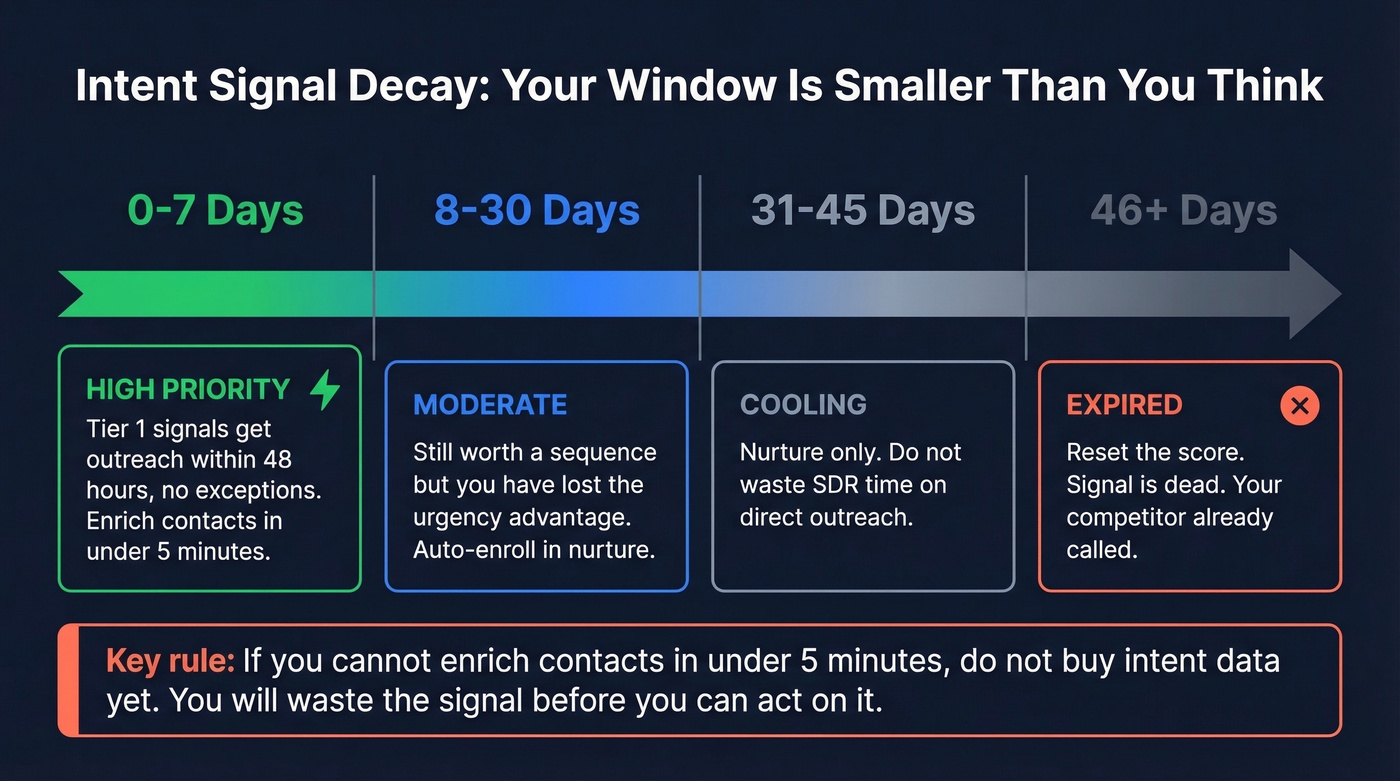
- 0-7 days: High priority. Tier 1 signals get outreach within 48 hours, no exceptions.
- 8-30 days: Moderate. Still worth a sequence, but you've lost the urgency advantage.
- 31-45 days: Cooling. Nurture only.
- 46+ days: Expired. Reset the score.
RevOps Wiring: Track and Route
Most intent playbooks stop at "follow up fast." Here's the actual plumbing.
Events to track: pricing_view_2x_7d, demo_request, roi_calc_use, integration_docs_view, g2_comparison_page
Push to: CRM lead/account score field + Slack alert channel + sequence enrollment tool (Instantly, Smartlead, Outreach, etc.)
Routing rules:
- Tier 1 signal - SDR gets a Slack ping, picks up within 5 minutes, enrolls in high-priority sequence
- Tier 2 signal - Auto-enroll in nurture sequence, flag for weekly review
- Tier 3 signal - Retargeting audience only, no direct outreach
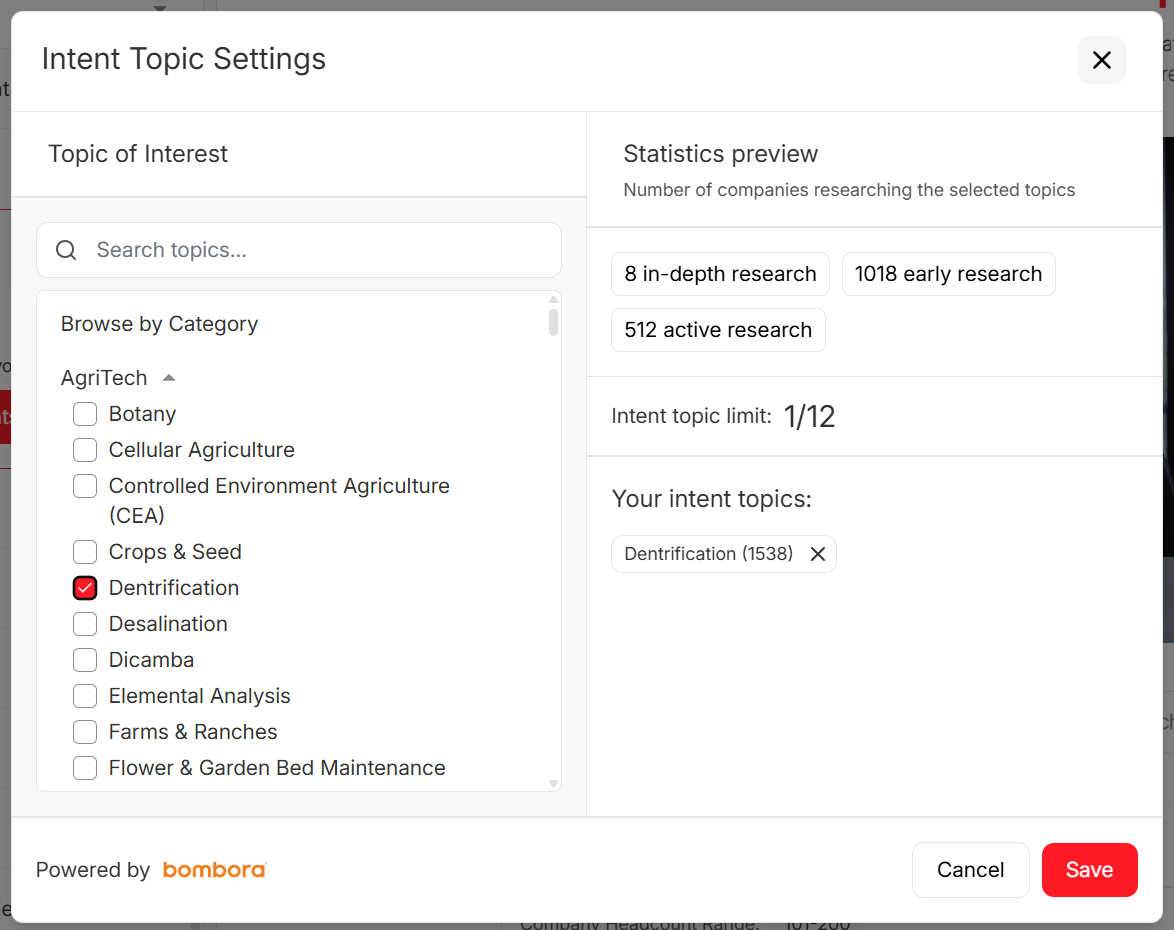
Skip topic intent entirely if you don't have a 48-hour SLA in place. You'll generate noise without conversion.
Outreach That Converts
Timeline-based hooks deliver a 10.01% reply rate versus 4.39% for problem-based hooks - a 2.3x lift. Frame your message around the buyer's timeline, not their pain. And never open with "We noticed you were researching X." It sounds like surveillance, not helpfulness.
Three openers that work:
Timeline hook: "Are you evaluating [category] solutions this quarter? We just shipped [specific feature] that's cutting implementation time in half for teams like yours."
Evaluation hook: "Most [title] at [company size] companies tell us the hardest part of choosing a [category] tool is [specific challenge]. Happy to share what we're seeing work - no pitch attached."
Business case hook: "Putting together a business case for [category]? I can send over a one-pager with ROI benchmarks from [similar company type] - takes 2 minutes to read."
Three Mistakes That Kill Conversions
Creepy messaging. Referencing surveillance-like language ("We see you're researching cloud security solutions") kills trust instantly. Buyers know they're being tracked. They don't want to be reminded. Lead with value, not visibility.
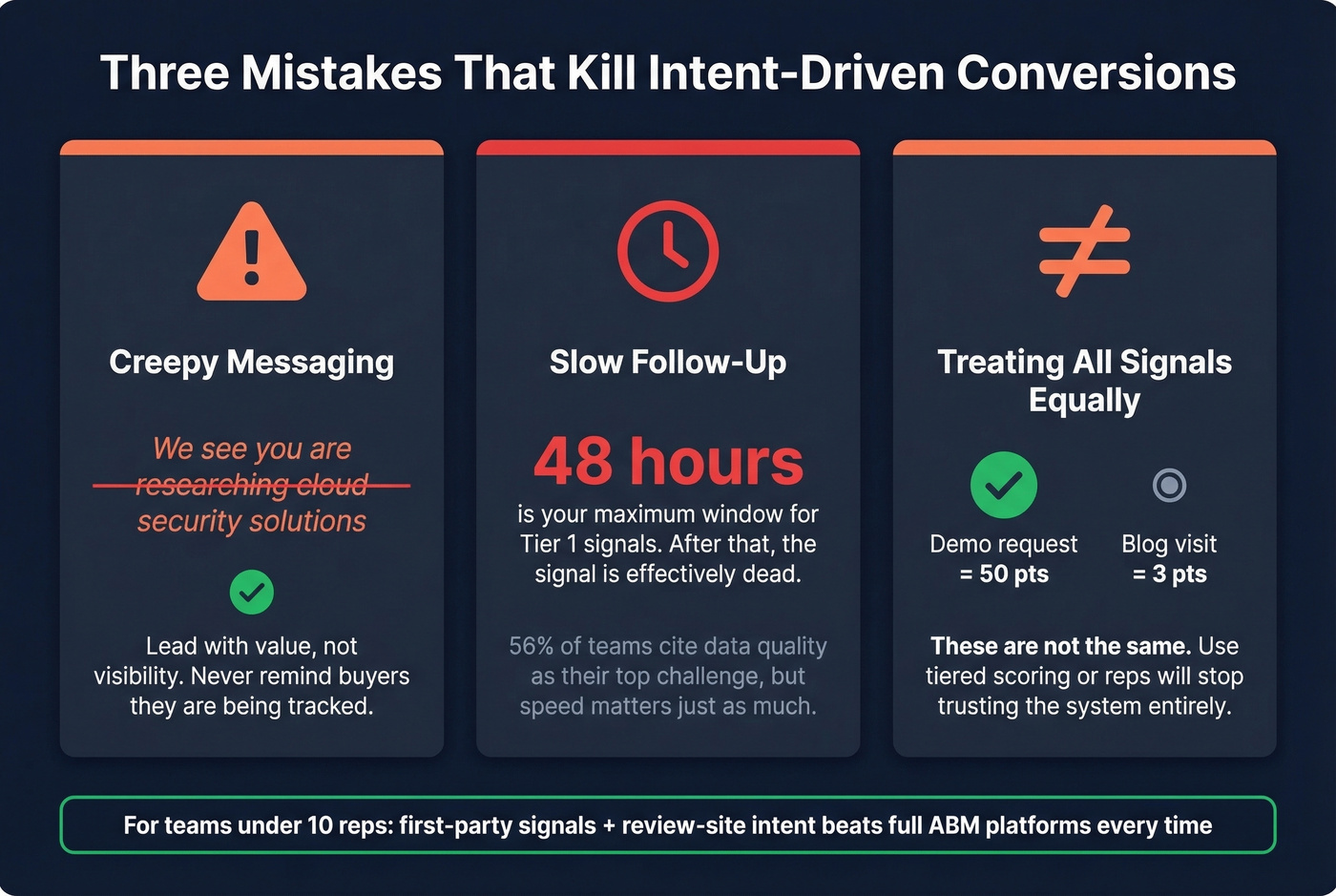
Slow follow-up. 56% of teams cite data quality as their top intent data challenge, but speed matters just as much. If you're not reaching out within 48 hours of a Tier 1 signal, the signal is effectively dead. Your competitor already called.
Treating all signals equally. A blog visit isn't a demo request. Use the tiered model above. We've watched teams route every form fill to sales as "high intent" and then wonder why reps stop trusting the scoring system entirely. For teams under 10 reps, first-party signals plus review-site intent beats full ABM platforms every time - skip the enterprise tooling until you've outgrown the simpler approach.
What Intent Data Costs in 2026
The intent data market hit $4.49B in 2026, growing at 16.6% CAGR. Pricing ranges are enormous depending on what you need.
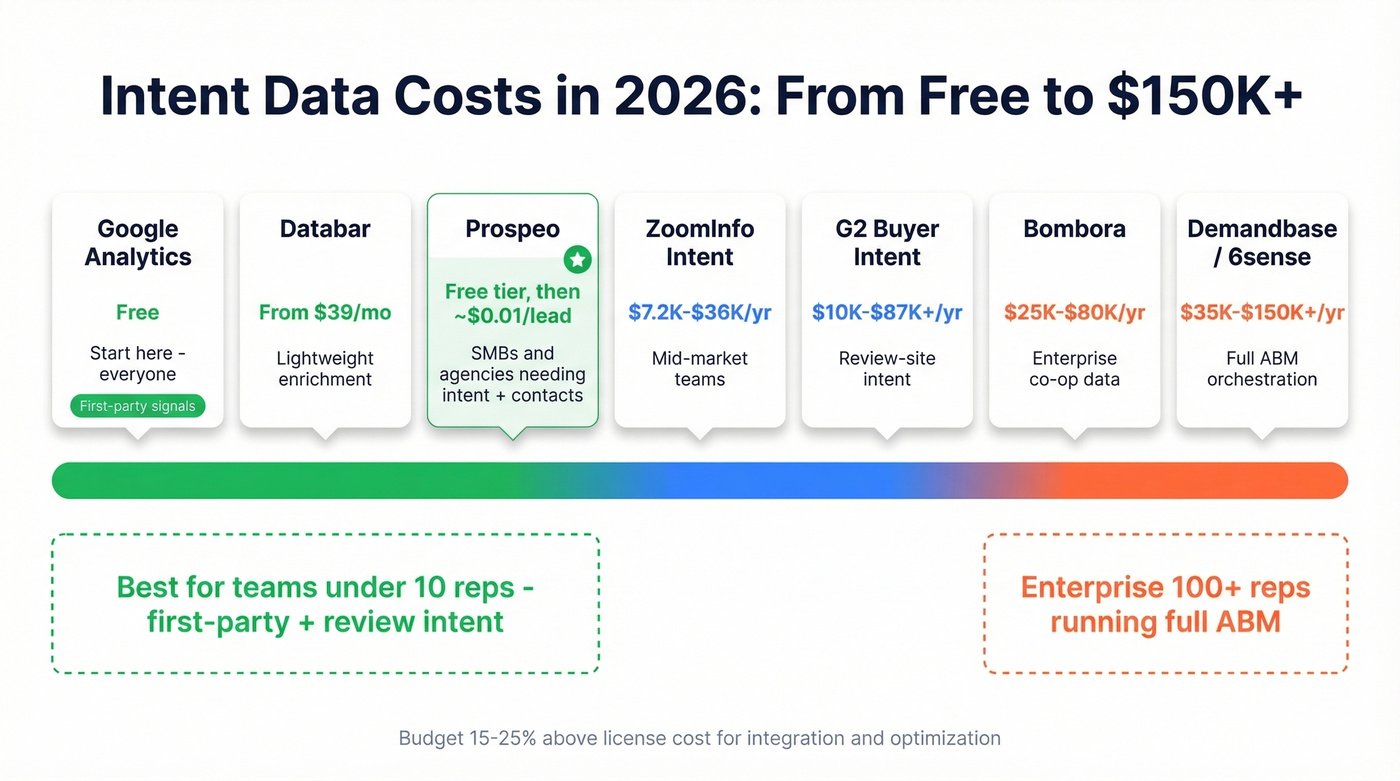
| Tool | Annual Cost | Best For |
|---|---|---|
| Google Analytics (1st-party) | Free | Everyone - start here |
| Databar (aggregator) | From ~$39/mo | Lightweight enrichment |
| Prospeo | Free tier; ~$0.01/lead | SMBs and agencies needing intent + contacts |
| G2 Buyer Intent | $10K-$87K+/yr | Review-site intent signals |
| ZoomInfo Intent | $7,200-$36,000/yr | Mid-market with existing ZoomInfo contracts |
| Bombora | $25K-$80K/yr | Enterprise co-op intent data |
| Demandbase | $40K-$120K/yr | Full ABM orchestration |
| 6sense | $35K-$150K+/yr | Enterprise predictive + intent |
Prospeo uses credit-based pricing - roughly $0.01 per email, with mobiles at 10 credits per number. The free tier includes 75 emails and 100 Chrome extension credits per month, enough to test the workflow before committing. No contracts, cancel anytime.
You don't need a $40K platform to act on buyer intent. Enterprise platforms make sense for 100+ rep organizations running full ABM. For everyone else, they're overkill. Budget 15-25% above license cost for integration and optimization regardless of which tool you pick.
Your Next 48 Hours
Let's be practical about what to do tomorrow morning. First, audit your current lead routing: are Tier 1 signals actually reaching a rep within 48 hours, or are they sitting in a queue? Second, implement the scoring model above in your CRM - even a custom field with manual scoring beats no scoring at all. Third, pick one intent source (first-party website behavior is free) and wire it into a Slack alert so someone sees it in real time.
You can layer on third-party intent data later. The workflow matters more than the data source.
If you need a blueprint for the plumbing, start with RevOps wiring and then automate the handoffs with CRM automation so intent signals don’t die in a queue.
A 48-hour SLA demands instant enrichment. Prospeo's database returns verified emails at $0.01 each and 125M+ direct dials with a 30% pickup rate - refreshed every 7 days so you're never calling stale data while the buyer books a demo with your competitor.
Enrich intent-surging accounts in seconds, not hours.
FAQ
What's the difference between high-intent and low-intent leads?
High intent leads show active buying behavior - pricing page visits, demo requests, competitor research on review sites. Low-intent leads show passive interest like blog reads or newsletter opens. The scoring model above assigns 25-50 points for high-intent actions versus 1-5 for low-intent, making the distinction operationally clear for routing and SLAs.
How quickly should you follow up on an intent signal?
Within 48 hours for Tier 1 signals like demo requests and repeated pricing page visits. Signals decay fast: 0-7 days is high priority, 8-30 days is moderate, and anything past 45 days is effectively expired. Speed is the single biggest controllable variable in intent-to-pipeline conversion.
Do you need expensive tools to act on buyer intent?
No. First-party signals - website behavior via Google Analytics, email engagement metrics - are free and underused. For third-party intent data, tools like Prospeo track 15,000 topics with verified contact data starting on a free tier at roughly $0.01/lead, a fraction of the $25K-$150K/year enterprise platforms charge.
What's a good lead scoring threshold for MQLs?
Most teams set the MQL threshold between 60-80 points. Below 60, the lead needs more nurturing through content and retargeting. Above 80, route directly to sales with a priority SLA. Recalibrate quarterly - scoring models that sit untouched drift as your ICP and market shift.