

How to Build a High Ticket Sales Funnel That Actually Converts
A RevOps lead we know spent $14,000 on a webinar funnel for a $25K consulting offer. Twelve weeks in, zero booked calls. The funnel wasn't broken - it was the wrong architecture for the price point. Most failures at this level aren't about copy or creative. They're about picking the wrong funnel type, feeding it bad data, and responding too slowly.
What Is a High Ticket Funnel?
A high ticket sales funnel is a structured path that moves qualified prospects toward a purchase worth four figures or more - a $2,000 course, a $25K coaching package, a $50K consulting retainer. The critical difference from low-ticket funnels: you're optimizing for qualified conversations, not volume.
Nobody buys a $10K service from a checkout page. Every high ticket funnel eventually funnels into a human interaction, and the entire system exists to make that conversation happen with the right person at the right time.
What You Need First
Before you build anything, nail these three things:
- Close 1-5 clients manually before automating. Automation amplifies what works - it doesn't create product-market fit.
- Match your funnel type to your price point. Webinar funnels work for $1K-$4K offers. VSL + application funnels work for $5K+. Wrong architecture means wasted spend.
- Fix your data and speed-to-lead. Conversion rates are 8x higher when you connect within 5 minutes, and 78% of buyers go with the first vendor to respond.
Validate Before You Automate
Here's the thing: the #1 mistake in high ticket funnels is building the funnel before proving the offer. We've watched teams spend months on landing pages, email sequences, and webinar decks for offers nobody wants at that price point.
Ken Yarmosh calls this the "shadow funnel" - selling manually to a lighthouse client through DMs, emails, and calls before you systematize anything. Luisa Zhou gives the same advice: close a handful of clients first, learn the objections, collect testimonials, then build the machine. If you can't close someone in a conversation, no amount of automation will fix it.
Skip the elaborate tripwire-upsell-downsell architecture until you've validated that people will pay your price.
Which Funnel Type Fits Your Price Point?
This is where most people get it wrong. They see a guru running webinar funnels and assume that's the model. Don't do that. Funnel architecture should follow price point, not trend.
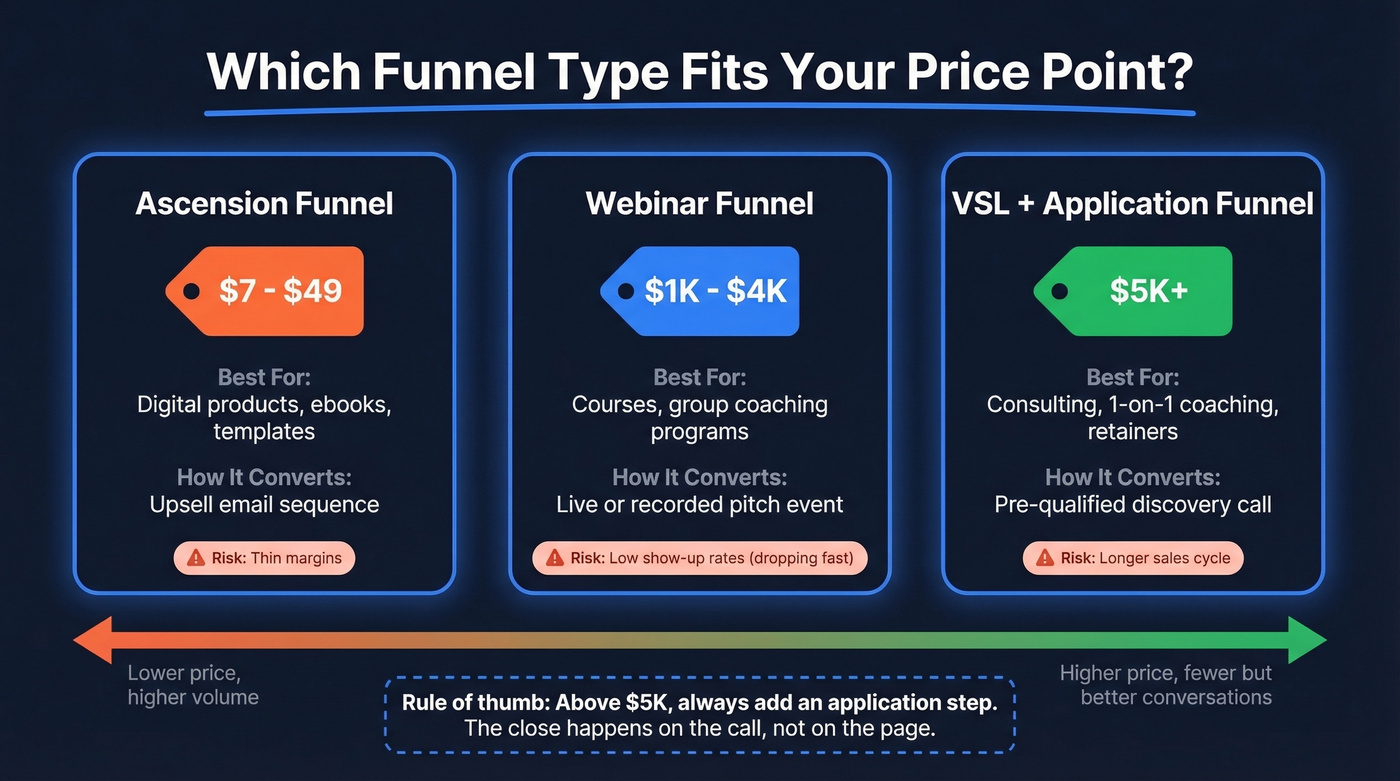
| Funnel Type | Best For | Price Range | Conversion Mechanism | Key Risk |
|---|---|---|---|---|
| Ascension | Digital products | $7-$49 | Upsell sequence | Thin margins |
| Webinar | Courses, group programs | $1K-$4K | Live/recorded pitch | Low show-up rates |
| VSL + Application | Consulting, 1:1 coaching | $5K+ | Qualifying call | Longer sales cycle |
Webinar funnels tend to underperform for $5K+ offers as webinar fatigue rises and attendance drops. For a $25K mastermind, a common "staircase of commitment" looks like: content, then a free automated webinar, then a paid strategy session, then an application, then an interview. For $50K+ consulting, a 25-minute VSL with case studies feeding into a pre-qualified audit call is the pattern we see working best.
If your average contract value is under $5K, you probably don't need an elaborate multi-step funnel at all - a strong landing page and a Calendly link will outperform any complex architecture. Save the complexity for offers where the math justifies it.
For anything above $5K, you need an application step. It filters tire-kickers and signals exclusivity. The close happens on the call, not on the page.

High ticket funnels live or die on speed-to-lead and data quality. If 78% of buyers go with the first vendor to respond, you can't afford bounced emails or wrong numbers. Prospeo's 30+ filters - including buyer intent and job changes - let you build lists of decision-makers who are actually in-market for your $5K+ offer.
Stop feeding stale data into a funnel you spent months building.
Stage-by-Stage Benchmarks
Every premium funnel moves through five stages: Lead, MQL, SQL, Opportunity, Closed Won. Most articles throw around conversion rates without context. Here are actual benchmarks from First Page Sage, based on data collected from 2017-2025 across a mix that's roughly 65% B2B.
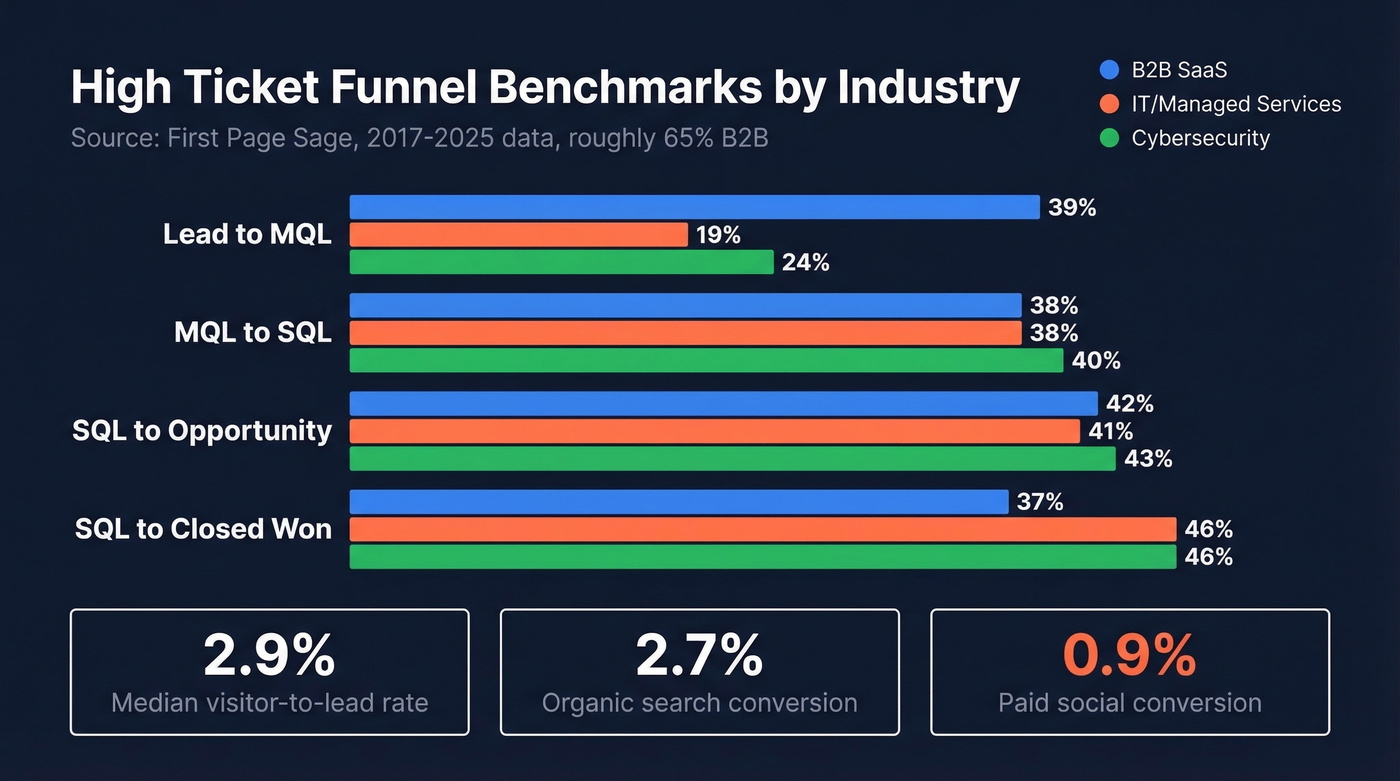
| Funnel Stage | B2B SaaS | IT/Managed Services | Cybersecurity |
|---|---|---|---|
| Lead to MQL | 39% | 19% | 24% |
| MQL to SQL | 38% | 38% | 40% |
| SQL to Opportunity | 42% | 41% | 43% |
| SQL to Closed Won | 37% | 46% | 46% |
The median B2B visitor-to-lead conversion rate is 2.9%. Channel matters too: organic search converts around 2.7%, email at 2.4%, and paid social at just 0.9%.
Now think about unit economics. If you close 1 in 3 discovery calls at $7,500, each call is worth $2,500 in expected revenue. Work backward: how many calls per month, what's your call-booking rate, what does a qualified lead cost? That math tells you whether your funnel is viable before you spend a dollar on ads.
Structuring the Discovery Call
The discovery call is where high ticket deals are won or lost. It's a structured diagnostic conversation, not a pitch.
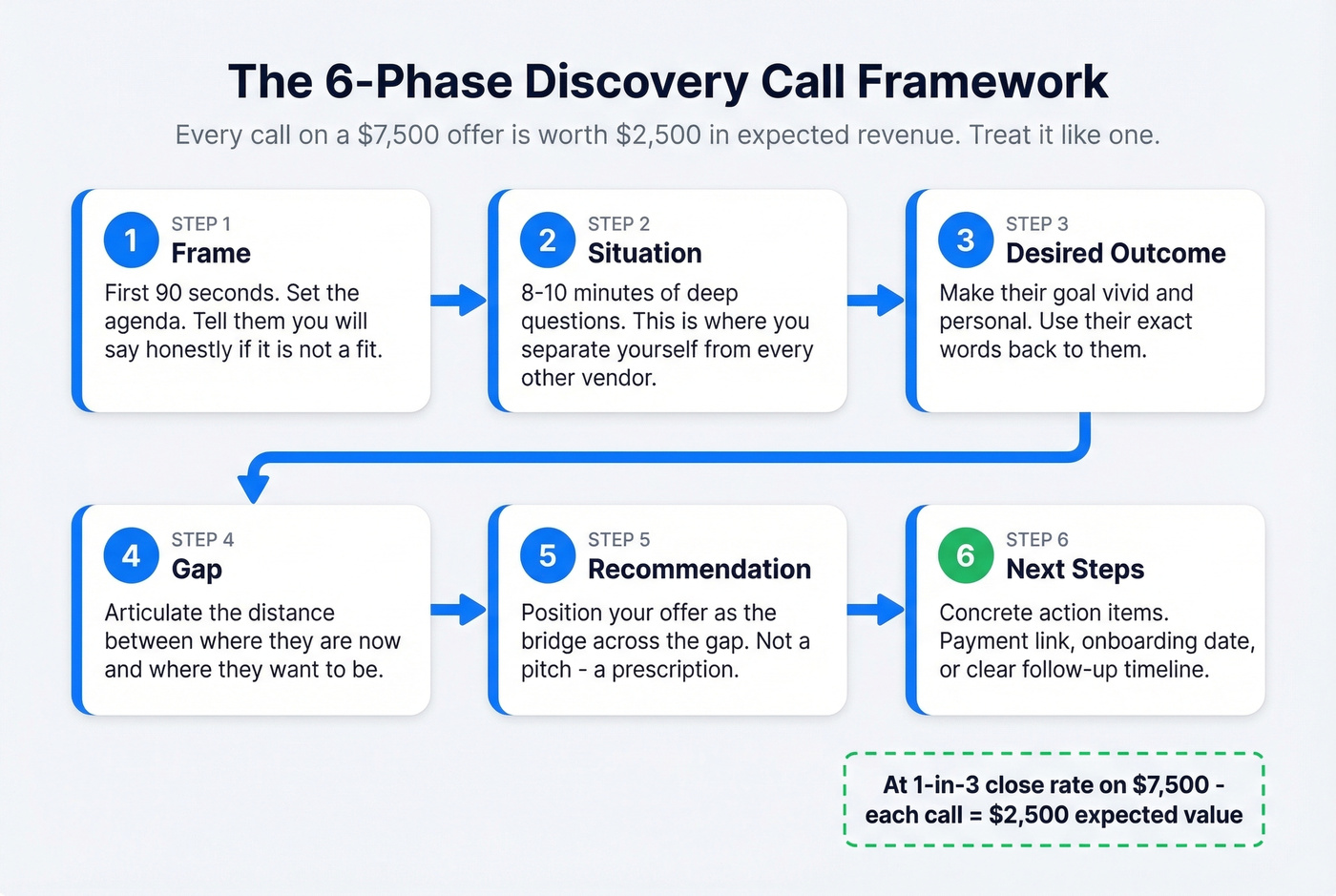
The High Ticket HQ framework breaks it into six phases: Frame the call in the first 90 seconds by setting the agenda and telling them you'll say honestly if it's not a fit. Then explore their Situation for 8-10 minutes - the depth of your questions is what separates you from every other vendor. Make the Desired Outcome vivid and personal, articulate the Gap between where they are and where they want to be, deliver your Recommendation as the bridge, and close with concrete Next Steps.
At a 1-in-3 close rate on a $7,500 offer, every discovery call carries $2,500 in expected value. We treat them like $2,500 meetings - because they are.
The Minimum Viable Tech Stack
You don't need 12 tools. You need six categories covered, and you need them talking to each other.
Funnel Builder: Perspective (~$62/mo) for mobile-first funnels.
Email Automation: ActiveCampaign (~$29-$49/mo+) for sequences and tagging.
Scheduling: Calendly (free to ~$15/mo).
Webinar: Zoom Webinars (~$80-$100+/mo).
CRM: HubSpot (free to ~$50/mo+ depending on seats and modules) for pipeline tracking.
Data & Enrichment: This is where most funnels quietly fail. You build a beautiful sequence, target the right titles, and then half your emails bounce because the data's stale. Prospeo handles this with 98% email accuracy on 143M+ verified addresses refreshed every 7 days, plus 30+ search filters covering buyer intent, technographics, and job changes. At roughly $0.01 per email versus the $15K-$40K/year range you'd pay for ZoomInfo, the pricing gap is hard to ignore when your funnel needs hundreds of verified contacts rather than millions.

Every discovery call on a $7,500 offer is worth $2,500 in expected revenue. Bad data means missed calls, bounced emails, and pipeline that never materializes. Prospeo delivers 98% email accuracy and 125M+ verified mobiles refreshed every 7 days - at $0.01/email instead of $15K+/year for ZoomInfo.
Protect your $2,500-per-call pipeline with data that actually connects.
Mistakes That Kill High Ticket Funnels
Five mistakes we see repeatedly - and let's be honest, we've made a couple of these ourselves:
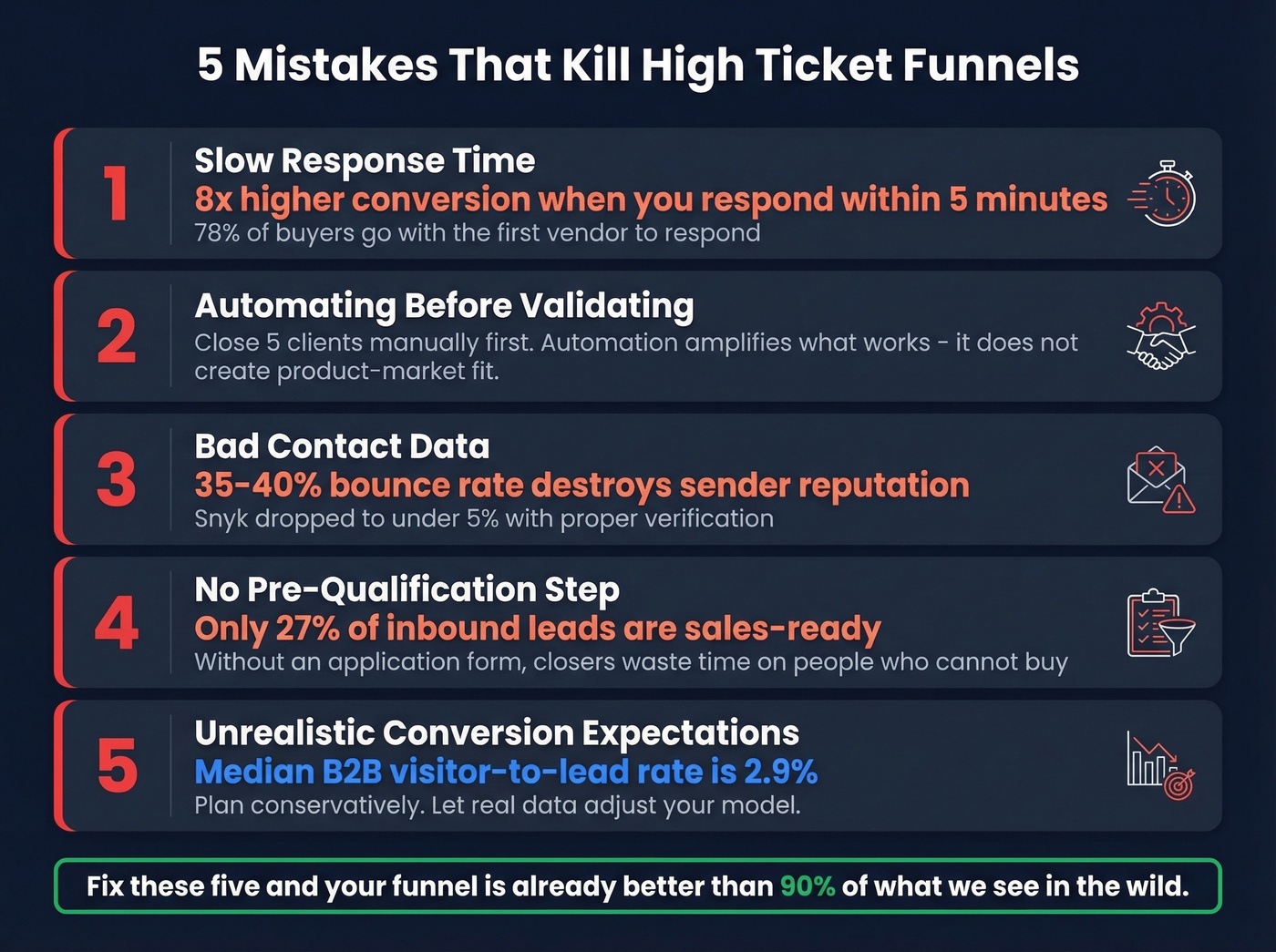
Slow response time. Conversion rates are 8x higher when you connect within 5 minutes. If your lead sits in a queue for 24 hours, you've already lost. 78% of buyers go with the first vendor to respond.
Automating before validating. Building a $5K webinar funnel before you've closed five clients manually is building a machine that amplifies nothing.
Bad contact data. If your outbound sequences bounce at 20%+, you're not just wasting sends - you're torching your domain reputation. Snyk dropped their bounce rate from 35-40% to under 5% after switching to a 5-step verification process that catches spam traps, honeypots, and catch-all domains before they hit your sender score.
No pre-qualification. Only 27% of inbound leads are actually sales-ready. Without an application form, your closers waste time on people who can't buy.
Unrealistic conversion expectations. The median B2B visitor-to-lead rate is 2.9%. Plan conservatively, let real data adjust your model, and you won't panic-kill a funnel that's actually working.
Tripwire to High Ticket - A Real Example
A ClickFunnels case study documents a fitness coaching funnel that generated $32K in high ticket online sales from $935 in ad spend - a documented 4,034% ROI. The architecture: Facebook ads driving ~$1 leads to a lead magnet with a 52% opt-in rate, a $7 tripwire case study acquired at break-even, then a bonus strategy session for tripwire buyers that converted into premium coaching packages.
This case study predates today's ad costs - expect higher CPLs now. But the architecture holds: use a low-cost front end to self-fund lead acquisition, then qualify and convert on the call.
FAQ
What Are Realistic Conversion Rates for a High Ticket Sales Funnel?
The median B2B visitor-to-lead rate is 2.9%, with roughly 39% lead-to-MQL and 37% SQL-to-closed-won for B2B SaaS. Plan with these numbers, not guru promises of 10%+ cold-traffic close rates.
How Much Ad Spend Before Killing a Funnel?
Budget enough to generate 10-15 discovery calls before making a decision. At a $50 CPL and 20% call-booking rate, that's roughly $2,500-$3,750. If none of those calls close, the problem is your offer or call structure - not the funnel.
Can You Fill a Premium Funnel Without Paid Ads?
Yes. Outbound prospecting to decision-makers using verified contact data, guest podcast appearances, and referral partnerships can match paid channels. The consensus on r/sales is that outbound paired with a solid scheduling link often outperforms paid for high-ticket B2B, especially when you're targeting a narrow ICP. Build targeted lists with buyer intent filters and verified emails, then pair with a scheduling link for a pipeline that doesn't depend on ad spend.