

Highrise vs Salesforce: A Comparison That No Longer Exists
If you're comparing Highrise vs Salesforce in 2026, the decision's already made - you can't buy Highrise. It shut down to new customers in August 2018. And Salesforce is probably overkill for the exact reason you liked Highrise in the first place.
These two were never real competitors. One was a contact notebook for small teams. The other is an enterprise GTM platform with a learning curve measured in months. Let's sort out what actually matters: whether Salesforce is the right move for you, and what simpler options deserve your attention instead.
30-Second Verdict
Highrise is discontinued for new customers. You can't sign up. Existing users can keep using the "forever version" with security and infrastructure updates, but there's no active product development.
Salesforce is powerful but likely wrong if you valued Highrise's simplicity. At $25/user/month, a 10-seat team pays $3,000/year - before implementation costs.
Skip both if you're a small team that wants a fast, affordable CRM. Look at Less Annoying CRM ($15/user), Pipedrive ($14/user), or HubSpot CRM (free tier).
What Happened to Highrise?
Highrise launched in 2007 as a dead-simple contact tracker. It grew to more than 10,000 companies before 37signals rebranded to Basecamp and, as former CEO Nathan Kontny put it, "all the traffic disappeared." Competitors published "Highrise is shutting down" posts, poaching panicked customers.
On August 20, 2018, Highrise stopped accepting new signups. The team committed to keeping it running as a "forever version" - security and infrastructure updates only. If you're an existing user, it still works. If you're shopping, it's not an option.
Highrise vs Salesforce at a Glance
| Highrise | Salesforce | Edge | |
|---|---|---|---|
| Status | Not accepting new customers (since 2018) | Active | Salesforce |
| Starting price | Was $4/user/mo | $25/user/mo | N/A - can't buy Highrise |
| G2 rating | N/A | 4.4/5 (25,000+ reviews) | Salesforce |
| Target user | Small teams | Mid-market to enterprise | Depends on team size |
| Learning curve | Minimal | Steep | N/A |
| Overall | Frozen product | Living ecosystem | Salesforce by default |
This isn't a fair fight - it's a category mismatch. One product has 25,000+ reviews because it serves a massive range of teams. The other is frozen in 2018.

A $15/user CRM with clean data beats a $25/user CRM stuffed with stale contacts. Prospeo enriches your entire contact list - returning verified emails, current job titles, and direct dials across 50+ data points at an 83% match rate. No contracts. Starts free.
Fix your data before you pick your CRM.
Is Salesforce the Right Replacement?
Salesforce is an incredible platform if you have the team, budget, and process maturity to use it. For a former Highrise user? Almost certainly the wrong call.
Use Salesforce if you're scaling past 50 reps, need deep customization, and have a dedicated admin. Pricing tiers run from Starter Suite at $25/user/mo up to $550/user/mo for Agentforce 1 Sales, and annual contracts are standard for Sales Cloud plans.
Skip Salesforce if you're under 30 people. In our experience, teams that size rarely touch more than 10% of Salesforce's features, and implementation alone typically runs $5,000-$20,000+ for SMBs. One Reddit user called it a "time-sucking nightmare" after paying a consultant $6k who eventually ghosted. Another at a sub-30-person company warned that leadership assumed they could "flick a switch" - they couldn't.
Here's the thing: if your average deal size is under five figures and your team is under 20 people, you don't need Salesforce. A $15/user CRM plus clean data will outperform a $25/user CRM stuffed with stale contacts every single time.
If you're planning a switch, treat it like a proper CRM data migration project, not a quick import.
Better Alternatives for Former Highrise Users
| Tool | Starting Price | Best For |
|---|---|---|
| HubSpot CRM | Free / $9/user/mo | All-around free tier |
| Pipedrive | $14/user/mo | Visual pipeline simplicity |
| Less Annoying CRM | $15/user/mo | No-contract budget pick |
| Bigin by Zoho CRM | $7/user/year | Ultra-low-cost SMB |
| Copper | $19-$119/user/mo | Google Workspace teams |
HubSpot CRM
HubSpot's free tier is genuinely useful - a real CRM you can run on, not a trial with a countdown clock. Paid plans start at $9/user/mo. The migration path from Highrise is straightforward: export your data to CSV, import it into HubSpot, and you're live.
If you're choosing a lightweight tool, it helps to compare options built for early teams - see our best CRM for startups breakdown.
Pipedrive
We've watched teams go from zero to productive in a single afternoon with Pipedrive. At $14/user/mo, you get a drag-and-drop deal board and activity reminders - the closest spiritual successor to Highrise's "just show me my deals and follow-ups" philosophy. For small sales teams, it's hard to beat.
If you're torn between the two budget picks in this list, compare Bigin vs Pipedrive.
Less Annoying CRM
The name is the pitch. $15/user/mo, monthly billing only, no annual lock-in. PCMag named it "Best for Budget-Conscious Start-Ups." If Highrise's simplicity was the feature you cared about most, this is your closest match - and it's the one we'd recommend first for teams under 10 people who just need a clean contact database with follow-up reminders.
Bigin by Zoho CRM
Starts at $7/user/year - not per month, per year. PCMag's 2026 roundup named it an Editors' Choice for SMB CRM. It's stripped down, pipeline-focused, and built for teams that don't want a full Zoho deployment.
Copper
If your team lives in Gmail and Google Calendar, Copper pulls contacts and deals directly from your inbox. Plans range from $19 to $119/user/mo. Niche pick, but for Google Workspace teams the native integration removes real friction that other CRMs can't match.
If you're evaluating these two specifically, see Copper vs Pipedrive.
Clean Your Data Before Migrating
This is the step most people skip during a CRM migration, and it's the one that causes the most pain later.
If you're exporting from Highrise, those contact records haven't been enriched since 2018 at the latest. Job titles are wrong. Emails have bounced. People have changed companies twice since then. We've seen teams import thousands of Highrise contacts only to discover half the emails bounce on day one - which tanks your sender reputation before you've even sent a real campaign.
Before importing into any new CRM, run your export through Prospeo's CSV enrichment. It returns 50+ data points per contact at an 83% enrichment match rate - verified emails with 98% accuracy, current job titles, direct dials. It integrates natively with Salesforce and HubSpot, so enriched records flow straight into your new CRM with data refreshing every 7 days.
If you want the broader framework behind this, follow a CRM hygiene checklist and fix the most common data quality issues before you import.
If bounced emails are already a problem, use an email verification tool and follow a practical sales data enrichment workflow.
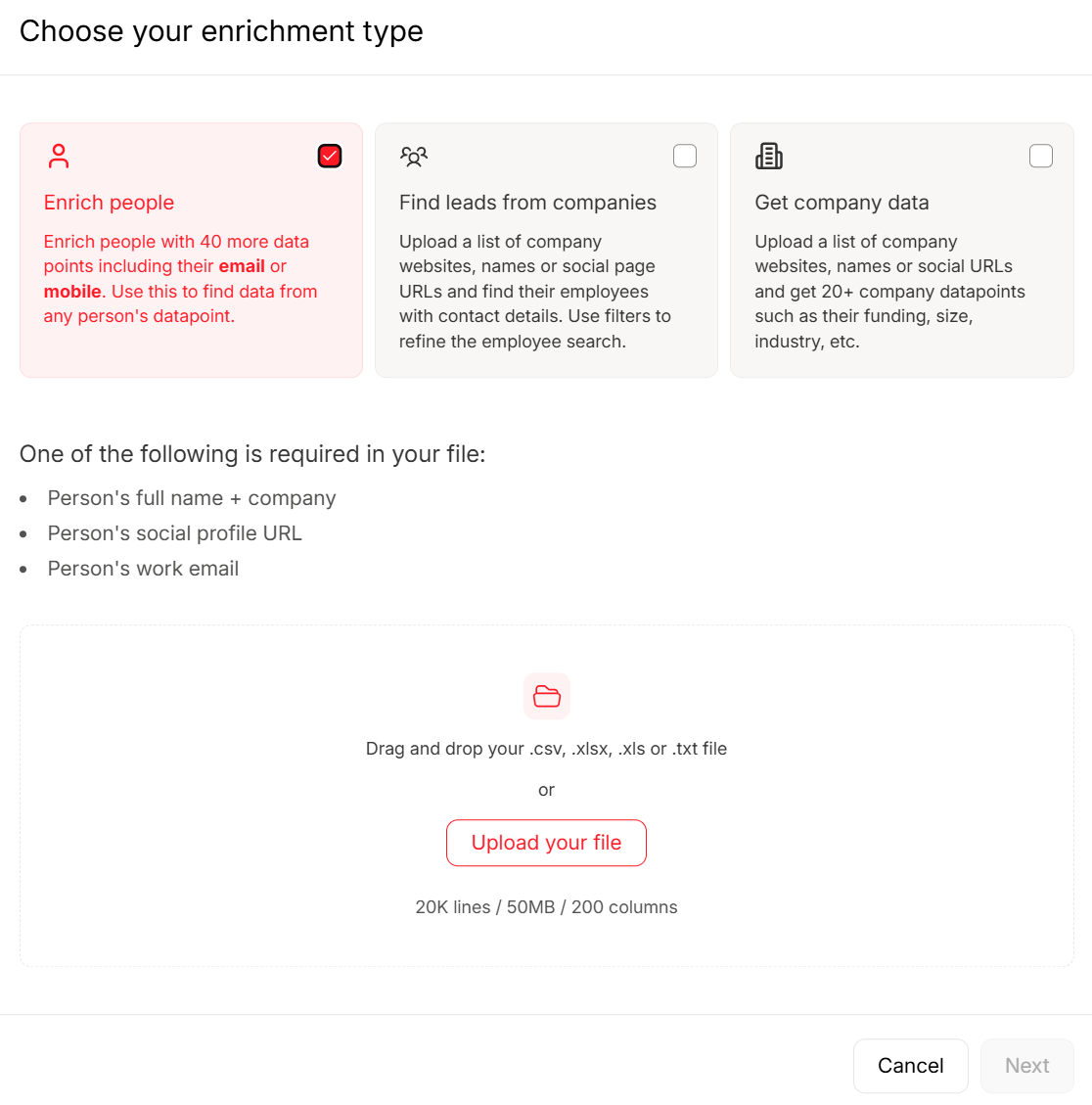
Your Highrise contacts haven't been updated since 2018. That means wrong titles, dead emails, and bounced sends the moment you import. Prospeo's CSV enrichment verifies emails at 98% accuracy on a 7-day refresh cycle - so your new CRM starts clean, not contaminated.
Stop importing dead data into your new CRM.
FAQ
Is Highrise CRM still available?
Only for existing customers. Highrise stopped accepting new signups on August 20, 2018. Current users can continue using it, but there's no new feature development - only security and infrastructure updates.
What's the cheapest Salesforce plan?
Salesforce Starter Suite costs $25/user/month, billed annually. Simpler alternatives like Pipedrive ($14/user) and Less Annoying CRM ($15/user) cost less with no annual commitment required.
How do I migrate my Highrise contacts to a new CRM?
Export Highrise contacts, notes, and tags to CSV, then import that file into your new CRM. Before importing, enrich your records with a tool like Prospeo (free tier available) so your new system starts with verified, current data rather than 2018-era contacts that'll bounce on first outreach.