

The 9 Best CRMs for Startups in 2026 (With Real Pricing)
A founder we know exported her "CRM" - a Google Sheet with 340 rows - and found 47 duplicate contacts, 12 dead email addresses, and three deals marked "hot" that had gone cold six months ago. She'd been making hiring decisions based on pipeline numbers that were fiction.
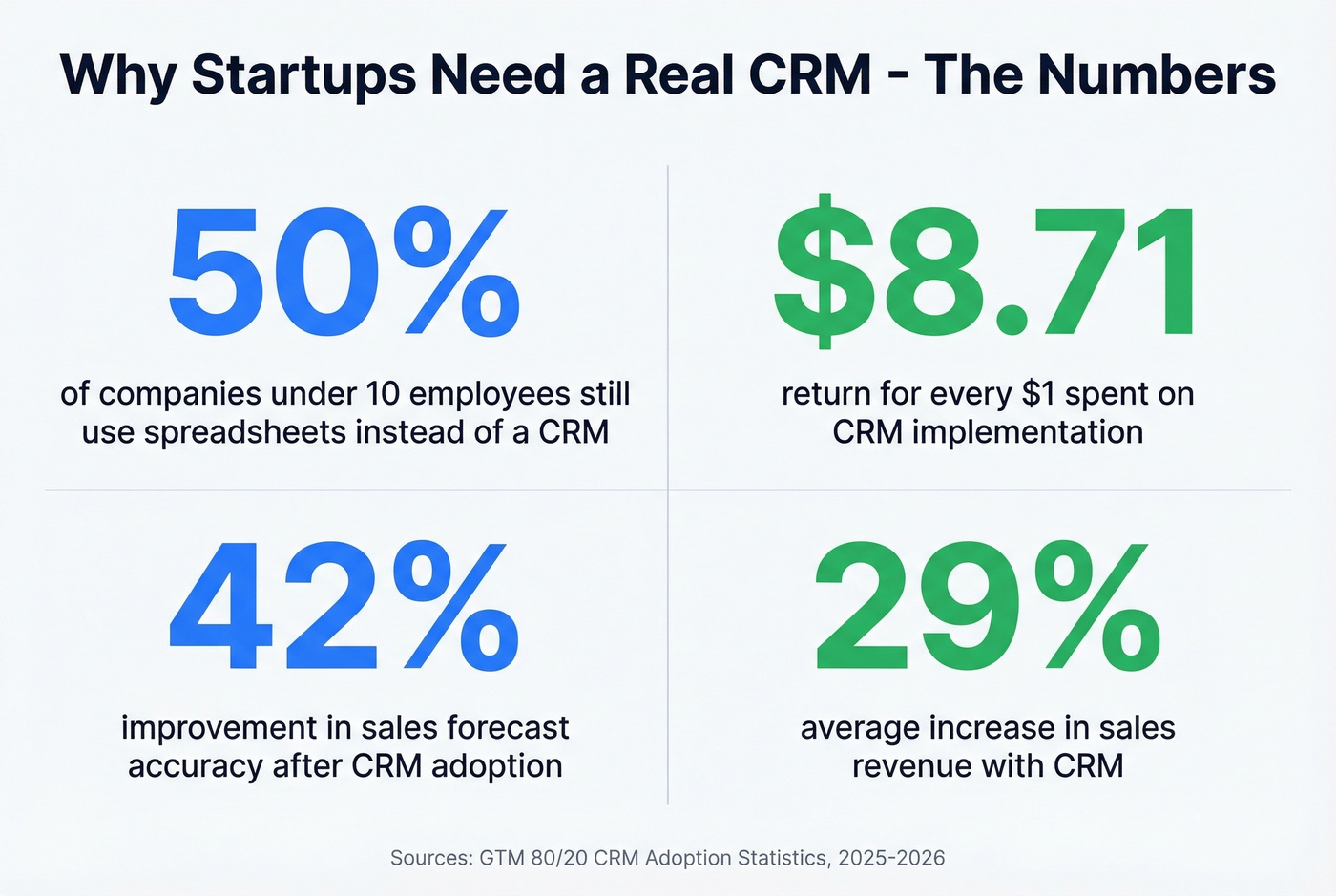
That's the spreadsheet breaking point. Nearly every startup hits it, and only 50% of companies with fewer than 10 employees actually use a CRM. The other half run on spreadsheets, Notion databases, or pure memory. Most comparison guides are written by vendors ranking themselves first. Let's skip that and look at what these tools actually cost.
Our Top Picks (TL;DR)
- Attio - Best modern CRM for startups that plan to scale. API-first, AI-enriched, transparent pricing.
- HubSpot Free - Best for inbound-first startups, especially if you qualify for the startup discount.
- Close - Best sales CRM for outbound-heavy teams who live on the phone.
- Zoho CRM - Best truly free CRM (3 users, full features, forever).
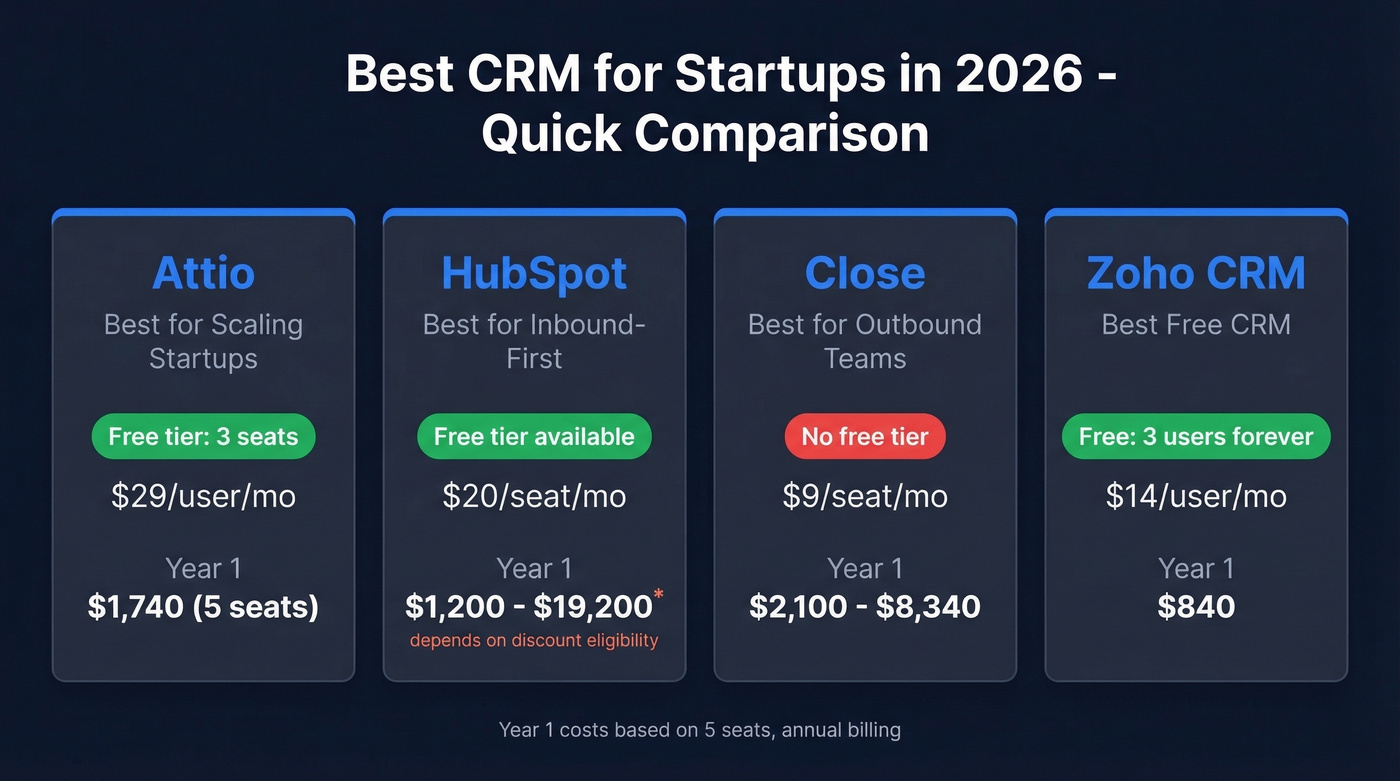
| Tool | Best For | Free Tier | Starting Paid | Year-1 Cost (5 seats) |
|---|---|---|---|---|
| Attio | Scaling startups | Yes (3 seats) | $29/user/mo | $1,740 |
| HubSpot | Inbound-first | Yes | $20/seat/mo | $1,200-$19,200* |
| Close | Outbound teams | No | $9/seat/mo | $2,100-$8,340 |
| Pipedrive | Visual pipeline | No | $14/seat/mo | $840-$5,100+ |
| Zoho CRM | Budget/free | Yes (3 users) | ~$14/user/mo | $840 |
| Folk | Earliest stage | Yes | $20/user/mo | $1,200 |
| Freshsales | Budget all-in-one | Yes (3 users) | $9/user/mo | $540 |
| Monday CRM | Project-first | No (3-seat min) | $10/seat/mo | $600 |
*HubSpot range depends on whether you qualify for the startup discount and which tier you need. More on that below.
What Actually Matters in a Startup CRM
Most comparison articles list 13 criteria. You need five. Everything else is noise at your stage.
1. Free tier quality and real limits. A free tier that caps you at 100 contacts or blocks automation isn't free - it's a demo. Check the actual ceiling before you commit.
2. Time-to-value. If your CRM takes more than a day to set up, something's wrong. Startups need to be selling, not configuring workflow automations in week one. Companies that adopt a CRM see a 42% improvement in forecast accuracy - but only if they actually use the thing. If you're still building your outbound motion, pair this with a simple set of sales prospecting techniques so the CRM fills with real activity.
3. Total cost at 12 months, including add-ons. The sticker price is almost never the real price. Pipedrive at $14/seat sounds cheap until you add LeadBooster, Campaigns, and Web Visitors. Model the full stack cost before you sign anything.
4. Data portability. Can you export everything to CSV without begging support? If a CRM makes it hard to leave, that tells you something about how they retain customers.
5. Integration depth, not count. "500+ integrations" means nothing if the Salesforce sync is one-directional or the email integration drops threads. Test the two or three integrations you'll actually use. If you're planning to connect outreach tools, use a checklist like this connect outreach tool to CRM guide.
The ROI case is real: CRM implementations drive an $8.71 return per $1 spent on average, with a 29% increase in sales. But that ROI only materializes if the data inside the CRM is accurate. We'll come back to that problem later.

9 Top CRM Tools for Startups in 2026
Attio - Best Modern CRM for Scaling Startups
Use it if: You're a seed-to-Series A startup that wants a CRM you won't outgrow in 18 months. You value API access, AI-enriched fields, and transparent pricing over brand recognition.
Skip it if: Your team is call-heavy and needs a built-in dialer. Attio's "last interaction" field only updates via email - if you're running 50 cold calls a day, you'll need workarounds or a separate tool to track phone activity.
Attio is the CRM HubSpot should have built. It's API-first, genuinely modern, and doesn't nickel-and-dime you with add-ons. The free tier gives you 3 seats, 50,000 records, 3 custom objects, and 200 emails per month - enough for a founding team to run real pipeline. Plus starts at $29/user/mo (annual) and scales to 250,000 records with 1,000 emails/mo and 500 credits/user/mo. Pro at $69/user/mo goes to 1M records with unlimited emails and 1,000 credits/user/mo.
What sets it apart: AI-enriched contact fields that auto-populate company data, meeting integrations that log touchpoints automatically, and a credit system that's actually transparent. The consensus on r/startups and r/sales is that Attio punches well above its weight compared to lighter alternatives like Folk. For a 5-seat team on Plus, you're looking at $1,740/year - roughly a tenth of what HubSpot Professional costs.

HubSpot CRM - Best for Inbound-First Startups
Use it if: You're inbound-first, you qualify for the discount, and you're comfortable with the three-year cost curve.
Skip it if: You're bootstrapped, outbound-heavy, or allergic to vendor lock-in.
HubSpot is the default recommendation, and defaults deserve scrutiny. The free tier is useful - contact management, deal tracking, basic email integration - but it caps automation and reporting hard enough that growing teams hit the paywall fast.
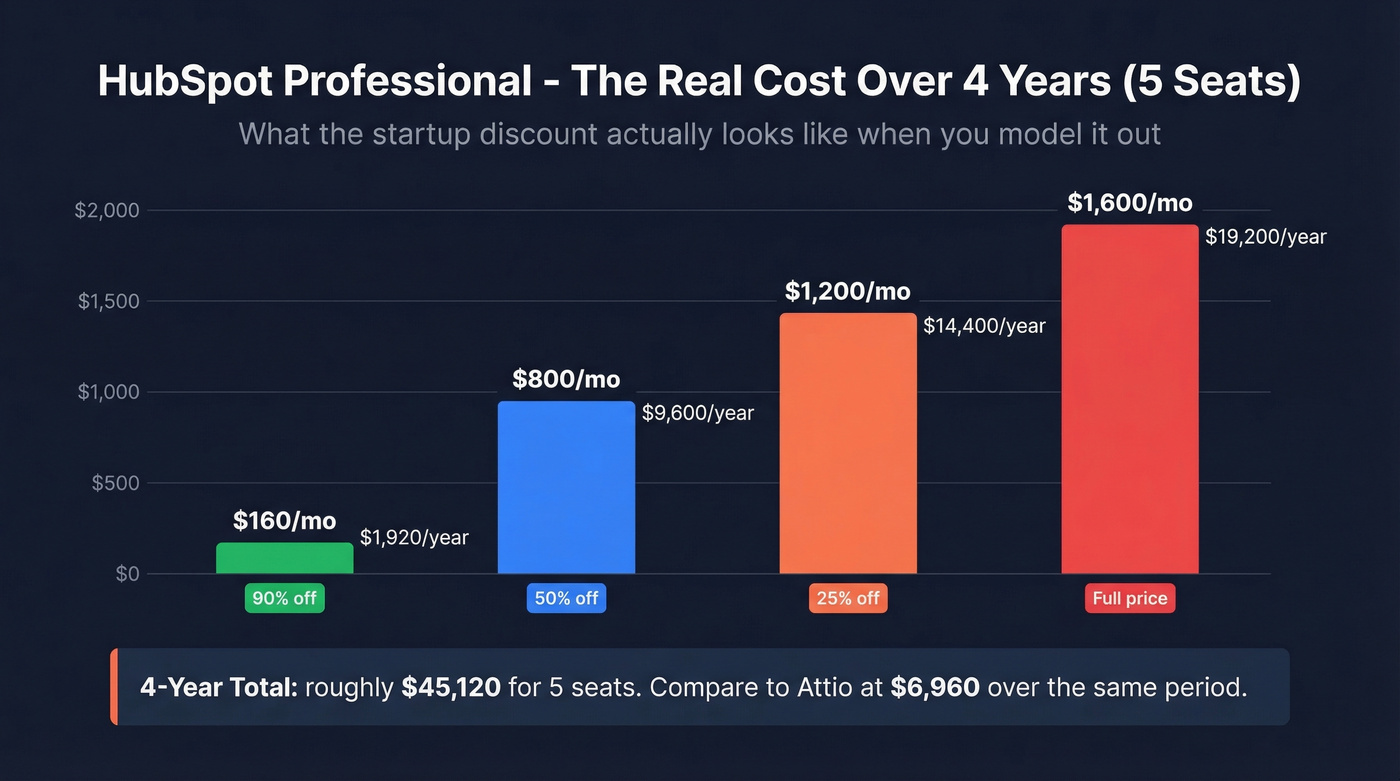
The startup discount is the real draw: 90% off year one, 50% off year two, 25% off year three. But eligibility isn't automatic. You need to be pre-seed through Series A, affiliated with an approved HubSpot partner, or have verified venture funding via Crunchbase or Pitchbook. Bootstrapped founders often don't qualify, and that's a detail most articles conveniently skip.
Without the discount, HubSpot Professional runs $1,600/mo for 5 seats. With the 90% discount, that's $160/mo in year one - incredible. But model the three-year cost, not just year one. By year three you're paying $1,200/mo, and by year four you're at full price. That's the upgrade trap: you build workflows, sequences, and reporting on HubSpot's platform, and switching costs compound every quarter. It's widely considered the strongest option for SaaS companies running inbound motions, but the long-term economics deserve a hard look before you commit.
Close - Best for Outbound Teams
Use it if: Your startup's motion is "call 80 prospects a day and send 50 cold emails." Close was purpose-built for that workflow. If you're building the outbound engine from scratch, start with these sales activities so reps don’t default to busywork.
Skip it if: You're inbound-only or need a CRM with a deep marketing automation layer.
Close is the CRM that was built for people who actually pick up the phone. Built-in dialer, power dialer, predictive dialer - it's all native, not bolted on.
Pricing starts deceptively low: Solo at $9/seat/mo (annual) is limited to one user and 10,000 leads. Essentials at $35/seat/mo and Scale at $139/seat/mo round out the tiers, but most startup teams need Growth at $99/seat/mo since Solo and Essentials lack workflow automation. Add Premium Phone Numbers at $19/line and Call Assistant at $50/mo plus $0.02/min, and a 3-person outbound team on Growth pays $366/mo before call minutes stack up.
Close works best when you feed it accurate emails and phone numbers from a dedicated enrichment tool. We've seen teams pair it with Prospeo - 98% verified emails and 125M+ mobile numbers - to build one of the most cost-effective outbound setups available at the seed stage. If you’re comparing vendors, this roundup of data enrichment services can help you sanity-check coverage and refresh rates.

Pipedrive - Best Visual Pipeline
Pipedrive's sticker price is a lie.
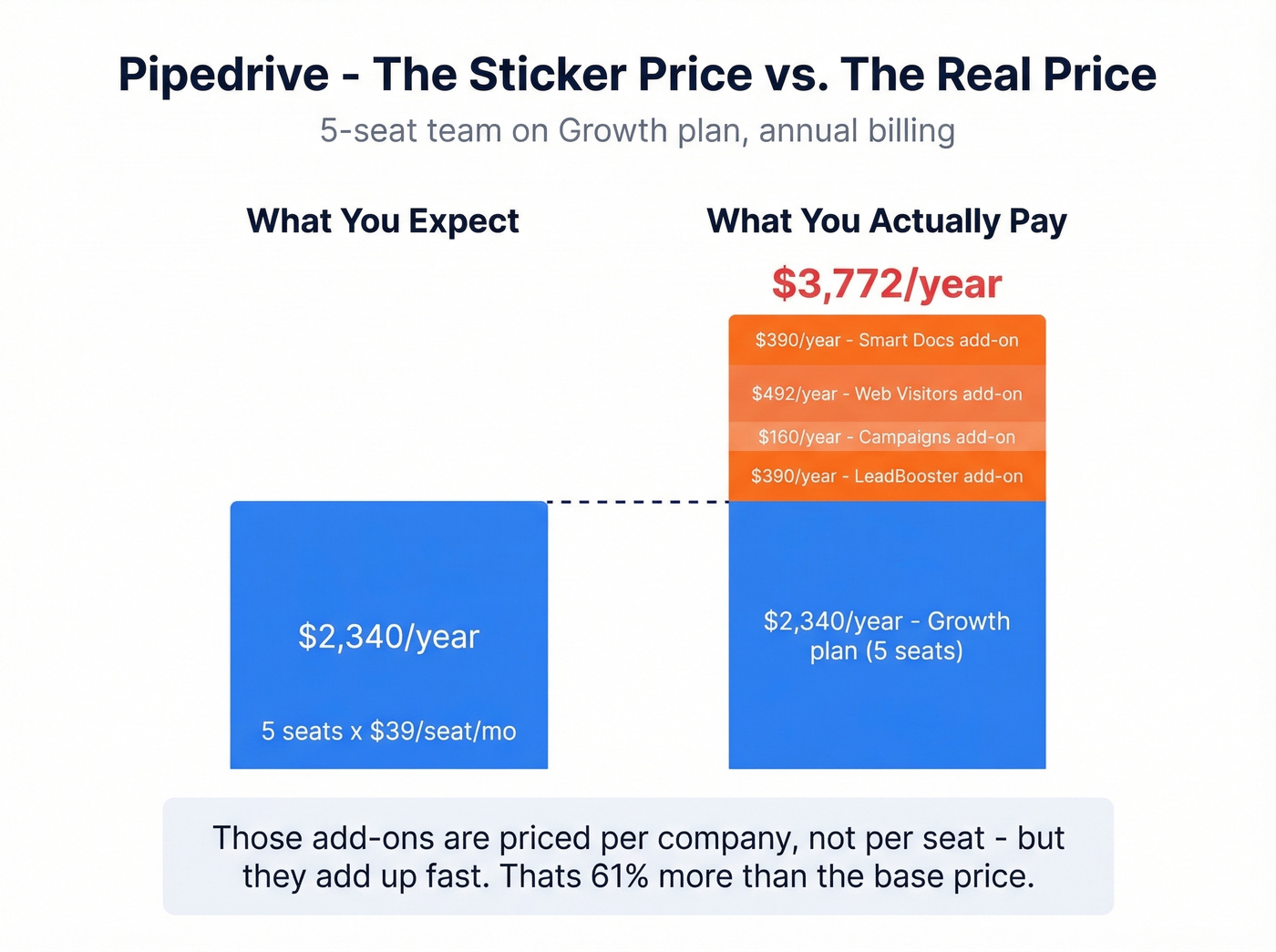
The base plans look reasonable: Lite at $14/seat/mo, Growth at $39/seat/mo, Premium at $59/seat/mo (all annual). But the features most startups actually need - lead generation, email campaigns, website visitor tracking, document management - are add-ons. LeadBooster starts at $32.50/mo. Campaigns at $13.33/mo. Web Visitors at $41/mo. Smart Docs at $32.50/mo.
Here's the part most teams miss: those add-ons are priced per company, not per seat. So a 5-seat team on Growth is $39/seat/mo, plus $45.83/mo for LeadBooster + Campaigns (before you add Web Visitors, Smart Docs, etc.). Total for a 5-seat team on Growth with LeadBooster and Campaigns comes to about $2,890/year - and you still don't have website visitor tracking.
Use it if: You love visual pipeline management and your sales process is straightforward. Skip it if: You need lead generation, email campaigns, or visitor tracking - the add-on costs will surprise you.
The drag-and-drop pipeline is excellent. But we've watched teams pick Pipedrive for the $14 price point and end up spending more than they would have on Attio or Close.
Zoho CRM - Best Free Tier
Use it if: You're pre-revenue with three co-founders who need deal tracking, email integration, and basic reporting without spending a dollar.
Skip it if: You care about UI polish or plan to stay on Zoho long-term without adopting the broader Zoho suite.
Zoho's free plan is one of the most generous in the market: 3 users, forever, with no artificial contact caps that force an upgrade in month two. Paid tiers start around $14/user/mo on annual billing, stepping up from there. For small startups watching every dollar, it's hard to beat.
The trade-off is the interface. Zoho feels more utilitarian than Attio or Folk - functional, not beautiful. But for a pre-revenue startup, zero dollars buys you a real CRM. Know that if you adopt the broader Zoho suite (Projects, Desk, Books), switching later gets expensive in migration time, not licensing.
Folk - Simplest CRM for Founders
Folk is what you graduate to when your Notion database stops cutting it. Dead simple, fast to adopt, with a manually editable "last interaction" field that actually works for founders who track relationships across email, WhatsApp, and in-person meetings - not just logged CRM activities.
Free tier available, paid plans from $20/user/mo. Best for 1-3 person teams who want a real CRM without the learning curve. Skip it if you need workflow automation, custom objects, or anything that scales past 10 active deals per rep. If you’re mostly trying to organize people and conversations, you may also want to compare against dedicated contact management software.
Freshsales - Budget All-in-One
This one's for the startup that wants calling, email, and chat in one tool without Close's add-on complexity and without HubSpot's tier-jump sticker shock.
Freshsales packs a built-in phone, email, and chat into plans starting at $9/user/mo (Growth tier, annual). Free plan covers 3 users, and most startup CRM setups can be implemented in a few hours. The downside: you're buying into the Freshworks ecosystem, and the integration story outside that ecosystem is thinner than HubSpot's or Attio's. Freshsales won't win any design awards, but at $540/year for a 5-seat team on Growth, the value is hard to argue with.
Monday CRM - For Project-First Teams
Monday CRM exists because Monday.com needed a CRM checkbox. Basic at $10/seat/mo, Standard at $14/seat/mo, Pro at $24/seat/mo - with a 3-seat minimum and no free plan. If your team already lives in Monday for project management, it's convenient. For everyone else, look elsewhere. The sales-specific features are shallow compared to every other tool on this list.
Honorable Mentions
We also evaluated Streak (great if you live entirely in Gmail), Copper (Google Workspace native), and Keap (marketing automation focus). None made the cut for most startup use cases - Streak and Copper are too narrow, and Keap's pricing starts at $159/mo, which is hard to justify at the seed stage.

You just read that CRM ROI only materializes when the data inside is accurate. Prospeo enriches your CRM with 50+ data points per contact at a 92% match rate - verified emails, direct dials, job titles, intent signals. Native integrations with HubSpot and Salesforce mean your startup CRM stays clean from day one.
Stop building pipeline on bad data. Enrich your CRM for $0.01 per lead.
Full Pricing Comparison
| Tool | Free Tier | Starting Paid | Year-1 (5 seats) | Hidden Costs |
|---|---|---|---|---|
| Attio | 3 seats | $29/user/mo | $1,740 | Credits for AI features |
| HubSpot | Yes | $20/seat/mo | $1,200-$19,200 | Pro tier jump is steep |
| Close | No | $9/seat/mo | $2,100-$8,340 | Phone + Call Assistant add-ons |
| Pipedrive | No | $14/seat/mo | $840-$5,100+ | Add-ons double the cost |
| Zoho CRM | 3 users | ~$14/user/mo | $840 | Ecosystem lock-in |
| Folk | Yes | $20/user/mo | $1,200 | Limited automation |
| Freshsales | 3 users | $9/user/mo | $540 | Freshworks lock-in |
| Monday CRM | No (3-seat min) | $10/seat/mo | $600 | 3-seat minimum; limited sales features |
The year-1 cost column assumes the lowest paid tier at annual billing. Real costs vary based on add-ons, tier upgrades, and usage - which is exactly why you should model 12-month total cost, not monthly sticker price.
How to Choose by Startup Stage
| Stage | Motion | Recommended Stack | Why |
|---|---|---|---|
| Pre-seed / bootstrapped | Any | Folk or Zoho Free | $0, fast setup |
| Seed | Outbound | Close + data enrichment tool | Dialer + verified data |
| Seed | Inbound | HubSpot Free | Best inbound ecosystem |
| Series A+ | Scaling | Attio or HubSpot (w/ discount) | Room to grow |
If you're pre-revenue with two founders, don't overthink this. Folk or Zoho Free gets you off spreadsheets in an afternoon. You can always migrate later - and if you pick a CRM with good export, migrating takes a day, not a quarter.
Here's the thing: if your average deal size is under $5,000, you probably don't need anything beyond Attio Plus or Close Growth. The teams we see overspending on CRM tools are almost always buying features they'll "grow into" - and half the time they churn before they get there. Buy for the next 12 months, not the next 36.
Your First Week Playbook
Don't spend a week configuring. Here's what actually matters:
Day 1: Import your contacts from whatever spreadsheet or tool you're using now. Clean duplicates during import, not after.
Day 2: Set up exactly 3 pipeline stages - not 7. "New," "In Conversation," and "Proposal Sent" covers 90% of early-stage deals.
Day 3: Send your first email sequence or make your first calls through the CRM. Keep custom fields to 5 maximum. You can always add more; removing fields people already depend on is painful. If you need copy that actually gets replies, keep a few sales follow-up templates handy.
And please - Salesforce is not a startup CRM. A 5-seat Salesforce setup once you include implementation help will run $30,000+ in year one and take months to get right. That's money and time a startup doesn't have. (If you’re still evaluating it, read the real Salesforce pricing breakdown first.)
The Data Quality Problem Nobody Talks About
B2B contact data decays 30-40% annually. People change jobs, companies get acquired, email domains rotate. If you never refresh your records, your CRM quietly fills up with bad emails and outdated titles - and most startups don't find out until their cold email sequence bounces 25% and their domain reputation tanks. If you’re seeing this already, start with bounce-rate basics in this email bounce rate guide.
This is where data enrichment changes the equation. A $0/month CRM with verified data outperforms a $1,600/month CRM full of bounced emails. That's not a hot take - it's math. The CRM is the container; the data is what actually drives revenue. Whether you pick the best CRM for your startup or the cheapest option on this list, enrichment is what separates a pipeline you can trust from one built on fiction.
Every CRM on this list has one weakness: garbage in, garbage out. Prospeo's 7-day data refresh cycle keeps your contacts current - not the 6-week-old records other providers deliver. With 300M+ profiles and 98% email accuracy, your startup team spends time selling, not cleaning spreadsheets.
The best CRM for your startup deserves the best data. Start free with 75 verified emails.
FAQ
Is a free CRM enough for a startup?
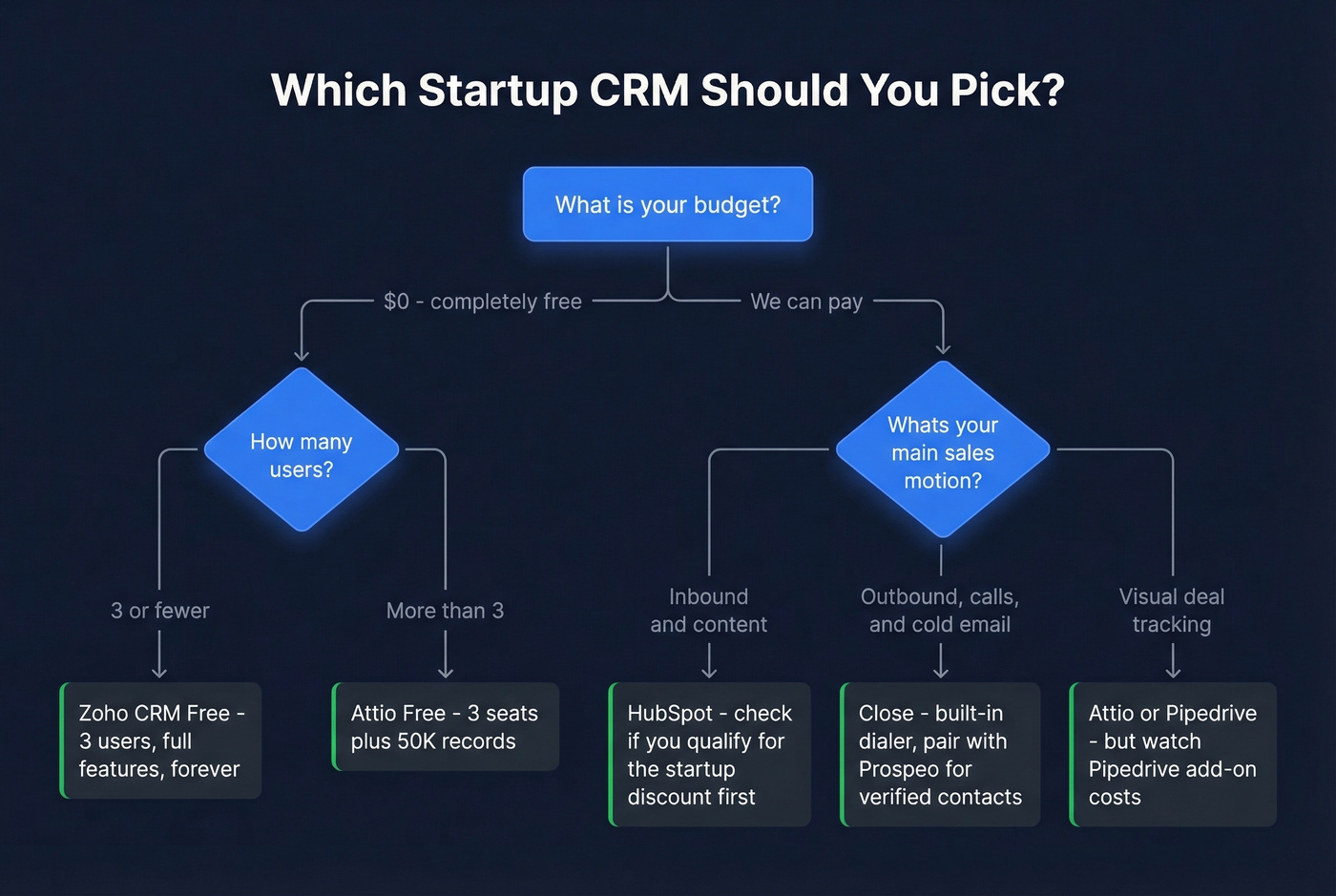
Yes, if you have fewer than 3 users and under 100 active leads. Zoho Free and Attio Free both handle this well. Watch for automation caps - HubSpot Free blocks most workflows. Upgrade when you hit 5+ active deals per rep or need email sequences. That's the natural inflection point.
When should a startup switch from spreadsheets to a CRM?
When you have 10+ active leads, multiple people touching deals, or you can't answer "did anyone follow up with that lead?" in 10 seconds. Most teams wait too long and lose deals to follow-up gaps before they realize the spreadsheet broke.
What's the real cost of HubSpot for startups?
Free is free. The 90% startup discount requires partner affiliation plus verified funding - bootstrapped founders often don't qualify. Model the three-year cost for 5 seats on Professional: ~$1,920/year (year one at 90% off) to ~$9,600/year (year two at 50% off) to ~$14,400/year (year three at 25% off). That ramp catches teams off guard.
Which CRM is best for a 2-person startup?
Folk or Zoho Free for pure simplicity. Attio Free if you want room to grow without migrating later. Avoid anything with seat minimums - Monday CRM requires 3 seats, which means you're paying for a ghost user from day one. Pick whichever one you'll actually use daily.
How do I keep my CRM data accurate?
B2B contact data decays 30-40% every year. Use a data enrichment tool connected to your CRM to keep records current automatically. Without active enrichment, your pipeline reports become fiction within two quarters. Budget for data quality the same way you budget for the CRM itself - it's not optional.