

Sales Data Enrichment: What It Is, What It Costs, and How to Do It Right
Your CRM has 50,000 contacts. By next year, roughly 11,000-12,500 of them will be outdated. B2B contact data decays at about 2.1% per month, which means a quarter of your database goes stale annually. Poor data quality costs organizations $12.9M per year on average.
Sales data enrichment is how you stop the bleeding.
The Short Version
- The core problem: No single data provider covers your entire market. Waterfall enrichment routinely delivers 30-40% more coverage than relying on one source.
- The fix: Use waterfall enrichment, verify before you send, refresh quarterly at minimum.
- The pricing reality: You can spend $0.01/email or $60k/year. The expensive option isn't always better.
What Sales Data Enrichment Actually Means
Sales data enrichment fills in missing or outdated fields on your prospect and account records so reps can act on them. The data falls into four categories: firmographic (company size, revenue, industry), technographic (tech stack), demographic (job title, seniority, location), and behavioral (intent signals, engagement patterns).
There are three practical tiers. Contact-level enrichment gets you emails, phones, and titles. Platform-level enrichment layers on technographics, intent signals, and workflow automation. Account intelligence tells you why to call today - funding rounds, leadership changes, hiring surges. Most teams need the first tier done well before worrying about the other two. Think of it as progressive data expansion: start with the basics, then layer on richer context as your processes mature.
Why It Matters - The Numbers
Here's the thing: 44% of sales reps cite outdated data as their biggest headache, and 17% of weekly outreach gets wasted on dead or disconnected contacts. The B2B enrichment market hit $2.9B in 2025 and is growing 10-12% annually because the problem keeps getting worse.
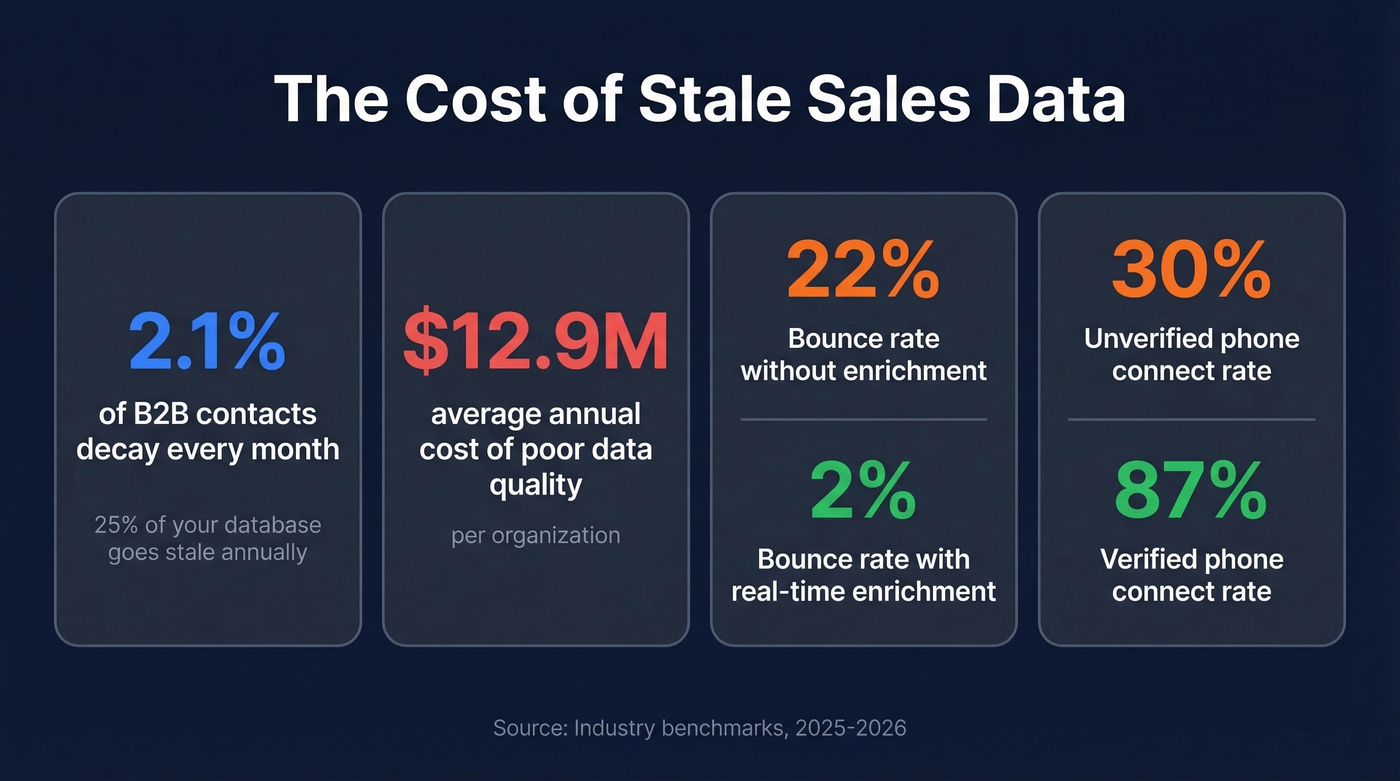
The impact on deliverability is brutal. Teams running outreach on stale lists regularly see bounce rates around 22%. With real-time enrichment and verification, that drops to roughly 2%. The gap between those numbers is the difference between a healthy sending domain and a blacklisted one. Verified phone numbers produce an 87% connect rate versus 30% for unverified industry averages - every data point you leave unverified costs you pipeline.
When teams use enriched records to improve conversions, the results compound. Cleaner data means better targeting, which means higher reply rates, which means more pipeline from the same send volume. Organizations that treat enrichment as a shared sales-and-marketing initiative rather than siloing it in one department consistently see the strongest returns.
Single-Source vs. Waterfall Enrichment
A common debate on r/sales and in sales ops communities is whether to buy a platform, build with APIs like People Data Labs, or hire manual researchers. For most teams doing outbound at any real volume (500+ contacts/month), the answer is waterfall enrichment - querying multiple data sources in sequence until you find a verified result.
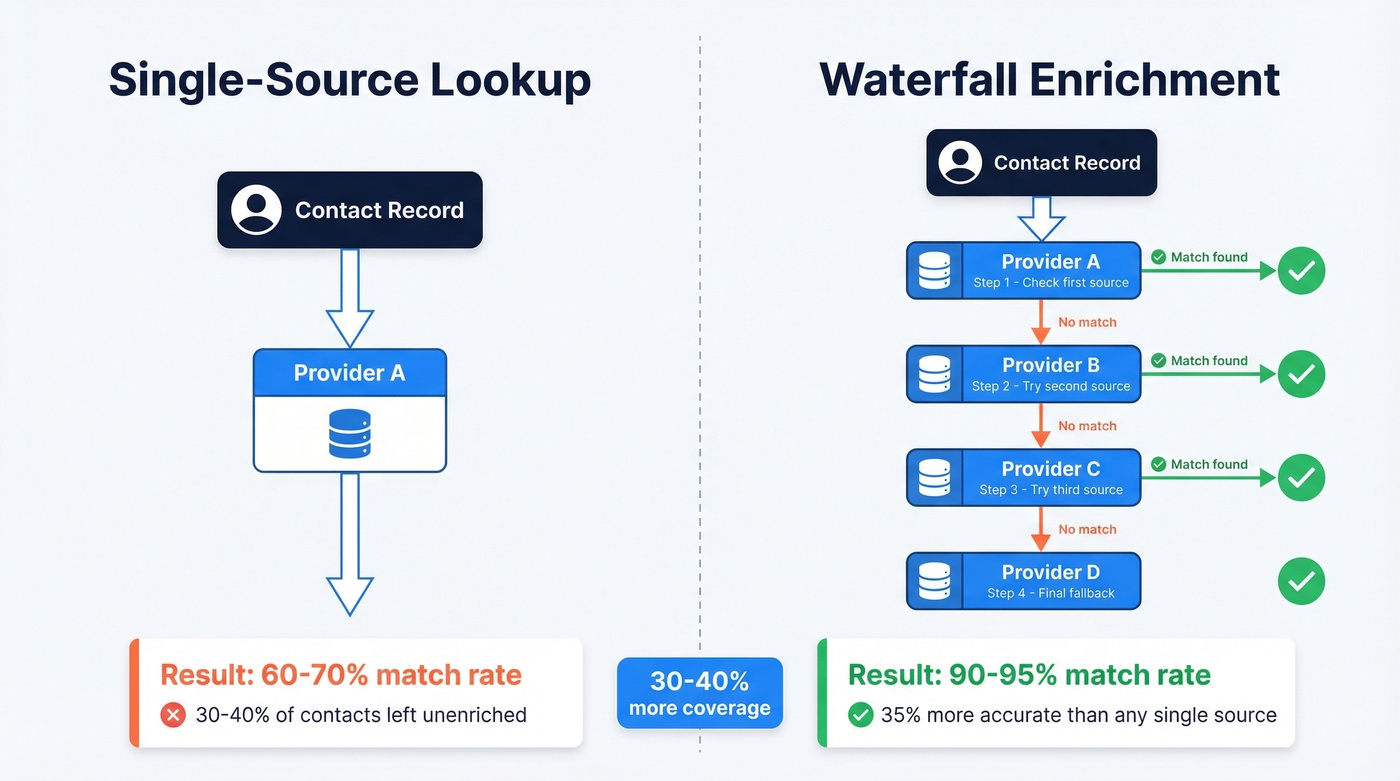
A SyncGTM benchmark testing 9 tools on the same 500-record dataset found waterfall enrichment produced 35% more accurate results than any single source. We've run waterfall setups across multiple client accounts, and the 30-40% coverage lift is consistent. No single database has everyone.
One critical warning: set overwrite controls. Don't let automated enrichment overwrite fields your reps have manually confirmed. We've seen teams lose months of hand-verified data because they didn't lock those fields down before flipping on an integration.

Waterfall enrichment beats single-source by 30-40%. But even the best waterfall starts with a provider that actually verifies data. Prospeo's 5-step verification delivers 98% email accuracy and an 83% enrichment match rate - returning 50+ data points per contact, refreshed every 7 days.
Stop enriching your CRM with data that's already stale.
Best Tools for Sales Data Enrichment
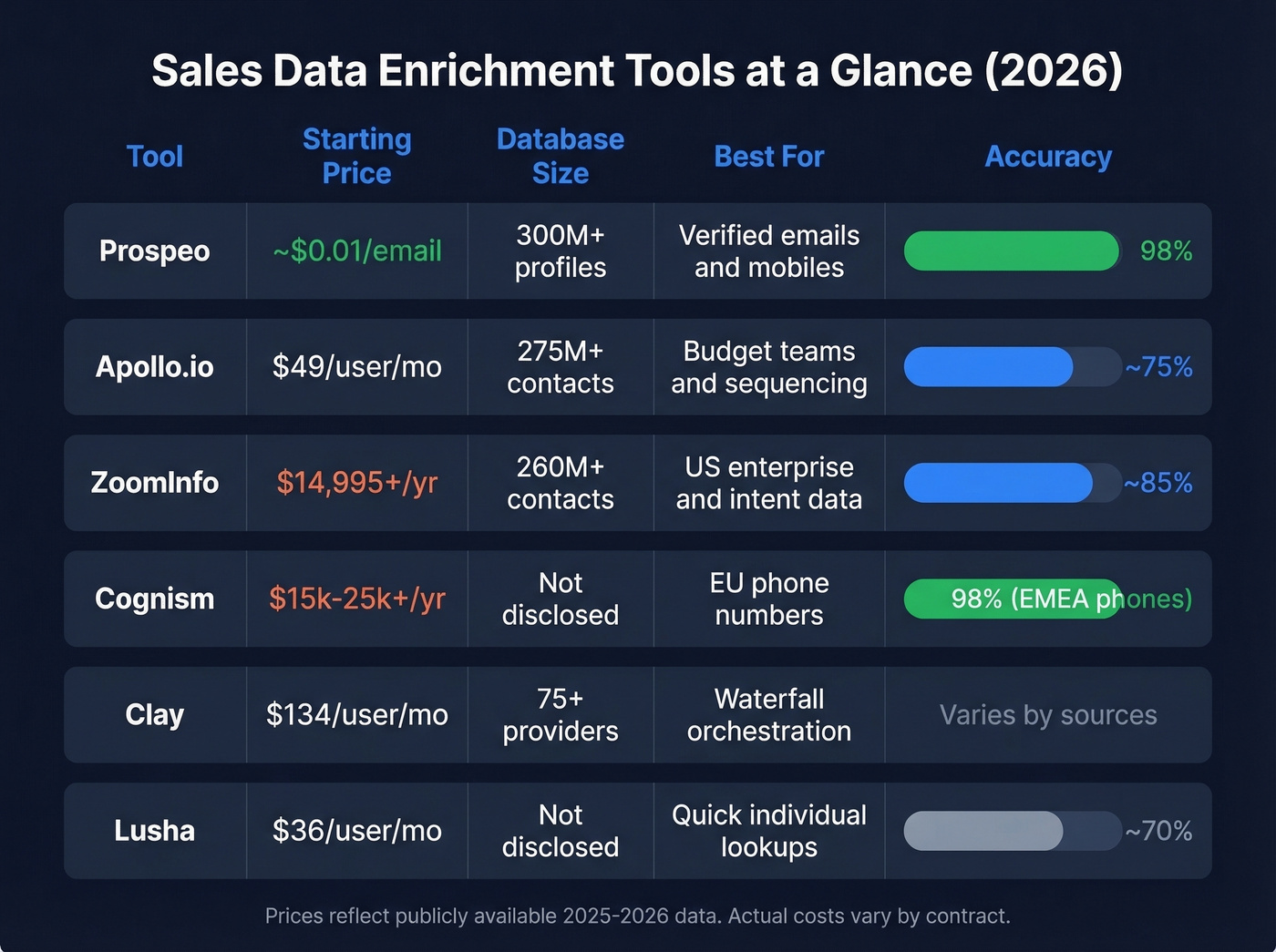
| Tool | Starting Price | Best For | Scope |
|---|---|---|---|
| Prospeo | ~$0.01/email, free tier | Verified emails + mobiles | Contact data specialist |
| Apollo.io | $49/user/mo (free tier) | Budget teams + sequencing | All-in-one lite |
| ZoomInfo | $14,995/yr (3 users) | US enterprise + intent | Full platform |
| Cognism | ~$15k-$25k+/yr | EU phone data | EMEA specialist |
| Clay | From $134/user/mo | Waterfall orchestration | Orchestration layer |
| Lusha | From $36/user/mo | Quick lookups | Supplement tool |
Prospeo
Prospeo's database covers 300M+ professional profiles, 143M+ verified emails, and 125M+ verified mobile numbers. The 98% email accuracy comes from a proprietary 5-step verification process - not a third-party provider bolted on as an afterthought. Every record refreshes on a 7-day cycle, compared to the 6-week industry average.
Pricing is credit-based at roughly $0.01 per email with a charge-on-success model, so you don't burn credits on invalid results. The free tier gives you 75 verified emails per month to test data quality before committing. Snyk moved their 50-person AE team over and watched bounce rates drop from 35-40% to under 5%, with AE-sourced pipeline up 180%. Native integrations with Salesforce, HubSpot, Smartlead, Instantly, Lemlist, Clay, Zapier, and Make mean the data flows straight into your existing stack without custom plumbing.

Snyk's 50 AEs dropped bounce rates from 35-40% to under 5% and grew AE-sourced pipeline 180% after switching their enrichment to Prospeo. At ~$0.01/email with a charge-on-success model, you never pay for invalid results. No contracts, no sales calls - just verified data.
Run your next enrichment batch through 143M+ verified emails.
Apollo.io
Apollo is the obvious starting point for budget-conscious teams that want enrichment and sequencing in one tool. The database covers 275M+ contacts, and the free tier gives you 100 credits/month. Paid plans run $49-$119/user/month billed annually. The built-in sequencer is the real differentiator - find a contact and email them without leaving the platform. In our testing, email find rates consistently landed around 75%, which means you'll want a verification layer on top. Skip this if you need high-accuracy mobiles or EMEA coverage.
ZoomInfo
Let's be honest: ZoomInfo is still the strongest all-in-one platform for US enterprise sales. But most teams don't need all-in-one. Professional plans start at $14,995/year for 3 users with 5,000 credits, but typical mid-market contracts land between $25k-$60k/year with 10-20% annual renewal increases. The 260M+ contact database across about 100M companies and the intent data are unmatched for large US-focused orgs. For everyone else, you're paying for modules you'll never activate. Opaque pricing and annual lock-in are a top complaint in every ZoomInfo comparison thread we've read.
Cognism
Cognism's Diamond Data is the play for EU phone numbers - their published case studies show a 98% match rate versus 72% for competitors in the same region. Pricing runs ~$15k-$25k+/year depending on package, plus per-user fees. If your ICP is EMEA decision-makers, it's worth the call. For US-only teams, you're overpaying.
Clay
Clay connects 75+ data providers into a single waterfall orchestration layer starting at $134/user/month. Impressive results when configured correctly, but expect a real setup investment. This isn't plug-and-play - it's a power tool for RevOps teams who know what they're building.
Lusha
Lusha starts at $36/user/month with a free plan. Best for individual reps doing quick lookups rather than bulk enrichment. A supplement, not a primary source.
How to Improve Conversion with Enriched Data
Choose charge-on-success pricing. Some providers charge per lookup regardless of results. This distinction alone can cut your effective cost by 30-40%, and it's the first thing we check when evaluating any new tool.
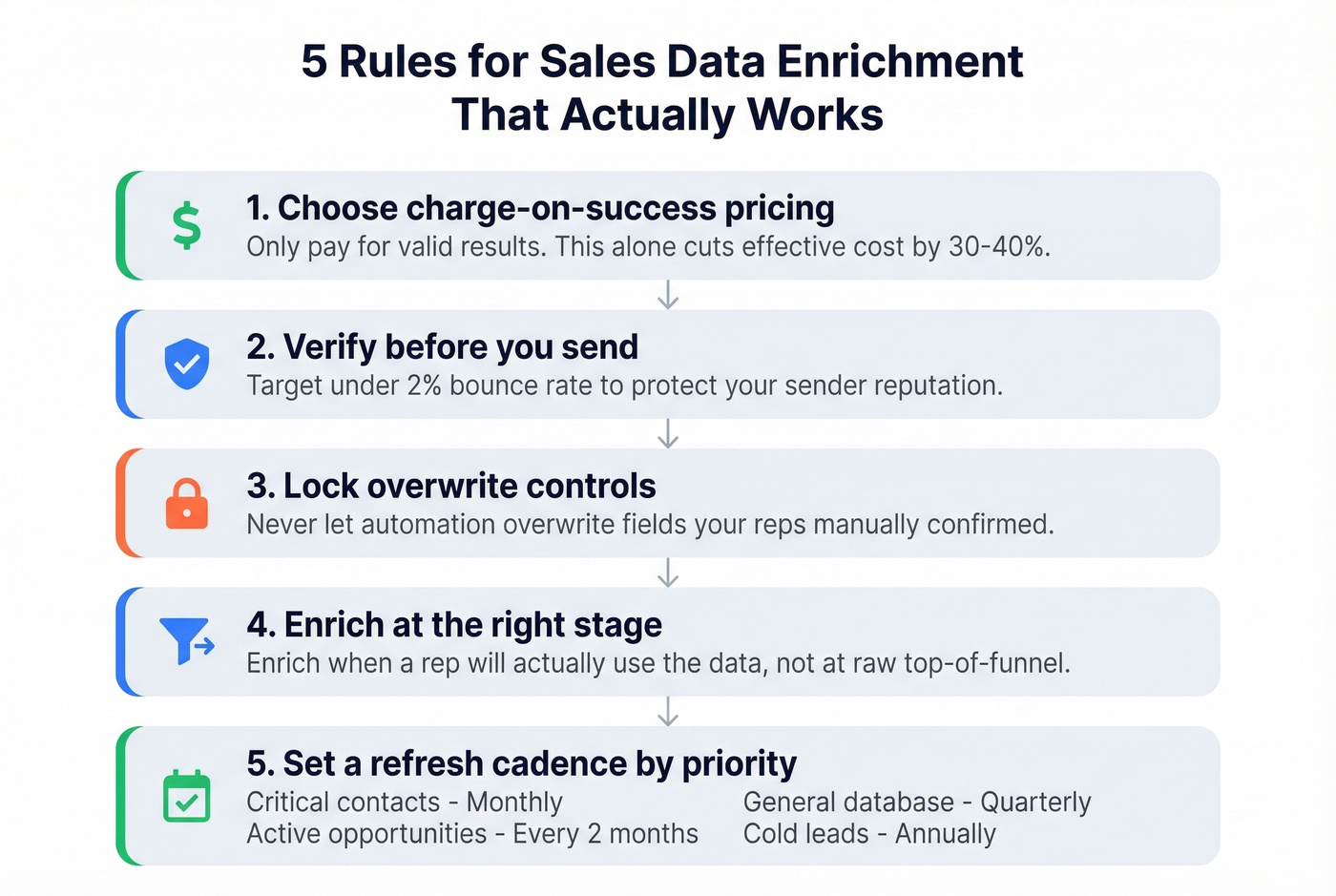
Verify before you send. Target a bounce rate under 2% - that's the threshold for maintaining sender reputation. Every invalid email you eliminate is one more message that reaches a real inbox.
Lock overwrite controls. Never let automated enrichment overwrite manually confirmed CRM fields. We can't stress this enough.
Don't enrich too early. Enriching top-of-funnel leads that haven't been qualified wastes credits. Enrich at the point where a rep will actually use the data. Set a refresh cadence by priority:
| Contact Priority | Refresh Frequency |
|---|---|
| Critical contacts | Monthly |
| Active opportunities | Bi-monthly |
| General database | Quarterly |
| Cold leads | Annual |
Measuring ROI in Salesforce
If your CRM is Salesforce, measuring the impact of enrichment is straightforward. Compare bounce rates, reply rates, and opportunity creation rates for enriched records versus unenriched ones over a 90-day window. Pull a simple report segmenting contacts by "enriched" vs. "not enriched" and track conversion to opportunity.
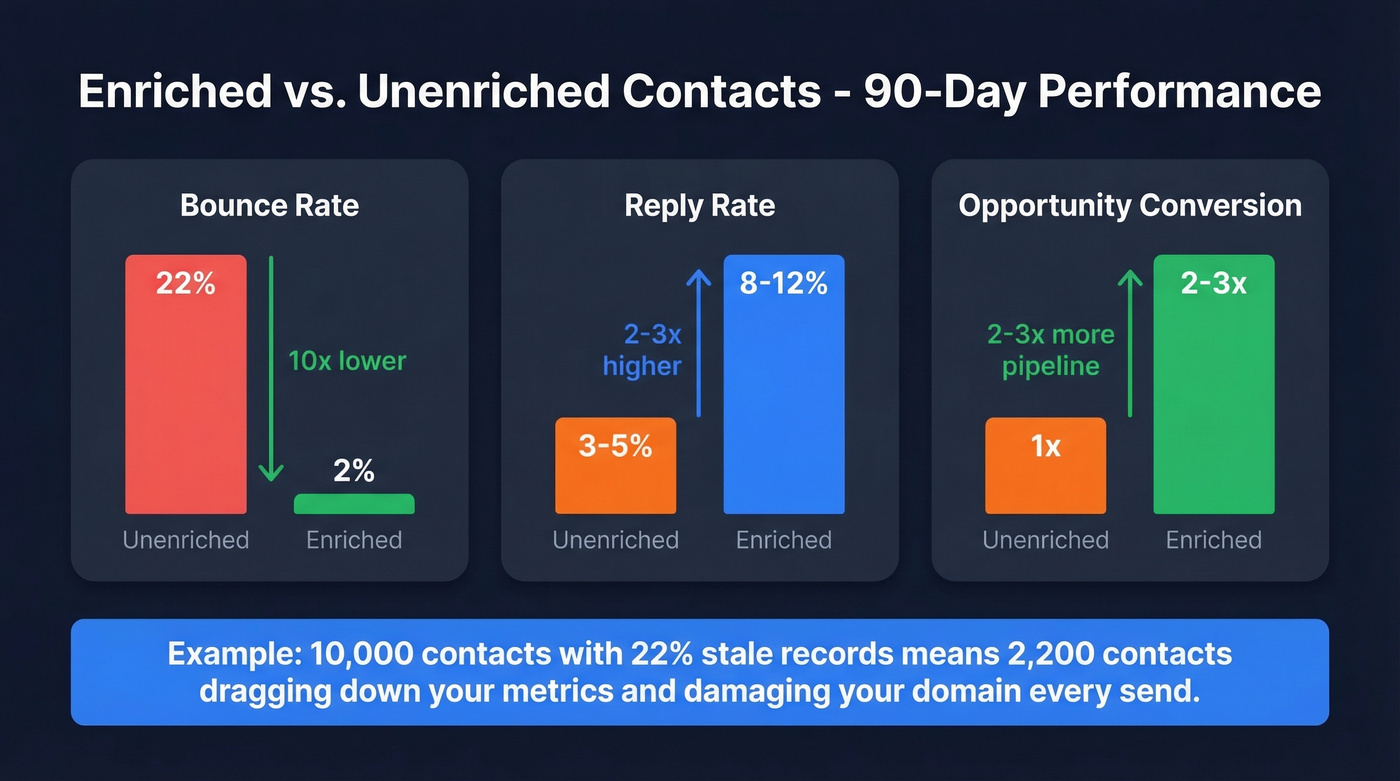
Teams that run this analysis typically find enriched contacts convert to opportunities at 2-3x the rate of stale records, making the cost of enrichment tools trivial relative to the pipeline they generate. One scenario we see often: a 10,000-contact database with 22% stale records means 2,200 contacts that are actively dragging down your metrics and damaging your sender reputation every time you hit send.
Compliance Essentials
B2B enrichment under GDPR typically relies on legitimate interest (Article 6(1)(f)). Document your Legitimate Interest Assessment before you start enriching. GDPR fines run up to 4% of global annual turnover or EUR 20M. CCPA penalties hit $2,500-$7,500 per violation.
Sign Data Processing Agreements with every vendor, honor opt-outs immediately, and maintain suppression lists that sync across your CRM, enrichment tools, and email platforms. A suppression gap is how fines happen. If you're unsure where the line is, start with a clear policy on buying email lists and how you source contacts.
FAQ
What's the difference between data enrichment and data cleansing?
Enrichment adds missing fields - emails, phones, firmographics - while cleansing fixes or removes bad existing data like duplicates, formatting errors, and invalid entries. Always cleanse first, then enrich, so you're not layering new data onto corrupted records.
How often should I re-enrich my CRM?
Critical contacts deserve monthly refreshes; general database records, quarterly. At 2.1% monthly decay, waiting a full year means roughly a quarter of your records are wrong. Prioritize accounts with active pipeline first.
Can I run sales data enrichment without an enterprise contract?
Yes. Credit-based tools start at ~$0.01/email with free tiers, and Apollo offers a free plan too. The days of needing a $15k+ annual commitment just to enrich contacts are over - self-serve options now match or beat enterprise data quality for most use cases.
How does enrichment help sales and marketing alignment?
When both teams draw from the same enriched dataset, marketing builds more precise segments and sales prioritizes the right accounts. Shared verified records eliminate finger-pointing over lead quality - everyone works from the same source of truth.