

How Many Emails Should a Nurture Sequence Have?
You built a 12-email sequence, watched opens crater by email 6, and now you're second-guessing everything. You're not alone - roughly 80% of marketing leads never convert, and a big reason is sequences that are either too short to build trust or too long to hold attention.
The Quick Answer: 5-7 Emails
Most B2B nurture sequences should contain 5-7 emails. The right number depends on what you're nurturing and how long the buying cycle runs.
| Use Case | Emails | Typical Timeframe |
|---|---|---|
| Welcome series | 3-5 | 7-14 days |
| SaaS trial | 3-4 | 7-14 days |
| Standard B2B nurture | 5-7 | 3-6 weeks |
| Long-cycle enterprise | 7-10 | 2-4 months |
| Cold outbound | 4-5 | 2-3 weeks |
Nurtured leads make 47% larger purchases than non-nurtured ones. Companies that excel at nurturing generate 50% more sales-ready leads at 33% lower cost per lead, per Forrester.
Engagement by Email Position
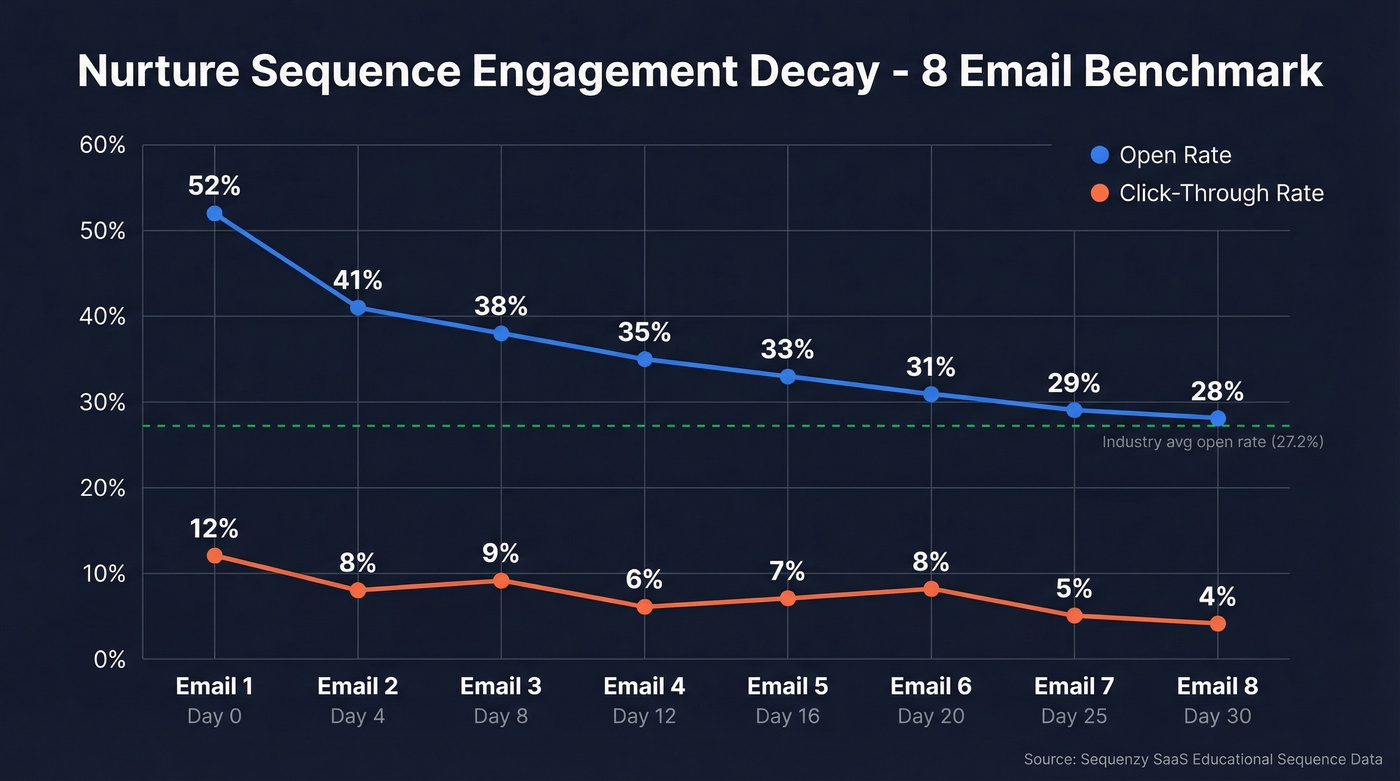
The real question isn't "how many emails" - it's "when do emails stop earning their keep?" Sequenzy's SaaS Educational Sequence benchmark shows the decay curve across an 8-email nurture:
| Day | Open Rate | CTR | |
|---|---|---|---|
| 1 | 0 | 52% | 12% |
| 2 | 4 | 41% | 8% |
| 3 | 8 | 38% | 9% |
| 4 | 12 | 35% | 6% |
| 5 | 16 | 33% | 7% |
| 6 | 20 | 31% | 8% |
| 7 | 25 | 29% | 5% |
| 8 | 30 | 28% | 4% |
Opens drop nearly in half from email 1 to email 8. But email 8 still pulls a 4% click-through rate - people clicking links and engaging a full month in. For context, Outreach's platform benchmarks average 27.2% opens and 2.9% reply rate, so a sequence holding 28% opens by email 8 is still performing at or above the open-rate norm.
Here's a useful heuristic: if your last-step reply rate is still above 3%, the sequence is probably too short. Add another email. If it's flatlined below 2%, you've found the natural end.
A content-type map helps too. Email 1 sets expectations. Emails 2-3 deliver educational value. Email 4 introduces social proof. Email 5 makes a soft pitch. Emails 6-7 go deeper with re-engagement content, advanced resources, or a direct ask for the contacts who are still opening.
Nurture vs. Cold Outbound
These are different animals. Cold outbound hits people who didn't ask to hear from you, so tolerance is low and decay is brutal. A Belkins dataset of 16.5 million cold emails tells the story: single-email campaigns had the highest reply rate at 8.4%. By the 3rd email, replies dropped 20%. By the 5th, they fell 55%. Spam complaints rose from 0.5% on email 1 to 1.6% by email 4.
Nurture subscribers opted in. They expect to hear from you. A 7-email sequence cadence spaced over several weeks feels natural. A 7-email cold sequence crammed into two weeks is a spam complaint waiting to happen.

Cold outbound sequences die fast when emails bounce. Prospeo's 98% email accuracy and 7-day data refresh mean every email in your sequence actually reaches a real inbox - no wasted touches, no domain reputation damage.
Send 5 emails that land instead of 10 that bounce.
Pick Your Nurture Cadence
The number of emails matters less than the spacing between them. Getting the cadence right is what separates sequences that convert from sequences that get ignored.
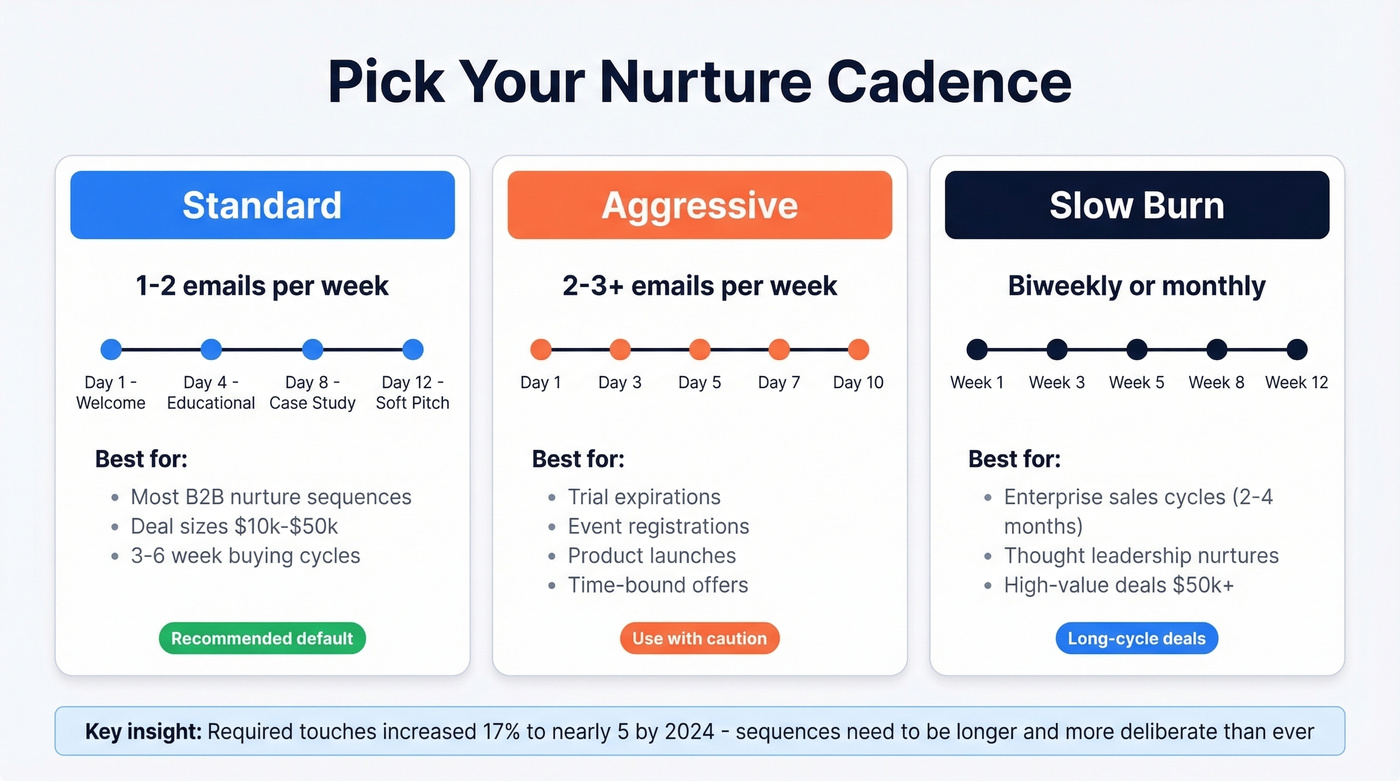
Standard (1-2 emails per week). The default for most B2B nurture. A clean starter schedule from Unreal Digital Group: Day 1 (welcome), Day 4 (educational), Day 8 (case study), Day 12 (soft pitch). Space emails about 3-4 days apart in the first two weeks to keep momentum without overwhelming.
Aggressive (2-3+ per week). Use this for time-bound situations: trial expirations, event registrations, product launches. Higher frequency is tolerated when there's a deadline driving urgency.
Slow burn (biweekly or monthly). Long enterprise sales cycles and thought-leadership nurtures. You're staying visible without wearing out your welcome. Some teams let subscribers self-select frequency - a "send me less often" option reduces unsubscribes without losing the contact entirely.
The old 3-email sequence doesn't match how hard it is to earn attention now. By 2024, Outreach data showed required touches had increased 17% to nearly 5, and the trend hasn't reversed. Sequences need to be longer and more deliberate than they were even two years ago.
Let's be honest: if your average deal size is under $10k, you don't need a 10-email enterprise nurture. Five tight, well-timed emails will outperform ten mediocre ones every time. Sequence length should match deal complexity, not your content calendar's ambitions.
Behavior Triggers Beat Scheduled Drips
The "Rule of Seven" - the idea that prospects need seven exposures before acting - originated in 1930s Hollywood as a movie advertising heuristic. It refers to total brand exposures across all channels, not seven emails. HockeyStack's data puts the real number for B2B SaaS at 266 touchpoints per closed deal. Seven emails aren't going to cut it alone.
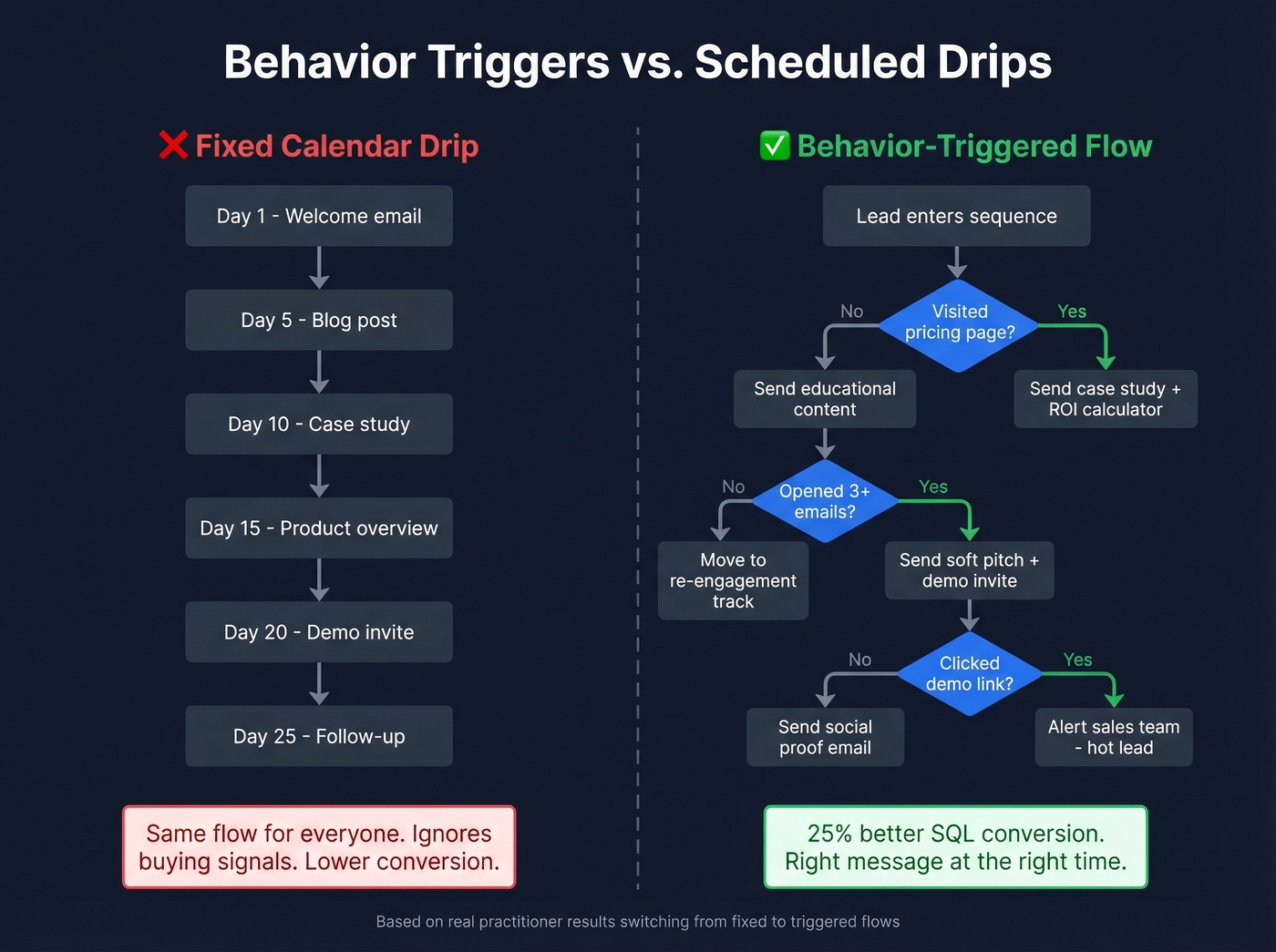
Aberdeen's research shows it takes roughly 10 marketing-driven touches to convert a lead, but those touches shouldn't be calendar-based. A practitioner on r/b2bmarketing described switching from a fixed "email every 5-7 days for six weeks" drip to behavior-triggered flows - pricing page visits, demo requests, re-engagement signals. The result: 25% improvement in SQL conversion.
The question isn't how many emails to schedule. It's which behaviors should trigger the next one. A rigid lead nurturing schedule based purely on calendar dates misses the signals that actually indicate buying intent.
Mistakes That Kill Sequences
1. Same drip for everyone. If your sequence is 8+ emails and every lead gets the identical flow regardless of behavior, you're spamming. We've seen teams cut sequence length from 10 to 6 emails and get better results just by splitting into two tracks based on engagement level.
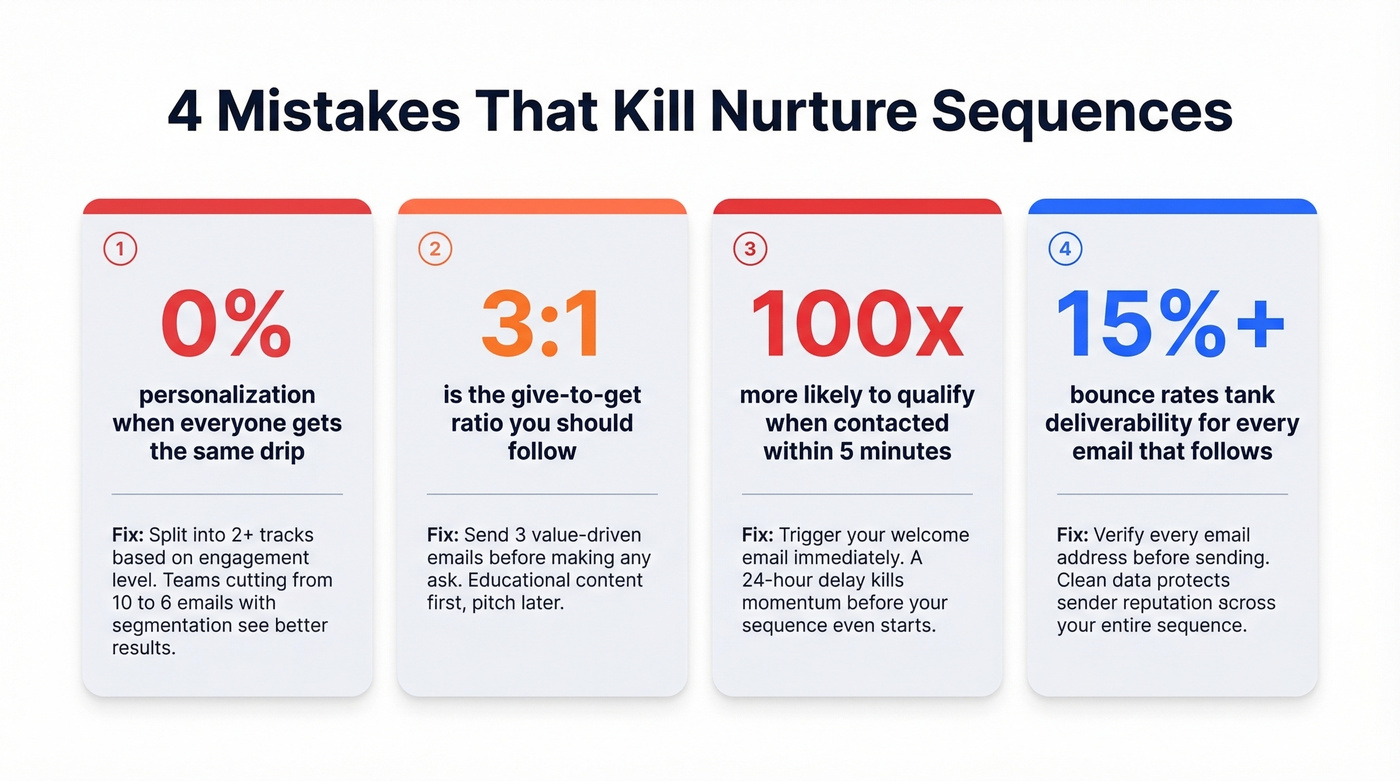
2. Selling too early. Follow a 3:1 give-to-get ratio. Three emails delivering genuine value before one that asks for anything.
3. Slow first touch. Leads contacted within 5 minutes are 100x more likely to qualify. If your welcome email fires 24 hours after signup, you've already lost momentum. (If you want to benchmark your speed-to-lead, see lead response time.)
4. Ignoring list quality. This one's a silent killer. Bounces damage sender reputation, tanking deliverability for every subsequent email in your sequence. A shorter sequence to verified contacts will outperform a longer sequence sent to a list full of bad addresses every single time. We've watched teams obsess over subject lines and copy while sending to lists with 15%+ bounce rates - it doesn't matter how good your email is if it never reaches the inbox. Verify your list before you launch. Prospeo checks emails in real time with 98% accuracy on a 7-day refresh cycle, so your sequence doesn't start with a deliverability handicap. (If you're comparing tools, start with email deliverability tools and NeverBounce alternatives.)

You just read that list quality is the silent killer of nurture sequences. Teams sending to unverified lists see 15%+ bounce rates that tank deliverability for every email that follows. Prospeo verifies emails in real time at 98% accuracy for ~$0.01 each - so your 5-7 email sequence starts clean and stays clean.
Stop optimizing subject lines for emails that never reach the inbox.
FAQ
What's the ideal number of emails in a nurture sequence?
Five to seven for most B2B sequences. Shorter for trials and welcome series (3-5), longer for enterprise deals with multi-month sales cycles (7-10). Match sequence length to buying complexity, not an arbitrary number.
How often should I send nurture emails?
One to two emails per week works for most B2B sequences. Aggressive cadence (2-3 per week) fits time-bound offers like trials or events. Long sales cycles benefit from biweekly or monthly sends. Let engagement signals - not a fixed calendar - dictate frequency.
When should I stop a nurture sequence?
Cut the sequence when per-email opens drop below 15% or CTR falls under 2%. If the last email still performs above those thresholds, add another touch. If it doesn't, redirect contacts to a different flow or a re-engagement campaign.
How do I keep bounce rates low across a long sequence?
Verify every address before your first send. Prospeo's 5-step verification catches invalid emails, spam traps, and catch-all domains at 98% accuracy - teams like Stack Optimize maintain under 3% bounce rates across all client campaigns. Clean data protects sender reputation so later emails in your sequence actually reach inboxes.