

B2B Lead Nurturing: The 2026 Playbook Nobody Gave You
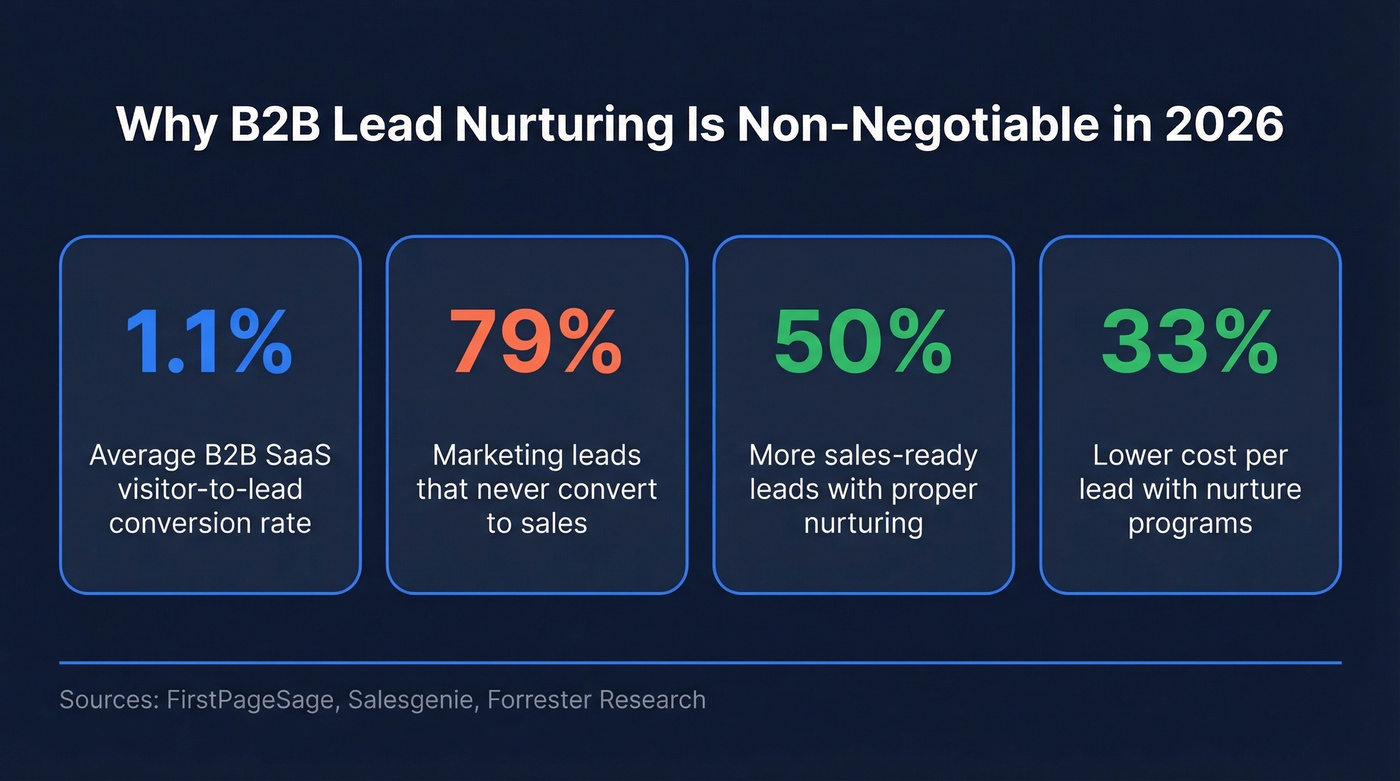
Somewhere in your HubSpot instance, there's a 5-email drip sequence that's been running for three months. It sends the same case study to every lead - whether they visited your pricing page or just downloaded a gated PDF about industry trends. Marketing calls it "nurture." Sales calls it "useless." 79% of marketing leads never convert to sales, and most of the time, the B2B lead nurturing program is the thing that failed them.
Stop optimizing your email copy. Fix your system first.
What You Need (Quick Version)
If you're short on time, here's the entire nurture system in five moves:
- Segment leads into Cold / Warm / Hot buckets. One-size-fits-all sequences are why your nurture program feels like a graveyard. Different engagement levels need different messaging.
- Build a scoring model with positive AND negative signals. A demo request adds points. A bounced email subtracts them. Scoring without penalties is a vanity metric.
- Map content to TOFU / MOFU / BOFU. Guides and short videos for awareness. Case studies and comparisons for consideration. Demos and pricing for decision.
- Use the 7-email sequence template below. Most responses come from emails 3-5, not email 1. The cadence matters as much as the copy.
- Verify your contact data before launching anything. A 30% bounce rate craters your sender score faster than bad subject lines ever could.
Templates, scoring tables, and cadence rules follow.
Why You Can't Ignore Lead Nurturing in 2026
The math is brutal at the top of the funnel. B2B SaaS companies convert just 1.1% of website visitors into leads. Even manufacturing - a relatively high-converting vertical - only hits 2.2%. That means 98-99% of your traffic leaves without raising a hand, and the tiny fraction that does convert isn't ready to buy. On top of that, 41% of buyers already have a preferred vendor before formal evaluation begins, so your nurture program needs to establish preference before the RFP drops.
Meanwhile, B2B buyers now touch an average of 10 channels before a purchase decision, up from 5 in 2016. Gartner puts 6-10 decision makers on a typical buying committee, each bringing 4-5 pieces of independent research to the table. Your single-channel email drip isn't reaching most of the people who matter.
Here's the upside: Forrester's research shows that companies excelling at lead nurturing generate 50% more sales-ready leads at 33% lower cost. Nurturing isn't optional. It's the mechanism that turns your 1.1% conversion into actual pipeline.
The 5-Step Nurture Framework
Segment Leads Into Three Buckets
Every lead in your CRM falls into one of three categories. Cold leads have no meaningful engagement - they downloaded something once and went silent. Warm leads are familiar with you but aren't showing buying signals yet. Hot leads are visiting pricing pages, requesting demos, or engaging with bottom-funnel content.
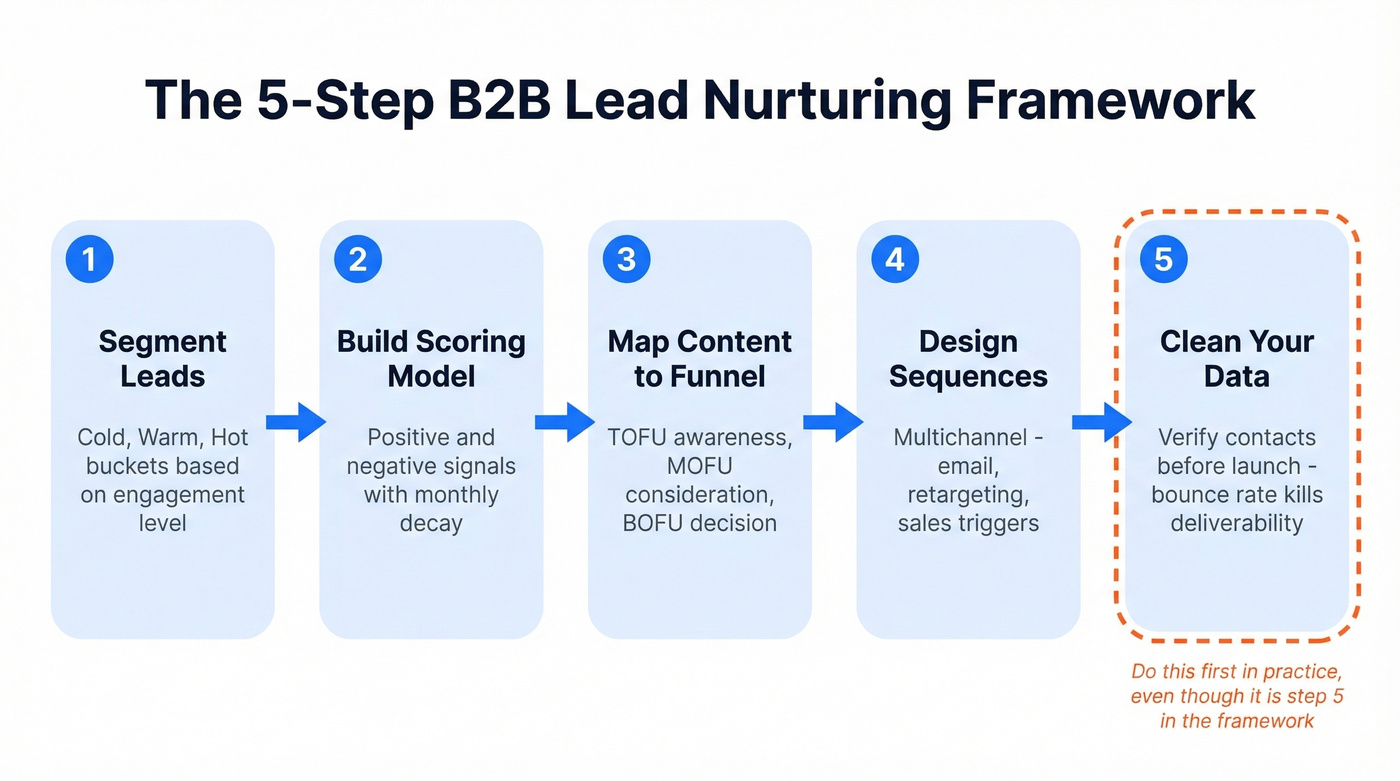
The mistake most teams make is treating all three the same. A cold lead needs education. A hot lead needs a sales call, not another blog post. As one marketer put it on r/marketing, nurture workflows become a "graveyard" for cold leads when sequences are generic - and we've seen this firsthand across dozens of campaigns.
Build a Scoring Model
Assign point values to behaviors and attributes, then set a threshold that triggers a handoff to sales. The scoring table in the next section gives you exact numbers.
The key principle: include negative signals. A bounced email, a competitor employee, an unsubscribe - these should subtract points aggressively. Lead scoring without penalties just inflates your MQL count. Track engagement signals using UTMs and webpage scoring, since these give you buyer intent data that email opens can't.
Map Content to Funnel Stages
TOFU content - insights, guides, and short videos - builds awareness. MOFU content like case studies, webinars, and comparison guides builds consideration. BOFU content including demos, pricing pages, and ROI calculators drives decisions. Aim for roughly 70% educational content and 30% product-focused across your sequences.
Christelle Fraysse, ex-CMO at Workbooks.com, is blunt about this: don't manage nurture logic in Excel. Use a CRM with dynamic content capabilities. After implementing more rigorous testing and a proper nurture setup, her team improved lead-to-pipeline conversion from under 10% to 25%.
Design Your Sequences
Multichannel beats email-only every time. Your sequences should combine email touches with retargeting ads and sales call triggers when an account crosses an engagement threshold. One tactic gaining traction: embedding 30-60 second video snippets in nurture emails to reopen dormant deals. Short, personalized video outperforms text-only follow-ups for re-engagement. The templates in Section 6 give you day-by-day timing for three different scenarios.
Clean Your Data First
This step comes last in the framework but should happen first in execution. If a third of your emails bounce, your domain reputation tanks and even perfectly crafted sequences land in spam.
Here's a concrete example: Snyk dropped their bounce rate from 35-40% to under 5% after switching to verified contact data, and AE-sourced pipeline jumped 180%. Verify every contact before they enter a nurture flow. No exceptions.
Lead Scoring That Actually Works
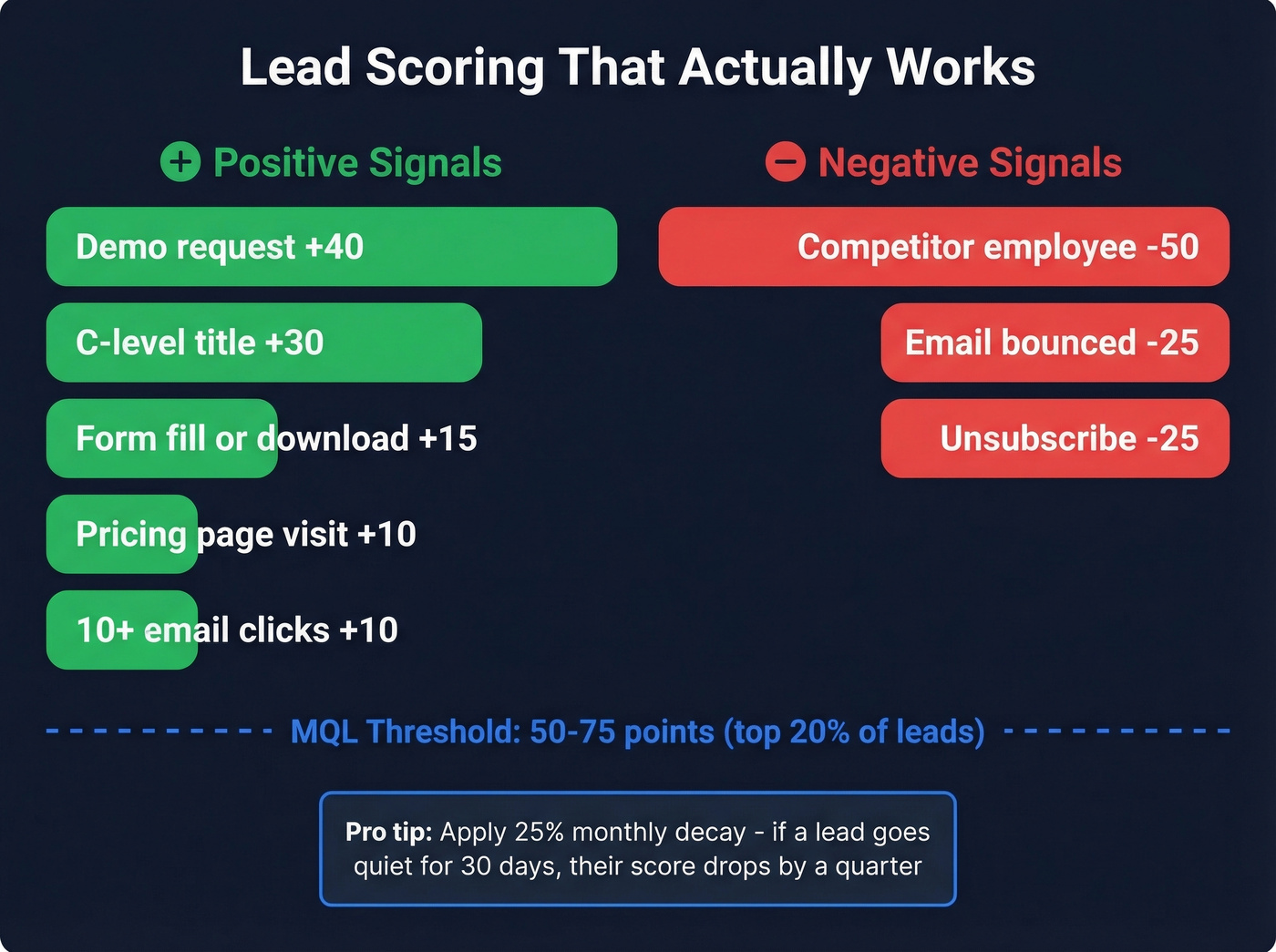
Most scoring models fail because they only count positive signals. A lead who clicked 10 emails but works at a competitor shouldn't be an MQL. Here's a scoring table with real point values:
| Signal | Points | Type |
|---|---|---|
| Pricing page visit | +10 | Behavioral |
| Form fill / download | +15 | Behavioral |
| 10+ email clicks | +10 | Engagement |
| C-level title | +30 | Firmographic |
| Demo request | +40 | Intent |
| Email bounced | -25 | Data quality |
| Competitor employee | -50 | Disqualifier |
| Unsubscribe | -25 | Disengagement |
Set your MQL threshold at the top 20% of leads by score - typically 50-75 points on a 100-point scale. Apply a 25% monthly decay rule: if a lead goes quiet for 30 days, their score drops by a quarter. Without decay, your pipeline fills with stale leads that scored high six months ago and haven't engaged since.
One operational note worth stealing from Belkins: stop weighting email opens. Privacy changes have made open rates unreliable. Shift your scoring toward on-site behavior - pricing page visits, form submissions, and content downloads are signals you can actually trust.
If "email bounced" is your most common negative signal, the problem isn't your scoring model. It's your data. Verify contacts before they enter the funnel, and that -25 penalty stops showing up.

Every bounced email costs you -25 points in your scoring model and tanks your sender reputation. Prospeo's 5-step verification delivers 98% email accuracy - the same data that dropped Snyk's bounce rate from 35% to under 5% and grew their pipeline 180%.
Clean data in, qualified pipeline out. Start verifying for free.
Nurture Sequence Templates
The biggest gap in most nurture guides is the actual sequence. Here are three templates with specific timing.
Cold Outreach Sequence (7 Emails)
| Day | Purpose | |
|---|---|---|
| 1 | 0 | Initial outreach |
| 2 | 3 | Value add |
| 3 | 7 | Social proof |
| 4 | 10 | Different angle |
| 5 | 14 | Quick check-in |
| 6 | 21 | Last value |
| 7 | 28 | Breakup email |
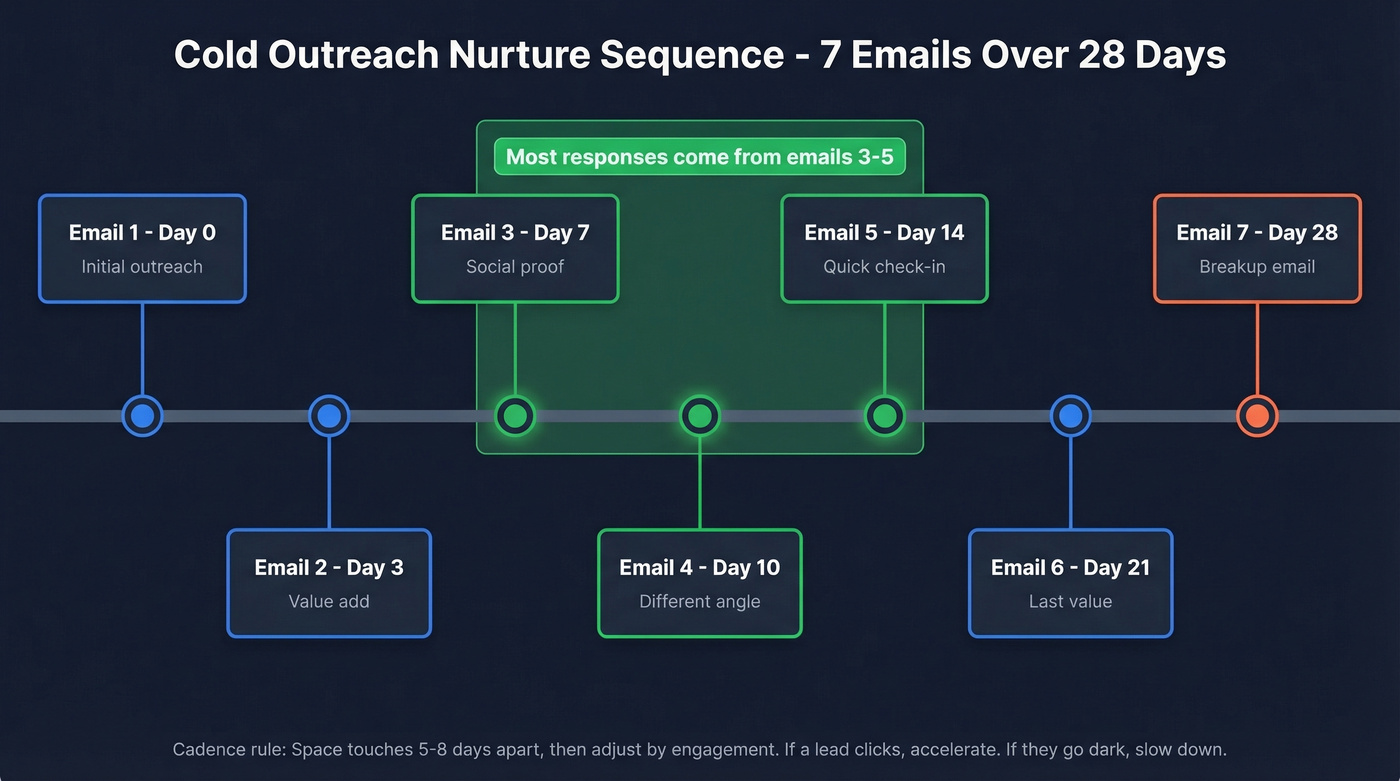
Most responses come from emails 3-5, not email 1. Don't panic if your first touch gets silence - that's normal.
As a baseline cadence rule, space touches 5-8 days apart, then adjust by engagement. If a lead clicks a link in email 2, accelerate the cadence. If they go dark after email 4, slow down.
Content-Based Nurture Sequence
This fires when someone downloads a resource, registers for a webinar, or subscribes to your newsletter:
- Immediate: Deliver the content they requested. No pitch.
- Day 3-5: Educational email expanding on the topic.
- Day 8-10: Case study showing results related to their interest.
- Day 14: Soft CTA - "Want to see how this works for your team?"
- Day 21: Check-in with a different content angle.
Since you already have their contact info, consider ungating content in nurture emails - removing friction increases engagement. The content mix here should lean heavily educational, 70/30 or even 80/20. You already have their attention. Don't burn it with a hard sell on email two.
Post-Demo Follow-Up
This is where deals die quietly. The cadence needs to be tighter:
- Within 2 hours: Recap email with next steps and any materials discussed.
- Day 2: Share a relevant case study or ROI example.
- Day 5: Address the most common objection for your product.
- Day 10: Check in with a specific question tied to their use case.
- Day 14+: If there's no response, loop in another stakeholder or shift to a longer nurture track.
Let's be honest about cadence anxiety. It's one of the most common concerns for teams launching nurture programs. But for post-demo leads, the anxiety is almost always unfounded. They asked for a demo. They're expecting follow-up. The real risk is going silent for two weeks and losing momentum.
Multi-Threaded Nurturing for Buying Committees
Single-threaded deals die. Forrester's 2024 data shows the average B2B purchase involves 13 stakeholders, 89% of these purchases cross multiple departments, and 86% stall at some point. If your nurture program only touches one person at an account, you're one vacation or job change away from a dead deal.
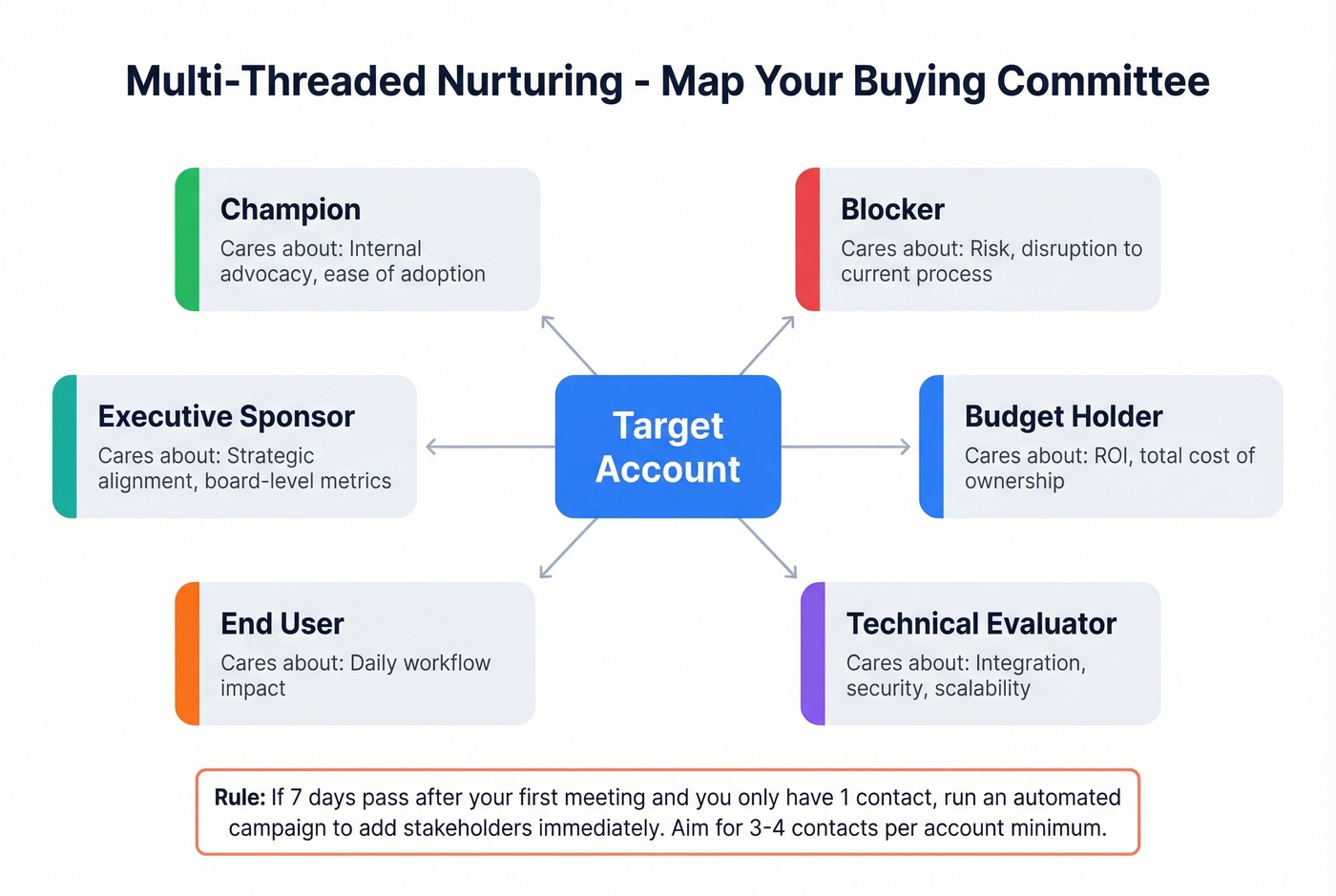
Map six roles for every target account:
| Role | What They Care About |
|---|---|
| Champion | Internal advocacy, ease of adoption |
| Blocker | Risk, disruption to current process |
| Budget holder | ROI, total cost of ownership |
| Technical evaluator | Integration, security, scalability |
| End user | Daily workflow impact |
| Executive sponsor | Strategic alignment, board-level metrics |
Aim for 3-4 contacts per account minimum. Thread both vertically across seniority levels and laterally across departments. A practical rule: if 7 days pass after your first meeting and you only have one contact, run an automated campaign to add stakeholders immediately.
Finding verified contacts for 3-4 roles per account is where a B2B database with 30+ search filters pays for itself - filter by department, seniority, and company in seconds instead of manually hunting down each stakeholder.
Common Mistakes That Kill Nurture Programs
Look, we've audited enough nurture setups to know the same six mistakes show up over and over:
Same content to every lead. Segment by persona, funnel stage, and intent signals. A CFO and a DevOps lead shouldn't get the same email. (If you need a tighter definition of segmentation rules, use an Ideal Customer Profile to anchor your scoring.)
Email-only nurturing. Add retargeting and sales call triggers. Buyers use 10 channels. Meet them there.
No negative scoring. Add bounce, competitor, and unsubscribe penalties. Without them, your MQL list is fiction. (If you want a deeper model, start with a dedicated lead scoring framework.)
Over- or under-nurturing. Space touches 5-8 days apart, then adjust by engagement. Accelerate for active leads, slow down for silent ones. (For reply-driving copy, keep sales follow-up templates handy.)
Ignoring post-purchase. Build a customer success nurture track with onboarding tips, feature education, check-ins, and advocacy asks. Only 29% of brands nurture beyond the initial purchase. That's a massive retention gap.
Dirty data. This is the mistake nobody talks about. Launching a nurture program on unverified contacts is the fastest way to waste your investment. If 30-40% of your emails bounce, your domain sender score craters and even your best sequences land in spam. (If you're diagnosing bounces, use an email bounce rate checklist.)
Track the right KPIs: engagement rate, MQL-to-SQL conversion, time in nurture, and pipeline influenced. (If you're standardizing reporting, align on funnel metrics first.)
Intent Data and AI in 2026
Most of your nurture program can be automated. The parts that can't are the parts that close deals. Layering intent data into your nurture workflows lets you prioritize accounts showing active research behavior, so your sequences reach the right people at the right time instead of firing on a fixed schedule. (If you want a practical setup, use intent based segmentation rules.)
| AI Handles | Human Handles |
|---|---|
| Behavioral signal detection | Interpreting context and nuance |
| Lead scoring and decay | Strategic pivots mid-deal |
| Trigger-based sends | High-stakes negotiations |
| Send-time optimization | Relationship-building touches |
BCG's research found that AI-leading companies achieve 1.7x revenue growth compared to laggards, and 49% of B2B marketers now prioritize leads using high-intent data signals. Let AI handle scoring, content recommendations, and cadence optimization. Keep humans on deal-level judgment and anything that requires reading the room.
Your Nurture Tech Stack
You need three layers, and most teams overcomplicate this.
Layer 1 - CRM: HubSpot (free CRM; paid tiers from $15 to $150/user/month) or Salesforce ($25-$350/user/month). This is your system of record. Pick one and commit. (If you're still deciding, compare examples of a CRM and pick based on workflow fit.)
Layer 2 - Marketing automation: If your CRM has built-in automation, start there. For standalone power, Marketo runs ~$1K-3K/mo and Eloqua ~$2K-4K/mo. These are enterprise tools - skip them until you've outgrown your CRM's native capabilities.
Layer 3 - Data quality: This is the layer most teams skip, and it's the one that makes or breaks everything else. Automation platforms cost $1,000+/month. The data quality layer underneath costs a fraction. With Prospeo, verified emails run about $0.01 each at 98% accuracy on a 7-day refresh cycle, and you get intent data tracking 15,000 topics via Bombora so you can layer buying signals directly into your scoring model without bolting on another vendor. (If you're evaluating vendors, start with data enrichment services to see what "good" looks like.)
Hot take: If your average deal size is under $15k, you probably don't need Marketo or Eloqua. HubSpot's free CRM plus verified contact data will outperform an expensive marketing automation platform sitting on top of a dirty database every single time.
Your nurture sequences touch 7+ emails across weeks of cadence. One bad contact wastes the entire sequence and damages your domain. Prospeo refreshes 300M+ profiles every 7 days - so leads entering your funnel have verified emails, direct dials, and 50+ data points from day one.
Stop nurturing dead emails. Start with data you can trust at $0.01 per lead.
FAQ
What's the difference between a drip campaign and lead nurturing?
A drip campaign is a fixed email sequence sent on a schedule regardless of recipient behavior. Lead nurturing adjusts messaging based on scoring, engagement signals, and funnel stage. Drip is a tactic. Nurturing is the strategy that contains it. Most teams running "nurture programs" are actually running drip campaigns with a nicer name.
How many emails should a nurture sequence include?
A typical cold nurture sequence runs 5-7 emails over 2-4 weeks, spaced 5-8 days apart. Content-based sequences can stretch to 8-12 emails with wider spacing. Adjust based on engagement: accelerate for active leads, slow down for silent ones. Under 5 emails rarely provides enough touches to convert.
How do I keep nurture emails from bouncing?
Run your contact list through an email verification tool before launching any sequence. Teams using verified data routinely cut bounce rates to under 5% - Snyk went from 35-40% to under 5%. Anything above 10% damages your domain sender score and pushes all emails toward spam.
How do you re-engage leads that go silent mid-funnel?
Shift silent leads into a slower cadence with fresh content angles - a new case study, an industry benchmark, or a short video. Apply your scoring decay rule so they don't clog the MQL pipeline, but don't delete them. Many deals resurface 3-6 months later when budget cycles reset or internal priorities shift.