

B2B Lead Response Time: 2026 Benchmarks & How to Fix Yours
One practitioner summed it up bluntly: they were bleeding 40-60% of inbound leads purely because of response time. Not bad messaging, not weak offers - just speed. A prospect submits a demo request at 3:47pm Thursday. By Monday, they've booked with your competitor.
That's a B2B lead response time problem, and it's costing you deals every single week.
Here's the 30-second version: among companies that respond at all, the average sales lead response time is over a day. In RevenueHero's 1,000-company test, 63.5% never responded at all. The fix is real-time routing with escalation timers, a 3-5 touch follow-up cadence, and verified contact data so reps aren't chasing dead numbers.
What the Numbers Actually Show
A 1,000-company study by RevenueHero submitted demo requests to B2B SaaS companies and tracked what happened. Only 365 responded. The average among those who did: one day, five hours, and seventeen minutes. Most companies in the sample were mid-market - 51-200 employees made up 61%, and 201-500 accounted for 37.8%.
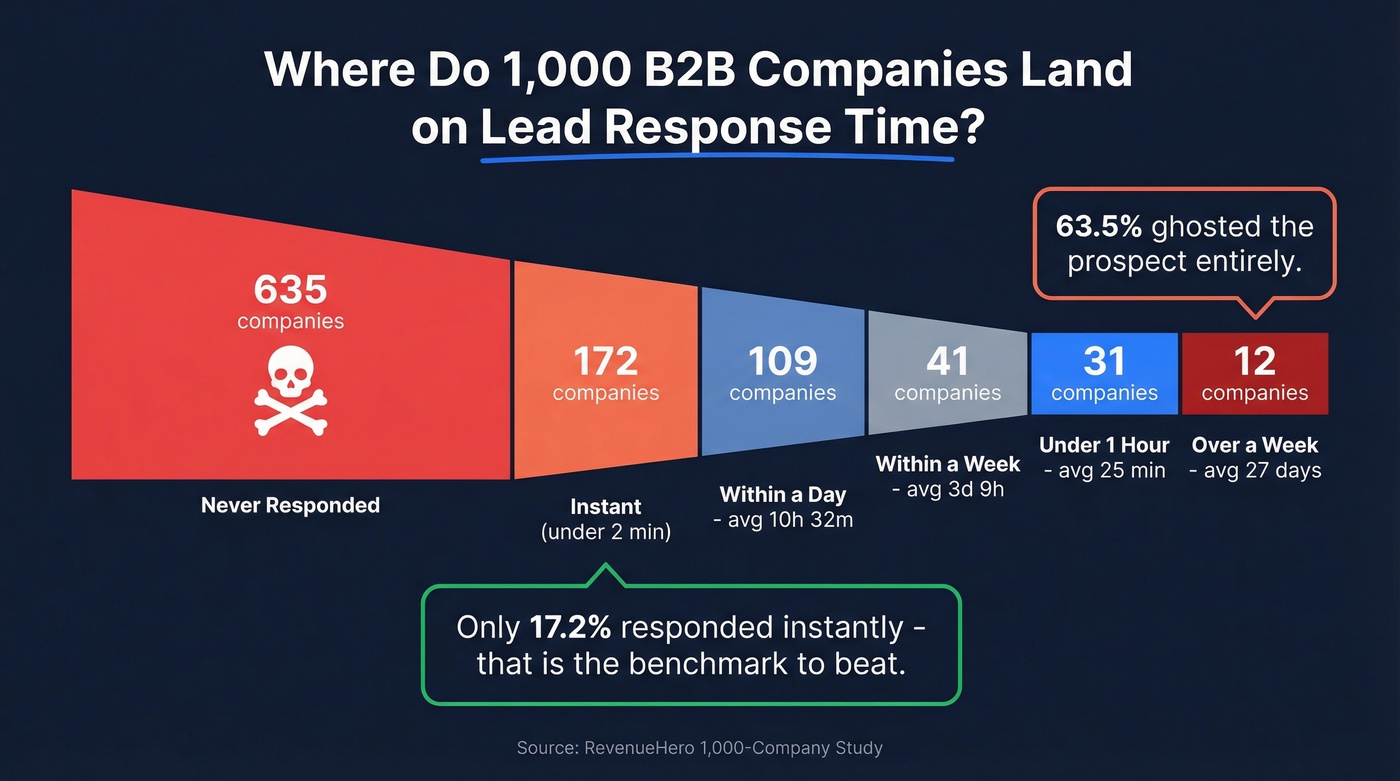
| Bucket | Companies (of 1,000) | Avg Response Time |
|---|---|---|
| Instant (<2 min) | 172 | 2 minutes |
| Under 1 hour | 31 | 25 minutes |
| Within a day | 109 | 10h 32m |
| Within a week | 41 | 3d 9h 31m |
| Over a week | 12 | 27d 14h 33m |
| Never responded | 635 | - |
Only 17.2% responded instantly. That's the benchmark to beat. The average is skewed by extreme outliers like the 27-day bucket, which means a median figure would paint an even grimmer picture for most teams.
The study also found the average demo form had 7 fields - one company had 21. More fields means more friction and slower perceived response, even if your team is technically fast.
Workato's study of 114 B2B companies broke results down by channel:
| Channel | % That Responded | Avg Response Time |
|---|---|---|
| ~81% | 11h 54m | |
| Phone | 31% | 14h 29m |
Not a single company called within five minutes. Companies using lead routing tools averaged 3h 32m - better than the 13-hour average without routing, but still far from the target. Only 113 of 1,000 companies had any scheduling tool on their site. Among non-responders, just 35 did.
The foundational research comes from James B. Oldroyd, Kristina McElheran, and David Elkington, whose 2011 Harvard Business Review study framed how quickly online leads decay after the first few minutes. The tools have changed since then. The math hasn't.
Why Inbound Lead Response Is Slow
Five causes show up repeatedly, and we've seen all of them across the teams we work with.
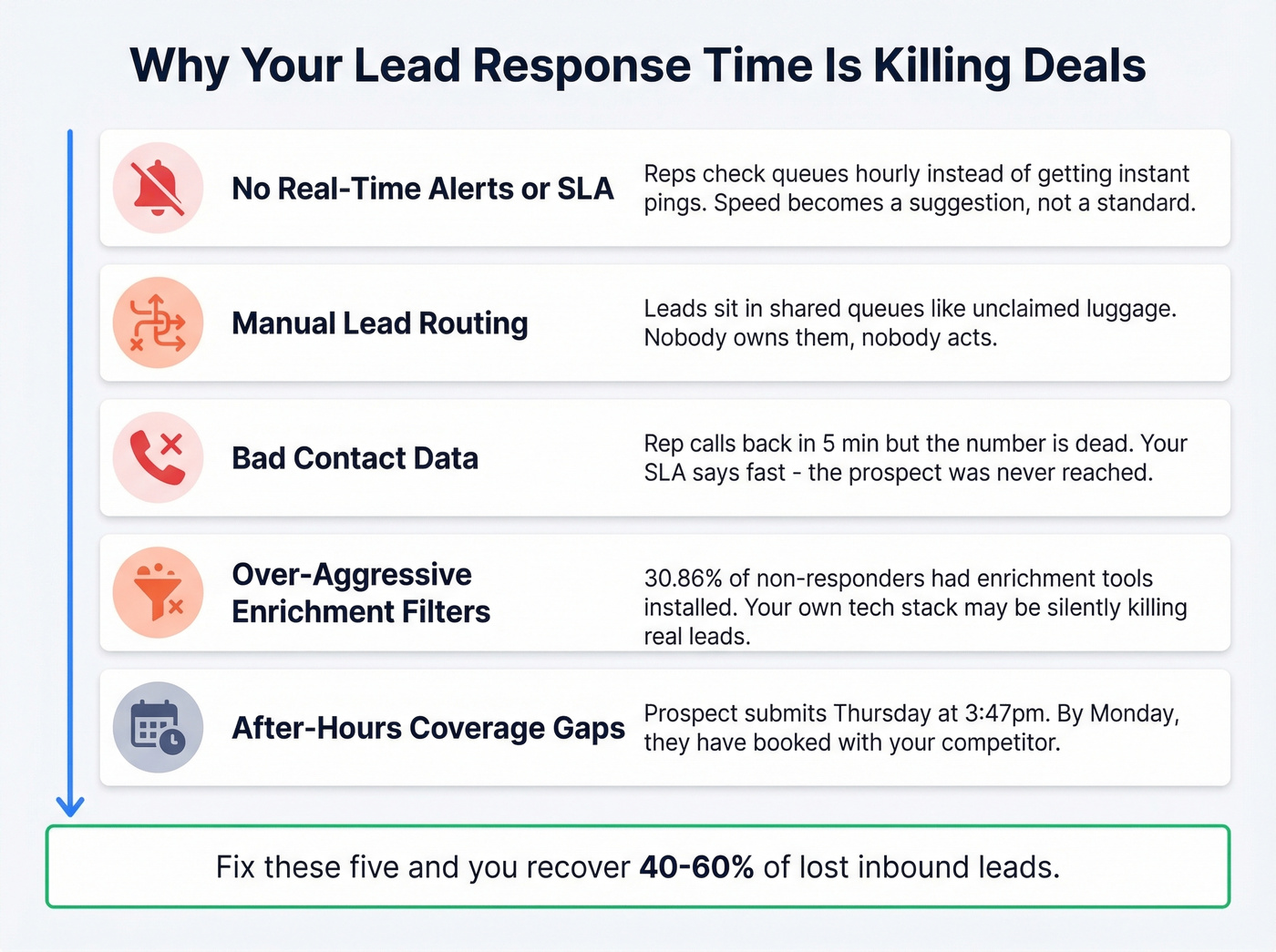
No real-time alerts and no SLA. If reps check a queue hourly instead of getting a Slack ping the second a form is submitted, you've already lost. Without a documented SLA - where sales "gets to it when they can" - speed-to-lead becomes a suggestion, not a standard. Define response windows by channel, enforce them in your CRM, and set escalation consequences.
Manual routing is the next killer. Leads land in a shared queue, nobody owns them, and they sit there like unclaimed luggage. Automated round-robin assignment with load balancing solves this overnight. Every minute a response is delayed, the odds of qualifying that prospect drop.
Then there's the problem nobody measures: bad contact data. Your rep calls back in five minutes, but the number is disconnected. The email bounces. Your speed-to-lead metric says five minutes; the prospect was never actually reached. This is where tools like Prospeo matter - with a 7-day data refresh cycle and 98% email accuracy, your response-time investment doesn't get wasted on dead contacts.

A surprising finding from the 1,000-company study: 30.86% of non-responding companies had data enrichment tools installed - Clearbit, ZoomInfo, 6sense. That doesn't prove enrichment caused the silence, but it's a strong signal that enrichment and filtering rules can disqualify or suppress legitimate demo requests before they ever reach a rep. Audit your enrichment rules quarterly, or you're paying for leads your own tech stack silently kills.

Bad contact data is the silent killer of lead response time. Your rep calls back in 5 minutes, but the number is disconnected. Prospeo's 7-day data refresh and 98% email accuracy mean your speed-to-lead investment actually reaches real buyers - not dead inboxes.
Stop wasting fast responses on stale data.
The Fix: SLAs, Routing, and Clean Data
Channel-Specific SLAs
| Channel | SLA Target | 1st Escalation | 2nd Escalation |
|---|---|---|---|
| Inbound forms | ≤5 min (business hrs) | 10 min | 20 min |
| Inbound (after-hrs) | ≤15 min | 20 min | 30 min |
| Referrals | ≤60 min | 90 min | 120 min |
Enterprise orgs may need follow-the-sun coverage to hit these windows. SMBs can get there with lightweight automation in HubSpot or Salesforce.
Automate the Workflow
The pattern: form submission → auto-assign to rep → create task due in 5 minutes → Slack DM to assigned SDR → escalate to manager if overdue. HubSpot and Salesforce support this natively, and most other CRMs can handle it via workflows or automation tools.
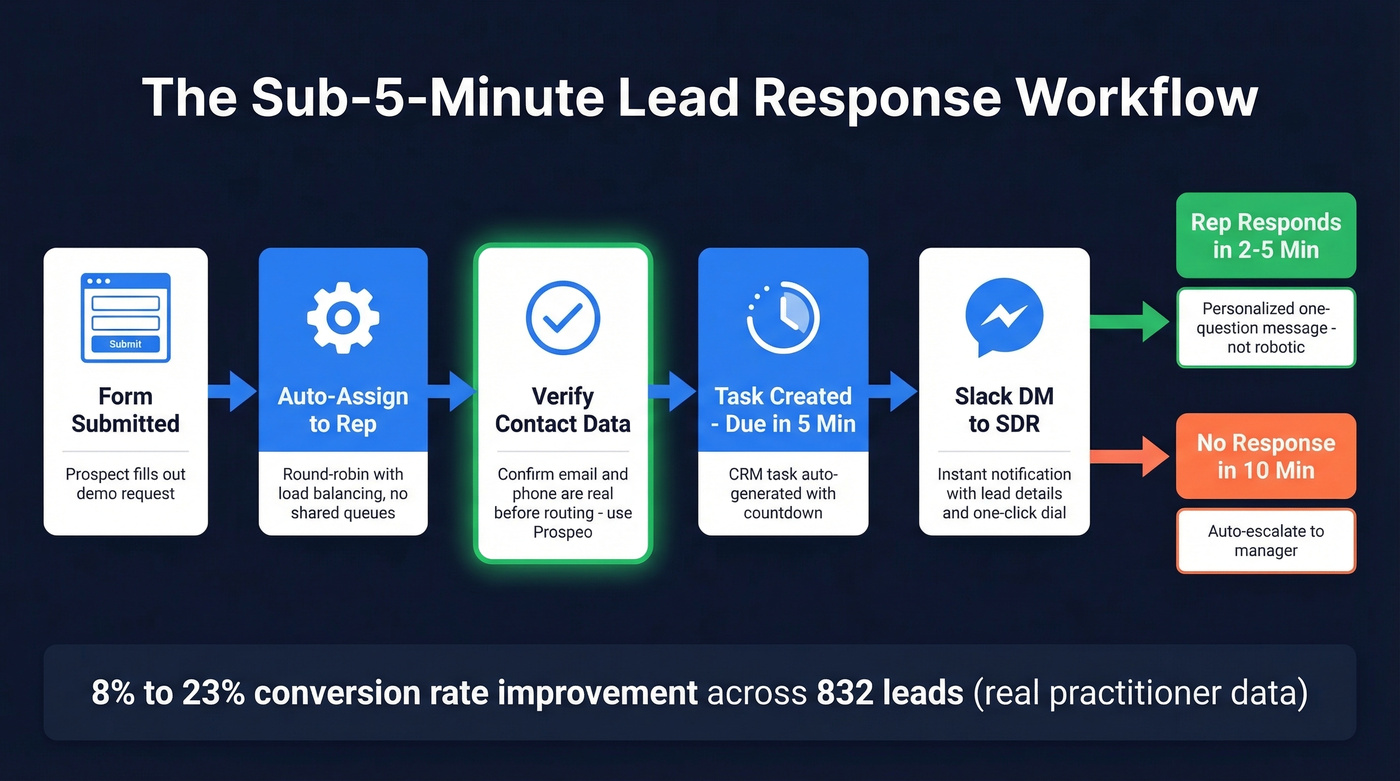
One practitioner on r/b2bmarketing shared results after building an automated inbound follow-up system: inquiry-to-booked-call conversion jumped from 8% to 23% across 832 leads over six months, with zero lost to slow response. That's real money left on the table by teams still running manual queues.
The catch? Responding in under 60 seconds triggered "Are you a bot?" reactions. The sweet spot was 2-5 minutes with a personalized, one-question message. They also found 3-5 follow-ups was the ceiling before prospects got annoyed - use a tight sales follow-up cadence instead of endless pings. 360Learning took a similar approach and cut response times to under 10 minutes, hitting 97% routing accuracy and a 40% conversion increase.
Verify Contact Data First
None of this matters if your reps are dialing disconnected numbers. Verify lead data before it hits the routing queue. With 125M+ verified mobile numbers and a 30% pickup rate, Prospeo helps reps connect on the first attempt far more often. Improving lead qualification speed starts with knowing the contact information is real - especially if you're building lists via name-to-email workflows.
Let's be honest about something: speed-to-lead is the most overhyped metric in B2B when it's measured in isolation. A five-minute response to a bad number is worse than a 30-minute response to a verified direct dial. Fix the data first, then optimize the clock.
A Simple ROI Formula
Recovered revenue = Monthly leads × (New conversion rate - Old conversion rate) × Avg deal value
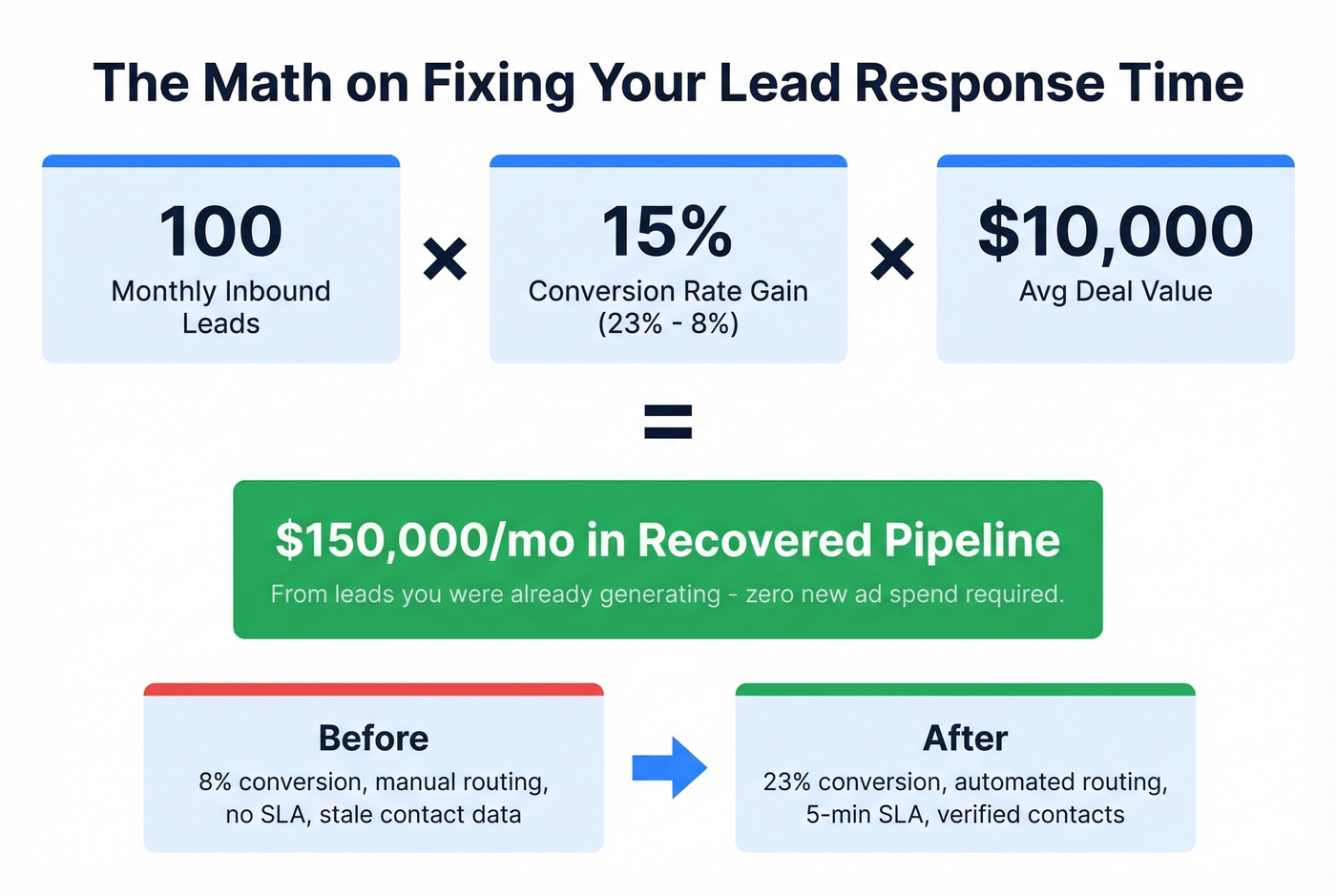
Say you generate 100 inbound leads per month with a $10K average deal value. Your current conversion rate is 8%. After implementing SLAs and routing automation, you hit 23% - matching the Reddit practitioner's results. That's 100 × (0.23 - 0.08) × $10,000 = $150,000/month in recovered pipeline from leads you were already generating.
Tightening your response time is the highest-leverage change most teams can make without increasing ad spend. We've watched companies triple pipeline just by fixing the plumbing between form submission and first touch - no new campaigns, no new headcount, just faster and cleaner execution on the leads they already had. If you want to pressure-test the rest of your funnel, compare your numbers to the average B2B lead conversion rate and review common sales pipeline challenges.
125M+ verified mobile numbers with a 30% pickup rate. When your SLA says 5 minutes, Prospeo makes sure that first call connects. Reps dial real direct lines - not switchboards, not disconnected numbers - so your response time translates to actual conversations.
Turn fast responses into booked meetings at $0.01 per email.
FAQ
What's a good B2B lead response time?
Under five minutes for inbound demo requests during business hours. The HBR study by Oldroyd, McElheran, and Elkington showed online leads decay sharply after the first few minutes. Only 17.2% of B2B SaaS companies hit this benchmark today - the rest lose deals to faster competitors.
What's the average response time for B2B leads?
Among companies that actually respond, 1 day, 5 hours, and 17 minutes. But 63.5% never responded at all in RevenueHero's 1,000-company test. Email averages 11h 54m; phone averages 14h 29m per Workato's study.
How do you reduce response time without sounding robotic?
Automate routing and alerts, but keep the first message human. Sub-60-second responses trigger "Are you a bot?" reactions. The sweet spot is 2-5 minutes with a personalized, one-question message. Verify contact data upfront so reps reach real people on the first attempt - skip this step and your speed advantage evaporates the moment a call hits voicemail on a dead line.