

How to Answer "Sell Me This Pen" - The Framework That Actually Works
You're sitting across the table. The hiring manager slides a cheap ballpoint toward you and says five words that make most candidates panic: "sell me this pen." How you answer in the next sixty seconds can determine whether you move forward or get a polite rejection email by Friday. Most candidates blow it - and the movie that made the question famous is the reason why.
The Wolf of Wall Street Got It Wrong
In the film, Jordan Belfort asks a room full of salespeople to sell him a pen. They fumble through feature lists - "it's a great pen," "it writes smoothly," "look at the color." Then Brad takes the pen and says "write your name down." Belfort can't. He doesn't have a pen anymore. "Supply and demand, my friend."
Great movie moment. Terrible sales strategy.
The real Belfort has distanced himself from the film's implied answer. In a Globe & Mail interview interview covered by ScreenRant, he emphasized understanding the buyer's needs before selling anything - the exact opposite of the artificial-scarcity gimmick the movie glorifies. Creating fake urgency by snatching a pen isn't consultative selling. It's a parlor trick. And most interviewers in 2026 know the difference.
The Short Version
- Never start by describing the pen. Ask at least three discovery questions before you mention a single feature.
- The "create demand" trick can get you rejected. Interviewers want a consultative conversation, not a movie reenactment.
- Memorize the framework, not a script. Scripts break the second the interviewer goes off-book. Frameworks adapt.
What the Interviewer Is Actually Scoring
This question isn't about the pen. It never was.
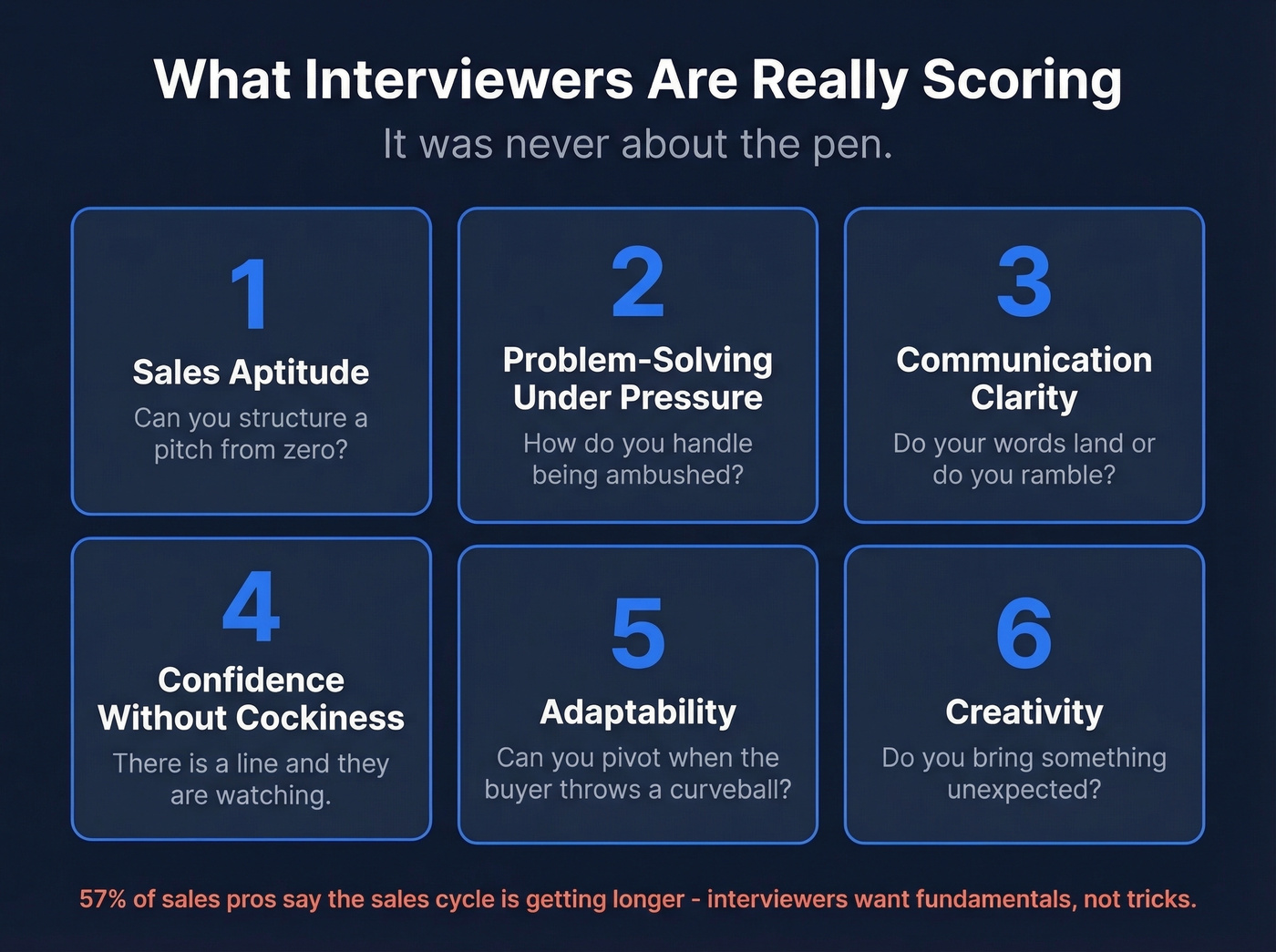
According to Monster's breakdown, recruiters use this prompt to assess six things at once:
- Sales aptitude - can you structure a persuasive conversation from scratch?
- Problem-solving under pressure - how do you perform when ambushed?
- Communication clarity - do your words land, or do you ramble?
- Confidence without cockiness - there's a line, and they're watching for it.
- Adaptability - can you pivot when the buyer throws a curveball?
- Creativity - do you bring something unexpected to a tired exercise?
Some hiring managers take it further. They'll ask candidates to prepare to sell the company's actual product, sometimes recording themselves doing it, then evaluating what they researched and how they structured the pitch.
We've interviewed dozens of sales candidates over the years, and the pattern is clear: the ones who ask questions first advance far more often than the ones who launch into a pitch. Brett Cenkus, a business consultant who's trained sales professionals, puts it simply: "Most interviewers are screening for confidence and cogency." Christopher Searles, who interviews candidates weekly, says the ideal response involves asking "penetrating questions" to determine whether the buyer even needs the item - calling needs identification "the single most important, and often most overlooked, aspect" of being a good salesperson.
Here's the thing: 57% of sales professionals say the sales cycle is getting longer. Interviewers aren't testing whether you can be clever. They're testing whether you have the fundamentals to survive a tougher market.
The 5-Step Framework for Selling the Pen
This is the core of your answer. Internalize the structure, not the exact words.
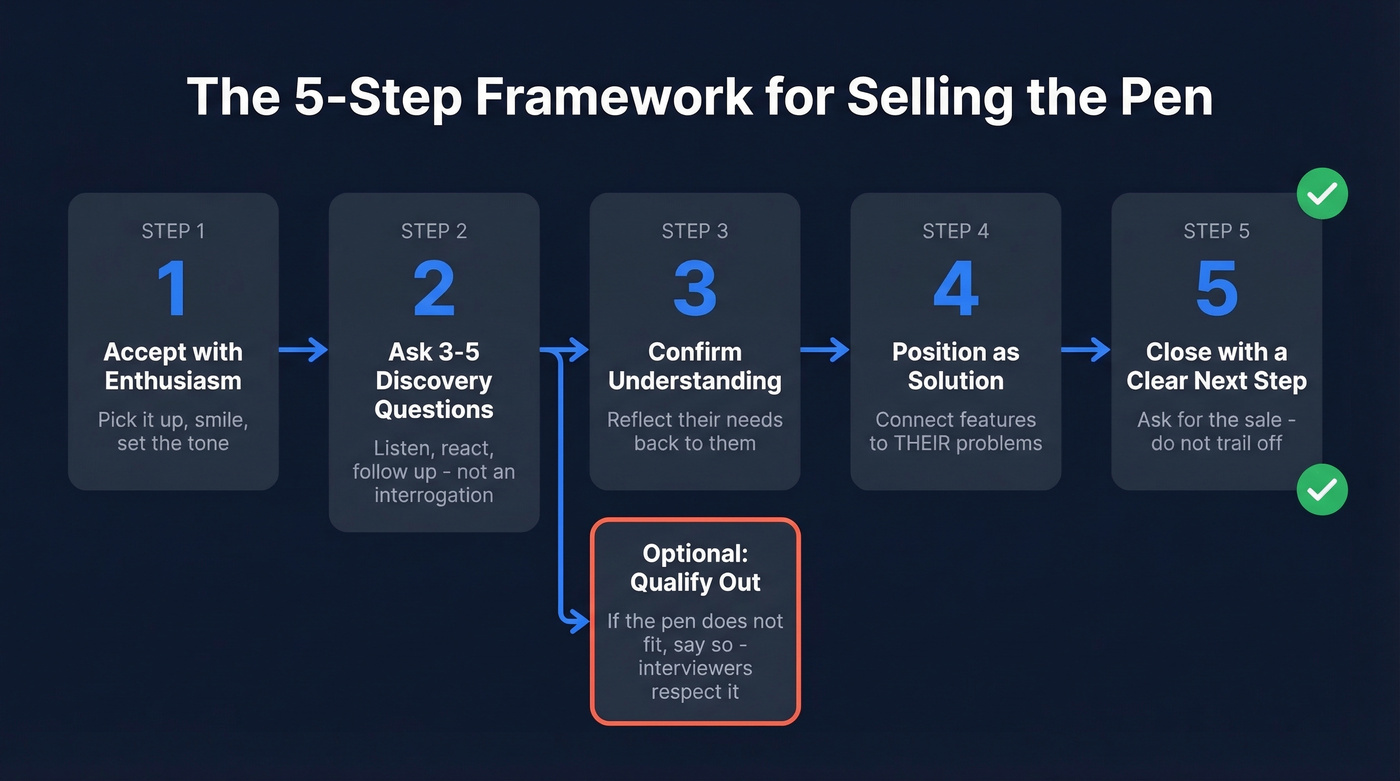
Step 1: Accept with Enthusiasm
Don't hesitate. Don't laugh nervously. Don't say "oh, I hate this question." Pick up the pen, smile, and treat it like a real sales conversation. Your energy in the first three seconds sets the tone for everything that follows.
Step 2: Ask 3-5 Discovery Questions
This is where you win or lose.
The Salesforce blog suggests questions like: How often do you use pens? What do you like about the one you currently use? What bothers you about it? Don't rapid-fire them. Listen to each answer. React. Follow up. This is a conversation, not an interrogation.
Discovery matters because 73% of B2B buyers actively avoid sellers who send irrelevant outreach. Discovery is how you prove you won't be one of them.
Step 3: Confirm Understanding
Reflect their needs back. "So it sounds like you write a lot of handwritten notes in meetings and your current pen smudges. Is that right?"
This shows you actually listened. 83% of the time, buyers mostly or fully define purchase requirements before speaking with sales. Proving you can uncover those requirements is the whole point. Forrester data reinforces the bigger picture: 86% of B2B purchases stall during the buying process, often because the seller never truly understood what the buyer needed.
Step 4: Position the Pen as a Solution
Now - and only now - you talk about the pen. But you don't list features. You connect features to the specific problems they told you about. "This pen uses quick-dry ink, so no more smudging in your meeting notes." One sentence. Targeted. Done.
Step 5: Close with a Clear Next Step
Don't trail off. Ask for the sale. "I've got two left at this price - want to grab one before they're gone?" or "Can I set you up with a box to try this week?"
The qualify-out option: Between steps 2 and 3, if discovery reveals the pen genuinely doesn't fit, pivot: "Honestly, this pen isn't the right fit for what you need. Would you like to set up time to discuss other options?" This is a power move. The best salespeople know when to walk away, and interviewers respect it more than a forced close. If you want a tighter structure for that moment, borrow from proven sales qualification frameworks.

Discovery questions win interviews. Verified data wins deals. Once you land the sales role, you need prospects who actually pick up. Prospeo gives you 125M+ verified mobile numbers with a 30% pickup rate and 98% accurate emails - so your consultative selling skills don't go to waste on bad contact data.
You learned the framework. Now get the data to use it.
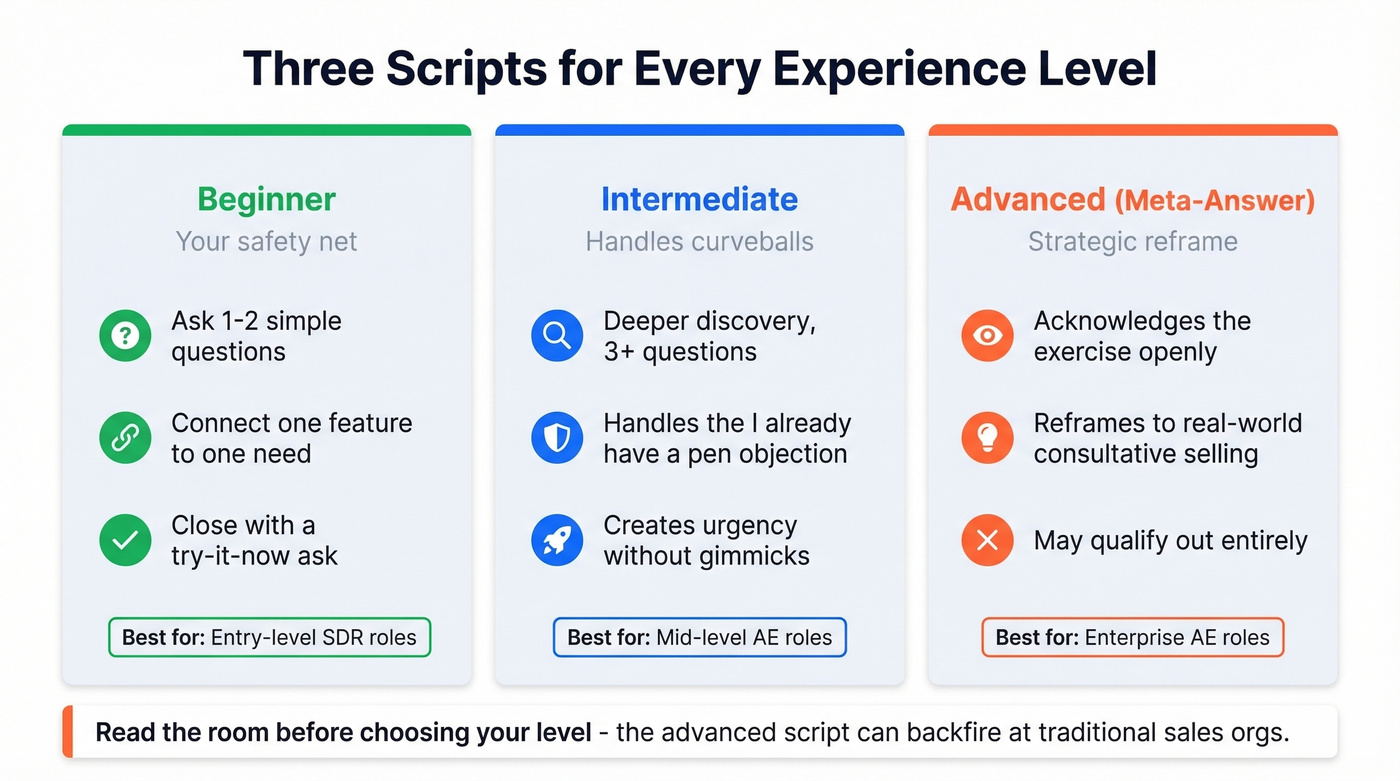
Three Sample Scripts
Beginner Script
Your safety net - clean, simple, effective.
You: "Great, I'd love to. Quick question - do you use pens regularly, or are you mostly digital?"
Interviewer: "I take handwritten notes in meetings."
You: "Got it. What do you look for in a pen?"
Interviewer: "Something that writes smoothly and doesn't skip."
You: "Then you'll like this one. It's a gel-tip that flows consistently - no skipping, no pressure needed. Want to try it right now?"
You asked questions, connected a feature to a need, and closed. Passing grade.
Intermediate Script
This handles the most common curveball: "I already have a pen."
You: "Before I pitch you, can I ask - how often do you find yourself reaching for a pen during the day?"
Interviewer: "A few times. Mostly for signing documents."
You: "And what's your current pen like? Anything you'd change?"
Interviewer: "It's fine. I already have a pen I like."
You: "Totally fair. What if I showed you a pen with a more comfortable grip that makes long signing sessions easier? We're running a limited batch at this price. Worth trying one?"
Deeper discovery, handles the objection, creates urgency without gimmicks, and closes with a low-commitment ask.
Advanced Script (The Meta-Answer)
You: "I could pitch you this pen right now - list the features, create some fake urgency, try to close you in 30 seconds. But that's not how I'd sell in the real world. I'd spend the first call understanding how your team handles written communication, where the friction is. Then I'd come back with a recommendation - which might not even be this pen. Can I ask you a few of those questions now?"
This approach acknowledges the exercise, reframes it, and demonstrates strategic thinking. It's the answer that gets discussed after you leave the room.
Use with caution. This works for enterprise AE roles at companies that value consultative selling. It'll get you rejected at organizations that want compliance and script-following. One r/sales poster went further - calling the question a "dumbass" prompt and refusing to sell a commodity pen at all, instead reframing to a multi-location pen-supply deal. High-risk, high-reward. Read the room before you try it.
Handling "I Don't Need a Pen"
Interviewers will deliberately act disinterested, dismissive, or even rude. That's the test.
"I don't use pens." Redirect to a different use case: "Fair enough - but do you ever sign documents, jot a quick note, or hand something to a colleague who does? This pen handles all three."
"I'm not interested." Qualify out gracefully: "I respect that. Not every product is for every buyer. But before I go - is there someone on your team who handles a lot of handwritten work? I'd love an introduction."
"I already have one." Don't argue. Ask one more question: "What would make you switch?" Their answer gives you the exact angle to reposition.
Demonstrating the judgment to walk away in a pen exercise is more impressive than bulldozing through a "no." Every experienced sales leadership leader we've talked to agrees on this.
Mistakes That Kill Your Answer
Feature-dumping without a single question. "This pen has a comfortable grip, smooth ink, and a retractable tip" - congratulations, you just described every pen ever made. Without discovery, features are noise.
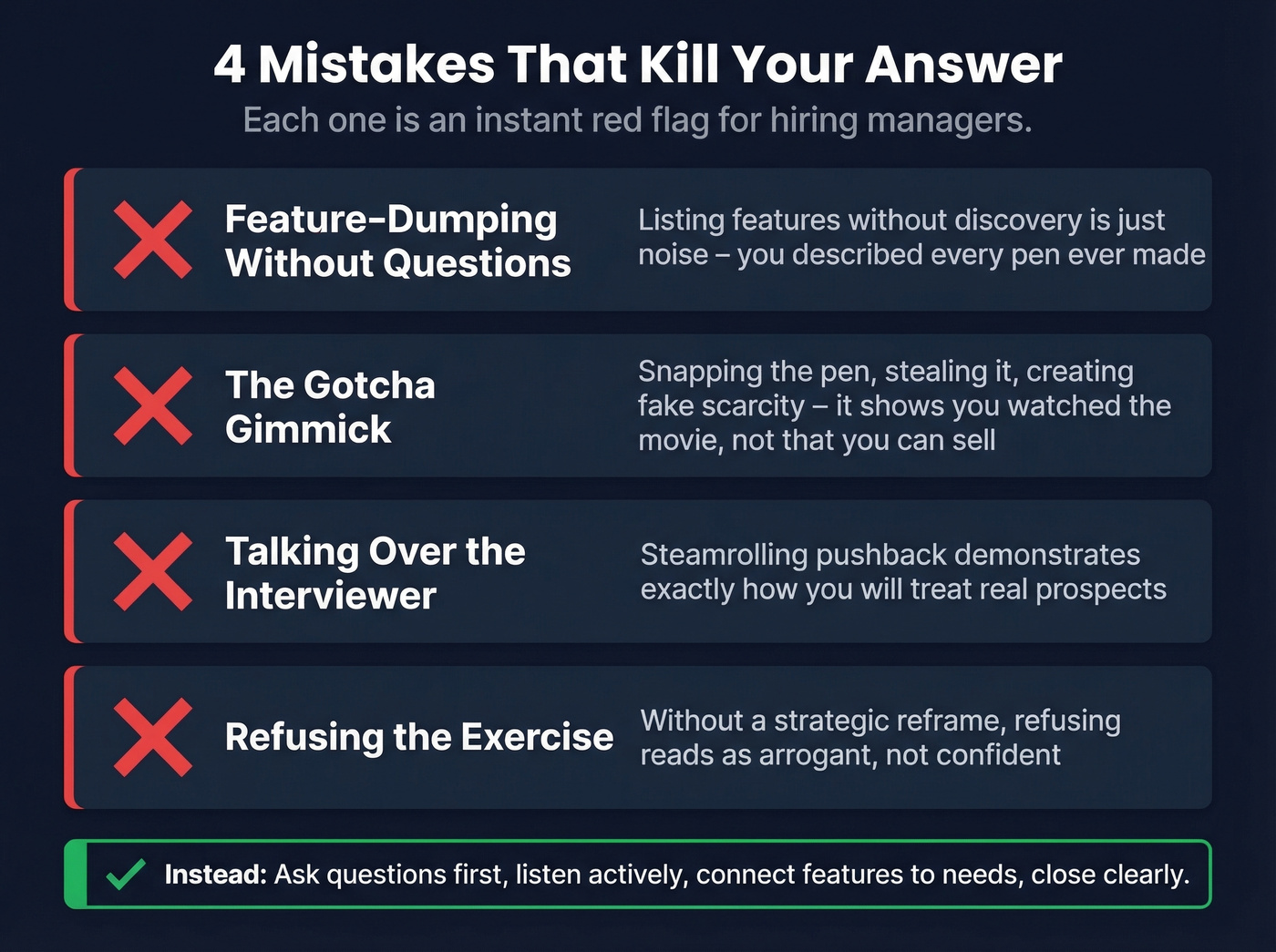
The "gotcha" gimmick. We've seen candidates try the pen-snapping trick in mock interviews - snapping it in half, then saying "looks like you need a new pen." It never lands the way they think it will. Same goes for stealing the pen to create artificial scarcity. These tricks show you watched the movie, not that you can sell.
Talking over the interviewer. If they push back and you steamroll them, you've just demonstrated exactly how you'll treat prospects. Instant disqualification. If you want to sharpen this skill, focus on sales communication fundamentals: pacing, mirroring, and clean summaries.
Refusing the exercise entirely. Unless you have the advanced reframe skill to pull it off and the read on the room to know it'll land, just play the game. Refusing without a strategic pivot reads as arrogant, not confident.
Let's be honest: if your interviewer asks this question in 2026, it's usually a sign of a more traditional sales org. But the skills the question tests - discovery, active listening, objection handling, closing - are timeless. Nail the framework and you'll outperform regardless of how outdated the prompt feels.
From the Interview to the Real Thing
The pen exercise is practice. The real version of this conversation happens every day in outbound sales - same skills, higher stakes. Discovery, personalization, closing.
The difference is that in the real world, your first challenge isn't the pitch. It's finding the right person to pitch. Sales reps spend roughly 60% of their time on non-selling tasks - hunting for contact info, cleaning bad data, chasing bounced emails. Tools like Prospeo cut that friction before the conversation starts, with 98% verified email accuracy and data refreshed every 7 days, so you spend your time selling instead of searching. If you're building a repeatable system, start with modern sales prospecting techniques and a clear lead generation workflow.
Master the framework in the interview. Then use it on real prospects with real data.
57% of sales pros say cycles are getting longer. The reps who win aren't just great at discovery - they start conversations with the right buyers. Prospeo's intent data tracks 15,000 topics so you reach prospects already in-market, and 30+ filters let you target by job change, funding, and headcount growth.
Stop selling pens. Start reaching real buyers at $0.01 per lead.
FAQ
What if I'm not applying for a sales role?
The question tests communication, persuasion, and composure - skills every role requires. Use the same five-step framework. Interviewers in non-sales roles are scoring confidence and structured thinking, not closing technique.
How long should my response take?
Aim for 60-90 seconds total. Spend about 30 seconds on discovery, 15 seconds confirming needs, and 30 seconds on your pitch and close. Practice with a timer - most people run long because they over-explain.
What if the interviewer keeps saying no?
They're testing your objection-handling skills. Acknowledge the objection, ask one more discovery question, then either pivot your pitch or qualify out gracefully. Never argue. Never repeat the same benefit louder.
Should I practice with a real pen?
Yes. Grab any pen, set a 90-second timer, and run through the framework with a friend or on camera. Watching yourself back is uncomfortable, but it's the fastest way to spot filler words, nervous habits, and moments where you talk past the close.