

How to Be a Good Salesperson: Scripts, Frameworks, and Habits That Actually Work
Here's a pattern we see across RevOps teams constantly: reps think they're selling most of the day, but a huge chunk of time vanishes into bad data, unstructured admin, and calls that never connect.
That gap is the real answer to how to be a good salesperson. 84% of reps missed quota last year, and the problem isn't new - HBR research on sales turnover found that 50% of new salespeople leave within year one, and nearly 80% are gone by year three. The profession chews people up. Generic advice like "be confident" or "build rapport" doesn't fix what's actually broken.
What fixes it is structure. Specific scripts, measurable habits, a methodology you commit to, and data that doesn't waste your morning.
The Short Version
If you're pressed for time, five things actually move the needle:
- A sales methodology you commit to - SPIN, Challenger, MEDDIC. Pick one, run it for 90 days, then evaluate.
- A talk-to-listen ratio you can measure - top closers speak 43% of the time, while average reps talk around 65%.
- Scripts for discovery and objections - not word-for-word monologues, but frameworks that keep you from winging it.
- A time-blocked daily routine - 50%+ of your day should be revenue-driving activity.
- Verified contact data - the best scripts in the world don't help if your first 12 dials hit voicemail or disconnected numbers.
Skip the personality trait lists. This is about what to do.
Traits of Top Salespeople
RAIN Group studied 1,004 sellers and sales managers globally and identified 21 skills that separate top performers from everyone else. The findings aren't what most people expect.
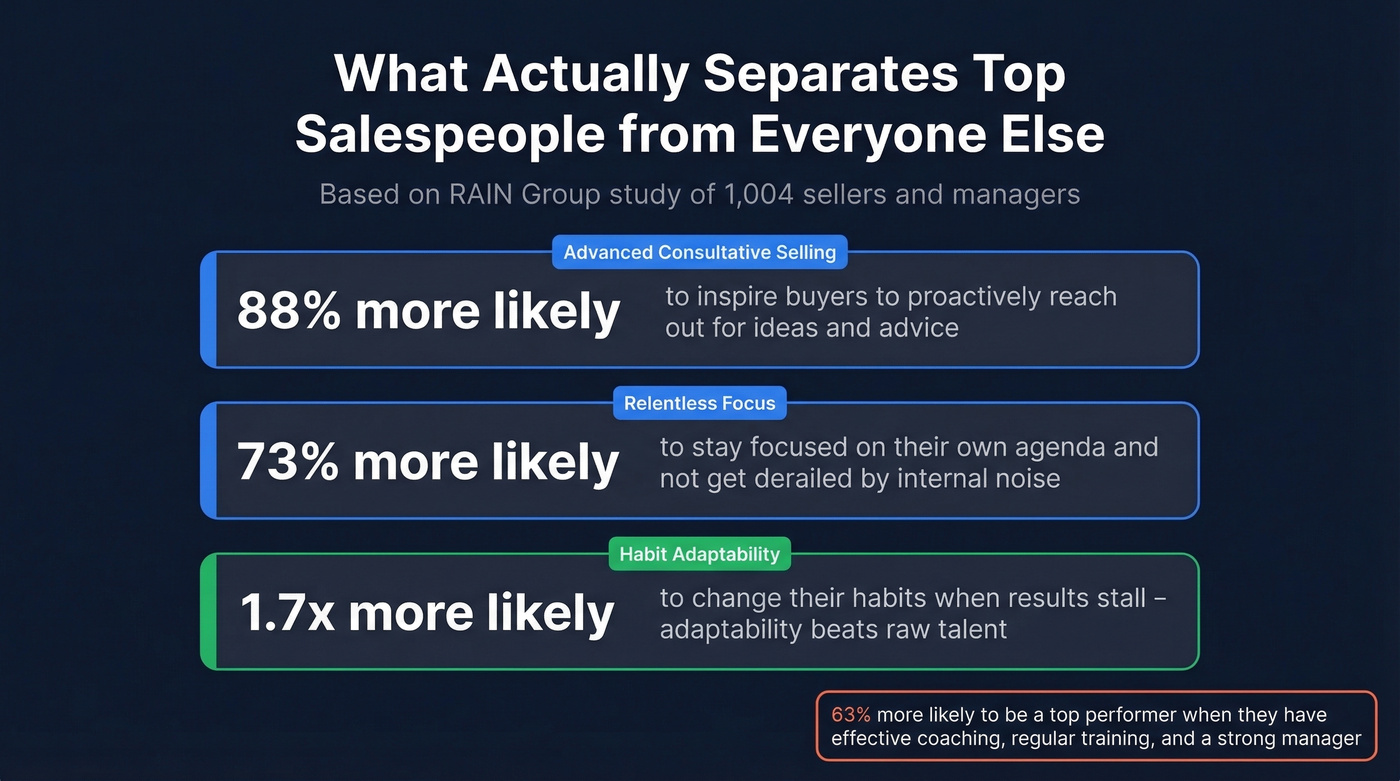
The #1 differentiator is advanced consultative selling. Top performers are 88% more likely to inspire buyers to proactively reach out for ideas and advice. That's not "being a good listener" - it's positioning yourself as someone worth calling back.
Focus is the second biggest gap. Top performers are 73% more likely to stay locked on their own agenda rather than getting derailed by internal noise, Slack messages, or the latest "urgent" request from marketing. This kind of discipline rarely gets discussed in training programs, but it shows up in the numbers every single quarter.
And the one that matters most for anyone reading this: top performers are 1.7x more likely to change their habits when results stall. Average reps keep doing what isn't working. Good reps adjust. The combination of effective coaching, regular training, and a strong manager makes sellers 63% more likely to land in the top-performer category. Adaptability, not raw talent, is what separates the best.
Pick a Methodology and Commit
There's no single "best" sales methodology. Choosing one approach for every customer is fundamentally flawed - buyers are different, deal complexity varies, and what works for a $5k SaaS deal won't work for a $500k enterprise contract.
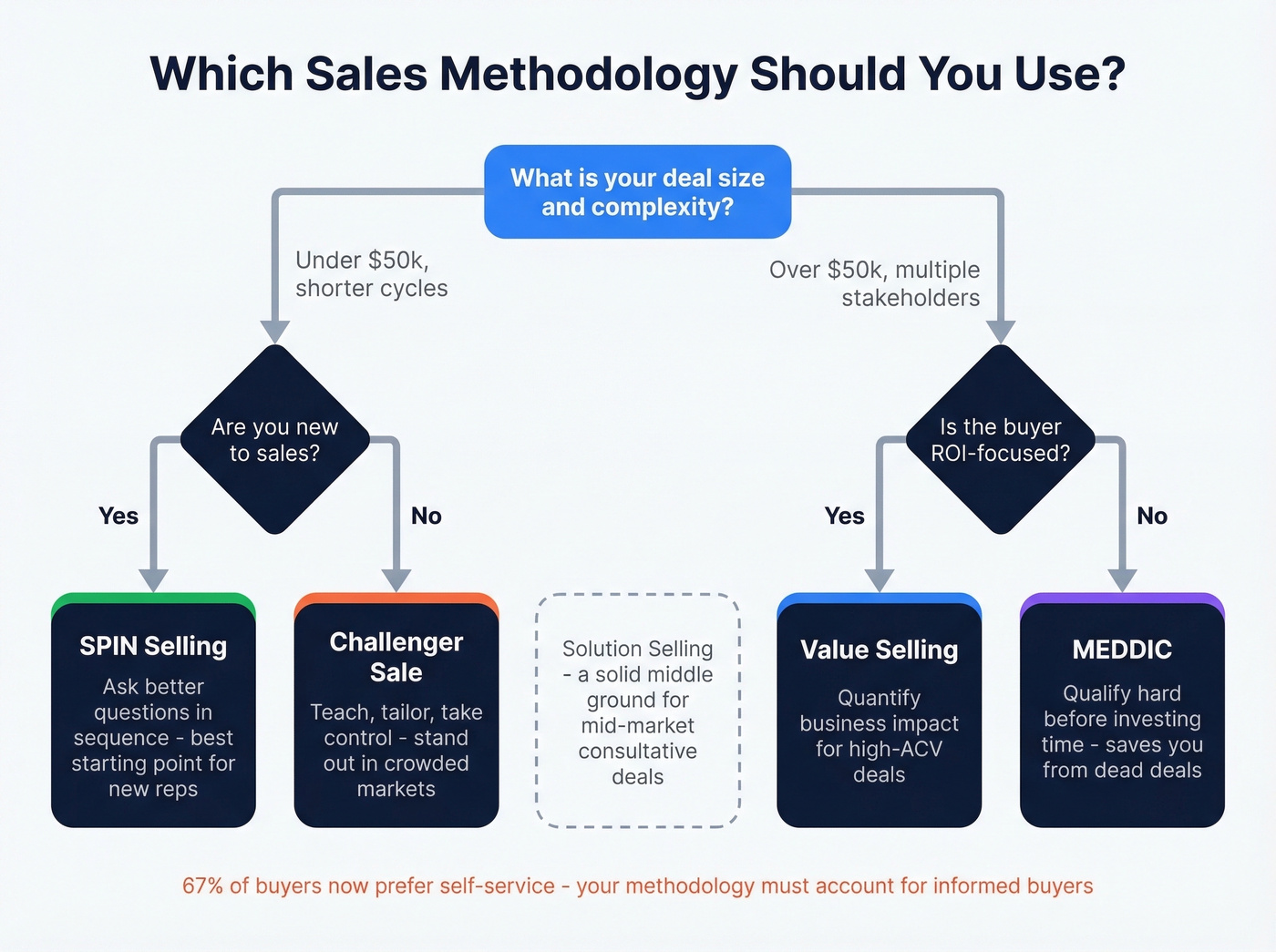
That said, you need to pick something and run it long enough to actually learn it:
| Methodology | Best For | Core Idea |
|---|---|---|
| SPIN Selling | New reps / SMB | Ask better questions in sequence |
| Challenger Sale | SDRs / competitive markets | Teach, tailor, take control |
| MEDDIC | Enterprise / complex deals | Qualify hard before investing time |
| Solution Selling | Mid-market / consultative | Diagnose pain, prescribe solution |
| Value Selling | High-ACV / ROI-driven buyers | Quantify business impact |
New to sales? Start with SPIN. It teaches you to shut up and ask questions - the single most important skill you can develop.
Enterprise B2B teams with multiple stakeholders and six-month cycles need MEDDIC. It'll save you from wasting quarters on deals that were never going to close. SDR wanting to stand out in a crowded inbox? Go Challenger.
One stat worth knowing: 67% of customers now prefer self-service over talking to a rep. By the time someone does talk to you, they've already done their homework. Your methodology needs to account for a buyer who's halfway through their journey before you even show up.
Master the Talk-to-Listen Ratio
This is the simplest, most measurable improvement you can make. Gong's data shows that top-closing B2B reps speak 43% of the time. Average performers? 65%. That's not a subtle difference - it's a completely different conversation dynamic.
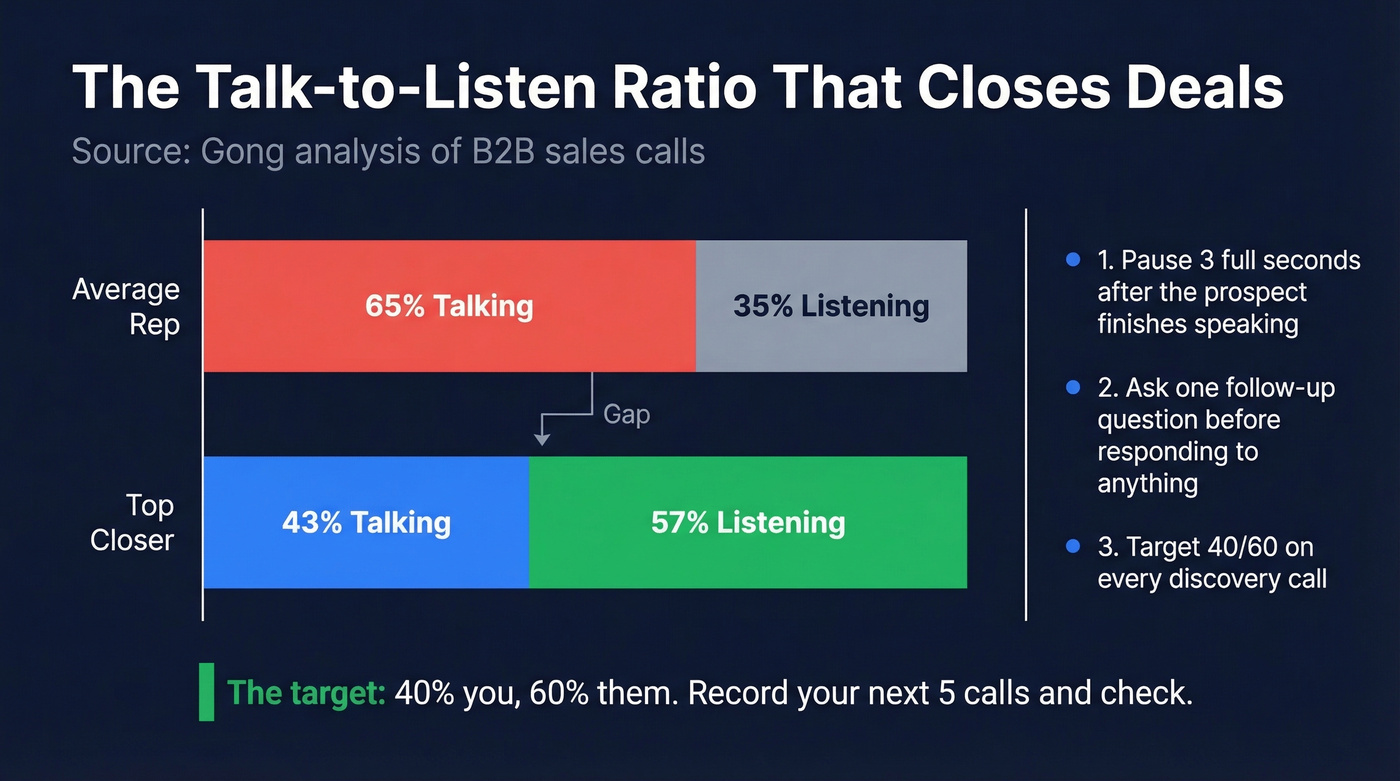
The target is a 40/60 talk-to-listen ratio on discovery calls.
Pause for a full three seconds after the prospect finishes speaking. It feels awkward. Do it anyway - they'll often fill the silence with the real objection or the detail you actually needed. Then ask one follow-up question before responding to anything they say. "Tell me more about that" or "What's driving that timeline?" buys you information and builds trust simultaneously. Most reps skip this entirely, and it shows in their close rates.
Scripts That Actually Work
Discovery Prompts
Most discovery calls fail because reps ask surface-level questions and accept surface-level answers. The prompts that actually open deals force the prospect to quantify their pain:
"What happens if this issue isn't solved in the next six months?"
"What would that cost in lost revenue or productivity?"
These aren't clever tricks. They're questions that make the prospect do the math on inaction - and that math becomes your business case later in the deal.
The reverse pitch technique is worth trying too: spend the first few minutes exploring reasons the prospect might not be a fit. It sounds counterintuitive, but it builds trust fast. When you say "honestly, this might not be the right solution for your situation - let's figure that out," the prospect drops their guard because you're not pushing. In our experience, reps who open with this kind of honesty close at a noticeably higher rate than those who lead with enthusiasm.
Objection Handling Framework
The five-step framework is simple: Listen, Ask, Solve, Confirm, Move on. Most reps skip steps one and two. They hear an objection and immediately jump to solving it, which means they're solving the wrong problem half the time.
For the most common objection - "I don't have time" - Morgan J. Ingram's script is the best we've heard:
"I completely understand. All I'm asking for is 30 seconds. If it's relevant, we can book time. If not, you can hang up on me. Does that sound fair?"
That works because it reframes the ask from a 30-minute meeting to a 30-second micro-commitment. The 70/30 rule applies on calls: the prospect should be talking 70% of the time once you've earned the right to ask questions.
Follow-Up Agreement
Look - 89% of B2B buyers report a purchase deal stalling in the past year. Most of that stalling happens because nobody agreed on what comes next.
Before you send a proposal, agree on how and when the follow-up will happen. "I'll send this over Thursday. Can we block 15 minutes next Tuesday to walk through questions?" That one sentence prevents more ghosting than any follow-up sequence. Most deals require 5-12 touchpoints to close - make each one intentional, not a "just checking in" email.

You just read that 84% of reps missed quota last year. A huge reason? Hours wasted dialing disconnected numbers and emailing bounced addresses. Prospeo gives you 125M+ verified mobiles with a 30% pickup rate and 98% email accuracy - so your scripts actually reach real buyers.
Stop perfecting your pitch for voicemail. Start reaching decision-makers.
Mistakes That Kill Deals
Do: Maintain a 40/60 talk-to-listen ratio. Skip: Talking 65% of the time. Record your next five calls and check your ratio. The number will probably surprise you.
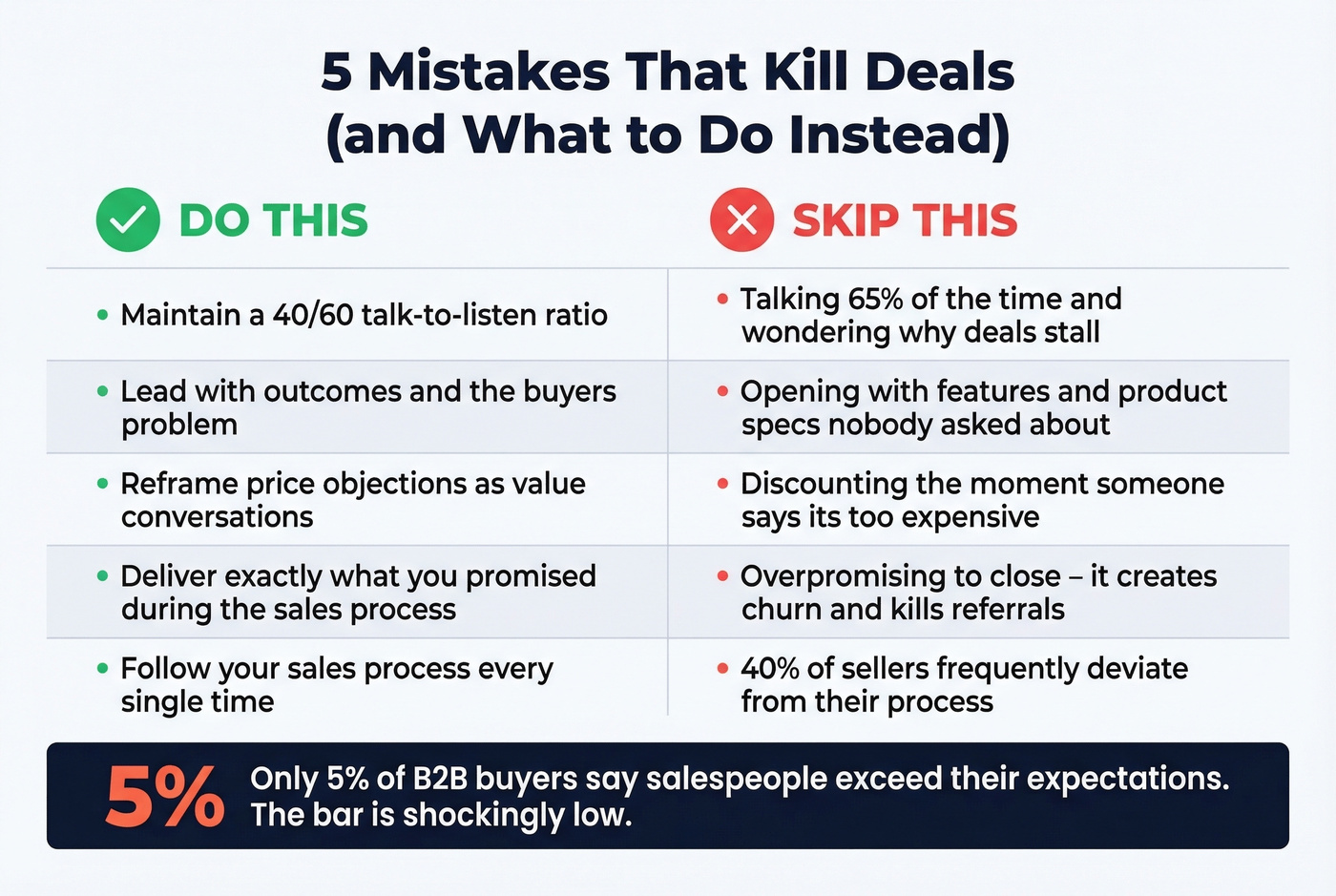
Do: Lead with outcomes and the buyer's problem. Skip: Opening with features and product specs. Only 5% of B2B buyers say salespeople exceed their expectations, and only 18% think reps are even well-prepared for conversations. That bar is brutally low, and it exists because most reps show up talking about their product instead of the buyer's world.
Do: Reframe price objections as value conversations. Skip: Discounting the moment a prospect says "it's too expensive." When they say that, they're really saying "I don't see enough value." That's a discovery failure, not a pricing problem.
Do: Deliver exactly what you promised during the sales process. Skip: Overpromising to close the deal. Nothing destroys trust faster than a customer who bought one thing and received another. Overpromising creates churn, kills referrals, and poisons your pipeline long-term.
Do: Follow your sales process every single time. 40% of sellers frequently deviate from their process, and only 20% of managers believe deals follow a repeatable path. If you don't have a process, you can't improve it. If you have one and ignore it, you're flying blind with extra steps.
Build a Daily Routine That Protects Selling Time
The University of London found that multitasking can cause an IQ decline similar to staying up all night. Time-blocking isn't a productivity hack - it's how you protect your cognitive capacity for the moments that actually matter.
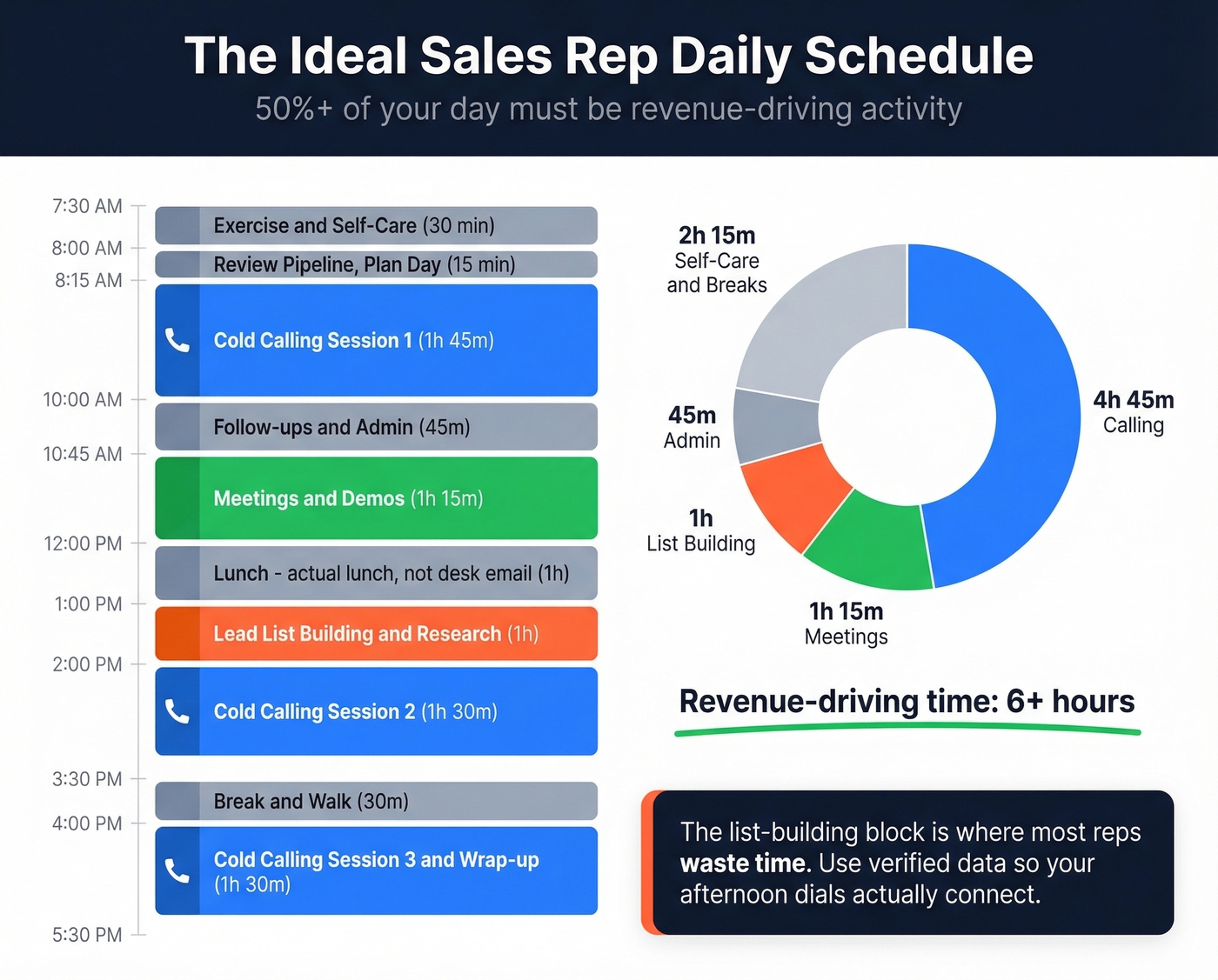
The rule is simple: 50%+ of your day must be revenue-driving activity.
| Time Block | Activity | Duration |
|---|---|---|
| 7:30-8:00 | Exercise / self-care | 30 min |
| 8:00-8:15 | Review pipeline, plan day | 15 min |
| 8:15-10:00 | Cold calling (session 1) | 1h 45m |
| 10:00-10:45 | Follow-ups + admin | 45m |
| 10:45-12:00 | Meetings / demos | 1h 15m |
| 12:00-1:00 | Lunch (actual lunch, not desk email) | 1h |
| 1:00-2:00 | Lead list building + research | 1h |
| 2:00-3:30 | Cold calling (session 2) | 1h 30m |
| 3:30-4:00 | Break / walk | 30m |
| 4:00-5:30 | Cold calling (session 3) + wrap-up | 1h 30m |
That's 4h 45m of calling, 1h 15m of meetings/demos, 1 hour of list building, 45 minutes of admin, and 2 hours 15 minutes of self-care including lunch and breaks. The list-building block is where most reps waste time - guessing at email formats, bouncing off disconnected numbers, manually researching companies. Spend that hour with a verified data platform like Prospeo so more of your afternoon dials actually connect.
Here's the thing: if your deal sizes sit below $10k, you probably don't need a $30k+/year data platform. But you absolutely need verified emails and direct dials. The difference between a rep who connects on 3 out of 20 dials and one who connects on 6 out of 20 is often just data quality. Treating data hygiene as non-negotiable is table stakes in 2026.
Use AI Before Your Competitors Do
Only 6% of sellers use AI for task prioritization, yet sellers who use AI effectively are 3.7x more likely to hit quota. The practical applications are already here: call transcription tools like Gong show you where you're losing deals, AI email personalization writes relevant first lines at scale, and lead scoring models prioritize your pipeline so you stop guessing who to call next.
If you're not using at least one AI tool in your workflow today, you're leaving quota on the table. Early adopters have a measurable edge right now - the rest of the field will catch up eventually.
Build Your Own Coaching System
The coaching mismatch is real: 94% of managers say they coach regularly, but 53% of sellers say they receive coaching quarterly or less. For every $1 spent on sales training, companies see $4.53 in return - but most reps don't control their company's training budget.
So build your own system. Record one call per week and review your talk-to-listen ratio with a sales call review scorecard. Roleplay a specific objection scenario with a peer for 15 minutes weekly using these sales role playing scenarios. Read one sales book per quarter and actually implement something from it. The reps who survive past year one aren't necessarily more talented - they built a feedback loop and used it. Small weekly improvements in discovery technique or objection handling add up to dramatically different close rates by quarter's end.
Your Data Is Your Pipeline
It's 9:15 AM. You've made 12 dials. Zero conversations. Three bounced emails. Two disconnected numbers. You're already behind, and you haven't even started selling yet.
We've seen this pattern destroy otherwise talented reps. The skills, the scripts, the methodology - none of it matters if your contact data is garbage. Bad data doesn't just waste time; it kills momentum. By the time you finally reach a live person, you're frustrated and off your game.
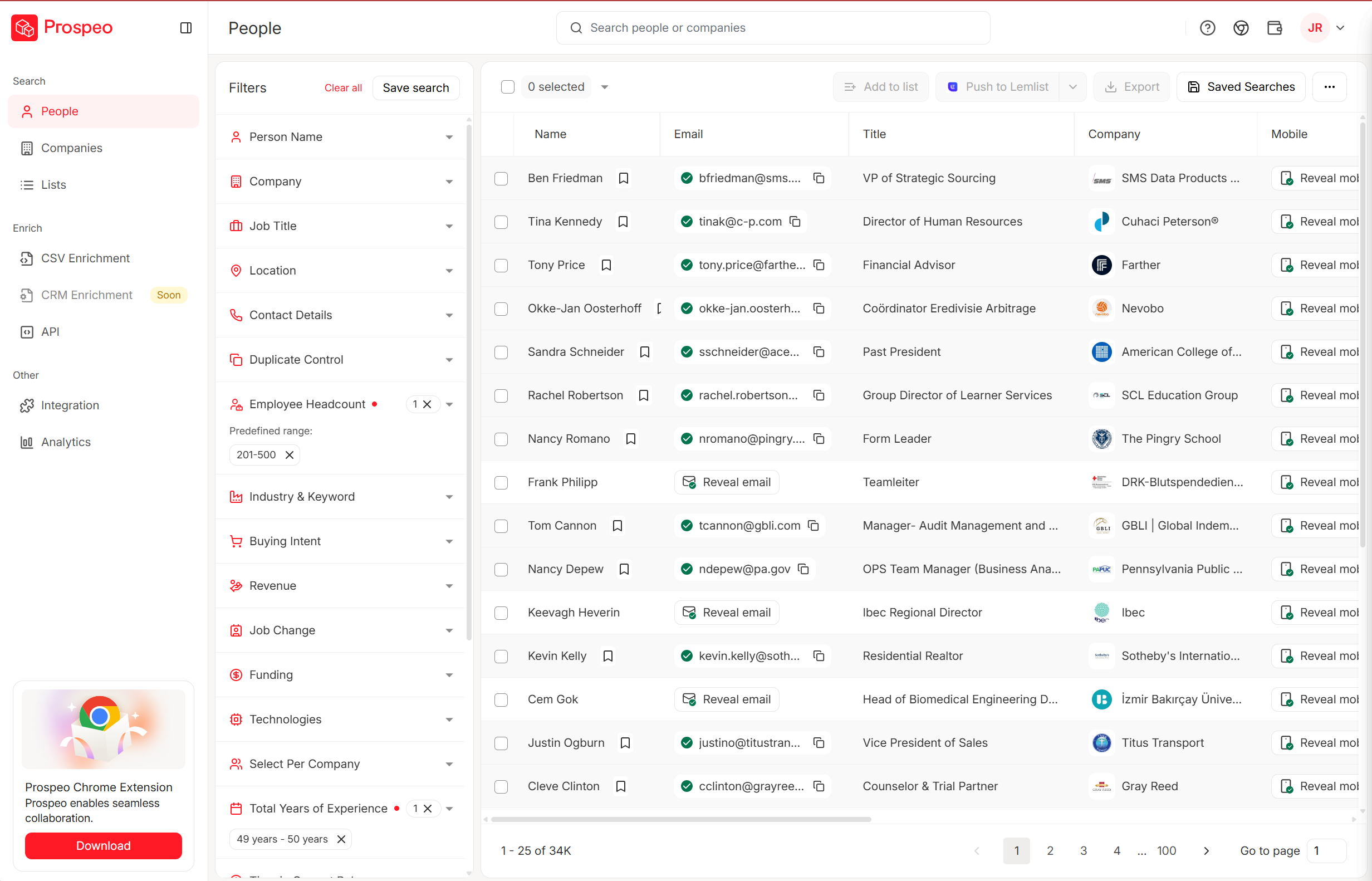
This is where Prospeo changes the math. With 98% email accuracy, 125M+ verified mobile numbers with a 30% pickup rate, and data that refreshes every seven days instead of the six-week industry average, your list-building hour produces prospects who are actually reachable. The free tier gives you 75 verified emails per month to test it - skip this if you're already happy with your current data provider's accuracy, but the consensus on r/sales is that most reps aren't.
Knowing how to be a good salesperson means nothing if you can't reach the people you're supposed to sell to. Get the fundamentals right - methodology, habits, scripts - then make sure your data doesn't undermine all of it. If you want a deeper system, build it into a repeatable sales playbook and track the right sales productivity metrics so you can see what's actually improving.
The article says 50%+ of your day should be revenue-driving activity. But most reps burn hours on list-building and data cleanup. Prospeo's 30+ search filters, intent data across 15,000 topics, and 7-day data refresh mean you build targeted lists in minutes - not hours.
Reclaim your selling time for $0.01 per verified email.
FAQ
What makes a good salesperson?
Discipline beats personality every time. RAIN Group's study of 1,004 sellers found the top differentiator is consultative selling - not charisma, not aggression. Ask better questions, listen more than you talk, and adjust your approach faster than your peers when results dip. The reps who make it past year three treat selling as a craft with measurable inputs.
How long does it take to get good at sales?
Most structured onboarding programs aim for 3-6 months to basic competency. HBR research shows 50% of new salespeople leave within year one - survivors typically hit their stride around month 9-12 with consistent coaching. Structured onboarding cuts ramp time by up to 34%.
Which sales methodology should I learn first?
SPIN Selling if you're new - it teaches you to ask better questions in a structured sequence. MEDDIC if you're in enterprise B2B with complex, multi-stakeholder deals. The Challenger Sale if you're an SDR competing for attention in crowded markets.
How do I handle the "I don't have time" objection?
Use Morgan J. Ingram's approach: "All I'm asking for is 30 seconds. If it's relevant, we book time. If not, you can hang up on me. Does that sound fair?" It reframes the ask from a full meeting to a micro-commitment, dramatically increasing the chance they'll hear you out.
What tools do top salespeople use?
A CRM like Salesforce or HubSpot, a conversation intelligence tool like Gong, and a verified data platform for accurate contact information. Bad emails and wrong numbers waste more selling time than any missing feature - that's the one area where cutting corners costs you the most.