

Sales Playbook Best Practices: Build One Reps Actually Use
A sales ops manager on r/SalesOperations spent two months building a playbook - competitive intel, objection handling, personas, the works. It was outdated within six weeks. That's not an edge case. 52% of teams say playbooks are difficult to create, 60% say they go stale fast, and adoption sits below 20% for many organizations. Most advice on sales playbook best practices tells you to "document everything." That advice is the problem.
The Short Version
- Cover only the plays that handle 80% of your selling motions. Alexander Group calls this the 80% rule - stop trying to document everything.
- Embed the playbook in your CRM, not a shared drive. If reps can't pull it up in under 10 seconds during a live call, it doesn't exist.
- Assign a dedicated owner and update monthly. 60% of playbooks go stale because nobody owns the refresh cycle.
Why Your Playbook Matters
Companies with a formal sales process grow revenue 18% faster than those winging it. Formal enablement programs correlate with 49% higher win rates and a 4:1 ROI on enablement spend. RAIN Group's research shows an 11-point win-rate gap between teams with highly effective training versus everyone else, and Alexander Group benchmarks put productivity improvement at up to 15%.
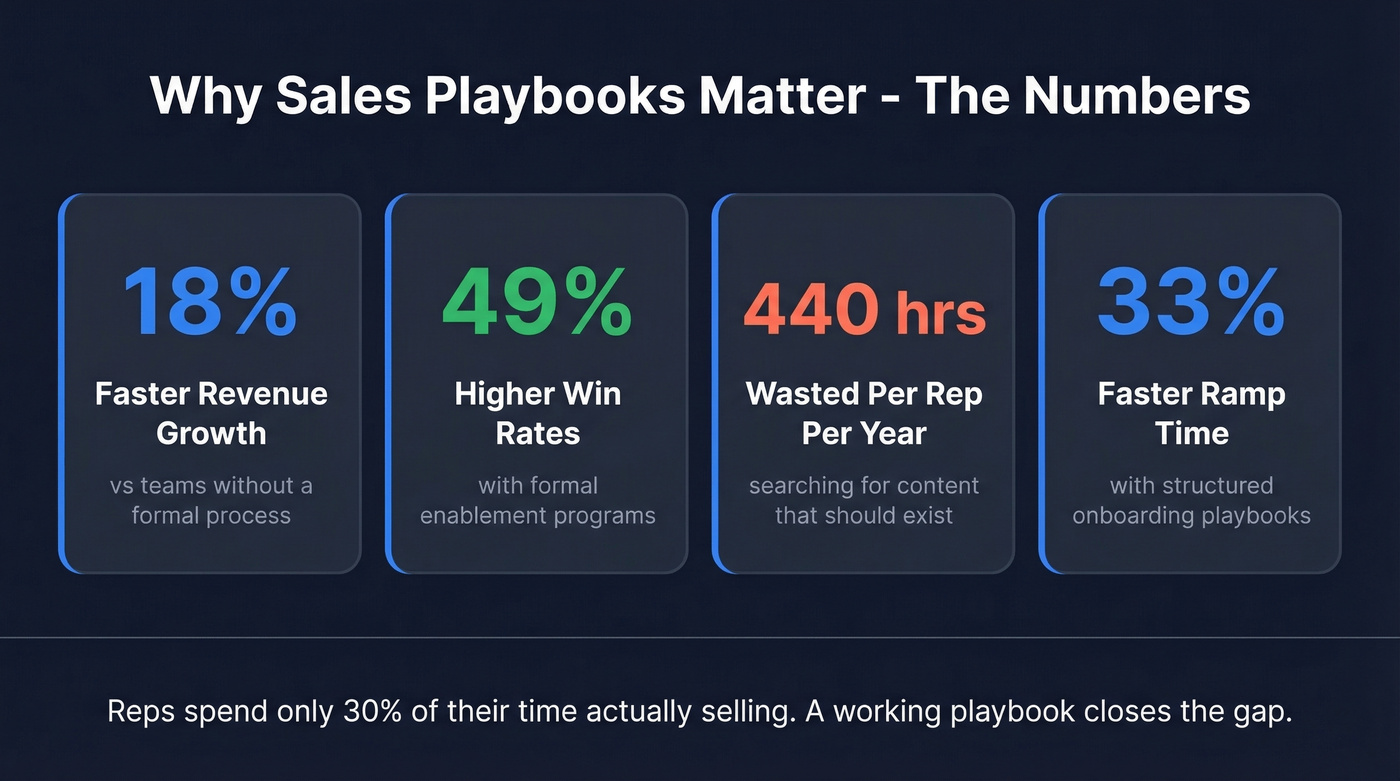
Here's the number that should bother you: reps spend only 30% of their time actually selling. They waste 440 hours per year searching for or recreating content that should already exist in a playbook. Average ramp time for new hires sits at 10 months, and structured onboarding cuts that by roughly a third. The gap between having a playbook and having one that works is where most revenue leaks live.
Why Most Playbooks Fail
We've seen the same five anti-patterns kill playbooks over and over:
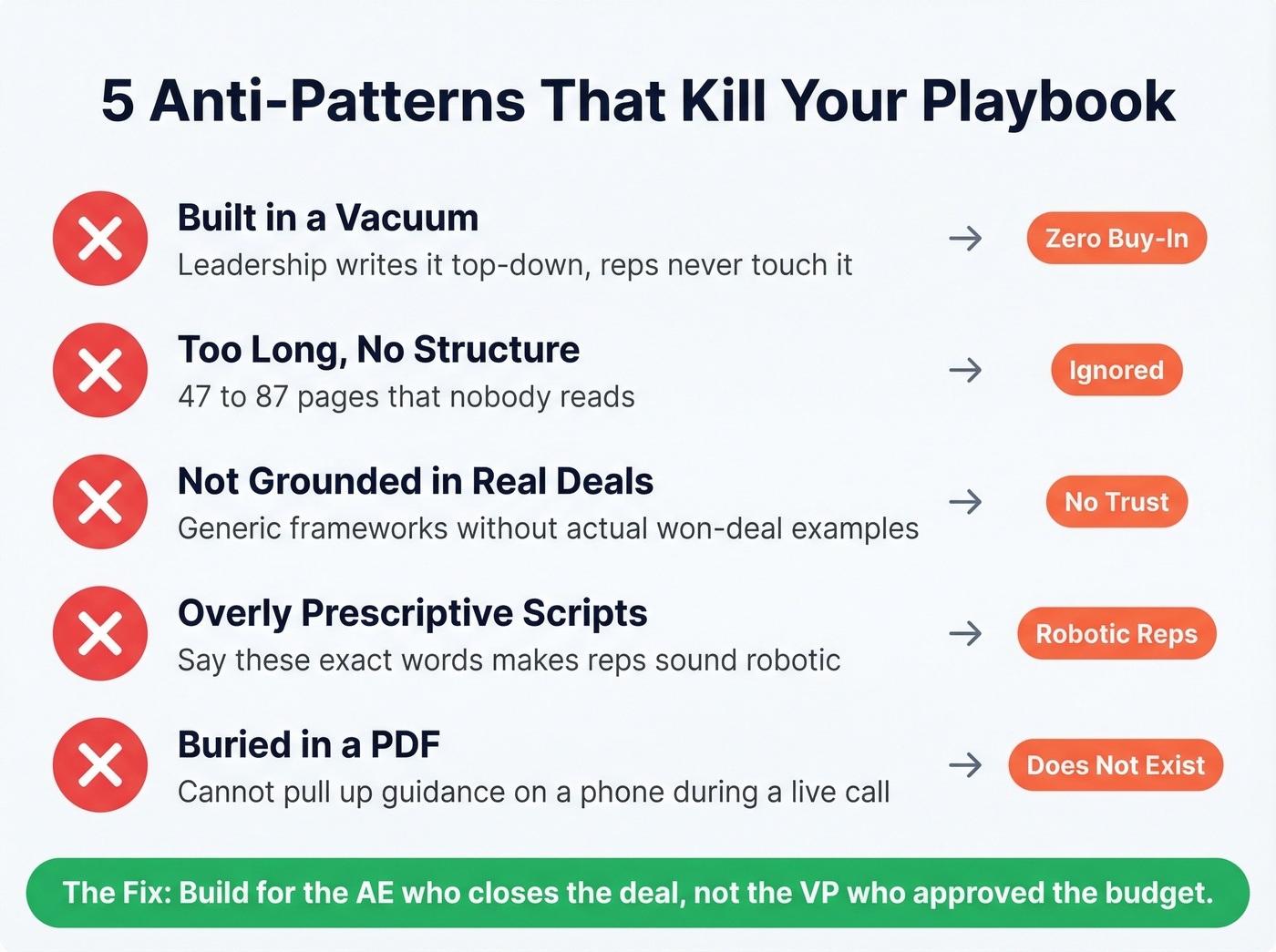
- Built in a vacuum. Leadership writes it top-down; reps never touch it.
- Too long, no structure. 47 pages, 64 pages, 87 pages - nobody reads these.
- Not grounded in real deals. Generic frameworks don't earn trust. If the playbook doesn't reference actual won deals, reps ignore it.
- Overly prescriptive scripts. "Say these exact words" makes reps sound robotic. Frameworks beat scripts every time.
- Buried in a PDF. The Reddit consensus is clear: if reps can't pull up guidance on their phone during a live call, the playbook doesn't exist.
Let's be honest about the root cause. Most playbooks fail not because they lack content, but because they're built for the VP who approved the budget, not the AE who needs to close the deal. Sales play execution breaks down the moment guidance lives somewhere reps don't already work. If your top rep wouldn't voluntarily open it, start over.
How to Structure Plays That Get Used
The Alexander Group's 80% rule is the antidote to the 87-page vanity project. Identify the plays that cover 80% of your common selling motions and document those well. Everything else is noise.
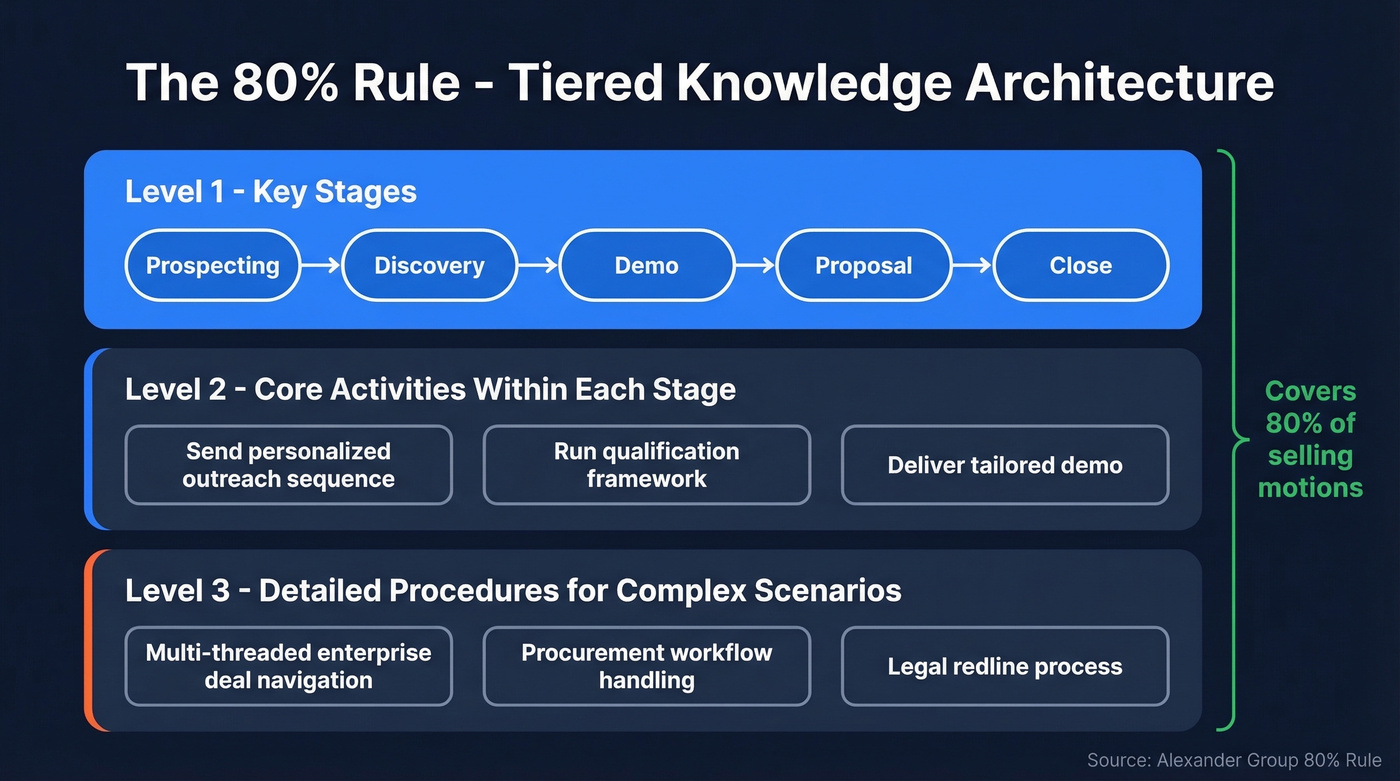
Structure those plays using a tiered knowledge model:
- Level 1 - Key stages: Prospecting through discovery through demo through proposal through close.
- Level 2 - Core activities within each stage: "Send personalized outreach sequence" within prospecting, for example.
- Level 3 - Detailed procedures for complex scenarios: Multi-threaded enterprise deal navigation, procurement workflows, legal redlines.
Someone has to own this. Enablement ownership is fragmented - RevOps owns it at 39.4% of organizations, Sales at 25.4%, C-Suite at 16.6%. The specific department matters less than having a dedicated, non-quota-carrying owner accountable for monthly updates. 31% of organizations update once a year and 12% never update. That's how playbooks become shelfware.

Your playbook is only as good as the data feeding it. Reps waste 440 hours a year chasing bad contacts - that's the gap between a documented process and real pipeline. Prospeo's 300M+ profiles with 98% email accuracy and a 7-day refresh cycle mean every prospecting play in your playbook connects to a real inbox, not a bounce.
Stop building plays on stale data. Start with contacts that connect.
Essential Components Checklist
Every playbook worth using covers these areas. We've tested variations of this structure across our own team and with partners, and the components below are the ones that actually drive adoption - not just the ones that look good in a table of contents.
ICP and buyer personas. Define who you're selling to with enough specificity that a new rep can identify a qualified prospect in 30 seconds. One team added a persona-based discovery question bank and saw a 23% increase in qualified opportunities.
Sales process with stage exit criteria. Map every stage and define what must be true before a deal advances. An enterprise software company added exit criteria checklists and cut stalled deals by 30%. Skip this if your team runs fewer than 50 deals per quarter - at that volume, a lightweight Kanban board with clear definitions works better than a formal stage-gate process.
Core plays. Prospecting, discovery, demo, objection handling, closing - each with frameworks, not scripts. (If you need a starting point, pull from proven sales prospecting techniques and standardize them into repeatable plays.)
Competitive battlecards. Cover your top 3-5 competitors. Update these monthly or they're worthless. (A simple sales battle cards format is usually enough.)
Messaging framework and talk tracks. Value propositions by persona, elevator pitches by use case, and email templates that convert. (Keep a swipe file of sample elevator pitches and talk track examples so reps can adapt fast.)
Sales methodology alignment. Whether you run SPIN, Challenger, or MEDDIC, the playbook should reinforce the methodology, not exist in parallel. (If you're a MEDDIC shop, align discovery to MEDDIC sales qualification.)
Tools and data sources. Document the tech stack and how each tool fits the workflow. For outbound plays, verified contact data is non-negotiable - tools like Prospeo with 98% email accuracy and a 7-day refresh cycle keep your prospecting cadences hitting real inboxes instead of bouncing into the void. (If you're evaluating vendors, compare options in data enrichment services.)
KPIs and dashboards. Link to live dashboards so reps can see their own performance against playbook benchmarks. Connecting individual rep activity to playbook-defined KPIs turns vague adoption goals into measurable outcomes. A mid-market team added a ramp scorecard tied to their playbook and saw 40% faster time to first quote. (For what to track, use a sales operations metrics framework.)
Klozers publishes a 55+ page playbook template covering 12 areas. Length isn't the problem - accessibility is. A 55-page playbook that's searchable and CRM-embedded beats a 10-page PDF every time.
Static vs. Dynamic Delivery
| Dimension | Static Playbook | Dynamic Playbook | Winner |
|---|---|---|---|
| Update frequency | Quarterly/annually | Real-time | Dynamic |
| Workflow integration | Disconnected (PDF/drive) | CRM-embedded | Dynamic |
| Analytics | None | Usage + correlation | Dynamic |
| Accessibility | Search a folder | Contextual surfacing | Dynamic |
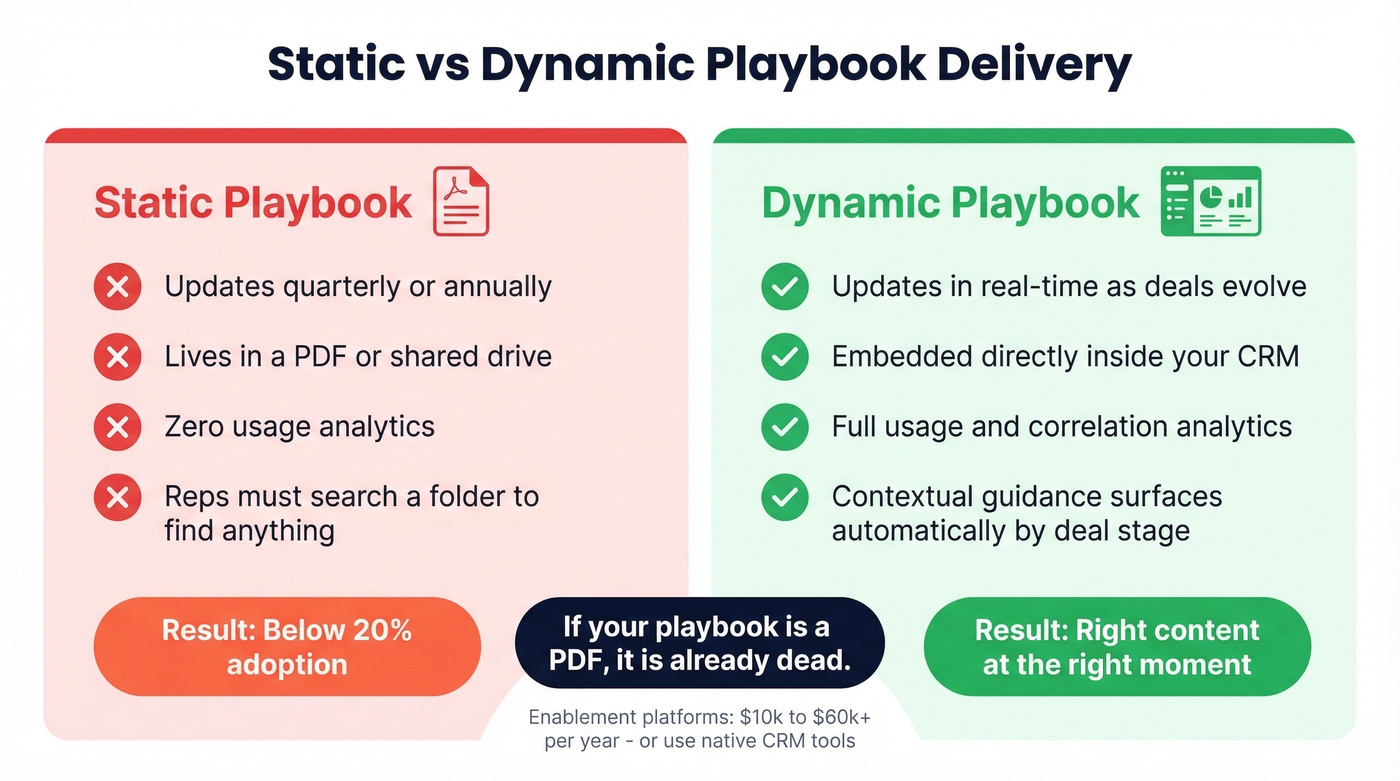
If your playbook is a PDF, it's already dead. Dynamic playbooks surface the right guidance based on deal stage, industry, and persona - right inside the CRM. This is what real-time delivery actually looks like: contextual content served at the moment of need, not a document reps have to go hunt for.
Tools like Highspot, Guru, and Hive Perform handle this well. Expect enablement platforms to run $10k-$60k+/year depending on seats and modules. For teams where that budget doesn't exist, native CRM tools in Salesforce or HubSpot can work - the key is in-workflow access, search, and a real update cadence. (If you're mapping your stack, it helps to start from examples of a CRM and work backward into enablement.)
How to Measure Playbook Success
If you're not measuring adoption, you're guessing. We run quarterly playbook audits with our own team, and the single most revealing metric is content usage analytics - which plays get opened, which get ignored, and where reps drop off. That tells you more than any win-rate dashboard.
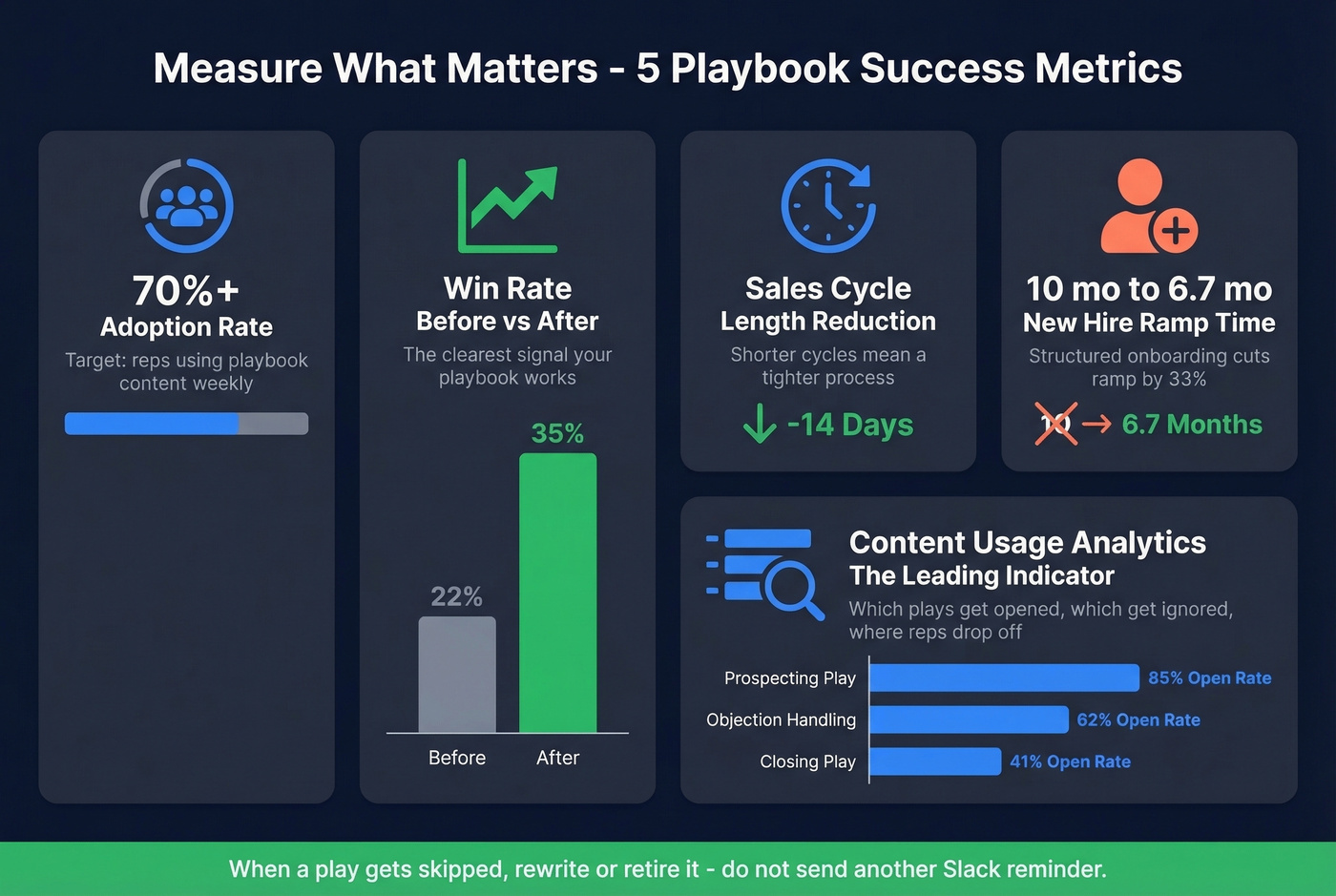
Track these five metrics:
- Adoption rate - target 70%+ of reps using playbook content weekly
- Win rate before/after - the clearest signal the playbook is working
- Sales cycle length - shorter cycles mean a tighter process
- New hire ramp time - benchmark is 10 months; structured onboarding cuts that by roughly a third (pair this with a 30-60-90 day plan for sales reps)
- Content usage analytics - the leading indicator that predicts everything above
When usage data shows a play is being skipped, that's a signal to rewrite or retire it - not to send another Slack reminder. Closing the feedback loop between metrics and content is what separates living enablement from shelfware.
The Data Layer Most Playbooks Miss
Your prospecting play says "send a 5-touch sequence to VP-level buyers in your ICP." Great. Then emails go out, bounces pile up, messages land with the wrong person, and your domain reputation takes a hit before the play even gets a fair shot. I've watched teams torch their outbound volume in weeks because their contact data hadn't been refreshed in months.
Outbound prospecting plays are only as good as the contact data behind them. A 7-day refresh cycle, 98% email accuracy, and 125M+ verified mobile numbers - that's what it takes for your cadences to actually reach the right people. Prospeo's free tier gives you 75 verified emails per month, enough to test whether your data layer is the bottleneck before committing to anything. (If bounces are creeping up, fix the root cause with an email deliverability guide and monitor your email bounce rate.)

You just built stage exit criteria, competitive battlecards, and prospecting cadences. Now your reps need contact data that keeps up. Prospeo refreshes every 7 days - not 6 weeks - so the outbound plays in your playbook never run on outdated emails. At $0.01 per email, scaling your playbook doesn't blow your budget.
Give your playbook the data infrastructure it deserves.
FAQ
How long should a sales playbook be?
Cover the plays that handle 80% of your common selling motions - typically 5-8 core plays across prospecting, discovery, demo, and closing. A 50-page playbook that's searchable and CRM-embedded outperforms a 10-page PDF every time. Length matters less than whether reps can find guidance fast enough to use it mid-conversation.
How often should you update it?
Monthly at minimum. 31% of organizations update once a year and 12% never update - that's how playbooks die. Assign a dedicated owner, set a monthly review cadence, and flag updates whenever messaging, pricing, or competitive positioning shifts.
What tools help deliver a playbook dynamically?
For in-CRM delivery, evaluate Highspot, Guru, or Hive Perform - all surface contextual guidance by deal stage and typically run $10k-$60k+/year. For the data layer underneath outbound plays, verify contact data before launching cadences. Bad emails and dead numbers undermine even the best-crafted sequences.
What's the fastest way to improve playbook adoption?
Embed guidance directly in your CRM workflow and track content usage analytics weekly. Teams that surface playbook content contextually - during the deal stage where it's relevant - see adoption rates above 70%, compared to sub-20% for static PDF playbooks stored on shared drives.