

How to Build a Sales Team That Actually Sells
Your first sales hire just quit after four months. They closed one deal, burned through your best leads, and left you with a CRM full of garbage data. Now you're back to square one - except you're down $80,000 in salary, recruiting fees, and lost pipeline. The cost of a mis-hire runs 1.5-2x annual salary, and with a 35% annual sales rep churn rate, this isn't a rare scenario. It's the default outcome when you try to build a sales team before you build a system.
The Short Version
- Don't hire until you've personally closed 50 deals. If you can't sell your own product, nobody else will either.
- First hire = SDR, not VP Sales. A VP without a team and a playbook is a $250K mistake.
- Budget $70K-$150K OTE per rep depending on role and segment. Below-market comp attracts below-market talent.
- Expect 5+ months to full productivity. Ramp time is real. Plan for it financially and emotionally.
- Start with three tools: CRM, sequencing, verified prospecting data. Everything else can wait.
Now let's build this thing properly.
Start With Founder-Led Sales
67% of founders hire their first salesperson before personally closing 50 deals. Most of those hires fail. Not because the rep was bad - because the founder hadn't figured out what actually works. The messaging, the objections, the ICP, the pricing conversations that close.
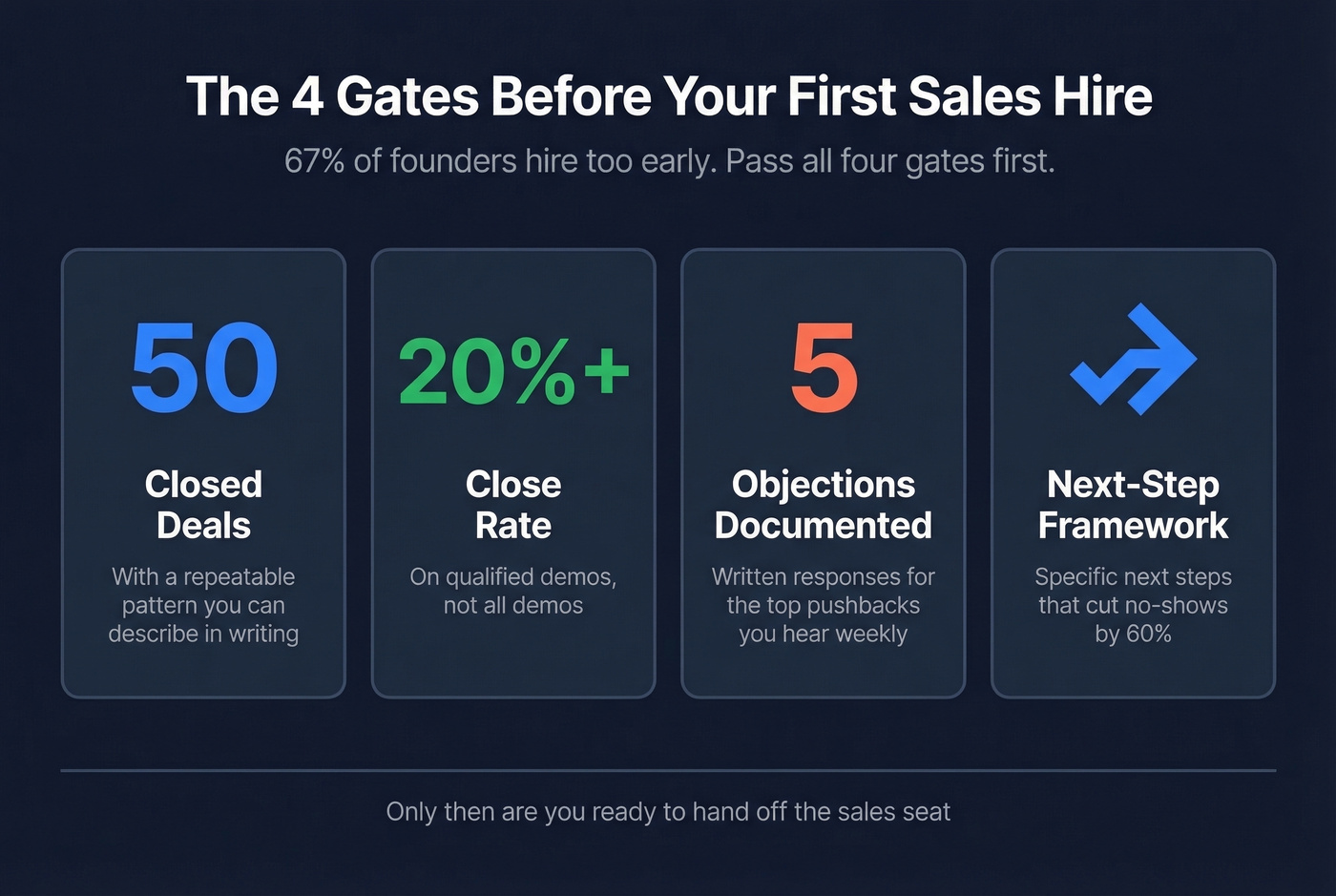
You're not ready to hire until you've hit these four gates:
- 50 closed deals with a repeatable pattern you can describe in writing
- 20%+ close rate on qualified demos (not all demos - qualified ones)
- Documented objection handling for the top 5 pushbacks you hear every week
- A next-step framework that keeps deals moving - specific next-step framing can cut no-shows by 60%
Here's the thing: this isn't about being precious with your time. It's about building the playbook your first rep will follow. If you can't articulate why customers buy, a new hire definitely can't figure it out for you. Stay in the seat until the motion is repeatable, then hand it off.
Choose Your Team Structure
Three models dominate B2B sales org design. The right one depends on your stage, not your ambition.
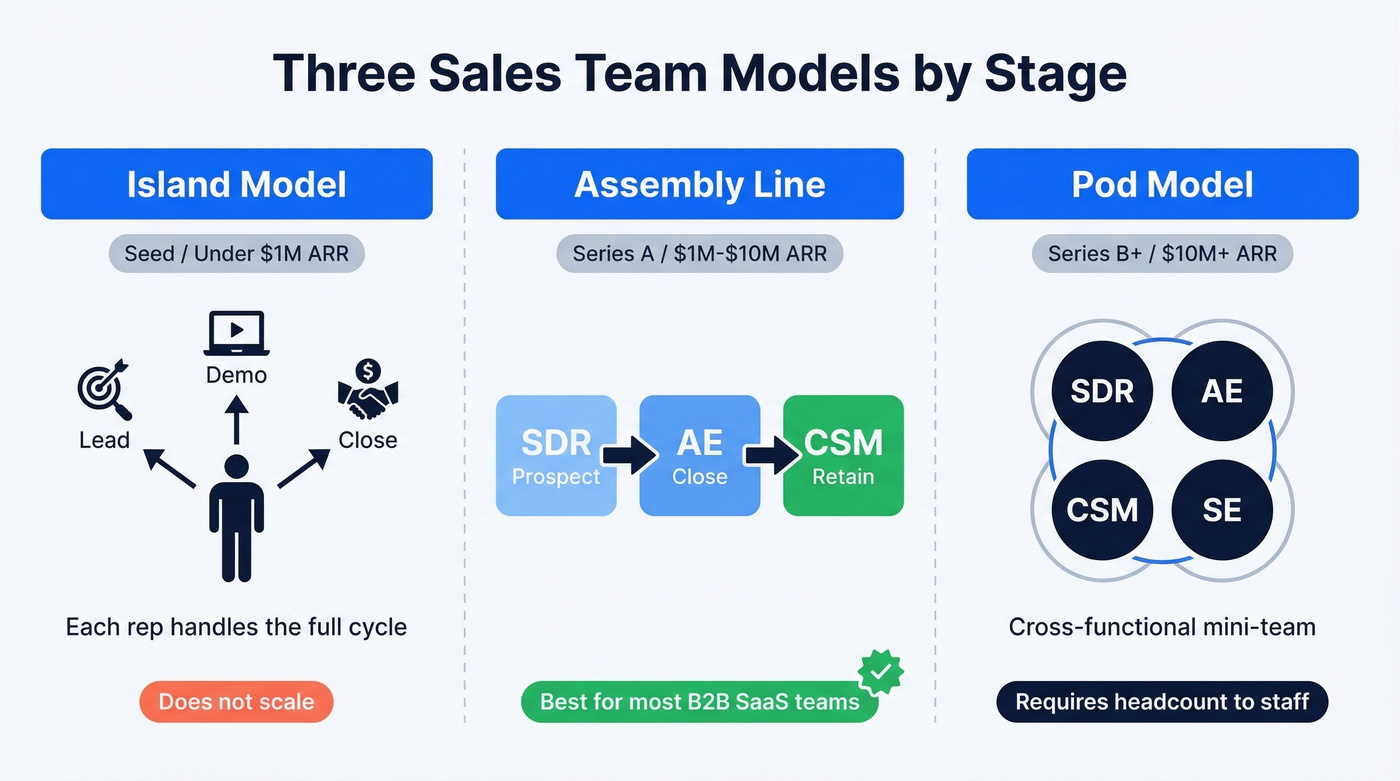
| Model | How It Works | Best For |
|---|---|---|
| Island | Each rep handles full cycle | Seed / Under $1M ARR |
| Assembly Line | SDR → AE → CSM handoffs | Series A / $1M-$10M |
| Pod | Cross-functional mini-teams | Series B+ / $10M+ |
The Assembly Line model - popularized by Aaron Ross in Predictable Revenue - is the right choice for most B2B SaaS teams between $1M and $10M ARR. It creates specialization, makes metrics cleaner, and lets you diagnose where deals die in the funnel. The Island model works when you have one or two reps who can do everything, but it doesn't scale. Pods are powerful but require enough headcount to staff them properly.
We've seen a recurring discussion on r/sales about EU-based teams trying to sell into North America. If that's you, your team structure needs to account for timezone coverage and market-specific selling styles - the Assembly Line model handles this well because you can slot SDRs into regional shifts without restructuring the whole org.
For ratios, plan on 1 SDR per 1-2 AEs depending on your outbound volume, and 6-8 reps per frontline manager.
Define Roles and Hiring Sequence
The order you hire matters more than most founders realize. Pipeline first, then closing capacity, then retention, then management:
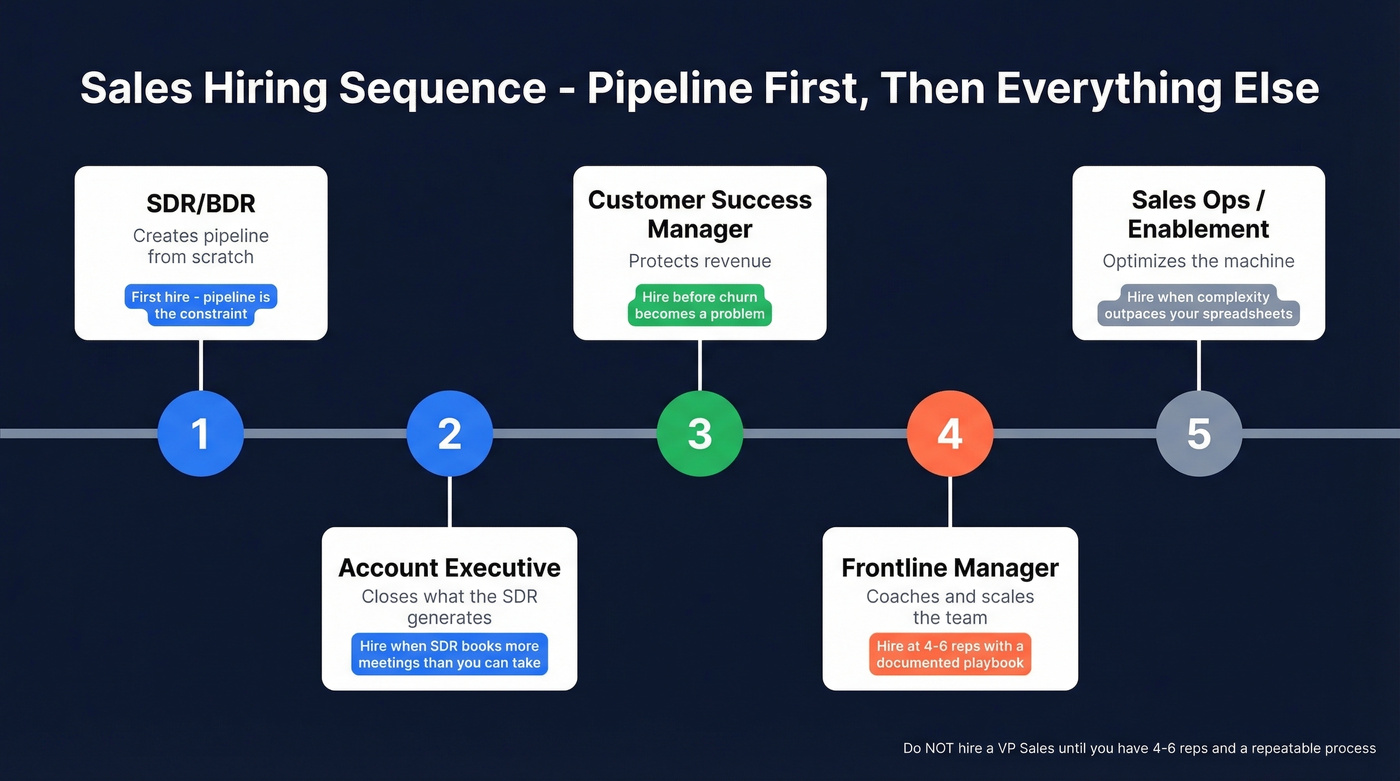
- SDR/BDR - creates pipeline from scratch. This is your first hire because pipeline is the constraint.
- Account Executive - closes what the SDR generates. Hire once the SDR is booking more meetings than you can take.
- Customer Success Manager - protects revenue. Hire before churn becomes a problem, not after.
- Frontline Manager - coaches and scales. Hire when you have 4-6 reps and a documented playbook.
- Sales Ops / Enablement - optimizes the machine. Hire when process complexity outpaces your spreadsheets.
Once you have SDRs booking and AEs closing, formalize your sales-marketing alignment early. Agree on a shared MQL definition and set an SLA on lead follow-up time - 15 minutes for inbound leads is the benchmark. Teams that skip this step end up with marketing blaming sales for ignoring leads and sales blaming marketing for sending garbage. Neither side is wrong; the handoff is just broken.
The biggest pipeline leakage point sits at the SDR-to-AE-to-CSM handoff. Document exactly what information transfers at each stage: deal context, buyer pain points, technical requirements, timeline. Every undocumented handoff is a place where deals go to die.
"Should I hire a VP Sales first?" No. Not until you have 4-6 reps and a repeatable process. A VP Sales without a team to manage and a playbook to scale is a $250K mistake that takes 6 months to unwind.
Hire Like a Scientist
"Hire A-players" is the most useless advice in sales leadership. Everyone thinks they're hiring A-players. The teams that actually do it use structured evaluation, not gut instinct. Structured interviews are twice as predictive of job performance compared to unstructured conversations.
Rate each competency 1-5 using this SDR scorecard:
| Competency | What to Evaluate | Sample Questions |
|---|---|---|
| Communication | Clarity, active listening | "Explain our product to a CFO in 60 seconds." / "Summarize what I just told you about our ICP." |
| Prospecting | Research skills, creativity | "Find 10 target accounts in our ICP right now." / "How would you prioritize these 50 leads?" |
| Objection Handling | Composure, reframing | "I'm not interested - handle that live." / "We already use [competitor]. Now what?" |
| Resilience | Response to rejection | "Tell me about a time you failed publicly." / "Describe your worst sales week and how you recovered." |
| Curiosity | Questions they ask you | Evaluate depth and relevance of their questions throughout the interview. |
Passing criteria: average score of 3+ across all five competencies, with at least one 4+ in Communication or Prospecting. If a candidate scores below 3 on Resilience, that's a hard pass regardless of other scores. SDR life is rejection, and resilience isn't coachable on a short timeline.
Run the same scorecard for every candidate. Compare scores side by side. The consistency removes the "they had great energy" bias that leads to bad hires.

Your first SDR hire will sink or swim based on the data you hand them. Bad emails mean bounced sequences, burned domains, and a rep who quits in four months. Prospeo delivers 98% verified emails with a 7-day refresh cycle - so your reps spend time selling, not cleaning lists.
Stop losing new hires to bad data. Give them Prospeo on day one.
2026 Compensation Benchmarks
Paying below-market comp and expecting above-market results is delusional. Here are the ranges you should be working with:
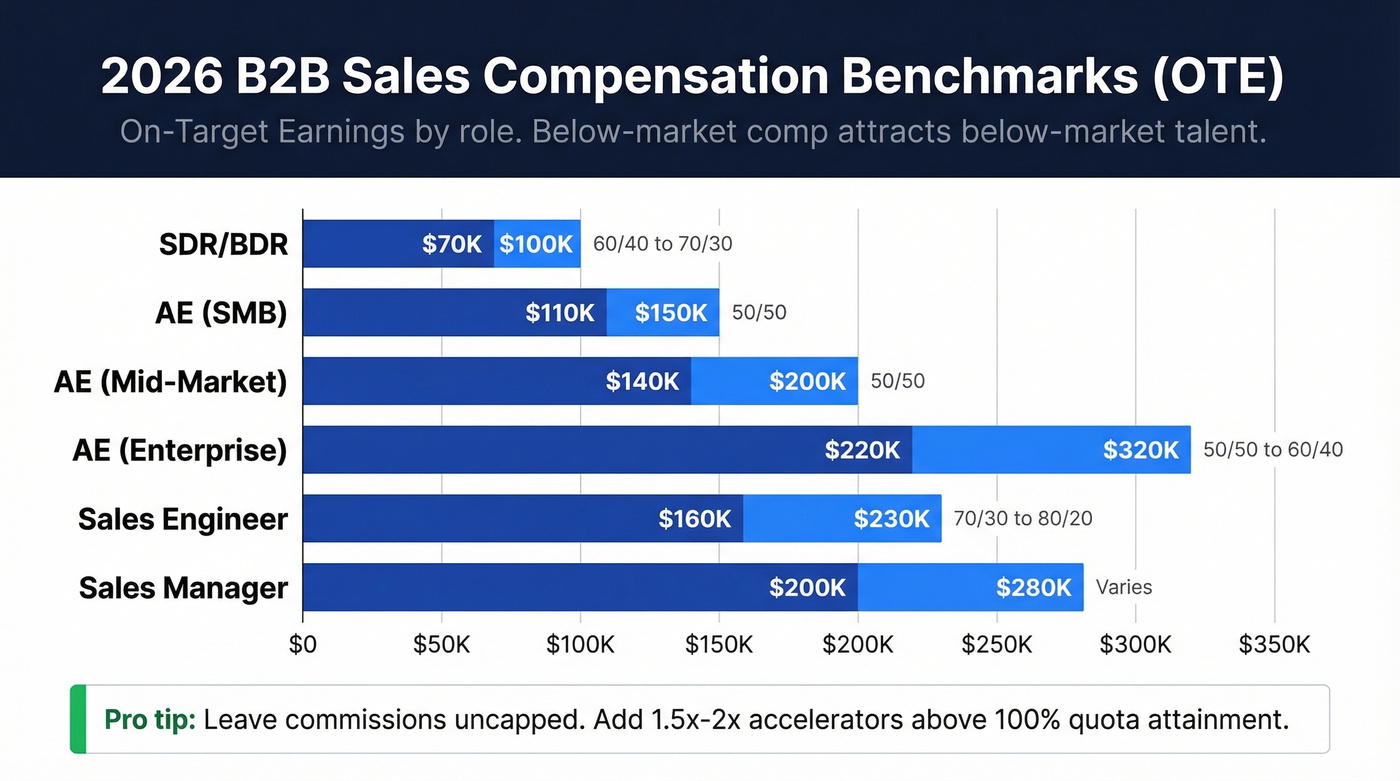
| Role | Base Range | OTE Range | Pay Mix |
|---|---|---|---|
| SDR/BDR | $45K-$65K | $70K-$100K | 60/40 to 70/30 |
| AE (SMB) | $60K-$80K | $110K-$150K | 50/50 |
| AE (Mid-Market) | $75K-$95K | $140K-$200K | 50/50 |
| AE (Enterprise) | $110K-$140K | $220K-$320K | 50/50 to 60/40 |
| Sales Engineer | $110K-$140K | $160K-$230K | 70/30 to 80/20 |
| Sales Manager | - | $200K-$280K | Varies |
These ranges reflect current compensation data from Sybill's salary guide. Hot SaaS hubs like SF, NYC, and Boston push SDR OTE toward $120K. Remote roles from lower cost-of-living areas sit at the bottom of each range.
For commission structure, keep it simple early on. The 50/50 pay mix for AEs is the SaaS standard - half base, half variable tied to quota. SDRs skew higher on base (70/30) because their output is activity-driven and the feedback loop is longer.
Leave commissions uncapped. Capping commissions tells your best reps to stop selling once they hit quota, which is exactly the opposite of what you want. Add accelerators above 100% attainment - 1.5x or 2x commission rates for overperformance - and watch your top performers pull away from the pack.
Onboarding - The First 90 Days
The average sales rep takes 5.3 months to reach full productivity. SDRs ramp faster at 3.2 months; AEs take about 4.4 months. Every extra month of slow ramp costs roughly 5% of annual revenue per rep. These aren't suggestions - they're the reality you need to budget for.
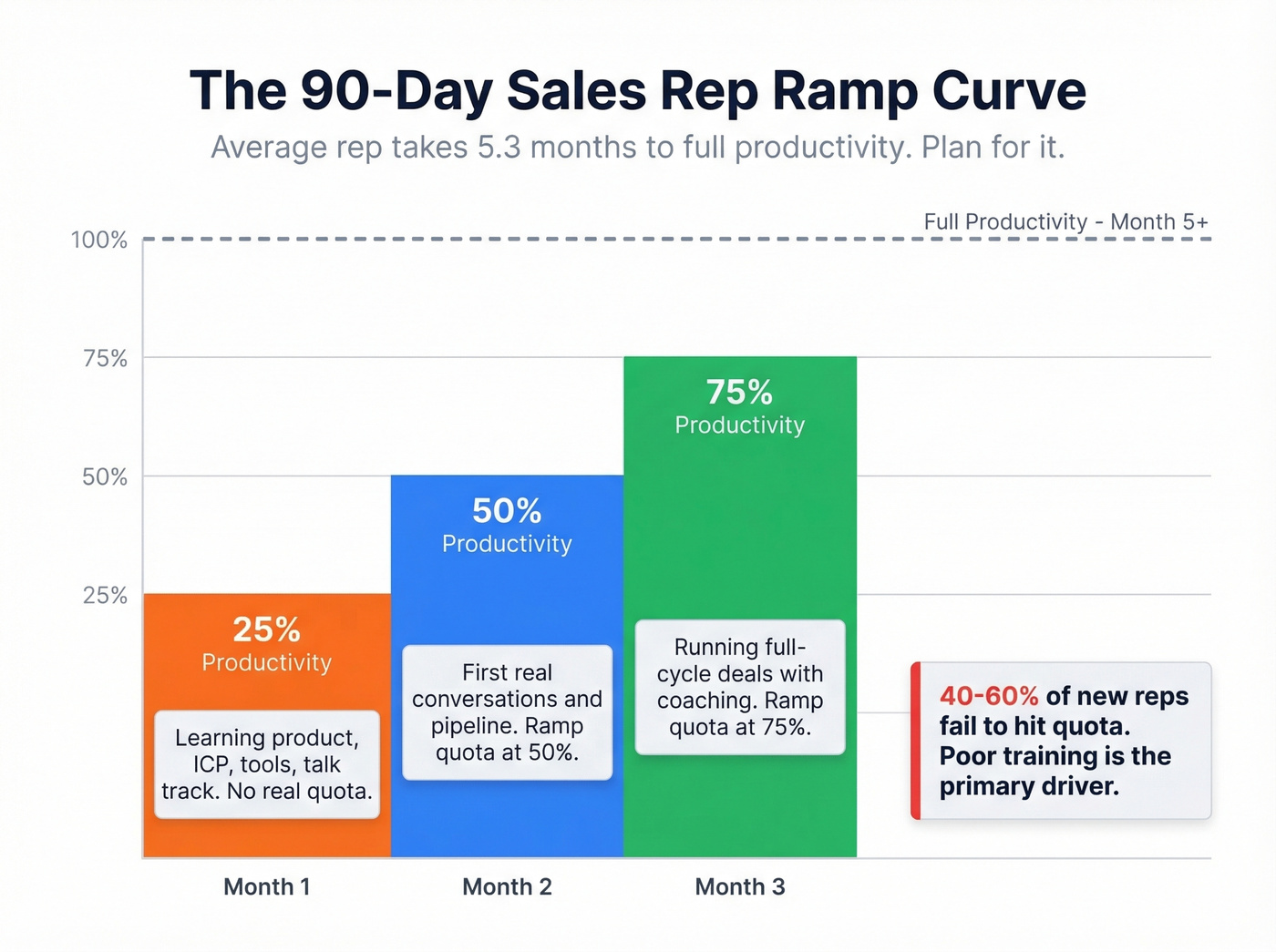
Here's the productivity curve to plan around:
- Month 1: ~25% productivity. Reps are learning the product, the ICP, the tools, and the talk track. They shouldn't be carrying real quota.
- Month 2: ~50% productivity. First real conversations, first pipeline created. Ramp quota at 50% of full target.
- Month 3: ~75% productivity. Reps should be running full-cycle deals with coaching support. Ramp quota at 75%.
40-60% of new sales reps fail to achieve quota, and poor training is the primary driver. Top-tier onboarding programs produce 21% higher win rates and 14% higher quota attainment - that's the difference between a rep who pays for themselves in Q1 and one who's on a PIP by month four.
The Right Tech Stack for a New Team
The average outbound team runs 5.6 tools. Most teams buy them in the wrong order. Buy what creates pipeline first, optimize later.
Priority 1: CRM. HubSpot's free tier works for startups. Salesforce is the move once you're past 10 reps and need custom objects. Pipedrive sits in between for SMBs who want simplicity.
Priority 2: Sequencing. Outreach and Salesloft are the enterprise standards at $100-$200/user/month. Instantly and Smartlead run around $30-$100/month for bootstrapped teams focused on cold email volume.
Prospeo starts free with 75 verified emails per month plus 100 Chrome extension credits, and paid plans are credit-based at about $0.01/email with no contracts.

| Category | Tools | Starting Price |
|---|---|---|
| CRM | HubSpot, Salesforce, Pipedrive | Free-$165/user/mo |
| Sequencing | Outreach, Salesloft, Instantly | $30-$200/user/mo |
| Prospecting Data | Prospeo, Apollo | Free-$99/user/mo |
| Conversation Intel | Gong, Avoma | $49-$150/user/mo |
| Dialer | Aircall, RingCentral | $20-$40/user/mo |
Everything else - conversation intelligence, interactive demos, proposal tools - can wait until you have reps consistently hitting quota and you need to optimize, not build.
Skip ZoomInfo if your average deal size is under $10K. A $15K+ annual data contract on a team closing $8K deals means your data costs more than your first few wins. Start lean, upgrade when the math justifies it.
Building an Assembly Line model means your SDRs need to fill pipeline fast. With 300M+ profiles, 30+ filters including buyer intent and headcount growth, and verified mobiles with a 30% pickup rate, Prospeo cuts rep ramp time so your team hits full productivity weeks sooner.
Ramp your sales team faster with data that actually connects to real buyers.
Set KPIs That Drive Revenue
Up to 70% of B2B sales reps missed quota in recent years. That's not a rep problem - it's a measurement and expectation problem. Measuring the right KPIs is the mechanism that separates teams that scale from teams that stall.
| Metric | Benchmark |
|---|---|
| Lead to Customer | 2-5% |
| MQL to SQL | 15-21% |
| Win Rate | 20-30% |
| Median Sales Cycle | 84 days |
| Median SaaS Deal | $26,265 |
| Pipeline Coverage | 3-4x quota |
The pipeline coverage ratio is the single most important planning metric for a new team. If your quarterly quota is $500K, you need $1.5M-$2M in pipeline at any given time. Without that coverage, no amount of coaching or closing technique saves the quarter.
Measure leading indicators - sales activities completed, meetings booked, pipeline created - not just lagging ones like closed revenue. By the time you realize closed revenue is short, it's too late to fix it. Leading indicators give you 60-90 days of warning. Track daily activities in week one, pipeline created by week four, and don't expect meaningful closed revenue until month three at the earliest.
Scale Without Breaking
Once your first 3-5 reps are consistently hitting quota, you'll feel the pull to hire fast. Resist it.
Start with a centralized sales ops model - one person or a fractional hire who owns CRM hygiene, reporting, territory assignments, and comp administration. Stay centralized until you have 15-20 reps. You don't need a federated or hybrid ops structure until multiple segments, regions, or product lines create conflicting process needs.
Add a frontline manager when you hit 4-6 reps. Add enablement when onboarding new reps takes more than 20% of your manager's time. Add a second manager before the first one exceeds 8 direct reports.
On underperformers: if a rep misses ramp quota by more than 25% in month three despite adequate coaching and enablement, start the exit conversation. I know that sounds harsh. But keeping underperformers past the ramp window does more damage than the vacancy - it demoralizes your top performers, drags down team metrics, and occupies management time that should go toward coaching reps who are actually improving. The best sales leaders fire fast and hire carefully, not the other way around.
Premature scaling - hiring reps before the playbook is locked - just multiplies your problems. One rep with a bad process loses you one territory. Ten reps with a bad process loses you a year. System first, headcount second. That's the whole game.
FAQ
What's the first step to building a sales team from scratch?
Close 50 deals yourself first. 67% of founders hire before reaching this threshold, and most of those hires fail. The rep isn't the problem - the missing playbook is. Document what works, then hand it off.
When should I hire a VP of Sales?
After you have 4-6 reps and a repeatable, documented sales process. A VP without a team to manage and a playbook to scale is a $250K mistake. They need something to optimize, not something to "figure out."
What prospecting tools work best for a new sales team?
Start with a CRM (HubSpot free tier), a sequencing tool ($30-$100/month), and verified contact data. Prospeo offers 75 free verified emails per month at 98% accuracy - enough to validate outbound before committing budget. Apollo is another option, though its accuracy rates are lower.
Should I hire inbound or outbound reps first?
Outbound first. Most early-stage companies don't have enough inbound volume to keep a rep busy. Start with SDRs who create pipeline from cold outreach, then shift reps to handle inbound once marketing produces consistent volume.
What's the biggest mistake first-time sales leaders make?
Hiring before they have a repeatable sales process. Close the deals yourself first, document what works, then hand it off. The playbook is the product your first rep actually needs.