

How to Create a Buyer Persona That Doesn't Collect Dust
You inherited a Google Doc titled "Buyer Personas - FINAL v3." Inside: a stock photo of a smiling guy named "Tech-Savvy Tom" who "loves innovation" and "values efficiency." Nobody on the sales team has opened it in 14 months.
If you're wondering how to create a buyer persona that people actually use, you're not alone. The consensus on r/b2bmarketing is blunt - these "fairytale personas" collect dust because they describe a fictional character, not a buying decision. Talk to real customers, focus on how they make decisions instead of their age or hobbies, validate with data, and keep it to 2-4 personas. Below: the full 7-step process, a complete interview question bank, a copy-paste template, and a validation framework most guides skip entirely.
What a Buyer Persona Is (and Isn't)
A buyer persona is a semi-fictional representation of your ideal customer, built from real research and data. That's the textbook definition. Here's the reframe that actually matters:
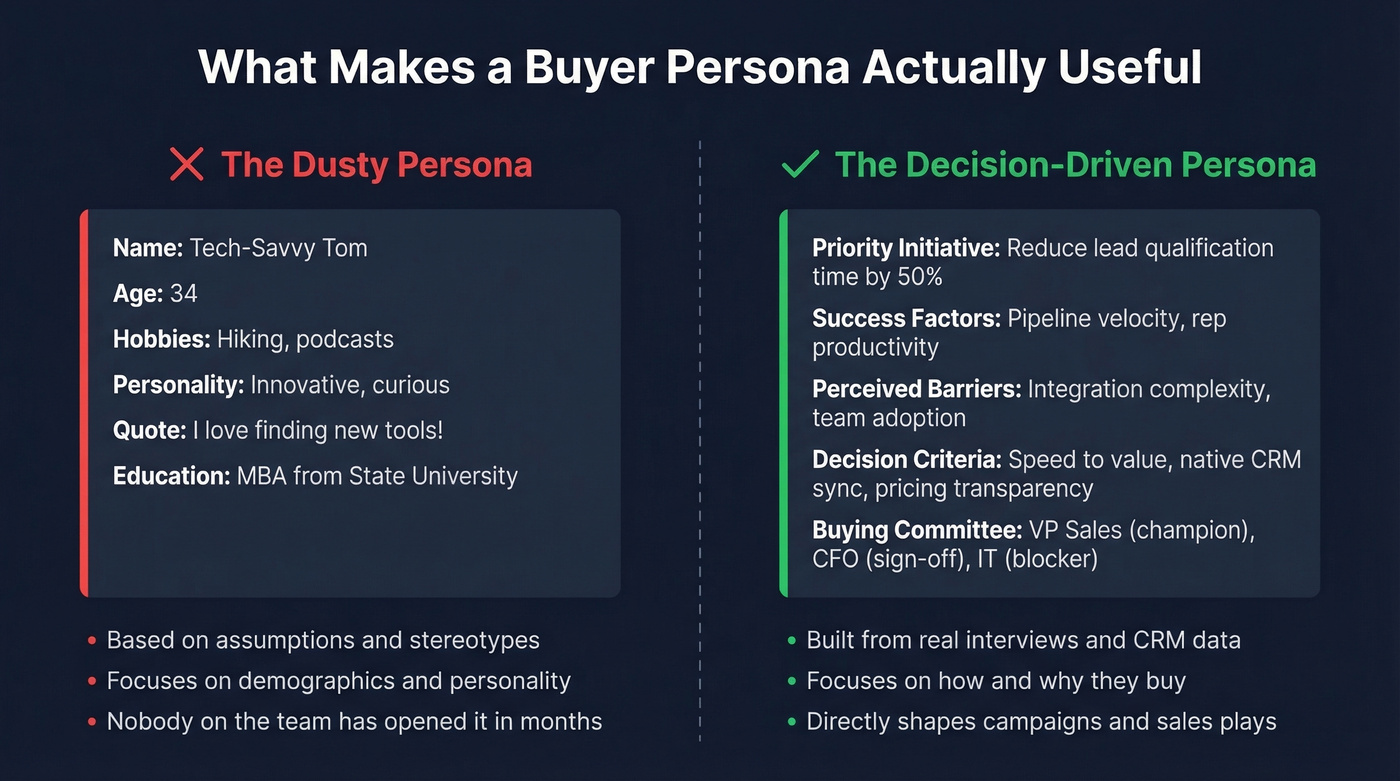
A useful persona describes a buyer's decision, not just the buyer. Adele Revella's "5 Rings of Buying Insight" framework nails this - what you need to capture is priority initiatives, success factors, perceived barriers, the buyer's journey, and decision criteria. Demographics are context. Decision drivers are the point. Companies that get this right see results: 93% of companies exceeding revenue goals segment their database by persona.
Here's the thing: if your persona document doesn't change a single campaign decision, it's decoration. Kill it and start over with the process below.
How Many Personas Do You Need?
Two to four. That's the sweet spot for most companies - one per meaningful segment where the buying motivation, decision process, or pain points genuinely differ.
The rookie mistake is creating eight personas because you can imagine eight types of buyers. Persona sprawl dilutes your messaging and makes it impossible to prioritize content. In our experience, the teams that start with one or two well-researched profiles and expand only when data forces them to always outperform the teams that try to boil the ocean on day one.
How to Build a Buyer Persona (7 Steps)
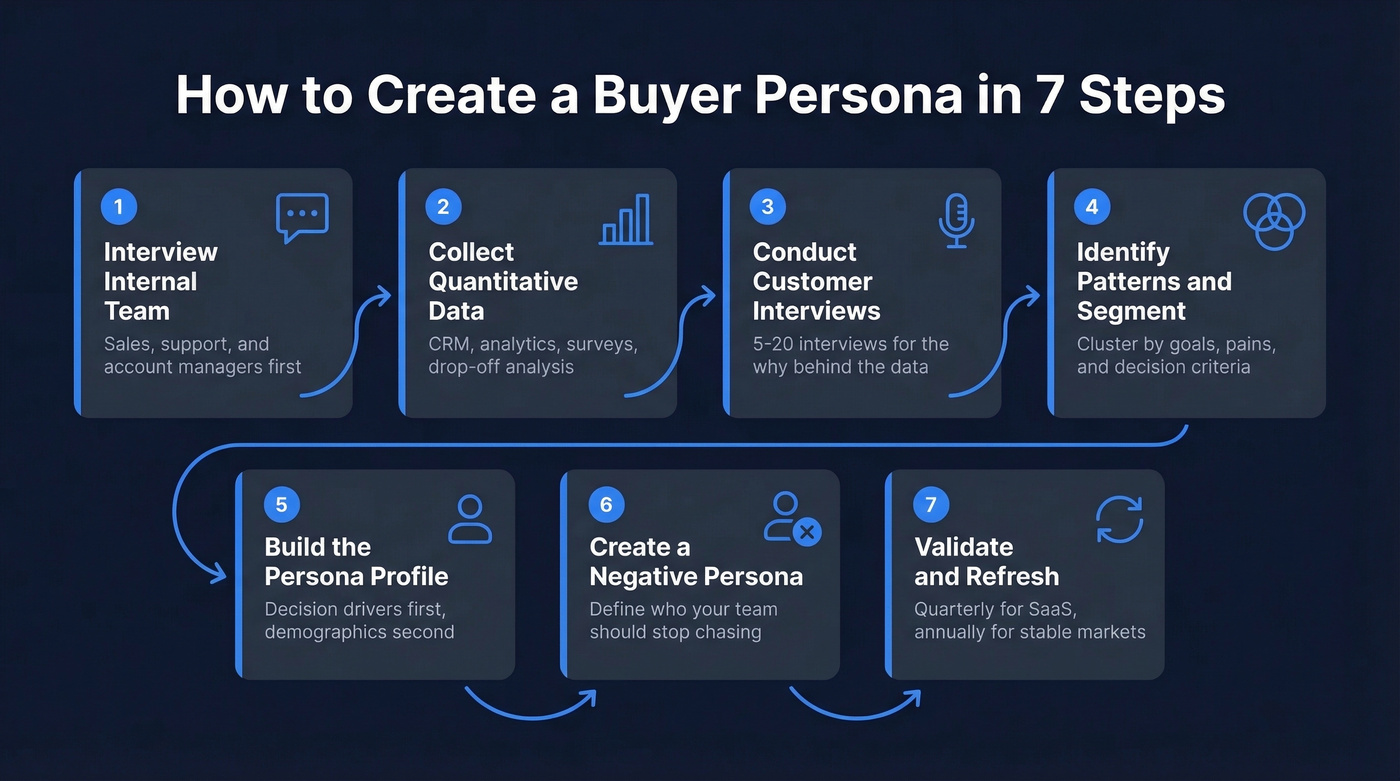
Step 1 - Interview Your Internal Team
Start with the people who talk to customers every day. Your sales reps, support agents, and account managers already know things your analytics can't tell you.
Ask them three questions:
- What are the most frequent questions prospects ask?
- What makes customers happiest after they buy?
- What frustrates them enough to churn?
These conversations take an afternoon and give you a working hypothesis before you spend weeks on external research. We've found that internal interviews surface roughly 80% of what ends up in the final persona - they're the single highest-ROI step in this entire process.
Step 2 - Collect Quantitative Data
Pull hard numbers from every system you've got. Google Analytics gives you behavior patterns. Your CRM shows purchase history, lead sources, and deal velocity. Surveys - kept to 10-15 questions for the highest completion rates - fill in the gaps.
One underrated move: include late-stage drop-offs in your analysis. People who almost bought but chose a competitor reveal more about your persona's decision criteria than people who converted easily. To understand how many real prospects match your persona assumptions, a B2B data platform like Prospeo lets you filter 300M+ profiles by job title, industry, company size, tech stack, and buyer intent - giving you a reality check before you build personas on guesses.
Step 3 - Conduct Customer Interviews
Five to twenty interviews give you the qualitative depth that numbers alone can't provide. You're listening for the "why" behind the data - why they searched, why they hesitated, why they picked you over the alternative.
These conversations pay off concretely. HubSpot documented a case where changing an asset type and headline based on interview feedback lifted conversion rates by 40%. That's not a marginal gain from a marginal effort. The full interview question bank is below - copy it and use it in your next five customer calls.
Step 4 - Identify Patterns and Segment
I once watched a marketing team spend three weeks building a persona around "mid-level managers who care about ROI." When they finally grouped their actual interview notes by recurring themes, they discovered two completely different buyers hiding inside that label - one driven by fear of looking bad to their VP, the other driven by a genuine desire to modernize their stack. Same title, opposite motivations, totally different messaging.
Look for clusters, not averages. Group your interview notes and survey data by recurring goals, pain points, decision criteria, and information sources. Separating what people do from why they do it is the core analytical challenge - analytics tell you the former, interviews tell you the latter. Pay special attention to the language patterns in open-ended survey responses. The exact words customers use to describe their problems become your ad copy, your email subject lines, your landing page headlines.
Step 5 - Build the Persona Profile
Lead with decision-centric fields, not demographics. Your persona profile should prioritize priority initiatives, success factors, perceived barriers, decision criteria, and preferred channels. Demographics and firmographics are supporting context, not the headline.
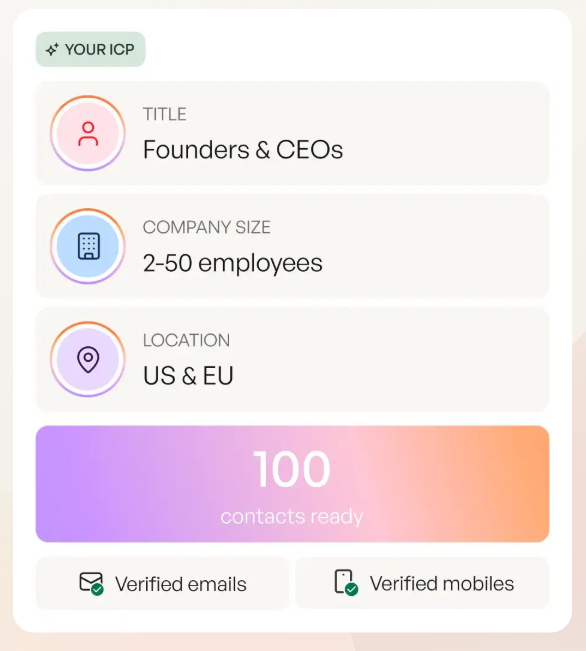
For B2B, add firmographics like company size, industry, tech stack, and funding stage, plus buying committee dynamics - who's the champion, who's the blocker, who signs the check. For B2C, lean into personal motivations and individual purchase behavior. The full template is in the next section.
Step 6 - Create a Negative Persona
Who should your sales team stop wasting time on?
That's your negative persona - the leads who'll never close, or who close but churn in 90 days. To build one, interview your low-satisfaction and low-value customers. What do they have in common? Maybe they're in an industry where your product doesn't fit. Maybe they're too small to get value from your pricing tier. We've seen teams skip this step and regret it within a quarter - their pipeline looks full, but close rates crater because half the leads were never going to buy. A negative persona saves your sales team hours every week and sharpens your ad targeting with explicit exclusion criteria.
Step 7 - Validate and Set a Refresh Cadence
A persona without a validation loop is just a guess with formatting. After building your profiles, set up a recurring check: review assumptions, collect fresh analytics, analyze gaps between what you predicted and what actually happened, then update or retire personas that no longer match reality.
| Market Type | Refresh Cadence |
|---|---|
| Fast-moving (SaaS, fintech) | Quarterly |
| Stable industries | Annually |
| After major shifts (product launch, market disruption, unexplained performance drops) | Immediately |
The full validation framework is in Section 9.
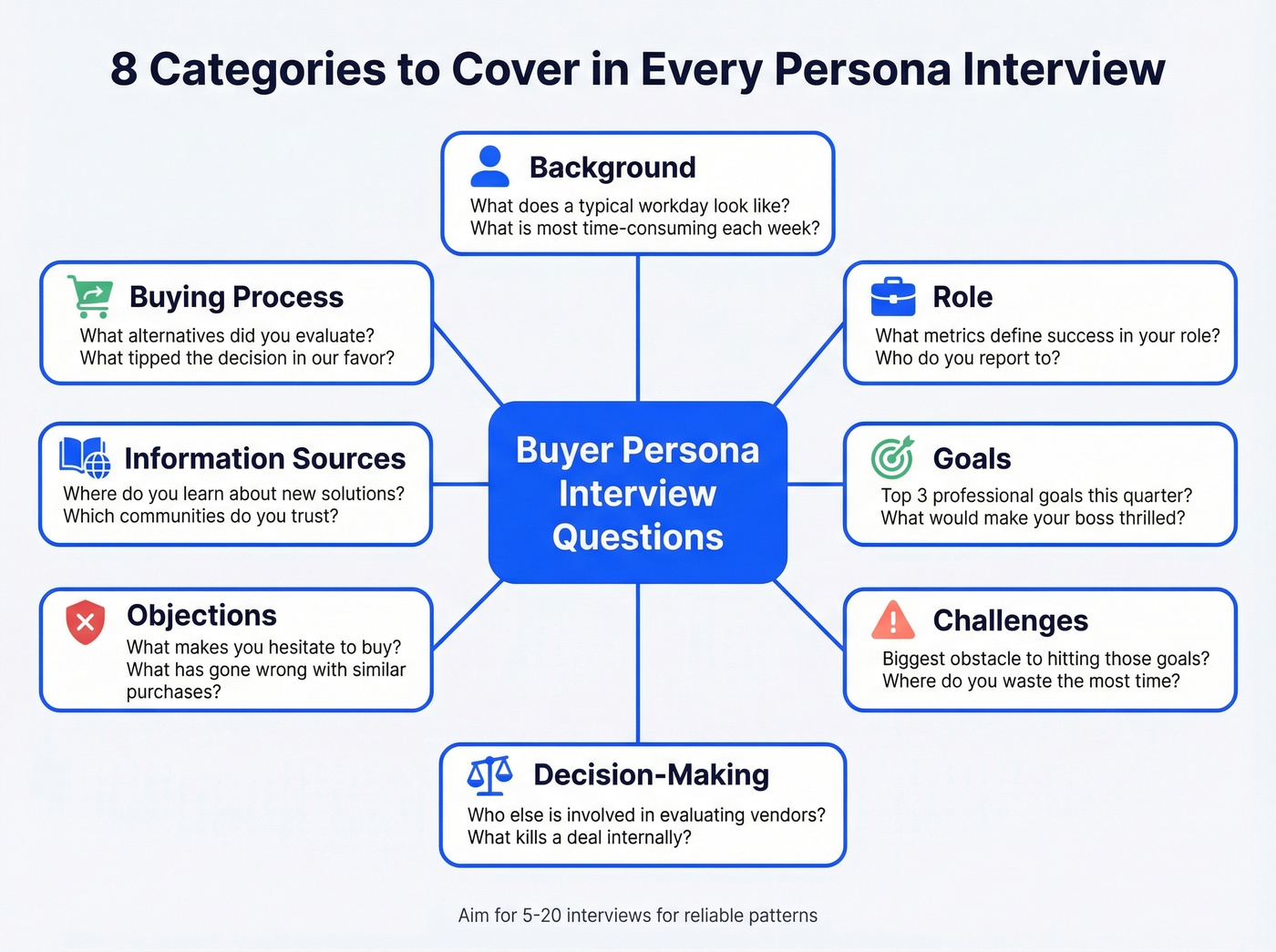
Persona Interview Questions
Copy these. Use them in your next five customer calls.
Background
- What's your job title and daily responsibilities?
- How long have you been in this role?
- What did you do before this position?
- What does a typical workday look like?
- What's the most time-consuming part of your week?
Role
- Who do you report to?
- What metrics define success in your role?
- How large is your team?
- What tools do you use daily?
Goals
- What are your top three professional goals this quarter?
- What does success look like for your team this year?
- What would make your boss thrilled with your performance?
- Where do you want your career to be in two years?
Challenges
- What's the biggest obstacle to hitting those goals?
- What frustrates you most about your current process?
- Where do you waste the most time?
- What problem, if solved tomorrow, would change your quarter?
Decision-Making
- Who else is involved when you evaluate a new tool or vendor?
- What's the typical approval process?
- What criteria matter most - price, speed, features, support?
- How long does a typical purchase decision take?
- What kills a deal internally?
Objections
- What would make you hesitate to buy a product like ours?
- What's gone wrong with similar purchases in the past?
- What would your most skeptical colleague say about this?
- What would need to be true for you to feel confident in this purchase?
Information Sources
- Where do you go to learn about new solutions?
- Which publications, podcasts, or communities do you trust?
- Do you attend industry events? Which ones?
- How much do peer recommendations influence your decisions?
Buying Process
- How did you first hear about us?
- What alternatives did you evaluate?
- What tipped the decision in our favor - or against us?
- If you could change one thing about how you bought this, what would it be?

Your buyer personas are only as good as the data behind them. Prospeo gives you 300M+ profiles with 30+ filters - job title, industry, company size, tech stack, buyer intent, and more - so you can validate persona assumptions against real market data instead of guesses.
Turn persona research into verified prospect lists in minutes.
Buyer Persona Template
| Field | What to Capture |
|---|---|
| Name & Role | Descriptive title, not a cute name |
| Company Type/Size | Industry, revenue, headcount |
| Goals | Top 2-3 professional objectives |
| Pain Points | Specific frustrations, not vague complaints |
| Priority Initiatives | What they're actively trying to fix |
| Success Factors | How they measure a good outcome |
| Perceived Barriers | What they think will go wrong |
| Decision Criteria | Price, speed, integrations, support |
| Preferred Channels | Where they consume info and engage |
| Common Objections | What makes them hesitate |
| Negative Indicators | Signals this person won't convert |
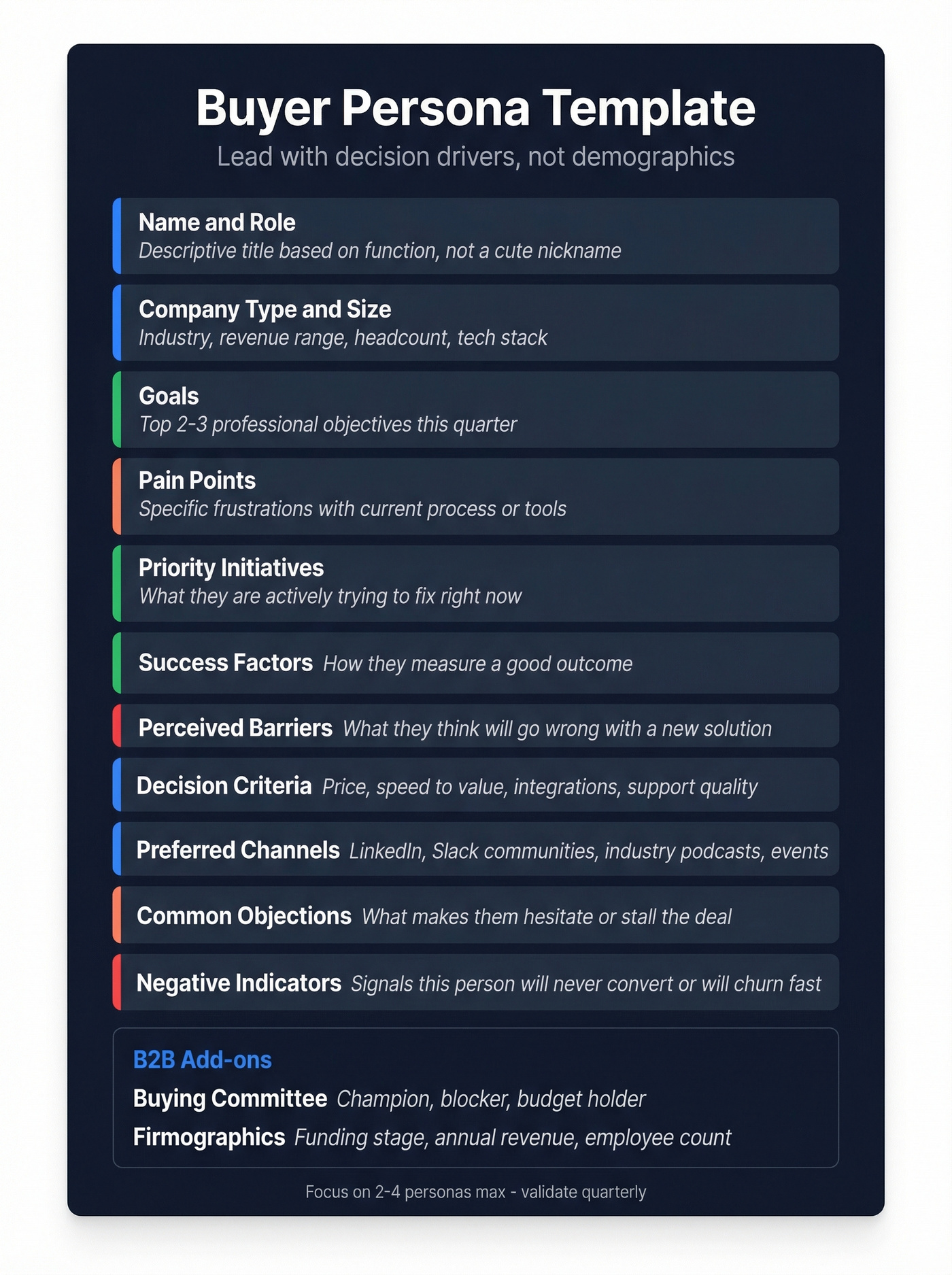
For B2B, add firmographics and buying committee structure - who's the champion, who's the blocker, who signs the check. For B2C, add personal motivations and individual purchase behavior. UXPressia's guide breaks down the structural differences well if you need deeper examples.
Personas vs Jobs-to-be-Done
Personas and JTBD aren't competing frameworks. They solve different problems, and the smartest teams use both.
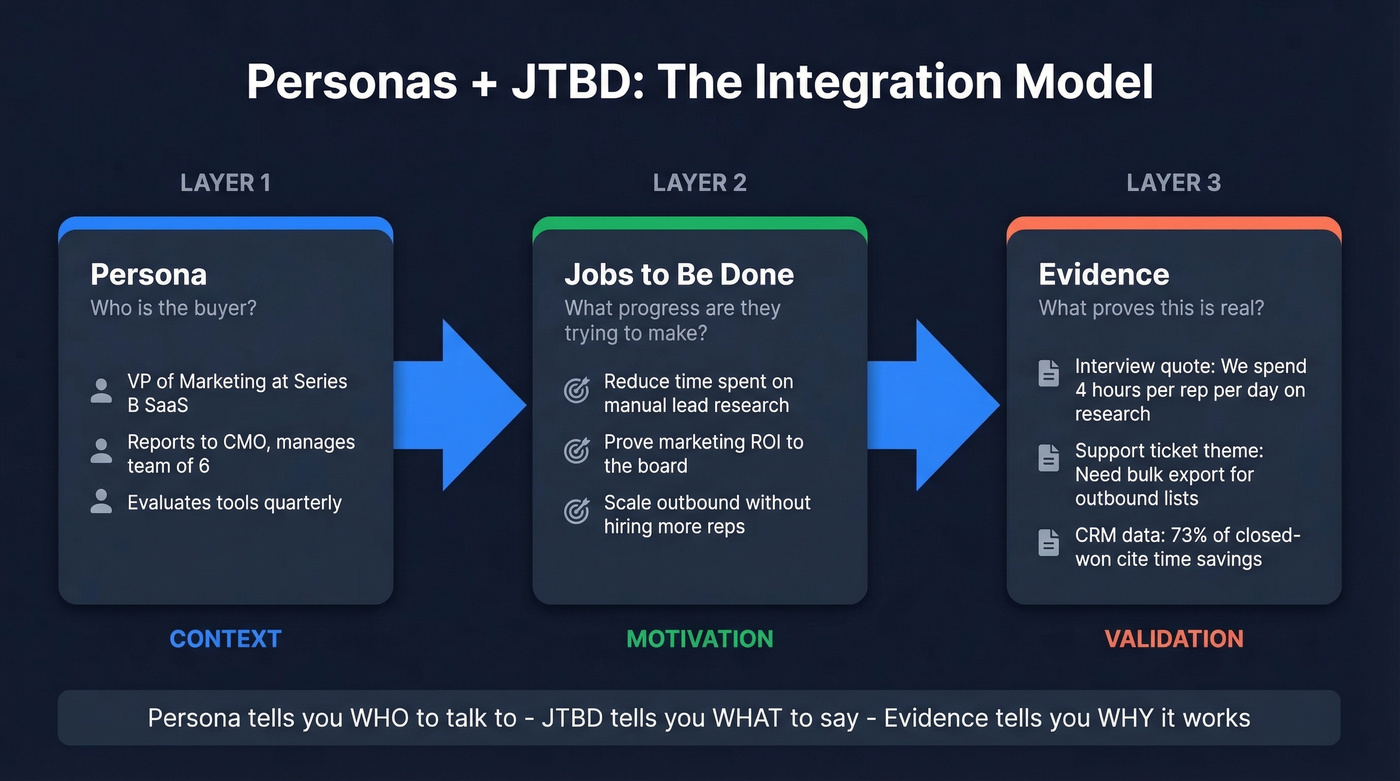
The practical integration model works like this: Persona -> Jobs -> Evidence. Your persona tells you who you're talking to. The jobs-to-be-done layer tells you what progress they're trying to make. The evidence layer anchors both to real quotes, support tickets, and measurable outcomes. Without that chain, you've got a character sheet for a person who doesn't exist.
A useful JTBD statement has three components: the situation (the trigger or context that creates the need), the motivation (the desired progress), and the outcome (measurable success). Rule of thumb from prodmgmt.world: use JTBD for product decisions - prioritization, metrics, roadmap. Use lightweight personas for communication and stakeholder alignment. Together, they're far more powerful than either one alone.
7 Persona Mistakes That Kill Marketing
Building from assumptions, not research. Interview at least five real customers before you write a single persona field. If you can't name the last customer you spoke to, you're guessing.
Leading with demographics in B2B. Lead with decision criteria and buying process. Nobody's marketing strategy improved because they learned their persona is 38 and lives in Austin.
Creating too many personas. Start with two. Expand only when data proves a new segment behaves differently. Every persona you add dilutes focus across your entire content calendar.
Describing an aspirational buyer instead of your actual buyer. Build from CRM data and closed-won analysis, not from who you wish was buying. Your best persona is the customer you already have ten of.
Ignoring negative personas. Define who you don't want. It's as valuable as defining who you do - and it saves your sales team from burning hours on leads that'll never convert.
Never updating after creation. Set a calendar reminder. Quarterly review minimum. A persona that was accurate 18 months ago might be steering you toward the wrong audience today - revisit the refresh cadence table in Step 7.
Treating personas as marketing-only. Real talk: if nobody on your sales team can name your primary persona without looking it up, the persona isn't working. Share it with sales, support, and product. Make it a living document, not a Notion artifact.
How to Validate Your Persona
If you can't point to a single campaign decision your persona influenced, it's decoration, not strategy. Here's the validation loop.
Review your assumptions. List every claim in your persona - "cares about integration speed," "reports to the VP of Ops" - and turn each into a testable question.
Collect analytics. Website behavior paths, social engagement patterns, CRM purchase history, and PPC conversion data each validate different persona dimensions. Invoke Media's framework maps which data source validates which assumption.
Analyze gaps. Where do your persona's predicted behaviors diverge from actual data? If your persona says "prefers long-form content" but your blog bounce rate is 80%, something's off. Dig into the disconnect before you adjust your persona or your content - sometimes the content is the problem, not the persona.
Validate with metrics. Customer lifetime value, conversion rate, product adoption, and sales cycle length - segment each by persona. If one persona's CLV is 3x another's, that tells you where to focus.
Update or retire. Personas that no longer match reality get revised or killed. Share updates across every team that touches the customer.
Tools for Building Buyer Personas
HubSpot Make My Persona is free and doesn't require an account. It's a solid starting point for generating a structured first draft. The limitation: AI-generated output still needs real customer research behind it, or you're just automating guesswork.
UXPressia offers a free tier with limited personas and paid plans starting around $15-$25/month. It's the best option if you want visually polished, design-forward persona documents that look good in stakeholder presentations.
Adobe Express has a free tier that works well for creating clean persona one-pagers. Good for the final presentation layer, not the research layer.
Prospeo is where the persona stops being a document and starts being a prospect list. Once you've defined your persona's job title, industry, company size, and tech stack, Prospeo's 30+ search filters let you find real people who match - across 300M+ profiles with 98% email accuracy and a 7-day data refresh cycle. Layer in buyer intent data across 15,000 topics to prioritize prospects actively researching solutions. Free tier gives you 75 emails + 100 Chrome extension credits/month to test the workflow; paid plans start at roughly $0.01/email.

Skip the first three tools if you already have a structured template you like. Where most teams stall isn't the document format - it's turning that document into action.
A negative persona saves your team hours, but only if you can actually filter out bad-fit leads. Prospeo's intent data tracks 15,000 topics so you can separate in-market buyers from tire-kickers - and build exclusion lists that protect your pipeline.
Stop filling your pipeline with leads that were never going to buy.
FAQ
What's the difference between a buyer persona and an ICP?
An ICP describes the company you're targeting - industry, size, revenue, tech stack. A buyer persona describes the person within that company - their role, goals, pain points, and decision criteria. For B2B, you need both: the ICP narrows your target account list, and the persona shapes how you message the humans inside those accounts.
How long does persona research take?
The document itself takes a day. The research behind it takes 2-4 weeks - internal interviews, customer conversations, analytics review, and pattern identification. A polished persona built on assumptions is worse than an ugly one built on real data. Don't skip the research.
Can AI tools replace customer interviews?
AI tools generate a structured first draft, but an AI-generated persona without real customer research is a guess with formatting. Use AI to accelerate structure, then validate with 5-20 actual interviews. Humans provide the insight; AI provides the scaffolding.
How often should I update my personas?
Quarterly for fast-moving industries like SaaS and fintech, annually for stable markets. Update immediately after product launches, market shifts, or unexplained drops in campaign performance. A persona that was accurate 18 months ago is probably steering you toward the wrong audience today.
How do I turn a persona into a prospect list?
Export your persona's key attributes - job title, industry, company size, tech stack - and use them as search filters in a B2B data platform. Prospeo's 30+ filters and 300M+ profiles with 98% email accuracy turn a static document into an actionable contact list with verified emails and direct dials.