

How to Demo a Product (Without Feature-Dumping)
You spent three weeks nurturing a prospect, got the meeting on the calendar, and watched them zone out 12 minutes into a feature tour they didn't ask for. That's not a bad prospect - that's a bad demo.
Knowing how to demo a product isn't about charisma. It's structure, data, and knowing when to shut up.
The Cheat Sheet
Nail these and you're ahead of 80% of reps walking into demos cold.
- Know the 76-second rule. An [analysis of 67,149 demos](https://www.gong.io/blog/sales-demos) found no closed-won demo had more than 76 seconds of uninterrupted pitching. Losing demos hit 106 seconds. If you're monologuing, you're losing.
- Aim for 47 minutes, not 30. Winning demos run 30.5% longer than losing ones (47 min vs 36 min). Don't rush to "respect their time" - use it for real conversation.
- Align AE + SE before every call on purpose, minimum success outcome, best-case outcome, and one repeatable core message.
- Prep a stable demo environment with the prospect's logo, realistic data, and a backup path.
- Run through your golden path once before the call - confirm every click works and your data loads.
What a Product Demo Actually Is
A product demo shows how your product works and why it matters to the person watching. A product demo is typically shorter, broader, and sits earlier in the buyer journey - think embedded walkthroughs or a video on a product page. A sales demo is live, personalized to pain points, and usually includes pricing discussion.
This guide focuses on SaaS and B2B sales demos. If you're running in-store product sampling or ecommerce video demos, the principles overlap but the execution differs.
A Wyzowl survey found 87% of people have been convinced to buy after watching a video. The question isn't whether to demo. It's whether your demonstration earns the next meeting or kills the deal.
What Winning Demos Look Like
A large published analysis - 67,149 sales demos - gives us the clearest picture of what separates demos that close from demos that don't.
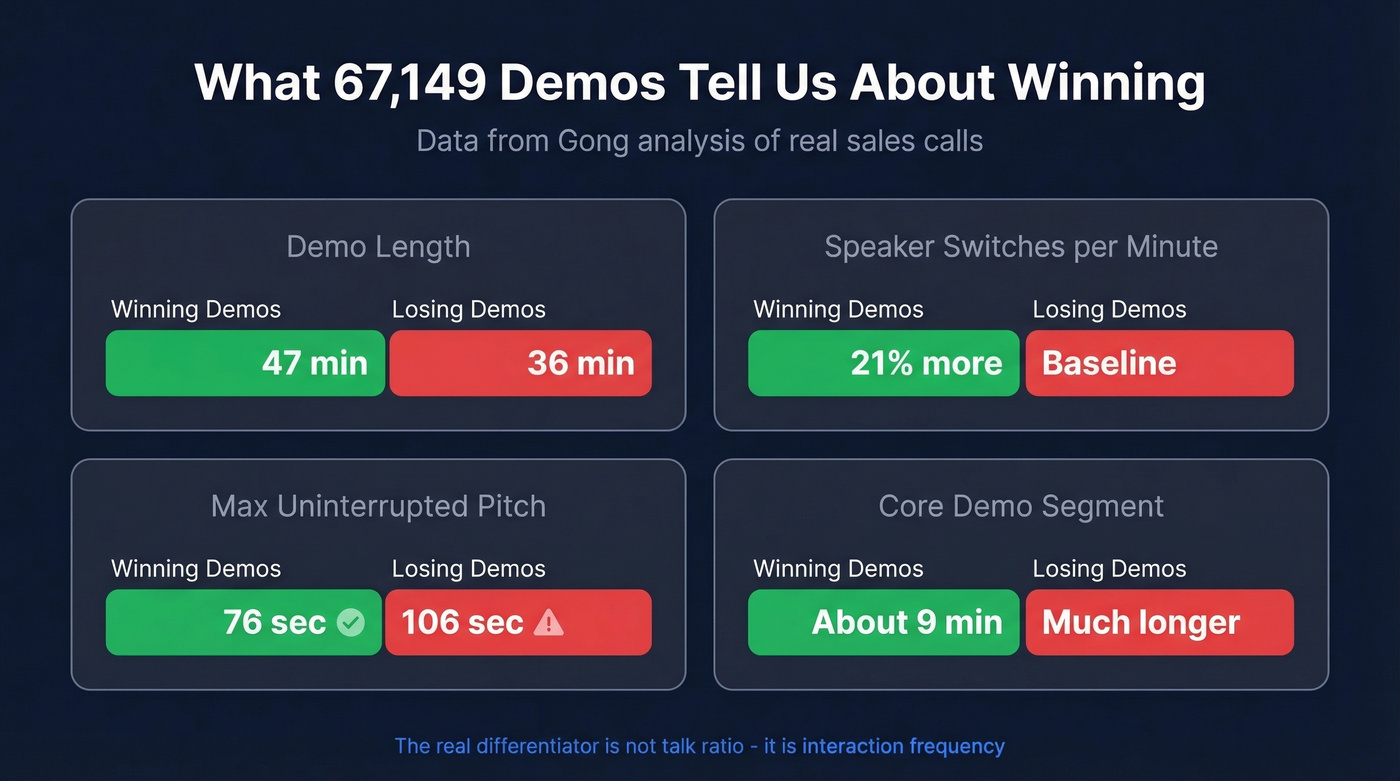
| Metric | Winning Demos | Losing Demos |
|---|---|---|
| Length | 47 min | 36 min |
| Speaker switches/min | 21% more | Baseline |
| Max uninterrupted pitch | 76 sec | Up to 106 sec |
| Core demo segment | ~9 min | Longer |
The talk ratio alone isn't the differentiator - losing demos have a similar overall ratio. Winning demos average a 65:35 rep-to-buyer talk-to-listen ratio, but the real signal is interaction pattern. Winning demos bounce back and forth constantly. The prospect is engaged, asking questions, reacting.
A separate analysis of 3 million demos reinforced this: top sellers spend 39% less time talking about features, and their buyers ask 28% more questions. The core walkthrough should run about 9 minutes. Not 25. Not 40. Nine minutes of concentrated, relevant demonstration surrounded by conversation.
Here's the thing: most reps think their demo problem is presentation skills. It's not. It's that they're showing 15 features when the prospect cares about two. If your deal size is under $20k, you probably don't need a 40-minute feature tour - you need a tight 9-minute core that makes the prospect say "when can we start?"
How to Prep Before the Call
This is where most demos are won or lost. The call itself is just execution.
Align AE + SE in 5 Minutes
If your AE and SE aren't aligned before the call, you're burning a demo slot. Before every demo, agree on four things: the purpose of this specific call, the minimum success outcome ("they agree to a technical deep-dive"), the best-case outcome ("they introduce us to procurement"), and one core message the prospect can repeat afterward.
No alignment = no demo. We've watched too many calls where the AE promises one thing in discovery and the SE shows something completely different. That disconnect is a deal-killer.
The 15-Minute Research Sprint
Block 15-20 minutes before the call. Focus on the prospect's role and priorities, their likely pain points based on industry and company stage, their current tech stack (job postings and technographic tools are gold here), and the success metrics their boss cares about. Before you research, make sure you're reaching the right people - verify emails and grab direct dials through Prospeo's email finder so you're not sending calendar invites into the void.
Set Up a "Golden Path" Environment
Never build anything live. Never.
Load your demo environment with realistic data - dashboards trending in the "successful customer" direction, teammates added to show collaboration features, the prospect's logo dropped in. Test your tech at least a day before. Have a backup path ready for when the integration you planned to show decides to throw an error at the worst possible moment.
The D.E.M.O. Framework
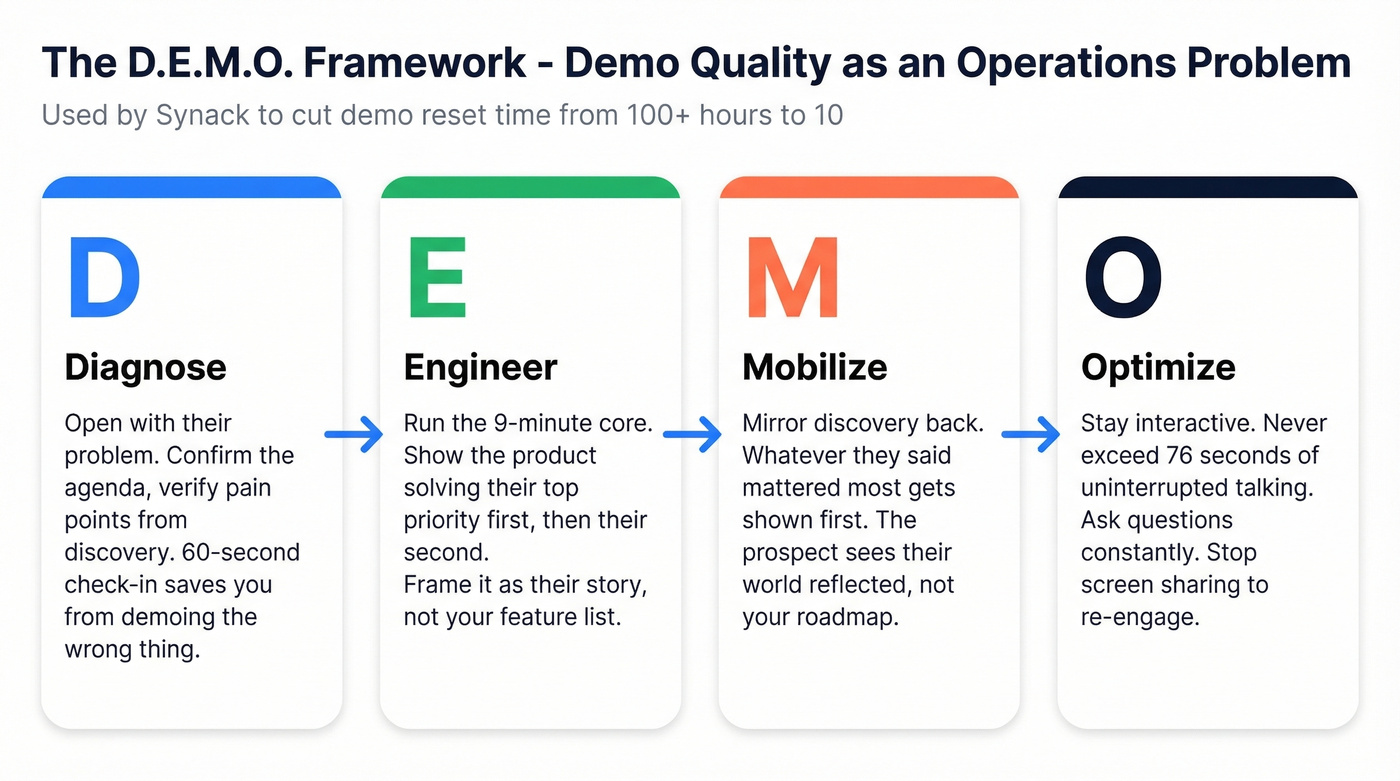
The [D.E.M.O. framework](https://www.demostack.com/post/the-demo-framework) treats demo quality as an operations problem, not a talent problem. Synack used it to cut demo reset time from 100+ hours to 10 by standardizing their environment and process.
Diagnose: Open With Their Problem
Don't open with your product. Confirm the agenda, confirm what success looks like, and verify the pain points from discovery are still accurate. A 60-second check-in saves you from demoing the wrong thing for 40 minutes.
Engineer: Run the 9-Minute Core
Nine minutes. Show the product solving their top priority, then their second. Frame it as a story with the prospect as the protagonist - not "here's our reconciliation module with 14 configuration options" but "here's how this eliminates your manual reconciliation step and gives your team back 6 hours a week."
Mobilize: Mirror Discovery
Mini-script: "You mentioned [pain point #1] was costing your team about [X hours/dollars]. Here's exactly how that changes. [Show the workflow.] Does this match how your team handles it today, or am I off?"
Whatever they said mattered most gets shown first. The prospect sees their world reflected back, not your product roadmap.
Optimize: Stay Interactive
Never exceed 76 seconds of uninterrupted talking. Ask questions constantly: "Is this the workflow you'd want to change first?" Every question is a chance to learn something and keep them engaged. Stop screen sharing every few minutes to re-engage the conversation - we've found this single habit changes the dynamic of the entire call.

A flawless demo means nothing if your calendar invite bounced. Prospeo's email finder delivers 98% verified accuracy across 300M+ profiles - so every demo slot goes to a real decision-maker, not a dead inbox.
Stop prepping demos for prospects who never got the invite.
Handle Objections Live
Objections during a demo are buying signals. A disengaged prospect doesn't object - they go quiet and ghost you.
Use a modernized Feel-Felt-Found approach without saying those words. Empathize with the concern, normalize it with social proof, resolve it with a specific outcome: "Our customers in financial services had the same concern about implementation timelines - the integration took 3 weeks, not the 3 months they expected."
Don't deploy it mechanically on every objection. When you genuinely don't know the answer, say so - "I'll get that number to you by Thursday" builds more trust than a confident guess. Dig into the objection before responding, too. "It seems expensive" often really means "I can't justify this to my CFO without an ROI model." (If price comes up often, tighten your price objection handling playbook.)
After the Demo
Chili Piper analyzed ~4 million form submissions and found that instant scheduling doubles inbound conversion from ~30% to 66.7%. Only about 8% of top B2B SaaS companies have this in place, which means it's a massive edge if you set it up.
Post-demo, move fast:
- Send a recap email within 2 hours with 3 key takeaways and next steps (use a proven follow up email after demo structure)
- Include a scheduling link for the follow-up
- Share a recorded clip of the specific workflow they cared about
- Loop in stakeholders they mentioned
- Set a follow-up task if they go dark at 48 hours and again at 5 business days
Benchmark Your Funnel
RevenueHero's 2026 benchmarks give you a baseline for inbound demo funnels.
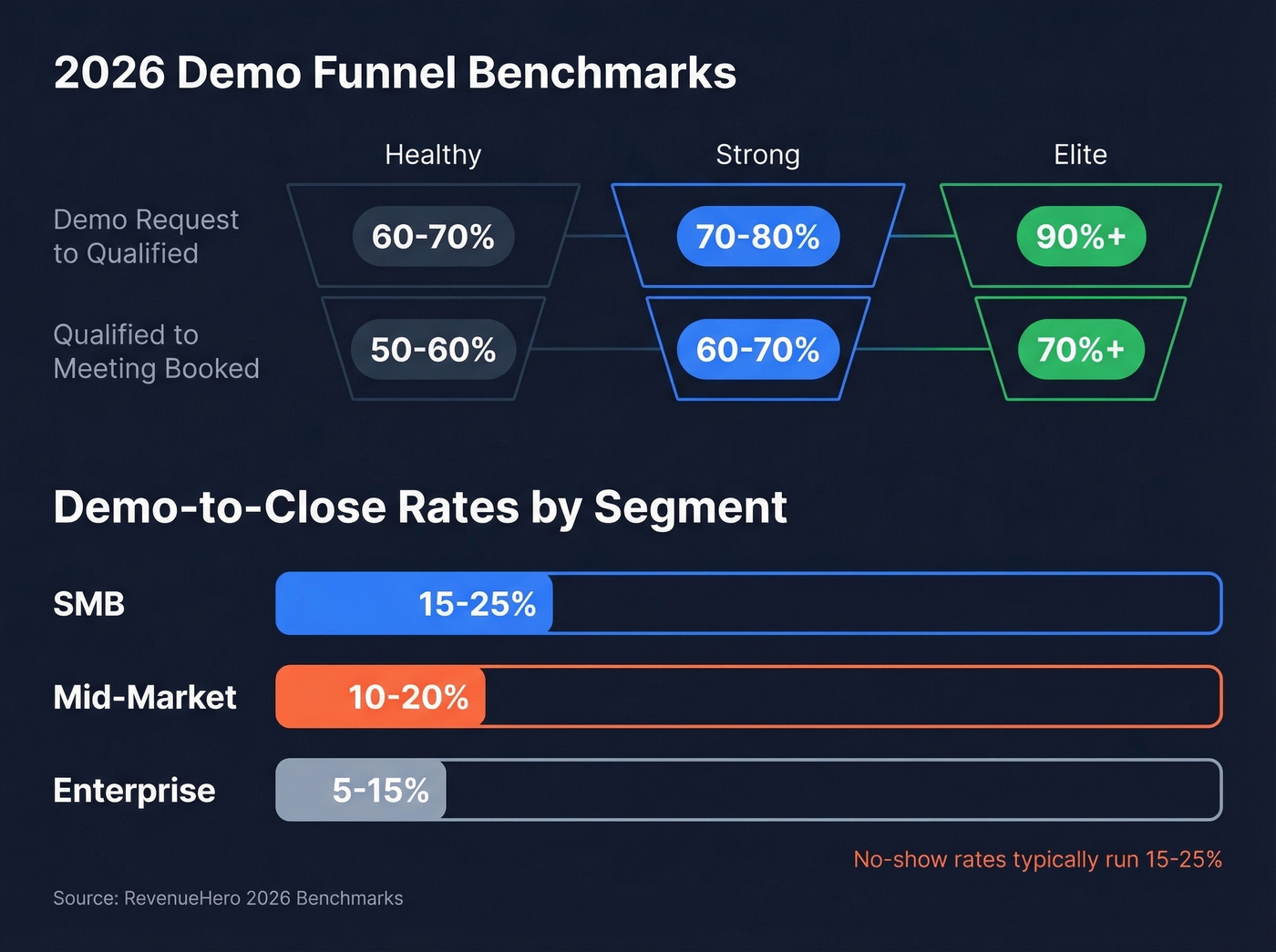
| Stage | Healthy | Strong | Elite |
|---|---|---|---|
| Demo request to Qualified | 60-70% | 70-80% | 90%+ |
| Qualified to Meeting booked | 50-60% | 60-70% | 70%+ |
Real-world segments vary dramatically. Real Estate Software hits 93.84% qualification and 73.78% meetings booked, while Healthcare Software runs 52.11% qualification but 61.26% meetings. If your qualification rate is below 60%, the problem is upstream: wrong traffic or bad form filtering.
Industry norms for demo-to-close typically run 15-25% for SMB, 10-20% for mid-market, and 5-15% for enterprise. No-show rates sit around 15-25% depending on speed-to-lead and confirmation workflow. If you want to map this to your pipeline math, start with pipeline conversion rate benchmarks.
Mistakes That Kill Deals
Feature-dumping. Pick your top 3 features that map to their pain points. Keep 2 backups. Five features max.
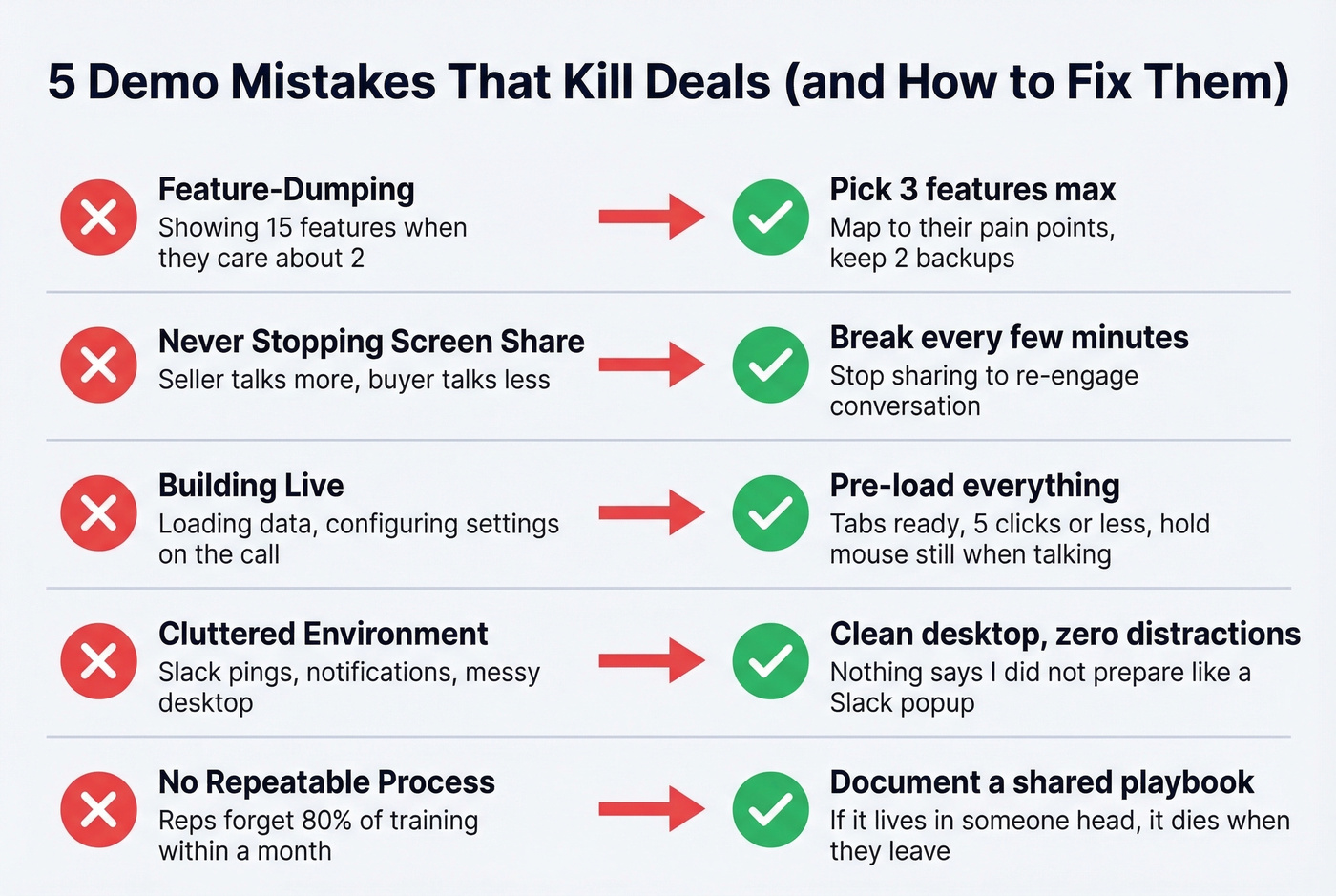
Never stopping the screen share. Screen sharing makes the seller talk more and the buyer talk less. Break the pattern every few minutes.
Building live. Have tabs and instances pre-loaded. Keep navigation to five clicks or less. Hold your mouse still when you're talking.
Cluttered environment. Clean desktop, no notifications, no Slack pings. We've seen this tank demos with C-suite prospects more than once - nothing says "I didn't prepare" like a Slack message from your manager popping up mid-demo.
No repeatable process. Reps forget over 80% of training within a month. If your demo process lives in someone's head, it dies when they leave. Document best practices in a shared playbook (or standardize it inside your sales process).
Tools That Help
| Tool | Best For | Starting Price | Note |
|---|---|---|---|
| Prospeo | Contact verification | Free / ~$0.01/email | Contact data, not a demo platform |
| Navattic | Top-of-funnel tours | Free / $500 / $1,000/mo | Lighter sales analytics |
| Consensus | Role-based personalization | $600 / $1,250/mo | Higher entry price |
| Storylane | Budget interactive demos | Free / $40 / $500 / $1,200/mo | Basic handoff insights |
| Walnut | Sales-led interactive demos | $750/mo | Custom pricing at higher tiers |
| Demostack | Enterprise demo environments | ~$2,750/mo | Custom enterprise pricing |
| Reprise | Enterprise sandbox demos | ~$2,620/mo | Custom enterprise pricing |
| Loom | Quick async video demos | Free / ~$10-$15/user/mo | No interactivity |
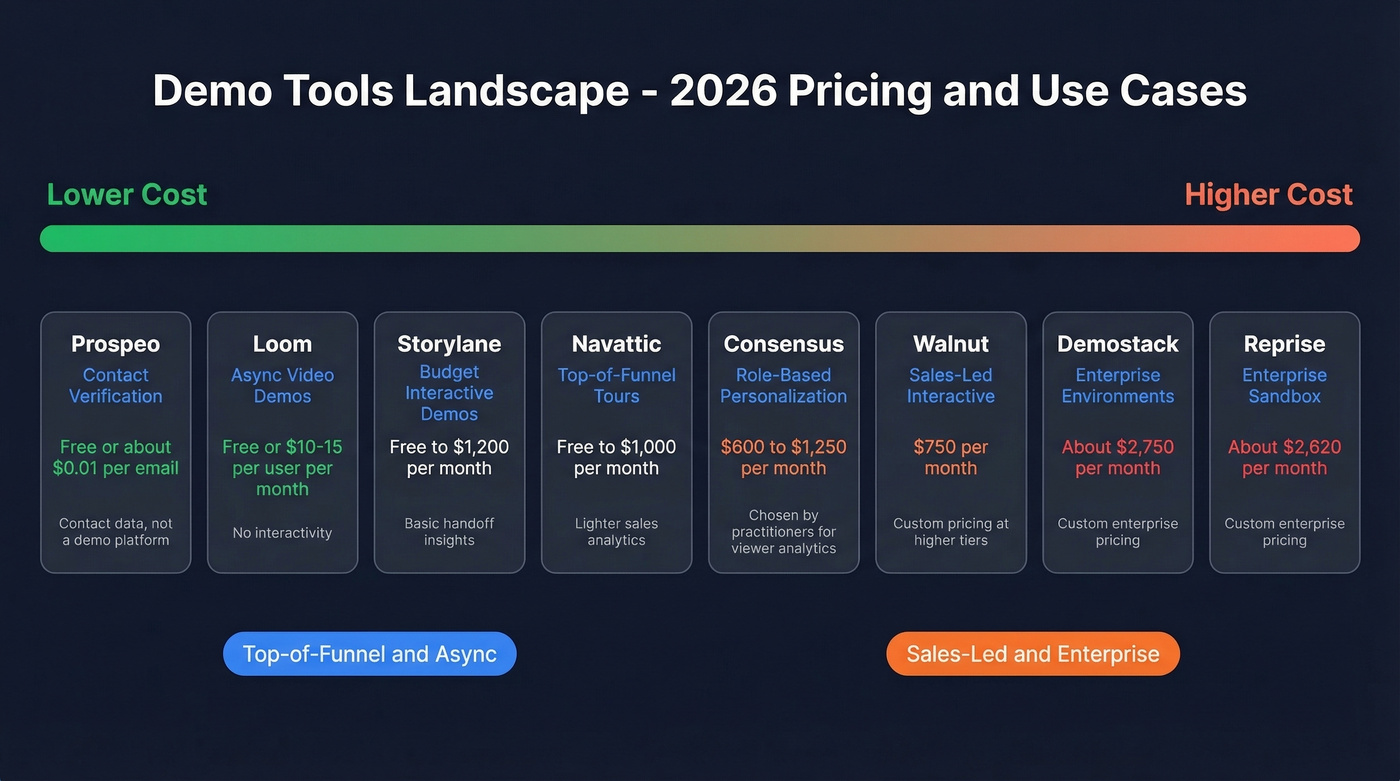
A practitioner on r/SalesOperations tested Consensus, Navattic, Storylane, and Arcade head-to-head and chose Consensus for role-based personalization and viewer analytics - different demo paths for a product manager vs a VP of Sales, plus data on what each viewer clicked and how long they spent. Navattic and Storylane are strong for top-of-funnel embedded demos but lighter on sales handoff insights. (If you're comparing platforms, see the full list of interactive product demo tools.)
Skip Demostack and Reprise unless you're running enterprise deals with complex environments that justify the $2,500+/month price tag. For teams under 20 reps, Storylane or Navattic will cover most use cases at a fraction of the cost.
The 15-minute research sprint works better when you have direct dials and verified contacts before the call. Prospeo gives you 125M+ mobile numbers with a 30% pickup rate and technographic filters to nail your pre-demo research.
Reach the right buyer before you ever share your screen.
FAQ
What's the ideal length for a sales demo?
Winning demos average 47 minutes versus 36 for losses, according to Gong's analysis of 67,149 calls. The extra time comes from conversation, not more slides - let the prospect's engagement guide your pacing rather than a rigid timer.
How do I stop feature-dumping?
Pick your top 3 features that map to the prospect's stated pain points and keep 2 backups. Show features in the order the prospect ranked their priorities during discovery. If you're talking about a feature they didn't ask about, stop.
Live demo or recorded - which converts better?
Recorded demos work best for top-of-funnel education and product pages where 87% of viewers say video convinced them to buy. Live demos win mid-funnel when personalization and real-time Q&A matter. Use both: recorded to generate interest, live to close.
How do I reduce demo no-shows?
Instant scheduling lifts conversion from ~30% to 66.7%. Combine that with verified contact data so your invites actually land, then send a confirmation with a personalized agenda and follow up with a brief async video recap within 2 hours.