

The 10 Best Interactive Product Demo Tools in 2026
Most "comparison guides" for interactive product demos are written by the vendors themselves - five of the biggest are just product pages in disguise, ranking their own tool first. That's not a buyer's guide. It's marketing collateral with a blog URL.
Meanwhile, [18% of B2B SaaS websites](https://www.navattic.com/report/state-of-the-interactive-product-demo-2026) now feature an interactive demo CTA, up 40% year-over-year. Over 40,000 demos were built on Navattic alone last year, a 35% jump. The category is exploding, and the buying advice hasn't kept up.
We evaluated these tools across pricing transparency, build speed, analytics depth, and review benchmarks - plus the thing nobody talks about: whether the demos you build actually reach the right people.
Our Picks at a Glance
| Use Case | Pick | Starting Price |
|---|---|---|
| Marketing teams | Navattic | Free (1 demo) |
| Best all-rounder | Storylane | Free, paid from $40/mo |
| Best free / budget | Supademo | Free (5 demos) |
| Enterprise sales | Walnut | $750/mo (3 seats) |
| Lightweight video demos | Arcade | Free tier available |
| AI-assisted creation | Fable | $40/user/mo |
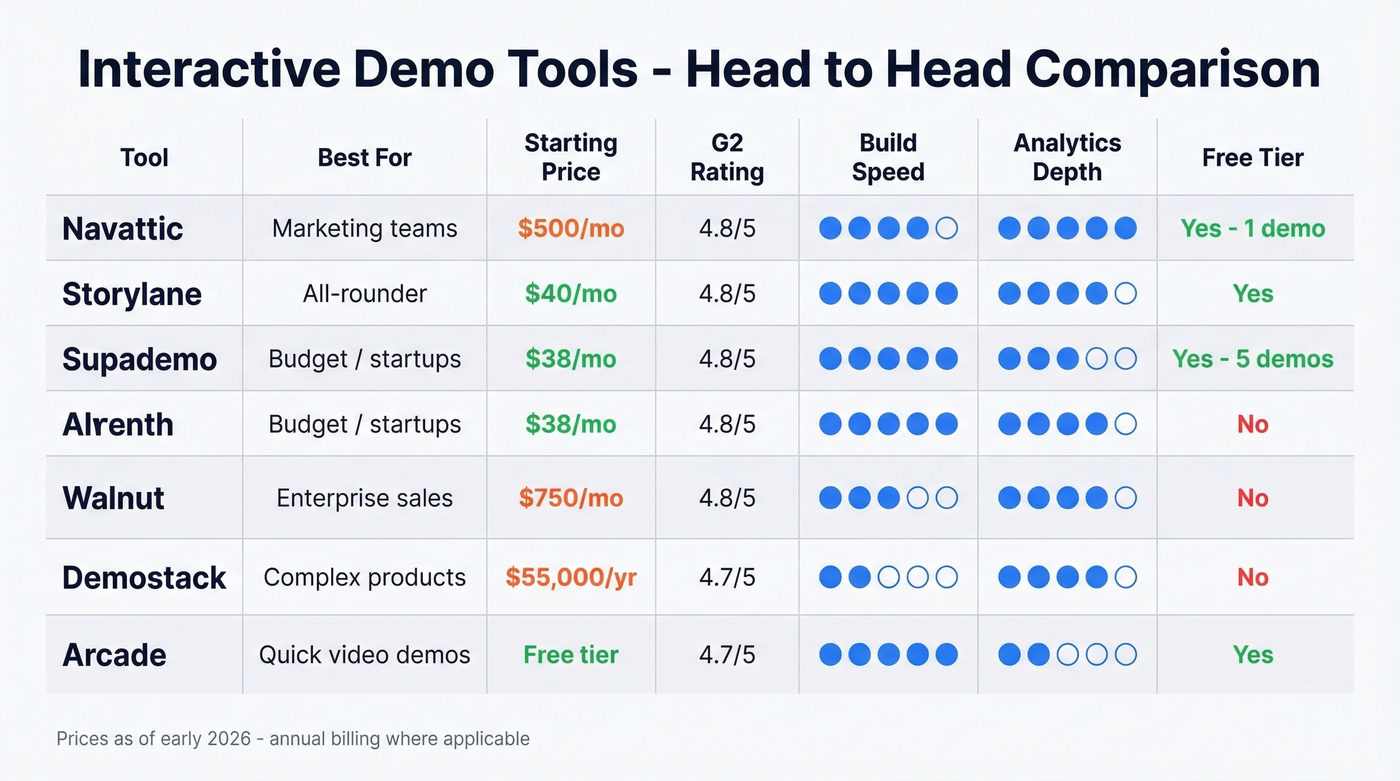
If you're a marketing team embedding demos on product pages, start with Navattic. Need sales and marketing alignment without a six-figure contract? Storylane is your best bet. And if you're sending demo links to prospect lists that haven't been verified - stop. Fix the data first.
Let's be honest: most teams evaluating $55,000/year enterprise demo platforms would get 80% of the value from Storylane or Navattic at a tenth of the cost. The gap between mid-market and enterprise tools is narrower than vendors want you to believe.
What Type of Demo Do You Need?
Before you compare features, figure out which category fits your workflow. And factor in maintenance burden, because rebuilding demos after every UI change is the hidden cost nobody quotes you.
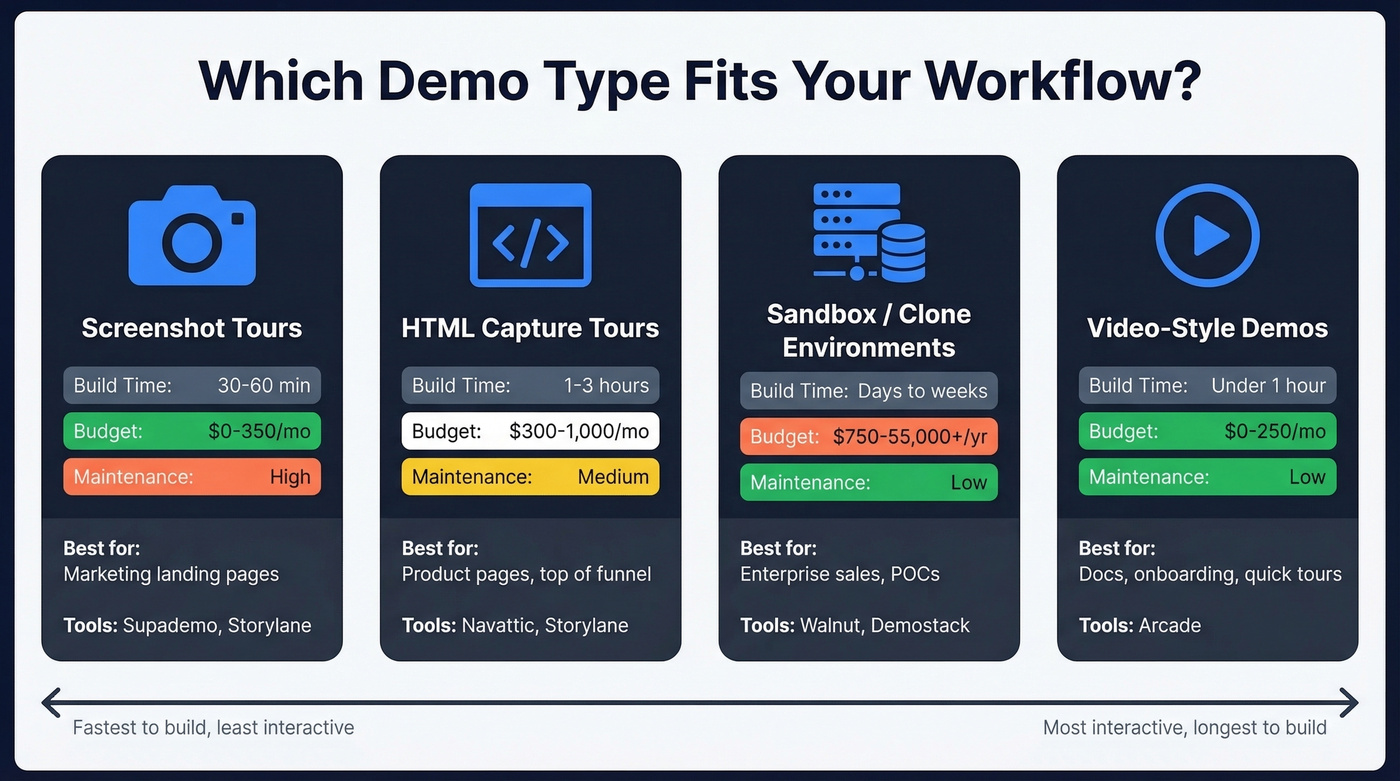
Screenshot tours capture your product's UI as images, then layer hotspots, tooltips, and guided flows on top. They're fast to build - 30 to 60 minutes - and perfect for marketing teams embedding demos on landing pages. The tradeoff: every time your UI changes, you're rebuilding. Supademo and Storylane both excel here. Budget: $0-350/mo.
HTML capture tours clone your product's front-end HTML/CSS, so prospects interact with something that looks and feels real. Navattic popularized this approach for marketing-led demos, and 86% of top-performing demos use web captures. Because web captures mirror real UI behavior, they cut maintenance versus pure screenshot tours. Budget: $300-1,000/mo.
Sandbox/clone environments create full replicas of your product with sample data. Walnut and Demostack live here. These are for enterprise sales teams running personalized demos for six- and seven-figure deals. Budget: $750-55,000+/year.
Video-style demos are recorded walkthroughs with interactive elements layered on top. Arcade owns this niche. Fastest to create, least interactive. Budget: $0-250/mo.
Where demos sit in your funnel determines the right tool. Top-of-funnel product pages call for screenshot or HTML tours. Mid-funnel sales enablement needs sandbox environments. Customer onboarding can use any of the above, depending on product complexity.
The 10 Best Demo Platforms Compared
We evaluated these tools across build speed, analytics depth, pricing transparency, and real user sentiment from G2 reviews and published benchmarks.
Navattic
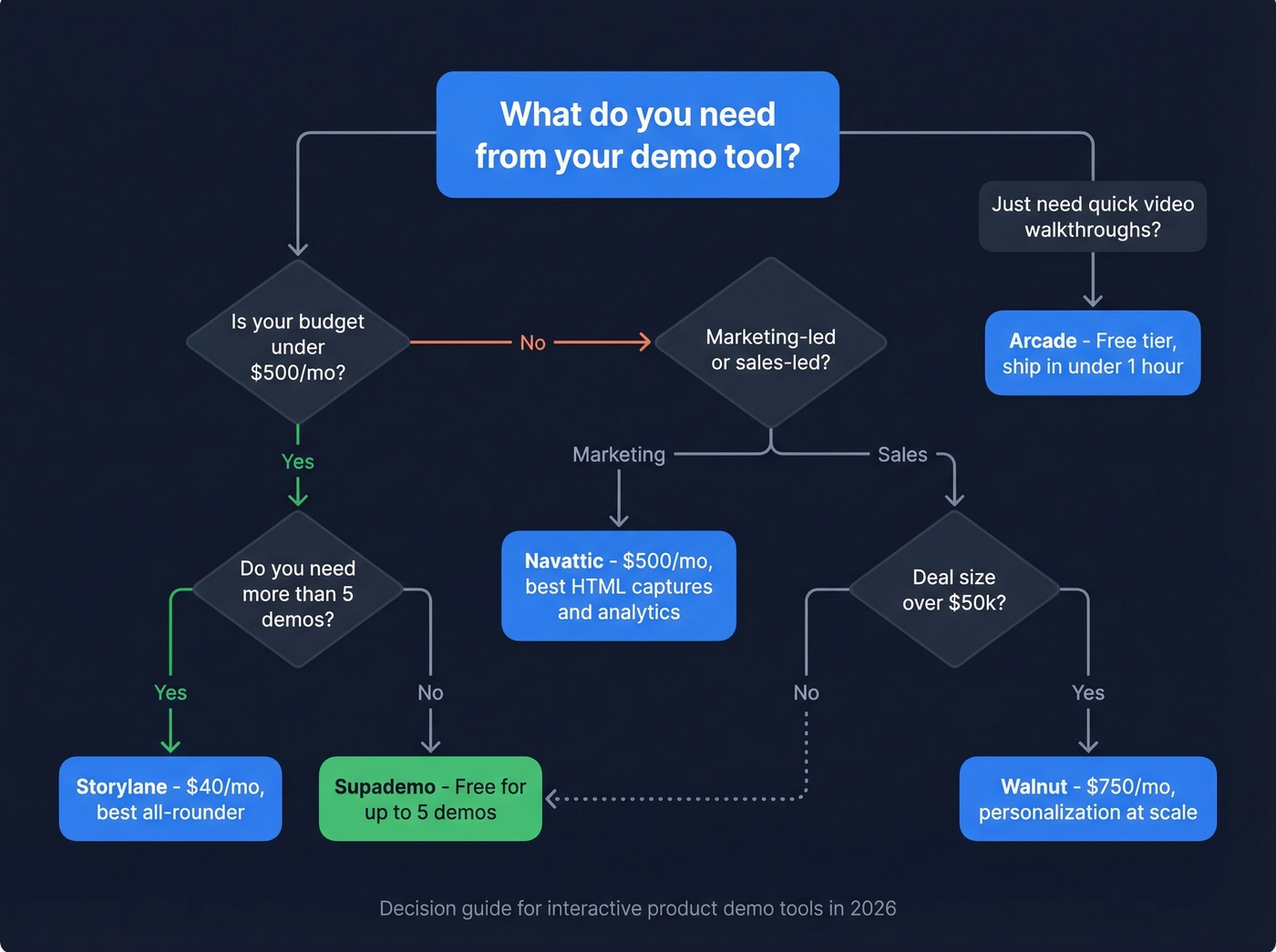
Navattic is the category leader for marketing-led interactive product demos, and it's earned that position. The HTML capture engine produces demos that feel like your actual product - not a slideshow with hotspots. The analytics are genuinely useful: you can see where prospects drop off, which features they explore, and tie demo engagement back to pipeline through HubSpot, Salesforce, and Marketo integrations.
Use this if you're a B2B marketing team that wants pixel-perfect HTML demos with real engagement analytics and CRM attribution.
Skip this if you need sandbox environments for live sales calls. Navattic includes sandbox demos on the Growth plan, but Walnut and Demostack are more mature for presales-heavy workflows.
Pricing: Starter is free and includes 1 seat and 1 demo. Base starts at $500/month billed annually and includes 5 builder seats with unlimited HTML demos plus CRM/MAP integrations. Growth includes 10 seats and adds A/B testing, personalization, and advanced analytics. Enterprise is custom.

Storylane
Storylane is the tool we'd recommend to any team that says "we need demos for both marketing and sales, and we don't want to spend $750/mo to get started." It balances ease-of-use and depth better than anything else in the mid-market.
The free plan lets you build and share demos without a credit card. Starter runs $40/month billed annually for 1 seat. Growth adds deeper collaboration and more advanced capabilities.
Use this if you want one platform that serves marketing embeds, sales leave-behinds, and customer onboarding without enterprise pricing.
Skip this if you need deep sandbox environments or you're running complex, multi-module enterprise demos.
Where Storylane wins over Navattic: faster time-to-value and a lower starting price. Where Navattic wins: deeper analytics and a more mature web-capture stack.
G2 rating: 4.8/5 (1,200+ reviews).

Supademo
Supademo has the best free tier in the category - 5 demos, unlimited views, AI text personalization, and the ability to share as link, embed, video, or PDF. For a startup or small team that needs a clickable walkthrough yesterday, this is where you start.
Supademo is also pushing hard into AI demo agents - automated, conversational demo experiences that adapt to what the prospect clicks. The State of Interactive Demos 2026 report analyzed thousands of demos and found that hero demos average 10-12 steps with 80%+ completion rates. That's a useful benchmark regardless of which tool you pick.
Use this if you're budget-conscious and want to ship demos fast. The Scale plan at $38/mo per creator is hard to beat.
Skip this if you need HTML capture or sandbox demos - those are locked behind the Growth plan at $350/mo for 5 creators. That's a steep jump.

Walnut
Walnut's strength is personalization at scale. For teams selling $50k+ deals, the ROI math works. For everyone else, Storylane or Navattic deliver 80% of the value at a fraction of the cost.
Use this if you're an enterprise sales team that needs personalization and sandbox demos tied to Salesforce deal data.
Skip this if your budget is under $750/mo. There's no free tier, just a 14-day trial.
Pricing: Ignite starts at $750/mo billed annually for 3 editor seats. Accelerate runs $1,550/mo billed annually for 10 seats with advanced Salesforce integration, prospect personalization, and deal analytics.
G2 rating: 4.8/5.
Demostack
Demostack is one of the most expensive tools on this list, and it earns that price tag for the right buyer. Two products - Live (overlay on your live product) and Environment (full sandbox replica) - cover both guided demos and hands-on POC environments.
The catch: pricing starts at $55,000/year with annual contracts only. Implementation for complex products can stretch to 12+ months. This is a tool for companies with dedicated presales teams and products complex enough to justify the investment. If you're a 50-person startup, keep scrolling.
G2 rating: 4.7/5 (78 reviews).
Arcade
Arcade is the fastest path from "I need a demo" to "here's a demo." The video-style approach - record your screen, add interactive hotspots - means you can ship something in under an hour. G2 users consistently cite ease of use as the top advantage.
The tradeoffs are real: limited customization and pricing that feels steep for what you get at $213/mo for 5 users. Great for quick product tours in documentation or onboarding. For high-stakes sales demos, you'll want something deeper.
G2 rating: 4.7/5 (106 reviews).
Fable
Fable leans hard into AI-powered demo creation with guided workflows. Entry pricing at $40/user/month is reasonable for a single seat but adds up fast with a team of five. G2 reviewers flag a learning curve before the AI features click, but once they do, the build speed advantage is significant.
Use this if you want AI assistance in building and personalizing demos. Skip this if you need instant time-to-value - there's a ramp-up period.
G2 rating: 4.8/5 (103 reviews).
Reprise
Enterprise sandbox/clone tool starting at $38,000/year. Users flag a learning curve and occasional buggy behavior. Best for orgs with complex multi-module products and dedicated presales teams who need code-level cloning. If that's not you, the price-to-value ratio won't make sense.
G2 rating: 4.4/5 (174 reviews).
Consensus
Different animal entirely. Consensus automates personalized video demos sent at scale - more "demo on demand" than interactive walkthrough. Best for teams that want prospects to self-select their demo experience before talking to sales. Pricing typically runs $1,000-3,000/mo.
Tourial
Tourial focuses on demo centers - curated collections of interactive tours organized by persona, use case, or product module. If you've built multiple demos and need a way to let prospects self-navigate to the right one, Tourial fills a gap most other tools ignore. Pricing starts around $500/mo for small teams, with enterprise plans scaling from there. It's a niche pick, but for companies with broad product lines, the demo center concept is a genuine differentiator.

You just spent weeks building the perfect interactive demo. But if you're sending demo links to unverified prospect lists, most of those demos never reach a real buyer. Prospeo delivers 98% email accuracy across 300M+ profiles - so every demo link lands in a real inbox.
Stop wasting polished demos on bad data. Verify your lists first.
Fix Your Contact Data First
Here's the thing nobody in the demo software space talks about: your tool's ROI is zero if the prospect list you're sending demos to is garbage.
If you're building lists from scratch, start with sales prospecting techniques that prioritize intent and fit - then clean the data.
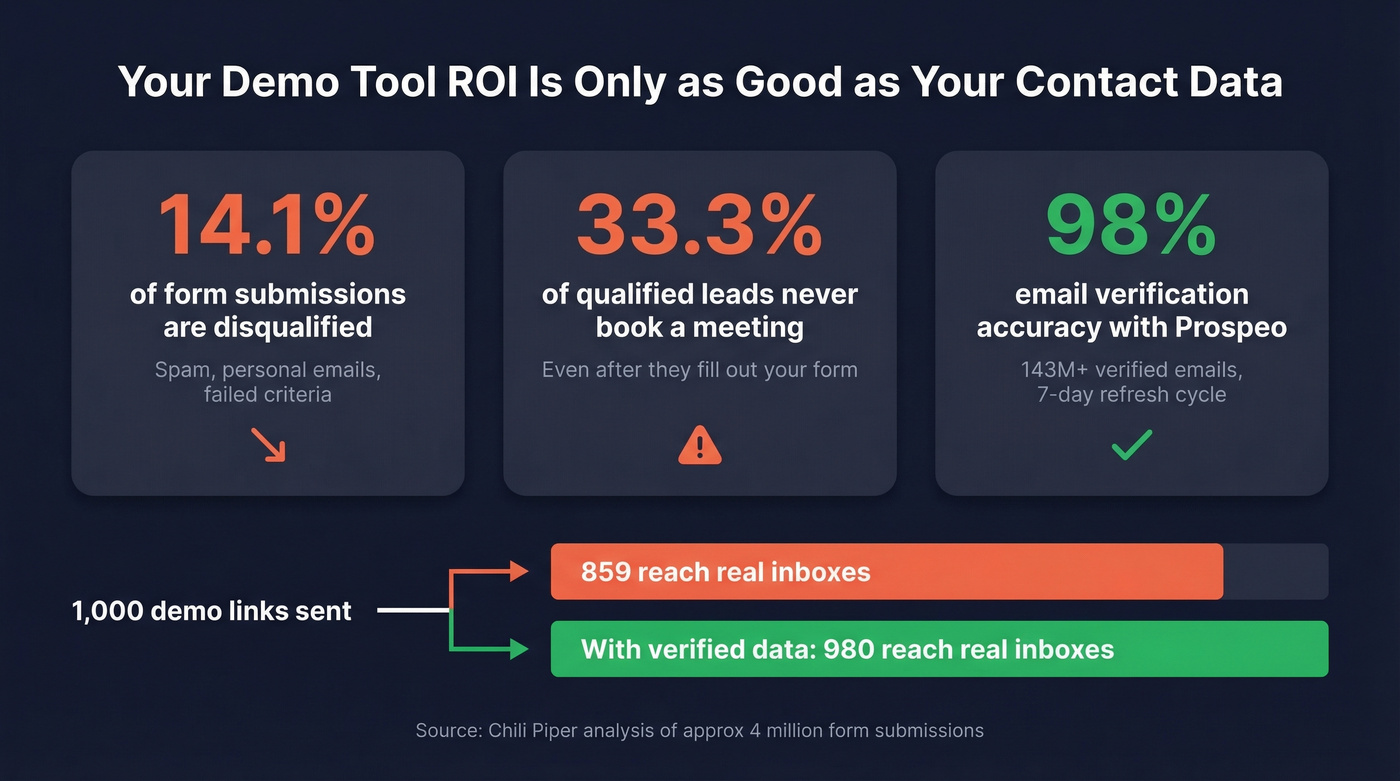
A Chili Piper analysis of ~4 million form submissions found that 14.1% of form fills were disqualified - spam, personal emails, failed criteria. Even when forms convert, only 66.7% of qualified submissions book a meeting. Bad contact data makes both numbers worse.
You're about to invest $350-55,000/year on demo tools. Spend five minutes verifying the contacts you're distributing those demos to. Prospeo runs 143M+ verified emails at 98% accuracy with a 7-day data refresh cycle - the industry average is six weeks. Upload a CSV, verify in bulk, and push clean contacts straight to your sequencer or CRM via native integrations with HubSpot, Salesforce, and 8+ outbound tools.
If you’re also enriching records (not just verifying), compare data enrichment services before you commit.
The free tier gives you 75 emails plus 100 Chrome extension credits per month. Paid plans run about $0.01 per email. That's a rounding error compared to what you're spending on demo software - and it's the difference between a demo link that lands and one that bounces. If bounces are already hurting you, use these email bounce rate benchmarks to diagnose the root cause.
If you’re worried about inboxing after list cleanup, follow an email deliverability guide before scaling volume.
Enterprise demo platforms cost $55,000/year. The prospect data feeding those demos shouldn't cost another fortune. Prospeo gives you verified emails at $0.01 each, 125M+ direct dials, and 30+ filters to target exactly who should see your demo - no contracts required.
Spend on the demo tool. Save 90% on the data powering it.
Full Pricing Comparison
| Tool | Free Tier | Starting Price | Best For | Seats |
|---|---|---|---|---|
| Navattic | Yes (1 demo) | $500/mo (billed annually) | Marketing HTML demos | 5 (Base) |
| Storylane | Yes | $40/mo (billed annually) | All-rounder, mid-market | 1 (Starter) |
| Supademo | Yes (5 demos) | $38/mo/creator | Budget / startups | 1 (Scale) |
| Walnut | 14-day trial | $750/mo (billed annually) | Enterprise sales | 3 (Ignite) |
| Demostack | No | $55,000/yr | Complex enterprise POCs | Talk to sales |
| Arcade | Yes | $213/mo | Quick video tours | 5 users |
| Fable | No | $40/user/mo | AI-assisted creation | 1 |
| Reprise | No | $38,000/yr | Code-level cloning | Talk to sales |
| Consensus | No | $1,000-3,000/mo | Automated video demos | Talk to sales |
| Tourial | No | ~$500/mo | Demo centers | Talk to sales |
The pricing opacity at the enterprise end is frustrating. Demostack and Reprise both require annual contracts and sales conversations before you see a number. For mid-market teams, Storylane and Supademo offer the most transparent pricing - you can see exactly what you're paying for before you talk to anyone.
If you’re evaluating where demos fit in your pipeline, map them to your sales funnel automation and track the right funnel metrics.
What High-Performing Demos Look Like
The State of Interactive Demos 2026 report analyzed thousands of demos and surveyed 200+ professionals. Combined with Navattic's benchmark data, the patterns are clear.
Most benchmarks converge on 5-13 steps total, with hero demos averaging 10-12 steps and the highest completion rates in the 1-6 step range. Hotspot copy should stay at 15-18 words; dialog and modal copy can run 25-30 words. Go longer than that and completion rates drop fast.
Placement matters enormously. 62% of top demos live on product pages, 48% on homepages. 71.9% of high-performing demos start with a modal - a welcome screen that sets context before the walkthrough begins. Teams that use demos across 3-5 use cases and 3+ buyer journey stages report up to 29% higher impact scores than single-use teams.
A few benchmarks we haven't seen covered elsewhere: top-performing demos average 4.7 CTAs, with typically just 1-2 steps containing a call to action. 29% of the best demos use "you/your" language in their copy - second-person framing that pulls the prospect into the experience rather than narrating at them. 24% use beacon-style hotspots instead of traditional tooltips, letting prospects explore at their own pace.
On the conversion side, healthy demo-to-qualified rates hit 60-70% based on recent data, with strong teams pushing 70-80%+. Real estate software companies in one dataset hit 93.84% qualification and 73.78% meeting rates - proof that when the audience is right, self-serve demos accelerate pipeline dramatically.
One more thing: freshness is underrated. Teams updating demos weekly or monthly report higher impact than teams that only refresh at major releases. Treat your demo like a living asset, not a one-time build.
If you want a tighter process for live and self-serve walkthroughs, use a product demo checklist and these software demo tips to standardize what “good” looks like.
FAQ
What's an interactive product demo?
A self-guided, clickable replica of your software that lets prospects explore features without a live sales call. Built via screenshot capture, HTML/web capture, or sandbox environments, then embedded on websites or shared as links. Most tools let you add hotspots, tooltips, and guided flows to simulate the real product experience.
How much does demo software cost?
Free tiers exist at Supademo, Arcade, Storylane, and Navattic. Mid-market tools run $38-$500/month per seat. Enterprise platforms like Demostack ($55,000/year) and Reprise ($38,000/year) require annual contracts and sales conversations before quoting a price.
Do interactive demos actually increase pipeline?
Yes. Teams using demos across 3+ buyer journey stages report up to 29% higher impact scores. Demo-to-qualified conversion rates hit 60-70%, with strong teams pushing 80%+. The key is placement on high-traffic pages, keeping demos under 13 steps, and making sure the contacts you distribute to are verified.
How long does it take to build one?
A basic screenshot tour takes 30-60 minutes. HTML/web capture demos take a few hours. Enterprise sandbox environments can take weeks to months - Demostack implementations can stretch to 12+ months for complex products.
Why do demo links bounce or underperform?
Often the demo itself is solid but the contact data is bad. If 14.1% of your form fills are disqualified and your outbound list has stale emails, your demo never reaches the prospect. Verifying emails before distribution prevents wasted spend and protects domain reputation.